AI Generated Quiz
Primary 6 PSLE Science Systems Quiz
Free P6 PSLE Science Systems quiz, HY3 AI version, with questions, answers, and PSLE-focused practice for Singapore students.
These static practice materials are generated from the site's syllabus and paper-generation workflow, with source and model context shown so students and parents can evaluate the material before use.
Questions
Free quiz and exam paper access
Enter your details to view this paper
Your access is remembered on this device.
Answers
Primary 6 PSLE Science Quiz - Systems (Answer Key)
Total Marks: 40
Topic: Systems (forces, environmental interactions, energy/photosynthesis)
Section A (1 mark each)
-
B) push or a pull
Teaching note: A force is any interaction that, when unopposed, changes the motion of an object. It is not energy or matter. -
B) A stretched rubber band pulling back
Teaching note: Elastic spring force is exerted by elastic materials when stretched or compressed. -
B) opposite to the direction of motion
Teaching note: Friction opposes relative motion between two surfaces in contact. -
C) producer
Teaching note: Producers (e.g., plants) make their own food using sunlight. -
B) Decomposer
Teaching note: Decomposers break down dead matter, returning nutrients to the soil. -
B) leaves
Teaching note: Leaves contain chlorophyll and are the main site of photosynthesis. -
D) Oxygen
Teaching note: Oxygen is a product, not a requirement. Requirements: light, water, CO₂. -
B) population
Teaching note: Population = same species in one place. Community = many populations. -
B) Tyres gripping the road
Teaching note: Grip is useful friction; wear and heat are usually unwanted. -
C) all living things on Earth
Teaching note: Sun’s energy flows to plants then animals via food chains.
Section B (2 marks each)
-
Any two of: move a stationary object; speed up/slow down/change direction of moving object; stop a moving object; change shape. (1 mark each)
Teaching note: These are the four standard effects of forces from syllabus. -
A stretched spring exerts elastic spring force because elastic materials return to original shape and pull/push objects as they recover. (2 marks: 1 for stretched elastic material, 1 for force on object)
-
Example: algae → tadpole → fish (2 marks: 3 organisms in correct arrow direction = 2)
Common mistake: Arrows must show energy flow (producer to consumer). -
Any two: deforestation, pollution (land/water/air), depletion of resources, global warming. (1 mark each)
-
Requirements: water, light energy, carbon dioxide (any two = 1 mark); Product: sugar and oxygen (1 mark for one product).
-
Example: Streamlined body (1 mark) reduces water resistance and helps fish swim faster (1 mark).
Marking: Structural feature + linked survival benefit.
Section C
-
(a) Gravitational force is the pull of the Earth on objects. (1 mark)
(b) Weight is the gravitational force acting on an object (1 mark: links gravity to weight). -
(a) Keep same: water, CO₂, plant type, temperature (1 mark for any one controlled variable).
(b) Leaf tested for starch turns blue-black with iodine (1 mark: starch = proof of photosynthesis). -
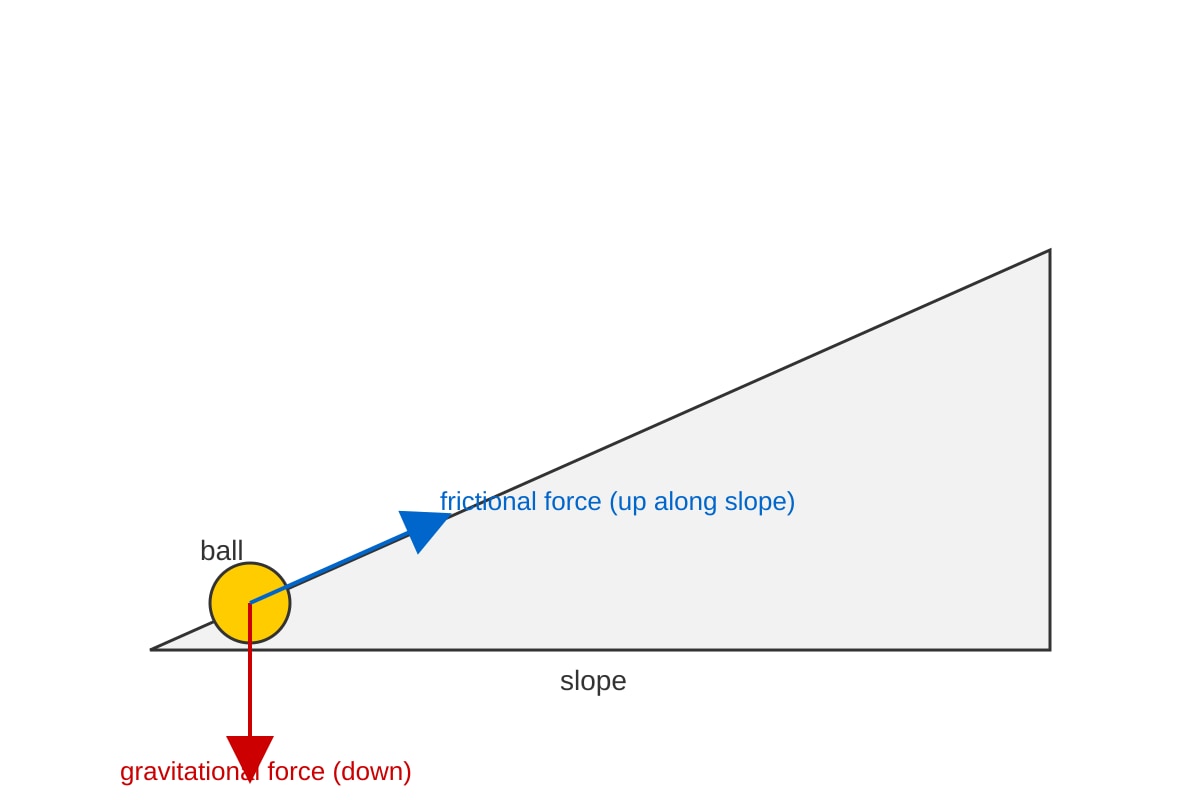
(a) Gravitational force (1 mark)
(b) Frictional force (1 mark)
Image note: Diagram must show downward arrow (gravity) and up-slope arrow (friction). -
(a) Food web: grass → grasshopper → frog → snake; grass → grasshopper → frog (1 mark for linking all four correctly).
(b) Frog population increases (1 mark) because fewer frogs are eaten by snakes (1 mark for explanation).
Teaching note: Removal of predator causes prey population rise (top-down effect).