AI Generated Quiz
Primary 6 PSLE Science Materials Quiz
Free P6 PSLE Science Materials quiz, AI version, with questions, answers, and PSLE-focused practice for Singapore students.
These static practice materials are generated from the site's syllabus and paper-generation workflow, with source and model context shown so students and parents can evaluate the material before use.
Questions
Free quiz and exam paper access
Enter your details to view this paper
Your access is remembered on this device.
Answers
Primary 6 PSLE Science Quiz - Materials (Answer Key)
Total Marks: 50
Section A: Multiple-Choice Questions (Questions 1 - 5)
1. Answer: B
- Marks: 1
- Explanation: A metal spoon feels hotter than a wooden spoon because metal is a better conductor of heat. Heat from the hot water is conducted quickly through the metal spoon to the top. Wood is a poor conductor of heat (an insulator), so heat travels through it much more slowly. The metal spoon does not "contain" more heat; it just transfers it faster.
- Common Mistake: Choosing A. Students may think the metal spoon has more heat energy. The key is the rate of heat transfer, not the amount of heat.
2. Answer: C
- Marks: 1
- Explanation: Burning paper is a chemical change because it produces new substances (ash, smoke, gases) and cannot be easily reversed. Melting ice, dissolving sugar, and stretching a rubber band are all physical changes—they do not produce new substances and can be reversed.
- Common Mistake: Choosing B. Dissolving sugar may seem like a change, but it is a physical change. The sugar can be recovered by evaporating the water.
3. Answer: C
- Marks: 1
- Explanation: Iron filings are magnetic, while sand is not. A magnet can be used to attract and separate the iron filings from the sand. Filtration and evaporation would not separate them because both are solids. Distillation is used for separating liquids from solutions.
4. Answer: C
- Marks: 1
- Explanation: Rubber is a good electrical insulator. Copper, iron, and aluminium are all metals and are good conductors of electricity. Insulators do not allow electric current to flow through them easily.
5. Answer: B
- Marks: 1
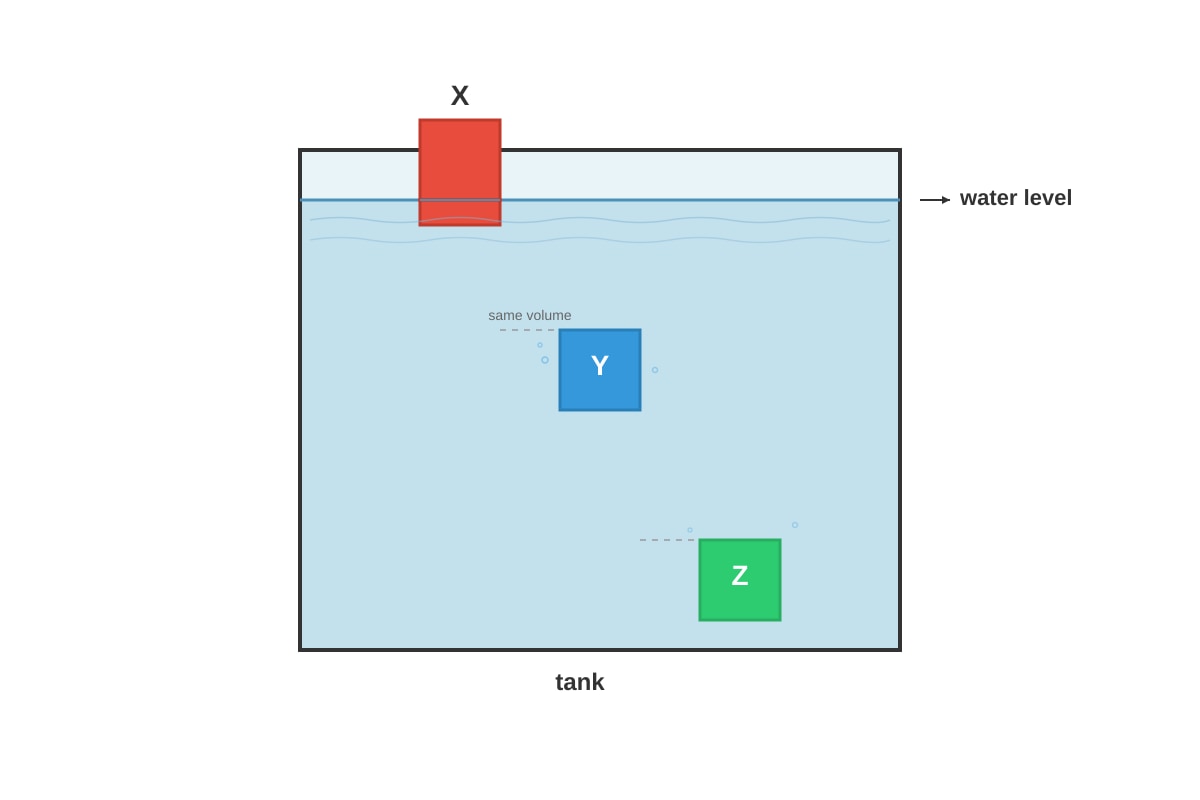
- Explanation: An object will float if its density is less than the density of the liquid. An object will sink if its density is greater than the density of the liquid. Cube X is floating, so it has the lowest density. Cube Z is at the bottom, so it has the highest density. Cube Y is suspended in the middle, so its density is equal to the density of the water. Therefore, Cube Y has a lower density than Cube Z.
- Common Mistake: Choosing A. Students may think that the object at the bottom is the heaviest, but the correct concept is density, not mass.
Section B: Short-Answer Questions (Questions 6 - 15)
6. Answers: (a) Conductor (b) Insulator (c) Conductor
- Marks: 1 mark for each correct answer (Total 3 marks)
- Explanation: Conductors allow electricity to flow through them easily. Metals like copper are good conductors. Insulators do not allow electricity to flow through them easily. Plastic is a common insulator. Graphite is a form of carbon that can conduct electricity, which is why it is used in pencil leads.
7. Answers: (a) Diffusion (b) When water is heated, the water particles gain more kinetic energy and move faster. This causes the ink particles to spread out and mix with the water particles more quickly.
- Marks: (a) 1 mark, (b) 2 marks (Total 3 marks)
- Explanation: Diffusion is the process by which particles spread out from an area of high concentration to an area of low concentration. Heating increases the energy and speed of particles, speeding up this process.
- Marking Note for (b): Award 1 mark for stating that particles move faster. Award 1 mark for linking this to the ink spreading/mixing more quickly.
8. Answers: (a) Material P. It conducts electricity, conducts heat, and is magnetic. Iron is a metal, so it is a conductor of heat and electricity, and it is the most common magnetic metal. (b) Material R. It is transparent and does not conduct electricity or heat. Glass is transparent and is an insulator.
- Marks: (a) 2 marks (1 mark for correct material, 1 mark for explanation), (b) 2 marks (1 mark for correct material, 1 mark for explanation) (Total 4 marks)
- Explanation: This question tests the ability to interpret a table of properties and match them to known materials. Iron is a magnetic conductor. Glass is a transparent insulator.
9. Answers:
- Add water to the mixture of sand and salt and stir. The salt will dissolve in the water, but the sand will not.
- Filter the mixture. The sand will be trapped in the filter paper, while the salt solution passes through as the filtrate.
- Heat the salt solution (or leave it in a shallow dish to evaporate) to evaporate the water, leaving behind dry salt crystals.
- Marks: 1 mark for each correct step (Total 3 marks)
- Explanation: This is a classic separation problem. It uses the fact that salt is soluble in water, but sand is not. The steps are: dissolve, filter, and evaporate.
- Marking Note: The steps must be in a logical order. Award marks for the key processes of dissolving, filtering, and evaporating.
10. Answers: (a) Static electric charge (or static charge). (b) The balloon gains a static electric charge when rubbed. This charged balloon can attract small, uncharged objects like the stream of water. The water is attracted to the balloon and bends towards it.
- Marks: (a) 1 mark, (b) 2 marks (Total 3 marks)
- Explanation: Rubbing a balloon with wool transfers electrons, giving the balloon a static charge. A charged object can induce a charge in a nearby neutral object, causing attraction. This is why the water bends.
- Marking Note for (b): Award 1 mark for stating the balloon is charged. Award 1 mark for stating that the charged balloon attracts the water.
11. Answers: (a) The temperature of the water. (b) Any one of the following:
-
The same amount (volume) of water in each beaker.
-
The same size/mass of sugar cube.
-
The same type of sugar.
-
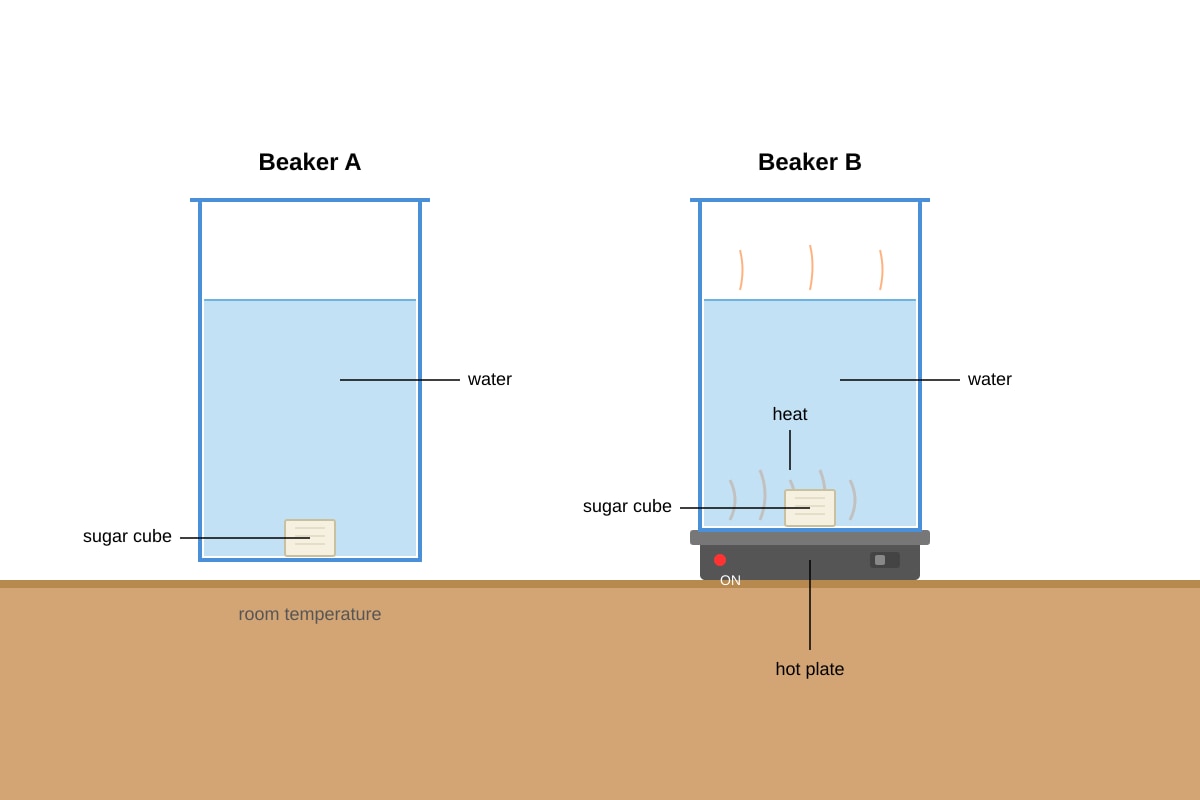
The same stirring (or no stirring). (c) Beaker B. The sugar cube will dissolve faster in Beaker B because the water is hotter. The particles in hot water have more energy and move faster, so they collide with the sugar cube more often and with more force, breaking it apart and dissolving it faster.
-
Marks: (a) 1 mark, (b) 1 mark, (c) 2 marks (Total 4 marks)
-
Explanation: The independent variable is what you change (temperature). The controlled variables are what you keep the same. The dependent variable is what you measure (rate of dissolving). Higher temperature increases the rate of dissolving.
-
Marking Note for (c): Award 1 mark for identifying Beaker B. Award 1 mark for explaining that particles move faster in hotter water.
12. Answers: Weigh an empty balloon on a balance. Then, blow up the balloon and tie it. Weigh the inflated balloon again. The inflated balloon will weigh slightly more, showing that air has mass.
- Marks: 2 marks (Total 2 marks)
- Explanation: This is a simple experiment to demonstrate that air is matter and has mass. The key is to compare the mass of an empty balloon with the mass of an inflated balloon.
- Marking Note: Award 1 mark for the method (weighing a balloon before and after inflating). Award 1 mark for the expected result (the inflated balloon weighs more).
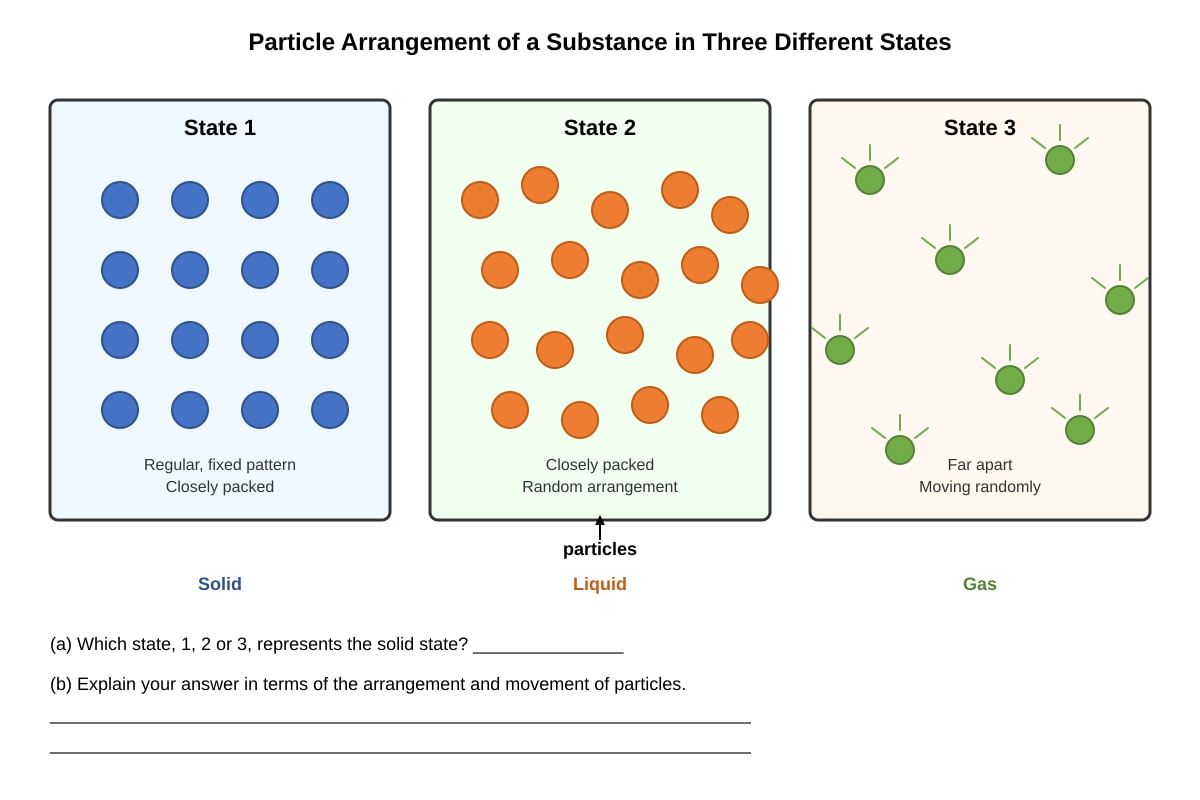
13. Answers: (a) State 1 (b) In a solid, the particles are packed closely together in a regular arrangement. They can only vibrate about their fixed positions.
- Marks: (a) 1 mark, (b) 2 marks (Total 3 marks)
- Explanation: The particle model describes the three states of matter. Solids have a fixed shape and volume because their particles are in a fixed, regular pattern. Liquids have a fixed volume but no fixed shape. Gases have no fixed shape or volume.
- Marking Note for (b): Award 1 mark for "closely packed" or "regular arrangement". Award 1 mark for "vibrate about fixed positions".
14. Answers: (a) Density = Mass / Volume = 240 g / 30 cm³ = 8 g/cm³. (b) The density of one half is still 8 g/cm³. Density is a property of the material itself. When the block is cut in half, both the mass and the volume are halved, so the ratio of mass to volume (density) remains the same.
- Marks: (a) 2 marks (1 mark for formula, 1 mark for correct answer with unit), (b) 1 mark (Total 3 marks)
- Explanation: Density is a measure of how much mass is packed into a given volume. It is an intensive property, meaning it does not depend on the amount of the substance.
- Marking Note for (a): Award full marks for the correct answer with the unit. Award 1 mark if the formula is correct but the calculation is wrong.
- Marking Note for (b): Award 1 mark for stating the density is the same and explaining that mass and volume are both halved.
15. Answers: (a) The test tube with water. (b) 1. Water (or moisture) 2. Oxygen (or air)
- Marks: (a) 1 mark, (b) 2 marks (Total 3 marks)
- Explanation: Rusting is a chemical reaction between iron, water, and oxygen. The silica gel in the dry test tube removes moisture, preventing rusting.
- Marking Note for (b): Award 1 mark for each correct condition.
Section C: Structured Questions (Questions 16 - 20)
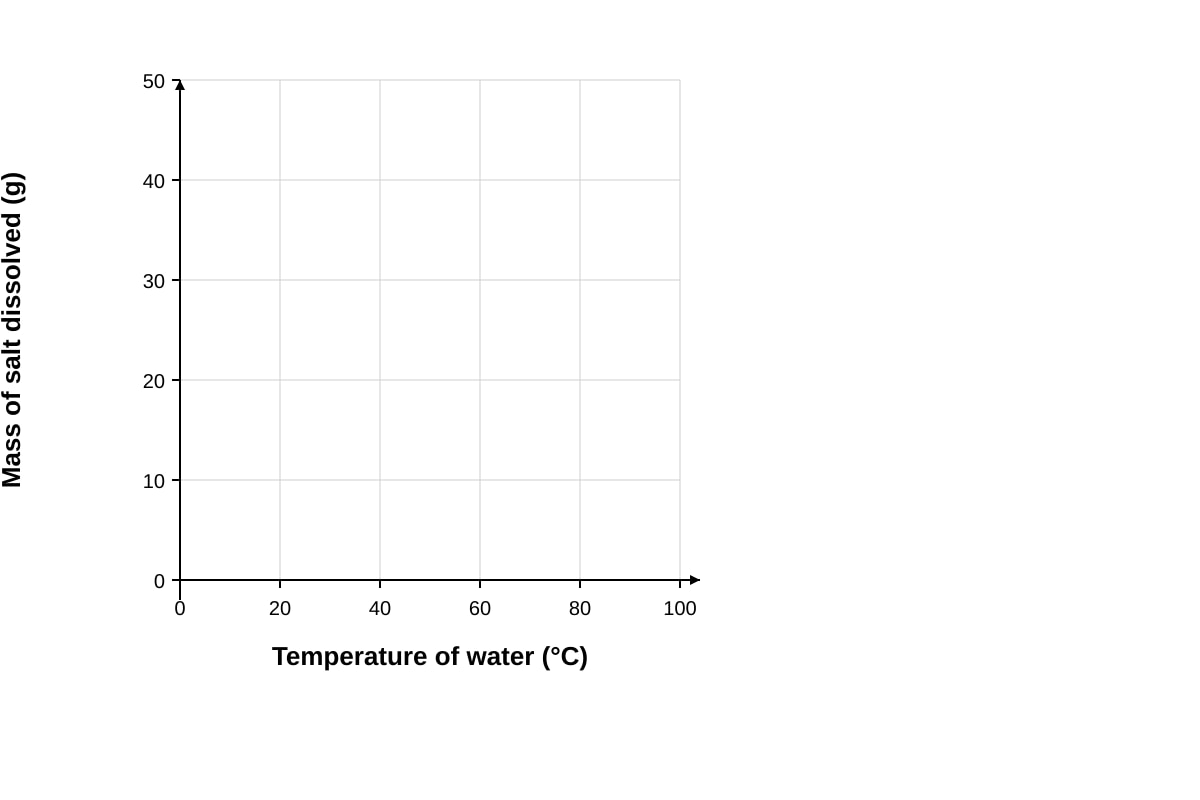
16. Answers: (a) To find out how the temperature of water affects the mass of salt that can dissolve in it (or the solubility of salt in water). (b) The graph should be a line graph with:
-
X-axis: Temperature of water (°C) with a suitable scale (e.g., 0 to 100).
-
Y-axis: Mass of salt dissolved (g) with a suitable scale (e.g., 0 to 50).
-
All four points plotted correctly.
-
A straight line or smooth curve drawn through the points. (c) Approximately 40.5 g (accept any value between 40 g and 41 g).
-
Marks: (a) 1 mark, (b) 3 marks (1 mark for correct axes and scales, 1 mark for correct plotting, 1 mark for a correct line), (c) 1 mark (Total 5 marks)
-
Explanation: This question tests the ability to plan an experiment, present data graphically, and interpret the graph. The graph shows a linear relationship between temperature and solubility.
-
Marking Note for (b): Award marks for the key components of a good graph.
-
Marking Note for (c): The answer should be read from the student's own graph. Accept a reasonable range.
17. Answers: (a) The baking soda will fizz and produce bubbles (effervescence). (b) The production of bubbles (a gas) is a sign that a new substance is being formed. This indicates a chemical change has occurred. (c) Mixing cornflour with water is a physical change. No new substance is formed. The cornflour can be separated from the water by filtration or evaporation.
- Marks: (a) 1 mark, (b) 1 mark, (c) 2 marks (Total 4 marks)
- Explanation: Baking soda and vinegar react to produce carbon dioxide gas, which is a new substance. Mixing cornflour and water is a physical change because the cornflour particles are just dispersed in the water and can be separated.
- Marking Note for (c): Award 1 mark for "physical change". Award 1 mark for explaining that no new substance is formed or that it can be reversed.
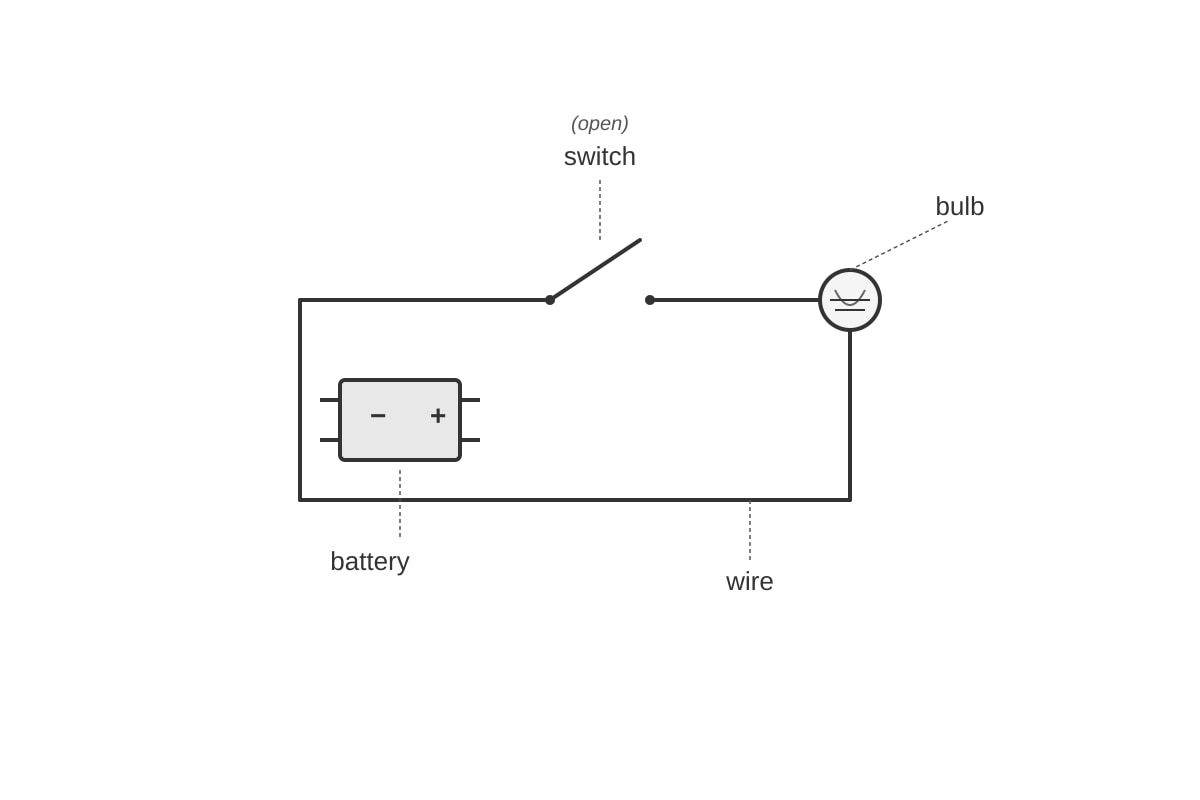
18. Answers: (a) No, the bulb will not light up. (b) The bulb will not light up. Rubber is an insulator and does not allow electric current to flow through it. This breaks the circuit, so no current can flow to the bulb. (c) Graphite (or pencil lead).
- Marks: (a) 1 mark, (b) 2 marks, (c) 1 mark (Total 4 marks)
- Explanation: A closed circuit is needed for current to flow. An open switch breaks the circuit. Insulators like rubber prevent current flow. Graphite is a non-metal that can conduct electricity.
- Marking Note for (b): Award 1 mark for stating the bulb will not light up. Award 1 mark for explaining that rubber is an insulator and breaks the circuit.
19. Answers: (a) The wax beads are used to measure the rate of heat conduction. The time taken for the wax to melt shows how quickly heat travels up the spoon. (b) Material Y is the best heat insulator. The wax on Spoon 2 took the longest time (60 s) to melt, which means that Material Y slowed down the transfer of heat from the hot water to the wax the most. (c) Any one of the following:
-
The same amount (volume) of hot water in the beaker.
-
The same starting temperature of the water.
-
The same size and shape of the spoons.
-
The same amount of wax on each spoon.
-
The spoons are placed in the water for the same depth.
-
Marks: (a) 1 mark, (b) 2 marks, (c) 1 mark (Total 4 marks)
-
Explanation: This is a fair test. The independent variable is the material coating the spoon. The dependent variable is the time for the wax to melt. All other variables must be controlled. A better insulator will take a longer time for the wax to melt.
-
Marking Note for (b): Award 1 mark for identifying Material Y. Award 1 mark for explaining that it took the longest time for the wax to melt.
20. Answers: (a) A fair test could be:
- Place each material over the top of a separate beaker or cup, securing it with a rubber band.
- Pour the same amount of water (e.g., 50 ml) onto each material from the same height.
- Measure the amount of water that passes through the material into the beaker after a set time.
- The material that lets the least water through is the most waterproof. (b) Any one of the following:
-
It should be flexible (able to bend easily).
-
It should be durable/strong (not tear easily).
-
It should be lightweight.
-
Marks: (a) 3 marks, (b) 1 mark (Total 4 marks)
-
Explanation: A fair test requires controlling variables. The key is to use the same amount of water, pour it from the same height, and measure the water that passes through. The material that lets the least water through is the most waterproof.
-
Marking Note for (a): Award 1 mark for a method that tests the materials. Award 1 mark for ensuring a fair test (same amount of water, etc.). Award 1 mark for a way to measure the result (e.g., measuring the water that passes through).
END OF ANSWER KEY