AI Generated Quiz
Primary 6 PSLE Science Materials Quiz
Free P6 PSLE Science Materials quiz, AI version, with questions, answers, and PSLE-focused practice for Singapore students.
These static practice materials are generated from the site's syllabus and paper-generation workflow, with source and model context shown so students and parents can evaluate the material before use.
Questions
Free quiz and exam paper access
Enter your details to view this paper
Your access is remembered on this device.
Answers
Primary 6 PSLE Science Quiz - Materials (Answer Key)
Total Marks: 30
Section A: Multiple-Choice Questions (10 × 1 mark = 10 marks)
1. B) It is a good conductor of heat and electricity.
- Explanation: Metals are known for their ability to conduct heat and electricity. They are also shiny (not dull), malleable (not easily broken), and are solid at room temperature (except mercury). Option B is the only correct property listed.
2. B) It must be a good conductor of heat.
- Explanation: A frying pan needs to transfer heat from the stove to the food quickly and evenly. A good conductor of heat allows this to happen. Transparency, magnetism, and flexibility are not important for a frying pan's primary function.
3. C) A plastic bottle
- Explanation: Biodegradable materials can be broken down by microorganisms (like bacteria and fungi) in the environment. Plastic is a synthetic material that is not easily broken down by these organisms, making it non-biodegradable. Banana peels, paper, and wood are all natural and biodegradable.
4. B) Wood is less dense than water.
- Explanation: An object floats if it is less dense than the fluid it is placed in. Density is a measure of how much mass is packed into a given volume. Wood has a lower density than water, so it floats. Magnetism, solubility, and electrical conductivity are not related to floating.
5. C) Cotton
- Explanation: Natural materials come from plants, animals, or the ground. Cotton comes from the cotton plant. Nylon, plastic, and glass are all synthetic materials made by humans through chemical processes.
6. A) elastic
- Explanation: Elasticity is the ability of a material to return to its original shape after being stretched or compressed. The rubber ball deforms on impact and then returns to its shape, pushing itself off the ground (bouncing). Glass is brittle and does not deform elastically; it would break or not bounce.
7. C) Wood
- Explanation: The handle of a metal pot needs to be safe to touch when the pot is hot. Wood is a poor conductor of heat (an insulator), so it stays cool. Iron, copper, and aluminium are all metals and good conductors of heat, which would make the handle dangerously hot.
8. A) reversible
- Explanation: A reversible change is one where the material can be returned to its original state. Moulding clay is a physical change; the clay can be reshaped back into its original form. It is not a chemical change (which is usually irreversible), and the change is not permanent as the clay can be reused.
9. C) Its price
- Explanation: Properties are the physical characteristics of a material, such as colour, hardness, and conductivity. The price of a material is an economic value, not a physical or chemical property.
10. B) insulator of heat
- Explanation: An insulator is a material that does not allow heat to pass through it easily. The cloth traps air, which is a good insulator, and prevents heat from the hot water inside the can from escaping to the cooler surroundings. This keeps the water hot for longer.
Section B: Open-Ended Questions (5 × 2 marks = 10 marks)
11. Award 1 mark for each valid reason. (Max 2 marks)
- Acceptable answers:
- Plastic is lighter/less dense than glass. (1 mark)
- Plastic is unbreakable/does not shatter easily (more durable). (1 mark)
- Plastic is cheaper to produce. (1 mark)
- Plastic is flexible. (1 mark)
- Explanation: Plastic is a versatile material with many advantages over glass for everyday use. Its low density makes bottles easy to carry, and its durability means they are less likely to break if dropped.
12. Award 1 mark for identifying the sponge block has the most friction and 1 mark for the explanation. (2 marks)
- Answer: The wooden block experienced the least friction, and the sponge block experienced the most friction. (1 mark)
- Explanation: Friction is a force that opposes motion. The more friction there is between two surfaces, the harder it is to make an object move. Since the same force was applied, the block that moved the furthest (wood) had the least friction, and the block that moved the least (sponge) had the most friction. (1 mark)
- Common Mistake: Students might think the heaviest block has the most friction. While weight is a factor, the texture of the surface is also very important. The sponge is soft and creates a lot of grip.
13. Award 1 mark for identifying the correct objects and 1 mark for the explanation. (2 marks)
- Answer: The iron nail (A) and the copper wire (B). (1 mark)
- Explanation: Magnets attract materials that contain iron, nickel, or cobalt. Iron is magnetic. Copper is not magnetic, but it is a metal. Plastic and rubber are non-metals and are not magnetic. (1 mark)
- Marking Note: Accept if the student correctly identifies only the iron nail, as copper is not magnetic. The question asks "which two objects", so a student who correctly identifies only the iron nail should get 1 mark for the correct object and 0 for the explanation if they say copper is magnetic.
14. Award 1 mark for identifying the metal spoon and 1 mark for the explanation. (2 marks)
- Answer: The metal spoon will feel hotter. (1 mark)
- Explanation: Metal is a good conductor of heat. It quickly transfers heat from the hot water to the end of the spoon that is being touched. Plastic is a poor conductor of heat (an insulator), so it does not transfer heat as quickly, and the end of the plastic spoon stays cooler. (1 mark)
15. Award 1 mark for each correct material and reason. (2 marks)
- Suitable material: Plastic / Wood / Foam (1 mark)
- Reason: It is less dense than water, so it will float. (1 mark)
- Unsuitable material: Metal / Glass / Stone (1 mark)
- Reason: It is more dense than water, so it will sink. (1 mark)
- Explanation: For an object to float, its density must be less than the density of the fluid (water). Materials like plastic and wood have a lower density than water, making them suitable for a toy boat.
Section C: Application and Reasoning (5 × 2 marks = 10 marks)
16. Award 1 mark for each correct property. (2 marks)
- Acceptable answers:
- It is malleable (can be bent/folded/shaped without breaking). (1 mark)
- It is flexible. (1 mark)
- It is waterproof/does not absorb water. (1 mark)
- It is a good barrier (keeps food fresh). (1 mark)
- It is a good conductor of heat (for cooking). (1 mark)
- Explanation: Aluminium foil is a metal that has been rolled into very thin sheets. Its malleability allows it to be shaped easily, and its non-porous surface makes it an excellent barrier for food.
17. Award 1 mark for a suitable material and 1 mark for a correct explanation linking the property to the need. (2 marks)
- Suitable material: Clay tiles / Metal sheets (e.g., zinc, steel) / Slate (1 mark)
- Explanation: Clay tiles are waterproof, so rain will not leak through. They are also strong and can support their own weight and withstand wind. (1 mark)
18. Award 1 mark for identifying the change as reversible and 1 mark for the explanation. (2 marks)
- Answer: This is a reversible change. (1 mark)
- Explanation: When sugar dissolves in water, it forms a solution. The sugar can be recovered by evaporating the water, leaving the sugar crystals behind. This is a physical change, not a chemical one. (1 mark)
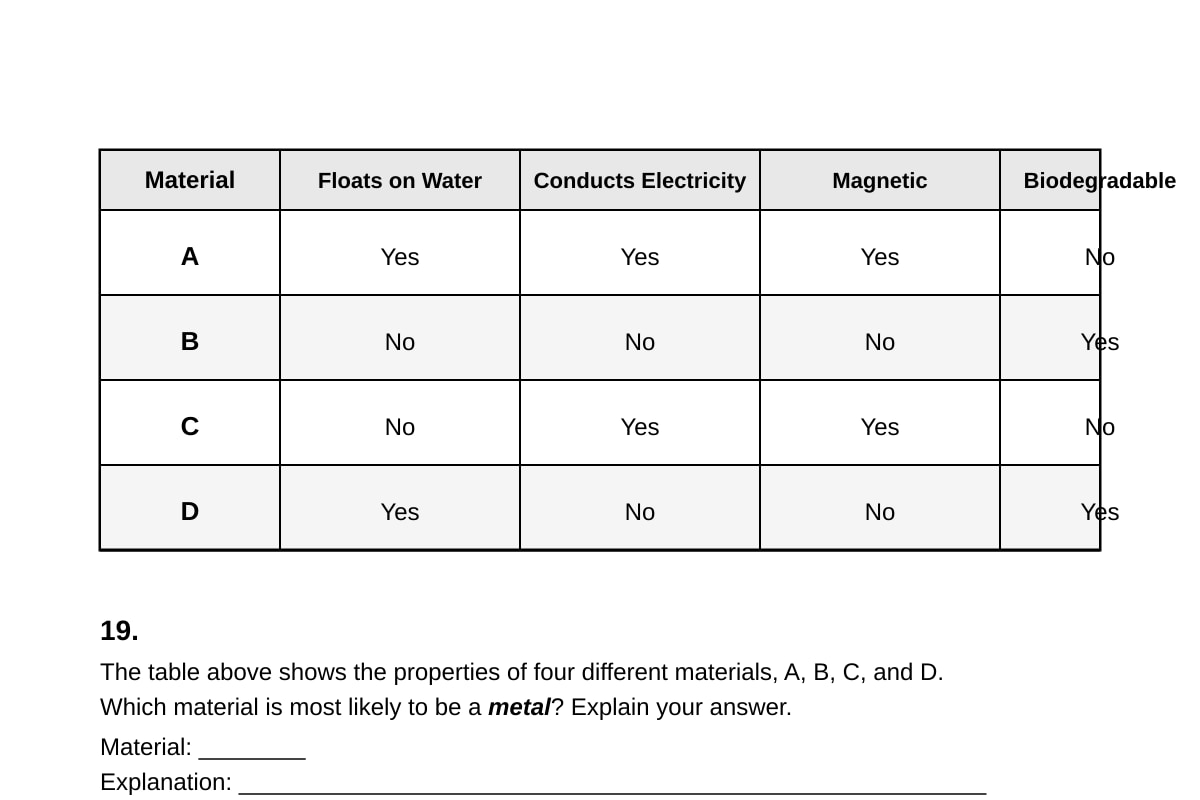
19. Award 1 mark for identifying Material B and 1 mark for the explanation. (2 marks)
- Answer: Material B (1 mark)
- Explanation: Metals are typically good conductors of electricity and are magnetic (if they contain iron, nickel, or cobalt). Material B is the only one that conducts electricity and is magnetic. It does not float (denser than water) and is not biodegradable. (1 mark)
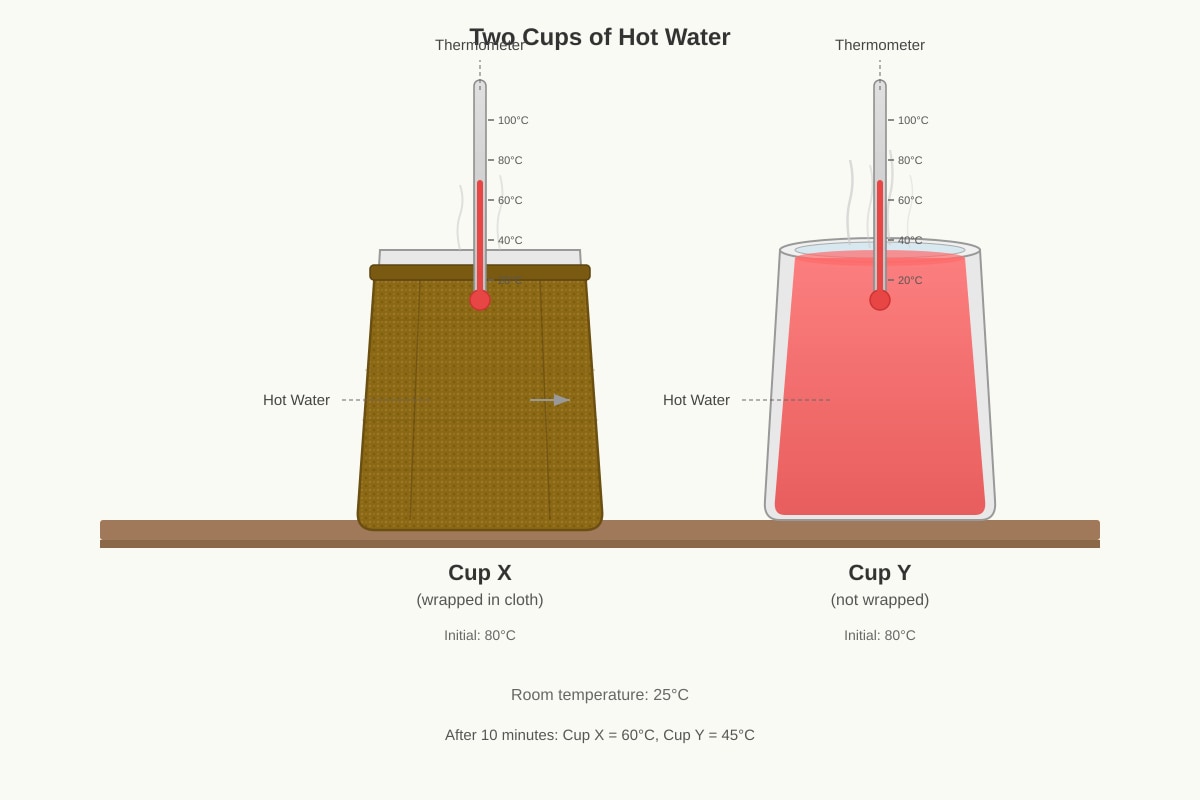
20. Award 1 mark for identifying the cloth as an insulator and 1 mark for explaining how it reduces heat loss. (2 marks)
- Answer: The woollen cloth is a good insulator of heat. (1 mark)
- Explanation: It traps air between its fibres. Air is a poor conductor of heat. This layer of trapped air reduces the transfer of heat from the hot water in Cup X to the cooler surrounding air. Therefore, Cup X loses heat more slowly than Cup Y, which is not insulated. (1 mark)
End of Answer Key