AI Generated Quiz
Primary 6 PSLE Science Magnets Quiz
Free P6 PSLE Science Magnets quiz, AI version, with questions, answers, and PSLE-focused practice for Singapore students.
These static practice materials are generated from the site's syllabus and paper-generation workflow, with source and model context shown so students and parents can evaluate the material before use.
Questions
Free quiz and exam paper access
Enter your details to view this paper
Your access is remembered on this device.
Answers
Primary 6 PSLE Science Quiz - Magnets (Answer Key)
Total Marks: 40
Section A: Multiple-Choice Questions (10 questions × 2 marks = 20 marks)
-
D) Both the north and south poles
- Explanation: The magnetic force is strongest at the poles of a magnet. Both the north and south poles are equally strong at attracting magnetic materials like iron. The centre of the magnet has the weakest magnetic force.
- Marking: 1 mark for correct answer. No marks for partial answers.
-
B) They will repel each other.
- Explanation: Like poles of a magnet repel each other. A north pole and a north pole are like poles, so they will push each other away.
- Marking: 1 mark for correct answer.
-
C) An iron nail
- Explanation: Magnets attract magnetic materials. Iron, steel, nickel, and cobalt are magnetic materials. Plastic, wood, and glass are non-magnetic materials.
- Marking: 1 mark for correct answer.
-
B) Each piece will become a weaker magnet with both a north and a south pole.
- Explanation: When a magnet is cut, each piece becomes a new, smaller magnet. Each new magnet will have its own north and south pole. The magnetic strength of each piece is weaker than the original magnet.
- Marking: 1 mark for correct answer.
-
B) magnetic field.
- Explanation: The Earth itself acts like a giant bar magnet with a magnetic field. A freely suspended magnet will align itself with the Earth's magnetic field, with its north pole pointing towards the Earth's geographic North Pole (which is actually a magnetic south pole).
- Marking: 1 mark for correct answer.
-
C) Stroking an iron nail with a magnet in one direction
- Explanation: Stroking a magnetic material (like iron) with a magnet in one direction aligns the magnetic domains within the material, turning it into a temporary magnet. Heating or hitting a magnet can demagnetise it.
- Marking: 1 mark for correct answer.
-
A) The end of the compass needle pointing to the magnet is its north pole.
- Explanation: Opposite poles attract. The compass needle's north pole is attracted to the south pole of the bar magnet. Therefore, the end of the compass needle pointing to the magnet is its north pole.
- Marking: 1 mark for correct answer.
-
B) The rod is made of a magnetic material, but it may or may not be a magnet.
- Explanation: A magnet will attract any magnetic material (like iron or steel), even if that material is not itself a magnet. The attraction only tells us the rod is made of a magnetic material, not that it is a magnet. To test if it is a magnet, you would need to see if it repels another magnet.
- Marking: 1 mark for correct answer.
-
B) 1
- Explanation: Steel is a magnetic material (it is mostly iron). Copper and aluminium are non-magnetic materials. Therefore, only the steel paperclip will be attracted to the magnet.
- Marking: 1 mark for correct answer.
-
B) They are like poles.
- Explanation: Like poles (north-north or south-south) repel each other. Opposite poles (north-south) attract each other. A push indicates repulsion, so the poles facing each other must be like poles.
- Marking: 1 mark for correct answer.
Section B: Short-Answer Questions (5 questions × 3 marks = 15 marks)
-
Answer:
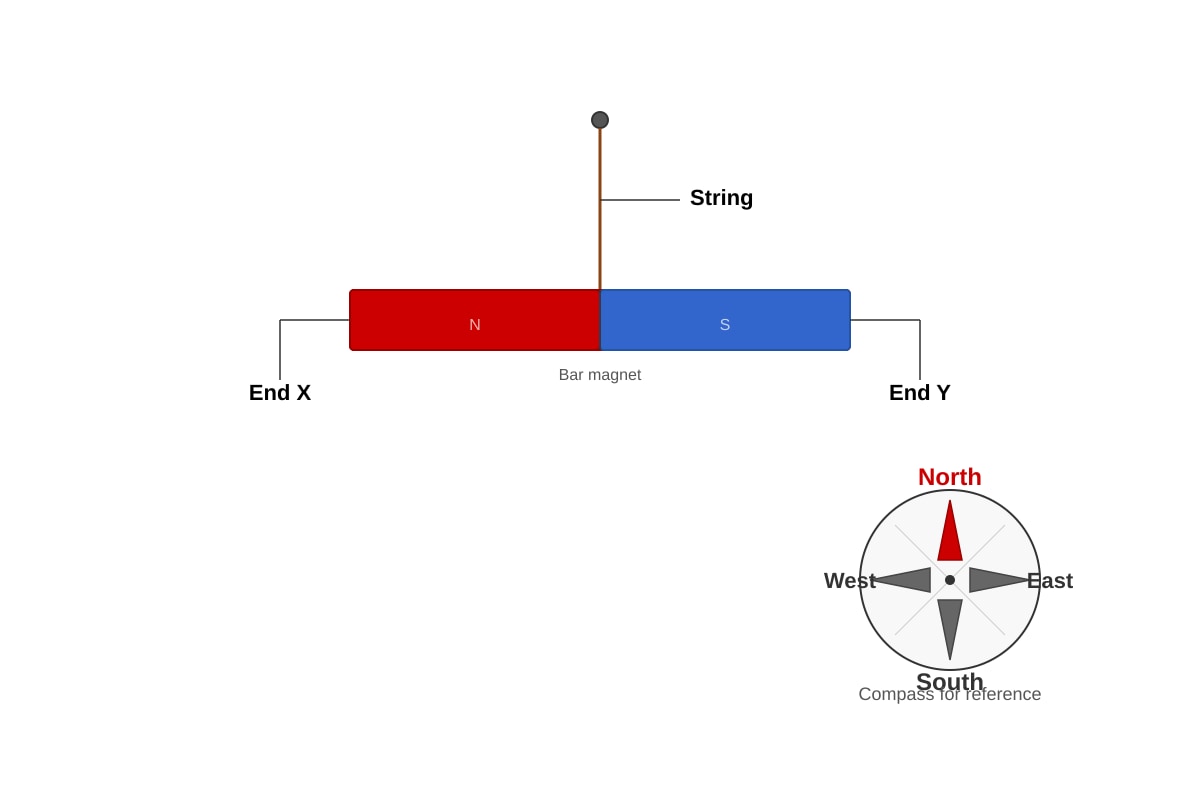
- Tie the string around the centre of the bar magnet so it hangs freely and can rotate. [1]
- Wait for the magnet to stop spinning. The end of the magnet that points towards the Earth's geographic North is the north pole of the magnet. [1]
- The other end is the south pole. [1]
Explanation: A freely suspended magnet will align itself with the Earth's magnetic field. The Earth's geographic North Pole acts as a magnetic south pole, so it attracts the north pole of a magnet. This is a standard method for finding the poles of a magnet.
Marking:
- 1 mark for describing the setup (hanging the magnet freely).
- 1 mark for stating that the magnet will point North-South.
- 1 mark for correctly identifying the north pole (the end pointing North).
-
Answer:
- Magnetic force can pass through non-magnetic materials like paper. [1]
- The paper is not a magnetic material, so it does not block the magnetic field. [1]
- The magnetic field from the magnet still reaches the iron paperclip, attracting it. [1]
Explanation: Magnetic fields can pass through many materials, especially non-magnetic ones like paper, plastic, wood, and even water. The paper does not act as a shield. Only certain materials, like thick iron sheets, can effectively block a magnetic field.
Marking:
- 1 mark for stating that magnetic force can pass through paper.
- 1 mark for explaining that paper is non-magnetic.
- 1 mark for concluding that the magnet still attracts the paperclip.
-
Answer:
- When the north pole of the magnet is brought near the iron, the iron becomes a temporary magnet. [1]
- The side of the iron closest to the magnet becomes a south pole (opposite pole). [1]
- The opposite poles (north of the magnet and south of the iron) attract each other. [1]
Explanation: This is called magnetic induction. The magnetic field of the permanent magnet causes the magnetic domains in the iron to align, turning it into a temporary magnet. The induced pole closest to the magnet is always the opposite pole, causing attraction.
Marking:
- 1 mark for stating that the iron becomes a temporary magnet.
- 1 mark for explaining that opposite poles are induced.
- 1 mark for concluding that opposite poles attract.
-
Answer:
- The student can conclude that both ends of the magnet have the same strength. [1]
- This is because the paperclip jumped to the magnet from the same distance (5 cm) for both ends. [1]
- A stronger magnet would attract the paperclip from a greater distance. [1]
Explanation: The distance at which a magnet can attract an object is a measure of its magnetic field strength. If both ends attract the paperclip from the same distance, they have the same strength.
Marking:
- 1 mark for stating the ends have the same strength.
- 1 mark for using the data (same distance) as evidence.
- 1 mark for explaining the relationship between distance and strength.
-
Answer:
- The steel pin has become a temporary magnet. [1]
- Stroking the pin with the magnet in one direction aligns the magnetic domains inside the steel pin. [1]
- This causes the pin to have its own magnetic field and attract the iron filings. [1]
Explanation: This is the method of magnetisation by stroking. The magnetic domains (tiny atomic magnets) in the steel are randomly arranged in an unmagnetised state. Stroking them in one direction with a magnet forces them to align, creating a net magnetic field.
Marking:
- 1 mark for stating the pin has become a magnet.
- 1 mark for explaining the alignment of domains.
- 1 mark for linking this to the attraction of iron filings.
Section C: Structured / Application Questions (5 questions × 1 mark = 5 marks)
-
Answer: They will attract each other.
- Explanation: Opposite poles (north and south) of a magnet attract each other.
- Marking: 1 mark for correct answer.
-
Answer: They will repel each other.
- Explanation: Like poles (north and north) of a magnet repel each other.
- Marking: 1 mark for correct answer.
-
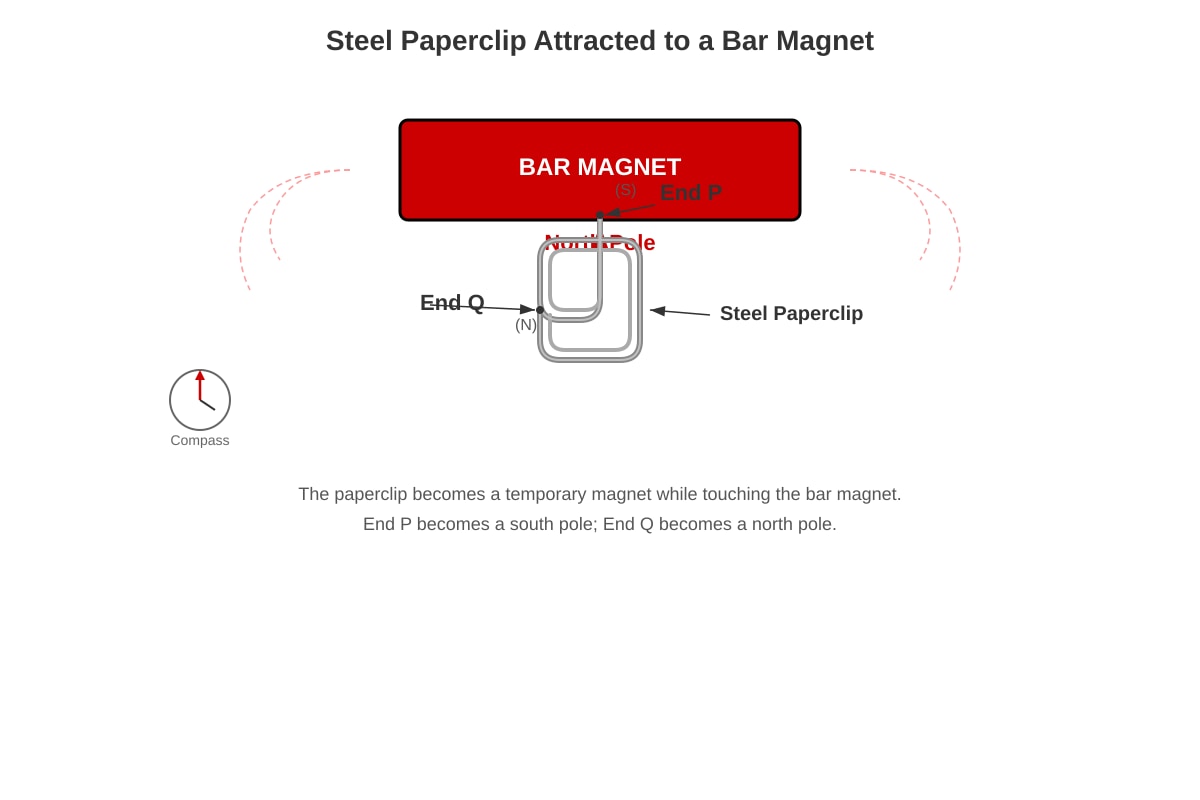
Answer: South pole.
- Explanation: When a magnetic material is touched to a pole of a magnet, the end that touches the magnet becomes the opposite pole. Since End P is touching the north pole, it becomes a south pole.
- Marking: 1 mark for correct answer.
-
Answer: North pole.
- Explanation: The paperclip becomes a temporary magnet. The end touching the north pole becomes a south pole. The free end (End Q) will be the opposite pole, which is the north pole.
- Marking: 1 mark for correct answer.
-
Answer: No, it will not be a magnet (or it will be a very weak magnet).
- Explanation: Steel is a 'hard' magnetic material, meaning it can retain some magnetism for a short time. However, for a simple paperclip, the magnetism is temporary and will be lost quickly once it is removed from the permanent magnet. The paperclip will lose most of its magnetism.
- Marking: 1 mark for correct answer (accept "No" or "It will be a very weak magnet").