AI Generated Quiz
Primary 6 PSLE Science Magnets Quiz
Free P6 PSLE Science Magnets quiz, AI version, with questions, answers, and PSLE-focused practice for Singapore students.
These static practice materials are generated from the site's syllabus and paper-generation workflow, with source and model context shown so students and parents can evaluate the material before use.
Questions
Free quiz and exam paper access
Enter your details to view this paper
Your access is remembered on this device.
Answers
Answer Key: Primary 6 PSLE Science Quiz - Magnets
Total Marks: 40
Section A: Multiple-Choice Questions (10 × 2 Marks = 20 Marks)
1.
- Answer: (2) Iron nail
- Explanation: Magnets attract magnetic materials. Iron is a magnetic material, while copper, aluminium, and plastic are not.
- Marking: 1 mark for correct option.
2.
- Answer: (2) North pole and South pole
- Explanation: Unlike poles attract each other. A North pole and a South pole will pull towards each other, causing the magnets to move together.
- Marking: 1 mark for correct option.
3.
- Answer: (2) The needle is a magnet that is affected by the Earth's magnetic field.
- Explanation: A compass needle is a small bar magnet. The Earth acts like a giant magnet, and its magnetic field exerts a force on the compass needle, causing it to align with the Earth's magnetic field, pointing North-South.
- Marking: 1 mark for correct option.
4.
- Answer: (3) Each piece will become a new, smaller magnet with its own North and South poles.
- Explanation: When a magnet is cut, the magnetic domains within each piece realign to form a new magnet. Each new piece will have its own North and South poles.
- Marking: 1 mark for correct option.
5.
- Answer: (3) Heating it strongly and then allowing it to cool down.
- Explanation: Heating a magnet disrupts the alignment of its magnetic domains. When the magnet cools, the domains do not realign, and the magnet loses its magnetic properties. Hitting it can also demagnetise it, but heating is a more reliable and complete method.
- Marking: 1 mark for correct option.
6.
- Answer: (1) its North pole pointing towards the North.
- Explanation: The North pole of a freely suspended magnet will point towards the Earth's geographic North. This is because the Earth's magnetic South pole is located near the geographic North, and unlike poles attract.
- Marking: 1 mark for correct option.
7.
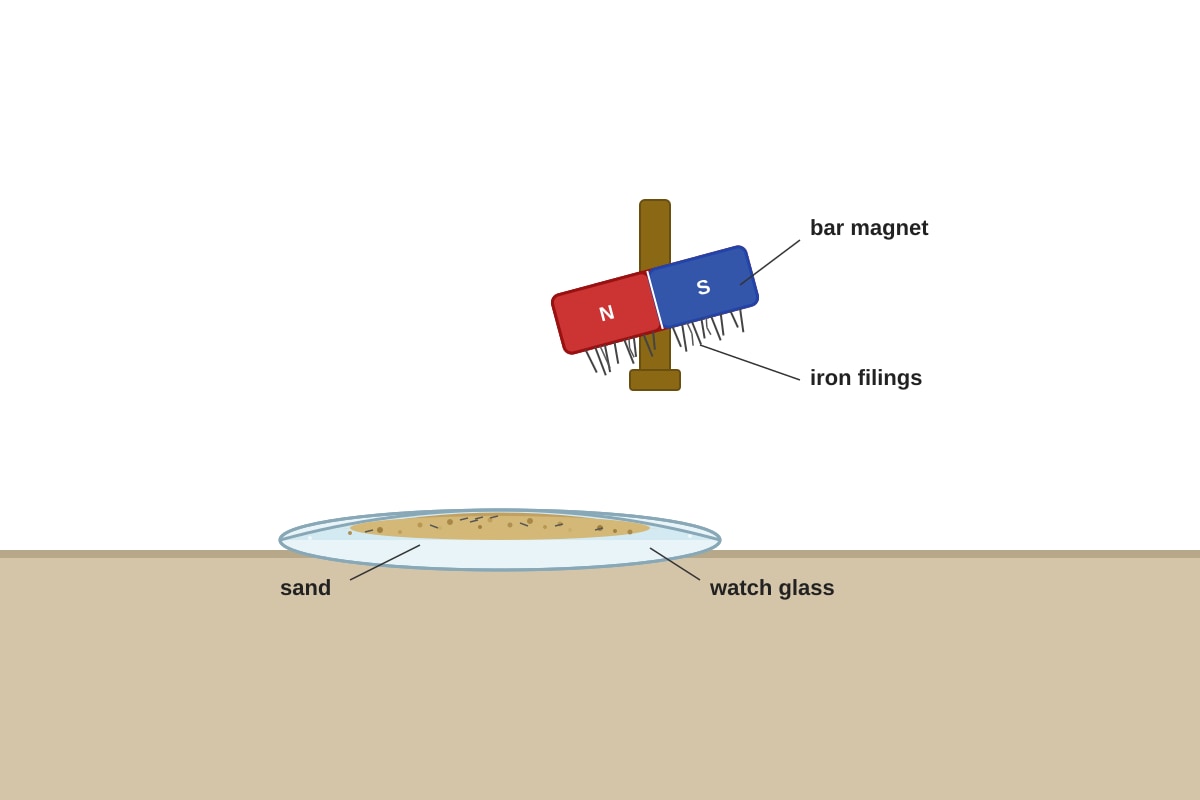
- Answer: (2) They are attracted to the magnet.
- Explanation: Iron is a magnetic material. The magnetic force from the bar magnet attracts the iron filings, pulling them out of the mixture, while the sand, which is not magnetic, is left behind.
- Marking: 1 mark for correct option.
8.
- Answer: (1) Hanging each bar from a string and seeing if it comes to rest pointing North-South.
- Explanation: A freely suspended magnet will always align itself in a North-South direction due to the Earth's magnetic field. An unmagnetised iron bar will not do this. This is a definitive test for a magnet.
- Marking: 1 mark for correct option.
9.
- Answer: (1) The iron becomes temporarily magnetised by induction.
- Explanation: When a magnet is brought near a piece of iron, the magnetic domains in the iron align in response to the magnet's field. This makes the iron a temporary magnet, with a North pole facing the magnet's South pole (or vice versa), causing attraction.
- Marking: 1 mark for correct option.
10.
- Answer: (1) Magnetic force can act through a vacuum.
- Explanation: Magnetic force is a non-contact force. It can act through a vacuum, air, and many other materials. It does not require objects to be touching.
- Marking: 1 mark for correct option.
Section B: Short-Answer Questions (5 × 2 Marks = 10 Marks)
11.
- (a) Answer: The pattern shows the magnetic field lines around the magnet. [1]
- (b) Answer: The magnetic force is strongest at the poles (the ends) of the magnet. [1]
- Explanation: Iron filings align along the invisible magnetic field lines. The lines are most concentrated at the poles, indicating the strongest force there.
- Marking: 1 mark for each correct part.
12.
- (a) Answer: South pole. [1]
- (b) Answer: Bring the North pole of Magnet P near the North pole of Magnet Q (or bring the South pole of Magnet P near the South pole of Magnet Q). [1]
- Explanation: Unlike poles attract, so if the North pole of P attracts an end of Q, that end must be a South pole. To repel, bring like poles together.
- Marking: 1 mark for each correct part.
13.
- (a) Answer: Magnetic force (from the Earth's magnetic field). [1]
- (b) Answer: The Earth acts like a giant magnet. The magnetic force from the Earth attracts the poles of the bar magnet, causing it to align in a North-South direction. [1]
- Explanation: The North pole of the magnet is attracted to the Earth's magnetic South pole (near geographic North), and the magnet's South pole is attracted to the Earth's magnetic North pole (near geographic South).
- Marking: 1 mark for naming the force, 1 mark for the explanation.
14.
- (a) Answer: An electromagnet. [1]
- (b) Answer: Increase the number of coils of wire around the nail / Increase the number of batteries (increase the current) / Use a stronger battery. [1]
- Explanation: The strength of an electromagnet increases with more coils or a stronger electric current.
- Marking: 1 mark for each correct part.
15.
- (a) Answer: Objects A and C. [1]
- (b) Answer: Wood / Plastic / Glass / Copper / Aluminium (any non-magnetic material). [1]
- Explanation: Magnetic materials are attracted to magnets. Non-magnetic materials are not.
- Marking: 1 mark for each correct part.
Section C: Open-Ended Questions (5 × 2 Marks = 10 Marks)
16.
- Answer:
- The iron bar becomes a temporary magnet. [1]
- The end of the iron bar nearest the magnet's North pole becomes a South pole. Since unlike poles attract, the iron bar is pulled towards the magnet. [1]
- Explanation: This is magnetic induction. The magnet's field causes the domains in the iron to align, creating a temporary magnet with opposite polarity at the near end.
- Marking: 1 mark for stating temporary magnetisation, 1 mark for explaining the attraction due to opposite poles.
17.
- (a) Answer: The hanging magnet will be attracted towards the other magnet (the South pole will move towards the North pole). [1]
- (b) Answer: Unlike poles attract each other. The North pole of the second magnet attracts the South pole of the hanging magnet. [1]
- Explanation: This is a direct application of the rule that unlike magnetic poles attract.
- Marking: 1 mark for the correct description, 1 mark for the correct explanation.
18.
- Answer:
- Test: Bring one end of the metal bar near the middle of the known magnet. [1]
- Explanation: If the bar is a magnet, it will be attracted to the middle of the known magnet. If it is just a piece of magnetic material, it will also be attracted to the middle. This test is not conclusive. A better test is to bring one end of the metal bar near one pole of the known magnet. If the bar is a magnet, it will either attract (if opposite poles) or repel (if like poles). If the bar is just a piece of iron, it will only be attracted, never repelled. [1]
- Explanation: The key is that repulsion is a unique property of two magnets. Attraction can happen between a magnet and a magnetic material, but repulsion can only happen between two magnets.
- Marking: 1 mark for describing a valid test, 1 mark for explaining how the result identifies a magnet. (Accept any test that correctly uses the principle of repulsion to identify a magnet.)
19.
- (a) Answer: Increase the number of coils of wire around the nail. [1]
- (b) Answer: More coils create a stronger magnetic field when current flows through them, which magnetises the iron nail more strongly. [1]
- Explanation: The magnetic field of a coil is stronger with more turns of wire. This stronger field magnetises the iron core more effectively.
- Marking: 1 mark for a valid change, 1 mark for the explanation. (Accept increasing the number of batteries/current, with a corresponding explanation.)
20.
- (a) Answer: The student will feel a pushing force, making it difficult to push the magnets together. [1]
- (b) Answer: Like poles (North and North) repel each other. The magnetic force pushes the magnets apart. [1]
- Explanation: This is a direct application of the rule that like magnetic poles repel.
- Marking: 1 mark for the correct description, 1 mark for the correct explanation.