AI Generated Quiz

Primary 6 PSLE Science Light Quiz

Free AI-Generated NVIDIA Nemotron 3 Ultra 550B A55B Free Primary 6 PSLE Science Light quiz with questions and answers for Singapore students. This page is rendered as a direct URL so the questions and answers can be discovered without pressing in-page buttons.

These static practice materials are generated from the site's syllabus and paper-generation workflow, with source and model context shown so students and parents can evaluate the material before use.

Primary 6 PSLE Science AI Generated Generated by NVIDIA Nemotron 3 Ultra 550B A55B Free Updated 2026-06-07

Questions

<!-- TuitionGoWhere generation metadata: stage=5-1; model=nvidia/nemotron-3-ultra-550b-a55b:free; model_label=NVIDIA Nemotron 3 Ultra 550B A55B Free; generated=2026-06-06; Sources: Stage 4-0 LLM templates, syllabus context, and Stage 2 evidence where available. -->

Primary 6 PSLE Science Quiz - Light

Name: ___________________________
Class: Primary 6 _______
Date: ___________________________
Score: _______ / 40

Duration: 45 minutes
Total Marks: 40

Instructions:

  1. Answer all questions.
  2. For Section A, choose the correct option and write its letter (A, B, C, or D) in the brackets provided.
  3. For Section B and C, write your answers in the spaces provided.
  4. The number of marks for each question is shown in brackets [ ].
  5. Diagrams are not drawn to scale unless stated.

Section A: Multiple-Choice Questions (10 × 1 mark = 10 marks)

1. Which of the following is a natural source of light?
A. Candle flame
B. Torchlight
C. The Sun
D. Television screen
[ ]

2. Light travels in a __________.
A. curved path
B. zigzag path
C. straight line
D. circular path
[ ]

3. When light hits a smooth, shiny surface like a mirror, it is __________.
A. absorbed
B. reflected
C. refracted
D. transmitted
[ ]

4. A shadow is formed when __________.
A. light passes through an object
B. an object blocks light
C. light bends around an object
D. light is reflected by an object
[ ]

5. Which of the following materials allows most light to pass through?
A. Wood
B. Frosted glass
C. Clear glass
D. Cardboard
[ ]

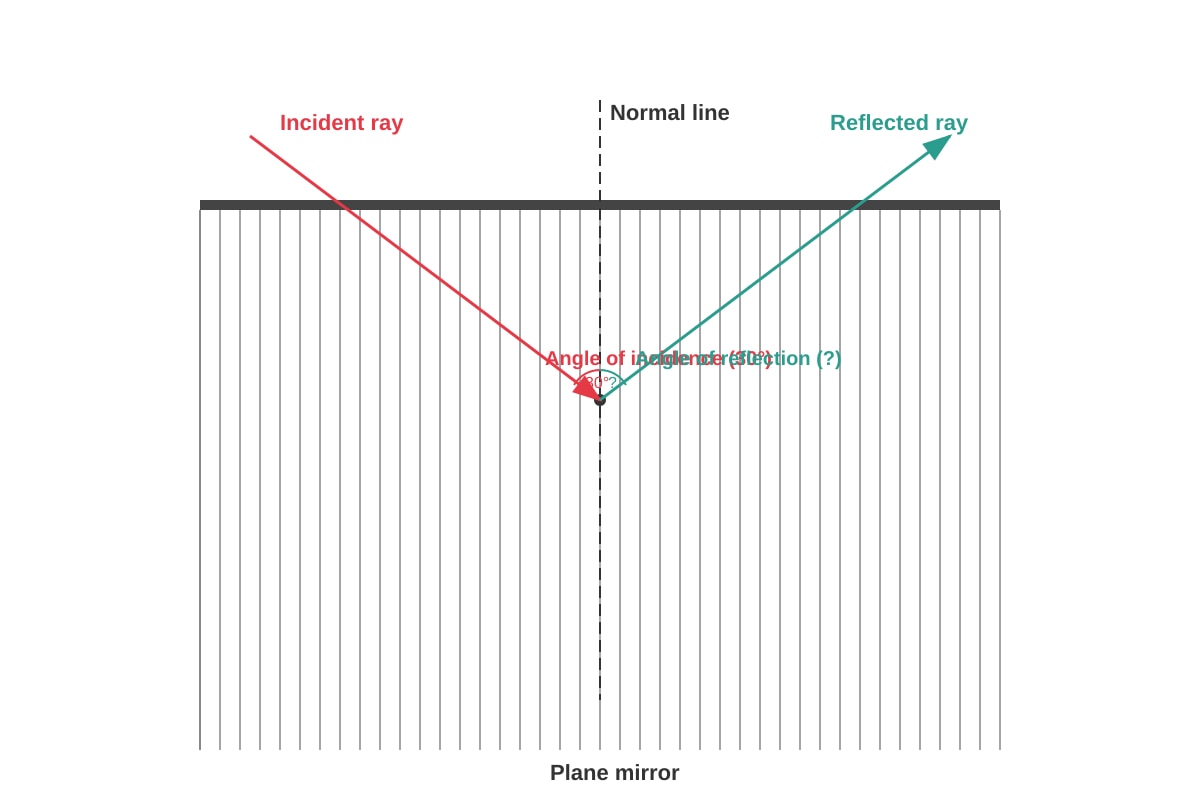
6. The diagram below shows a ray of light hitting a plane mirror.
<image_placeholder> id: Q6-fig1 type: diagram linked_question: Q6 description: A ray of light (incident ray) strikes a plane mirror at an angle of 30° to the normal. The reflected ray is shown leaving the mirror. labels: incident ray, reflected ray, normal line, angle of incidence (30°), angle of reflection (?), plane mirror values: angle of incidence = 30° must_show: incident ray, reflected ray, normal line, angle labels, mirror surface </image_placeholder>

What is the angle of reflection?
A. 15°
B. 30°
C. 60°
D. 90°
[ ]

7. White light is made up of __________ different colours.
A. 3
B. 5
C. 7
D. 9
[ ]

8. When white light passes through a glass prism, it splits into a spectrum of colours. This phenomenon is called __________.
A. reflection
B. refraction
C. dispersion
D. absorption
[ ]

9. A red apple appears red because it __________.
A. reflects red light and absorbs other colours
B. absorbs red light and reflects other colours
C. produces red light
D. transmits red light only
[ ]

10. Which of the following will produce the sharpest shadow?
A. A point source of light
B. A large fluorescent tube
C. A cloudy sky
D. A torch with a wide beam
[ ]


Section B: Structured Questions (10 × 2 marks = 20 marks)

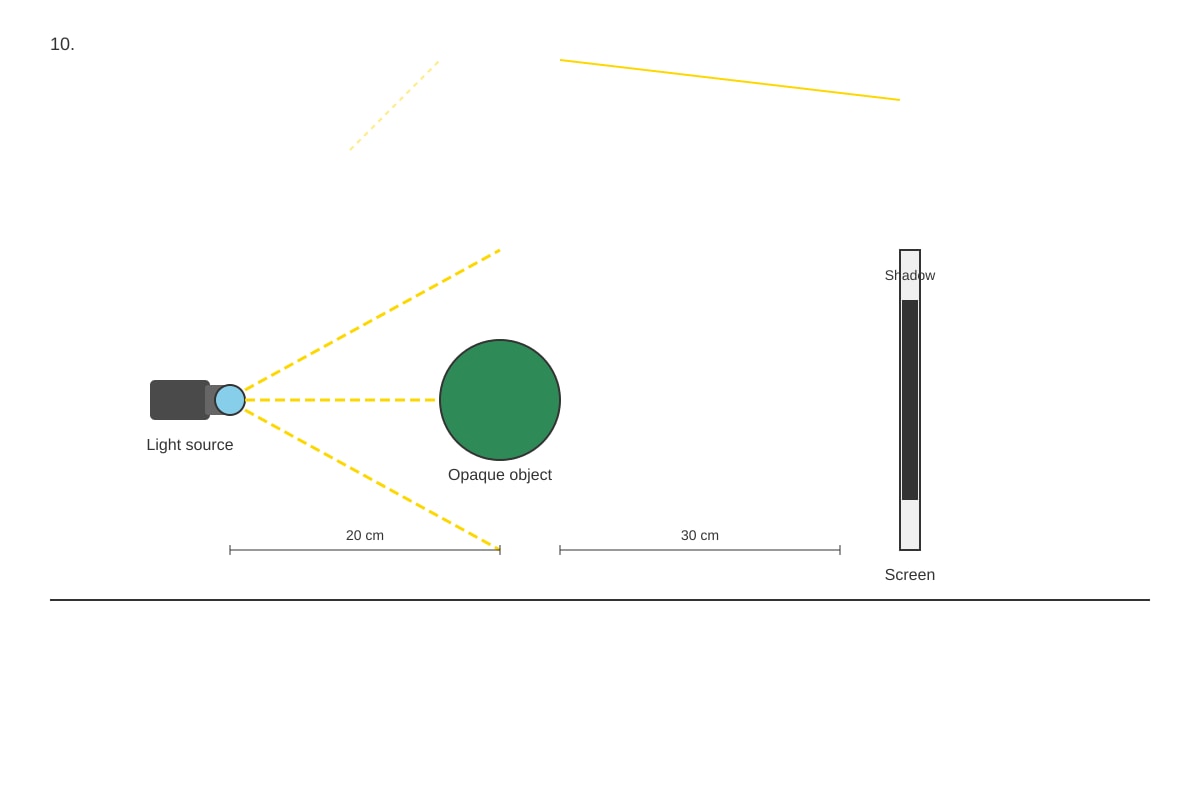
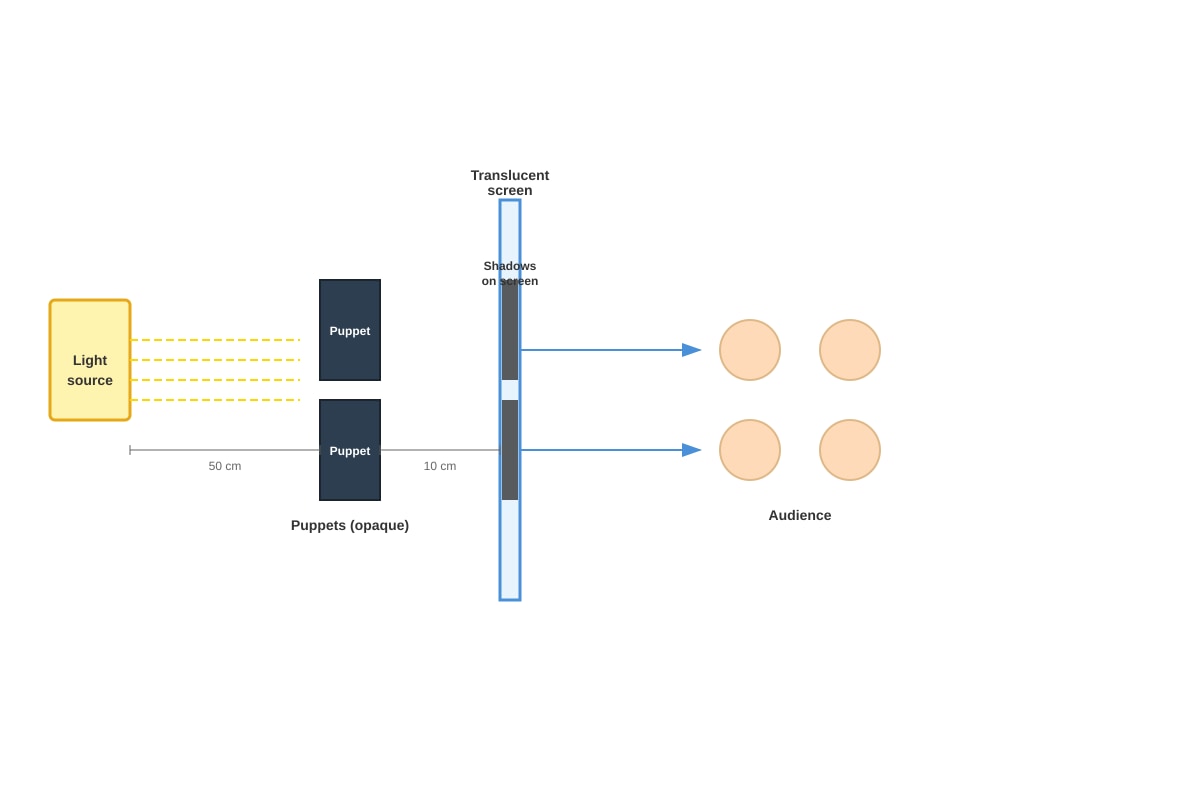
11. The diagram below shows a torch shining on a wooden block. A shadow is formed on the screen.
<image_placeholder> id: Q11-fig1 type: diagram linked_question: Q11 description: Side view of a torch on the left, a wooden block in the middle, and a vertical screen on the right. Light rays from the torch travel in straight lines, are blocked by the block, and form a shadow on the screen. labels: torch (light source), wooden block (opaque object), screen, light rays (straight lines), shadow region on screen values: distance from torch to block = 20 cm, distance from block to screen = 30 cm, height of block = 10 cm must_show: straight light rays, blocked rays forming shadow, labels for all components, distances </image_placeholder>

(a) Explain why a shadow is formed on the screen.


________________________________________________________________________ [1]

(b) If the torch is moved closer to the wooden block, what will happen to the size of the shadow on the screen?
________________________________________________________________________ [1]

12. Classify the following objects into the table below based on how they interact with light.

ObjectTransparentTranslucentOpaque
Clear plastic ruler
Frosted bathroom window
Aluminium foil
Clean water
Tracing paper

[2]

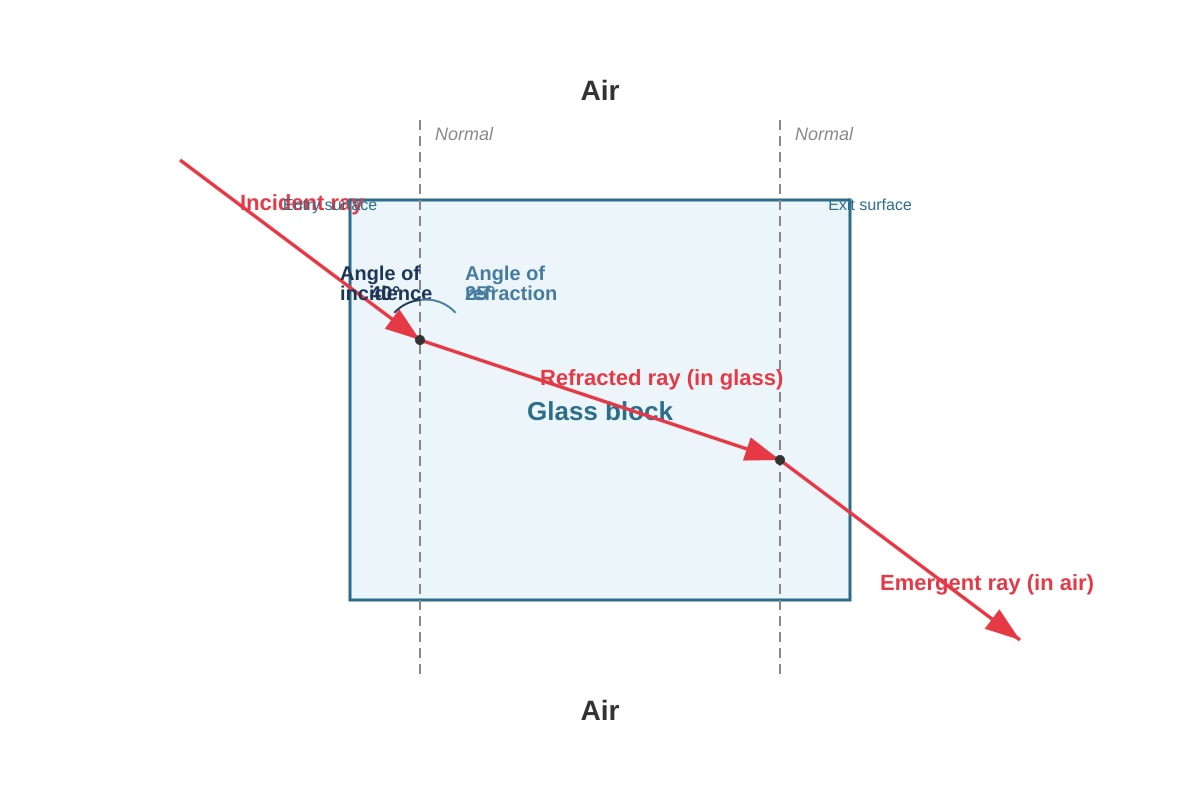
13. The diagram below shows a light ray passing from air into a glass block.
<image_placeholder> id: Q13-fig1 type: diagram linked_question: Q13 description: A light ray travels from air (top) into a rectangular glass block (middle) and exits back into air (bottom). The ray bends at the first surface (air-glass) and bends again at the second surface (glass-air). The emergent ray is parallel to the incident ray but laterally displaced. labels: incident ray, refracted ray (inside glass), emergent ray, normal lines at both surfaces, angle of incidence, angle of refraction, glass block, air values: angle of incidence = 40°, refractive index of glass = 1.5 must_show: bending at both surfaces, parallel emergent ray, normal lines, angle labels </image_placeholder>

(a) State what happens to the speed of light when it enters the glass block from air.
________________________________________________________________________ [1]

(b) The ray bends towards the normal when entering the glass. Explain why this happens.


________________________________________________________________________ [1]

14. Peter shines a torch at a red filter and observes the light that passes through. He then shines the same torch at a blue filter.

(a) What colour of light passes through the red filter?
________________________________________________________________________ [1]

(b) If Peter places both the red filter and the blue filter together in front of the torch, what will he observe? Explain your answer.


________________________________________________________________________ [1]

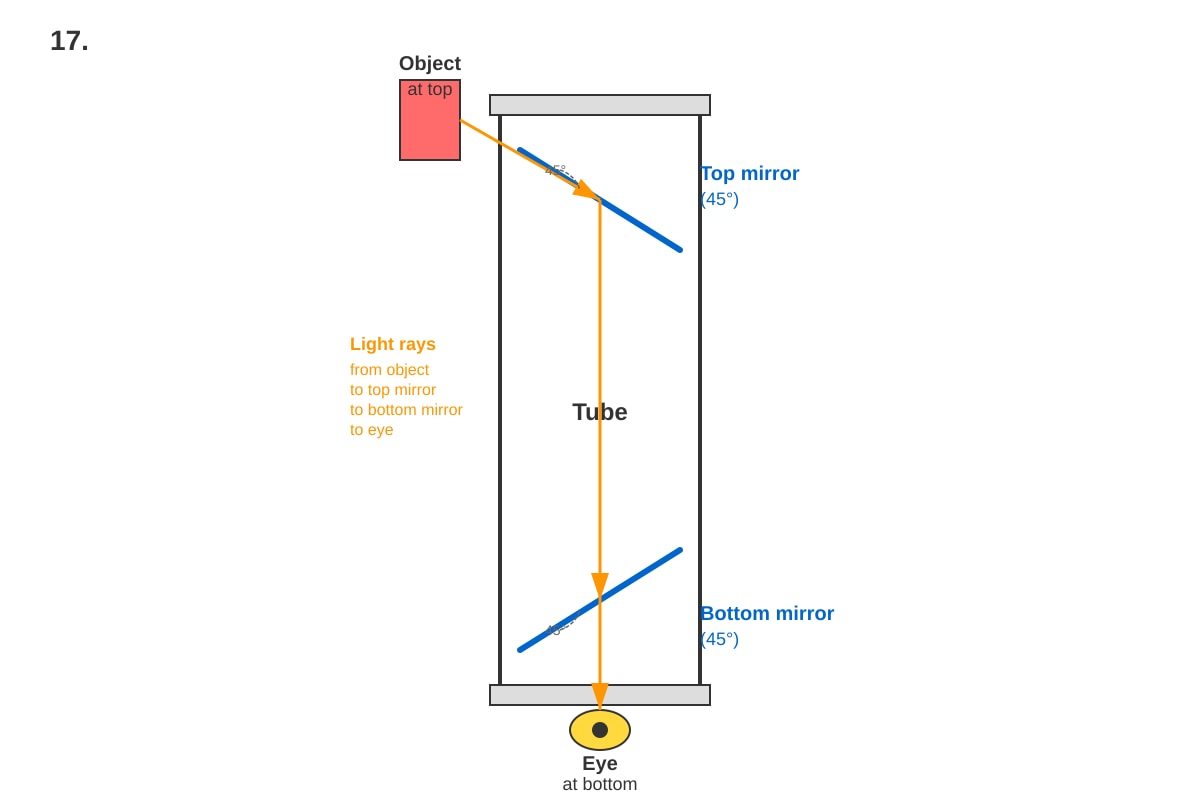
15. The diagram below shows a periscope.
<image_placeholder> id: Q15-fig1 type: diagram linked_question: Q15 description: A periscope consisting of a long tube with two plane mirrors fixed at 45° at each end. The top mirror faces down, the bottom mirror faces up. Light from an object enters the top, reflects off the top mirror, travels down the tube, reflects off the bottom mirror, and enters the observer's eye. labels: object, top mirror (45°), bottom mirror (45°), light rays (straight lines with reflections), observer's eye, tube values: mirrors at 45° to horizontal must_show: two mirrors at 45°, light path with two reflections, object at top, eye at bottom </image_placeholder>

(a) On the diagram, draw the path of light from the object to the observer's eye. Use a ruler and show arrows.
[1]

(b) State one property of a plane mirror that allows the periscope to work.
________________________________________________________________________ [1]

16. A student conducts an experiment to investigate how the distance between a light source and an object affects the size of the shadow formed on a screen. The screen is kept at a fixed distance from the object.

Distance between light source and object (cm)Height of shadow on screen (cm)
1030
2020
3015
4012

(a) State the relationship between the distance of the light source from the object and the size of the shadow.
________________________________________________________________________ [1]

(b) Predict the height of the shadow if the distance between the light source and the object is 50 cm.
________________________________________________________________________ [1]

17. The diagram below shows a convex lens forming an image of a distant object on a screen.
<image_placeholder> id: Q17-fig1 type: diagram linked_question: Q17 description: A convex lens with parallel light rays from a distant object (at infinity) converging at the focal point on the other side. A screen is placed at the focal point showing a real, inverted, diminished image. labels: convex lens, parallel incident rays, focal point (F), focal length (f), screen, real inverted image, principal axis values: focal length = 10 cm must_show: parallel rays converging at focal point, screen at focal point, inverted image on screen, focal length labelled </image_placeholder>

(a) What type of image is formed on the screen? (Choose: real/virtual, upright/inverted, magnified/diminished/same size)
________________________________________________________________________ [1]

(b) If the screen is moved further away from the lens beyond the focal point, what will happen to the image on the screen?
________________________________________________________________________ [1]

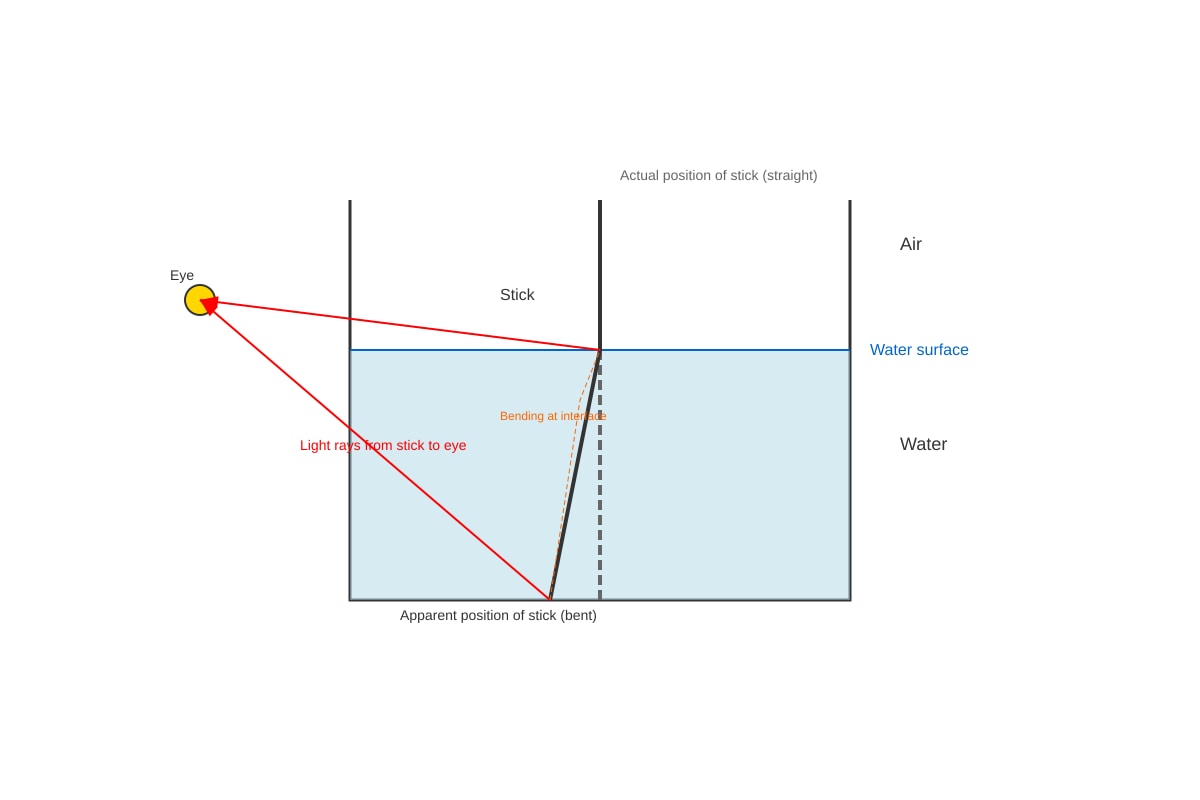
18. Mary looks at a straw placed in a glass of water from the side. The straw appears bent at the water surface.
<image_placeholder> id: Q18-fig1 type: diagram linked_question: Q18 description: A glass of water with a straw placed in it. The straw appears bent at the water-air interface. Light rays from the straw in water bend away from the normal as they exit into air, making the straw appear shallower and bent. labels: straw, water, air, apparent position of straw, actual position of straw, light rays bending at interface, normal line, observer's eye values: refractive index of water = 1.33 must_show: actual straw, apparent bent straw, light rays bending away from normal, observer position </image_placeholder>

(a) Name the phenomenon that causes the straw to appear bent.
________________________________________________________________________ [1]

(b) Explain why the straw appears bent using the concept of light travelling through different media.


________________________________________________________________________ [1]

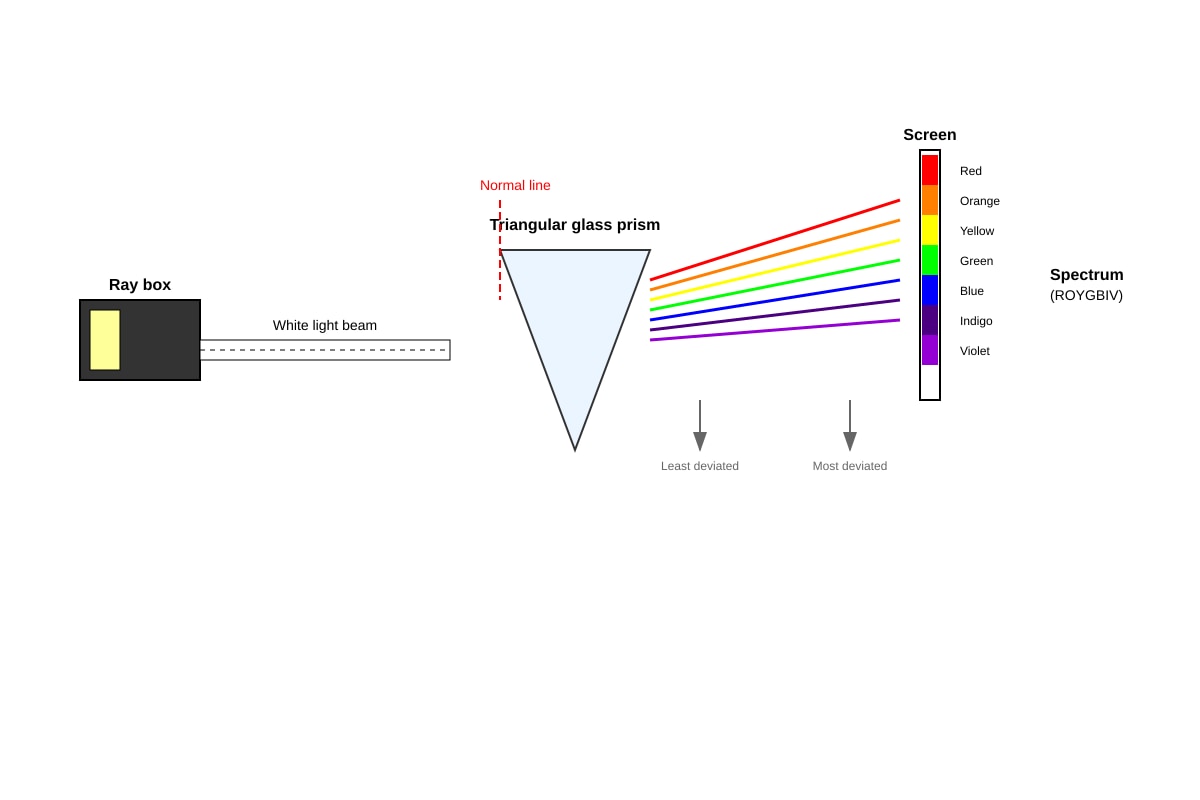
19. The diagram below shows white light passing through a triangular glass prism.
<image_placeholder> id: Q19-fig1 type: diagram linked_question: Q19 description: A triangular glass prism with a beam of white light entering one face. The light splits into a spectrum of seven colours (red, orange, yellow, green, blue, indigo, violet) exiting the other face. Red deviates least, violet deviates most. labels: white light beam, triangular prism, spectrum (ROYGBIV), red light (least deviation), violet light (most deviation), normal lines values: seven colours in order must_show: white light in, spectrum out, colour order, different deviation angles </image_placeholder>

(a) List the seven colours of the spectrum in order from the least deviated to the most deviated.
________________________________________________________________________ [1]

(b) Why does white light split into different colours when passing through the prism?


________________________________________________________________________ [1]

20. A driver sees a traffic light turn red. The red light has a wavelength of approximately 650 nm. The driver's car is 100 m away from the traffic light. The speed of light is 3 × 10⁸ m/s.

(a) Calculate the time taken for the red light to travel from the traffic light to the driver's eyes.


________________________________________________________________________ [1]

(b) State one difference between red light and blue light in terms of wavelength.
________________________________________________________________________ [1]


End of Quiz

Answers

<!-- TuitionGoWhere generation metadata: stage=5-1; model=nvidia/nemotron-3-ultra-550b-a55b:free; model_label=NVIDIA Nemotron 3 Ultra 550B A55B Free; generated=2026-06-06; Sources: Stage 4-0 LLM templates, syllabus context, and Stage 2 evidence where available. -->

Primary 6 PSLE Science Quiz - Light (Answer Key)

Total Marks: 40


Section A: Multiple-Choice Questions (10 marks)

1. C — The Sun is a natural source of light. Candle flame, torchlight, and television screens are artificial/man-made sources.
Mark: 1

2. C — Light travels in straight lines. This is a fundamental property of light (rectilinear propagation).
Mark: 1

3. B — Smooth, shiny surfaces like mirrors reflect light. This is regular (specular) reflection.
Mark: 1

4. B — A shadow is formed when an opaque or translucent object blocks light from reaching a surface.
Mark: 1

5. C — Clear glass is transparent and allows most light to pass through. Wood and cardboard are opaque; frosted glass is translucent (allows some light but scatters it).
Mark: 1

6. B — According to the law of reflection, the angle of incidence equals the angle of reflection. Both are measured from the normal. Given angle of incidence = 30°, angle of reflection = 30°.
Mark: 1

7. C — White light is made up of 7 colours (Red, Orange, Yellow, Green, Blue, Indigo, Violet — ROYGBIV).
Mark: 1

8. C — Dispersion is the splitting of white light into its constituent colours when passing through a prism. Refraction is the bending of light; dispersion is the separation of colours due to different wavelengths refracting by different amounts.
Mark: 1

9. A — A red apple appears red because its surface absorbs most other colours (wavelengths) of white light and reflects predominantly red light to our eyes.
Mark: 1

10. A — A point source of light produces sharp shadows with clear edges (umbra only). Extended sources (fluorescent tube, cloudy sky, wide-beam torch) produce fuzzy shadows with penumbra.
Mark: 1


Section B: Structured Questions (20 marks)

11.
(a) Light travels in straight lines. The wooden block is opaque and blocks the light from the torch, preventing it from reaching the screen. This creates a dark region (shadow) on the screen where light cannot reach.
Key points: straight-line propagation (1), opaque object blocks light (1) — but only 1 mark allocated, so concise answer gets full mark.
Mark: 1

(b) The shadow will become larger.
Explanation: When the light source moves closer to the object, the light rays diverge more, causing a larger shadow on the fixed screen. This is similar to moving a torch closer to your hand on a wall — the shadow grows.
Mark: 1

12.

ObjectTransparentTranslucentOpaque
Clear plastic ruler
Frosted bathroom window
Aluminium foil
Clean water
Tracing paper

Marking: ½ mark per correct classification (5 objects × ½ = 2.5, capped at 2 marks). Award 2 marks for all 5 correct; 1 mark for 3-4 correct; 0 marks for ≤2 correct.
Mark: 2

13.
(a) The speed of light decreases when it enters the glass block from air.
Explanation: Light travels slower in optically denser media. Glass is optically denser than air (refractive index 1.5 vs 1.0).
Mark: 1

(b) Light bends towards the normal because it slows down when entering the optically denser medium (glass). The change in speed causes the light ray to change direction (refract) towards the normal.
Key concept: Refraction occurs due to change in speed. Towards normal = entering denser medium.
Mark: 1

14.
(a) Red light passes through the red filter.
Explanation: A red filter transmits (allows through) red light and absorbs other colours.
Mark: 1

(b) No light will pass through (it will appear black/dark).
Explanation: The red filter only allows red light to pass. The blue filter only allows blue light to pass. Since the red filter blocks blue light and the blue filter blocks red light, placing them together blocks all light.
Mark: 1

15.
(a) Diagram should show:

  • Light rays from object travelling down to top mirror
  • Reflection at top mirror (angle of incidence = angle of reflection = 45°)
  • Rays travelling vertically down the tube
  • Reflection at bottom mirror (45°)
  • Rays travelling horizontally to observer's eye
  • Arrows showing direction from object → eye
    Mark: 1 (for correct path with arrows)

(b) A plane mirror reflects light such that the angle of incidence equals the angle of reflection.
Alternative acceptable answer: A plane mirror produces a virtual, upright, laterally inverted image at the same distance behind the mirror as the object is in front.
Key property used in periscope: predictable reflection at 45° to change light direction by 90°.
Mark: 1

16.
(a) As the distance between the light source and the object increases, the size of the shadow decreases.
Or: The shadow size is inversely related to the distance of the light source from the object.
Mark: 1

(b) Approximately 10 cm (accept 9–11 cm)
Reasoning: The pattern shows decreasing increments: 30→20 (–10), 20→15 (–5), 15→12 (–3). The decreases are roughly halving each step. Next decrease ~1.5–2 cm, giving ~10–10.5 cm. Alternatively, using inverse proportion: shadow height ∝ 1/distance. At 10 cm → 30 cm shadow. At 50 cm (5× distance), shadow ≈ 30/5 = 6 cm. But the data doesn't follow exact inverse proportion due to extended source size. Extrapolating the trend: 10 cm is a reasonable estimate.
Mark: 1

17.
(a) Real, inverted, diminished
Explanation: For a distant object (at infinity), a convex lens forms a real image at the focal point. The image is inverted (upside down) and diminished (smaller than object).
Mark: 1

(b) The image will become blurred / out of focus.
Explanation: A sharp real image is only formed at the focal point (for distant objects). Moving the screen away from the focal point means the converging rays have already crossed and are diverging again, producing a blurred image on the screen.
Mark: 1

18.
(a) Refraction
Mark: 1

(b) Light travels at different speeds in different media. When light rays from the straw in water pass from water (denser medium) into air (less dense medium), they speed up and bend away from the normal. Our brain assumes light travels in straight lines, so it traces the rays back in straight lines to an apparent position that is shallower and offset, making the straw appear bent at the water surface.
Key points: different speeds in different media (1), bend away from normal when entering less dense medium (1), brain interprets straight-line path (1) — but only 1 mark, so concise version gets full mark.
Mark: 1

19.
(a) Red, Orange, Yellow, Green, Blue, Indigo, Violet (ROYGBIV)
Mark: 1 (all 7 in correct order)

(b) Different colours of light have different wavelengths. In glass, shorter wavelengths (violet/blue) slow down more and refract (bend) more than longer wavelengths (red). This causes each colour to deviate by a different amount, splitting white light into a spectrum.
Key concept: Dispersion occurs because refractive index depends on wavelength (shorter λ → higher n → more bending).
Mark: 1

20.
(a) Time = Distance / Speed
= 100 m / (3 × 10⁸ m/s)
= 3.33 × 10⁻⁷ s
= 0.333 microseconds (or 333 nanoseconds)
Working: 100 ÷ 300,000,000 = 1/3,000,000 = 3.33 × 10⁻⁷ s
Mark: 1 (correct formula, substitution, and answer with units)

(b) Red light has a longer wavelength than blue light. (Red ~650 nm, Blue ~450 nm)
Alternative: Blue light has a shorter wavelength / higher frequency than red light.
Mark: 1


Marking Notes for Teachers

  • Section A: 1 mark each, no half marks. Total 10 marks.
  • Section B: 2 marks per question. Award partial marks where indicated.
  • Common mistakes to watch for:
    • Q6: Confusing angle of incidence with angle to mirror surface (should be to normal).
    • Q11(b): Thinking shadow gets smaller when torch moves closer.
    • Q13(b): Saying light bends "because it enters glass" without mentioning speed change.
    • Q14(b): Thinking red + blue filters make purple light (filters subtract, not add).
    • Q16(b): Using exact inverse proportion (6 cm) instead of trend extrapolation (~10 cm).
    • Q17(b): Saying image gets larger or inverted again (it just blurs).
    • Q18(b): Not explaining why brain sees bent straw (straight-line assumption).
    • Q19(b): Saying "different colours travel at different speeds" without linking to refraction/bending.
    • Q20(a): Forgetting to convert to scientific notation or missing units.

Total: 40 marks