AI Generated Quiz
Primary 6 PSLE Science Light Quiz
Free AI-Generated Kimi K2 6 Free Primary 6 PSLE Science Light quiz with questions and answers for Singapore students. This page is rendered as a direct URL so the questions and answers can be discovered without pressing in-page buttons.
These static practice materials are generated from the site's syllabus and paper-generation workflow, with source and model context shown so students and parents can evaluate the material before use.
Questions
Primary 6 PSLE Science Quiz - Light
Name: _________________________________ Class: __________ Date: __________
Duration: 40 minutes Total Marks: 40 Instructions: Answer all questions. Write your answers in the spaces provided.
Section A: Multiple Choice (Questions 1–8)
Choose the correct answer and write its letter in the bracket. Each question carries 1 mark.
[8 marks]
1. Which of the following is NOT a light source?
A) The Sun B) A burning candle C) The Moon D) A light bulb
Answer: ( )
2. Light travels at approximately 300,000,000 m/s in air. What happens to the speed of light when it enters glass?
A) It increases B) It decreases C) It stays the same D) It becomes zero
Answer: ( )
3. A student stands 2 m in front of a plane mirror. How far is the image from the student?
A) 1 m B) 2 m C) 3 m D) 4 m
Answer: ( )
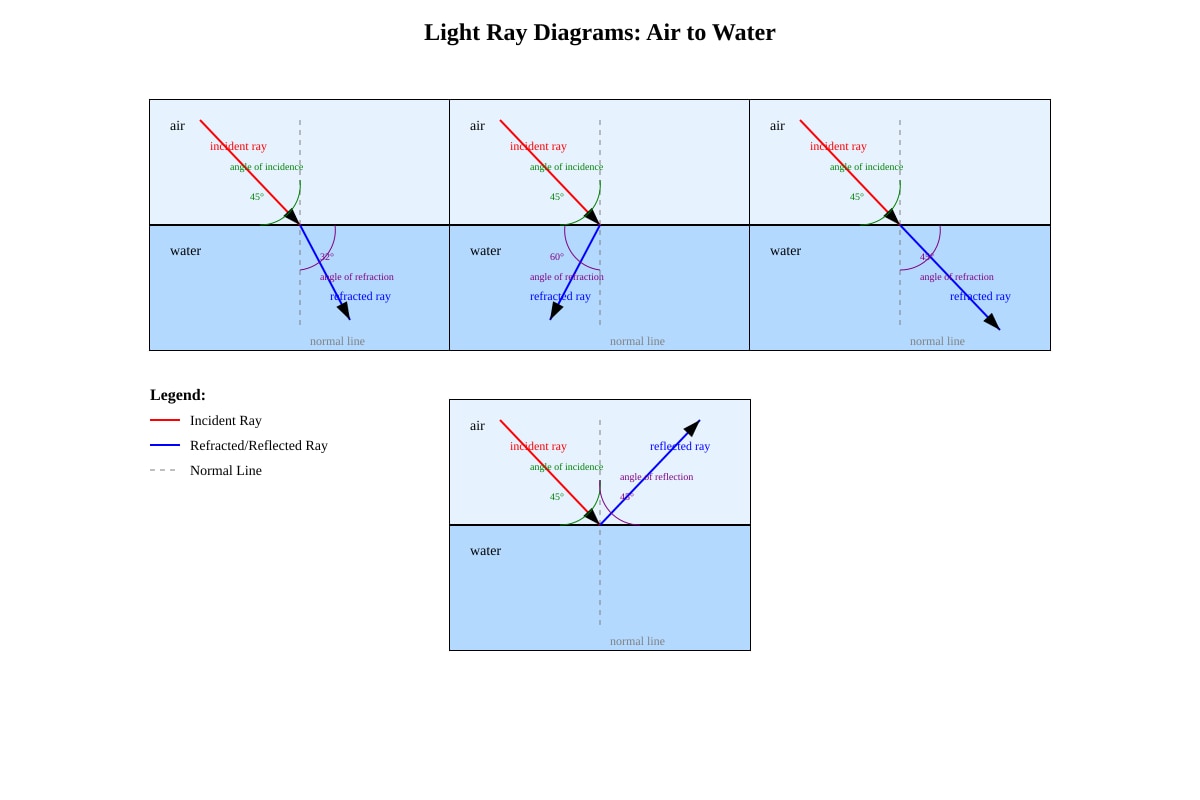
4. Which diagram correctly shows the path of light when it travels from air into water?
<image_placeholder> id: Q4-fig1 type: diagram linked_question: Q4 description: Four ray diagrams labeled A, B, C, D showing light ray entering water from air at an angle labels: A, B, C, D; normal line; air; water; incident ray; refracted ray; angle of incidence; angle of refraction values: angle of incidence = 45° in all diagrams; different refracted angles shown must_show: Diagram A shows ray bending towards normal with correct angles; B shows bending away; C shows no bending; D shows reflection only. Clear labels for air and water boundary. </image_placeholder>
Answer: ( )
5. A concave lens is also known as a:
A) Converging lens B) Diverging lens C) Magnifying lens D) Focusing lens
Answer: ( )
6. During a solar eclipse, what is the correct arrangement of the Sun, Moon, and Earth?
A) Sun — Earth — Moon B) Earth — Sun — Moon C) Sun — Moon — Earth D) Moon — Earth — Sun
Answer: ( )
7. A red shirt appears red in white light because the shirt:
A) Absorbs all colours and reflects red light B) Reflects all colours and absorbs red light C) Transmits red light and absorbs other colours D) Produces red light by itself
Answer: ( )
8. In which of the following situations is light NOT necessary?
A) A plant making food in its leaves B) A student reading a book C) A camera taking a photograph D) A bat flying in a dark cave
Answer: ( )
Section B: Short Answer (Questions 9–16)
Answer in the spaces provided. Show your working where necessary.
[20 marks]
9. State two properties of light that allow us to see an object. [2 marks]
10. (a) Define "reflection of light" in your own words. [1 mark]
(b) State the two laws of reflection. [2 marks]
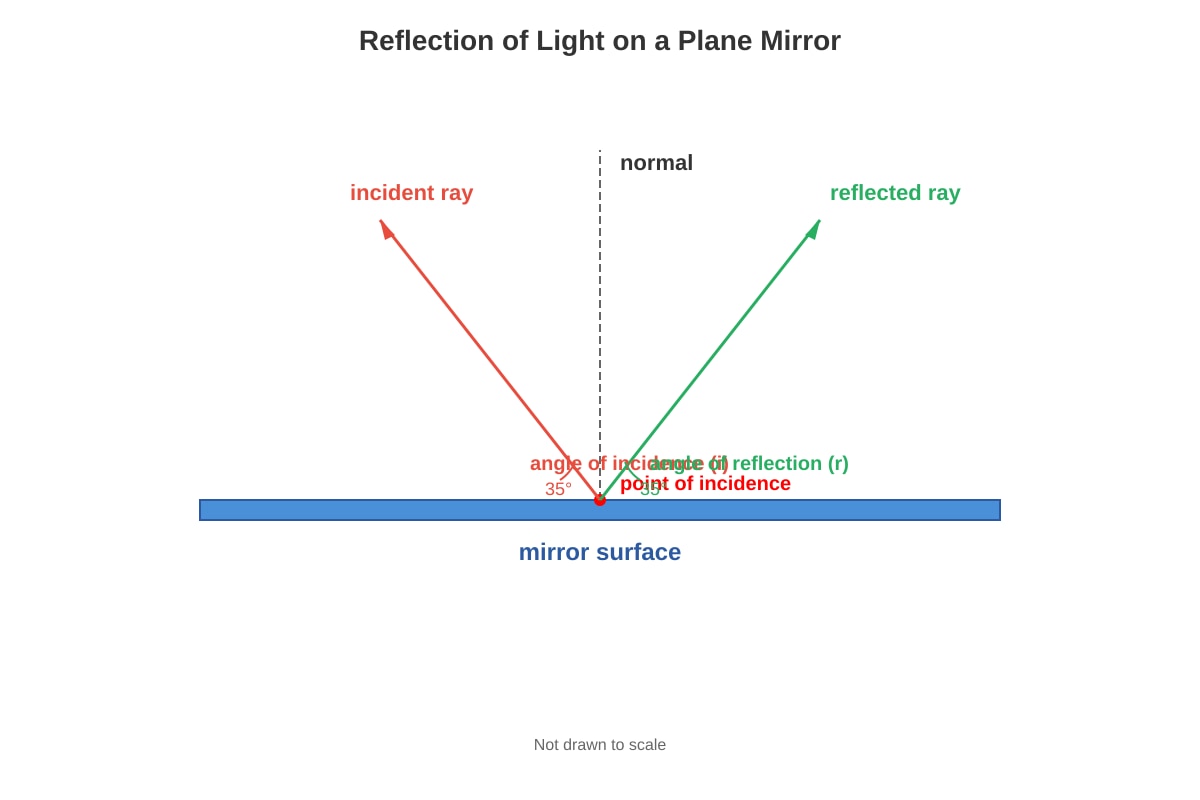
11. The diagram below shows a light ray hitting a plane mirror.
<image_placeholder> id: Q11-fig1 type: diagram linked_question: Q11 description: A light ray striking a plane mirror at point of incidence, with normal line drawn labels: incident ray; reflected ray; normal; point of incidence; angle of incidence (i); angle of reflection (r); mirror surface values: angle of incidence = 35° must_show: Clear normal line perpendicular to mirror surface; incident ray approaching from upper left at 35° to normal; mirror clearly labeled; all labels visible </image_placeholder>
(a) Use a protractor to measure and state the angle of incidence shown in the diagram. [1 mark]
Angle of incidence = __________°
(b) What is the angle of reflection? [1 mark]
Angle of reflection = __________°
(c) State the law of reflection that connects your answers in (a) and (b). [1 mark]
12. A swimming pool appears shallower than it really is when viewed from above.
(a) Explain why this happens using the idea of refraction. [2 marks]
(b) Name one other everyday situation where refraction of light causes a similar misleading appearance. [1 mark]
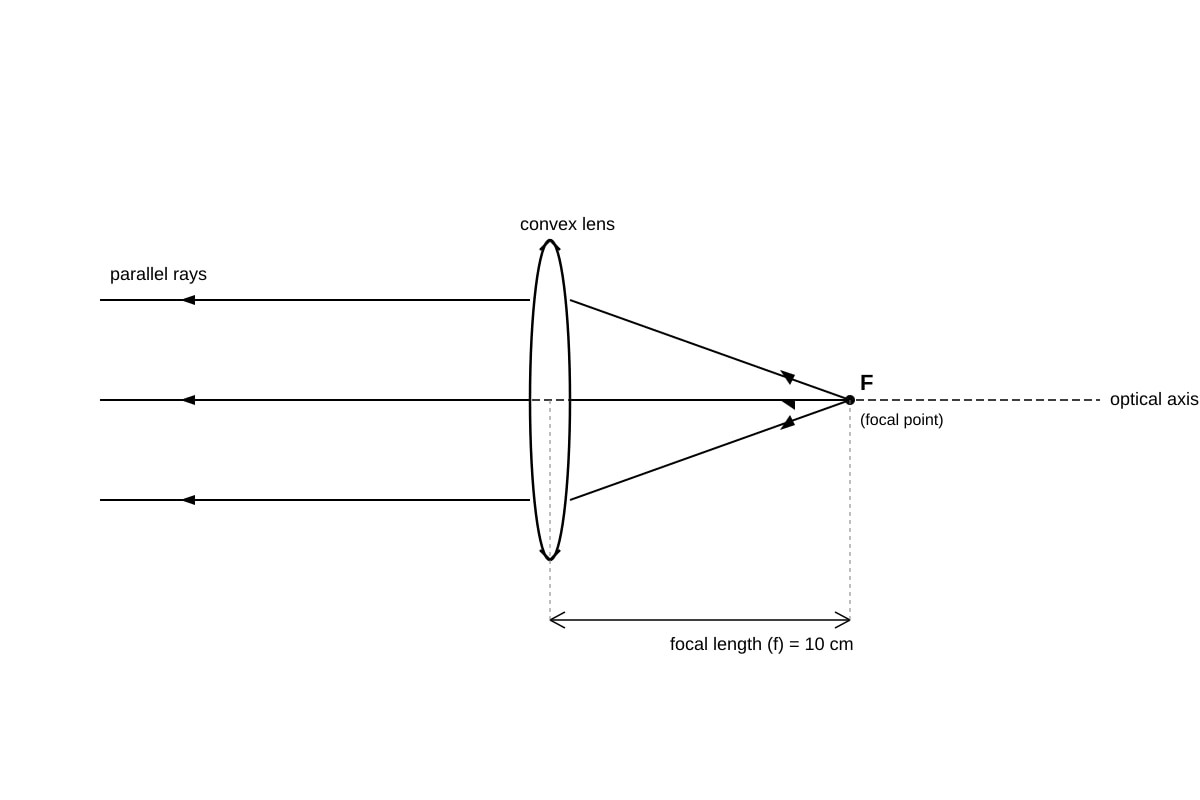
13. The diagram shows a convex lens focusing parallel rays of light.
<image_placeholder> id: Q13-fig1 type: diagram linked_question: Q13 description: Convex lens with parallel light rays entering from left, converging to focal point on right labels: convex lens; optical axis; parallel rays; focal point (F); focal length (f) values: focal length = 10 cm indicated with double-arrow line must_show: Lens shape clearly convex; at least three parallel rays shown converging through focal point; F labeled on optical axis; focal length distance clearly marked with measurement line </image_placeholder>
(a) What is the name of point F on the diagram? [1 mark]
(b) The focal length of this lens is 10 cm. Explain what is meant by "focal length." [2 marks]
(c) State one use of a convex lens in everyday life. [1 mark]
14. A student sets up an experiment to show that white light is made up of different colours.
(a) Name the piece of equipment used to split white light into a spectrum of colours. [1 mark]
(b) List the seven colours of the visible spectrum in order, starting with the colour that is bent the most. [2 marks]
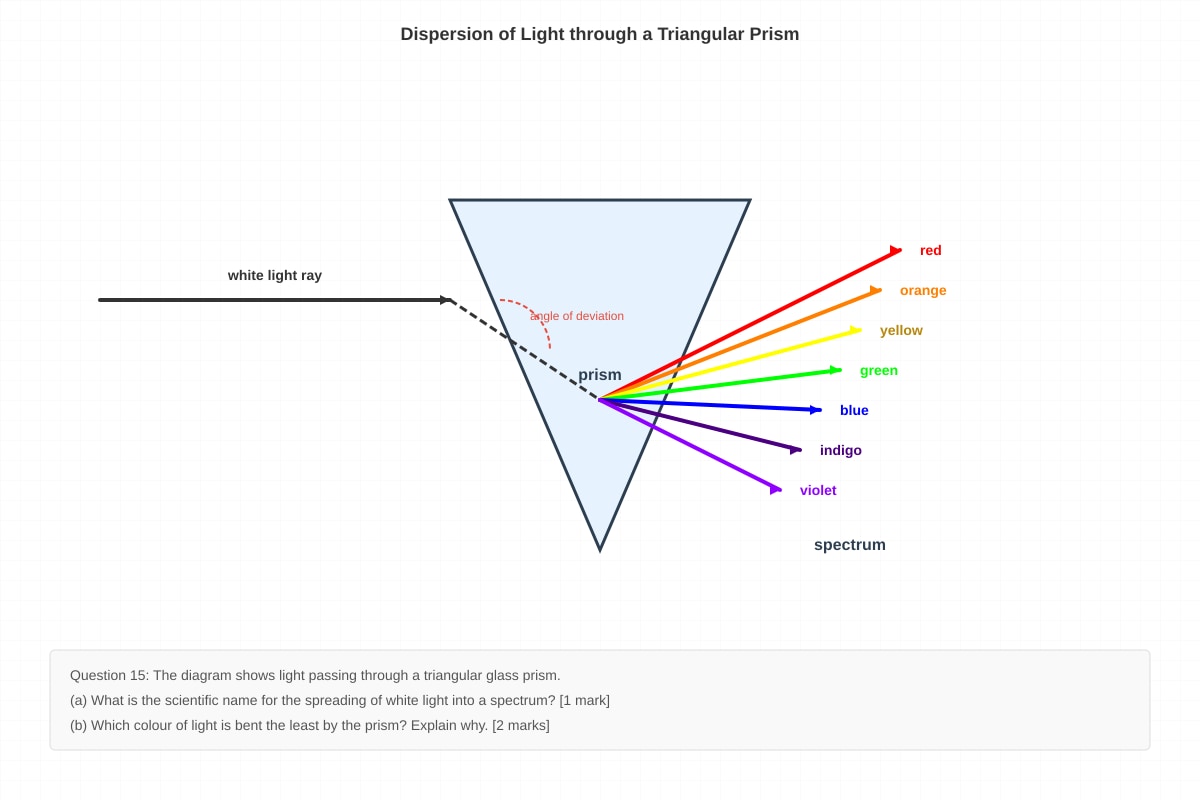
15. The diagram shows light passing through a triangular glass prism.
<image_placeholder> id: Q15-fig1 type: diagram linked_question: Q15 description: Triangular prism with white light entering one face and spectrum emerging from another face labels: white light ray; prism; spectrum (red, orange, yellow, green, blue, indigo, violet); angle of deviation values: none must_show: Incident white light on left face; emerging spread spectrum on right face with colors labeled in order; prism shape clearly triangular; light path bending through prism </image_placeholder>
(a) What is the scientific name for the spreading of white light into a spectrum? [1 mark]
(b) Which colour of light is bent the least by the prism? Explain why this colour appears at that position in the spectrum. [2 marks]
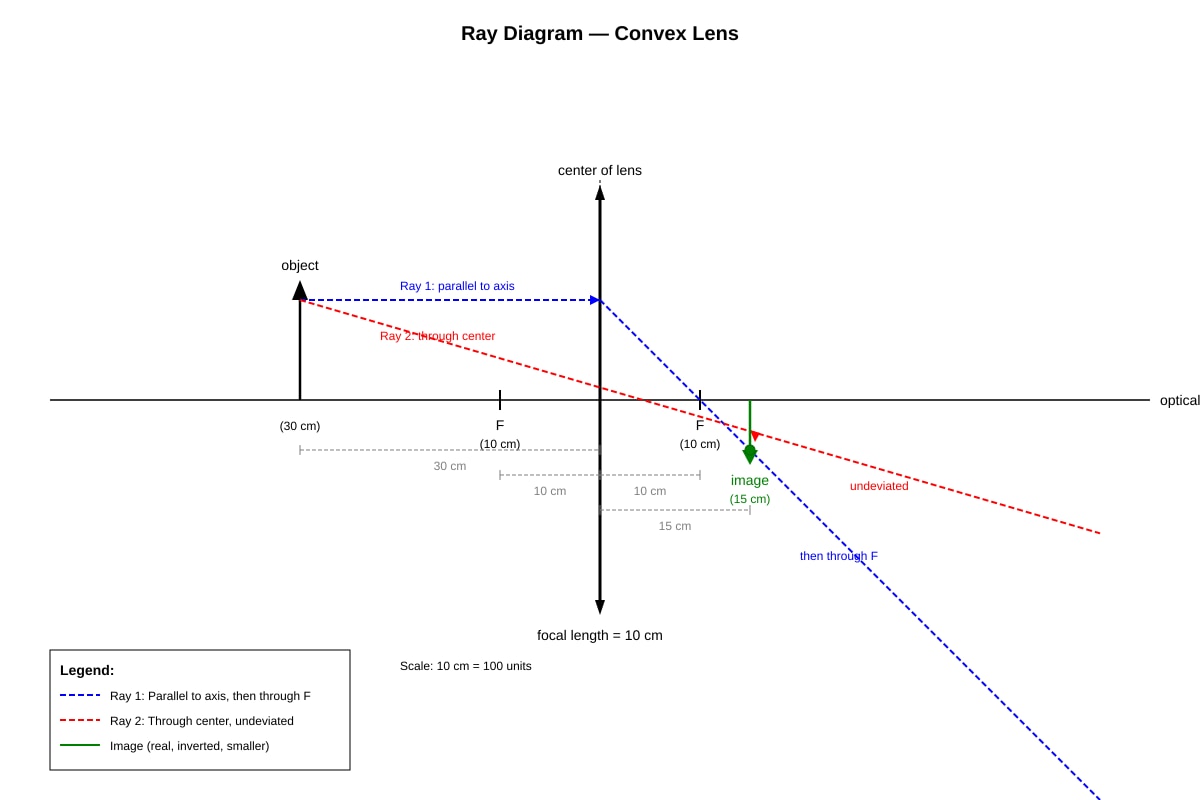
16. An object is placed 30 cm from a convex lens. The focal length of the lens is 10 cm.
(a) On the diagram below, complete the ray diagram to show where the image is formed. [2 marks]
<image_placeholder> id: Q16-fig1 type: diagram linked_question: Q16 description: Ray diagram setup with convex lens, object placed to left, two construction rays to be drawn labels: convex lens; optical axis; object (arrow); focal points F (both sides); center of lens; image position to be found values: object distance = 30 cm; focal length = 10 cm; F at 10 cm each side of lens center must_show: Lens center marked; both focal points F at 10 cm from center; object as upright arrow at 30 cm left of lens; construction rays: one parallel to axis then through F, one through center undeviated; image formed where rays intersect on right side </image_placeholder>
(b) Describe three characteristics of the image formed (consider: size, orientation, and whether it is real or virtual). [3 marks]
Section C: Longer Answer (Questions 17–20)
Answer in the spaces provided. These questions require more explanation and reasoning.
[12 marks]
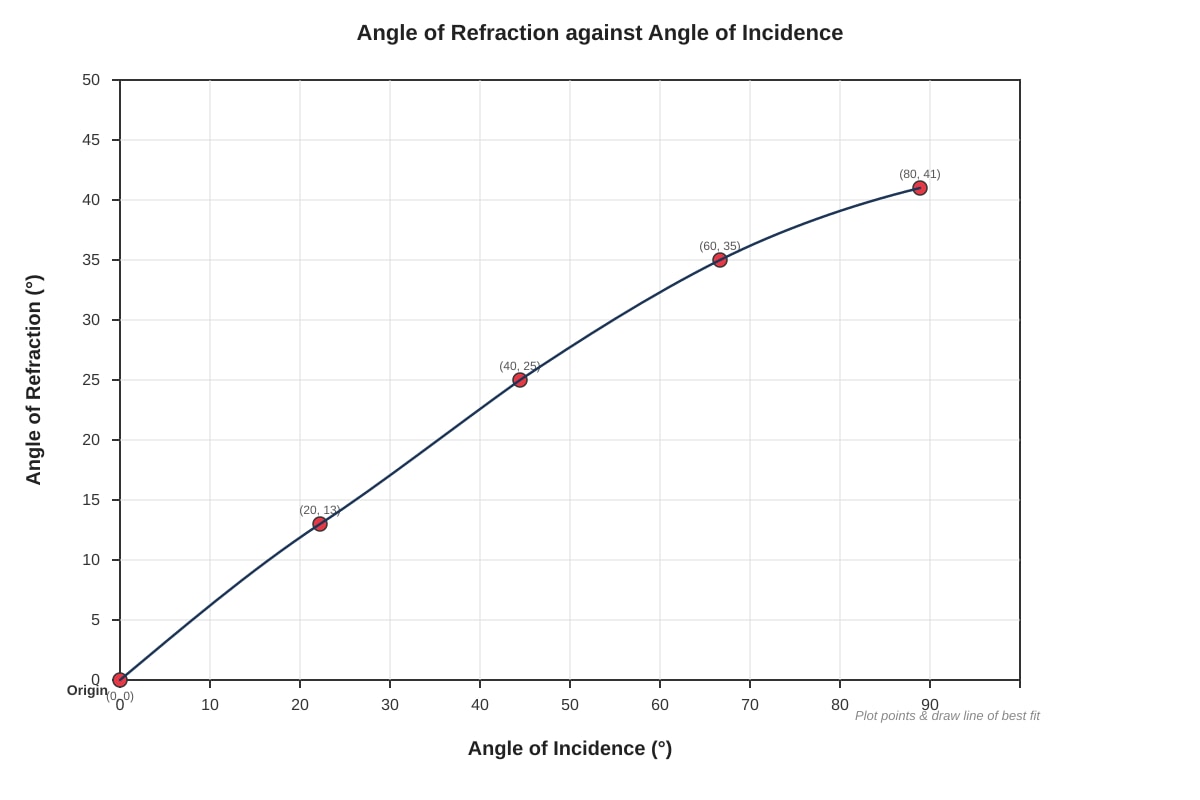
17. A student investigates how the angle of incidence affects the angle of refraction when light passes from air into a glass block. Her results are shown in the table.
| Angle of incidence (°) | Angle of refraction (°) |
|---|---|
| 0 | 0 |
| 20 | 13 |
| 40 | 25 |
| 60 | 35 |
| 80 | 41 |
(a) Plot a graph of angle of refraction (vertical axis) against angle of incidence (horizontal axis). [2 marks]
<image_placeholder> id: Q17-fig1 type: graph linked_question: Q17 description: Blank graph axes for plotting angle of refraction vs angle of incidence labels: horizontal axis: angle of incidence (°); vertical axis: angle of refraction (°); origin (0,0); point markers to be plotted values: axes from 0 to 90° horizontal, 0 to 50° vertical; data points: (0,0), (20,13), (40,25), (60,35), (80,41) must_show: Labeled axes with units; proper scale; all five data points plotted accurately; smooth curve or line of best fit through points </image_placeholder>
(b) Describe the pattern shown by the data. [2 marks]
(c) Use your graph to estimate the angle of refraction when the angle of incidence is 50°. Show your working on the graph. [2 marks]
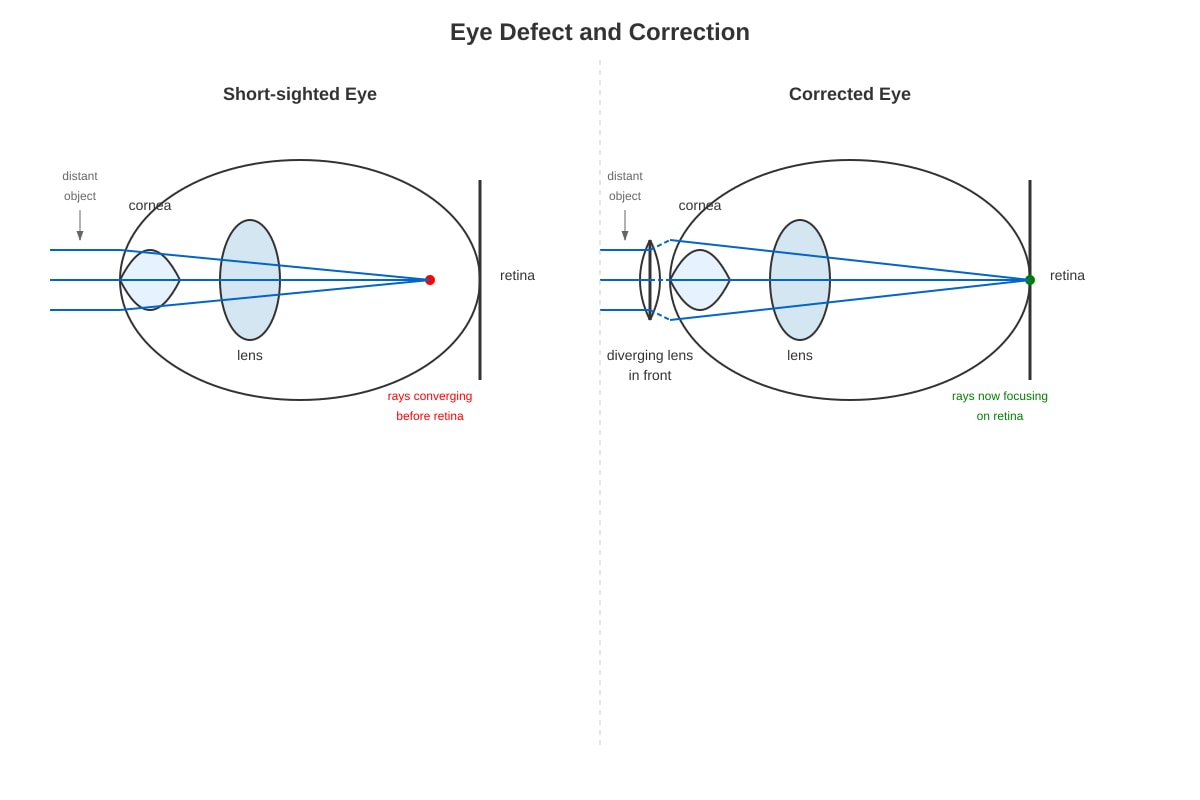
18. The diagram shows an eye defect and how it is corrected using a lens.
<image_placeholder> id: Q18-fig1 type: diagram linked_question: Q18 description: Two ray diagrams side by side: left showing eye defect with rays focusing in front of retina; right showing same eye with correcting lens labels: left diagram: cornea; lens; rays converging before retina; retina; short-sighted eye. Right diagram: cornea; lens; diverging lens in front; rays now focusing on retina; retina; corrected eye values: none must_show: Both diagrams clearly labeled; left shows parallel rays from distant object converging to point in front of retina; right shows same eye with concave/diverging lens placed before eye making rays diverge slightly so they focus exactly on retina; retinas at same position in both </image_placeholder>
(a) Name the eye defect shown in the left diagram. [1 mark]
(b) Explain why this person cannot see distant objects clearly. [2 marks]
(c) What type of lens is used to correct this defect? Explain how this lens helps. [2 marks]
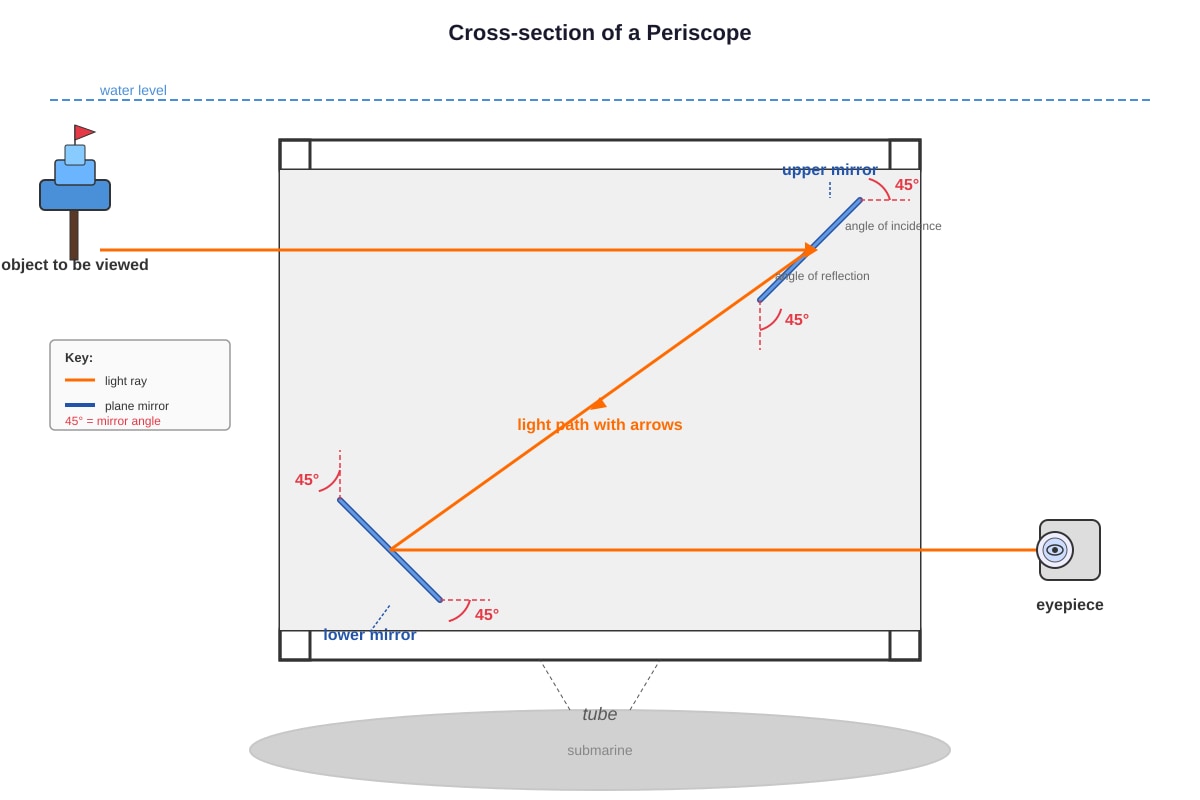
19. The diagram shows a periscope used in a submarine.
<image_placeholder> id: Q19-fig1 type: diagram linked_question: Q19 description: Cross-section of periscope showing two plane mirrors at 45° angles in vertical tube, with light path shown labels: upper mirror; lower mirror; eyepiece; object to be viewed; light path with arrows; 45° angle markings; tube values: mirrors at 45° to horizontal and vertical must_show: Two plane mirrors mounted at 45° to horizontal; upper mirror facing down-forward, lower mirror facing up-forward; light ray path with direction arrows showing: enters from left, hits upper mirror, travels down, hits lower mirror, exits to right toward eye; 45° angles clearly marked; tube structure visible </image_placeholder>
(a) On the diagram, trace the path of a light ray from the object to the observer's eye. Use arrows to show the direction of light travel. [2 marks]
(b) Explain why the two mirrors are placed at 45° to the horizontal. [2 marks]
20. A group of students wants to find out whether the colour of an object affects how much light energy it absorbs. They use four identical metal cans painted different colours: black, white, red, and silver. They fill each can with 200 mL of cold water at 20°C, place them in sunlight for 20 minutes, then measure the temperature of the water in each can.
| Colour of can | Temperature of water after 20 minutes (°C) |
|---|---|
| Black | 38 |
| White | 24 |
| Red | 32 |
| Silver | 22 |
(a) State the variable that the students change (manipulated variable) and the variable they measure (responding variable). [2 marks]
Manipulated variable: _______________________________________________
Responding variable: ________________________________________________
(b) Explain why it is important that all the cans are identical in size and shape. [1 mark]
(c) Using the results, explain which colour absorbs the most light energy and which absorbs the least. [3 marks]
(d) Suggest how the students could improve their experiment to make their results more reliable. [1 mark]
End of Quiz
Check your answers before handing in your paper.
Answers
Primary 6 PSLE Science Quiz - Light: Answer Key
Total Marks: 40
Section A: Multiple Choice
| Question | Answer | Explanation |
|---|---|---|
| 1 | C | The Moon is not a light source. It reflects sunlight. A light source produces its own light. |
| 2 | B | Light travels slower in glass (and other transparent media) than in air. This change in speed causes refraction. |
| 3 | D | The image in a plane mirror is as far behind the mirror as the object is in front. Object is 2 m in front, image is 2 m behind, so total distance = 4 m. |
| 4 | A | Light bends towards the normal when entering a denser medium (water from air). Diagram A shows correct bending with refraction toward normal. |
| 5 | B | A concave lens is thinner in the middle and causes parallel rays to diverge (spread out). |
| 6 | C | Solar eclipse: Moon passes between Sun and Earth, blocking sunlight from reaching Earth. |
| 7 | A | Objects appear coloured because they absorb some wavelengths and reflect others. Red shirt absorbs other colours, reflects red. |
| 8 | D | Bats use echolocation (sound, not light) to navigate. Photosynthesis (A), reading (B), and photography (C) all need light. |
Section A Total: 8 marks
Section B: Short Answer
9. Two properties of light: [2 marks]
- Light travels in straight lines (rectilinear propagation) [1]
- Light can be reflected [1] OR Light can be refracted / Light transfers energy / Light travels very fast
Teaching note: Understanding light's straight-line travel explains shadows and eclipses. Reflection allows us to see non-luminous objects.
10. (a) Reflection of light: [1 mark]
- When light bounces off a surface and changes direction
(b) Laws of reflection: [2 marks]
- The angle of incidence equals the angle of reflection [1]
- The incident ray, reflected ray, and normal all lie in the same plane [1]
Teaching note: "i = r" is the key equation. The normal is an imaginary line perpendicular to the surface at the point where light hits.
11. (a) Angle of incidence = 35° [1]
(b) Angle of reflection = 35° [1]
(c) The law of reflection states that the angle of incidence always equals the angle of reflection (or i = r) [1]
Teaching note: These angles are always measured from the normal, not from the mirror surface. Common mistake: measuring 55° (from mirror surface) instead of 35° (from normal).
12. (a) Explanation of why pool appears shallower: [2 marks]
- Light travels from the bottom of the pool through water and bends away from the normal as it exits into air (refraction) [1]
- Our eyes trace the light back in a straight line, making the bottom appear higher up (closer to the surface) than it really is [1]
(b) Another example: [1 mark]
- A drinking straw appears bent at the water's surface / A fish appears closer to the surface than it really is / A coin in a beaker becomes visible when water is added
13. (a) Point F is the focal point (or principal focus) [1]
(b) Focal length meaning: [2 marks]
- The distance from the center of the lens to the focal point [1]
- It is the distance where parallel rays of light are brought to a focus after passing through the lens [1]
(c) Use of convex lens: [1 mark]
- Magnifying glass / Eye glasses for long-sightedness / Camera lens / Telescope / Projector / Microscope
14. (a) Equipment: prism (or glass prism / triangular prism) [1]
(b) Seven colours in order (most bent first): [2 marks]
- Violet, indigo, blue, green, yellow, orange, red [2] (deduct [1] for each error in sequence, minimum 0)
Teaching note: Mnemonic: VIBGYOR backwards for most bent to least bent, or ROYGBIV forwards for least bent to most bent. Violet bends most because it has the shortest wavelength; red bends least with longest wavelength.
15. (a) Dispersion of light (or splitting of white light) [1]
(b) Red light is bent the least [1]
- Red light has the longest wavelength (or lowest frequency) among visible colours, so it is deviated least by the prism [1]
Teaching note: Different wavelengths refract by different amounts. Shorter wavelengths (violet/blue) interact more strongly with the glass, bending more.
16. (a) Ray diagram completion: [2 marks]
- Ray 1: From top of object, parallel to axis, then through focal point F on opposite side [1]
- Ray 2: From top of object, straight through center of lens without bending [1]
- Image forms where rays intersect (between F and 2F, inverted, diminished)
(b) Image characteristics: [3 marks]
- Diminished (smaller than object) [1]
- Inverted (upside down) [1]
- Real (can be projected on a screen / rays actually converge there) [1]
Teaching note: When object is beyond 2F (30 cm > 2 × 10 cm = 20 cm), image forms between F and 2F on opposite side. This is the standard camera arrangement.
Section C: Longer Answer
17. (a) Graph plotting: [2 marks]
- Correct axes labels with units [1]
- All points plotted accurately and smooth curve/line drawn [1]
(b) Pattern description: [2 marks]
- As angle of incidence increases, angle of refraction also increases [1]
- But angle of refraction increases more slowly than angle of incidence (or the increase is not proportional / curve levels off) [1]
(c) Estimated angle of refraction at 50° incidence: approximately 30°–32° [2]
- Reading from graph at 50° on horizontal axis, up to curve, across to vertical axis [1]
- Acceptable range 30°–32° based on curve trend [1]
18. (a) Eye defect: Short-sightedness (or myopia) [1]
(b) Explanation: [2 marks]
- The eyeball is too long, or the lens is too curved [1]
- Light from distant objects focuses in front of the retina instead of on it, so the image is blurry [1]
(c) Correcting lens: Concave lens (or diverging lens) [1]
- The concave lens diverges light rays before they enter the eye, so they spread out slightly [1]
- This means the eye's own lens can now focus the light onto the retina instead of in front of it [1]
Teaching note: Contrast with long-sightedness (hyperopia), where near objects blur because image would form behind retina; corrected with convex lens.
19. (a) Light path tracing: [2 marks]
- Light from object enters periscope, hits upper mirror at 45°, reflects downward [1]
- Hits lower mirror at 45°, reflects horizontally to eye; arrows show light traveling left→down→right [1]
(b) Why 45° placement: [2 marks]
- At 45°, the angle of incidence equals 45°, so angle of reflection equals 45° [1]
- This turns the light through exactly 90° (downward or sideways), allowing the periscope to "see" around corners while keeping the tube vertical [1]
Teaching note: Two reflections each turn light 90°, total 180° direction change, so observer sees object at same height but from concealed position.
20. (a) Variables: [2 marks]
- Manipulated variable: Colour of the can (or surface colour / paint colour) [1]
- Responding variable: Temperature of the water (or final temperature / temperature increase) [1]
(b) Why identical cans: [1 mark]
- To ensure fair test / so that only colour affects result, not size or shape; to control variables
(c) Explanation of results: [3 marks]
- Black can: Water reached highest temperature (38°C), so black absorbs the most light energy / black is the best absorber of light/heat energy [1]
- Silver can: Water stayed coolest (22°C), so silver absorbs the least light energy / silver is the poorest absorber (best reflector) [1]
- Dark/dull colours absorb more, light/shiny colours reflect more; black absorbs all colours, silver reflects all colours [1]
(d) Improvement for reliability: [1 mark]
- Repeat the experiment several times and calculate average temperatures / use more accurate thermometer / ensure same sunlight intensity for all cans / place cans same distance apart
Grand Total: 40 marks
Common Mistakes to Avoid:
- Confusing concave and convex lenses (concave = thinner middle, diverges; convex = thicker middle, converges)
- Forgetting that image distance in plane mirror equals object distance; total distance is double
- Measuring angles of incidence/reflection from the mirror surface instead of from the normal
- Confusing short-sightedness (myopia, corrected by concave lens) with long-sightedness (hyperopia, corrected by convex lens)