AI Generated Quiz
Primary 6 PSLE Science Life Cycles Quiz
Free P6 PSLE Science Life Cycles quiz, Kimi2.6 AI version, with questions, answers, and PSLE-focused practice for Singapore students.
These static practice materials are generated from the site's syllabus and paper-generation workflow, with source and model context shown so students and parents can evaluate the material before use.
Questions
Free quiz and exam paper access
Enter your details to view this paper
Your access is remembered on this device.
Answers
Primary 6 PSLE Science Quiz - Life Cycles: ANSWER KEY
Total Marks: 40
Section A: Multiple Choice (Questions 1–10, 1 mark each)
1. Answer: ( A )
Explanation: Complete metamorphosis involves four distinct stages: egg → larva (caterpillar) → pupa (chrysalis) → adult butterfly. The larva looks completely different from the adult and has different feeding habits. This is different from incomplete metamorphosis (like grasshoppers) where the young resemble small adults without wings.
Key concept: Complete metamorphosis = dramatic body change through pupa stage.
2. Answer: ( C )
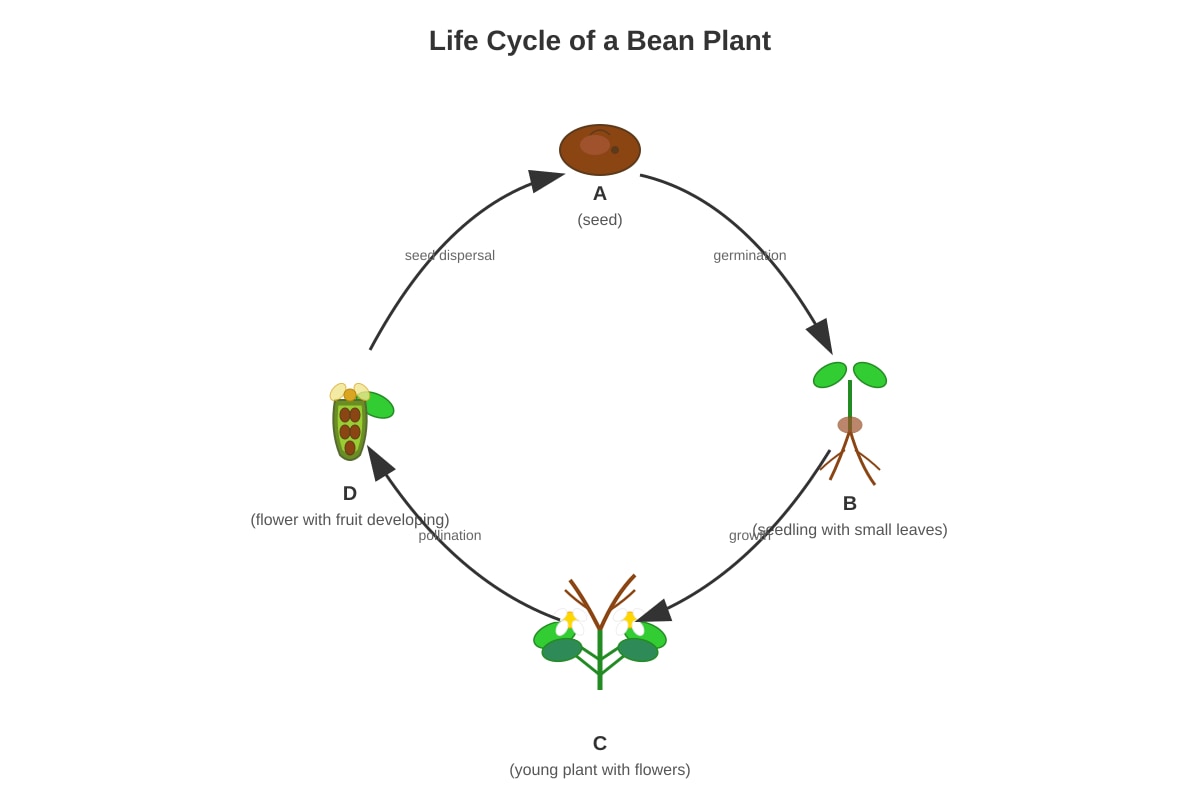
Explanation: The life cycle of a flowering plant is: seed → seedling → young plant → mature plant (with flowers) → fruit and seeds. The pupa is a stage in the life cycle of insects with complete metamorphosis (butterflies, moths, beetles), not in plants.
Common mistake: Confusing animal and plant life cycles. Remember: plants don't have pupae!
3. Answer: ( D )
Explanation: While each stage involves growth, the metamorphosis from tadpole to adult frog is the most dramatic change. The tadpole lives in water, breathes with gills, has a tail, and eats plant matter. The adult frog lives on land and water, breathes with lungs and skin, has four legs, and eats insects. This complete body restructuring during metamorphosis is the most dramatic change.
Key concept: Metamorphosis = complete change in body form and lifestyle.
4. Answer: ( B )
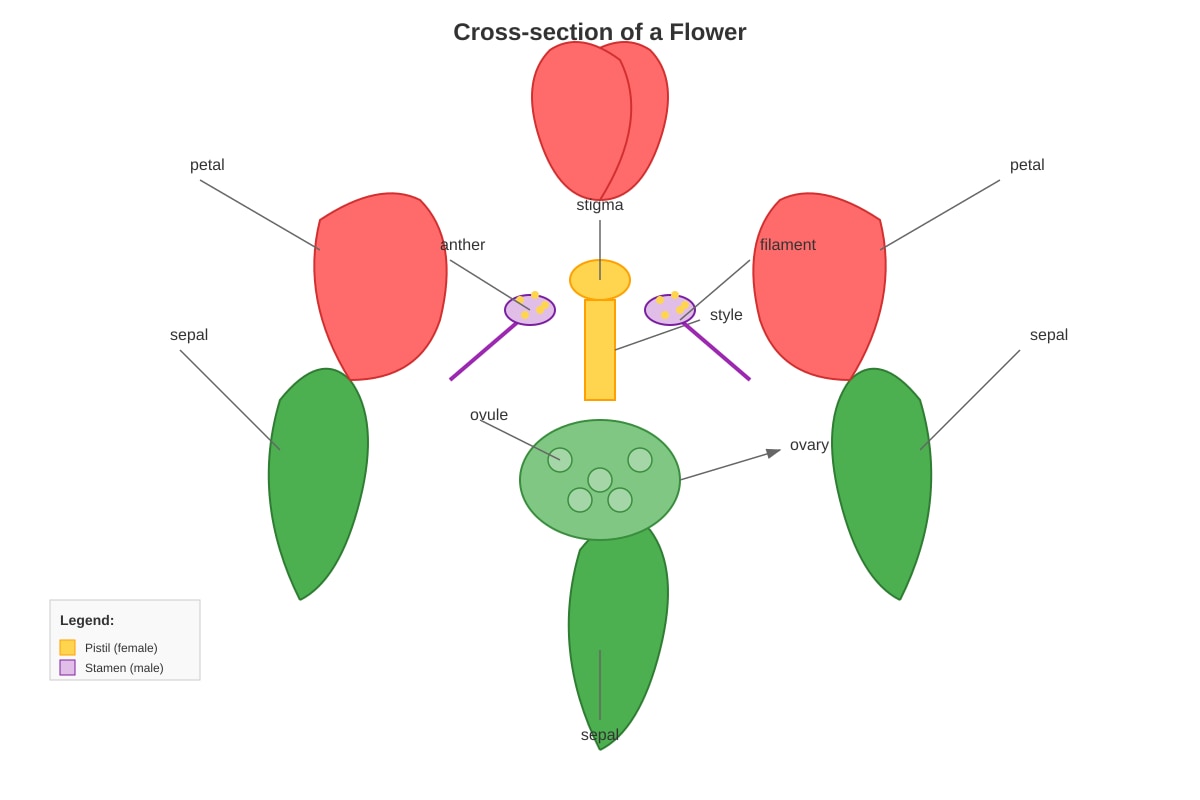
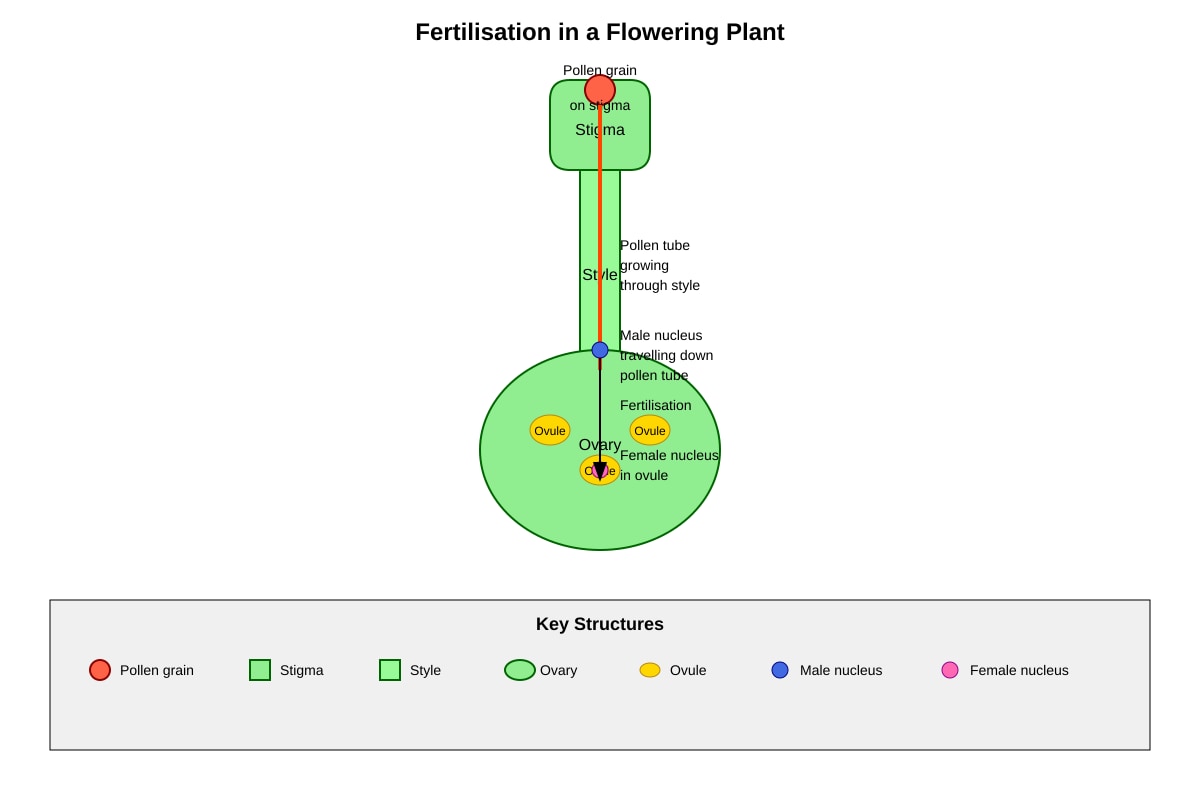
Explanation: After fertilisation, the ovary swells and develops into the fruit. The ovules inside the ovary develop into seeds. The flower's other parts (petals, sepals, stamens, stigma, style) wither and fall away.
Teaching note: Remember this sequence: Ovary → Fruit; Ovule → Seed. The ovary is like a protective container that becomes the fruit wall.
5. Answer: ( A )
Explanation: Mosquitoes undergo complete metamorphosis: Egg → Larva (wriggler, lives in water) → Pupa (tumbler, also in water) → Adult (flying insect). The larva and pupa are aquatic, while the adult is terrestrial/aerial.
Key distinction: Complete metamorphosis always has a pupa stage; incomplete metamorphosis does not.
6. Answer: ( B )
Explanation: Stem cuttings are a form of asexual reproduction (vegetative propagation). The new plant grows from a part of the parent plant and has identical genetic material (same DNA). This produces a clone — genetically identical to the parent. Seeds from sexual reproduction combine genetic material from two parents, so offspring vary.
Key concept: Asexual reproduction = no genetic variation = identical offspring.
7. Answer: ( A )
Explanation: Ferns reproduce by spores, not seeds. They do not produce flowers, fruits, or cones. Spores develop in tiny cases (sporangia) on the underside of fronds. Ferns can perform photosynthesis (they are green plants); they just don't use seeds for reproduction.
Common mistake: Option C says "spores found in cones" — that's gymnosperms (conifers), not ferns. Ferns have sporangia, not cones.
8. Answer: ( B )
Explanation: Grasshoppers have incomplete metamorphosis (hemimetabolism): egg → nymph → adult. The nymph looks like a small adult but lacks fully developed wings and cannot reproduce yet. It goes through multiple moults, gradually developing wings and growing larger until it reaches adult form.
Key difference from complete metamorphosis: No pupa stage; gradual change, not dramatic transformation.
9. Answer: ( C )
Explanation: Both reproductive strategies are evolutionarily successful because they suit different niches:
- Many small eggs, no care (Species X): Good in unstable environments or where adult survival is uncertain. High quantity compensates for low survival.
- Few large eggs, with care (Species Y): Good in stable environments where investing heavily in each offspring pays off. High quality over quantity.
Neither is "better" absolutely — success depends on environment, predation pressure, resource availability, and parental survival.
Key concept: Reproductive strategies represent evolutionary trade-offs, not simple superiority.
10. Answer: ( C )
Explanation: The pollen grain contains the male gametes (male sex cells). When pollen lands on a compatible stigma, it germinates and grows a pollen tube down to the ovule for fertilisation. The ovule (A) contains the female gamete; stigma (B) receives pollen; ovary (D) protects ovules and becomes fruit.
Teaching tip: Remember: Pollen = male; Ovule = female.
Section B: Short Answer (Questions 11–16, 2 marks each)
11. Two advantages of seed dispersal: (2 marks)
Marking scheme — any two of:
| Point | Explanation |
|---|---|
| Reduces overcrowding/competition (1 mark) | Seeds that land away from parent plant have more space, light, water, and nutrients, reducing competition with parent and siblings |
| Colonises new habitats (1 mark) | Allows species to spread to new areas, increasing range and survival chances if original habitat becomes unsuitable |
| Reduces predation/disease buildup (1 mark) | Concentrated seedlings attract predators; dispersal spreads risk |
Sample answer:
- Seeds dispersed away from the parent plant reduce competition for light, water, and nutrients (1 mark)
- This allows the species to colonise new areas and increases survival chances (1 mark)
12. (a) Fertilisation / pollination and fertilisation (1 mark)
Note: Accept "pollination followed by fertilisation" or just "fertilisation." Pollination alone is not sufficient — fertilisation (fusion of male and female nuclei) must occur for fruits and seeds to develop.
(b) Why seeds need dispersal away from parent plant: (1 mark)
Key point: To reduce competition for resources (light, water, nutrients, space) with the parent plant, which would reduce survival of seedlings.
Sample answer: If seeds fall directly under the parent, they would compete with the parent for sunlight, water, and minerals, and most would not survive to grow into healthy plants.
13. (a) Animal P (Frog) — lowest survival rate (1 mark)
Reason: It produces the largest number of offspring but provides no parental care. With many eggs and no protection, most offspring will be eaten by predators or die from environmental conditions. This is a high-quantity, low-investment strategy with inherently low survival rates.
Note: Must state both high number AND no parental care to explain low survival.
(b) One advantage and one disadvantage of Animal R's strategy: (1 mark)
| Advantage (0.5 mark) | High survival rate of offspring due to extensive parental care and protection; offspring more likely to reach reproductive age |
| Disadvantage (0.5 mark) | High energy cost to parent; fewer offspring produced per reproduction; if parent dies, offspring vulnerable; slow population recovery if numbers drop |
Note: Any one valid advantage and one valid disadvantage accepted. Must identify which is which.
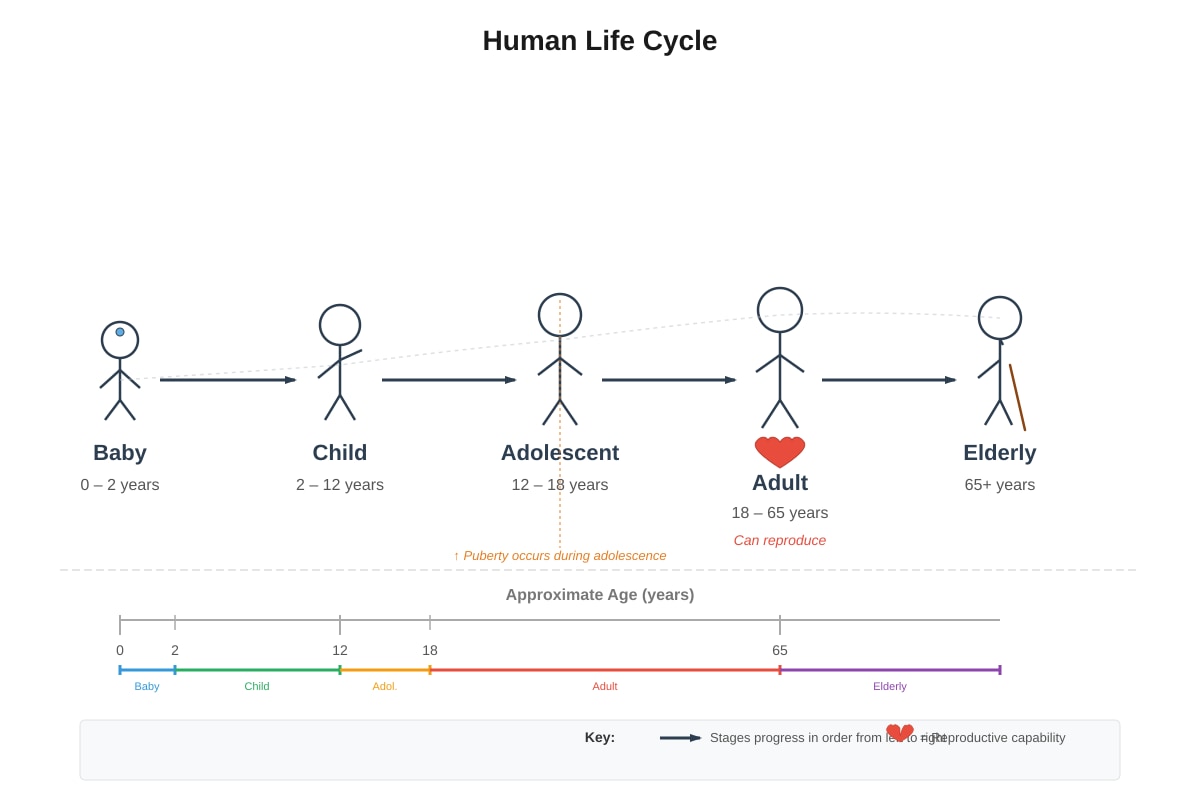
14. (a) Adolescent stage / teenage years / puberty (1 mark)
Accept: "Between child and adult" or approximate age range 12–18 years.
(b) Why reproduction is important for species continuation: (1 mark)
Key concept: Reproduction produces new individuals to replace aging/dead members, ensuring the species does not die out (extinction). It passes genetic information to the next generation.
Sample answer: Reproduction ensures that new individuals are produced to take the place of those that die, allowing the species to continue existing and preventing extinction.
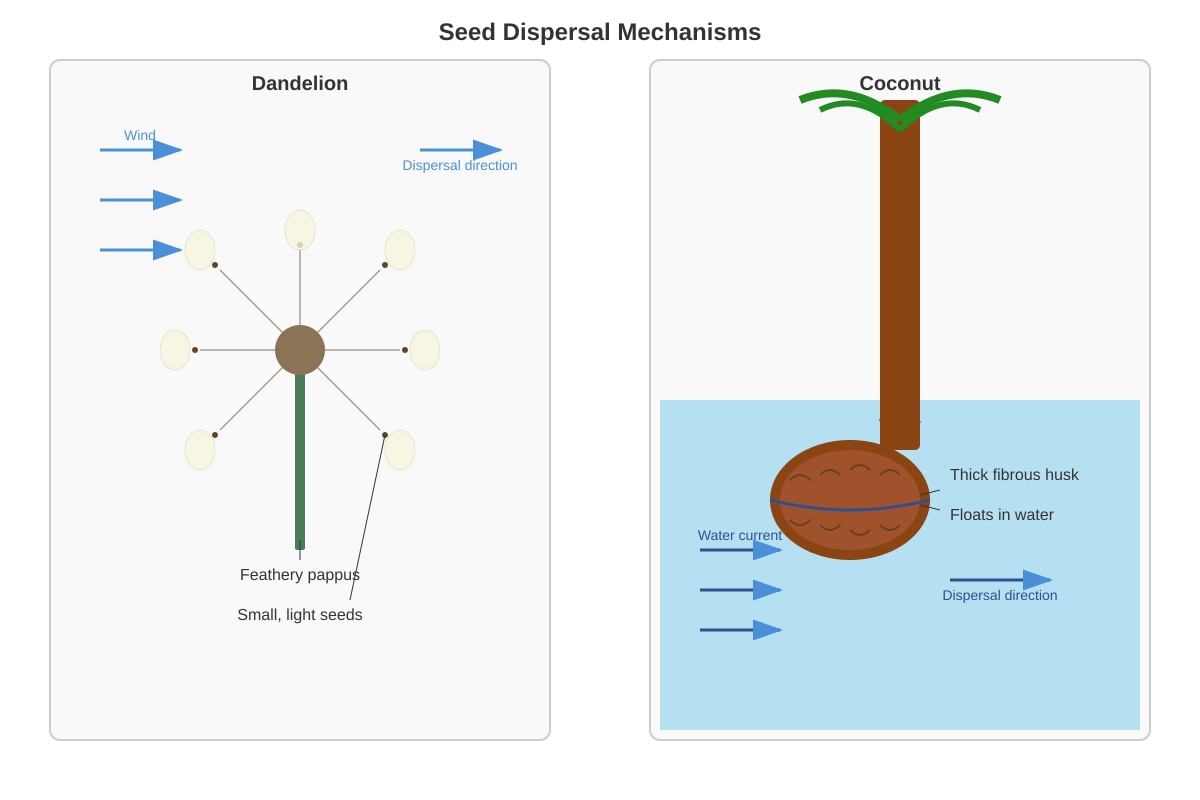
15. (a) Methods of seed dispersal: (1 mark — both correct for 1 mark, no half marks)
| Plant | Method of seed dispersal |
|---|---|
| Dandelion | By wind |
| Coconut | By water |
(b) Features suited to dispersal method: (1 mark — one for each plant)
| Plant | Feature | How it suits method |
|---|---|---|
| Dandelion (0.5 mark) | Light seeds with feathery pappus/parachute | Increases surface area, catches wind, allows seeds to float far from parent |
| Coconut (0.5 mark) | Fibrous husk and waterproof shell / air spaces in husk | Provides buoyancy in water, protects embryo from salt water damage, allows long-distance travel by ocean currents |
16. Fertilisation and development: (2 marks)
Step-by-step answer:
| Step | What happens |
|---|---|
| 1 | The male nucleus fuses with the female nucleus in the ovule (0.5 mark) |
| 2 | This forms a zygote (fertilised egg cell) (0.5 mark) |
| 3 | The zygote divides repeatedly by mitosis to form an embryo (0.5 mark) |
| 4 | The embryo develops inside the seed, with stored food and protective seed coat; this structure is the seed which can grow into a new plant (0.5 mark) |
Teaching note: After fertilisation: zygote → embryo → seed. The ovule becomes the seed; the ovary becomes the fruit.
Section C: Structured and Application Questions (Questions 17–20, 3 marks each)
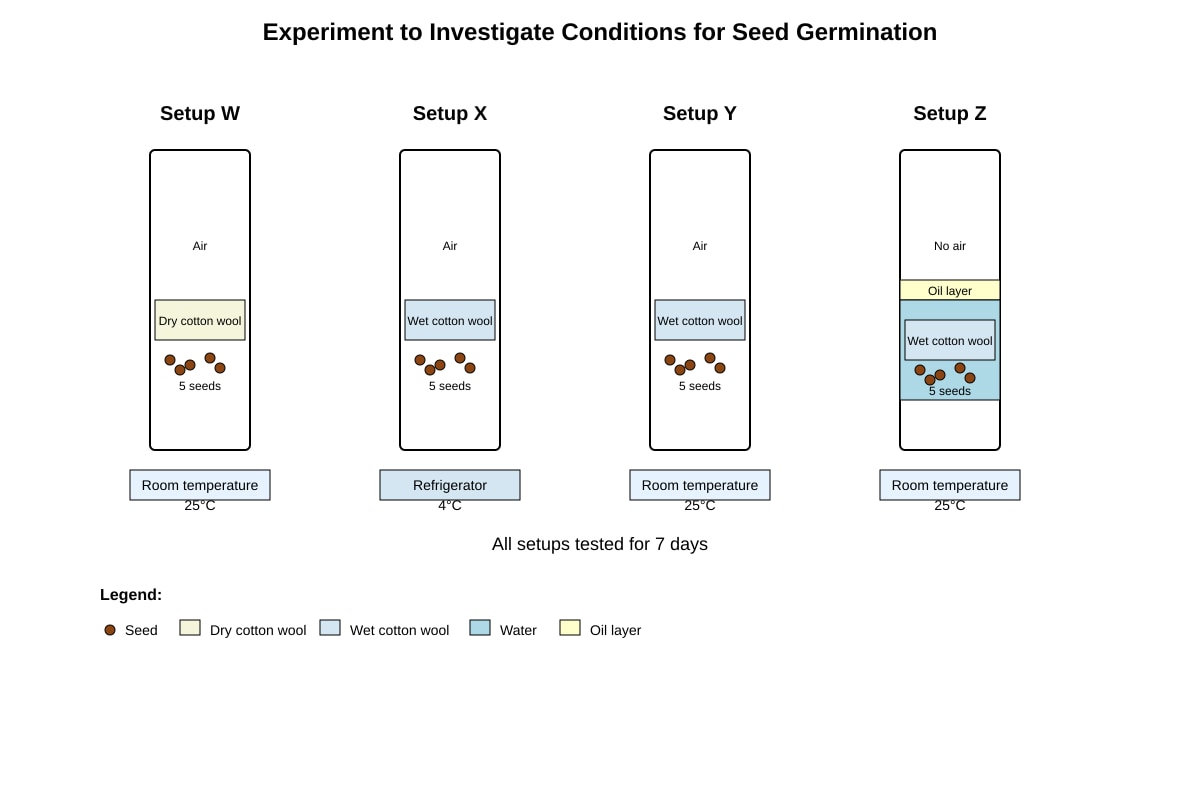
17. Seed germination experiment: (3 marks)
(a) Setup Y will show germination (1 mark)
Reason: Setup Y has all three necessary conditions for germination:
- Water — absorbed for metabolic processes and enzyme activation
- Air/oxygen — needed for aerobic respiration to release energy for growth
- Suitable temperature (room temperature, 25°C) — enzymes work best at moderate temperatures
(1 mark for correct identification, 1 mark for correct explanation of all three conditions)
Why others fail:
- W: No water — seeds remain dormant, metabolic reactions cannot start
- X: Too cold (4°C) — enzymes work too slowly, metabolic reactions halted
- Z: No oxygen — oil prevents air reaching seeds; seeds cannot respire aerobically to get energy
(b) Purpose of Setup W: (1 mark)
As a control. To show that seeds with air and suitable temperature but without water cannot germinate. This proves that water is necessary for germination by comparison with Setup Y.
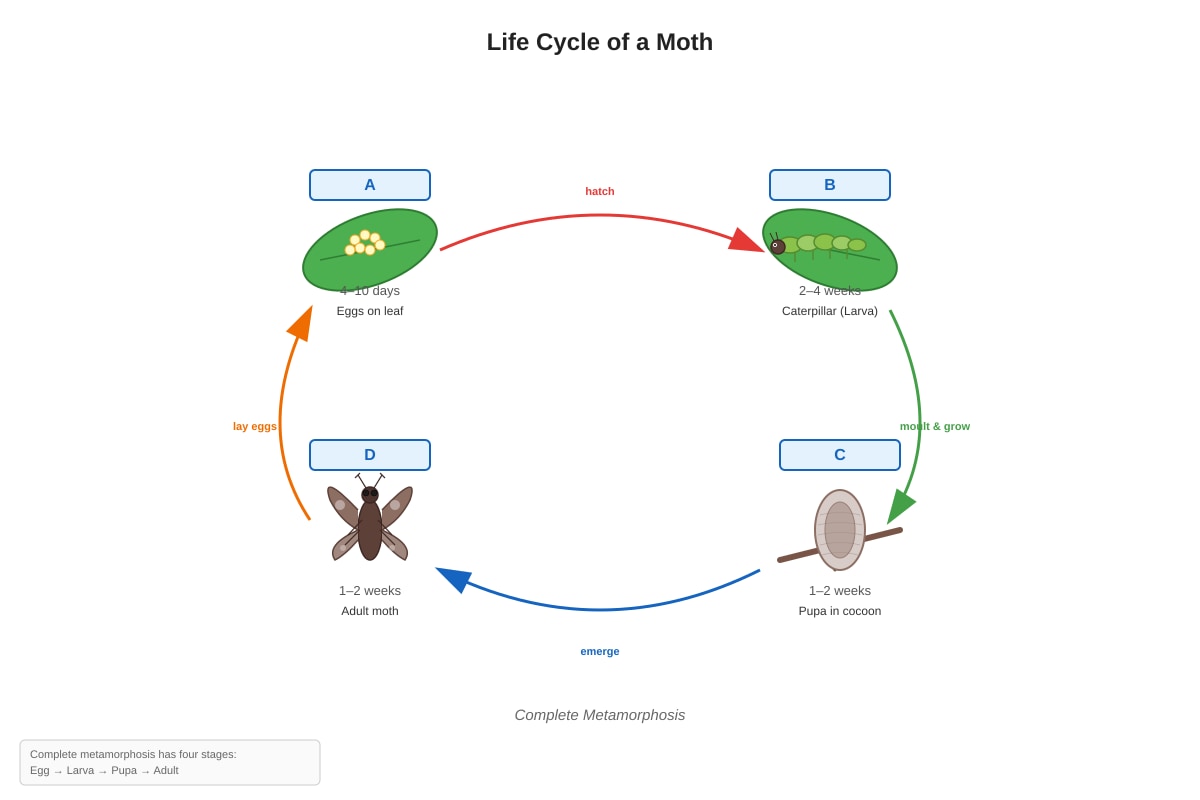
18. Moth life cycle: (3 marks)
(a) Correct order: A → B → C → D (Egg → Larva → Pupa → Adult) (1 mark)
Must be in correct sequence. Accept written description if letters unclear.
(b) Two differences from grasshopper life cycle: (2 marks)
| Difference | Moth | Grasshopper |
|---|---|---|
| 1. Type of metamorphosis (1 mark) | Complete metamorphosis (dramatic change, pupa stage) | Incomplete metamorphosis (gradual change, no pupa) |
| 2. Larval form (1 mark) | Larva (caterpillar) looks completely different from adult — different body shape, feeding habits, habitat | Nymph looks like small adult — similar body shape, same food, same habitat |
| 3. Number of stages (alternative) | Four distinct stages | Three stages (egg, nymph, adult) |
| 4. Resting stage (alternative) | Has a pupa/cocoon stage where major restructuring occurs | No resting/pupa stage; active growth throughout |
Any two valid differences accepted, 1 mark each.
19. Apple tree reproduction strategies: (3 marks)
(a) Why grafting produces more consistent fruit quality: (1 mark)
Grafting is asexual reproduction/vegetative propagation. The new tree has identical genetic material/DNA to the parent plant (it is a clone). Therefore, it will produce fruit with the same characteristics (size, colour, taste, ripening time) as the parent with desirable traits.
Keywords: identical genes/DNA, clone, same desirable characteristics.
(b) One disadvantage of grafting: (1 mark)
- Lack of genetic variation — all trees are genetically identical, so if a new disease or pest appears that can attack one tree, all trees are equally vulnerable (no resistance variation)
- OR: Expensive and requires skill — needs trained workers, specific timing, correct rootstock selection
- OR: Dependent on existing rootstock — may have limited root characteristics (disease susceptibility, soil preference)
(c) Why commercial farmers still prefer grafting: (1 mark)
- Guaranteed quality and market requirements — consumers expect consistent apple size, colour, taste; grafting ensures this predictability
- Faster fruit production — grafted trees bear fruit in 2–3 years; seed-grown trees take 5–8 years or more
- Proven disease resistance of rootstock — can combine good fruit genes (scion) with strong root genes (rootstock)
Any valid economic or agricultural reason accepted.
20. Forest ecosystem changes: (3 marks)
(a) Ecological succession (1 mark)
Accept: "succession" or "secondary succession" (since it started from grassland, not bare rock).
(b) Why animal types changed with plant changes: (1 mark)
Animals are dependent on plants for food and habitat/shelter. As plant types changed:
- Grasses → grasshoppers/butterflies (herbivores feeding on grasses, nectar)
- Shrubs → shrub-nesting birds (nesting sites, berries/seeds)
- Tall trees → squirrels (tree-dwelling, nuts) and birds of prey (hunting from high perches, prey availability increased)
Key concept: Different animals have specific adaptations suited to particular plant structures and food sources.
(c) Two effects of forest clearing: (1 mark for any two valid points)
| Effect | Explanation |
|---|---|
| Loss of habitat/shelter | Trees destroyed, animals lose nesting sites and protection from predators/weather |
| Loss of food sources | Fruit, nuts, leaves, nectar gone; herbivores starve or migrate, followed by carnivores |
| Increased extinction risk | Species specialised for mature forest cannot survive in open farmland |
| Soil erosion | No tree roots to hold soil; streams polluted → affects aquatic organisms |
| Climate change | Less transpiration, local temperature/humidity changes |
Marking: Any two valid effects with brief explanation = 1 mark (0.5 each). Must be specific to "organisms established in mature forest."
END OF ANSWER KEY