AI Generated Quiz
Primary 6 PSLE Science Heat Quiz
Free AI-Generated NVIDIA Nemotron 3 Ultra 550B A55B Free Primary 6 PSLE Science Heat quiz with questions and answers for Singapore students. This page is rendered as a direct URL so the questions and answers can be discovered without pressing in-page buttons.
These static practice materials are generated from the site's syllabus and paper-generation workflow, with source and model context shown so students and parents can evaluate the material before use.
Questions
Primary 6 PSLE Science Quiz - Heat
Name: ________________________
Class: Primary 6 ______
Date: ________________________
Score: ______ / 50
Duration: 45 minutes
Total Marks: 50
Instructions:
- Answer all questions.
- For Section A, choose the correct option and write its letter (A, B, C, or D) in the brackets provided.
- For Section B and C, write your answers in the spaces provided.
- The number of marks for each question is shown in brackets [ ].
- Show all working for calculation questions.
Section A: Multiple-Choice Questions (10 × 1 mark = 10 marks)
1. Which of the following statements about heat and temperature is correct? [1]
A. Heat and temperature are the same thing.
B. Heat is a form of energy; temperature is a measure of how hot or cold something is.
C. Temperature is measured in joules (J).
D. Heat flows from a colder object to a hotter object.
( )
2. A metal spoon feels colder than a wooden spoon at room temperature because: [1]
A. Metal has a lower temperature than wood.
B. Metal is a better conductor of heat than wood.
C. Wood is a better conductor of heat than metal.
D. Metal absorbs less heat from your hand.
( )
3. When a solid is heated, its particles: [1]
A. Move closer together and vibrate less.
B. Move further apart and vibrate more vigorously.
C. Stop moving completely.
D. Move closer together and vibrate more vigorously.
( )
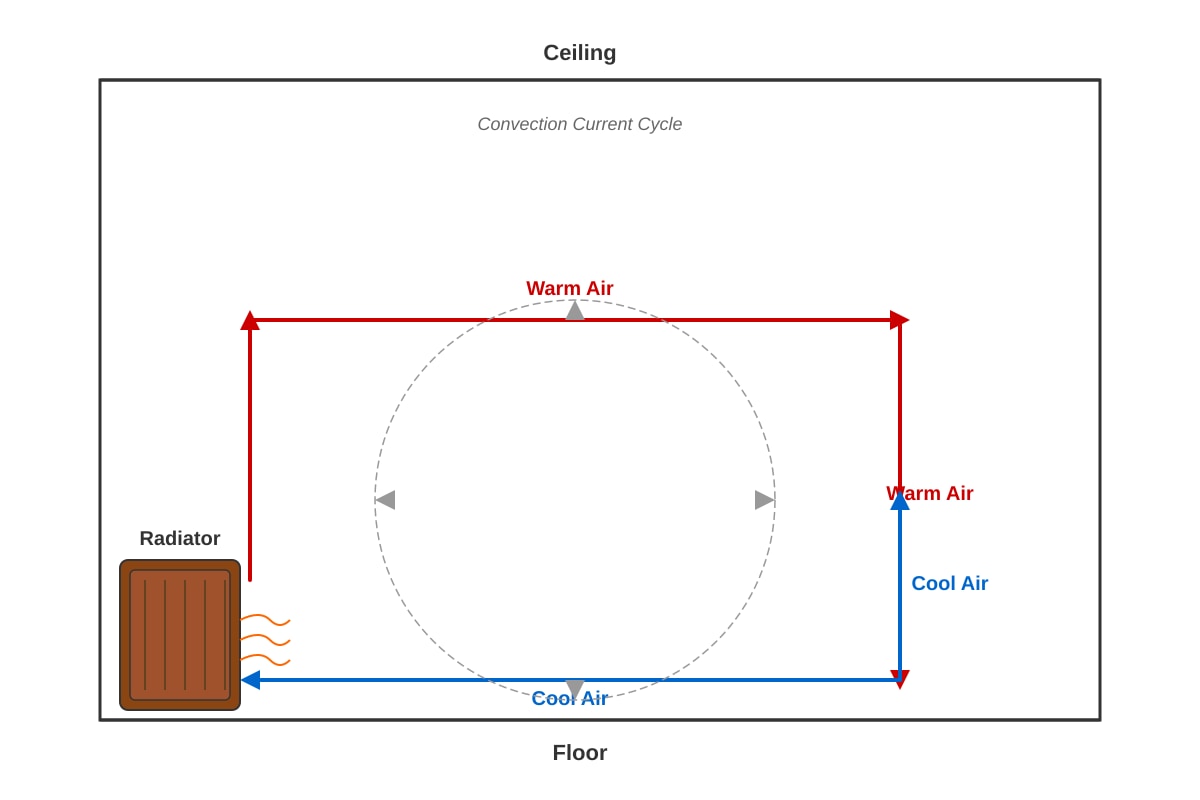
4. Which of the following is the best example of heat transfer by convection? [1]
A. A metal rod heated at one end becomes hot at the other end.
B. Warm air rising above a radiator.
C. Feeling warmth from the Sun on your face.
D. A pot handle getting hot when the pot is on the stove.
( )
5. A student places 100 g of water at 20°C in a beaker and heats it until it reaches 80°C. The specific heat capacity of water is 4.2 J/g°C. How much heat energy is gained by the water? [1]
A. 2520 J
B. 25 200 J
C. 33 600 J
D. 252 000 J
( )
6. Which of the following materials is the best insulator of heat? [1]
A. Copper
B. Aluminium
C. Air (trapped in foam)
D. Iron
( )
7. In a vacuum flask, the silvered walls reduce heat loss by: [1]
A. Conduction
B. Convection
C. Radiation
D. Evaporation
( )
8. When ice at 0°C melts to water at 0°C, the temperature remains constant because: [1]
A. No heat is absorbed.
B. Heat absorbed is used to overcome forces between particles, not increase kinetic energy.
C. Heat is lost to the surroundings.
D. The specific heat capacity of ice is zero.
( )
9. A bimetallic strip bends when heated because: [1]
A. Both metals expand at the same rate.
B. The two metals expand at different rates.
C. One metal contracts while the other expands.
D. The strip becomes magnetic.
( )
10. Which of the following applications uses the principle of expansion and contraction of solids? [1]
A. Thermos flask
B. Mercury thermometer
C. Riveting metal plates together
D. Solar water heater
( )
Section B: Structured Questions (8 × 3 marks = 24 marks)
11. The diagram below shows a saucepan with a metal body and a plastic handle.
<image_placeholder> id: Q11-fig1 type: diagram linked_question: Q11 description: Cross-section of a saucepan showing metal body, plastic handle, and labels for materials labels: Metal body (stainless steel), Plastic handle, Heat source (flame), Direction of heat flow arrows values: None must_show: Clear distinction between metal and plastic parts; heat source at bottom; arrows showing heat conduction through metal but not plastic </image_placeholder>
(a) Explain why the body of the saucepan is made of metal while the handle is made of plastic. [2]
(b) The metal body of the saucepan becomes hot quickly. Name the process of heat transfer through the metal body. [1]
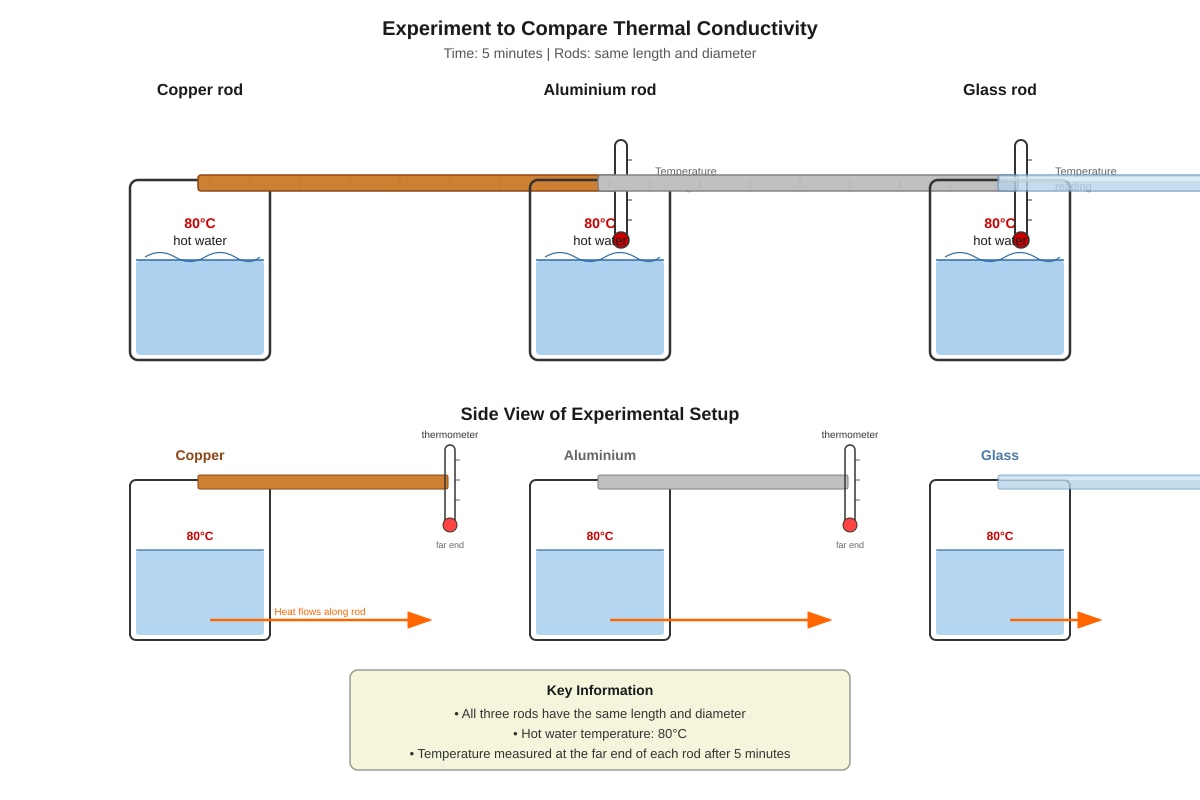
12. A student conducts an experiment to compare the thermal conductivity of four rods made of different materials (copper, aluminium, iron, and glass). Each rod has the same length and cross-sectional area. One end of each rod is placed in hot water at 80°C, and a thumbtack is attached to the other end using wax. The time taken for the thumbtack to fall off is recorded.
<image_placeholder> id: Q12-fig1 type: diagram linked_question: Q12 description: Experimental setup showing four rods in hot water with thumbtacks attached by wax labels: Copper rod, Aluminium rod, Iron rod, Glass rod, Hot water (80°C), Thumbtacks, Wax, Stopwatch values: None must_show: Four identical rods side by side; one end in hot water; thumbtacks at far end; wax melting concept </image_placeholder>
The results are shown below:
| Material | Time for thumbtack to fall (s) |
|---|---|
| Copper | 15 |
| Aluminium | 28 |
| Iron | 55 |
| Glass | Did not fall after 300 s |
(a) Which material is the best conductor of heat? Explain your answer using the results. [2]
(b) State one variable that must be kept constant to ensure a fair test. [1]
13. The diagram below shows a convection current in a beaker of water being heated from below. Potassium permanganate crystals are placed at the bottom to visualise the water movement.
<image_placeholder> id: Q13-fig1 type: diagram linked_question: Q13 description: Beaker of water with heat source at bottom, potassium permanganate crystals, and convection current arrows labels: Heat source (Bunsen burner), Potassium permanganate crystals, Convection current arrows (up in centre, down at sides), Water values: None must_show: Clear convection loop; crystals at bottom centre; upward flow in middle; downward flow at sides </image_placeholder>
(a) Explain why the water rises in the centre of the beaker. [2]
(b) Why does the water sink at the sides of the beaker? [1]
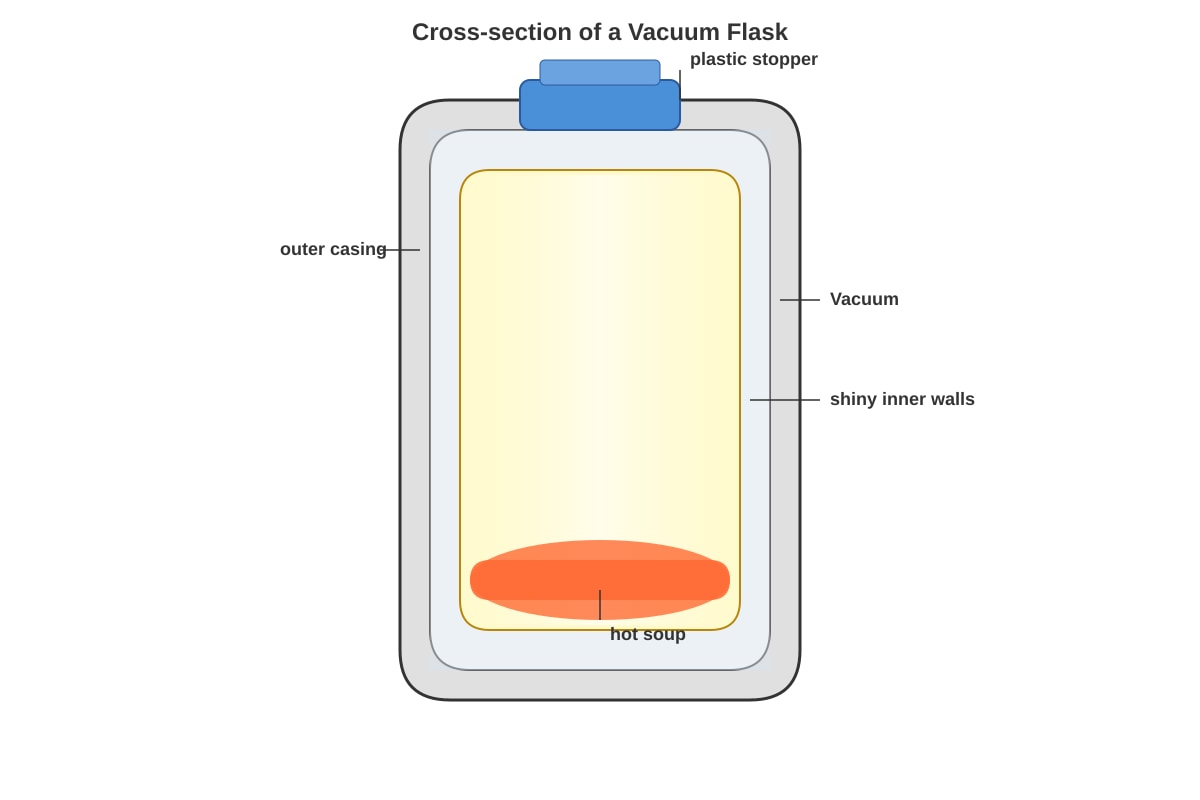
14. A vacuum flask is designed to keep hot liquids hot and cold liquids cold. The diagram shows a cross-section of a vacuum flask.
<image_placeholder> id: Q14-fig1 type: diagram linked_question: Q14 description: Cross-section of vacuum flask showing double wall, vacuum, silvered surfaces, stopper, and outer casing labels: Inner wall (silvered), Outer wall (silvered), Vacuum, Stopper (plastic/cork), Outer casing, Hot liquid inside values: None must_show: Double-walled structure; vacuum space; silvered surfaces facing vacuum; tight-fitting stopper </image_placeholder>
(a) Explain how the vacuum between the two walls reduces heat transfer. [2]
(b) Explain the purpose of the silvered walls. [1]
15. The graph below shows the heating curve of a pure substance as it is heated steadily from solid to gas.
<image_placeholder> id: Q15-fig1 type: graph linked_question: Q15 description: Heating curve graph with temperature on y-axis and time on x-axis showing plateaus at melting and boiling points labels: Temperature (°C), Time (min), Solid heating, Melting plateau, Liquid heating, Boiling plateau, Gas heating, Melting point, Boiling point values: Melting point = 50°C, Boiling point = 150°C must_show: Clear plateaus at 50°C and 150°C; sloping lines for heating phases; labelled axes </image_placeholder>
(a) What is the melting point of the substance? [1]
(b) During which stage(s) does the temperature remain constant? Explain why. [2]
16. A 200 g block of aluminium at 100°C is placed into 500 g of water at 25°C in an insulated container. The final temperature of the mixture is 30°C. The specific heat capacity of water is 4.2 J/g°C. Assume no heat loss to the surroundings.
(a) Calculate the heat energy gained by the water. [1]
(b) Calculate the specific heat capacity of aluminium. [2]
17. The diagram shows a bimetallic strip made of brass and iron at room temperature and when heated.
<image_placeholder> id: Q17-fig1 type: diagram linked_question: Q17 description: Bimetallic strip at room temperature (straight) and when heated (bent) labels: Brass layer, Iron layer, Room temperature (straight), Heated (bent towards iron side), Direction of bend values: None must_show: Two layers bonded together; straight at room temp; bent when heated with brass on outer curve </image_placeholder>
(a) When heated, the strip bends towards the iron side. Which metal expands more, brass or iron? [1]
(b) Explain how a bimetallic strip is used in a fire alarm. [2]
18. In hot countries, houses are often painted white and have shiny foil insulation in the roof space.
(a) Explain why painting the house white helps to keep it cooler. [2]
(b) Explain how the shiny foil insulation in the roof space reduces heat transfer into the house. [1]
Section C: Long-Answer Questions (2 × 8 marks = 16 marks)
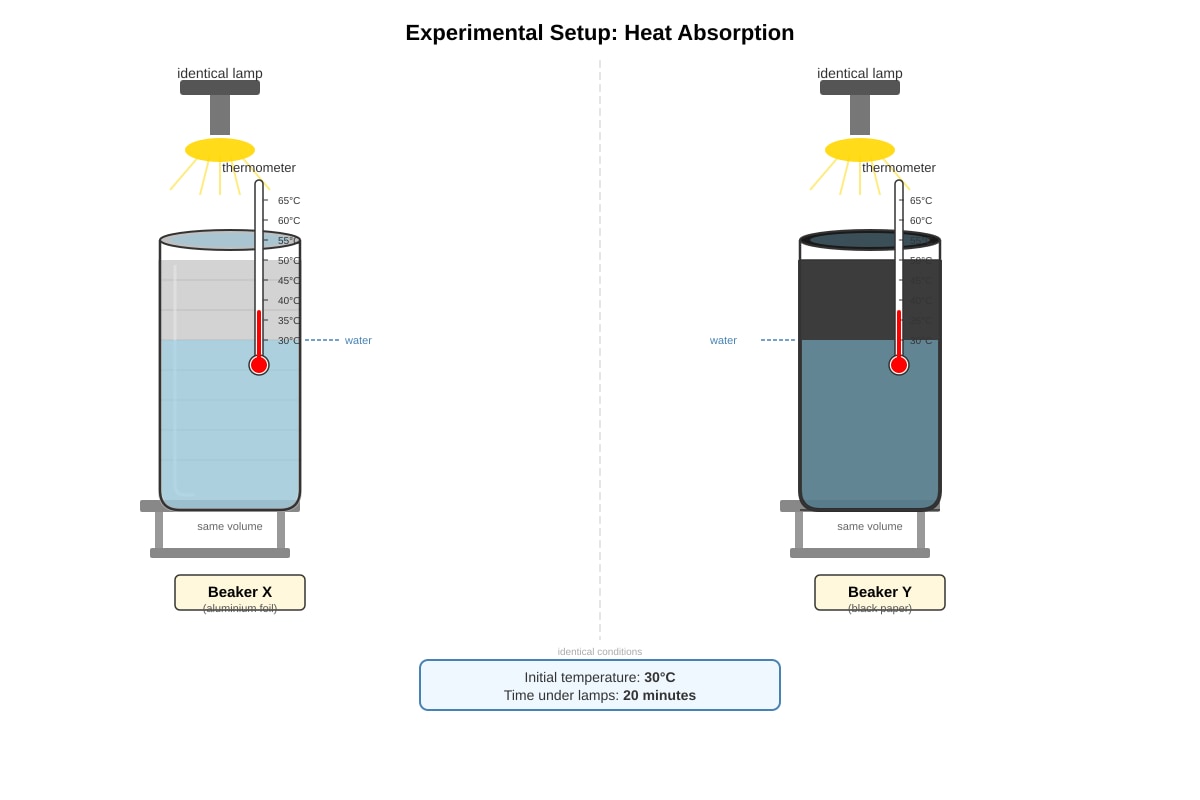
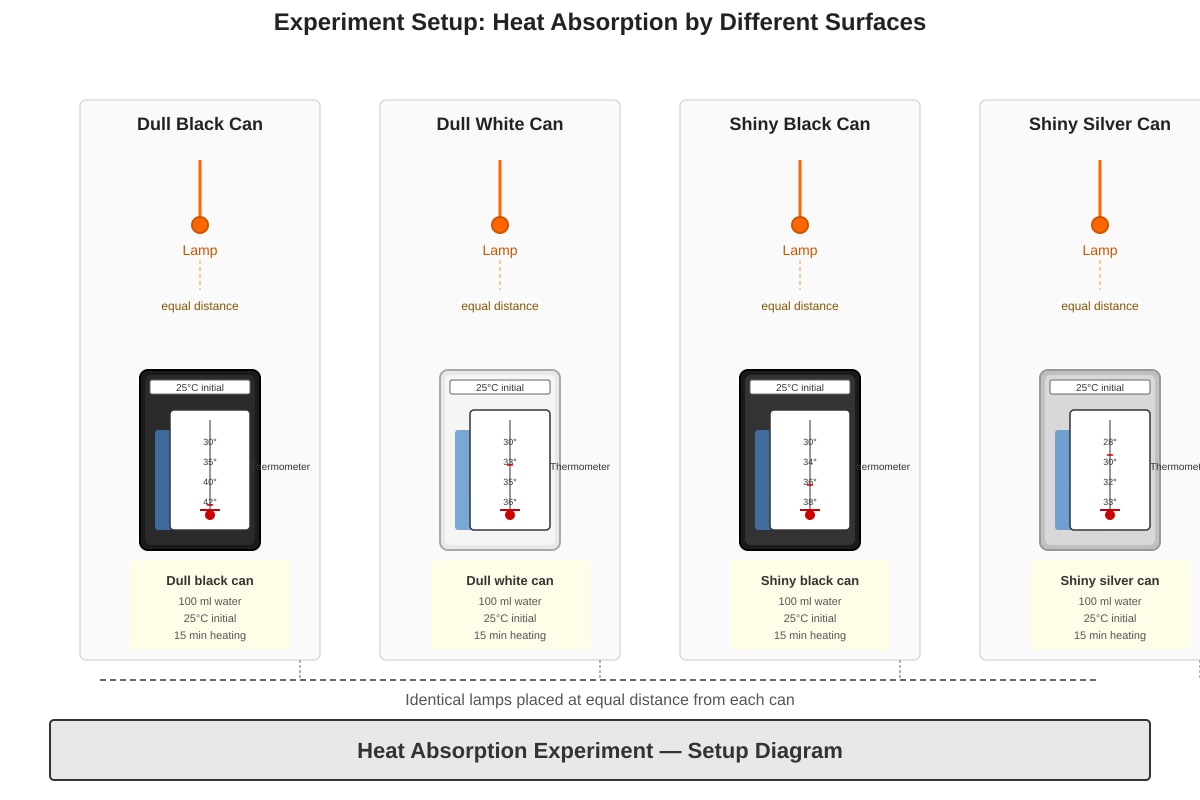
19. A student wants to investigate how the colour of a surface affects the amount of heat absorbed by radiation. She sets up the following experiment:
- Four identical metal cans are painted matt black, glossy black, matt white, and glossy white.
- Each can is filled with 100 mL of water at room temperature (28°C).
- The cans are placed at equal distances from an infrared heat lamp.
- The temperature of the water in each can is measured every 2 minutes for 10 minutes.
<image_placeholder> id: Q19-fig1 type: experimental_setup linked_question: Q19 description: Four painted cans under a heat lamp with thermometers labels: Heat lamp, Matt black can, Glossy black can, Matt white can, Glossy white can, Thermometers, Water (100 mL each), Equal distances marked values: Initial water temperature = 28°C, Time intervals = 2 min, Total time = 10 min must_show: Four cans side by side; heat lamp centred above; thermometers in each can; equal distance markings </image_placeholder>
(a) State the independent variable and the dependent variable in this experiment. [2]
Independent variable: ___________________________________________________________
Dependent variable: ___________________________________________________________
(b) State two variables that must be kept constant to ensure a fair test. [2]
(c) Predict the order of temperature rise from highest to lowest after 10 minutes. Explain your reasoning. [3]
(d) The student repeats the experiment but places the cans in a vacuum chamber. How would this affect the results? Explain. [1]
20. The diagram below shows a solar water heating system for a house.
<image_placeholder> id: Q20-fig1 type: diagram linked_question: Q20 description: Solar water heating system with collector panel, storage tank, pipes, pump, and house labels: Solar collector panel (black absorber plate, glass cover, insulation), Insulated storage tank, Cold water inlet, Hot water outlet to house, Circulation pump, Temperature sensor, Controller values: None must_show: Collector on roof; tank above collector (thermosiphon) or with pump; black absorber; glass cover; insulated pipes; cold in, hot out </image_placeholder>
(a) Explain why the absorber plate in the solar collector is painted black. [2]
(b) The glass cover over the absorber plate helps to keep the collector hot. Explain how it reduces heat loss. [2]
(c) Cold water enters the bottom of the collector and hot water leaves from the top to the storage tank. Explain why this arrangement is effective, using the concept of convection. [2]
(d) On a cloudy day, the water temperature in the storage tank only reaches 40°C. A household needs water at 55°C for showering. Suggest one way to ensure the water reaches the required temperature, and explain how it works. [2]
End of Quiz
Answers
Primary 6 PSLE Science Quiz - Heat (Answer Key)
Total Marks: 50
Section A: Multiple-Choice Questions (10 marks)
1. Answer: B [1]
Explanation: Heat is a form of energy (measured in joules) that transfers due to a temperature difference. Temperature is a measure of the average kinetic energy of particles, indicating how hot or cold an object is (measured in °C or K). They are different concepts.
2. Answer: B [1]
Explanation: Metal is a good conductor of heat. It conducts heat away from your hand quickly, making it feel colder. Wood is a poor conductor (insulator), so it does not draw heat from your hand as rapidly. Both are at the same room temperature.
3. Answer: B [1]
Explanation: When a solid is heated, its particles gain kinetic energy and vibrate more vigorously about their fixed positions. This increased vibration pushes particles slightly further apart, causing thermal expansion.
4. Answer: B [1]
Explanation: Convection is heat transfer through fluid (liquid/gas) movement. Warm air rising above a radiator is a classic convection current. Option A is conduction, C is radiation, D is conduction.
5. Answer: B [1]
Working:
Heat energy = mass × specific heat capacity × temperature change
= 100 g × 4.2 J/g°C × (80°C – 20°C)
= 100 × 4.2 × 60
= 25 200 J
6. Answer: C [1]
Explanation: Trapped air (in foam, fibreglass, etc.) is an excellent insulator because air is a poor conductor and convection is prevented in small trapped pockets. Metals (copper, aluminium, iron) are good conductors.
7. Answer: C [1]
Explanation: The vacuum prevents conduction and convection. The silvered walls reflect radiant heat (infrared radiation) back into the flask, reducing heat loss by radiation.
8. Answer: B [1]
Explanation: During melting, heat energy (latent heat of fusion) is absorbed to overcome the intermolecular forces holding particles in a fixed lattice arrangement. This energy increases potential energy, not kinetic energy, so temperature remains constant.
9. Answer: B [1]
Explanation: A bimetallic strip consists of two metals with different coefficients of thermal expansion bonded together. When heated, the metal that expands more (brass) becomes longer, causing the strip to bend towards the metal that expands less (iron).
10. Answer: C [1]
Explanation: Riveting uses thermal expansion/contraction: a hot rivet is placed through holes and cools, contracting to pull plates tightly together. Mercury thermometer uses liquid expansion. Thermos flask uses vacuum/silvering. Solar heater uses radiation absorption.
Section B: Structured Questions (24 marks)
11. (a) Answer: [2]
- Metal (stainless steel) is a good conductor of heat, allowing heat from the flame to transfer quickly and evenly to the food.
- Plastic is a poor conductor (insulator), so the handle stays cool enough to hold safely.
Marking: 1 mark for metal conducts heat well for cooking; 1 mark for plastic insulates/handle stays cool.
(b) Answer: Conduction [1]
Explanation: Heat transfers through the solid metal body by conduction (particle vibration and free electron movement).
12. (a) Answer: [2]
Copper is the best conductor. The thumbtack on the copper rod fell off in the shortest time (15 s), meaning heat travelled fastest through copper to melt the wax.
Marking: 1 mark for identifying copper; 1 mark for linking shortest time to fastest heat conduction.
(b) Answer: Length and cross-sectional area of rods / initial temperature of water / amount of wax / distance of thumbtack from water [1]
Explanation: Any one valid controlled variable. The question states "same length and cross-sectional area" so other variables like water temperature, wax amount, or thumbtack position are acceptable.
13. (a) Answer: [2]
Water at the bottom is heated, expands, becomes less dense, and rises due to buoyant force. The potassium permanganate colours the rising water, showing the upward flow in the centre.
Marking: 1 mark for heated water expands/becomes less dense; 1 mark for rises due to density difference/buoyancy.
(b) Answer: [1]
As hot water rises, cooler water from the sides moves down to replace it. This cooler water is denser, so it sinks, completing the convection current.
14. (a) Answer: [2]
The vacuum eliminates the medium (air) needed for conduction and convection. With no particles between the walls, heat cannot transfer by these two methods.
Marking: 1 mark for no medium for conduction; 1 mark for no medium for convection.
(b) Answer: [1]
The silvered surfaces reflect radiant heat (infrared radiation) back towards the liquid, reducing heat loss by radiation.
15. (a) Answer: 50°C [1]
Explanation: Read from the first plateau on the graph where temperature remains constant during melting.
(b) Answer: [2]
Temperature remains constant during melting (50°C) and boiling (150°C). During these phase changes, heat energy absorbed is used to overcome intermolecular forces (latent heat), increasing potential energy of particles, not their kinetic energy.
Marking: 1 mark for identifying both plateaus (melting and boiling); 1 mark for explaining latent heat overcomes forces, not increasing kinetic energy.
16. (a) Answer: [1]
Heat gained by water = m × c × Δθ
= 500 g × 4.2 J/g°C × (30°C – 25°C)
= 500 × 4.2 × 5
= 10 500 J
(b) Answer: [2]
Heat lost by aluminium = Heat gained by water = 10 500 J
m_Al × c_Al × Δθ_Al = 10 500
200 g × c_Al × (100°C – 30°C) = 10 500
200 × c_Al × 70 = 10 500
c_Al = 10 500 / (200 × 70)
c_Al = 10 500 / 14 000
c_Al = 0.75 J/g°C
Marking: 1 mark for correct heat lost = heat gained principle and substitution; 1 mark for correct final answer with unit.
17. (a) Answer: Brass [1]
Explanation: The strip bends towards the iron side, meaning the brass side becomes longer (expands more) and forms the outer curve.
(b) Answer: [2]
In a fire alarm, the bimetallic strip is part of an electrical circuit. When heated by fire, the strip bends (towards the less expansive metal) and makes/breaks contact, completing the circuit and triggering the alarm bell/siren.
Marking: 1 mark for strip bends when heated; 1 mark for completes/breaks circuit to trigger alarm.
18. (a) Answer: [2]
White surfaces are poor absorbers and good reflectors of radiant heat (infrared radiation) from the Sun. Less heat is absorbed by the walls/roof, keeping the interior cooler.
Marking: 1 mark for white reflects/poorly absorbs radiation; 1 mark for less heat absorbed → cooler interior.
(b) Answer: [1]
The shiny foil reflects radiant heat from the hot roof back upwards, reducing heat transfer by radiation into the house. (Also reduces emission from the foil surface.)
Section C: Long-Answer Questions (16 marks)
19. (a) Answer: [2]
Independent variable: Colour and finish of the can surface (matt black, glossy black, matt white, glossy white)
Dependent variable: Temperature rise of water / final temperature of water after 10 minutes
Marking: 1 mark each.
(b) Answer: [2]
- Volume/amount of water in each can (100 mL)
- Initial temperature of water (28°C)
- Distance from heat lamp
- Intensity/duration of heat lamp
- Size/material/shape of cans
(Any two valid)
Marking: 1 mark each.
(c) Answer: [3]
Order (highest to lowest temperature rise): Matt black > Glossy black > Matt white > Glossy white.
Reasoning:
- Black surfaces are better absorbers of radiation than white surfaces.
- Matt surfaces are better absorbers than glossy/shiny surfaces of the same colour.
- Therefore, matt black absorbs the most heat, glossy white absorbs the least.
Marking: 1 mark for correct order; 1 mark for black > white; 1 mark for matt > glossy.
(d) Answer: [1]
In a vacuum, there is no air, so convection and conduction from the can surfaces to the surroundings are eliminated. The cans would heat up faster and reach higher temperatures because heat loss to the surroundings is reduced.
Marking: 1 mark for reduced heat loss (no convection/conduction) → higher temperatures.
20. (a) Answer: [2]
Black surfaces are excellent absorbers of radiation. The black absorber plate absorbs maximum solar radiation (visible and infrared) and converts it to heat, which is then transferred to the water.
Marking: 1 mark for black is good absorber of radiation; 1 mark for absorbs max solar energy → heats water.
(b) Answer: [2]
The glass cover allows shortwave solar radiation to pass through (transparent to visible light) but traps longwave infrared radiation emitted by the hot absorber plate (greenhouse effect). It also reduces heat loss by convection (traps air) and conduction.
Marking: 1 mark for greenhouse effect / traps infrared; 1 mark for reduces convection/conduction losses.
(c) Answer: [2]
Cold water enters at the bottom, gets heated, becomes less dense, and rises by convection to the top where it exits to the tank. This creates a natural convection current (thermosiphon) that circulates water without needing a pump (or assists the pump). Hot water naturally rises, so collecting it at the top is efficient.
Marking: 1 mark for cold water sinks, hot water rises (convection); 1 mark for natural circulation / efficient collection at top.
(d) Answer: [2]
Install an electric backup heater (immersion heater) in the storage tank, controlled by a thermostat. When solar heating is insufficient (cloudy day), the thermostat activates the electric heater to raise the water to 55°C.
Alternative: Use a heat pump / gas booster / increase collector area.
Marking: 1 mark for valid supplementary heating method; 1 mark for explanation of how it ensures required temperature.
End of Answer Key