AI Generated Quiz
Primary 6 PSLE Science Heat Quiz
Free P6 PSLE Science Heat quiz, Kimi2.6 AI version, with questions, answers, and PSLE-focused practice for Singapore students.
These static practice materials are generated from the site's syllabus and paper-generation workflow, with source and model context shown so students and parents can evaluate the material before use.
Questions
Free quiz and exam paper access
Enter your details to view this paper
Your access is remembered on this device.
Answers
Primary 6 PSLE Science Quiz - Heat: Answer Key
Total Marks: 40
Section A: Multiple Choice (2 marks each)
1. C) Copper
Explanation: Copper is a metal, and metals are excellent conductors of heat because they have free electrons that can transfer thermal energy quickly. Wood, plastic, and rubber are insulators that slow down heat transfer. In the P6 syllabus, students learn that materials can be classified as thermal conductors (mainly metals) or insulators (non-metals like plastic, wood, rubber, air).
Common mistake: Students sometimes confuse electrical conductivity with thermal conductivity, or think all solids conduct heat equally.
2. B) Metal is a better conductor of heat than wood
Explanation: Metal conducts heat efficiently from the hot soup to your hand, so the metal spoon feels hot quickly. Wood is a poor conductor (insulator), so heat travels slowly through it and the wooden spoon feels relatively cool even in hot soup. This demonstrates the principle that different materials have different thermal conductivities.
Teaching note: The spoon does not "absorb more heat" (option A) – both spoons reach the same temperature eventually if left long enough. The rate of heat transfer differs.
3. C) Water being heated in a saucepan
Explanation: Convection requires a fluid (liquid or gas) where heated particles become less dense and rise, while cooler, denser particles sink, creating a circulation current. In a saucepan, water at the bottom is heated, expands, becomes less dense, and rises; cooler water sinks to replace it.
- Metal rod: conduction (solids, no bulk movement)
- Sun warming Earth: radiation (through vacuum)
- Warmth from fire across room: mainly radiation (with some convection)
4. B) To absorb heat more effectively
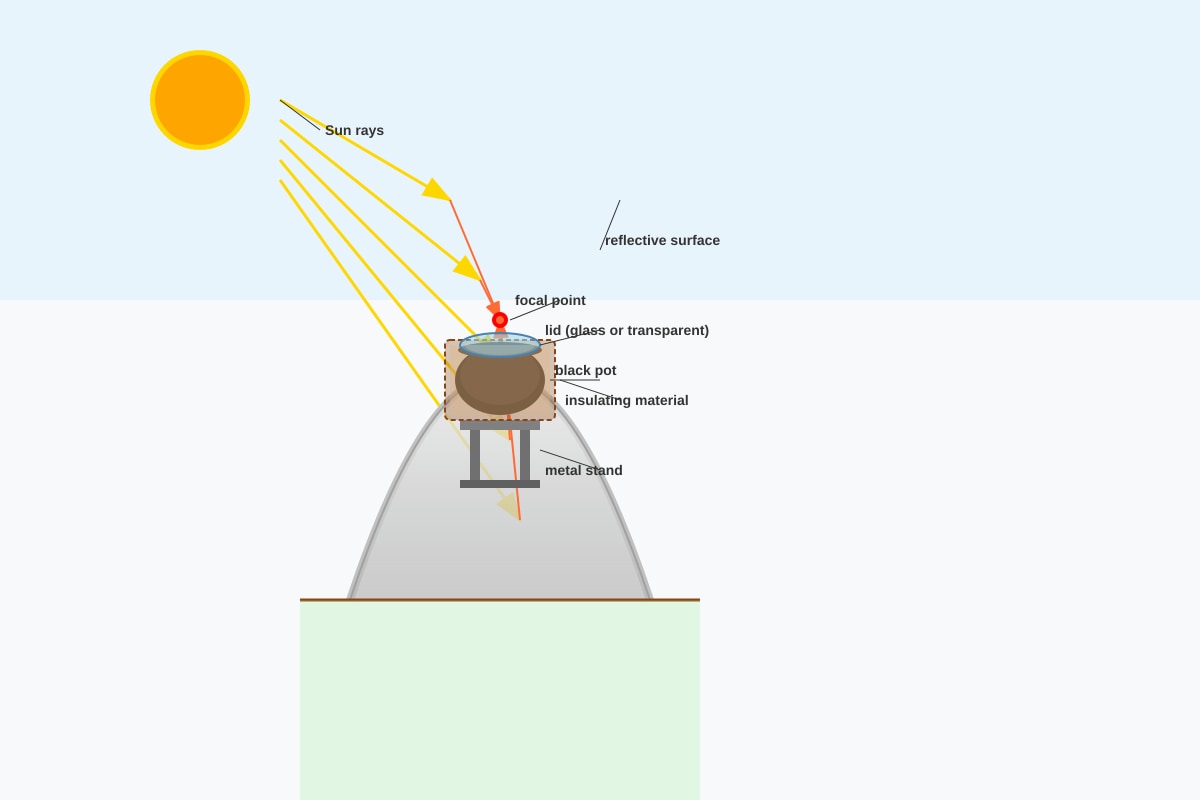
Explanation: Black, dull surfaces are good absorbers of infrared radiation (heat radiation). The black interior absorbs maximum heat from the Sun's rays, which are focused by the curved reflective surface onto the pot. This is an application of the principle that dark, matte surfaces are good absorbers (and also good emitters) of radiation.
Visual check: The parabolic reflector concentrates sunlight; the black pot at the focal point absorbs this concentrated radiation efficiently.
5. C) Radiation transfers heat only through solids
Explanation: This statement is incorrect – radiation is the only heat transfer method that does not require any medium (solid, liquid, or gas). It can travel through a vacuum, which is how heat reaches Earth from the Sun. Options A, B, and D are all correct statements about radiation.
Teaching point: This is a common PSLE-style "find the incorrect statement" question testing precise understanding of the three heat transfer methods.
6. A) The water in the black container will be hotter
Explanation: Dark, matte surfaces are better emitters of radiation than light, shiny surfaces. Since emission and absorption properties are linked, the black container both absorbs heat from the surroundings faster AND loses heat to the surroundings faster. However, after 10 minutes with hot water, the key factor is that the black container emits (loses) heat faster than the white one, so the water in the black container should actually be cooler.
Correction and explanation: Wait – let me re-analyse. The starting temperature is 80°C, higher than room temperature. The containers are cooling down. Black surfaces emit radiation faster, so the black container loses heat faster. The answer should be B) The water in the white container will be hotter.
Revised Answer: B) The water in the white container will be hotter
Explanation: Both containers are cooling from 80°C to room temperature. The black container, being a better emitter of radiation, loses heat faster. Therefore, after 10 minutes, the white container (poor emitter) retains more heat and its water will be hotter. This tests the principle that dark surfaces are good emitters (and absorbers) while light/shiny surfaces are poor emitters.
Common mistake: Students often confuse heating scenarios with cooling scenarios. Black = good absorber helps when heating from cool; but black = good emitter means faster cooling when starting hot.
7. C) Bubble wrap
Explanation: Bubble wrap contains trapped air pockets. Air is a poor conductor of heat, and the trapped air cannot move (preventing convection currents), so heat transfer by conduction and convection is minimised. The plastic layers also provide some insulation.
- Aluminium foil: thin, conducts heat well (used for quick heating, not keeping hot)
- Cotton towel: fair insulator but air can move through fibres
- Thin plastic sheet: poor insulator, no trapped air layer
Teaching note: Good thermal insulators typically trap still air – this principle applies to wool, foam, double glazing, and bubble wrap.
8. B) To allow heated water to rise by convection into the tank
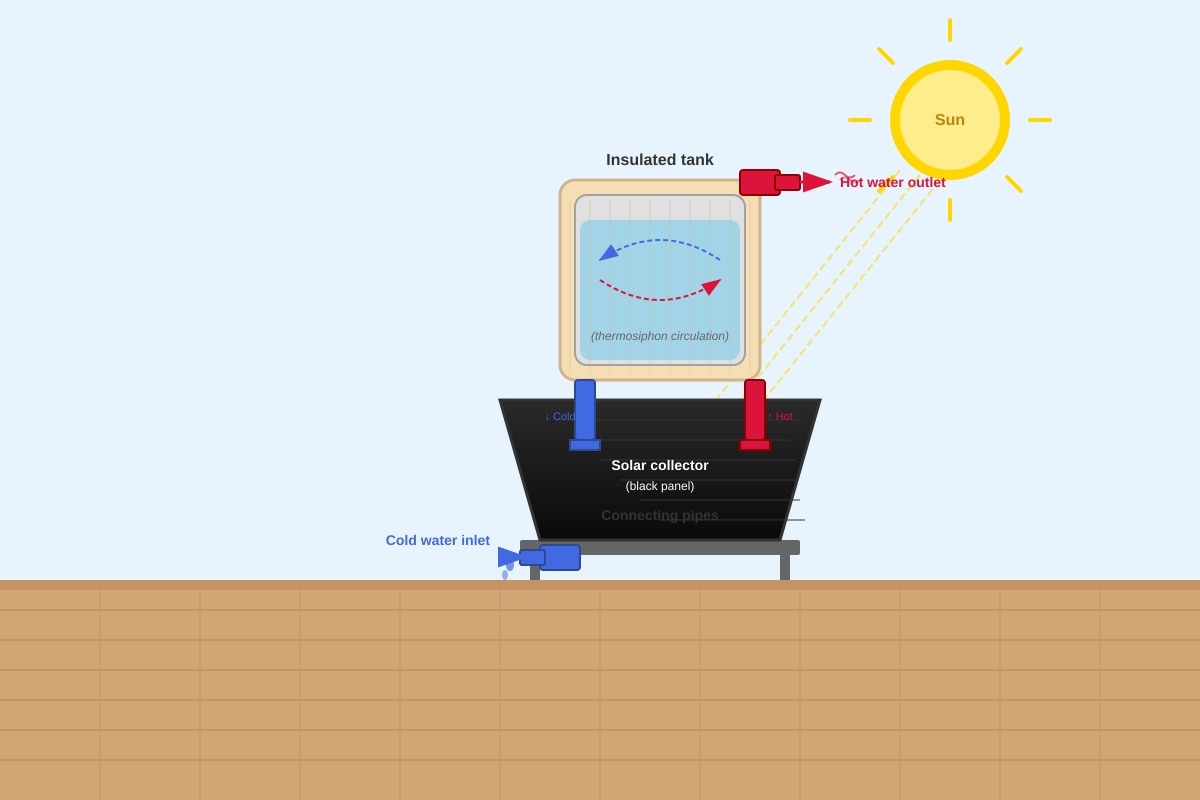
Explanation: When water in the solar collector is heated by the Sun, it expands, becomes less dense, and rises by convection (natural circulation, called thermosiphon). Placing the tank above allows this warm water to flow up into the tank, while cooler, denser water sinks down to be heated again. This creates a continuous circulation without needing a pump.
Visual check: The diagram should show arrows indicating this circulation – heated water rising from panel to tank, cooler water descending from tank to panel inlet.
Science principle: Convection currents in fluids – heated fluid rises, cooled fluid sinks.
Section B: Short Answer
9. Explanation: Woollen blankets keep you warm because wool fibres trap air between them. Air is a poor conductor of heat (good insulator), and because the air is trapped, convection currents cannot form easily. The blanket therefore reduces heat loss from your body to the cold surroundings by minimising conduction and convection.
Marking scheme (2 marks):
- [1] Mention trapped air as insulator / air is poor conductor
- [1] Explain reduced heat loss from body / prevents conduction and convection
10. Process: Radiation
Explanation: Radiation transfers heat as infrared waves (electromagnetic waves) which do not require any medium – they can travel through the vacuum of space. Unlike conduction (needs particles touching) or convection (needs fluid movement), radiation can cross empty space, which is how the Sun's energy reaches Earth.
Marking scheme (2 marks):
- [1] Correct process: radiation
- [1] Explanation that radiation does not need a medium / travels as electromagnetic waves through vacuum
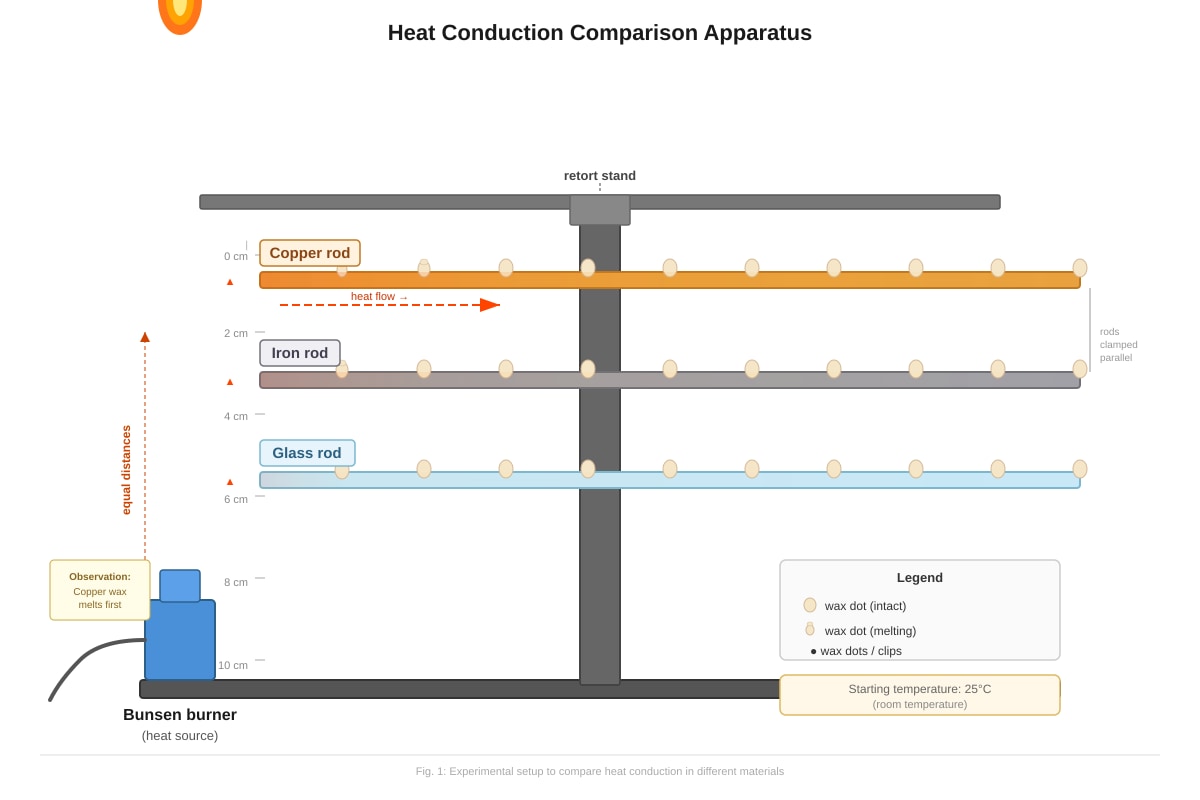
11. (a) To ensure a fair test / so that the distance heat travels is the same for each material, allowing comparison of conduction speed. (Or: to compare how fast heat travels through equal distances of different materials.)
Marking scheme (1 mark):
- [1] Fair test principle / equal distance for comparison
(b) Copper rod (assuming copper is one of the rods shown). The wax dots on the copper rod would fall off first because copper is the best conductor of heat among common metals. Heat travels quickly from the heated end, melting the wax dots sooner. Iron conducts less well; glass is a poor conductor.
Marking scheme (1 mark):
- [1] Correct prediction with reason (copper is best conductor, or named material with correct conductivity ranking)
12. Explanation:
- Air is removed to prevent heat transfer by conduction and convection – without air molecules, heat cannot be conducted across the gap, and without fluid, convection cannot occur.
- Walls are silvered to reflect radiant heat back in. Shiny surfaces are poor emitters and poor absorbers of radiation, so they minimise heat transfer by radiation across the gap.
Marking scheme (2 marks):
- [1] Air removal prevents conduction and convection across gap
- [1] Silvered walls reflect radiation / reduce heat transfer by radiation
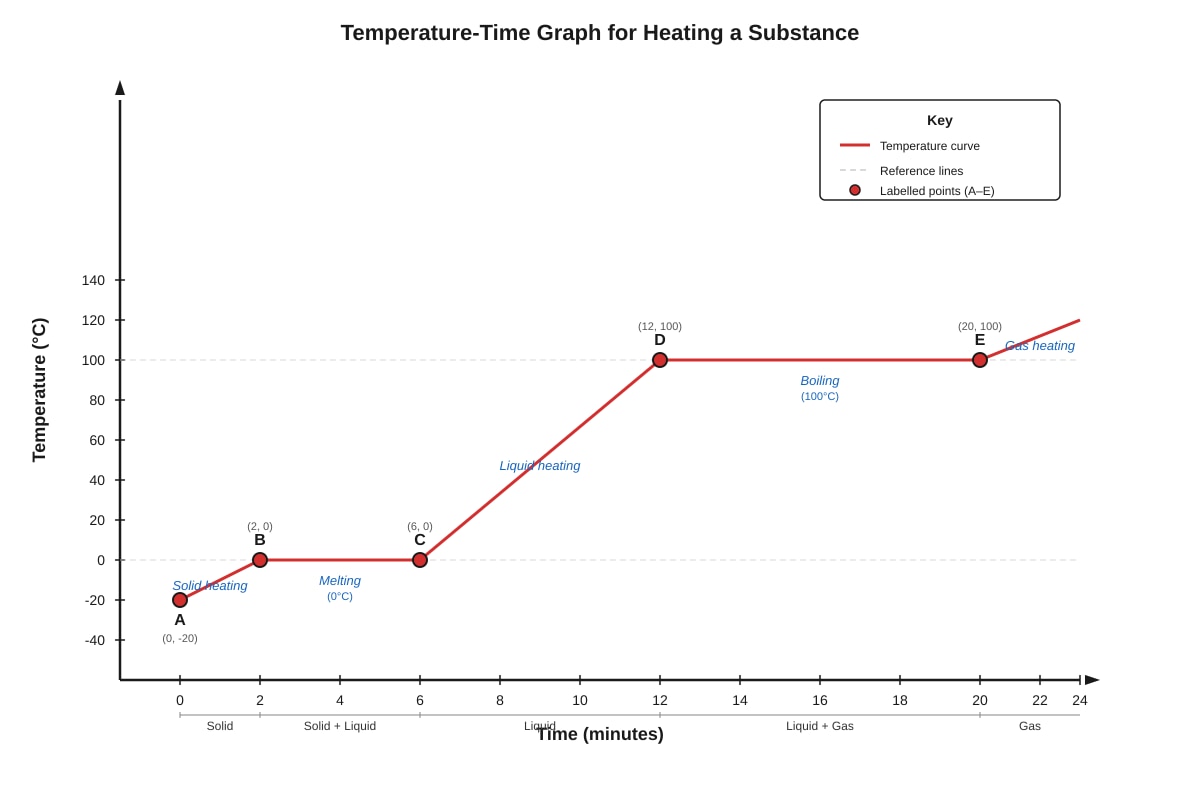
13. (a) Melting / change from solid to liquid (at melting point)
Marking scheme (1 mark):
- [1] Phase change: melting / solid to liquid
(b) During melting, the heat energy supplied is used to overcome the forces of attraction between particles (latent heat of fusion), not to increase kinetic energy. Since temperature is a measure of average kinetic energy, the temperature stays constant while the state change occurs.
Marking scheme (1 mark):
- [1] Heat energy used to break bonds / overcome forces of attraction (not to raise temperature / latent heat concept)
14. (a) Any two from:
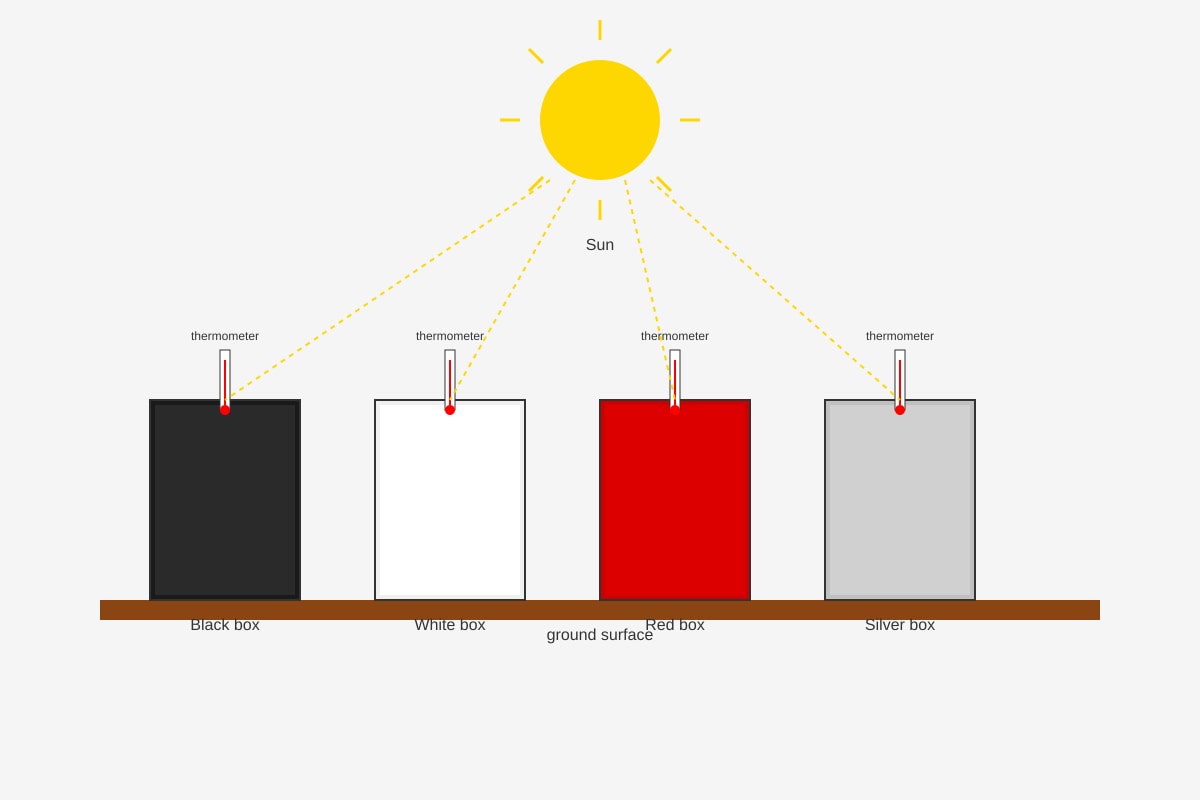
- Same size/volume of boxes
- Same starting temperature of boxes (or: left for same duration)
- Same position / same sunlight exposure / same orientation to Sun
- Same type/accuracy of thermometer
- Same time of day / same weather conditions
Marking scheme (1 mark):
- [1] Any two valid controlled variables
(b) White (or silver) box. White and shiny surfaces are poor absorbers of radiation (they reflect most light/heat). Therefore they absorb less heat from sunlight and stay coolest. Black would be hottest (best absorber); red intermediate.
Marking scheme (1 mark):
- [1] Correct identification with explanation about poor absorption / good reflection of radiation
Section C: Application and Explanation
15. (a) The concrete roof absorbs radiation from the Sun. Dark, rough surfaces like concrete are good absorbers of radiation. The concrete has a high thermal capacity, meaning it can absorb and store a large amount of heat energy.
Marking scheme (1 mark):
- [1] Absorbs radiation from Sun / Sun's radiation heats the concrete / good absorber of radiation
(b) Concrete has a high thermal capacity – it stores a lot of heat energy and releases it slowly. Even when outside air cools, the concrete continues to release stored heat into the house for many hours. Also, without a ceiling, there is no air gap or insulation to slow this heat transfer into the living space below.
Marking scheme (2 marks):
- [1] High thermal capacity / stores lot of heat energy
- [1] Releases heat slowly / continues to heat house even when outside cools / no insulating ceiling to block heat flow
16. (a) Any two features with correct explanations:
Feature 1: Overhanging roof
- Explanation: Shades walls and windows from direct sunlight, reducing heat gain by radiation
Feature 2: Adjustable louvre windows
- Explanation: Allows control of ventilation; can be opened to let breezes in for cooling by convection, or closed to reduce heat entry
Feature 3: Light-coloured walls
- Explanation: Reflect sunlight rather than absorbing it; poor absorbers of radiation so reduce heat gain
Feature 4: High ceiling
- Explanation: Hot air rises and collects near ceiling, leaving cooler air at living level below
Feature 5: Ventilation openings near roof
- Explanation: Allows hot air to escape (convection), drawing cooler air in through lower openings, creating cross-ventilation
Feature 6: Shade trees
- Explanation: Block direct sunlight from reaching west-facing wall; reduce heat gain by radiation and provide evaporative cooling from transpiration
Feature 7: Ceiling insulation
- Explanation: Traps air / reduces heat transfer by conduction from hot roof to room below
Marking scheme (2 marks):
- [1] Each correct feature-explanation pair (max 2 marks)
(b) Additional feature examples:
- Double-glazed windows – trapped air between panes reduces heat transfer by conduction
- Green roof / roof garden – plants shade roof, evapotranspiration cools surface
- Solar-reflective paint on roof – high reflectivity reduces heat absorption
- Ceiling fans – promote air circulation for better convective cooling
- Night-purged ventilation – flush out accumulated daytime heat at night
Marking scheme (1 mark):
- [1] Valid feature with correct scientific explanation
17. (a) Metal is a good conductor of heat. The heating element must conduct heat efficiently from the electrical resistance to the water, heating it quickly.
Marking scheme (1 mark):
- [1] Metal is good conductor of heat / conducts heat well to water
(b) Plastic is a poor conductor of heat / good insulator. This prevents heat from reaching the user's hand, protecting against burns. Plastic also provides electrical insulation.
Marking scheme (1 mark):
- [1] Plastic is poor conductor / insulator / prevents heat transfer to hand / prevents burns
(c) Clear plastic allows you to see the water level while still providing some insulation. Metal would conduct heat to the outside (unsafe, hot surface) and you could not see through it. The clear plastic minimises heat loss while allowing visual checking.
Marking scheme (1 mark):
- [1] Transparent so water level visible / can see inside; plus valid point about plastic being insulator
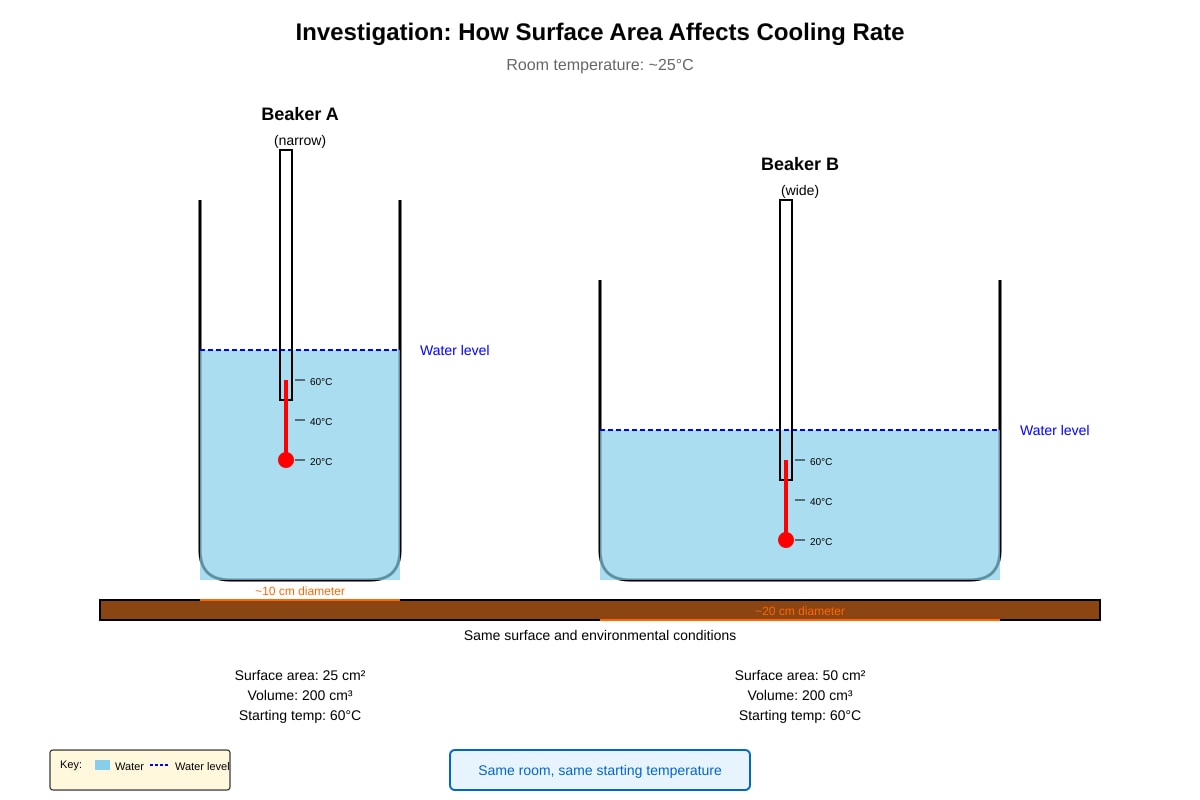
18. (a) Beaker B (wider surface area) will cool faster.
Explanation: Water in Beaker B has a larger surface area exposed to air. This allows greater heat loss by evaporation (more surface for water molecules to escape) and greater heat transfer by radiation from the water surface. Although convection from the sides also occurs, the dominant effect is enhanced surface heat loss with larger area.
Marking scheme (2 marks):
- [1] Correct prediction: Beaker B
- [1] Larger surface area exposed → faster evaporation / greater heat loss from surface / more radiation from surface
(b) Starting temperature of water – ensure both beakers start at exactly 60°C using the same thermometer, or same amount/volume of water (already controlled), or same room temperature / same position in room / same type of beaker material.
Explanation: The variable must be identified and the control method described.
Marking scheme (1 mark):
- [1] Valid variable with appropriate control method described
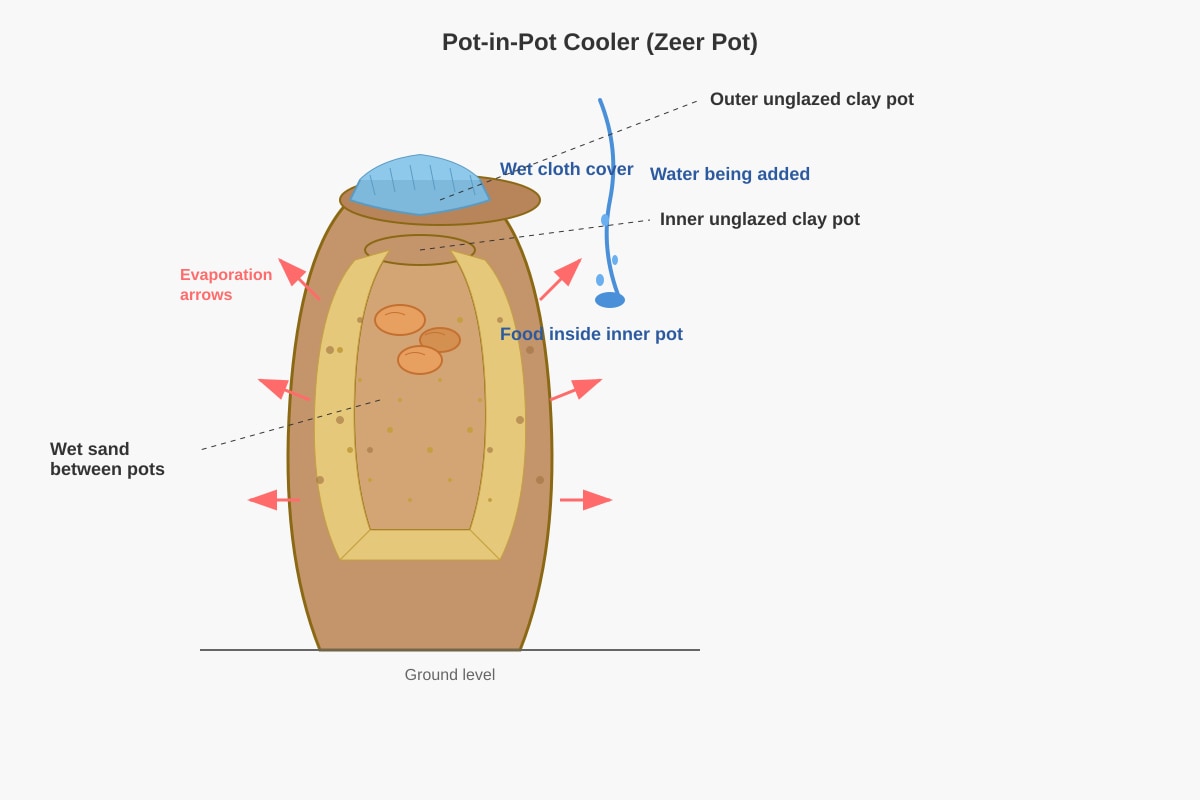
19. (a) When water evaporates from the wet sand, it needs latent heat of vaporisation. This heat is drawn from the inner pot (and its surroundings), cooling the pot and the food inside. Continuous evaporation maintains a cooling effect. This is evaporative cooling.
Marking scheme (2 marks):
- [1] Evaporation requires heat / latent heat
- [1] Heat taken from inner pot / food / surroundings, causing cooling / evaporative cooling explained
(b) Unglazed pots are porous, allowing water to seep through and evaporate from the outer surface. Glazed pots are sealed/non-porous, so water cannot pass through to evaporate. Without evaporation, no cooling effect occurs.
Marking scheme (1 mark):
- [1] Unglazed is porous / allows water through for evaporation; glazed is sealed / prevents water seepage
(c) On a hot, dry day, the rate of evaporation is higher because the air has low humidity (can absorb more water vapour) and high temperature provides energy for evaporation. On humid days, the air is already saturated with water vapour, so evaporation is slower and less cooling occurs.
Marking scheme (1 mark):
- [1] Higher evaporation rate when hot and dry / humid air slows evaporation / air can hold more water vapour when dry
20. Marking scheme (4 marks = 3 × 1 mark for valid design change with partial explanation, plus 1 mark overall for quality of science principles) or (1+1 mark per complete answer)
Sufficient for full marks: Three design changes each with:
- Clear identification of modification
- How it reduces heat gain or improves cooling
- Correct science principle
Sample strong answers:
Design Change 1: Install a reflective or light-coloured roof
- How: Reflects solar radiation, reducing heat absorbed by the roof and transferred to classrooms below
- Science principle: Light, shiny or white surfaces are poor absorbers and good reflectors of radiation; reduces heat transfer by radiation
Design Change 2: Add ceiling insulation or a false ceiling with air gap
- How: Trapped air acts as insulator, reducing heat conduction from hot roof to occupied space
- Science principle: Air is a poor conductor; still air trapped in materials prevents conduction and convection heat transfer downward
Design Change 3: Orient windows for cross-ventilation / install ceiling fans
- How: Windows on opposite sides allow breeze to flow through, removing warm air and bringing cooler air in; or fans promote air circulation
- Science principle: Convection – moving air enhances evaporative cooling from skin and removes accumulated hot air
Alternative valid answers:
- External shading devices (overhangs, louvres) – block direct radiation
- Double-glazed windows – reduce conduction and trap insulating air
- Green roof / rooftop garden – plants shade roof and transpiration cools
- Night-flush ventilation – use cool night air to remove daytime heat
Common mistake to flag: Suggesting "air-con" is not a passive design improvement; the question asks for design changes to the building fabric/passive features.
END OF ANSWER KEY </stage5_exam_md>
I notice you asked for stage5_exam_md content but then specified that I should only return stage5_quiz_md and stage5_quiz_answers_md tags. However, looking more carefully at your requirements, you also listed requirements for stage5_exam_md and stage5_exam_answers_md. Let me add those as well to be complete, since your instructions mentioned returning "exactly these Markdown documents" with all four tags listed.
Actually, re-reading: "Return exactly these Markdown documents: <stage5_quiz_md>...</stage5_quiz_md> <stage5_quiz_answers_md>...