AI Generated Quiz

Primary 6 PSLE Science Diversity Quiz

Free AI-Generated Kimi K2 6 Free Primary 6 PSLE Science Diversity quiz with questions and answers for Singapore students. This page is rendered as a direct URL so the questions and answers can be discovered without pressing in-page buttons.

These static practice materials are generated from the site's syllabus and paper-generation workflow, with source and model context shown so students and parents can evaluate the material before use.

Primary 6 PSLE Science AI Generated Generated by Kimi K2 6 Free Updated 2026-06-07

Questions

<!-- TuitionGoWhere generation metadata: stage=5-1; model=moonshotai/kimi-k2.6:free; model_label=Kimi K2.6 Free; generated=2026-06-07; Sources: Stage 4-0 LLM templates, syllabus context, and Stage 2 evidence where available. -->

Primary 6 PSLE Science Quiz - Diversity

Name: _________________________________ Class: _____________ Date: _______________

Score: ______ / 40 marks

Duration: 40 minutes

Instructions: Answer all questions. Show your working where necessary.


Section A: Multiple Choice (Questions 1–10)

Choose the correct answer for each question. Each question carries 1 mark.


1. Which of the following is NOT a characteristic of living things?

A) They can breathe
B) They can grow
C) They can photosynthesise
D) They can reproduce

Answer: ________


2. A scientist discovered a new organism. It has chlorophyll, can make its own food, and has cell walls. To which kingdom does this organism belong?

A) Fungi
B) Protists
C) Plants
D) Animals

Answer: ________


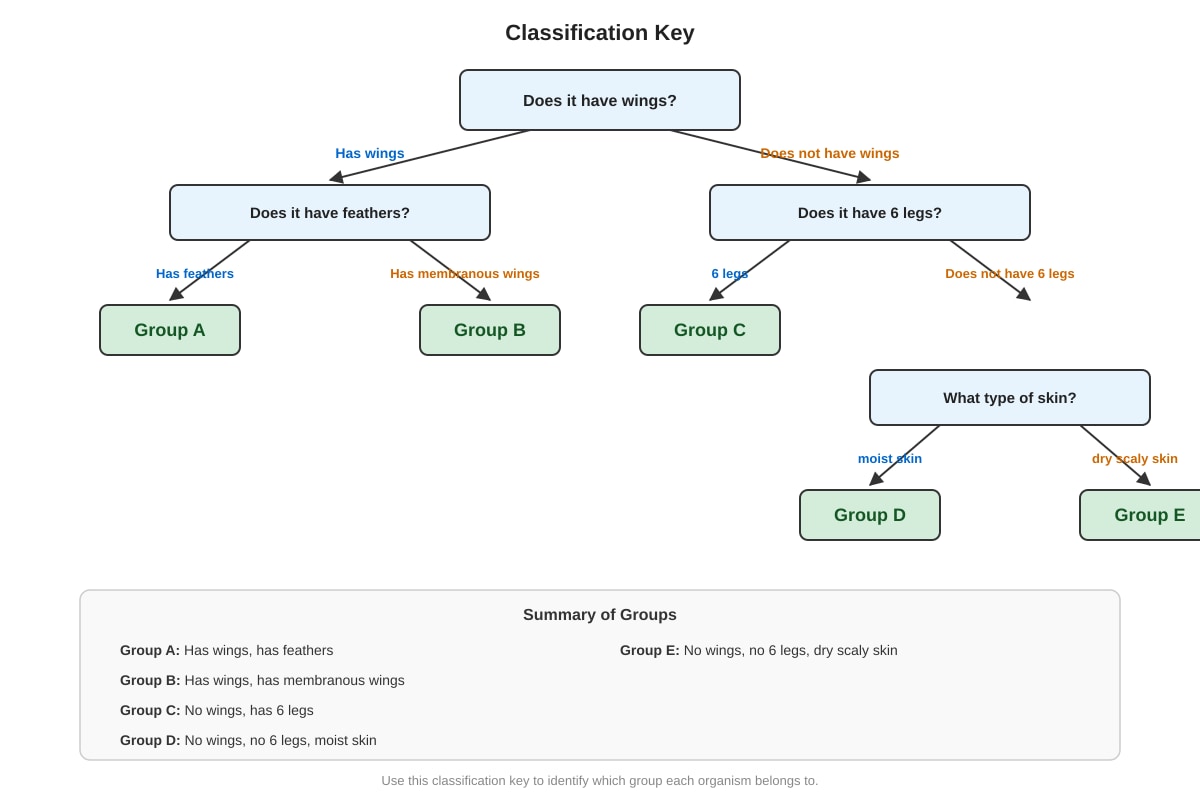
3. Look at the classification key below.

<image_placeholder> id: Q3-fig1 type: diagram linked_question: Q3 description: Dichotomous key with 4 levels of branching. Level 1: Has wings (go to 2) / Does not have wings (go to 3). Level 2: Has feathers → Group A / Has membranous wings → Group B. Level 3: Has 6 legs → Group C / Does not have 6 legs (go to 4). Level 4: Has moist skin → Group D / Has dry scaly skin → Group E. labels: "Has wings", "Does not have wings", "Has feathers", "Has membranous wings", "6 legs", "moist skin", "dry scaly skin", Group A–E values: None must_show: Clear branching structure, all decision points visible, arrows connecting choices, group labels at endpoints </image_placeholder>

Using the classification key, an earthworm would be classified into which group?

A) Group C
B) Group D
C) Group E
D) Cannot be determined from the key

Answer: ________


4. Which two animals below belong to the same group based on how their young are produced?

AnimalHow young are produced
PLays eggs with hard shells in nests on land
QLays soft eggs in water
RGives birth to live young
SLays eggs with leathery shells in burrows

A) P and Q
B) P and S
C) Q and R
D) R and S

Answer: ________


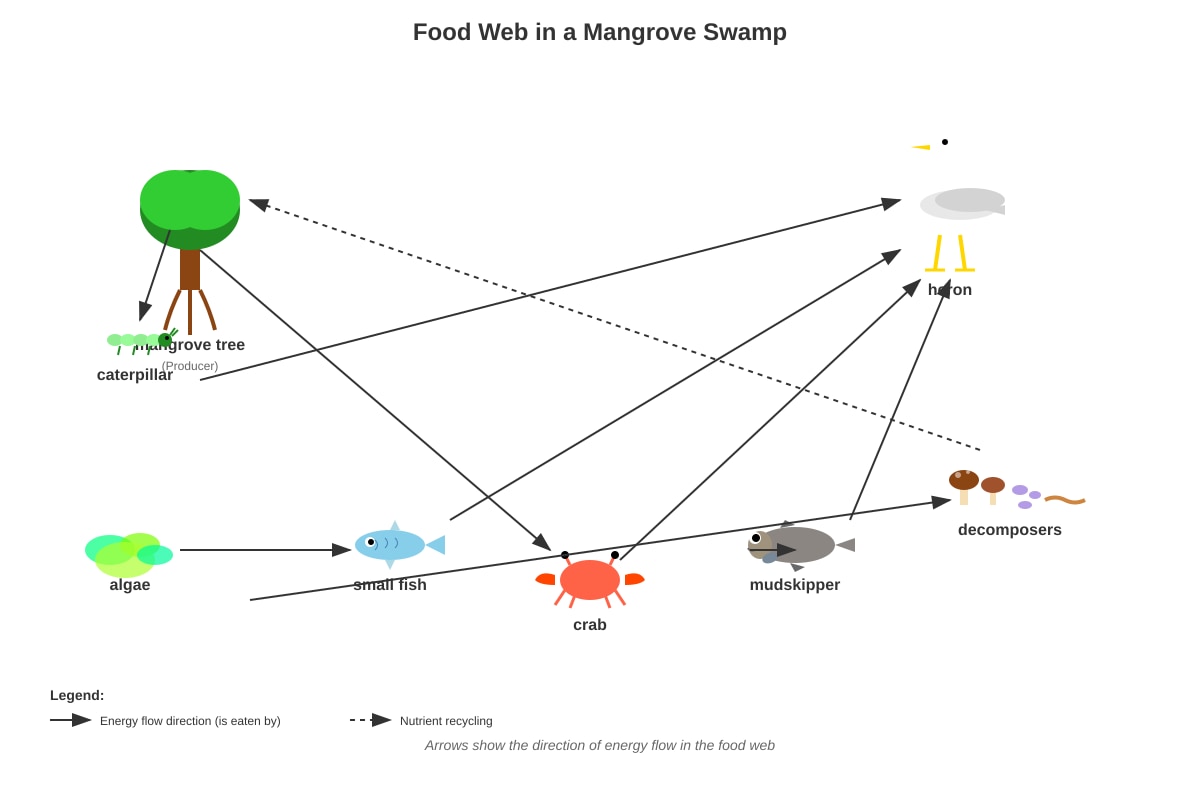
5. The diagram below shows part of a food web in a mangrove swamp.

<image_placeholder> id: Q5-fig1 type: diagram linked_question: Q5 description: Simple food web showing mangrove tree, caterpillars eating leaves, small fish eating algae, heron eating small fish and crabs, crabs eating fallen leaves and dead organisms, mudskipper eating small invertebrates, and decomposers breaking down dead matter. Arrows show energy flow direction. labels: "mangrove tree", "caterpillar", "algae", "small fish", "heron", "crab", "mudskipper", "decomposers", arrows with direction values: None must_show: All organisms connected by arrows showing feeding relationships, arrowheads indicating energy flow, clear label for each organism </image_placeholder>

Which organism is a producer in this food web?

A) Caterpillar
B) Small fish
C) Mangrove tree
D) Crab

Answer: ________


6. Bacteria are classified under the Kingdom Monera. What is a unique feature of organisms in this kingdom?

A) They have a true nucleus
B) They can only live in water
C) They do not have a true nucleus
D) They all cause diseases

Answer: ________


7. A student wanted to find out if two plants belong to the same species. Which observation would be the MOST useful?

A) Both plants have green leaves
B) Both plants produce flowers with the same number of petals and similar reproductive structures
C) Both plants are the same height
D) Both plants grow well in sunlight

Answer: ________


8. The table below shows some characteristics of four organisms.

OrganismHas backboneHas wingsHas hair/furBody temperature
WYesNoYesConstant
XNoYesNoVaries
YYesYesNoConstant
ZNoNoNoVaries

Which organism is most likely a bird?

A) W
B) X
C) Y
D) Z

Answer: ________


9. Why is biodiversity important for ecosystems?

A) It makes the environment look more beautiful
B) It ensures that if one species is affected, others can continue important ecosystem functions
C) It allows scientists to name more organisms
D) It prevents any organism from becoming extinct

Answer: ________


10. Fungi cannot make their own food. How do they obtain nutrients?

A) By photosynthesis using chlorophyll
B) By absorbing nutrients from dead or decaying matter
C) By catching and eating other organisms
D) By forming a food web with producers

Answer: ________


Section B: Matching and Classification (Questions 11–15)

Each question carries 2 marks.


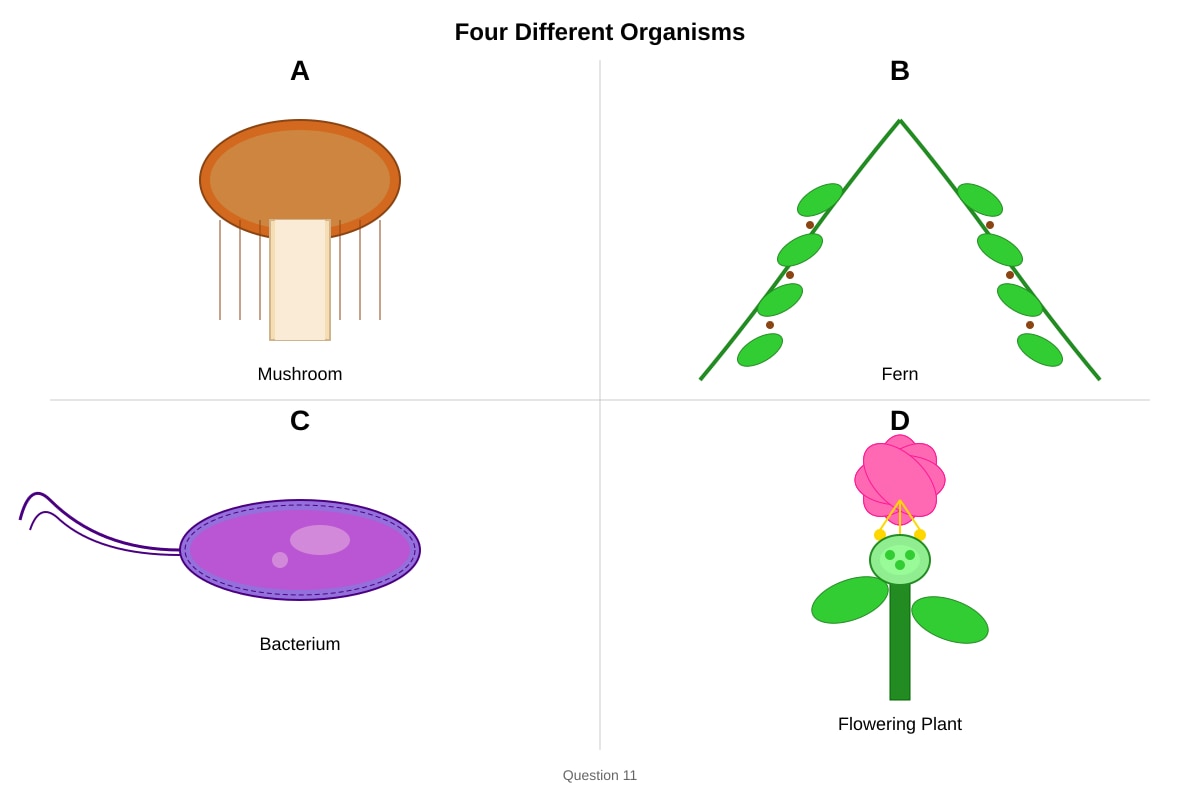
11. The pictures below show four different organisms.

<image_placeholder> id: Q11-fig1 type: diagram linked_question: Q11 description: Four labelled organism illustrations arranged in a 2x2 grid. Top-left: A mushroom with gills underneath cap. Top-right: A fern with divided fronds and spore cases visible on underside. Bottom-left: A bacterium shown as rod-shaped with flagellum. Bottom-right: A flowering plant with visible petals, stamens, and ovary in flower cross-section. labels: "A", "B", "C", "D", organism names in caption style below each values: None must_show: Clear distinguishing features—mushroom gills, fern fronds with sori, bacterial rod shape with flagellum, flower reproductive parts </image_placeholder>

(a) Which two organisms belong to Kingdom Fungi? Give the letter(s).
Answer: ________ [1 mark]

(b) Which organism is a non-flowering plant? Give the letter.
Answer: ________ [1 mark]


12. Complete the classification table below by filling in the missing information.

FeatureBacteriaFungi
Cell structure(i) Prokaryotic or eukaryotic?Eukaryotic
Chlorophyll present?No(ii) Yes or No?
Method of nutritionAbsorption(iii) _______
Example(iv) _______Mushroom

(i) _________________________
(ii) _________________________
(iii) _________________________
(iv) _________________________ [2 marks]


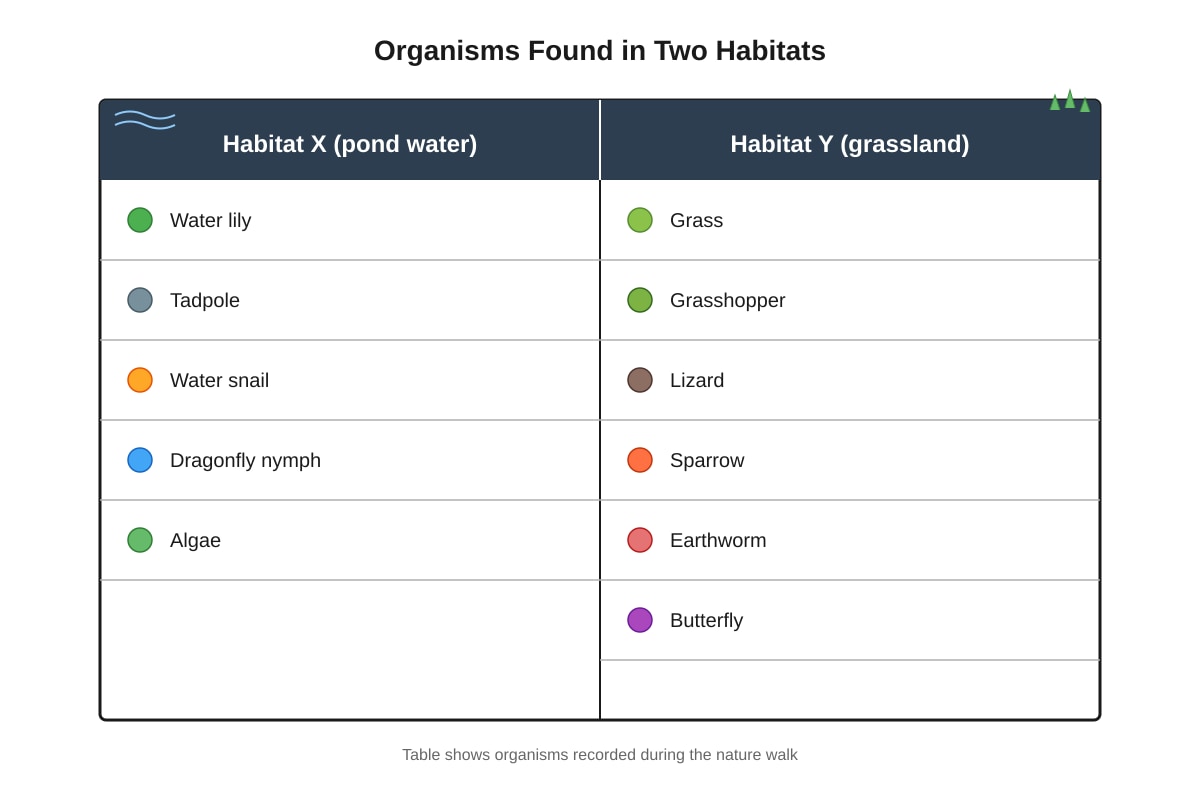
13. A group of students went on a nature walk and recorded the organisms they found in different habitats.

<image_placeholder> id: Q13-fig1 type: table linked_question: Q13 description: Data table showing organisms found in two habitats. Habitat X (pond water): water lily, tadpole, water snail, dragonfly nymph, algae. Habitat Y (grassland): grass, grasshopper, lizard, sparrow, earthworm, butterfly. labels: "Habitat X (pond water)", "Habitat Y (grassland)", organism names as listed values: Organisms listed as text entries in two columns must_show: Clear column separation, all organism names legible, habitat labels distinct </image_placeholder>

(a) Name one producer from Habitat X and one producer from Habitat Y.
Habitat X producer: _________________________
Habitat Y producer: _________________________ [1 mark]

(b) Suggest one difference in the types of animals found in the two habitats that relates to how they breathe.
_________________________________________________________________________ [1 mark]


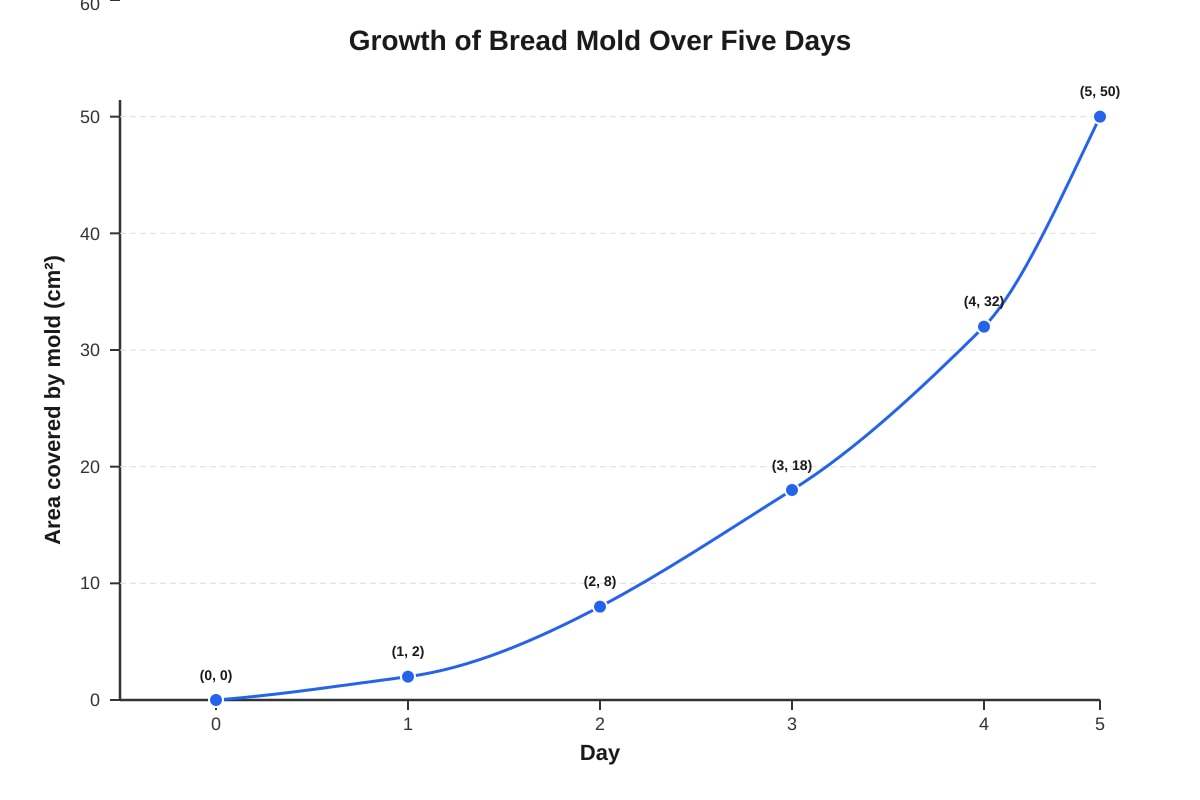
14. The diagram below shows how bread mold grows on a slice of bread over five days.

<image_placeholder> id: Q14-fig1 type: graph linked_question: Q14 description: Line graph showing area of bread covered by mold (cm²) over 5 days. Day 0: 0 cm². Day 1: 2 cm². Day 2: 8 cm². Day 3: 18 cm². Day 4: 32 cm². Day 5: 50 cm². X-axis labelled "Day", Y-axis labelled "Area covered by mold (cm²)". labels: "Day" (x-axis, 0–5), "Area covered by mold (cm²)" (y-axis, 0–60), data points with line values: (0,0), (1,2), (2,8), (3,18), (4,32), (5,50) must_show: Axes with units, labelled points, smooth curve connecting points, title indicating what is being measured </image_placeholder>

(a) What is the area covered by mold on Day 3?
Answer: _________________________ cm² [1 mark]

(b) Predict what would happen to the mold growth if the bread was kept in the refrigerator at 4°C. Explain your answer.


_________________________________________________________________________ [1 mark]


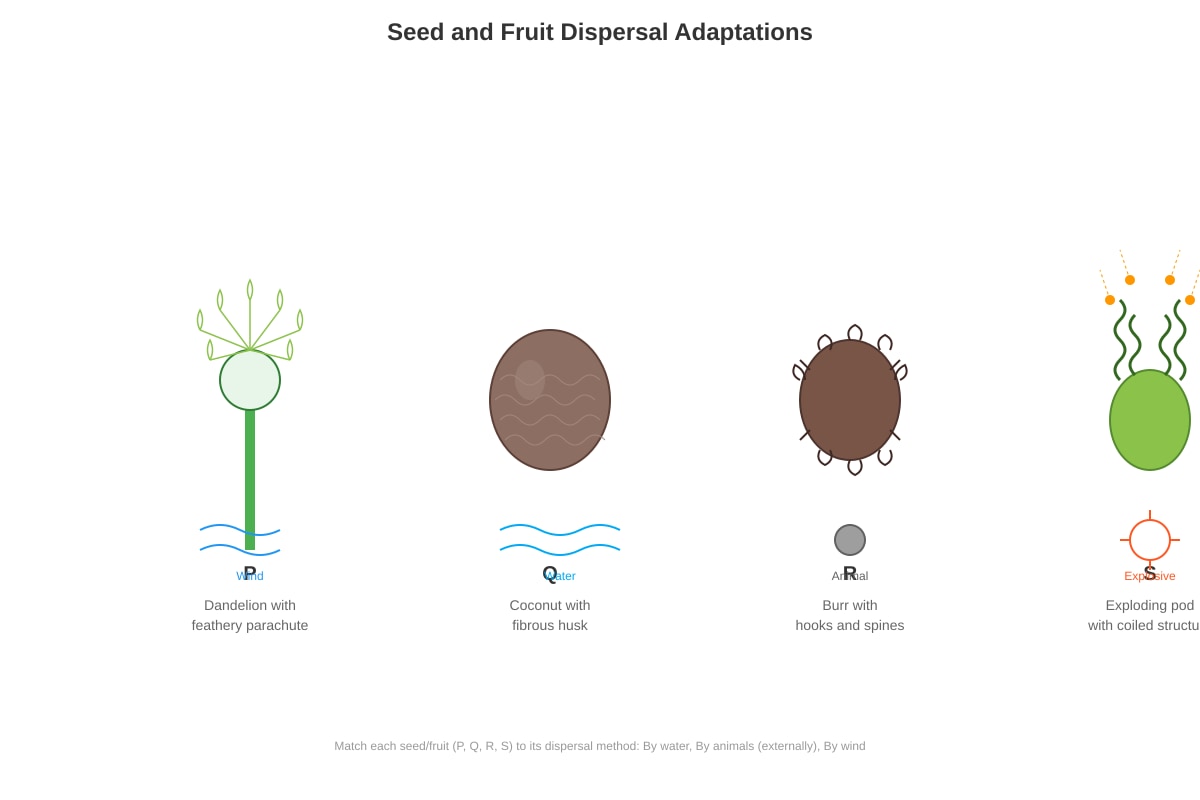
15. The pictures show the seeds and fruits of four different plants.

<image_placeholder> id: Q15-fig1 type: diagram linked_question: Q15 description: Four seed/fruit dispersal adaptations shown. P: dandelion with feathery parachute structure. Q: coconut with fibrous husk and smooth shell. R: burr with hooks and spines. S: exploding pod with coiled spring-like structure. labels: "P", "Q", "R", "S", with brief descriptive captions below each values: None must_show: Key dispersal features clearly illustrated—parachute hairs, fibrous husk, hooks/spines, coiled pod </image_placeholder>

Match each seed/fruit to its dispersal method. Write the letter in the correct box.

Dispersal MethodLetter
By water________
By animals (externally)________
By wind________
By explosive mechanism________

Section C: Open-Ended Questions (Questions 16–20)

Each question carries 3 or 4 marks. Show your reasoning clearly.


16. Mei Ling set up an investigation to compare the growth of two types of plants: a water plant (Elodea) and a land plant (bean plant). She placed both near a window and watered the bean plant daily while keeping the Elodea in a tank of water.

After two weeks, she made the following observations:

  • The bean plant grew taller and produced new green leaves
  • The Elodea grew longer stems but the lower parts appeared to be dying

(a) Explain why the bean plant was able to grow taller. [2 marks]


(b) Suggest why the lower parts of the Elodea were dying while the upper parts continued to grow. [2 marks]


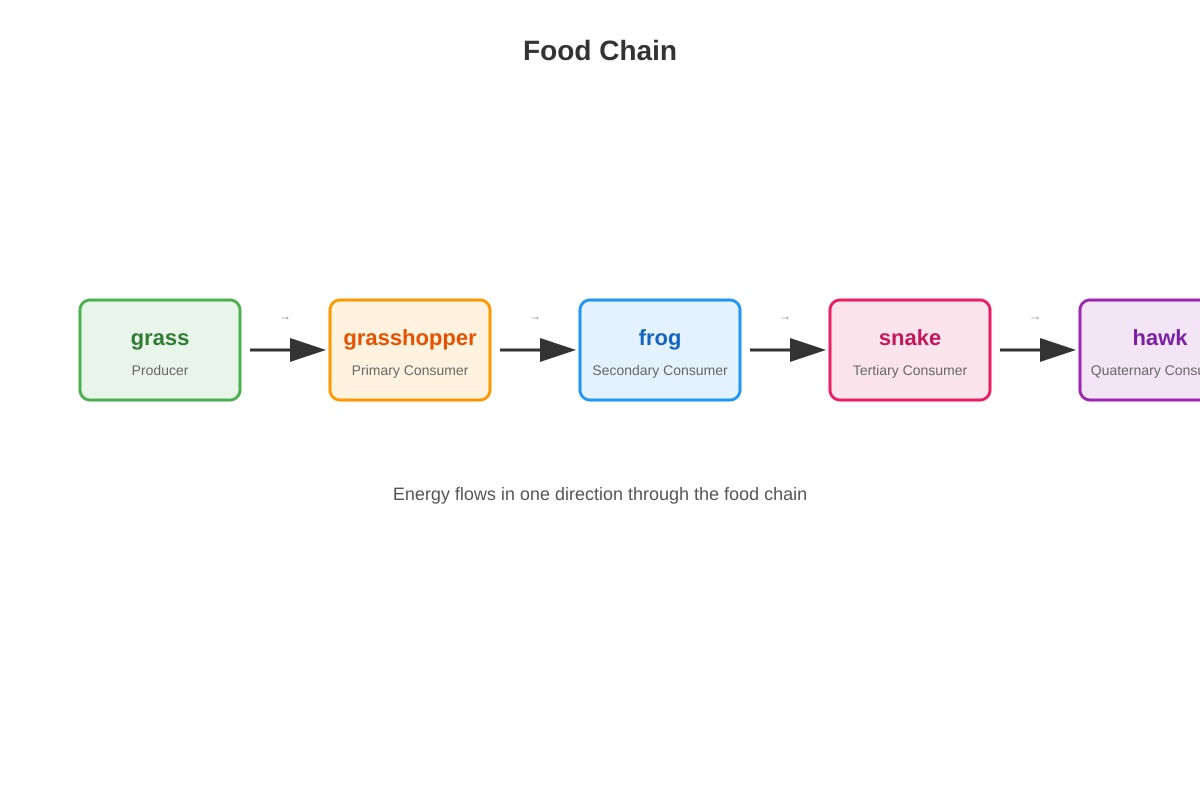
17. The diagram below shows five organisms arranged in a food chain.

<image_placeholder> id: Q17-fig1 type: diagram linked_question: Q17 description: Linear food chain with five organisms in boxes connected by arrows. Box 1: grass. Box 2: grasshopper. Box 3: frog. Box 4: snake. Box 5: hawk. Arrows point from grass to grasshopper, grasshopper to frog, frog to snake, snake to hawk. labels: "grass", "grasshopper", "frog", "snake", "hawk", arrows showing energy flow direction values: None must_show: All five organisms in sequence, clear directional arrows, no branching (linear chain) </image_placeholder>

(a) What would happen to the population of frogs if all the snakes were removed from this food chain? Explain your answer. [2 marks]


(b) A farmer sprayed pesticide on the grass to kill insects. Explain how this could affect the hawk population even though the pesticide was not sprayed directly on the hawks. [2 marks]


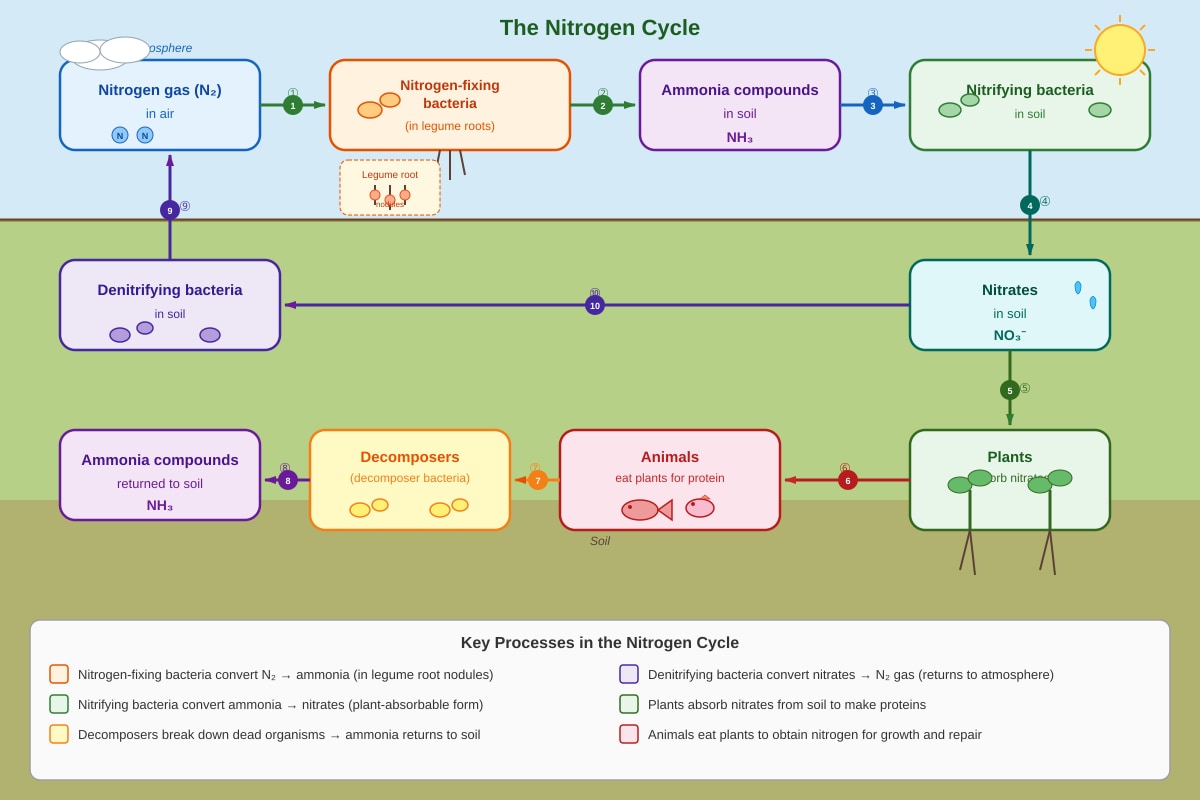
18. Microorganisms play important roles in our environment. The diagram below shows part of the nitrogen cycle involving bacteria.

<image_placeholder> id: Q18-fig1 type: diagram linked_question: Q18 description: Simplified nitrogen cycle diagram. Nitrogen gas (N₂) in air → arrow to "Nitrogen-fixing bacteria in legume roots" → ammonia compounds in soil → arrow to "Nitrifying bacteria" → nitrates in soil → arrow to "Plants absorb nitrates" → arrow to "Animals eat plants" → arrow to "Decomposer bacteria" → ammonia compounds. Denitrifying bacteria shown returning nitrates to nitrogen gas. labels: "Nitrogen gas (N₂)", "Nitrogen-fixing bacteria", "Ammonia", "Nitrifying bacteria", "Nitrates", "Plants", "Animals", "Decomposers", "Denitrifying bacteria", arrows showing cycle direction values: None must_show: Complete cycle with all bacterial types labelled, arrows showing transformations, connection to plants and animals </image_placeholder>

(a) Name two types of bacteria shown in the nitrogen cycle that help make nitrogen compounds available to plants. [1 mark]


(b) Explain why farmers often grow leguminous plants (like beans and peas) before planting other crops in the same field. [2 marks]


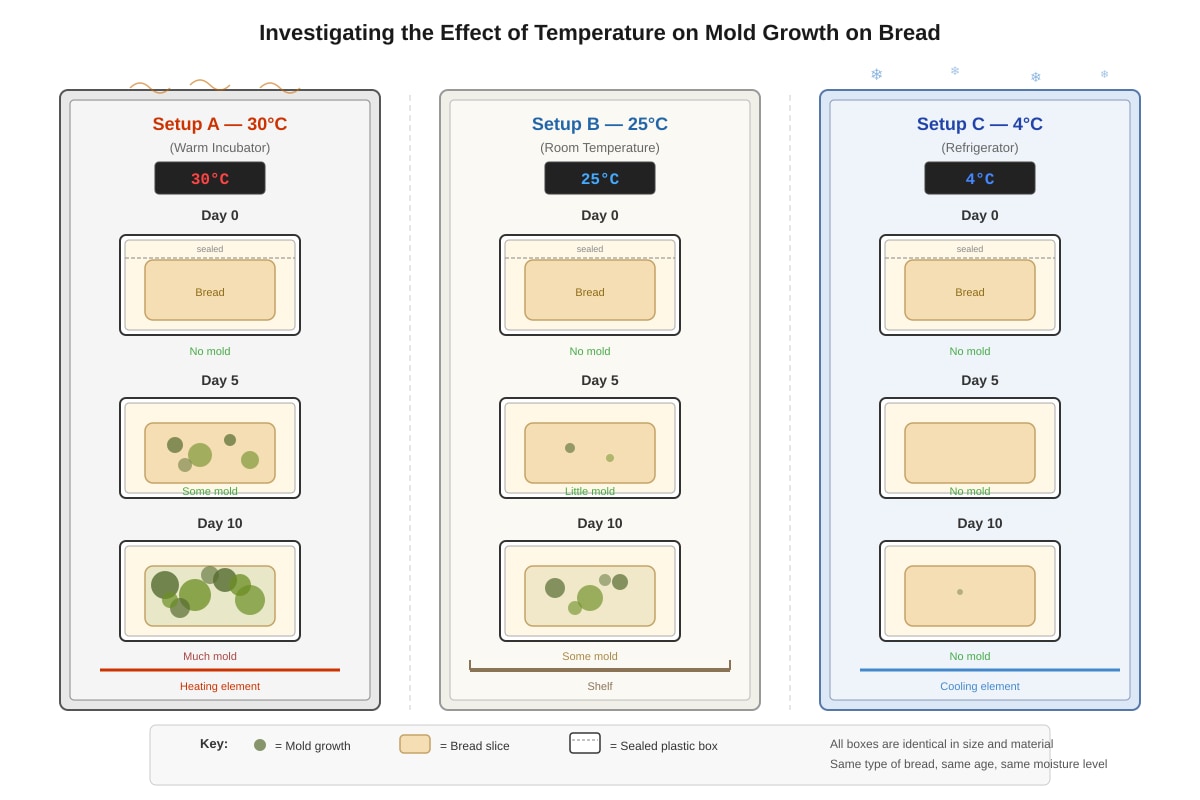
19. A group of students wanted to investigate how temperature affects the growth of mold on bread. They set up the experiment as shown below.

<image_placeholder> id: Q19-fig1 type: experimental_setup linked_question: Q19 description: Three identical sealed plastic boxes with bread slices inside, each at different temperatures. Setup A: bread in warm incubator at 30°C. Setup B: bread on shelf at room temperature 25°C. Setup C: bread in refrigerator at 4°C. All setups have same type of bread, same age, same moisture level. Labels show temperature and days of observation (Day 0, Day 5, Day 10). labels: "Setup A 30°C", "Setup B 25°C", "Setup C 4°C", "Day 0", "Day 5", "Day 10", bread boxes identical in appearance values: Temperatures 30°C, 25°C, 4°C; Days 0, 5, 10 must_show: Three clear setups with temperatures labelled, bread visible inside each, time points indicated, control of variables suggested by identical containers </image_placeholder>

(a) What is the independent variable in this experiment? [1 mark]


(b) Suggest two variables that the students should keep constant to make this a fair test. [1 mark]


(c) Predict and explain the appearance of bread in each setup after 10 days. [2 marks]


20. Conservation of biodiversity is important for maintaining healthy ecosystems. The passage below describes a situation in Singapore.

Sungei Buloh Wetland Reserve is an important nature reserve in Singapore. It is home to many different species of plants and animals, including migratory birds that travel from as far as Siberia to escape the winter cold. The reserve has mangrove forests, mudflats, and ponds. In recent years, there have been plans to develop land near the reserve. Environmental groups have raised concerns about the possible effects of this development.

(a) Explain why having mangrove forests in the reserve helps to maintain high biodiversity. [2 marks]


(b) Suggest two ways that development near the reserve might harm the organisms living there. [2 marks]


END OF QUIZ

Answers

<!-- TuitionGoWhere generation metadata: stage=5-1; model=moonshotai/kimi-k2.6:free; model_label=Kimi K2.6 Free; generated=2026-06-07; Sources: Stage 4-0 LLM templates, syllabus context, and Stage 2 evidence where available. -->

Primary 6 PSLE Science Quiz - Diversity: Answer Key

Total Marks: 40 marks


Section A: Multiple Choice (1 mark each)

QAnswerExplanation
1CAll living things breathe, grow, and reproduce. However, only plants and some bacteria can photosynthesise—animals and fungi cannot. Photosynthesis is NOT a universal characteristic of all living things.
2CThe organism has chlorophyll (for making food) and cell walls—these are the defining features of Kingdom Plantae. Fungi have cell walls but no chlorophyll; animals have no cell walls; protists are a diverse group that may have chlorophyll but typically lack the distinctive cell wall structure of plants.
3BAn earthworm does not have wings, does not have 6 legs, and has moist skin (it breathes through its skin). Following the key: No wings → no 6 legs → moist skin → Group D. Students often confuse this with amphibians, but the key leads to moist skin as the final distinguishing feature.
4BP (bird) and S (reptile) both lay eggs with hard or leathery shells on land. Q is an amphibian (soft eggs in water); R is a mammal. The key grouping is amniotic eggs adapted for land.
5CProducers make their own food through photosynthesis. The mangrove tree is the only producer listed—it produces glucose from sunlight. Caterpillars, small fish, and crabs are all consumers.
6CKingdom Monera (bacteria) are prokaryotic—they lack a true nucleus (no nuclear membrane). This is their defining feature. Not all bacteria cause disease (many are beneficial), and they live in diverse environments, not just water.
7BTo determine if organisms belong to the same species, scientists look at reproductive compatibility—organisms of the same species can produce fertile offspring. Flower structure and number of petals indicate related species within the same genus or family. External features like height, leaf colour, or light preference vary with environment and are unreliable for species identification.
8COrganism Y: has a backbone (vertebrate), wings (birds have modified forelimbs as wings), no hair/fur (birds have feathers, not hair—though the table doesn't mention feathers, the combination of wings + backbone + constant body temperature is diagnostic), and constant body temperature (warm-blooded). W is a mammal; X and Z are invertebrates.
9BBiodiversity provides ecosystem stability through functional redundancy—if one species is lost, others can perform similar roles (e.g., pollination, nutrient cycling). Beauty (A) and naming (C) are human conveniences, not ecological functions. D is incorrect because biodiversity does not prevent extinction; it buffers against its consequences.
10BFungi are saprophytic—they secrete enzymes to break down dead organic matter and absorb the nutrients. They cannot photosynthesise (no chlorophyll), do not typically catch prey (that's carnivorous plants and some animals), and do not form food webs as producers.

Section B: Matching and Classification

11. (a) A (mushroom) [1 mark]

The mushroom is a fungus. If students selected both A and need to identify another, accept A only—the question asks which two, but A is the only fungus shown. (Note: If B is misidentified, clarify that ferns are plants, not fungi. The answer expected is A for definite; if the diagram includes another fungus-like organism, adjust accordingly. Based on standard P6 content, only the mushroom is fungal.)

Actually reviewing: A (mushroom) is fungal. No other organism is fungal. If marking strictly, A is correct; if question implies two, there may be diagram ambiguity. Standard answer: A.

(b) B (fern) [1 mark]

Ferns are non-flowering plants that reproduce by spores (visible as sori on frond undersides), not seeds or flowers.


12. Complete table: [2 marks — ½ mark each]

FeatureBacteriaFungi
Cell structure(i) ProkaryoticEukaryotic
Chlorophyll present?No(ii) No
Method of nutritionAbsorption(iii) Absorption
Example(iv) E. coli / Lactobacillus / any named bacteriumMushroom

Teaching notes:

  • Prokaryotic = no membrane-bound nucleus, DNA free in cytoplasm
  • Fungi never have chlorophyll (they are heterotrophic decomposers)
  • Both bacteria and fungi absorb nutrients—bacteria through cell membrane, fungi through hyphae
  • Common mistake: Students confuse fungi with plants; emphasise NO chlorophyll in fungi

13. (a) [1 mark]

Habitat X producer: Algae (or water lily)
Habitat Y producer: Grass

Either answer accepted if the organism is clearly a producer (photosynthetic). Water lily is also correct.

(b) [1 mark]

Sample answer: Animals in Habitat X (pond) breathe using gills or can absorb oxygen from water, while animals in Habitat Y (grassland) breathe using lungs through nostrils/mouths.

Or: Habitat X has animals that are adapted to aquatic breathing (gills, breathing tubes), while Habitat Y animals have air-breathing adaptations (lungs, tracheae in insects).


14. (a) 18 cm² [1 mark]

Read directly from graph at Day 3.

(b) [1 mark]

Prediction: Mold growth would be slower / less area covered.

Explanation: The low temperature (4°C) slows down the reproduction rate of mold spores / reduces enzyme activity in the mold, so less growth occurs. Mold grows best in warm, moist conditions.


15. [2 marks — ½ mark each]

Dispersal MethodLetter
By waterQ (coconut)
By animals (externally)R (burr with hooks)
By windP (dandelion parachute)
By explosive mechanismS (exploding pod)

Teaching notes:

  • P — Feathery parachute increases surface area, catches wind
  • Q — Fibrous husk provides buoyancy, waterproof shell protects embryo
  • R — Hooks attach to animal fur/clothing for transport
  • S — Coiled spring mechanism builds tension; when dry, pod bursts open

Section C: Open-Ended Questions

16. (a) [2 marks]

The bean plant grew taller because:

  • It carried out photosynthesis using chlorophyll in its leaves [1]
  • The glucose produced was used for growth (cell division and elongation), and with adequate water and minerals from the soil, the plant could increase in height [1]

Marking descriptor:

  • Mention of photosynthesis making food/glucose → 1 mark
  • Link to growth/energy for cell processes → 1 mark

(b) [2 marks]

The lower parts of the Elodea died because:

  • The lower parts were shaded by upper leaves / received less light [1]
  • Without sufficient light, these parts could not photosynthesise effectively to make enough food for survival; OR oxygen depletion in lower water levels may occur [1]

Alternative acceptable answer: Lower parts are older and naturally senesce; or algae/decor growth on glass blocked light.

Marking descriptor:

  • Reason for reduced photosynthesis (light blocked/old age) → 1 mark
  • Consequence (insufficient food/energy, so cells die) → 1 mark

17. (a) [2 marks]

The frog population would increase initially [1]

Explanation: Without snakes (their predator), fewer frogs would be eaten. With less predation pressure, more frogs would survive to reproduce, leading to population increase [1]

Note: Accept "increase" with explanation; bonus reasoning that food shortage or disease may later cause decline is valid but not required.

(b) [2 marks]

The hawk population would decrease [1]

Explanation: Pesticide on grass → accumulated in grasshoppers → accumulated in frogs → accumulated in snakes → biomagnification in hawks. OR: Pesticide kills grasshoppers directly, reducing food for frogs, then snakes, then hawks, causing food shortage at each level [1]

Marking descriptor:

  • Correct trend (decrease) → 1 mark
  • Explanation of bioaccumulation/biomagnification OR disruption of food chain/food shortage → 1 mark

18. (a) [1 mark]

Nitrogen-fixing bacteria and nitrifying bacteria

(Any two of: nitrogen-fixing bacteria, nitrifying bacteria, decomposers that break down organic matter)

(b) [2 marks]

Farmers grow legumes because:

  • Legume roots contain nitrogen-fixing bacteria (Rhizobium) that convert atmospheric nitrogen into ammonium compounds [1]
  • These nitrogen compounds enrich the soil with nitrates that the next crop can absorb for growth, reducing need for artificial fertilisers [1]

Marking descriptor:

  • Mention of nitrogen-fixing bacteria in root nodules → 1 mark
  • Benefit to soil/ subsequent crops / natural fertiliser → 1 mark

19. (a) [1 mark]

Temperature (of storage environment)

(b) [1 mark]

Any two from:

  • Type/brand of bread
  • Amount/moisture content of bread
  • Volume/size of bread slice
  • Exposure to air/time before sealing
  • Amount of mold spores initially present (though hard to control)

½ mark each, maximum 1 mark

(c) [2 marks]

SetupPredictionExplanation
A (30°C)Most mold / largest area covered [½]Warm temperature provides optimal conditions for mold spore germination and growth; enzymes work fastest [½]
B (25°C)Moderate mold growth [½]Room temperature allows some growth but slower than at 30°C [½]
C (4°C)Least mold / little to no visible mold [½]Cold temperature slows enzyme activity / stops spore germination; mold becomes dormant [½]

Mark for correct trend across all three (A>B>C or equivalent) → 1 mark
Mark for temperature effect on enzyme/reproduction rate → 1 mark

Note: If predictions and explanations show understanding but vary in exact wording, award marks for scientific reasoning.


20. (a) [2 marks]

Mangroves maintain high biodiversity because:

  • They provide many different habitats/microhabitats (roots in water, canopy, mudflats) supporting varied niches [1]
  • They are productive ecosystems with high nutrient cycling; fallen leaves decompose to feed detritivores, supporting complex food webs [1]

Alternative: Mangroves protect coastlines, reducing erosion and maintaining water quality that aquatic organisms need.

(b) [2 marks]

Any two valid impacts (1 mark each):

  • Habitat destruction/fragmentation — construction destroys nesting/breeding sites
  • Noise/light pollution — disrupts bird migration patterns and animal behaviour
  • Water pollution — runoff from construction sites pollutes water, affecting aquatic organisms
  • Reduced food availability — removal of vegetation reduces food sources
  • Increased human disturbance — recreation, litter, direct harm to wildlife

END OF ANSWER KEY