AI Generated Quiz
Primary 6 PSLE Science Diversity Quiz
Free P6 PSLE Science Diversity quiz, HY3 AI version, with questions, answers, and PSLE-focused practice for Singapore students.
These static practice materials are generated from the site's syllabus and paper-generation workflow, with source and model context shown so students and parents can evaluate the material before use.
Questions
Free quiz and exam paper access
Enter your details to view this paper
Your access is remembered on this device.
Answers
Primary 6 PSLE Science Quiz - Diversity (Answer Key)
Total Marks: 40
Topic: Diversity (syllabus-first, LLM-inferred; not past-year derived)
Section A Answers (1 mark each)
-
B – Diversity means the variety of different living things in an area.
Teaching note: "Variety" is the key word; not just count but different types. -
C – Producers (e.g., plants) make their own food using sunlight (photosynthesis).
Common mistake: Confusing producers with consumers. -
B – A community is many populations living together in a place.
Teaching note: Population = one species; community = many species. -
B – A pond is a natural habitat supporting living things.
Teaching note: Habitat is where organisms live. -
A – A population is a group of the same organisms (e.g., all ants in a garden).
Marking: 1 mark for correct example of same-species group. -
C – Fungus is a decomposer that breaks down dead matter.
Teaching note: Decomposers recycle nutrients. -
B – Mangrove swamps support diverse plants/animals adapted to muddy salty water.
Marking: 1 mark for mentioning variety and adaptation. -
B – Temperature is a physical factor affecting survival.
Other acceptables: light, water (not asked but valid). -
B – Sun → Producer → Consumer is correct energy flow.
Teaching note: Energy starts from Sun, taken by producers, then consumers. -
B – Different organisms depend on one another (food webs, survival).
Marking: 1 mark for interdependence idea.
Section B Answers (2 marks each)
-
Sample answer: A pond has water and aquatic plants/animals, while a garden has soil and land plants/animals. [2 marks]
Marking: 1 mark for each correct contrasting feature (water vs land; different organisms). -
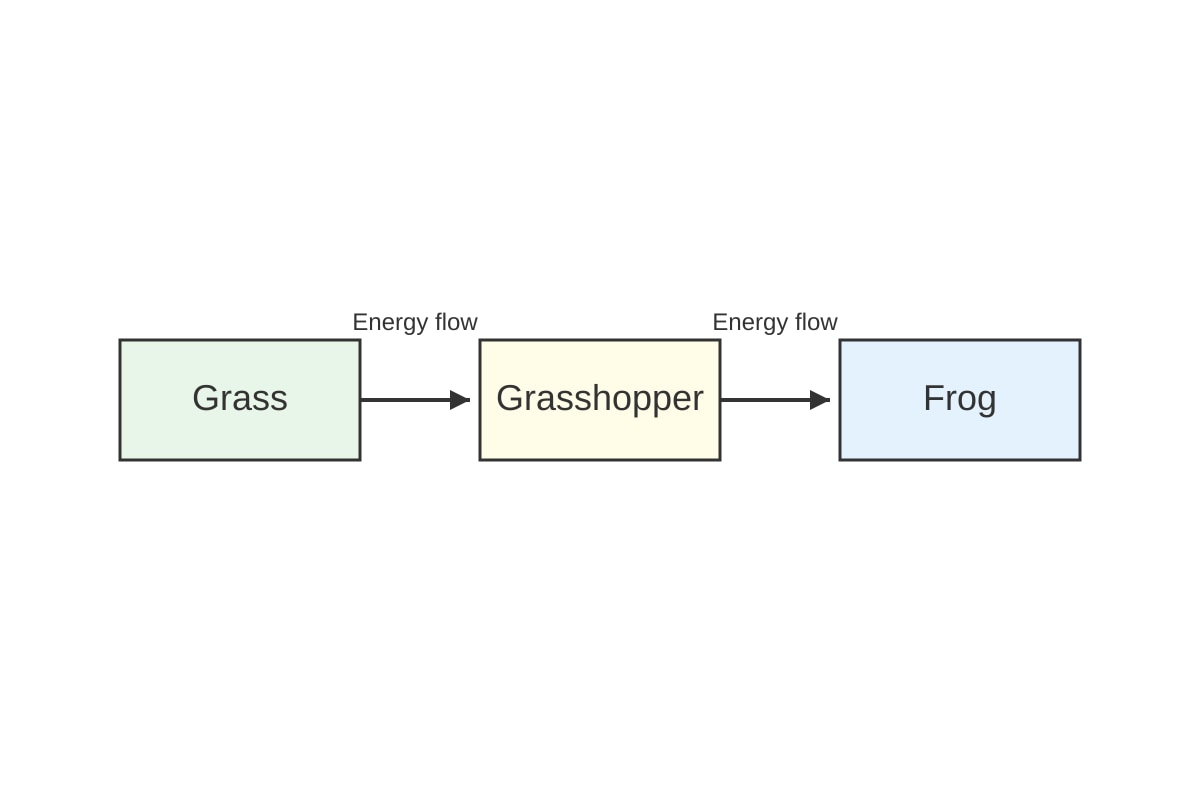
Sample answer: A food chain shows how energy flows from one organism to another. Example: Sun → grass → grasshopper → frog. [2 marks]
Marking: 1 mark for definition of energy flow; 1 mark for three-organism example. -
Sample answer: Structural: roots that breathe air above mud (e.g., mangrove tree roots). Behavioural: crab hiding in mud during low tide. [2 marks]
Marking: 1 mark each for correct type and example. -
Sample answer: Decomposers break down dead organisms and return nutrients to soil/water for producers to use. [2 marks]
Marking: 1 mark for breaking down dead matter; 1 mark for nutrient recycling. -
Sample answer: Negative: deforestation, pollution. Positive: reforestation. [2 marks]
Marking: 1 mark for two negatives; 1 mark for one positive. -
Sample answer: A population is one species in an area; a community has many populations of different species. They are not the same. [2 marks]
Marking: 1 mark for population definition; 1 mark for community definition.
Section C Answers
-
[Total 2 marks]
(a) A producer is an organism that makes its own food (e.g., by photosynthesis). [1 mark]
(b) Any garden producer: hibiscus, grass, rose plant. [1 mark] -
[Total 2 marks]
(a) A predator hunts and eats other animals (prey). [1 mark]
(b) Example: frog (predator) eats grasshopper (prey). [1 mark] -
[Total 2 marks]
Image note: Diagram must show Grass → Grasshopper → Frog with right arrows.
(a) Grass (producer). [1 mark]
(b) Grasshopper (consumer eating producer). [1 mark] -
[Total 3 marks]
(a) Water availability / light / food supply. [1 mark]
(b) If water decreases, pond organisms may move to another pond or die because they need water to survive. [2 marks: 1 for link to survival, 1 for movement response]
Marking descriptor: Must state factor change + organism response with reason.