From Real Exams Quiz
Primary 6 PSLE Science Systems Quiz
Free Exam-Derived Kimi K2 6 Free Primary 6 PSLE Science Systems quiz with questions and answers for Singapore students. This page is rendered as a direct URL so the questions and answers can be discovered without pressing in-page buttons.
These static practice materials are generated from the site's syllabus and paper-generation workflow, with source and model context shown so students and parents can evaluate the material before use.
Questions
Primary 6 PSLE Science Quiz - Systems
Name: _________________________________ Class: _______
Date: _________________ Score: _______ / 40
Duration: 40 minutes
Instructions: Answer all questions. Write your answers in the spaces provided.
Total Marks: 40
Section A: Multiple Choice (Questions 1–5)
Choose the correct answer and write A, B, C, or D in the box. (1 mark each)
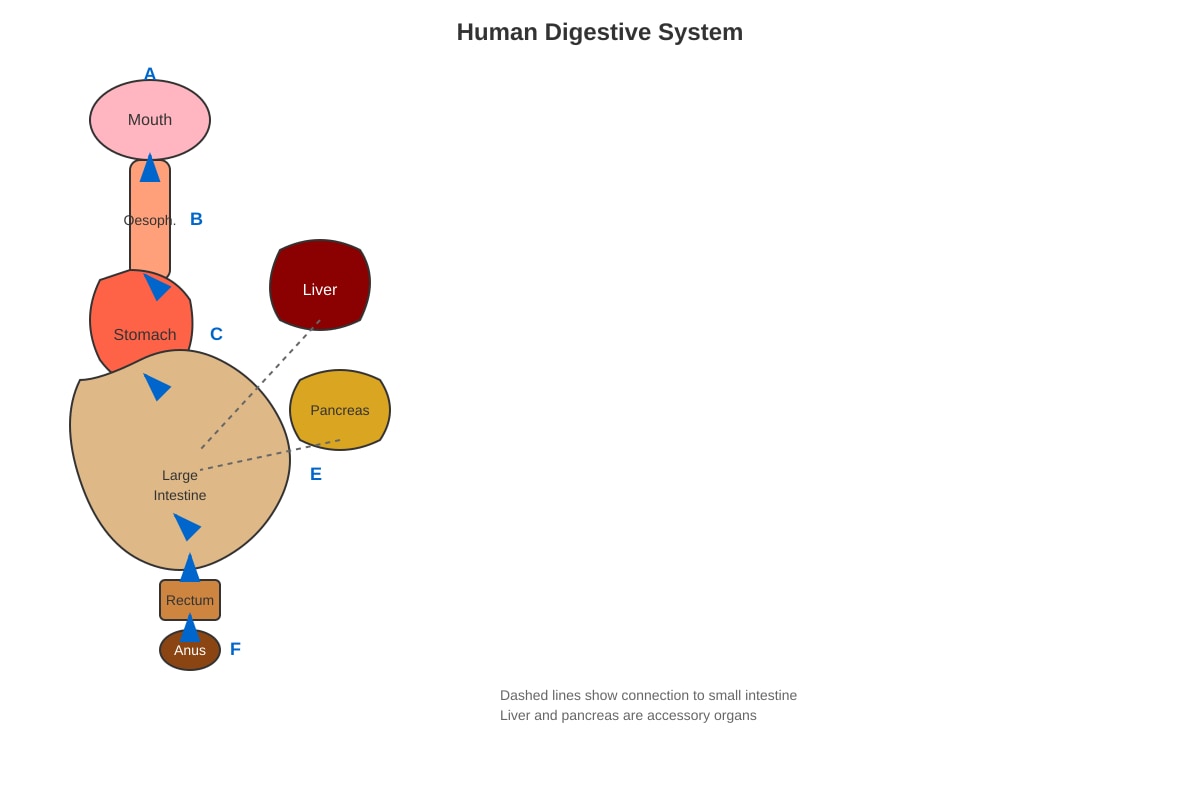
1. The diagram below shows the human digestive system.
<image_placeholder> id: Q1-fig1 type: diagram linked_question: Q1 description: Simple labelled diagram of human digestive system showing mouth, oesophagus, stomach, small intestine, large intestine, rectum, anus, liver, pancreas labels: A (mouth), B (oesophagus), C (stomach), D (small intestine), E (large intestine), F (anus), liver, pancreas values: none must_show: Clear labels A-F pointing to correct organs; arrows showing direction of food movement; liver and pancreas as accessory organs </image_placeholder>
Without mechanical digestion or digestive enzymes, the food will no longer be able to breakdown. Therefore, it will just pass through the alimentary canal and gets removed from the body.
Which organ does not produce any digestive enzymes?
- A Mouth
- B Oesophagus
- C Stomach
- D Small intestine
Answer: □
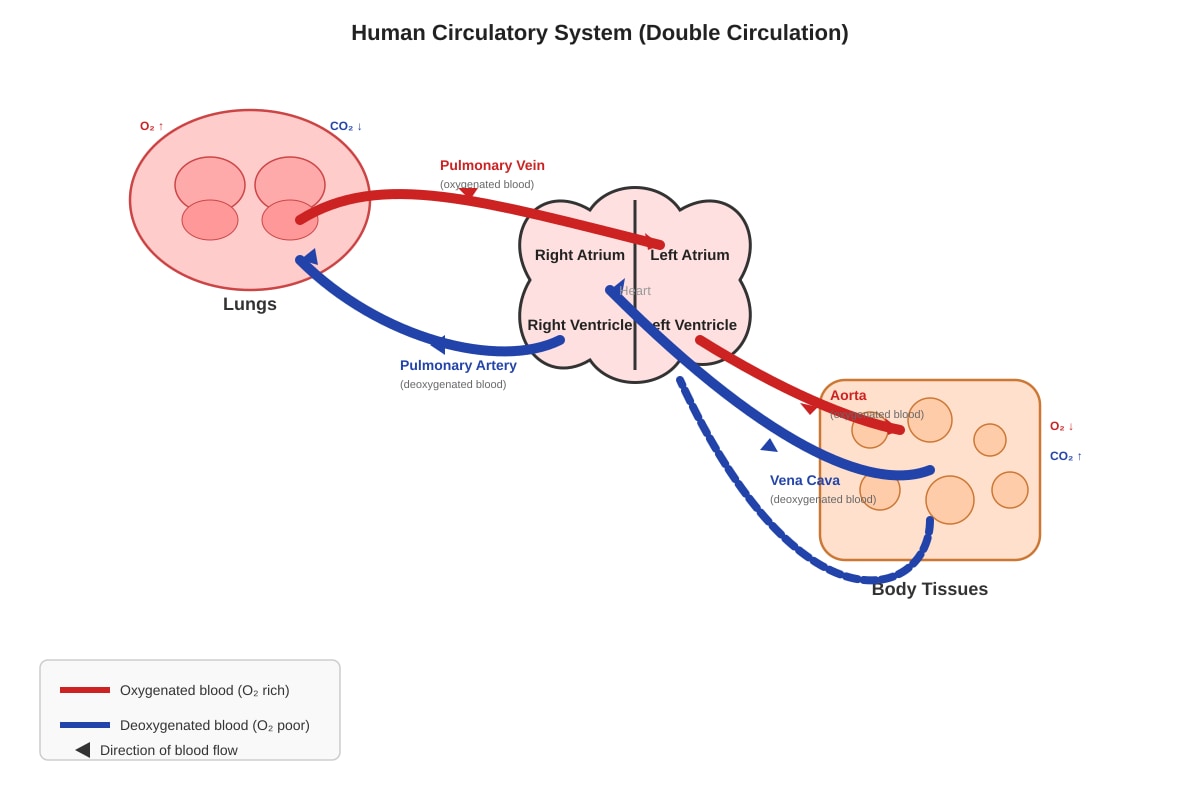
2. The diagram shows the human circulatory system.
<image_placeholder> id: Q2-fig1 type: diagram linked_question: Q2 description: Simplified diagram of double circulatory system showing heart with four chambers, pulmonary artery/vein, aorta, vena cava, lungs, body tissues; arrows showing direction of blood flow; oxygenated and deoxygenated blood shown as different shades labels: right atrium, right ventricle, left atrium, left ventricle, pulmonary artery, pulmonary vein, aorta, vena cava, lungs, body values: none must_show: Four chambers of heart correctly positioned; deoxygenated blood to lungs via pulmonary artery; oxygenated blood returns via pulmonary vein; aorta leaving left ventricle; vena cava entering right atrium </image_placeholder>
What is the correct path of blood flow from the legs back to the lungs?
- A Legs → vena cava → right atrium → right ventricle → pulmonary artery → lungs
- B Legs → vena cava → left atrium → left ventricle → pulmonary artery → lungs
- C Legs → aorta → right atrium → right ventricle → pulmonary vein → lungs
- D Legs → pulmonary vein → right atrium → right ventricle → pulmonary artery → lungs
Answer: □
3. Which of the following is a function of the human respiratory system?
- A To transport oxygen to all parts of the body
- B To remove undigested food from the body
- C To exchange gases between the body and the environment
- D To pump blood around the body
Answer: □
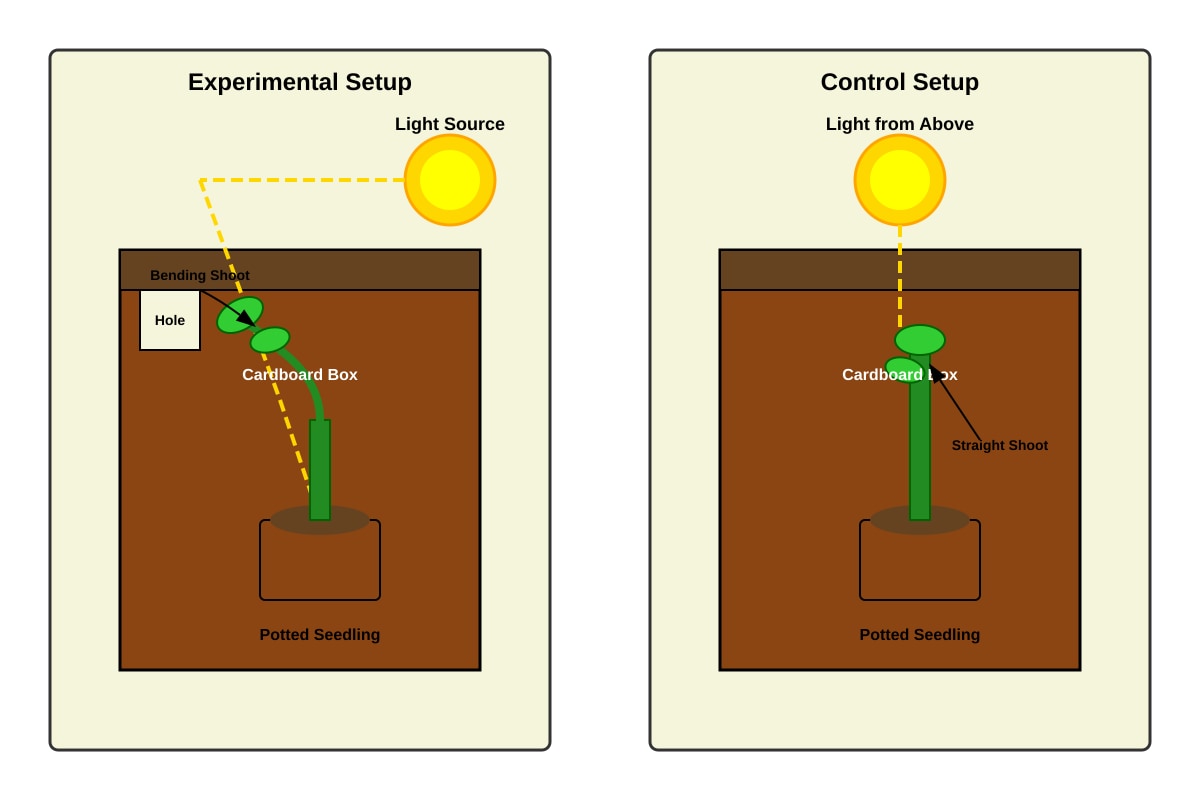
4. The diagram shows an experiment to investigate the effect of light on the path taken by a growing plant shoot.
<image_placeholder> id: Q4-fig1 type: experimental_setup linked_question: Q4 description: Box with plant seedling inside; light source shining through hole on left side of box; plant shoot bending toward light source; control setup with light from above shown for comparison labels: light source, cardboard box, hole, potted seedling, bending shoot, control setup, light from above with straight shoot values: none must_show: Bending of shoot toward light; hole position on one side; comparison straight shoot under top light; labels for experimental and control setups </image_placeholder>
Which characteristic of living things is being demonstrated?
- A Reproduction
- B Respiration
- C Sensitivity
- D Excretion
Answer: □
5. The table shows the components of blood and their functions.
| Component | Function |
|---|---|
| Red blood cells | P |
| White blood cells | Q |
| Platelets | R |
| Plasma | S |
Which row correctly identifies all the functions?
- A P: fight disease; Q: carry oxygen; R: clot blood; S: transport nutrients and waste
- B P: carry oxygen; Q: fight disease; R: clot blood; S: transport nutrients and waste
- C P: carry oxygen; Q: clot blood; R: fight disease; S: transport nutrients and waste
- D P: transport nutrients and waste; Q: fight disease; R: carry oxygen; S: clot blood
Answer: □
Section B: Structured Questions (Questions 6–15)
Answer in the spaces provided. Show your working where necessary.
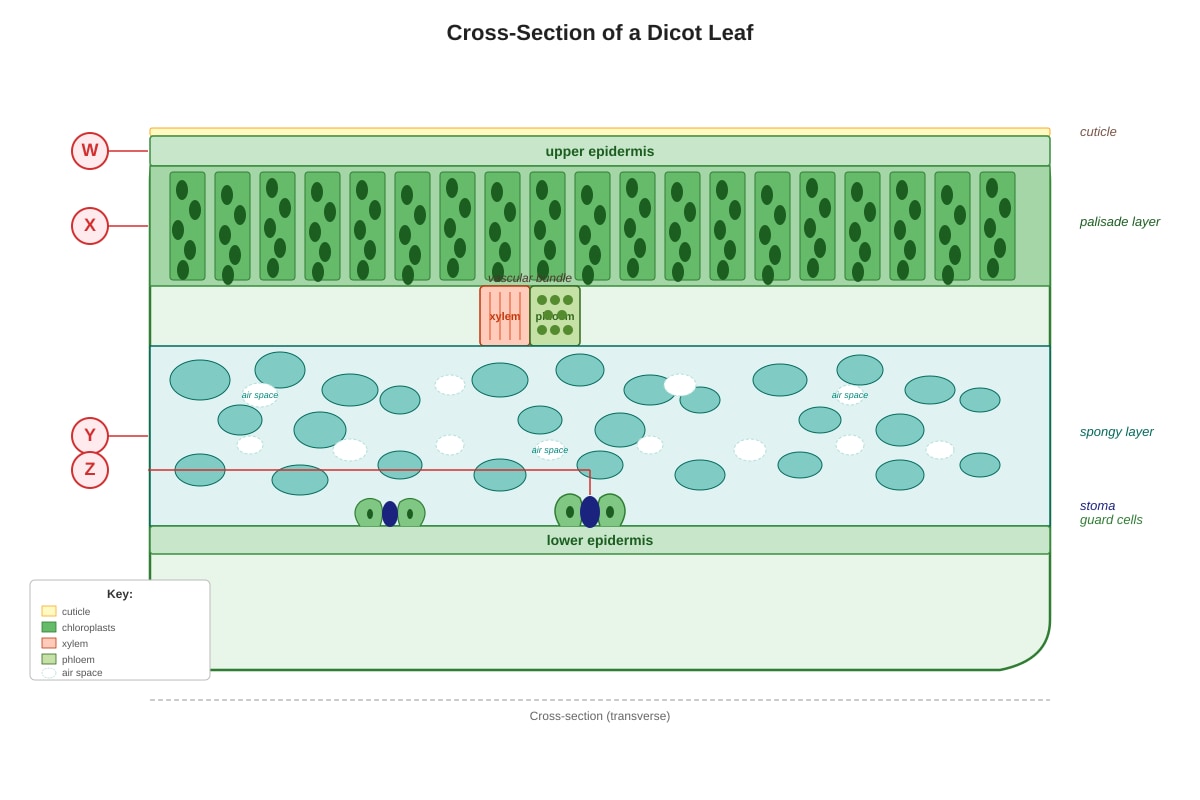
6. The diagram shows a cross-section of a leaf.
<image_placeholder> id: Q6-fig1 type: diagram linked_question: Q6 description: Cross-section of dicot leaf showing upper epidermis, palisade mesophyll, spongy mesophyll, lower epidermis with stoma, guard cells, xylem, phloem, cuticle, air spaces labels: W (upper epidermis), X (palisade layer), Y (spongy layer), Z (stoma with guard cells) values: none must_show: W, X, Y, Z labels clearly pointing to correct structures; chloroplasts in palisade cells; air spaces in spongy mesophyll; vascular bundle with xylem and phloem </image_placeholder>
(a) State two functions of the waxy cuticle on the upper epidermis (W). (1 mark)
(b) Explain why the palisade layer (X) contains the most chloroplasts. (2 marks)
(c) Describe how carbon dioxide enters the leaf through structure Z. (1 mark)
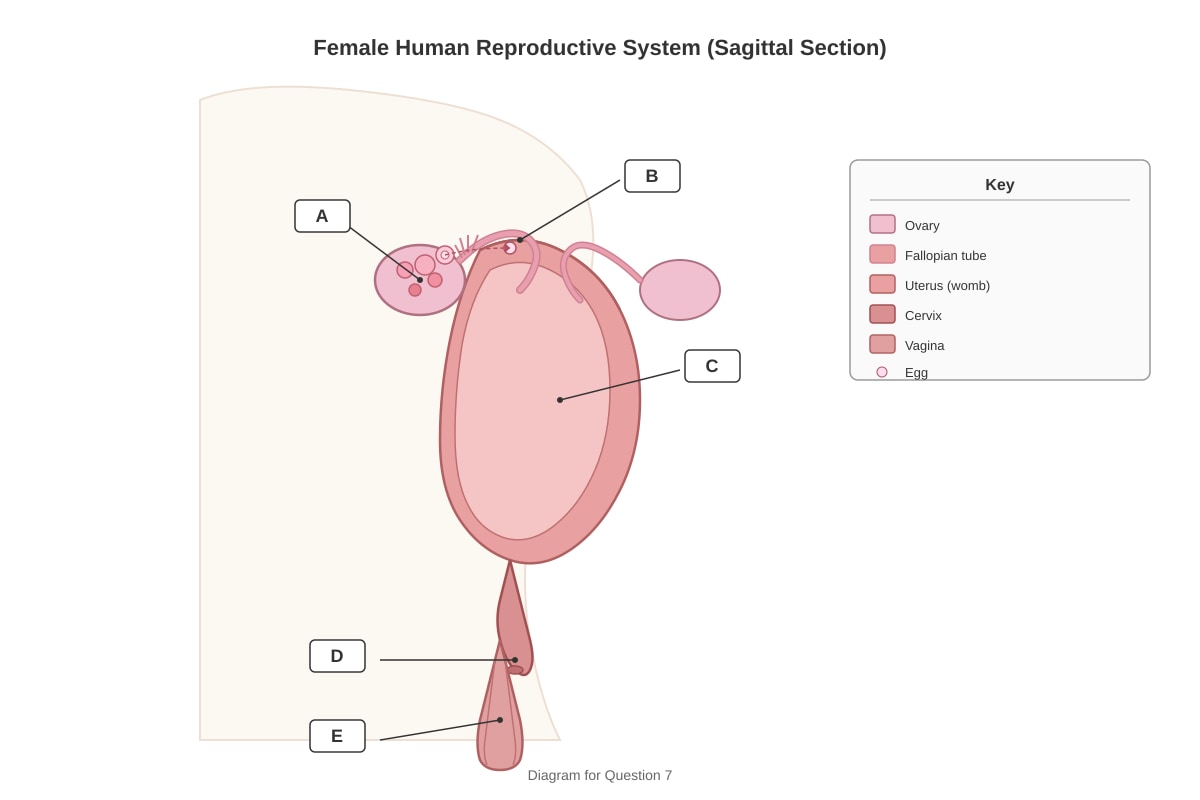
7. The diagram shows the female human reproductive system.
<image_placeholder> id: Q7-fig1 type: diagram linked_question: Q7 description: Simplified sagittal section of female reproductive system showing ovaries, fallopian tubes, uterus, cervix, vagina; one ovary with developing follicles shown, egg travelling down fallopian tube labels: A (ovary), B (fallopian tube/oviduct), C (uterus/womb), D (cervix), E (vagina) values: none must_show: A-E labels pointing to correct structures; path from ovary to uterus; relative positioning of organs </image_placeholder>
(a) Name the structure where fertilisation usually takes place. (1 mark)
(b) Explain why structure C has a thick muscular wall. (2 marks)
(c) Describe one way the structure labelled A is adapted to produce egg cells. (1 mark)
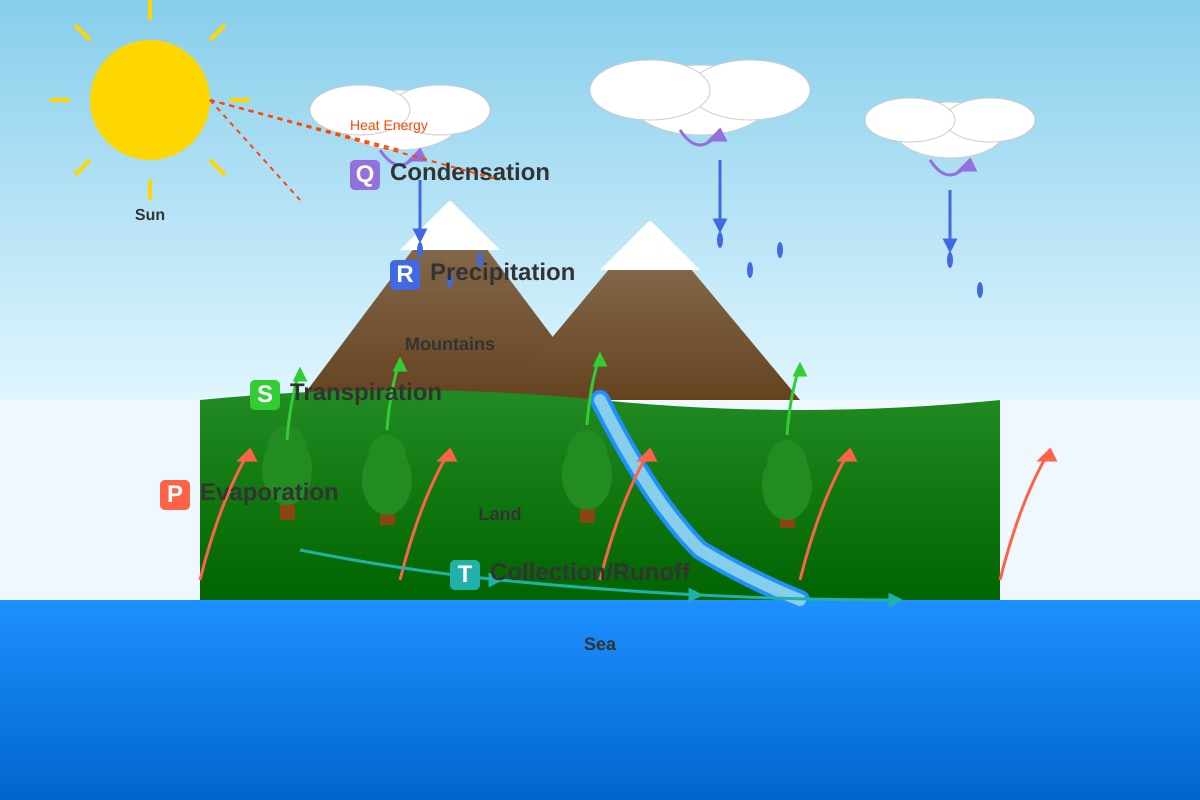
8. The diagram shows the water cycle.
<image_placeholder> id: Q8-fig1 type: diagram linked_question: Q8 description: Water cycle diagram showing sea, sun, clouds, rain over land, river flowing back to sea, arrows for evaporation, condensation, precipitation, collection; mountains with snow, trees with transpiration arrows labels: P (evaporation), Q (condensation), R (precipitation), S (transpiration), T (collection/runoff) values: none must_show: Sun providing heat energy; arrows for P, Q, R, S, T; water movement from sea to atmosphere to land and back; transpiration from trees </image_placeholder>
(a) The water cycle is an important system on Earth. State what provides the energy for processes P and S. (1 mark)
(b) Explain why process Q usually happens at higher altitudes. (2 marks)
(c) Describe what happens to rainwater when it falls on permeable soil. (1 mark)
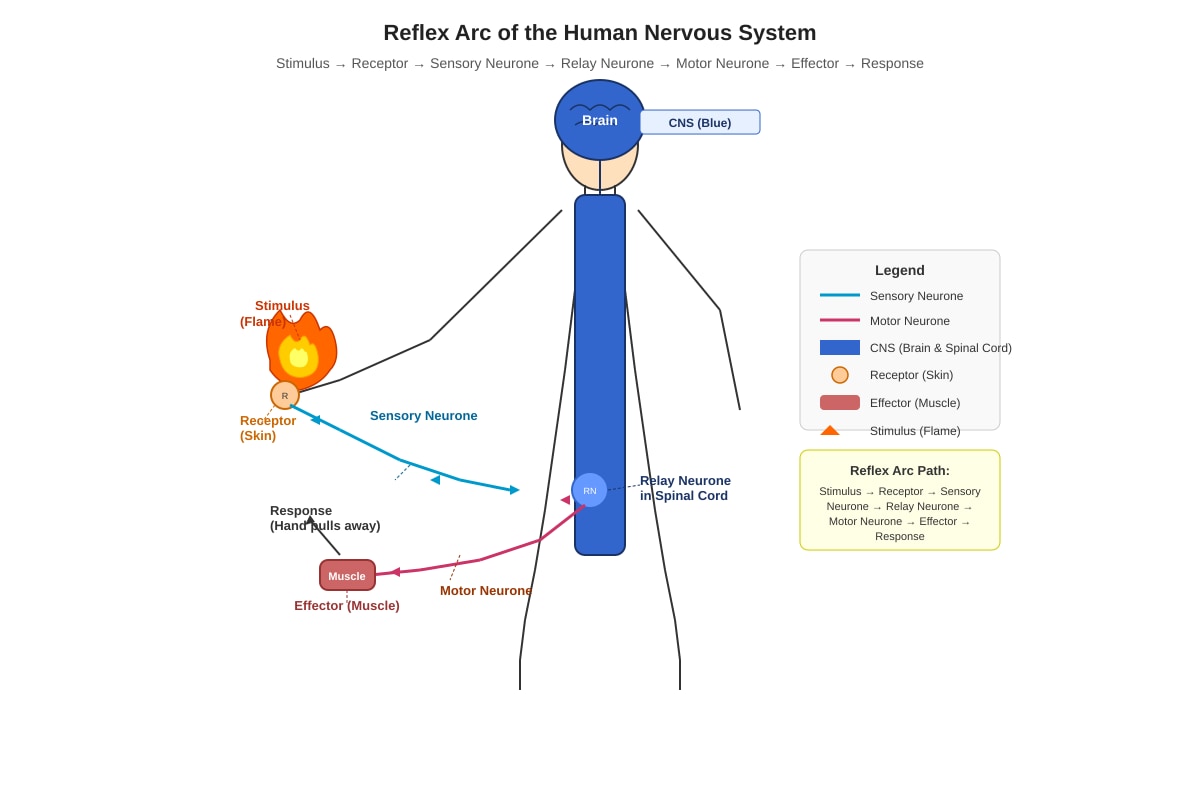
9. The diagram shows part of the human nervous system.
<image_placeholder> id: Q9-fig1 type: diagram linked_question: Q9 description: Human figure showing central nervous system (brain and spinal cord in blue) and peripheral nerves; detailed reflex arc from hand to spinal cord and back to muscle; stimulus shown as flame near finger labels: brain, spinal cord, sensory neurone, relay neurone in spinal cord, motor neurone, effector (muscle), receptor (skin), stimulus (flame) values: none must_show: Full reflex arc with 3 neurones; direction of nerve impulses with arrows; CNS shown in different colour; stimulus and response clearly indicated </image_placeholder>
(a) The central nervous system consists of the brain and which other structure? (1 mark)
(b) Describe the sequence of events when the finger touches a hot object, from receptor to response. (3 marks)
(c) Explain the advantage of a reflex action compared to a voluntary action in this situation. (1 mark)
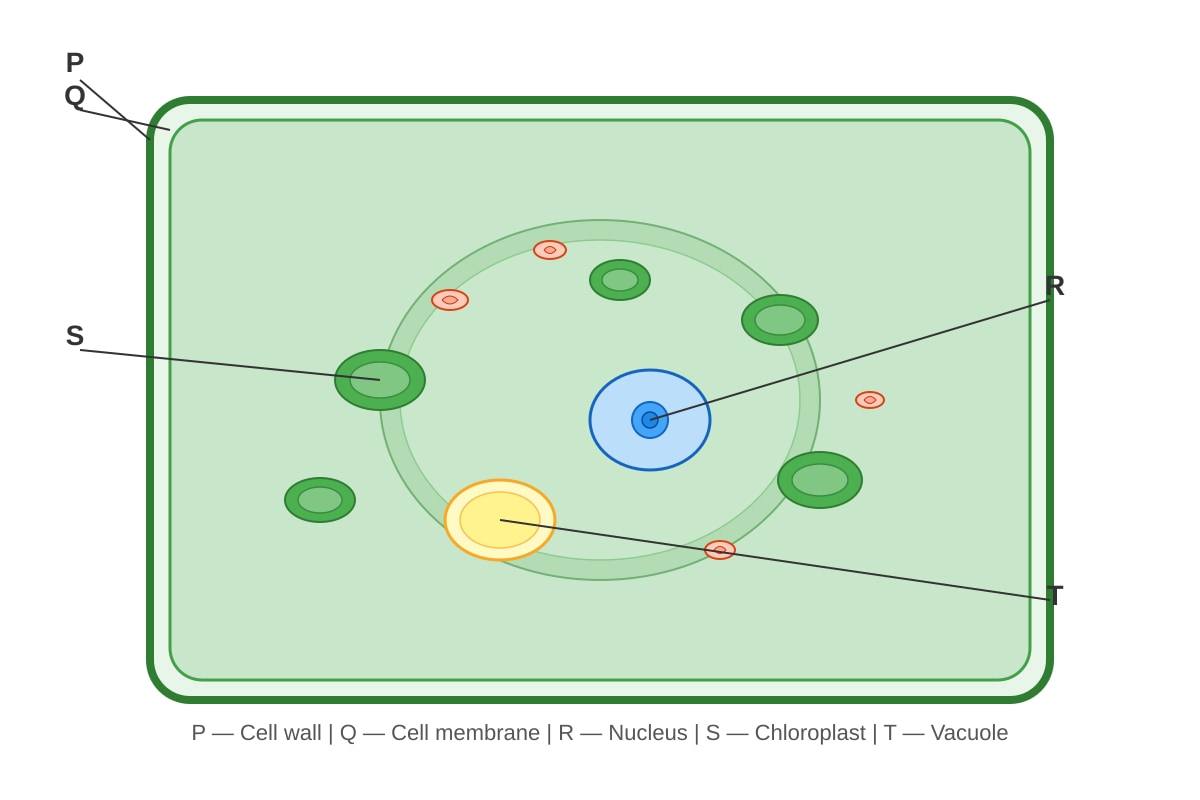
10. The diagram shows a plant cell.
<image_placeholder> id: Q10-fig1 type: diagram linked_question: Q10 description: Typical plant cell with cell wall, cell membrane, cytoplasm, nucleus, large vacuole, chloroplasts, mitochondria; labels pointing to each structure labels: P (cell wall), Q (cell membrane), R (nucleus), S (chloroplast), T (vacuole) values: none must_show: Rectangular shape due to cell wall; large central vacuole; multiple chloroplasts; nucleus near cell membrane; labels P-T </image_placeholder>
(a) State two structures found in plant cells but not in animal cells. (1 mark)
(b) Explain the function of structure S during photosynthesis. (2 marks)
(c) Describe what would happen to the cell if structure P were removed. (1 mark)
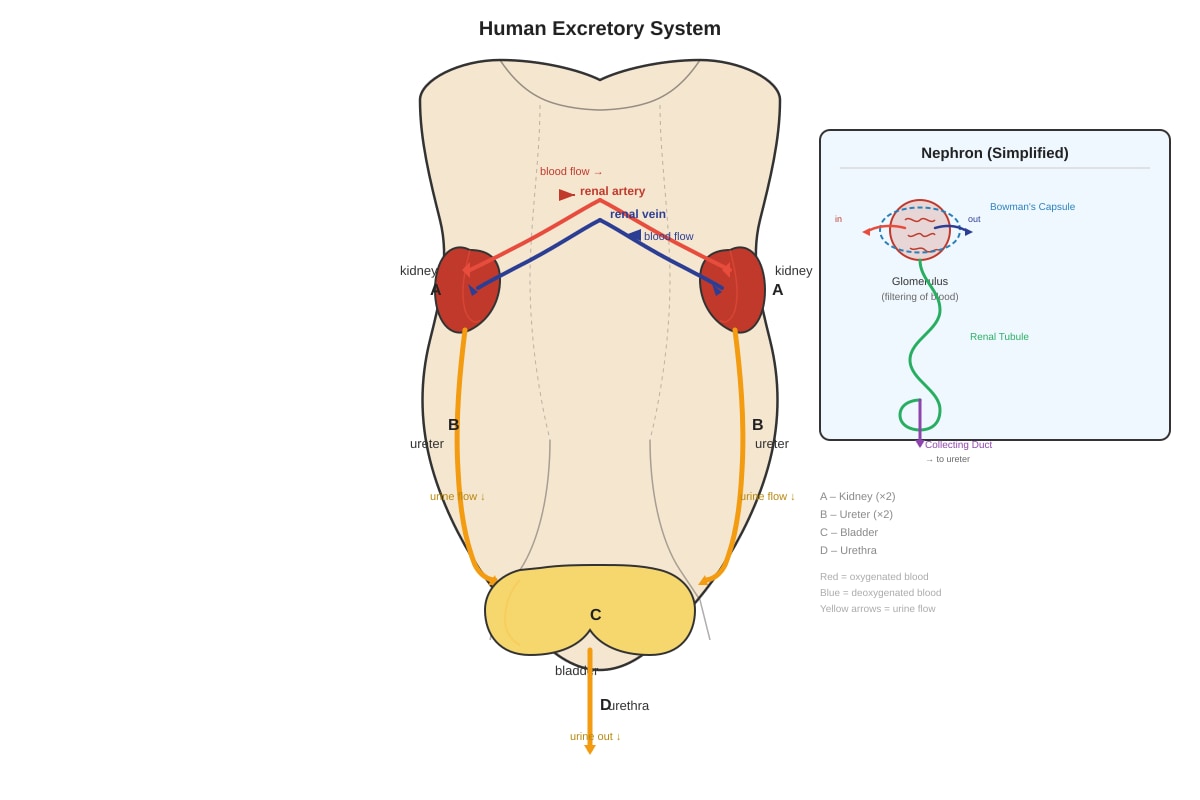
11. The diagram shows the human excretory system.
<image_placeholder> id: Q11-fig1 type: diagram linked_question: Q11 description: Human torso showing kidneys, ureters, bladder, urethra; renal artery and renal vein; simplified nephron structure inset; direction of blood flow and urine flow shown with arrows labels: A (kidney), B (ureter), C (bladder), D (urethra), renal artery, renal vein, nephron (inset) values: none must_show: Paired kidneys at back; ureters descending to bladder; urethra exiting bladder; blood supply via renal artery and vein; nephron detail in inset </image_placeholder>
(a) Name the liquid waste produced by structure A. (1 mark)
(b) Explain why structure C is able to expand and contract. (2 marks)
(c) Describe what happens to the waste if structure B is blocked. (1 mark)
12. The table shows the composition of inhaled and exhaled air.
| Component | Inhaled air (%) | Exhaled air (%) |
|---|---|---|
| Nitrogen | 78 | 78 |
| Oxygen | 21 | 16 |
| Carbon dioxide | 0.04 | 4 |
| Water vapour | Variable | Saturated |
(a) Explain why the percentage of oxygen decreases in exhaled air. (2 marks)
(b) During exercise, the breathing rate increases. Explain why this is necessary. (2 marks)
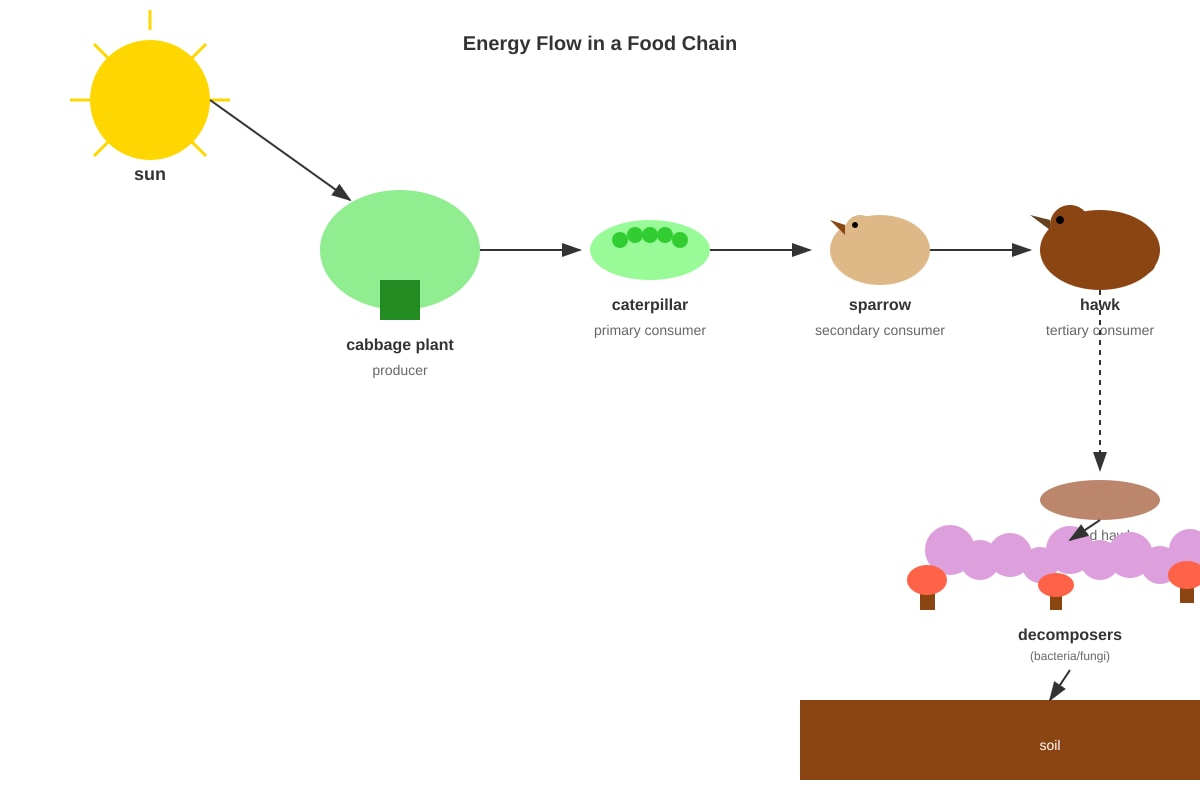
13. The diagram shows a food chain in a garden ecosystem.
<image_placeholder> id: Q13-fig1 type: diagram linked_question: Q13 description: Food chain diagram: cabbage plant → caterpillar → sparrow → hawk; arrows showing energy flow; sun providing energy to cabbage; decomposers (bacteria/fungi) shown breaking down dead hawk labels: producer, primary consumer, secondary consumer, tertiary consumer, decomposers, sun values: none must_show: Trophic levels with correct labels; arrows pointing in direction of energy transfer; sun as energy source; decomposers returning nutrients to soil </image_placeholder>
(a) Name the producer in this food chain. (1 mark)
(b) Explain why only about 10% of energy is transferred from the caterpillar to the sparrow. (2 marks)
(c) Describe the role of decomposers in this ecosystem. (1 mark)
14. The diagram shows the structure of the human eye.
<image_placeholder> id: Q14-fig1 type: diagram linked_question: Q14 description: Cross-section of human eye showing cornea, iris, pupil, lens, ciliary muscles, suspensory ligaments, retina, optic nerve, vitreous humour; light rays from distant object entering eye and focusing on retina labels: A (cornea), B (iris), C (lens), D (retina), E (optic nerve) values: none must_show: Light rays bending at cornea and lens; focal point on retina; lens shape for distant vision; clear path from front to back of eye; all labels A-E </image_placeholder>
(a) State the function of structure A. (1 mark)
(b) Explain how structure C changes shape to focus on near objects. (2 marks)
(c) A person cannot see distant objects clearly. State which structure is most likely not functioning correctly. (1 mark)
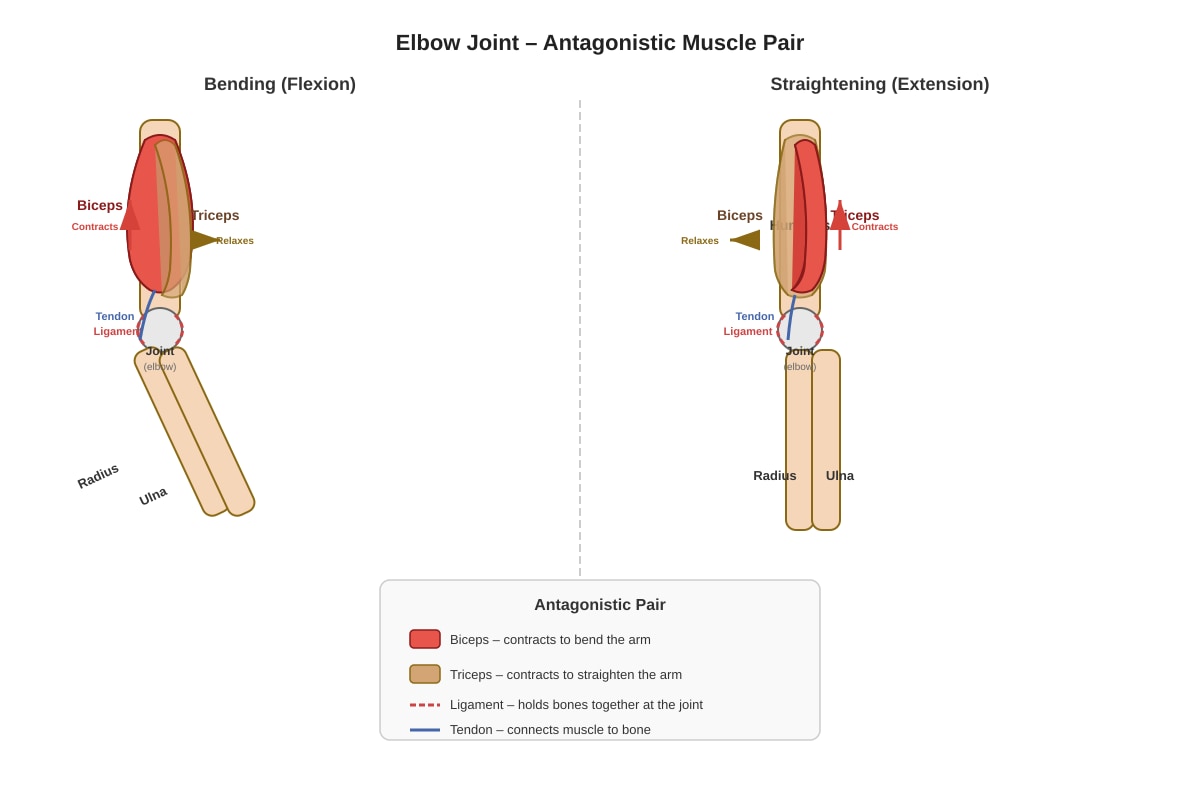
15. The diagram shows the human skeletal-muscular system working at the elbow joint.
<image_placeholder> id: Q15-fig1 type: diagram linked_question: Q15 description: Arm showing elbow joint with humerus, radius, ulna; biceps and triceps muscles labelled as antagonistic pair; arrows showing contraction and relaxation; ligaments at joint shown; tendon connecting muscle to bone labels: humerus, radius, ulna, biceps, triceps, ligament, tendon, joint (elbow) values: none must_show: Biceps contracted/triceps relaxed for bending; triceps contracted/biceps relaxed for straightening; ligaments holding bones together; tendon attachment points </image_placeholder>
(a) State the type of joint found at the elbow. (1 mark)
(b) Explain how the biceps and triceps work together to bend the arm. (2 marks)
(c) Describe the function of ligaments at this joint. (1 mark)
Section C: Application and Data Analysis (Questions 16–20)
Write your answers in the spaces provided. Show all working.
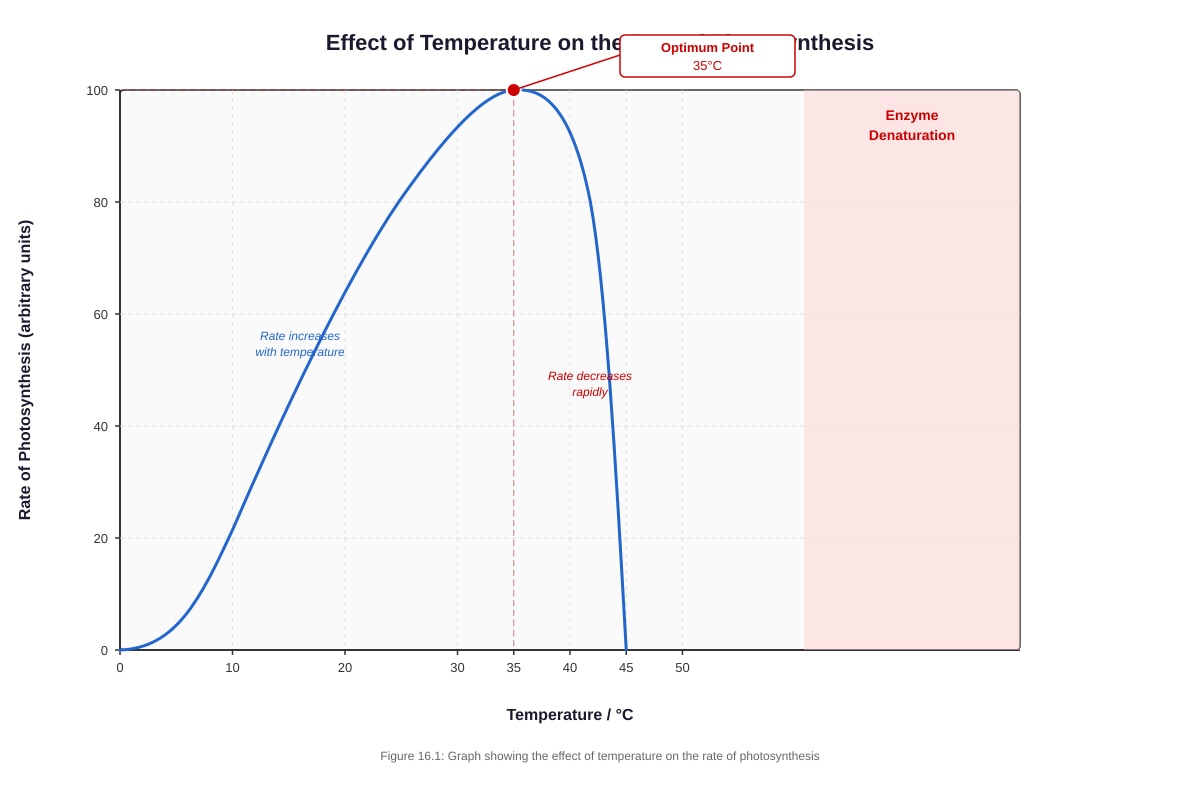
16. The graph shows the effect of temperature on the rate of photosynthesis in a green plant.
<image_placeholder> id: Q16-fig1 type: graph linked_question: Q16 description: Line graph with temperature (°C) on x-axis (0-50°C) and rate of photosynthesis (arbitrary units) on y-axis; curve rising from 0 to optimum at 35°C, then falling sharply to zero at 45°C; labels for optimum point, enzyme denaturation region labels: x-axis: Temperature / °C (0, 10, 20, 30, 35, 40, 45, 50); y-axis: Rate of photosynthesis; optimum point at 35°C; shaded region labeled enzyme denaturation values: 0 at 0°C, rising to maximum at 35°C, falling to 0 at 45°C must_show: Bell-shaped curve; clear peak at 35°C; sharp decline after 40°C; both axes labelled with units; zero rate at low and high extremes </image_placeholder>
(a) State the optimum temperature for photosynthesis shown on the graph. (1 mark)
(b) Explain why the rate of photosynthesis decreases above 35°C. (2 marks)
(c) A student claims that photosynthesis stops completely at 45°C. Using your knowledge of enzymes, evaluate this claim. (3 marks)
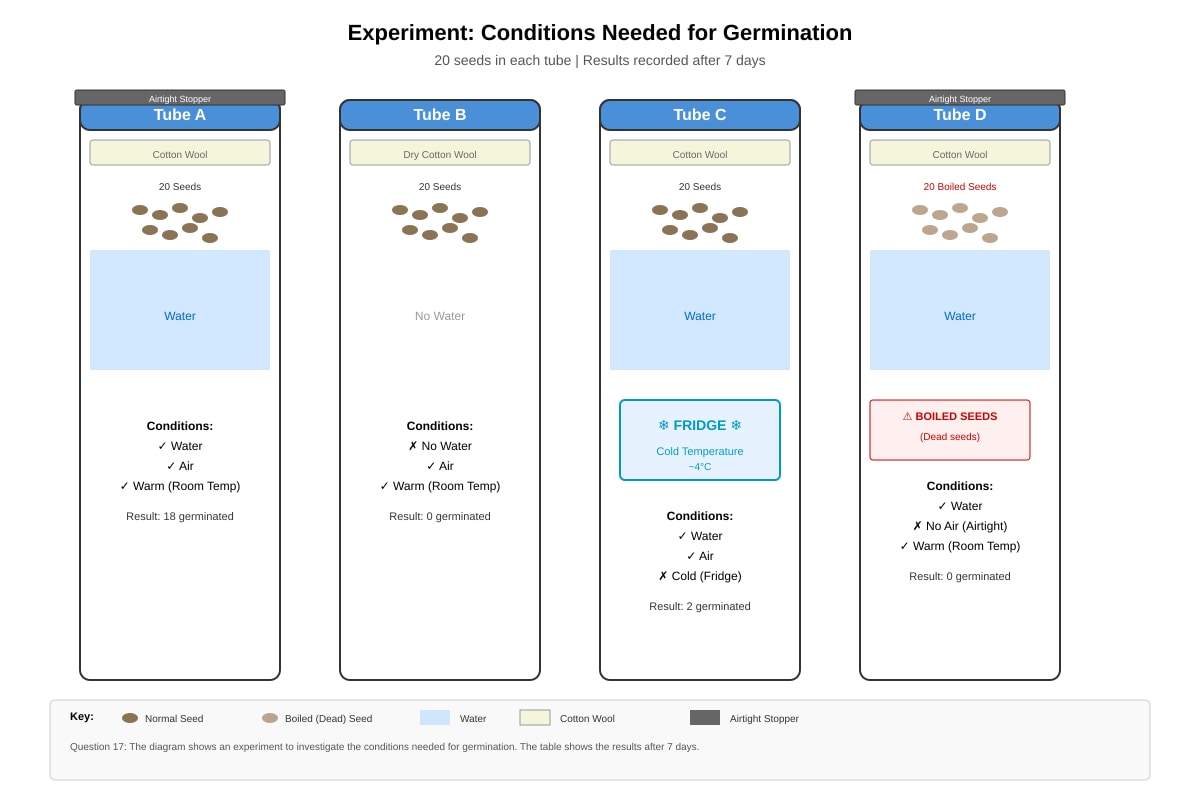
17. The diagram shows an experiment to investigate the conditions needed for germination.
<image_placeholder> id: Q17-fig1 type: experimental_setup linked_question: Q17 description: Four boiling tubes setup: Tube A (seeds, water, cotton wool, airtight stopper, room temperature); Tube B (seeds, dry cotton wool, room temperature); Tube C (seeds, water, cotton wool, placed in fridge); Tube D (boiled seeds, water, cotton wool, room temperature, airtight stopper) labels: Tube A - water, air, warm; Tube B - no water, air, warm; Tube C - water, air, cold; Tube D - boiled seeds, water, no air (airtight), warm; all with cotton wool values: 20 seeds in each tube; 7 days duration must_show: Clear differences between tubes; airtight stoppers on A and D; fridge for C; dry cotton wool for B; boiled seeds note for D; seeds visible in each tube </image_placeholder>
The table shows the results after 7 days.
| Tube | Conditions | Number of seeds germinated |
|---|---|---|
| A | Water, air, warm | 18 |
| B | No water, air, warm | 0 |
| C | Water, air, cold | 2 |
| D | Water, no air, warm | 0 |
(a) Explain why Tube A is used in this experiment. (2 marks)
(b) Using the results, explain whether water or temperature is more important for germination. (3 marks)
(c) Suggest why 2 seeds germinated in Tube C despite the cold conditions. (1 mark)
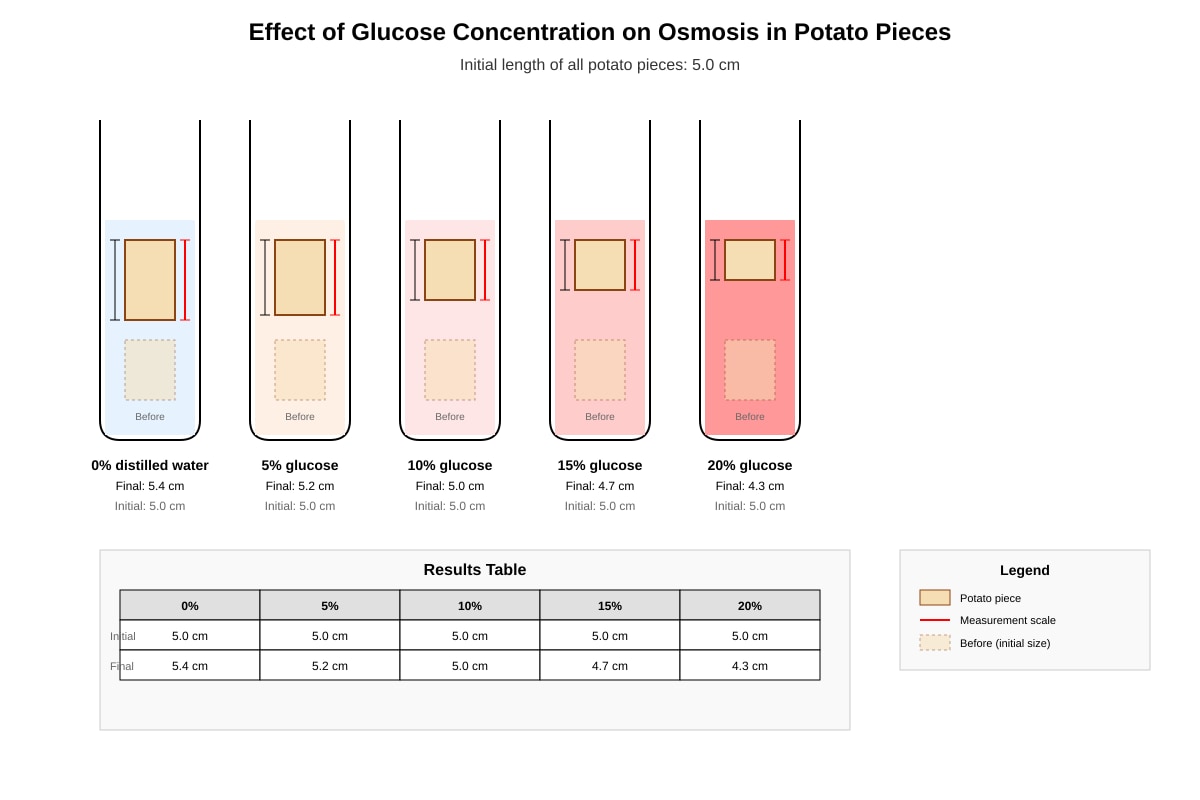
18. The diagram shows an investigation into the effect of different concentrations of glucose solution on osmosis in potato pieces.
<image_placeholder> id: Q18-fig1 type: experimental_setup linked_question: Q18 description: Five test tubes with potato pieces of equal size in different glucose concentrations (0%, 5%, 10%, 15%, 20%); potato drawn before and after showing size change; ruler showing measurements labels: 0% distilled water, 5%, 10%, 15%, 20% glucose; initial length 5.0 cm for all; final lengths shown in table below figure values: initial length 5.0 cm each; final lengths: 5.4 cm (0%), 5.2 cm (5%), 5.0 cm (10%), 4.7 cm (15%), 4.3 cm (20%) must_show: Equal sized potato pieces; different concentrations clearly labelled; measuring ruler; before/after comparison visible; beaker/container for each solution </image_placeholder>
(a) Calculate the percentage change in length of the potato piece in 20% glucose solution. Show your working. (2 marks)
(b) Explain why the potato piece in distilled water increased in length. (2 marks)
(c) A student concluded that the concentration of glucose inside the potato cells is 10%. Evaluate whether the data supports this conclusion. (2 marks)
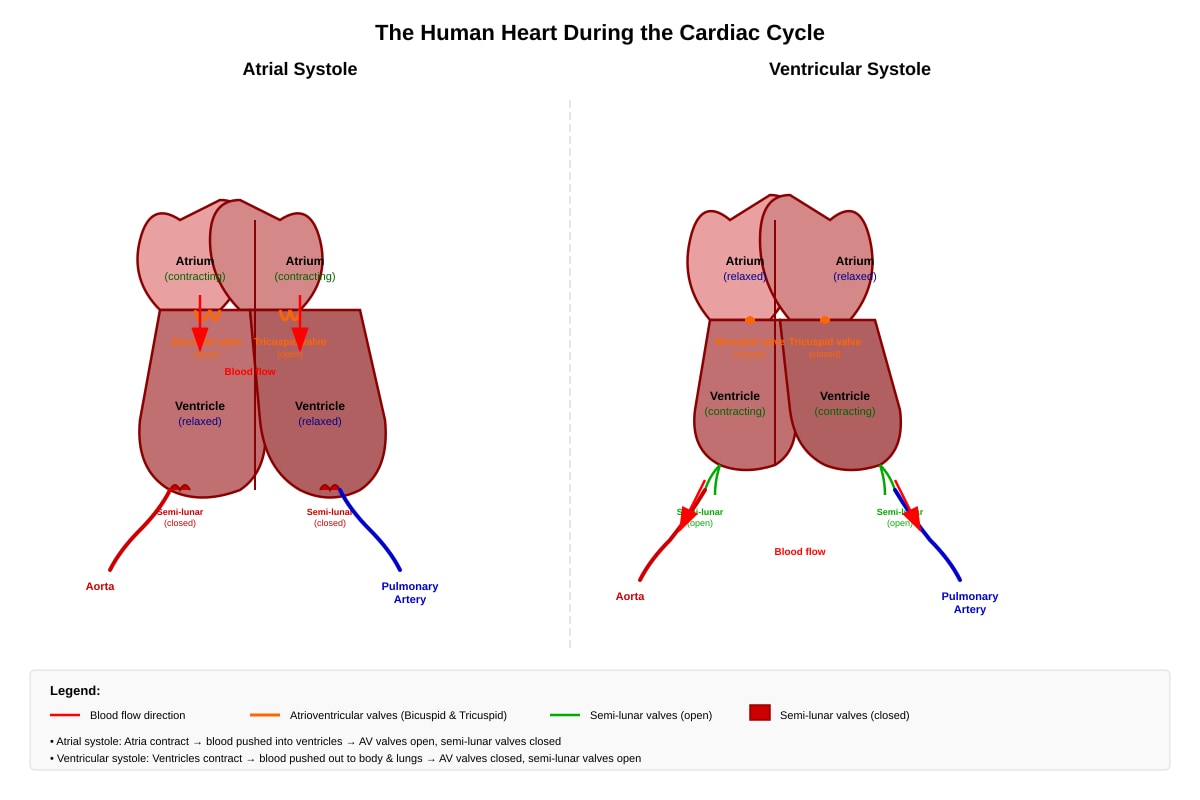
19. The diagram shows the human heart during the cardiac cycle.
<image_placeholder> id: Q19-fig1 type: diagram linked_question: Q19 description: Two diagrams of heart side by side: left diagram shows atria contracting (systole), ventricles relaxed, arrows showing blood pushed into ventricles; right diagram shows ventricles contracting, atria relaxed, arrows showing blood pushed out to body and lungs; valves shown closed/open labels: atrium (relaxed/contracting), ventricle (relaxed/contracting), bicuspid valve, tricuspid valve, semi-lunar valves, aorta, pulmonary artery; arrows for blood flow values: none must_show: Valve states (open/closed) in each phase; blood flow directions clear; first diagram labelled atrial systole, second labelled ventricular systole; atrioventricular valves and semi-lunar valves distinguishable </image_placeholder>
(a) State whether the bicuspid valve is open or closed during atrial systole. (1 mark)
(b) Describe what happens to the semi-lunar valves during ventricular systole and explain why. (3 marks)
(c) Calculate the heart rate if one complete cardiac cycle takes 0.8 seconds. Show your working. (2 marks)
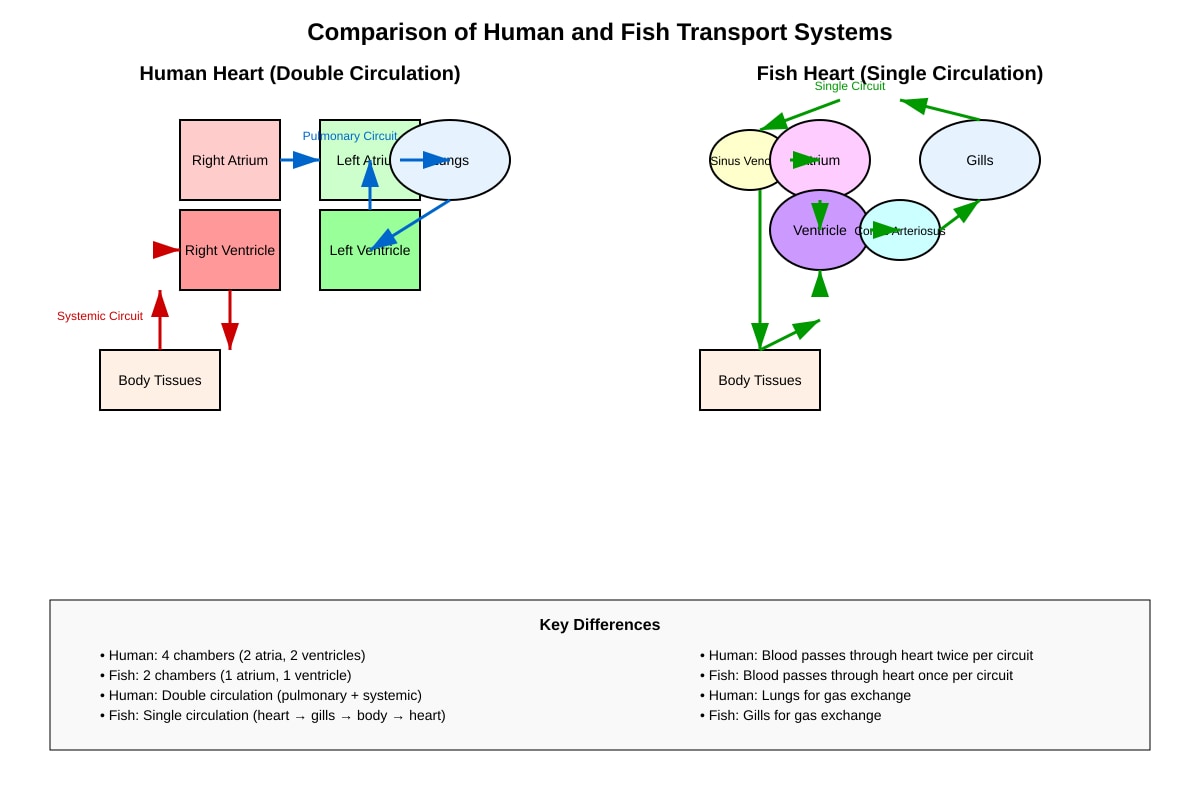
20. The diagram shows a comparison of the human and fish transport systems.
<image_placeholder> id: Q20-fig1 type: diagram linked_question: Q20 description: Two diagrams side by side: human heart with four chambers, double circulatory system arrows; fish heart with two chambers, single circulatory system arrows; both showing gills/lungs and body tissues labels: human: left atrium, left ventricle, right atrium, right ventricle, pulmonary circuit, systemic circuit; fish: atrium, ventricle, sinus venosus, conus arteriosus, gills, single circuit to body values: none must_show: Four chambers vs two chambers clearly; double circulation with two loops in human; single circulation in fish with blood passing through heart once per circuit; gills in fish vs lungs in human </image_placeholder>
(a) State one advantage of the human double circulatory system over the fish single circulatory system. (1 mark)
(b) Explain why a fish heart with two chambers is sufficient for its needs, despite being less efficient than a human heart. (2 marks)
(c) Some fish species can survive in water with very low oxygen levels. Suggest how their circulatory system might be adapted to meet this challenge. (2 marks)
END OF QUIZ
Total: 40 marks
Answers
Primary 6 PSLE Science Quiz - Systems
ANSWER KEY
Total Marks: 40
Section A: Multiple Choice
1. Answer: B — Oesophagus (1 mark)
- The oesophagus is a muscular tube that transports food from mouth to stomach by peristalsis. It does not produce any digestive enzymes.
- The mouth produces saliva containing amylase (starch digestion).
- The stomach produces pepsin and hydrochloric acid (protein digestion).
- The small intestine produces multiple enzymes: maltase, lactase, sucrase, peptidase, and receives bile and pancreatic enzymes.
- Common mistake: Students confuse the oesophagus with organs of chemical digestion. The oesophagus is purely for transport (mechanical movement only).
2. Answer: A — Legs → vena cava → right atrium → right ventricle → pulmonary artery → lungs (1 mark)
- This is the correct path of deoxygenated blood returning to the heart and then to the lungs for oxygenation.
- Step-by-step reasoning:
- Deoxygenated blood from legs enters the inferior vena cava
- Enters right atrium (top right chamber)
- Passes to right ventricle (bottom right chamber)
- Pumped via pulmonary artery to lungs (only artery carrying deoxygenated blood)
- Why other options wrong:
- B: Blood does NOT go to left side before lungs — this would skip oxygenation.
- C: Aorta carries blood AWAY from heart to body, not toward it.
- D: Pulmonary vein carries oxygenated blood FROM lungs TO heart, wrong direction.
3. Answer: C — To exchange gases between the body and the environment (1 mark)
- The respiratory system (lungs, trachea, bronchus, alveoli) performs gas exchange: taking in oxygen and releasing carbon dioxide.
- A describes the circulatory system (blood transport).
- B describes the digestive/excretory system.
- D describes the circulatory system (heart function).
4. Answer: C — Sensitivity (1 mark)
- Sensitivity (or irritability/response to stimuli) is the ability of living things to detect and respond to changes in their environment.
- The plant shoot grows toward light — this is phototropism, a response to light stimulus.
- Other characteristics: reproduction (making offspring), respiration (energy release), excretion (waste removal).
5. Answer: B — P: carry oxygen; Q: fight disease; R: clot blood; S: transport nutrients and waste (1 mark)
| Component | Correct Function |
|---|---|
| Red blood cells | Contain haemoglobin → bind and carry oxygen (also some CO₂) |
| White blood cells | Phagocytosis and antibody production → fight disease/ infection |
| Platelets | Release clotting factors → blood clotting at wounds |
| Plasma | Liquid medium → transport nutrients, hormones, waste products |
Section B: Structured Questions
6. (a) — 1 mark
Two functions of the waxy cuticle:
- Prevents water loss / reduces transpiration (any one for 1 mark)
- Protects leaf from physical damage / pathogens (either acceptable)
6. (b) — 2 marks
The palisade layer (X) contains the most chloroplasts because:
- It is the upper layer of mesophyll, closest to the upper epidermis and light source (1 mark)
- Its cells are column-shaped and tightly packed to maximize light absorption and hold many chloroplasts efficiently (1 mark)
Teaching note: Chloroplasts contain chlorophyll, the green pigment that traps light energy for photosynthesis. The palisade layer is adapted for maximum light capture.
6. (c) — 1 mark
Carbon dioxide enters through the stoma (Z) by diffusion — moving from an area of higher concentration (outside air) to lower concentration (inside leaf where CO₂ is used in photosynthesis).
7. (a) — 1 mark
Fallopian tube / oviduct (structure B)
7. (b) — 2 marks
The uterus (C) has a thick muscular wall because:
- It needs to contract strongly during childbirth to push the baby out through the birth canal (1 mark)
- The muscular layer (myometrium) expands during pregnancy and contracts rhythmically during labour (1 mark)
7. (c) — 1 mark
The ovary (A) is adapted by containing many follicles that can develop into egg cells, and it produces hormones (oestrogen and progesterone) to regulate the menstrual cycle.
8. (a) — 1 mark
The Sun / solar energy / heat from the Sun
8. (b) — 2 marks
Condensation (Q) happens at higher altitudes because:
- Temperature decreases with altitude / air is cooler higher up (1 mark)
- Cooler air cannot hold as much water vapour, so water vapour condenses into liquid water droplets forming clouds (1 mark)
8. (c) — 1 mark
Rainwater infiltrates / seeps into the ground to become groundwater, which may eventually flow into rivers, lakes, or aquifers, or be absorbed by plant roots.
9. (a) — 1 mark
The spinal cord
9. (b) — 3 marks
Sequence of reflex arc (1 mark for correct order, 2 marks for explanation):
- Receptor in the skin detects heat/pain and generates nerve impulse (½ mark)
- Sensory neurone transmits impulse to the spinal cord (CNS) (½ mark)
- Relay neurone in the spinal cord passes impulse to motor neurone (½ mark)
- Motor neurone carries impulse to effector (muscle) causing it to contract and pull hand away (½ mark + ½ mark for "muscle contracts")
- Brain is informed after the reflex has occurred (½ mark for awareness/monitoring)
Teaching note: The reflex arc bypasses the brain for speed — the brain receives the message later so you are aware of what happened.
9. (c) — 1 mark
A reflex action is faster because it does not travel to the brain; it goes only to the spinal cord and back, protecting the body from injury more quickly.
10. (a) — 1 mark
Any two from: cell wall, chloroplasts, large permanent vacuole (½ mark each, 1 mark total)
10. (b) — 2 marks
Structure S (chloroplast) contains chlorophyll which (1 mark):
- Traps/absorbs light energy from the sun (½ mark)
- Uses this energy to convert carbon dioxide and water into glucose and oxygen during photosynthesis (½ mark)
10. (c) — 1 mark
Without the cell wall (P), the cell would lose its rigid shape / become flaccid and may burst if too much water enters by osmosis (there is no wall to provide structural support or protection against excessive water uptake).
11. (a) — 1 mark
Urine
11. (b) — 2 marks
The bladder (C) can expand and contract because:
- Its wall contains smooth muscle (detrusor muscle) that can contract to push urine out (1 mark)
- The lining is folded/rugae and the wall is elastic, allowing it to stretch and store urine before emptying (1 mark)
11. (c) — 1 mark
If the ureter (B) is blocked, urine cannot drain from the kidney to the bladder. This causes urine to back up in the kidney, potentially causing kidney damage, infection, or swelling (hydronephrosis).
12. (a) — 2 marks
Oxygen decreases in exhaled air because:
- Oxygen is absorbed into the blood in the lungs at the alveoli (1 mark)
- It is used by body cells for aerobic respiration to release energy (1 mark)
12. (b) — 2 marks
During exercise:
- Muscles need more energy, so they need more oxygen for increased aerobic respiration (1 mark)
- Increased breathing rate means more air (and oxygen) is taken in per minute, and more carbon dioxide (waste product) is removed more quickly (1 mark)
13. (a) — 1 mark
Cabbage (plant)
13. (b) — 2 marks
Only about 10% of energy transfers to the next level because:
- Most energy is lost as heat during respiration for life processes (movement, maintaining body temperature) (1 mark)
- Some energy is lost in indigestible parts / waste (faeces), and some energy remains in uneaten parts / dead organisms (1 mark)
13. (c) — 1 mark
Decomposers (bacteria and fungi) break down dead organisms and waste, releasing nutrients/minerals back into the soil for the producer (cabbage) to absorb and reuse.
14. (a) — 1 mark
The cornea (A) refracts/bends light entering the eye, helping to focus light onto the retina.
14. (b) — 2 marks
To focus on near objects:
- The ciliary muscles contract (1 mark)
- This makes the suspensory ligaments slacken, allowing the lens to become thicker/more convex (1 mark), which increases its refractive power to focus light from close objects onto the retina.
14. (c) — 1 mark
The lens (C) — this person is myopic/short-sighted; the lens may be too curved or the eyeball too long, causing images to focus in front of the retina instead of on it.
15. (a) — 1 mark
Hinge joint (or synovial joint)
15. (b) — 2 marks
To bend the arm:
- The biceps muscle contracts and pulls on the radius bone (1 mark)
- At the same time, the triceps muscle relaxes, allowing this movement to occur (1 mark)
- This is antagonistic muscle action — muscles work in opposite pairs.
15. (c) — 1 mark
Ligaments hold bones together at the joint, providing stability and preventing dislocation while allowing controlled movement.
Section C: Application and Data Analysis
16. (a) — 1 mark
35°C
16. (b) — 2 marks
Above 35°C:
- The enzymes involved in photosynthesis begin to denature (1 mark)
- This means their active site changes shape, so they can no longer bind efficiently to substrate molecules, slowing the reaction rate (1 mark)
16. (c) — 3 marks
Evaluation of the claim:
| Aspect | Marking point |
|---|---|
| The claim is partially correct / needs qualification | (½ mark) |
| Above 45°C, the graph shows zero rate of photosynthesis measured | (1 mark) |
| However, this is likely because enzymes are denatured, not that the process conceptually "stops" — with denatured enzymes, the reaction cannot proceed | (1 mark) |
| If temperature were reduced quickly enough, some enzymes might refold and function again; permanently denatured enzymes cannot | (½ mark) |
Full marks for nuanced evaluation: The student should recognize the measurement shows zero, but explain this as enzyme denaturation — a physical/chemical failure of biological catalysts rather than photosynthesis "choosing" to stop.
17. (a) — 2 marks
Tube A is the control (1 mark) because it has all factors present (water, air, warmth) so it shows normal germination conditions for comparison with tubes where one factor is removed (1 mark).
17. (b) — 3 marks
Analysis of whether water or temperature is more important:
| Evidence | Conclusion |
|---|---|
| Tube B (no water, warm): 0% germination | Without water, no germination at all |
| Tube C (water, cold): 2/20 germinated (10%) | With water but cold, very low germination |
| Difference: 0% vs 10% | More seeds germinated with water present (even when cold) than with no water (even when warm) |
Conclusion: Water is more critical than optimal temperature for germination to occur at all, though warmth greatly increases the rate/success (3 marks for reasoned conclusion with data comparison, 2 marks for partial analysis, 1 mark for attempt)
17. (c) — 1 mark
Possible reasons: those 2 seeds may have different genetic tolerance to cold, or the fridge temperature fluctuated/was not consistently cold, or seed dormancy was broken by other factors for those particular seeds.
18. (a) — 2 marks
Calculation:
Answer: -14% (or decreased by 14%) — decrease must be indicated (2 marks with working, 1 mark partial)
18. (b) — 2 marks
In distilled water (0% glucose):
- Water concentration is higher outside the potato than inside the potato cells (1 mark)
- Water moves into the potato cells by osmosis (down the water potential gradient), causing cells to swell and the potato to increase in length/turgidity (1 mark)
18. (c) — 2 marks
| Evaluation point | Mark |
|---|---|
| At 10% glucose, no change in length (5.0 cm → 5.0 cm), suggesting equal water potential / no net osmosis | (1 mark) |
| This supports the conclusion that internal concentration is approximately 10% | (½ mark) |
| However, we cannot be exactly certain without testing more concentrations between 5% and 15% to find the precise equilibrium point | (½ mark) |
19. (a) — 1 mark
Open — during atrial systole, blood is pushed from atria into ventricles, so the atrioventricular valves (bicuspid/tricuspid) must be open.
19. (b) — 3 marks
During ventricular systole:
| What happens | Why |
|---|---|
| Semi-lunar valves OPEN | (½ mark) |
| Blood pressure in ventricles exceeds pressure in arteries | (1 mark) |
| This pressure gradient pushes semi-lunar valves open, allowing blood to exit into aorta and pulmonary artery | (1 mark) |
| Atrioventricular valves are closed at this time to prevent backflow into atria | (½ mark) |
19. (c) — 2 marks
Calculation:
Answer: 75 bpm (or 75 beats/min) — 2 marks with working, 1 mark for correct method with error.
20. (a) — 1 mark
One advantage: higher blood pressure / faster blood flow to body tissues, allowing more efficient delivery of oxygen and nutrients and better removal of waste; OR oxygenated and deoxygenated blood do not mix; OR can maintain different pressures in pulmonary and systemic circuits.
20. (b) — 2 marks
Two chambers are sufficient because:
- Fish have lower metabolic demands than mammals / are cold-blooded (ectothermic), so they need less oxygen than humans (1 mark)
- Water contains less dissolved oxygen than air, so gills are adapted with counter-current exchange to maximise extraction; the simpler heart is adequate for their lower energy needs and aquatic environment (1 mark)
20. (c) — 2 marks
Possible adaptations in low-oxygen environments:
| Adaptation | Explanation |
|---|---|
| More efficient gill structure / larger gill surface area | Extracts more oxygen from poorly oxygenated water |
| Slower metabolism / ability to tolerate low oxygen | Reduces overall oxygen demand |
| Special haemoglobin with higher oxygen affinity | Binds oxygen more strongly even at low concentrations |
| Ability to breathe atmospheric air (some species) | Supplemental air breathing |
Any 2 reasonable suggestions with explanation: 2 marks (1 mark each)
END OF ANSWER KEY