From Real Exams Quiz
Primary 6 PSLE Science Systems Quiz
Free P6 PSLE Science Systems quiz, HY3 Exam version, with questions, answers, and PSLE-focused practice for Singapore students.
These static practice materials are generated from the site's syllabus and paper-generation workflow, with source and model context shown so students and parents can evaluate the material before use.
Questions
Free quiz and exam paper access
Enter your details to view this paper
Your access is remembered on this device.
Answers
Primary 6 PSLE Science Quiz - Systems (Answer Key)
Total Marks: 40
Topic: Systems
Section A (1 mark each)
1. B
Teaching note: The lung is part of the respiratory system, not the digestive system. Digestive system parts include mouth, stomach, small intestine (and others). Common mistake: confusing breathing with eating.
2. B
Teaching note: Red blood cells contain haemoglobin that binds oxygen in the lungs and carries it to all body cells via the circulatory system.
3. B
Teaching note: A force is a push or a pull that can move, stop, or change the shape of an object. It is not energy or matter.
4. C
Teaching note: Gravitational force is the pull of the Earth on objects, giving them weight. Magnetic and elastic are contact/field forces; friction opposes motion.
5. B
Teaching note: Producers (like plants) make their own food by photosynthesis using sunlight, forming the start of the energy flow.
Section B (2 marks each)
6. (2m)
Answer: Two organs: e.g. nose (breathes in air / filters air), lungs (gas exchange: oxygen in, carbon dioxide out).
Marking: 1m per organ + function.
Teaching: Respiratory system brings in oxygen and removes CO₂; examples include nose, trachea, lungs.
7. (2m)
Answer: Friction between our shoes and ground prevents slipping, allowing us to push backward and move forward.
Marking: 1m friction opposes slipping, 1m explains forward movement.
Teaching: Frictional force acts opposite to motion; useful for grip.
8. (2m)
Answer: Elastic spring force; it pulls back (towards original length / opposite to stretch).
Marking: 1m type, 1m direction.
Teaching: Stretched elastic exerts a restoring force opposite to the stretch.
9. (2m)
Answer: Sun → grass (producer) → rabbit (consumer). Rabbit is a consumer (eats producer).
Marking: 1m pathway, 1m role.
Teaching: Energy flows from Sun to producer to consumer.
10. (2m)
Answer: A population is a group of the same kind of organisms living together. Example: a school of fish / flock of birds.
Marking: 1m definition, 1m example.
11. (2m)
Answer: Fish have gills that extract oxygen from water.
Marking: 1m structure, 1m function.
Teaching: Gills are structural adaptations for underwater respiration.
12. (2m)
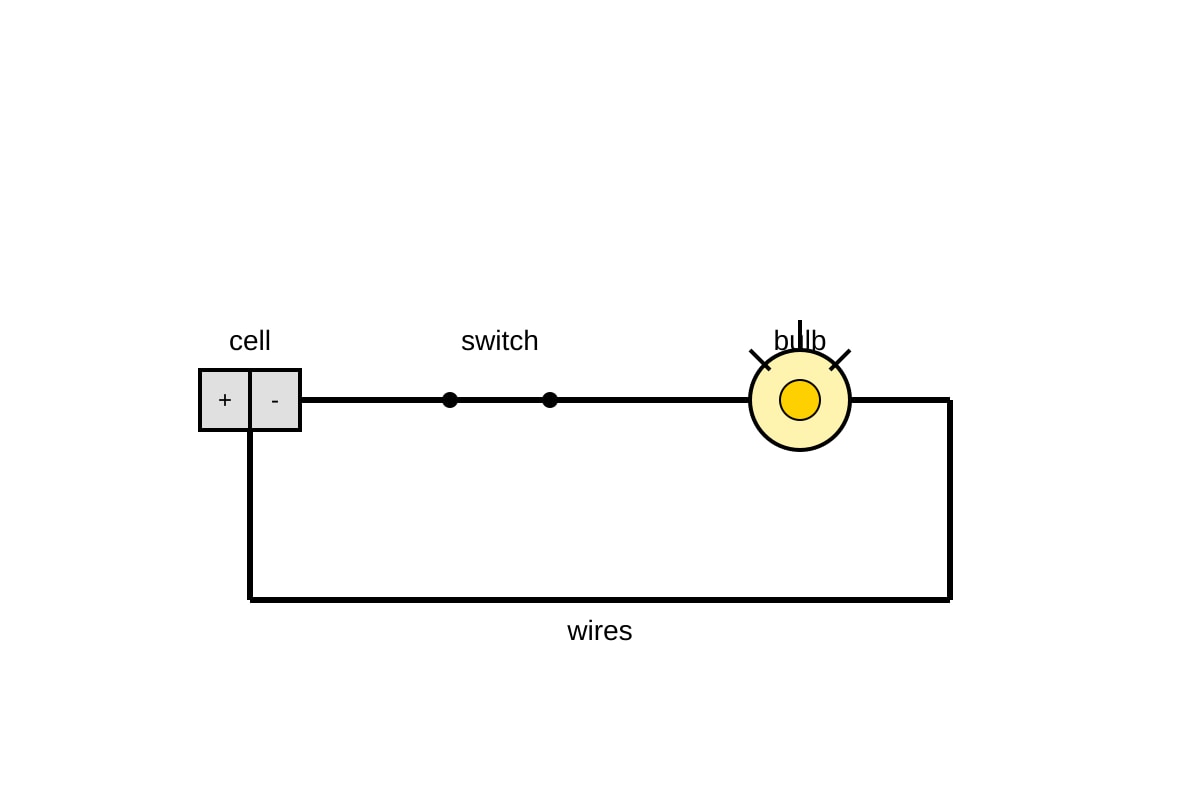
Answer: Bulb lights up because closing the switch completes the circuit, allowing current to flow.
Marking: 1m lights, 1m reason (complete circuit).
Visual: Series circuit with cell, switch closed, bulb lit.
13. (2m)
Answer: Negative: deforestation / pollution; Positive: reforestation / conservation.
Marking: 1m each.
14. (2m)
Answer: Weight = m × g = 1 kg × 10 N/kg = 10 N downward.
Marking: 1m formula/substitution, 1m answer with unit.
Teaching: Weight is gravitational force; use g = 10 N/kg at P6.
15. (2m)
Answer: Decomposers break down dead organisms; this returns nutrients to soil/water for producers.
Marking: 1m action, 1m benefit.
Section C (2 marks each)
16. (2m)
Answer: May start moving; may speed up / change direction / change shape. (Any two)
Marking: 1m per correct effect.
17. (2m)
Answer: Digestive system breaks food into nutrients absorbed into blood; circulatory system transports nutrients/glucose to cells for respiration to release energy.
Marking: 1m digestion absorption, 1m transport to cells for energy.
18. (2m)
Answer: Pond plants = producer; insects & frogs = consumers; bacteria = decomposer.
Marking: 1m correct grouping, 1m all classified.
19. (2m)
Answer: Elastic spring force from stretched rubber band; it pushes pellet forward (starts motion / launches).
Marking: 1m force type, 1m effect on motion.
20. (2m)
Answer: They may adapt and survive; they may move to another place.
Marking: 1m per point. (Die is given; other two from syllabus.)