From Real Exams Quiz

Primary 6 PSLE Science Materials Quiz

Free Exam-Derived NVIDIA Nemotron 3 Ultra 550B A55B Free Primary 6 PSLE Science Materials quiz with questions and answers for Singapore students. This page is rendered as a direct URL so the questions and answers can be discovered without pressing in-page buttons.

These static practice materials are generated from the site's syllabus and paper-generation workflow, with source and model context shown so students and parents can evaluate the material before use.

Primary 6 PSLE Science From Real Exams Generated by NVIDIA Nemotron 3 Ultra 550B A55B Free Updated 2026-06-07

Questions

<!-- TuitionGoWhere generation metadata: stage=3-0; model=nvidia/nemotron-3-ultra-550b-a55b:free; model_label=NVIDIA Nemotron 3 Ultra 550B A55B Free; generated=2026-06-05; Sources: Stage 2-1 real exam-derived templates and Stage 2-2 exam-enriched syllabus. -->

Primary 6 PSLE Science Quiz - Materials

Name: ___________________________
Class: Primary 6 ______
Date: _______________
Score: ______ / 40

Duration: 45 minutes
Total Marks: 40

Instructions:

  1. Answer all questions.
  2. For Section A, choose the correct option and write its number (1, 2, 3, or 4) in the brackets provided.
  3. For Section B and C, write your answers in the spaces provided.
  4. The number of marks for each question is shown in brackets [ ].

Section A: Multiple-Choice Questions (10 × 1 mark = 10 marks)

1. Which of the following is not a property of metals?
(1) Good conductor of heat
(2) Malleable
(3) Transparent
(4) Ductile
[ ]

2. A student wants to make a handle for a cooking pot. Which property is most important for the material used?
(1) Flexibility
(2) Poor conductor of heat
(3) Transparency
(4) Magnetic
[ ]

3. Which material is most suitable for making a window pane?
(1) Wood
(2) Metal
(3) Glass
(4) Rubber
[ ]

4. The diagram below shows a paper clip being attracted to a magnet.

<image_placeholder> id: Q4-fig1 type: diagram linked_question: Q4 description: A bar magnet with its north pole facing a steel paper clip. The paper clip is shown a short distance away from the magnet with an arrow indicating attraction. labels: N (north pole of magnet), S (south pole of magnet), paper clip (steel), arrow showing attraction values: None must_show: Magnet with labelled poles, paper clip, attraction arrow </image_placeholder>

What property of the paper clip allows it to be attracted to the magnet?
(1) It is a metal.
(2) It is made of a magnetic material.
(3) It is a good conductor of electricity.
(4) It is shiny.
[ ]

5. Four strips of different materials (W, X, Y, Z) of the same size and thickness were tested for flexibility. The results are shown in the table below.

MaterialDistance bent (cm) before breaking
W2
X8
Y5
Z12

Which material is the most flexible?
(1) W
(2) X
(3) Y
(4) Z
[ ]

6. Which of the following objects is best made from a transparent material?
(1) A raincoat
(2) A spectacle lens
(3) A frying pan
(4) A towel
[ ]

7. John placed a metal spoon and a plastic spoon into a cup of hot water. After one minute, he touched the handles. The metal spoon handle felt hotter. This shows that metal is a __________.
(1) poor conductor of heat
(2) good conductor of heat
(3) poor conductor of electricity
(4) good conductor of electricity
[ ]

8. The diagram below shows three bars (A, B, C) made of different materials. Each bar is placed between two supports and a 500 g mass is hung from the centre. The amount each bar bends is measured.

<image_placeholder> id: Q8-fig1 type: diagram linked_question: Q8 description: Three horizontal bars (A, B, C) supported at both ends. A 500 g mass hangs from the centre of each bar. Bar A bends slightly, Bar B bends moderately, Bar C bends significantly. labels: Bar A, Bar B, Bar C, supports, 500 g mass, amount of bend (arrows) values: 500 g mass on each bar must_show: Three bars with different amounts of bending under identical load </image_placeholder>

Which bar is made of the stiffest material?
(1) Bar A
(2) Bar B
(3) Bar C
(4) Cannot be determined
[ ]

9. Which property makes rubber suitable for making erasers?
(1) Waterproof
(2) Flexible
(3) Transparent
(4) Magnetic
[ ]

10. A material is waterproof, flexible, and a poor conductor of heat. Which of the following is it most likely to be?
(1) Metal
(2) Glass
(3) Rubber
(4) Wood
[ ]


Section B: Structured Questions (6 × 2 marks = 12 marks)

11. The table below shows the properties of four materials (A, B, C, D).

MaterialWaterproofFlexibleTransparentMagneticConductor of heat
AYesNoYesNoPoor
BYesYesNoNoPoor
CYesNoNoYesGood
DNoNoNoNoPoor

(a) Which material is most suitable for making a raincoat? Give a reason for your choice. [1]


(b) Which material is most suitable for making a cooking pot? Give a reason for your choice. [1]


12. Study the classification chart below.

<image_placeholder> id: Q12-fig1 type: diagram linked_question: Q12 description: A classification flowchart for materials. Top level: Materials. Two branches: Natural and Man-made. Natural branches to: From plants (e.g., cotton, wood, rubber), From animals (e.g., wool, silk, leather), From Earth (e.g., metal ores, clay, sand). Man-made branches to: Plastics, Glass, Alloys, Synthetic fibres. labels: Materials, Natural, Man-made, From plants, From animals, From Earth, Plastics, Glass, Alloys, Synthetic fibres values: None must_show: Complete classification chart with examples </image_placeholder>

(a) State one example of a natural material that comes from animals. [1]


(b) State one example of a man-made material. [1]


13. The diagram below shows an experiment to test the strength of four strings (P, Q, R, S) made of different materials. Each string has the same length and thickness. Weights are added until the string breaks.

<image_placeholder> id: Q13-fig1 type: diagram linked_question: Q13 description: Four strings (P, Q, R, S) suspended from a support. Weights are hung from the bottom of each string. String P holds 2 kg, String Q holds 5 kg, String R holds 3 kg, String S holds 7 kg before breaking. labels: Strings P, Q, R, S, support, weights, maximum weight held values: P: 2 kg, Q: 5 kg, R: 3 kg, S: 7 kg must_show: Four strings with different maximum weights before breaking </image_placeholder>

(a) Which string is the strongest? [1]


(b) State one variable that must be kept the same to ensure a fair test. [1]


14. A student wants to choose a material to make a food container that can be heated in a microwave oven. The container must not melt and must allow microwaves to pass through to heat the food.

(a) State two properties the material must have. [1]


(b) Would metal be suitable? Explain your answer. [1]


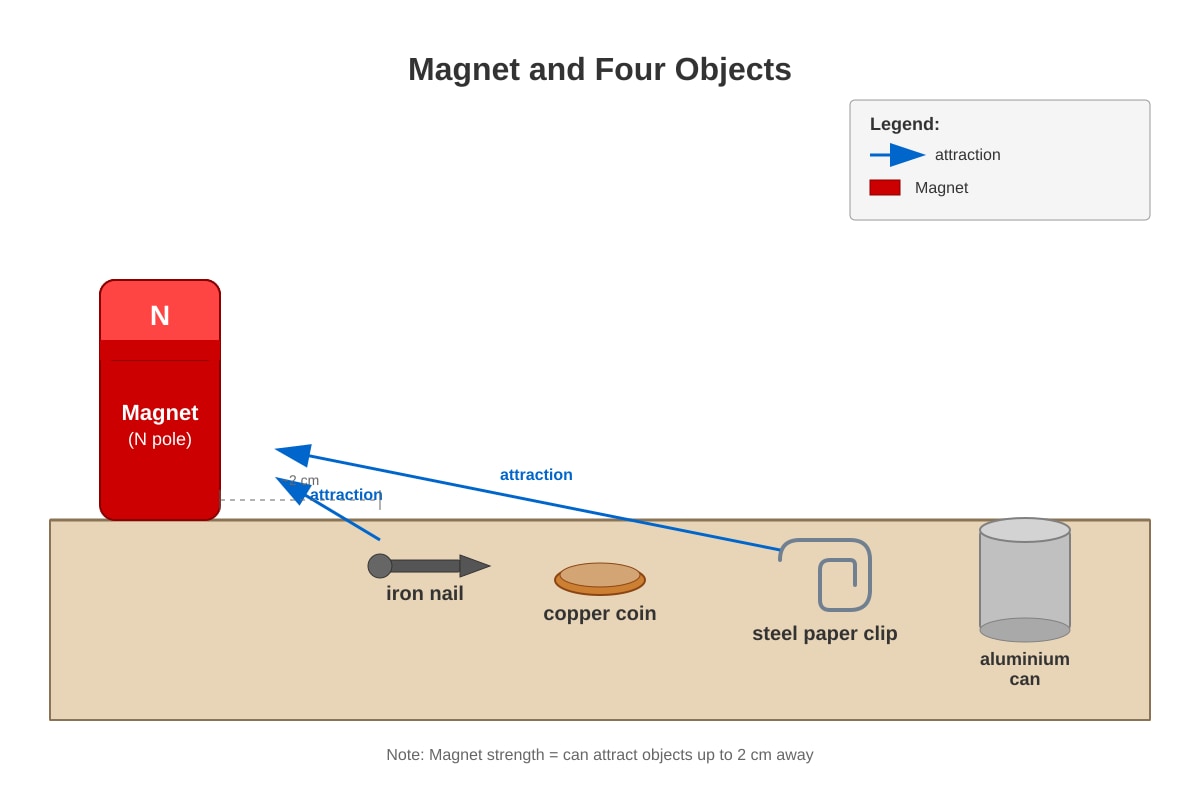
15. The diagram below shows a magnet brought near four objects (W, X, Y, Z). The observations are recorded in the table.

<image_placeholder> id: Q15-fig1 type: diagram linked_question: Q15 description: A bar magnet brought near four objects. Object W is attracted. Object X is attracted. Object Y is not affected. Object Z is repelled. labels: Magnet (N and S poles), Objects W, X, Y, Z, arrows showing attraction/repulsion/no effect values: None must_show: Magnet interacting differently with four objects </image_placeholder>

ObjectObservation
WAttracted
XAttracted
YNo effect
ZRepelled

(a) Which object(s) is/are definitely a magnet? Explain. [1]


(b) Which object(s) could be made of a magnetic material but not a magnet? [1]


16. The table below shows the results of a water absorption test on four materials (E, F, G, H). Equal-sized pieces were placed in water for 10 minutes, then weighed.

MaterialMass before (g)Mass after (g)Mass of water absorbed (g)
E20222
F203515
G20200
H20288

(a) Which material is waterproof? [1]


(b) Which material is most absorbent? [1]


Section C: Open-Ended Questions (4 × 4 marks = 16 marks + 1 × 2 marks = 2 marks)

17. Peter wants to make a tent for camping. He tests three materials (J, K, L) for their properties. The results are shown below.

PropertyMaterial JMaterial KMaterial L
WaterproofYesNoYes
FlexibleYesYesNo
LightweightYesYesYes
Allows light throughNoYesYes

(a) Which material is most suitable for making the tent? [1]


(b) Explain your choice based on two properties from the table. [2]


(c) State one property from the table that is not important for a tent and explain why. [1]


18. The diagram below shows a bimetallic strip made of two different metals (Metal 1 and Metal 2) riveted together. When heated, the strip bends.

<image_placeholder> id: Q18-fig1 type: diagram linked_question: Q18 description: A bimetallic strip at room temperature (straight) and when heated (bent). Metal 1 is on top, Metal 2 at bottom. When heated, the strip bends with Metal 1 on the outer curve. labels: Metal 1, Metal 2, rivets, room temperature (straight), heated (bent), direction of bend values: None must_show: Bimetallic strip straight and bent, labels for both metals </image_placeholder>

(a) The strip bends when heated because the two metals __________ at different rates. [1]


(b) When heated, Metal 1 expands more than Metal 2. On the diagram above, the strip bends with Metal 1 on the outer curve. Explain why. [2]


(c) State one practical use of a bimetallic strip in everyday life. [1]


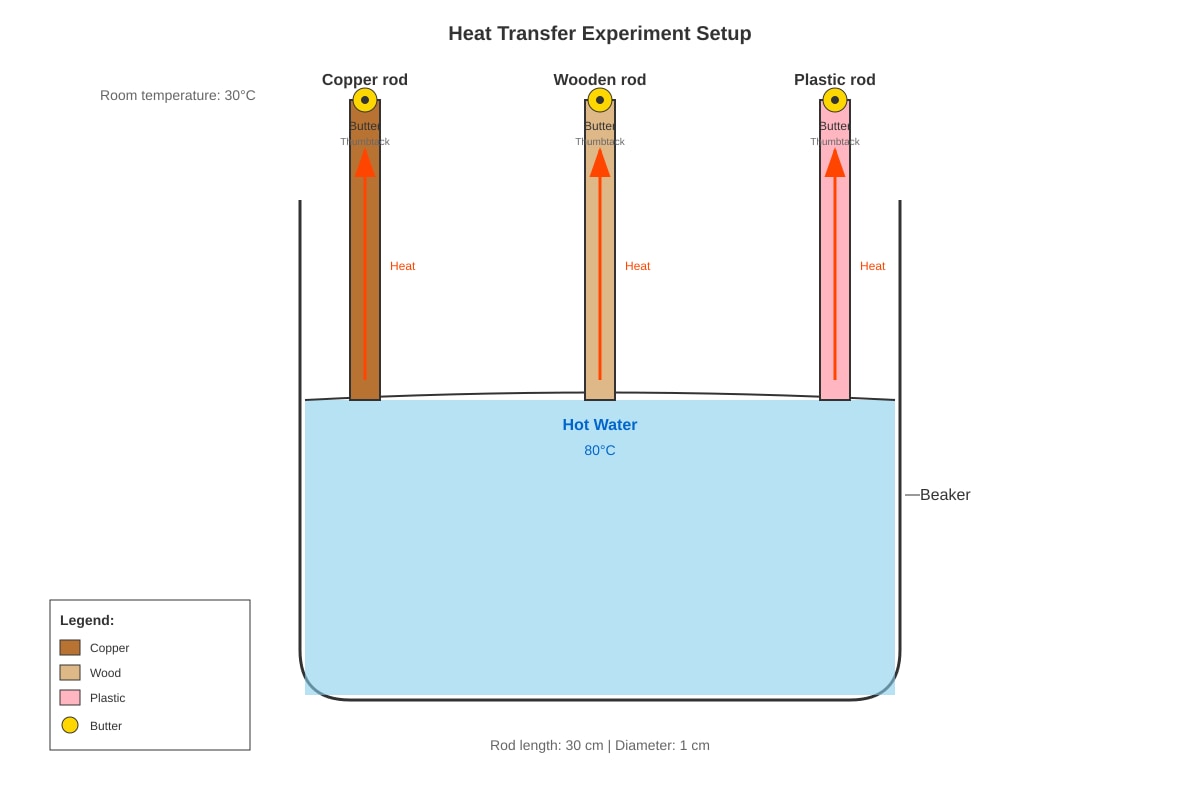
19. An experiment was conducted to compare the heat conductivity of four rods (A, B, C, D) made of different materials. Each rod had the same length and diameter. A thumbtack was attached to each rod with wax at the same distance from the heat source. The time taken for the thumbtack to drop was recorded.

<image_placeholder> id: Q19-fig1 type: diagram linked_question: Q19 description: Four rods (A, B, C, D) placed over a heat source (candle/Bunsen burner). Each rod has a thumbtack attached with wax at the same distance from the heat source. A stopwatch is shown for timing. labels: Rods A, B, C, D, heat source, thumbtacks, wax, equal distance from heat, stopwatch values: None must_show: Four identical rods with thumbtacks at same position, heat source at one end </image_placeholder>

The results are shown below.

RodTime for thumbtack to drop (s)
A15
B45
C30
D60

(a) Which rod is the best conductor of heat? Explain your answer. [2]


(b) State two variables that must be kept the same to ensure a fair test. [2]


20. The diagram below shows a simple electromagnet made by coiling wire around an iron nail and connecting it to a battery.

<image_placeholder> id: Q20-fig1 type: experimental_setup linked_question: Q20 description: An iron nail with insulated copper wire coiled around it. The wire ends connect to a battery. Paper clips are attracted to the nail. labels: Iron nail, insulated copper wire, battery (+ and - terminals), paper clips, switch (open/closed) values: None must_show: Complete electromagnet setup with battery, coil, nail, and paper clips </image_placeholder>

(a) State two ways to increase the magnetic strength of this electromagnet. [2]


(b) The iron nail is replaced with a steel nail. The electromagnet is switched on and then off. What difference would you observe? [1]


(c) Explain why copper wire is used instead of iron wire for the coil. [1]


End of Quiz

Answers

<!-- TuitionGoWhere generation metadata: stage=3-0; model=nvidia/nemotron-3-ultra-550b-a55b:free; model_label=NVIDIA Nemotron 3 Ultra 550B A55B Free; generated=2026-06-05; Sources: Stage 2-1 real exam-derived templates and Stage 2-2 exam-enriched syllabus. -->

Primary 6 PSLE Science Quiz - Materials (Answer Key)

Total Marks: 40


Section A: Multiple-Choice Questions (10 marks)

1. Answer: (3) Transparent [1]
Explanation: Metals are opaque, not transparent. They are good conductors of heat, malleable (can be hammered into sheets), and ductile (can be drawn into wires). Transparency is a property of glass and some plastics.

2. Answer: (2) Poor conductor of heat [1]
Explanation: A cooking pot handle must not conduct heat well, otherwise it would burn the user's hand. Materials that are poor conductors of heat (insulators) like wood, plastic, or bakelite are used for handles.

3. Answer: (3) Glass [1]
Explanation: Window panes need to be transparent to allow light to pass through while keeping wind and rain out. Glass is transparent, waterproof, and rigid. Wood and metal are opaque; rubber is not rigid enough.

4. Answer: (2) It is made of a magnetic material. [1]
Explanation: Only magnetic materials (iron, steel, nickel, cobalt) are attracted to magnets. Not all metals are magnetic (e.g., copper, aluminium). Being a metal, conductor, or shiny does not guarantee magnetic attraction.

5. Answer: (4) Z [1]
Explanation: Flexibility is the ability to bend without breaking. Material Z bent the most (12 cm) before breaking, making it the most flexible.

6. Answer: (2) A spectacle lens [1]
Explanation: Spectacle lenses must be transparent to allow light to pass through so the wearer can see. Raincoats need to be waterproof, frying pans need to conduct heat, towels need to be absorbent.

7. Answer: (2) good conductor of heat [1]
Explanation: The metal spoon handle felt hotter because metal conducts heat quickly from the hot water to the handle. Plastic is a poor conductor of heat (insulator), so the plastic spoon handle remained cooler.

8. Answer: (1) Bar A [1]
Explanation: Stiffness is the resistance to bending. Bar A bent the least under the same 500 g load, meaning it is the stiffest material.

9. Answer: (2) Flexible [1]
Explanation: Erasers need to bend and change shape to rub against paper and remove pencil marks. Flexibility allows the eraser to conform to the paper surface. Waterproof, transparent, and magnetic properties are not relevant.

10. Answer: (3) Rubber [1]
Explanation: Rubber is waterproof (used for raincoats, boots), flexible (can stretch and bend), and a poor conductor of heat (insulator). Metals conduct heat well; glass is rigid and breaks easily; wood absorbs water.


Section B: Structured Questions (12 marks)

11.
(a) Material B [1]
Reason: A raincoat must be waterproof to keep rain out and flexible to allow movement. Material B has both properties (Waterproof: Yes, Flexible: Yes). Material A is not flexible; Material C is not flexible; Material D is not waterproof.

(b) Material C [1]
Reason: A cooking pot must be a good conductor of heat to cook food evenly and efficiently. Material C is the only one that is a good conductor of heat. It is also waterproof (won't rust easily if stainless steel) and rigid (not flexible).

12.
(a) Wool / Silk / Leather (any one) [1]
Explanation: These are natural materials obtained from animals (sheep, silkworms, cattle respectively).

(b) Plastics / Glass / Alloys / Synthetic fibres (any one) [1]
Explanation: These are man-made materials produced through industrial processes.

13.
(a) String S [1]
Explanation: String S held the greatest mass (7 kg) before breaking, indicating it has the highest tensile strength.

(b) Length of string / Thickness of string / Type of support / Method of adding weights (any one) [1]
Explanation: For a fair test comparing strength, only the material (type of string) should change. Length, thickness, support, and weight-adding method must be kept constant.

14.
(a) 1. Heat-resistant (does not melt at high temperatures) 2. Allows microwaves to pass through (transparent to microwaves) [1]
Explanation: The container must withstand heating without melting, and microwaves must penetrate to heat the food inside.

(b) No. Metal reflects microwaves and can cause sparks/fire in a microwave oven. It does not allow microwaves to pass through to heat the food. [1]
Explanation: Metal is unsuitable because it blocks microwaves and creates a safety hazard.

15.
(a) Object Z [1]
Explanation: Repulsion is the only sure test for a magnet. A magnet repels another magnet with like poles facing. Attraction can occur between a magnet and a magnetic material (like iron), so W and X could just be magnetic materials.

(b) Objects W and X [1]
Explanation: Both W and X are attracted to the magnet. They could be magnets (with opposite poles facing) or simply magnetic materials (iron/steel). Since they were not repelled, we cannot confirm they are magnets.

16.
(a) Material G [1]
Explanation: Material G absorbed 0 g of water (mass before = mass after = 20 g), meaning it is waterproof.

(b) Material F [1]
Explanation: Material F absorbed the most water (15 g), making it the most absorbent.


Section C: Open-Ended Questions (18 marks)

17.
(a) Material J [1]

(b) Material J is waterproof, which keeps rain out, and flexible, which allows the tent to be folded and pitched easily. It is also lightweight for portability. [2]
Marking: 1 mark for waterproof + reason; 1 mark for flexible + reason. (Lightweight is a third valid property but only two required.)

(c) Allows light through (Transparency). A tent does not need to be transparent; in fact, opacity is often preferred for privacy and to block sunlight for sleeping. [1]
Explanation: Transparency is not a required property for a tent. Privacy and darkness for sleeping are more important.

18.
(a) expand [1]
Explanation: When heated, metals expand. The two metals expand at different rates, causing the strip to bend.

(b) Metal 1 expands more than Metal 2, so it becomes longer on the outer side of the curve. Metal 2 expands less, so it is on the inner side. The difference in expansion causes the strip to bend towards the metal that expands less (Metal 2). [2]
Marking: 1 mark for stating Metal 1 expands more/becomes longer; 1 mark for explaining bend direction (towards Metal 2 / Metal 1 on outer curve).

(c) Thermostat in electric iron / rice cooker / air-conditioner / fire alarm / thermometer (any one) [1]
Explanation: Bimetallic strips are used in thermostats to switch circuits on/off at specific temperatures.

19.
(a) Rod A. It took the shortest time (15 s) for the thumbtack to drop, meaning heat travelled fastest along Rod A to melt the wax. [2]
Marking: 1 mark for identifying Rod A; 1 mark for correct explanation linking shortest time to fastest heat conduction.

(b) 1. Length of rods 2. Diameter/cross-sectional area of rods 3. Distance of thumbtack from heat source 4. Amount of wax used 5. Temperature of heat source (any two) [2]
Marking: 1 mark each for any two valid controlled variables. These ensure only the material (type of rod) affects the result.

20.
(a) 1. Increase the number of coils/turns of wire around the nail. 2. Increase the current/voltage (use more batteries or higher voltage battery). 3. Use a softer iron core (though nail is already iron). (any two) [2]
Marking: 1 mark each for any two valid methods. Common answers: more coils, more batteries/current.

(b) The steel nail would remain magnetised (become a permanent magnet) after the current is switched off, while the iron nail loses its magnetism immediately (temporary magnet). [1]
Explanation: Iron is a soft magnetic material (temporary magnet); steel is a hard magnetic material (retains magnetism).

(c) Copper is a good conductor of electricity, allowing current to flow easily to create a magnetic field. Iron has higher resistance and would heat up, wasting energy and not creating as strong a magnetic field. [1]
Explanation: The coil needs low resistance to carry current efficiently. Copper's high electrical conductivity makes it ideal for electromagnet coils.


End of Answer Key