From Real Exams Quiz
Primary 6 PSLE Science Light Quiz
Free Exam-Derived NVIDIA Nemotron 3 Ultra 550B A55B Free Primary 6 PSLE Science Light quiz with questions and answers for Singapore students. This page is rendered as a direct URL so the questions and answers can be discovered without pressing in-page buttons.
These static practice materials are generated from the site's syllabus and paper-generation workflow, with source and model context shown so students and parents can evaluate the material before use.
Questions
Primary 6 PSLE Science Quiz - Light
Name: ___________________________
Class: Primary 6 _______
Date: _______________
Score: _______ / 40
Duration: 45 minutes
Total Marks: 40
Instructions:
- Answer all questions.
- For Section A, choose the correct option and write its number (1, 2, 3, or 4) in the brackets provided.
- For Section B and C, write your answers in the spaces provided.
- The number of marks for each question is shown in brackets [ ].
Section A: Multiple-Choice Questions (10 × 1 mark = 10 marks)
1. Which of the following is a natural source of light?
(1) Candle flame
(2) Lightning
(3) Torchlight
(4) Television screen
[ ] [1]
2. Light travels in a __________.
(1) curved path
(2) zigzag path
(3) straight line
(4) circular path
[ ] [1]
3. Which of the following objects is transparent?
(1) Wooden door
(2) Frosted glass
(3) Clear glass window
(4) Cardboard box
[ ] [1]
4. A shadow is formed when __________.
(1) light passes through an object
(2) light is reflected by an object
(3) an opaque object blocks light
(4) light is absorbed by an object
[ ] [1]
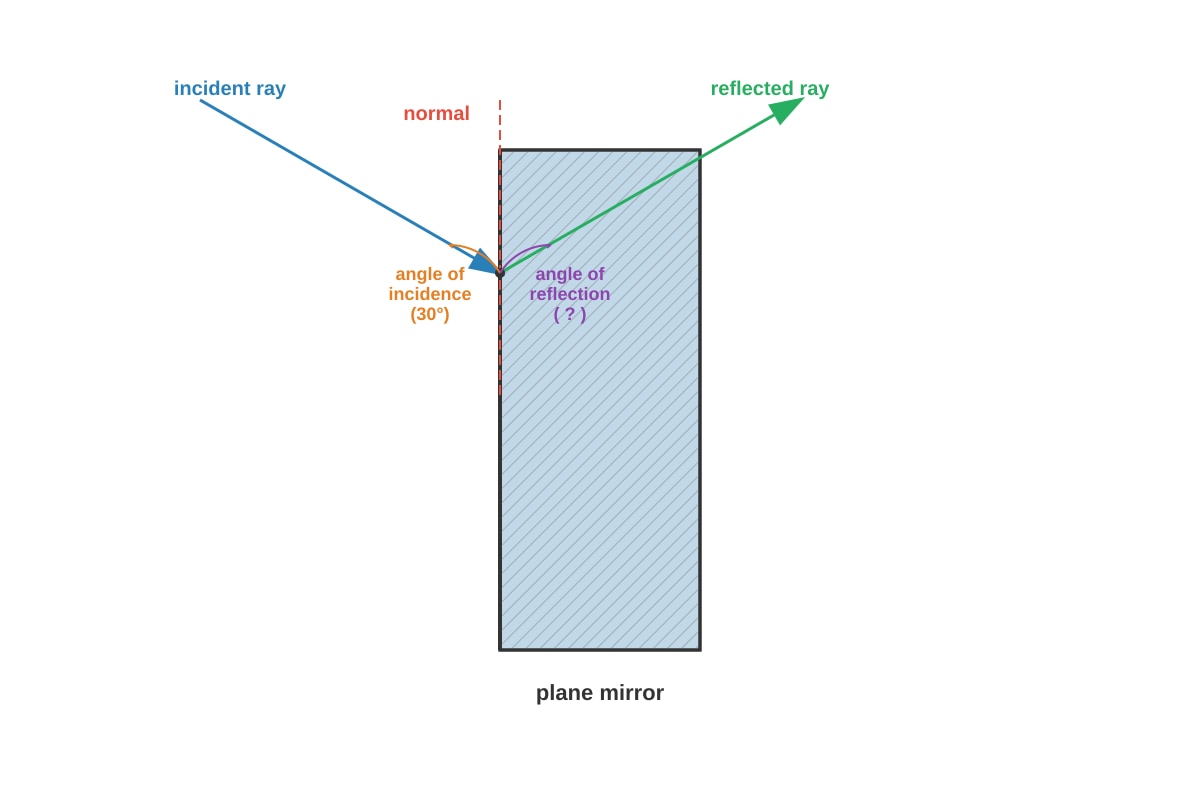
5. The diagram below shows a light ray striking a plane mirror.
<image_placeholder>
id: Q5-fig1
type: diagram
linked_question: Q5
description: A light ray striking a plane mirror at an angle of incidence of 30 degrees. Show the incident ray, normal line, reflected ray, angle of incidence (i), and angle of reflection (r).
labels: Incident ray, Normal, Reflected ray, Angle of incidence (i = 30°), Angle of reflection (r)
values: Angle of incidence = 30°
must_show: Incident ray, normal line (dashed), reflected ray, angle labels i and r, mirror surface
</image_placeholder>
What is the angle of reflection?
(1) 30°
(2) 60°
(3) 90°
(4) 120°
[ ] [1]
6. When white light passes through a glass prism, it splits into seven colours. This phenomenon is called __________.
(1) reflection
(2) refraction
(3) dispersion
(4) absorption
[ ] [1]
7. Which of the following shows the correct order of colours in a spectrum, from the colour that bends the most to the colour that bends the least?
(1) Red, Orange, Yellow, Green, Blue, Indigo, Violet
(2) Violet, Indigo, Blue, Green, Yellow, Orange, Red
(3) Red, Violet, Blue, Green, Yellow, Orange, Indigo
(4) Violet, Red, Orange, Yellow, Green, Blue, Indigo
[ ] [1]
8. An object appears red because it __________.
(1) absorbs red light and reflects other colours
(2) reflects red light and absorbs other colours
(3) transmits red light only
(4) produces red light
[ ] [1]
9. Which of the following will produce the sharpest shadow?
(1) A point source of light
(2) A large fluorescent tube
(3) A torch with a wide beam
(4) Light from a cloudy sky
[ ] [1]
10. Light travels fastest in __________.
(1) water
(2) glass
(3) air
(4) vacuum
[ ] [1]
Section B: Structured Questions (6 × 2 marks = 12 marks)
11. The diagram below shows a torch shining on a wooden ball. A screen is placed behind the ball.
<image_placeholder>
id: Q11-fig1
type: diagram
linked_question: Q11
description: Side view of a torch, a wooden ball, and a vertical screen. The torch is on the left, the ball in the middle, and the screen on the right. Light rays from the torch hit the ball and cast a shadow on the screen.
labels: Torch, Wooden ball, Screen, Light rays (straight lines), Shadow on screen
values: Distance from torch to ball = 20 cm, Distance from ball to screen = 30 cm
must_show: Torch emitting light rays in straight lines, ball blocking light, umbra (dark shadow) on screen
</image_placeholder>
(a) Draw the shadow of the wooden ball on the screen in the diagram above. [1]
(b) Explain why the shadow has the same shape as the wooden ball. [1]
12. Ali conducted an experiment to investigate how the distance between a torch and an object affects the size of the shadow formed on a screen. He kept the distance between the object and the screen constant at 20 cm. The results are shown below.
| Distance between torch and object (cm) | Height of shadow on screen (cm) |
|---|---|
| 10 | 12 |
| 15 | 9 |
| 20 | 7 |
| 25 | 6 |
(a) State the relationship between the distance of the torch from the object and the size of the shadow. [1]
(b) Explain why the shadow becomes smaller when the torch is moved further away from the object. [1]
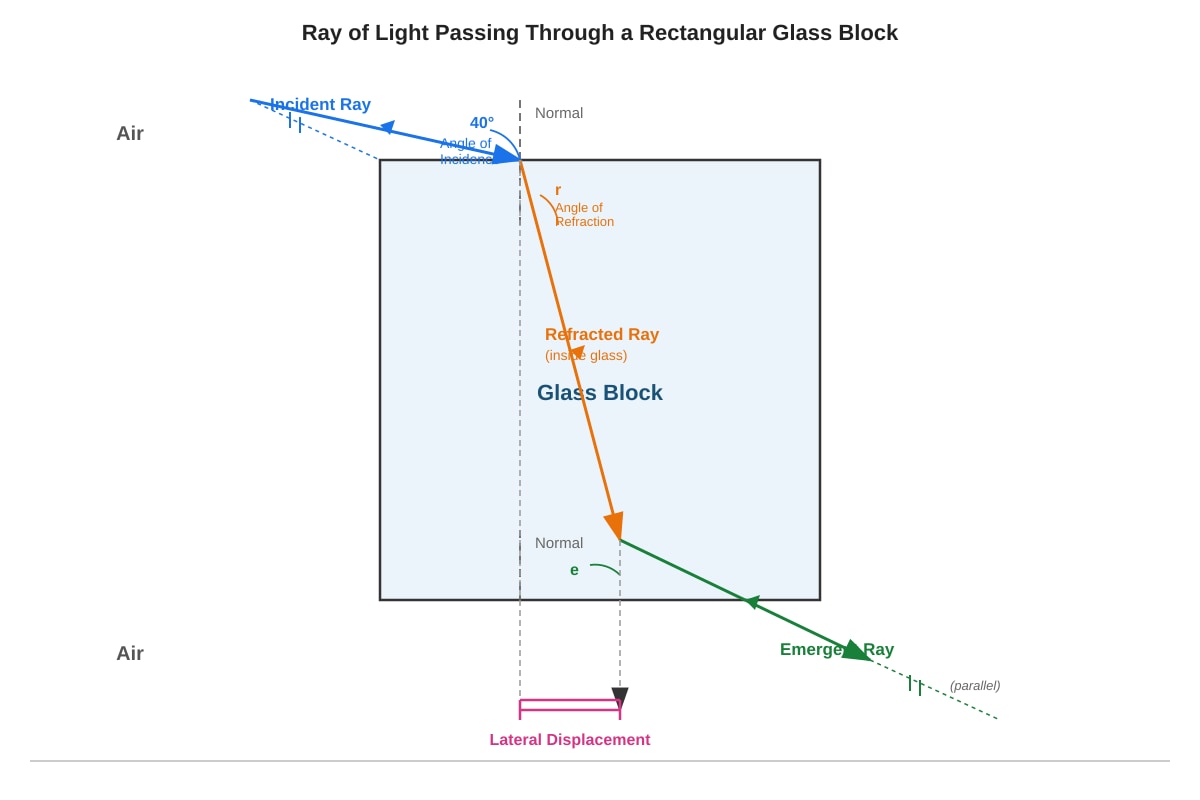
13. The diagram below shows a light ray passing from air into a glass block.
<image_placeholder>
id: Q13-fig1
type: diagram
linked_question: Q13
description: A rectangular glass block. A light ray enters from air (top left) into the glass block, bending towards the normal. The ray travels through the block and exits back into air (bottom right), bending away from the normal. The emergent ray is parallel to the incident ray but laterally displaced.
labels: Air, Glass block, Incident ray, Refracted ray, Emergent ray, Normal (dashed lines at both surfaces), Angle of incidence (i), Angle of refraction (r)
values: Angle of incidence = 40°, Angle of refraction = 25°
must_show: Rectangular glass block, incident ray bending towards normal on entry, ray travelling straight through block, emergent ray bending away from normal on exit, emergent ray parallel to incident ray
</image_placeholder>
(a) On the diagram, label the angle of incidence (i) and angle of refraction (r) at the first surface. [1]
(b) State what happens to the speed of light when it enters the glass block from air. [1]
14. Mei Ling shines a torch through a red filter and then through a blue filter. No light passes through. She then shines the torch through a red filter only. Red light passes through.
(a) Explain why no light passes through when both filters are used. [1]
(b) What colour light would pass through if she used a red filter and then a green filter? [1]
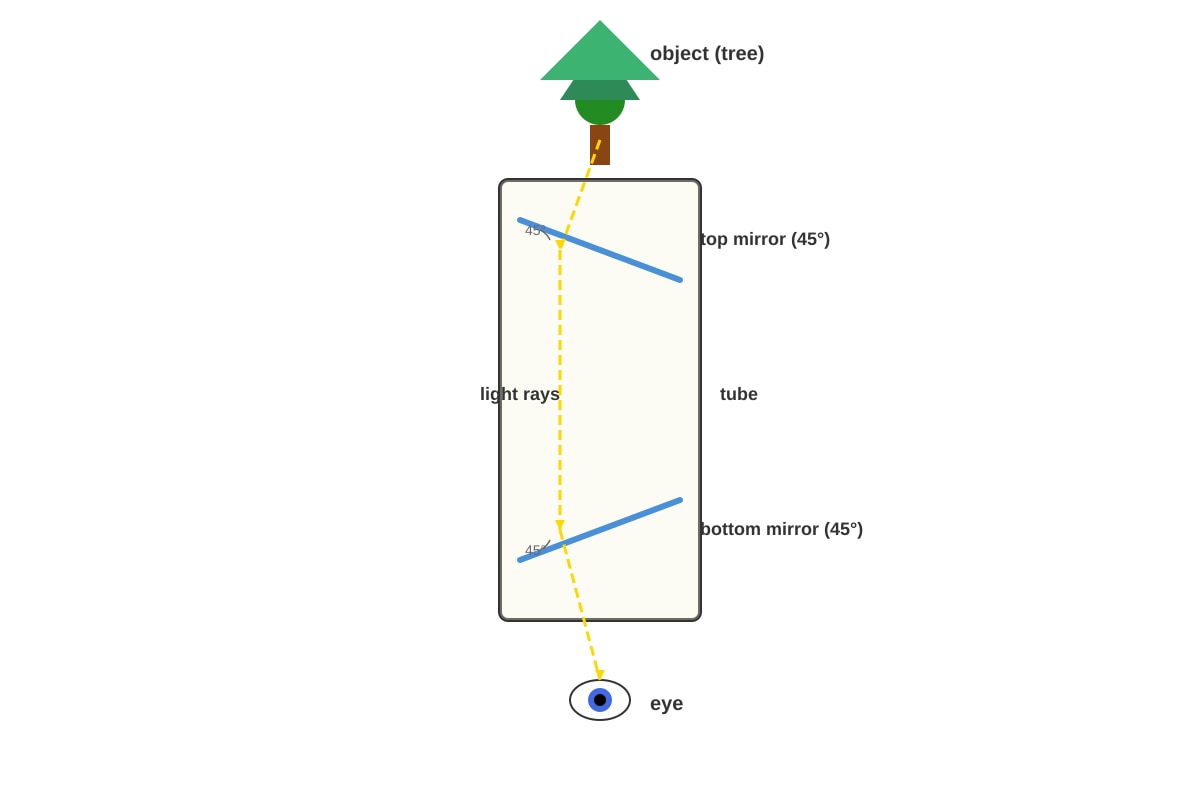
15. The diagram below shows a periscope.
<image_placeholder>
id: Q15-fig1
type: diagram
linked_question: Q15
description: A periscope consisting of a long tube with two plane mirrors fixed at 45° at each end. The top mirror faces down, the bottom mirror faces up. An eye at the bottom looks into the bottom mirror. An object is shown above the top mirror.
labels: Top mirror (45°), Bottom mirror (45°), Eye, Object, Light rays from object to top mirror, to bottom mirror, to eye
values: Mirrors at 45° to horizontal
must_show: Two plane mirrors at 45°, light rays reflecting from top mirror to bottom mirror to eye, object at top, eye at bottom
</image_placeholder>
(a) Complete the path of light from the object to the eye by drawing two light rays with arrows. [1]
(b) State one property of the image seen through the periscope. [1]
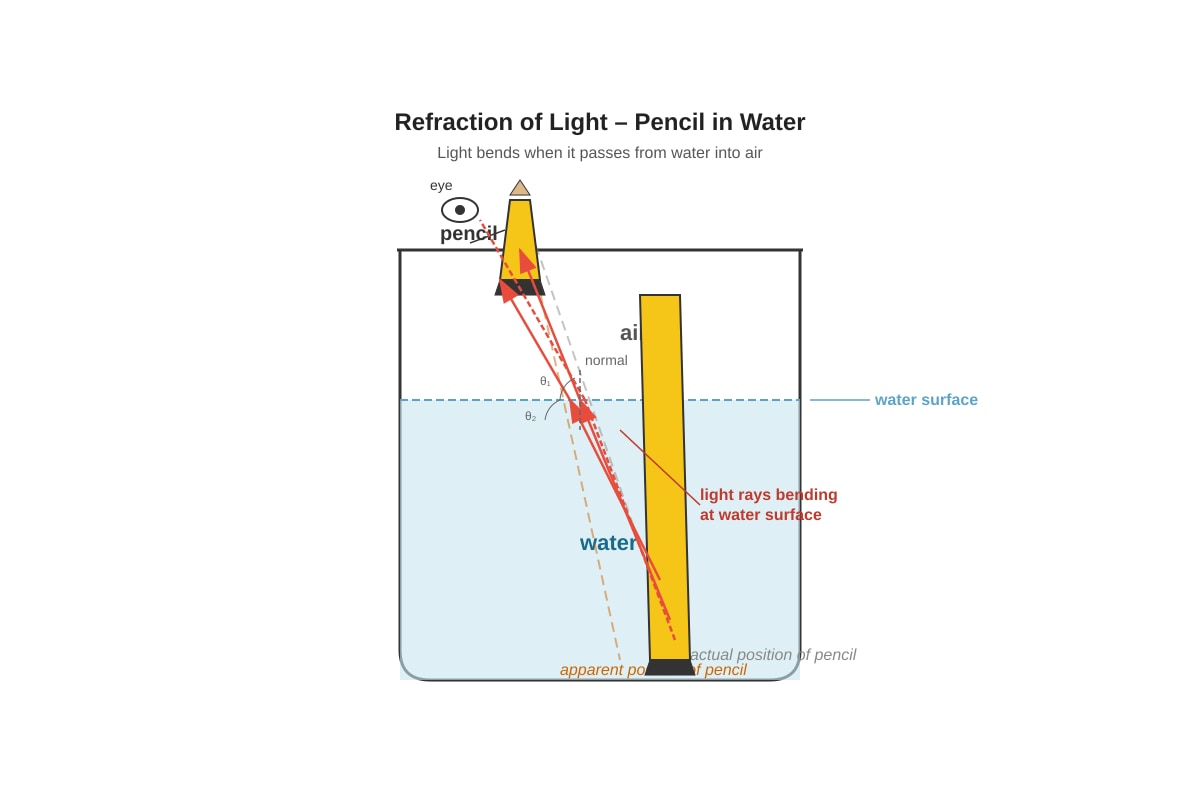
16. A student places a pencil in a beaker of water. When viewed from the side, the pencil appears bent at the water surface.
<image_placeholder>
id: Q16-fig1
type: diagram
linked_question: Q16
description: A beaker of water with a pencil partially submerged. The pencil appears bent at the water-air interface. Light rays from the submerged part of the pencil bend away from the normal as they exit water into air.
labels: Beaker, Water, Air, Pencil (straight), Apparent position of pencil (bent), Light rays from pencil bending at water surface, Normal (dashed)
values: Refractive index of water = 1.33
must_show: Pencil straight in reality, apparent bend at water surface, light rays from submerged part bending away from normal as they exit water
</image_placeholder>
(a) Name the phenomenon that causes the pencil to appear bent. [1]
(b) Explain why the pencil appears bent. [1]
Section C: Open-Ended Questions (4 × 4 marks = 16 marks)
17. John set up an experiment as shown below. He placed a light sensor at position X to measure the amount of light passing through different materials.
<image_placeholder>
id: Q17-fig1
type: experimental_setup
linked_question: Q17
description: A light source (torch) on the left, a holder for test materials in the middle, and a light sensor at position X on the right. All aligned horizontally.
labels: Torch, Material holder, Light sensor (Position X), Distance from torch to material = 30 cm, Distance from material to sensor = 20 cm
must_show: Torch, material holder, light sensor, all in a straight line, dark surroundings implied
</image_placeholder>
He tested four materials of the same size and thickness. The results are shown below.
| Material | Light sensor reading (units) |
|---|---|
| A | 0 |
| B | 45 |
| C | 85 |
| D | 95 |
(a) Which material allows the most light to pass through? [1]
(b) Classify materials A, B, C, and D as transparent, translucent, or opaque. [2]
(c) Suggest one possible material for Material B. [1]
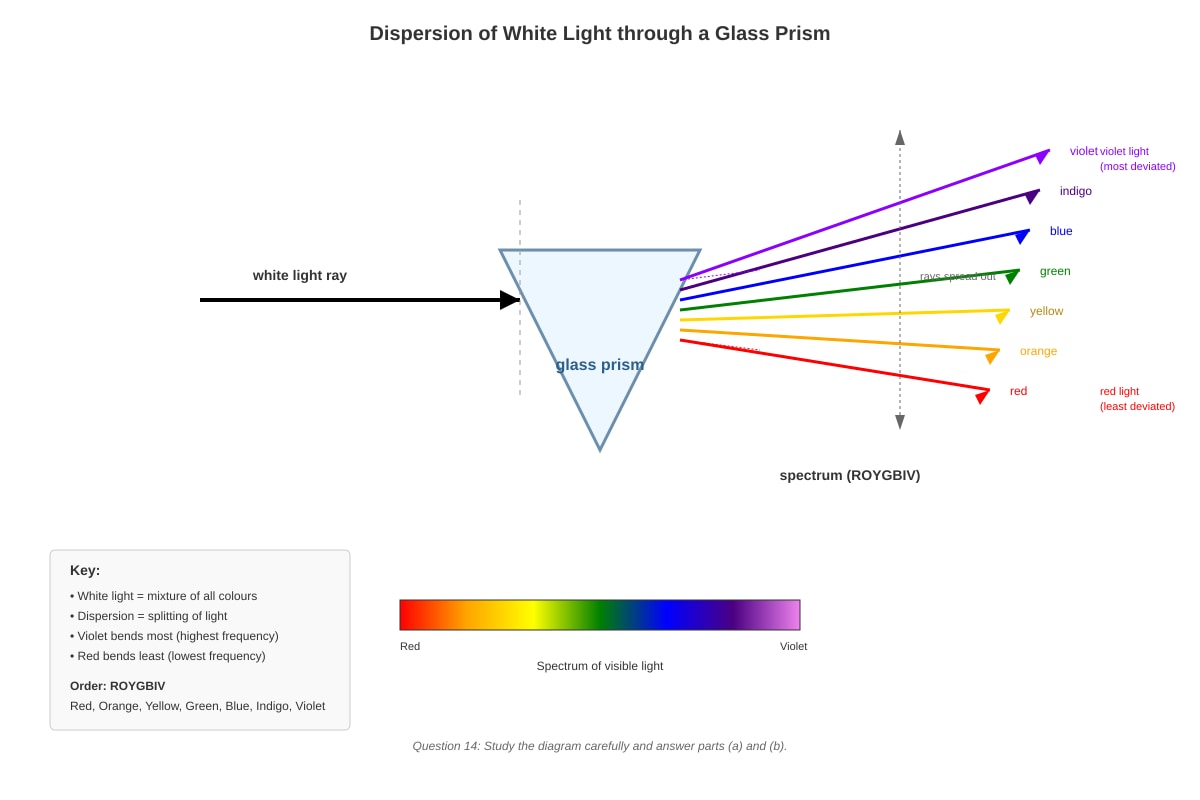
18. The diagram below shows a ray of white light passing through a triangular glass prism.
<image_placeholder>
id: Q18-fig1
type: diagram
linked_question: Q18
description: A triangular glass prism. A ray of white light enters one face, disperses into a spectrum (VIBGYOR) inside the prism, and emerges as a spread-out spectrum on a screen.
labels: White light ray, Triangular prism, Spectrum on screen (Violet, Indigo, Blue, Green, Yellow, Orange, Red), Normal lines at entry and exit faces
values: Angle of prism = 60°
must_show: White light entering prism, dispersion inside prism, spectrum emerging and spreading on screen, violet deviated most, red deviated least
</image_placeholder>
(a) Name the phenomenon that occurs when white light passes through the prism. [1]
(b) Which colour of light is deviated (bent) the most? [1]
(c) Explain why different colours of light are bent by different amounts. [2]
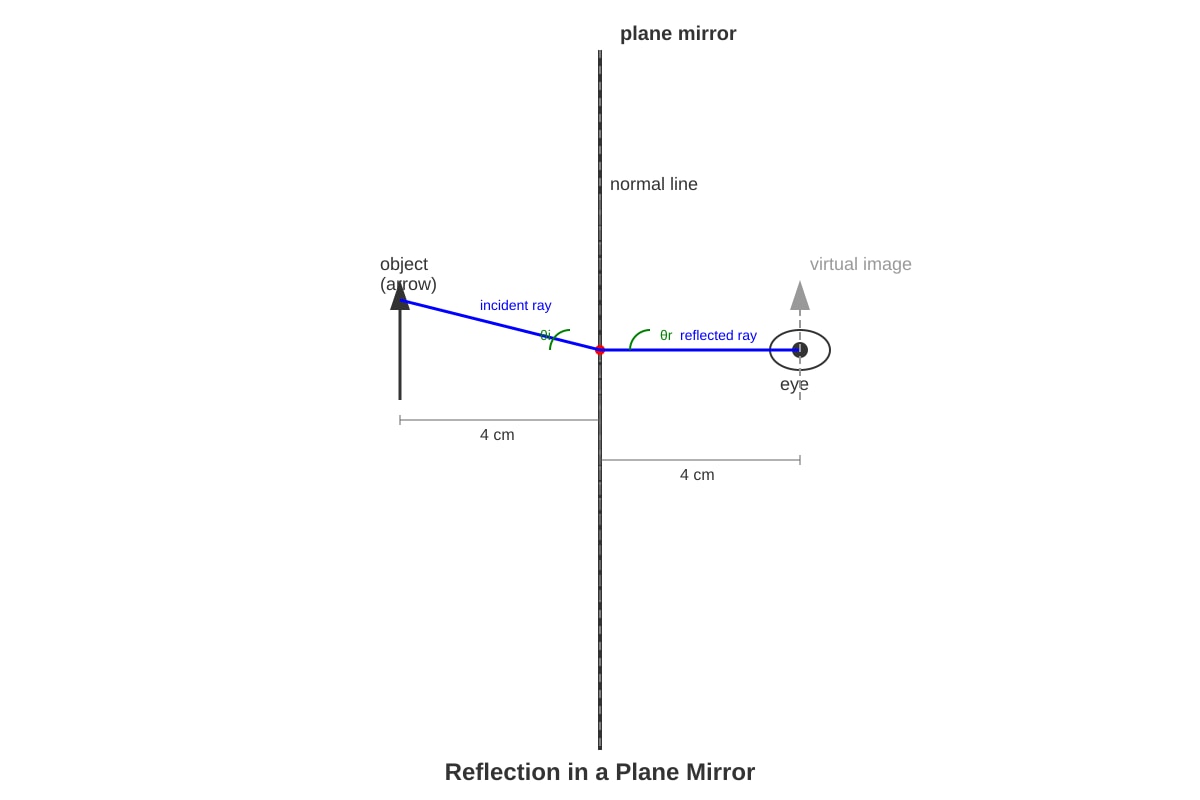
19. The diagram below shows an object O placed in front of a plane mirror.
<image_placeholder>
id: Q19-fig1
type: diagram
linked_question: Q19
description: A vertical plane mirror (line MM'). An object O (an arrow pointing up) placed 4 cm in front of the mirror. Two light rays from the top of the object: one perpendicular to mirror, one at an angle. Both reflect. Extensions behind mirror meet at image I.
labels: Mirror MM', Object O (4 cm in front), Image I (4 cm behind), Incident rays, Reflected rays, Virtual rays (dashed behind mirror), Normal
values: Object distance = 4 cm
must_show: Object O, mirror, two incident rays from top of object, reflected rays, virtual rays extended behind mirror meeting at image I, image same size as object, laterally inverted
</image_placeholder>
(a) On the diagram, draw the image of the object and label it I. [1]
(b) State three characteristics of the image formed by a plane mirror. [3]
20. Sarah wants to investigate how the colour of a surface affects the amount of light it reflects. She sets up the experiment as shown below.
<image_placeholder>
id: Q20-fig1
type: experimental_setup
linked_question: Q20
description: A light source shining on a coloured card (test surface). A light sensor positioned at a fixed angle to measure reflected light. The coloured card can be changed.
labels: Light source, Coloured card (test surface), Light sensor, Angle of incidence = Angle of reflection = 45°, Distance from source to card = 20 cm, Distance from card to sensor = 20 cm
must_show: Light source, coloured card, light sensor at equal angles (45°), fixed distances, dark surroundings
</image_placeholder>
She tests five different coloured cards and records the light sensor readings.
| Colour of card | Light sensor reading (units) |
|---|---|
| White | 90 |
| Yellow | 75 |
| Red | 50 |
| Blue | 40 |
| Black | 5 |
(a) Which colour reflects the most light? [1]
(b) Which colour absorbs the most light? [1]
(c) Explain why a black car gets hotter than a white car when parked under the sun. [2]
End of Quiz
Answers
Primary 6 PSLE Science Quiz - Light (Answer Key)
Total Marks: 40
Section A: Multiple-Choice Questions (10 marks)
1. (2) Lightning
Marks: 1
Explanation: Lightning is a natural source of light. Candle flame, torchlight, and television screens are man-made sources of light.
2. (3) straight line
Marks: 1
Explanation: Light travels in straight lines. This is a fundamental property of light and explains why shadows are formed and why we cannot see around corners.
3. (3) Clear glass window
Marks: 1
Explanation: Transparent objects allow most light to pass through so that objects can be seen clearly through them. Wooden door is opaque, frosted glass is translucent, and cardboard box is opaque.
4. (3) an opaque object blocks light
Marks: 1
Explanation: A shadow is formed when light is blocked by an opaque object. Light travels in straight lines, so the area behind the object receives no light, forming a dark patch called a shadow.
5. (1) 30°
Marks: 1
Explanation: According to the law of reflection, the angle of incidence equals the angle of reflection (i = r). Since the angle of incidence is 30°, the angle of reflection is also 30°.
6. (3) dispersion
Marks: 1
Explanation: Dispersion is the splitting of white light into its constituent colours (spectrum) when it passes through a prism. Refraction is the bending of light, but dispersion specifically refers to the separation of colours.
7. (2) Violet, Indigo, Blue, Green, Yellow, Orange, Red
Marks: 1
Explanation: In a spectrum, violet light bends the most (shortest wavelength) and red light bends the least (longest wavelength). The order from most bent to least bent is Violet → Indigo → Blue → Green → Yellow → Orange → Red.
8. (2) reflects red light and absorbs other colours
Marks: 1
Explanation: The colour of an opaque object is the colour of light it reflects. A red object reflects red light into our eyes and absorbs the other colours of the spectrum.
9. (1) A point source of light
Marks: 1
Explanation: A point source produces sharp shadows with clear edges (umbra only). Extended sources (like fluorescent tubes, wide-beam torches, cloudy sky) produce fuzzy shadows with penumbra.
10. (4) vacuum
Marks: 1
Explanation: Light travels fastest in vacuum (approximately 3 × 10⁸ m/s). It slows down in any medium: air (slightly slower), water (about 2.25 × 10⁸ m/s), glass (about 2 × 10⁸ m/s).
Section B: Structured Questions (12 marks)
11. (a) Draw a dark circular/oval shadow on the screen behind the ball. [1]
Marking note: The shadow should be drawn on the screen, same shape as the ball (circular), and completely dark (umbra only since torch is a small source).
(b) Light travels in straight lines. The wooden ball is opaque and blocks the light, so the shadow formed has the same shape as the ball. [1]
Explanation: Because light travels in straight lines, the outline of the shadow corresponds exactly to the outline of the object blocking the light. The ball is spherical, so its shadow is circular.
12. (a) As the distance between the torch and the object increases, the size of the shadow decreases. [1]
Alternative: The further the torch from the object, the smaller the shadow.
(b) When the torch is further away, the light rays hitting the object are more parallel/less divergent, so the shadow cast on the screen is smaller (closer to the actual size of the object). [1]
Explanation: When the light source is close, light rays diverge significantly, causing the shadow to be magnified on the screen. As the source moves away, rays become more parallel, reducing magnification.
Common mistake: Saying "light rays become parallel" without linking to shadow size. Must explain the geometry.
13. (a) Label angle i between incident ray and normal at air-glass boundary; label angle r between refracted ray and normal inside glass. [1]
Marking note: Both angles must be correctly labelled at the first (entry) surface.
(b) The speed of light decreases when it enters the glass block from air. [1]
Explanation: Glass is optically denser than air. Light slows down when entering a denser medium, which causes it to bend towards the normal (refraction).
14. (a) The red filter only allows red light to pass through. The blue filter only allows blue light to pass through. Since no red light reaches the blue filter (it was blocked by the red filter), and the blue filter blocks all other colours including red, no light passes through both filters. [1]
Explanation: Filters work by subtracting colours. Red filter transmits red, absorbs others. Blue filter transmits blue, absorbs others (including red). No common colour transmitted.
(b) No light (or black/dark) [1]
Explanation: Red filter transmits only red. Green filter transmits only green. Red light is absorbed by the green filter. No light passes through.
15. (a) Draw two rays: from top of object → top mirror (45°) → bottom mirror (45°) → eye. Arrows must show direction from object to eye. [1]
Marking note: Rays must reflect correctly at 45° at each mirror (angle of incidence = angle of reflection = 45°). Arrows essential.
(b) The image is upright / same size as object / laterally inverted / virtual / same distance behind mirror as object in front. (Any one) [1]
Explanation: A periscope uses two plane mirrors. Each mirror produces a virtual, upright, laterally inverted image. Two lateral inversions cancel out, so the final image is upright and same orientation as object (but not laterally inverted overall). Actually, two mirrors at 90° to each other produce an image that is upright but laterally inverted. Wait: In a periscope, mirrors are parallel (both at 45° to horizontal, so 90° to each other). Two reflections: first mirror inverts left-right, second mirror inverts left-right again → final image is upright and NOT laterally inverted. But it is virtual.
Correct property: Upright, same size, virtual, same distance from final mirror as object from first mirror.
Accept: Upright / same size / virtual.
16. (a) Refraction [1]
(b) Light rays from the submerged part of the pencil travel from water (denser medium) to air (less dense medium). They bend away from the normal at the water surface. Our brain interprets light as travelling in straight lines, so the submerged part appears higher/shifted, making the pencil look bent. [1]
Explanation: Refraction at the water-air interface causes the apparent position of the underwater part to shift. The light rays bend away from the normal as they exit water into air.
Section C: Open-Ended Questions (16 marks)
17. (a) Material D [1]
Explanation: Material D has the highest light sensor reading (95 units), meaning it allows the most light to pass through.
(b) A: Opaque
B: Translucent
C: Transparent
D: Transparent [2]
Marking: ½ mark each correct classification.
Explanation:
- A (0 units): No light passes → Opaque
- B (45 units): Some light passes but not clear → Translucent
- C (85 units) and D (95 units): Most light passes → Transparent
Note: Both C and D are transparent; D is more transparent (e.g., clearer glass).
(c) Frosted glass / tracing paper / thin fabric / wax paper (Any one) [1]
Explanation: Translucent materials allow some light to pass but scatter it, so objects cannot be seen clearly through them.
18. (a) Dispersion [1]
(b) Violet [1]
Explanation: Violet light has the shortest wavelength and is refracted (bent) the most when passing through the prism.
(c) Different colours of light have different wavelengths. In glass, shorter wavelengths (violet) travel slower and are bent more, while longer wavelengths (red) travel faster and are bent less. This causes each colour to refract at a slightly different angle, spreading them out into a spectrum. [2]
Mark breakdown:
- 1 mark: Different colours have different wavelengths/speeds in glass
- 1 mark: Shorter wavelength bends more / longer wavelength bends less → spread out
Key concept: Refractive index of glass varies with wavelength (dispersion).
19. (a) Draw image I behind the mirror: same size as object, 4 cm behind mirror, upright but laterally inverted (arrow pointing up but facing opposite direction). Label I. [1]
Marking note: Image must be same distance behind mirror as object in front (4 cm), same size, upright, laterally inverted.
(b) Any three of the following: [3]
- Virtual (cannot be formed on a screen)
- Upright (same orientation as object)
- Same size as object
- Laterally inverted (left-right reversed)
- Same distance behind the mirror as the object is in front
- Formed by the apparent intersection of reflected rays (extensions behind mirror)
Marking: 1 mark each, max 3 marks.
20. (a) White [1]
Explanation: White card has the highest sensor reading (90 units), meaning it reflects the most light.
(b) Black [1]
Explanation: Black card has the lowest sensor reading (5 units), meaning it reflects the least light and therefore absorbs the most.
(c) Black surfaces absorb most of the light energy (including infrared/heat radiation) from the sun and convert it to heat. White surfaces reflect most of the light energy, so less is absorbed and converted to heat. Therefore, the black car gets hotter. [2]
Mark breakdown:
- 1 mark: Black absorbs more light/heat; white reflects more
- 1 mark: Absorbed light energy converted to heat → temperature rises
Common mistake: Saying "black attracts heat" — incorrect. Black absorbs radiation.
End of Answer Key