From Real Exams Quiz
Primary 6 PSLE Science Light Quiz
Free P6 PSLE Science Light quiz, HY3 Exam version, with questions, answers, and PSLE-focused practice for Singapore students.
These static practice materials are generated from the site's syllabus and paper-generation workflow, with source and model context shown so students and parents can evaluate the material before use.
Questions
Free quiz and exam paper access
Enter your details to view this paper
Your access is remembered on this device.
Answers
Primary 6 PSLE Science Quiz - Light (Answer Key)
Total Marks: 40
Topic: Light
Section A Answers (1 mark each)
-
C) A glowing bulb
Teaching note: A source of light makes its own light. The Moon, mirror, and wall only reflect light from other sources. -
B) straight
Teaching note: Light travels in straight lines. This is why shadows have sharp edges and beams look straight. -
C) reflected
Teaching note: A smooth mirror sends light back; this is reflection. -
B) Clear glass
Teaching note: Transparent materials let light pass through with little scattering so we see clearly. -
B) blocked
Teaching note: Opaque objects stop light, forming a shadow behind them. -
B) A tracing paper
Teaching note: Translucent objects let some light through but scatter it, so images are blurry. -
A) absorbs all colours and reflects red
Teaching note: Coloured objects reflect their own colour and absorb others. Red apple reflects red light to our eyes. -
B) Angle of incidence equals angle of reflection
Teaching note: Law of reflection: the incoming angle equals the outgoing angle. -
B) reflected at angles
Teaching note: Periscope mirrors reflect light at 45°, letting us see over obstacles. -
C) A solid wooden block
Teaching note: Opaque and thick objects block the most light, giving darkest shadows.
Section B Answers (2 marks each)
-
Answer: In a completely dark room, there is no light source. (1 mark) Light is needed to enter our eyes after reflecting from objects, so without light we cannot see the object. (1 mark)
Common mistake: Saying "eyes do not work" instead of explaining lack of light. -
Answer: Transparent materials let most light through and we see clearly (e.g. clear glass). (1 mark) Translucent materials let some light through but scatter it, so we see blurry images (e.g. tracing paper). (1 mark)
-
Answer: Draw a straight line from torch to mirror (incident ray), and a straight line leaving mirror at same angle (reflected ray). Label both. (2 marks: drawing 1, labels 1)
Teaching note: Show angle of incidence = angle of reflection. -
Answer: When the object moves closer to the light, the light rays spread out more after passing the object's edges. (1 mark) This makes a bigger shadow on the screen. (1 mark)
-
Answer: A shadow of the book appears on the screen. (1 mark) The book is opaque and blocks light from the lamp, so light cannot reach that part of the screen. (1 mark)
-
Answer: Two mirrors at an angle reflect light from the back of the head to the first mirror, then to the second mirror, then to the eyes. (1 mark) This uses reflection to let us see around corners. (1 mark)
Section C Answers (8 marks total)
-
(a) Reflection is when light bounces off a surface. [1]
(b) Example: seeing yourself in a mirror / mirror in a pond. [1] -
(a) Source: Sun or bulb; Non-source: Moon or table. [1]
(b) Source makes its own light; non-source only reflects light from a source. [1] -
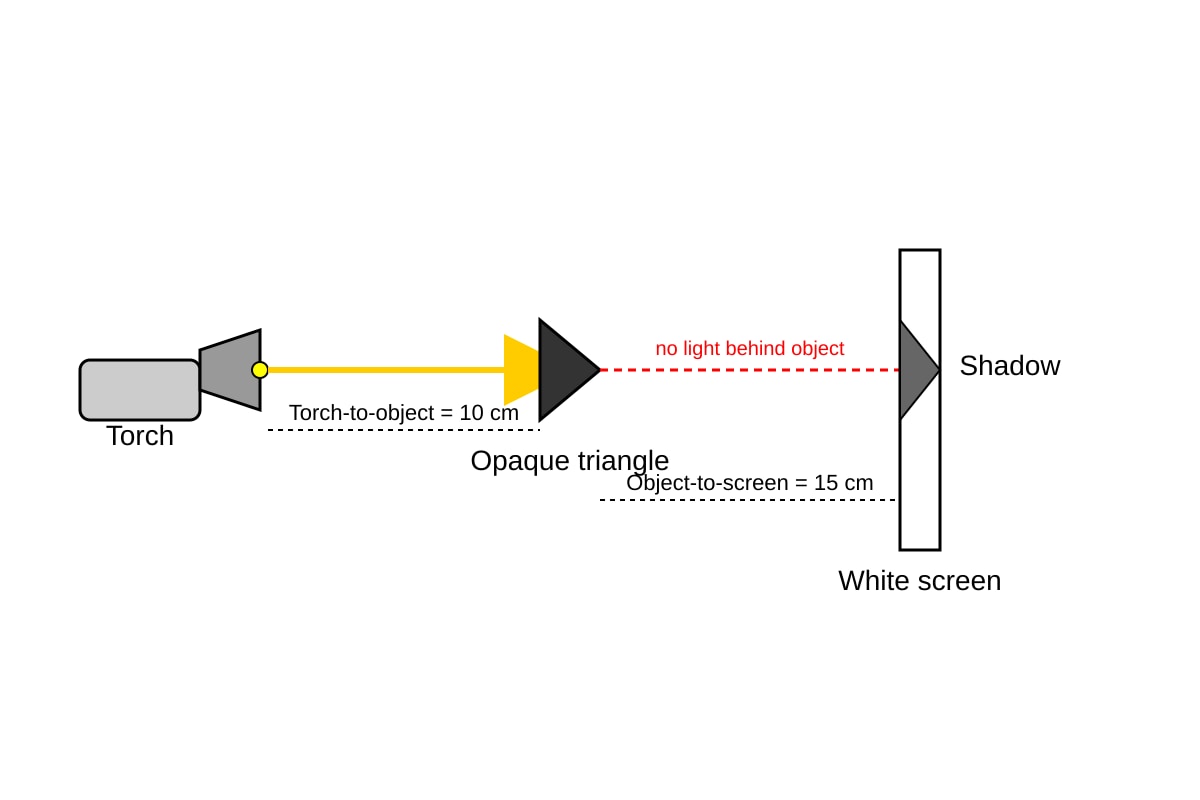
(a) A shadow (triangular shape) is formed on the screen. [1]
(b) The triangle blocks the light rays, so no light reaches behind it on the screen. [1]
Visual check: Image must show straight rays blocked, dark triangle on screen. -
(a) Translucent. [1]
(b) It lets some light through but scatters it, so we cannot see clearly through it. [1]
(c) It gives privacy while letting daylight in (e.g. bathroom window). [1]
(d) Any opaque object: wood, metal, book. [1]