From Real Exams Quiz
Primary 6 PSLE Science Light Quiz
Free P6 PSLE Science Light quiz, Exam version, with questions, answers, and PSLE-focused practice for Singapore students.
These static practice materials are generated from the site's syllabus and paper-generation workflow, with source and model context shown so students and parents can evaluate the material before use.
Questions
Free quiz and exam paper access
Enter your details to view this paper
Your access is remembered on this device.
Answers
Answer Key: Primary 6 PSLE Science Quiz - Light
Total Marks: 40
Section A: Multiple-Choice Questions (10 marks)
1. Answer: C (2 marks)
- Explanation: A mirror has a very smooth, shiny surface. When light hits a smooth surface, it undergoes regular reflection (specular reflection), where the light rays are reflected in a single direction. The light is not absorbed (A) because mirrors are designed to reflect most light. Light does not pass through (B) because mirrors have a reflective coating. Light is not scattered (D) because scattering happens on rough surfaces.
- Common Mistake: Students may choose D, confusing reflection with scattering. Scattering occurs when light hits a rough surface and bounces off in many directions.
2. Answer: A (2 marks)
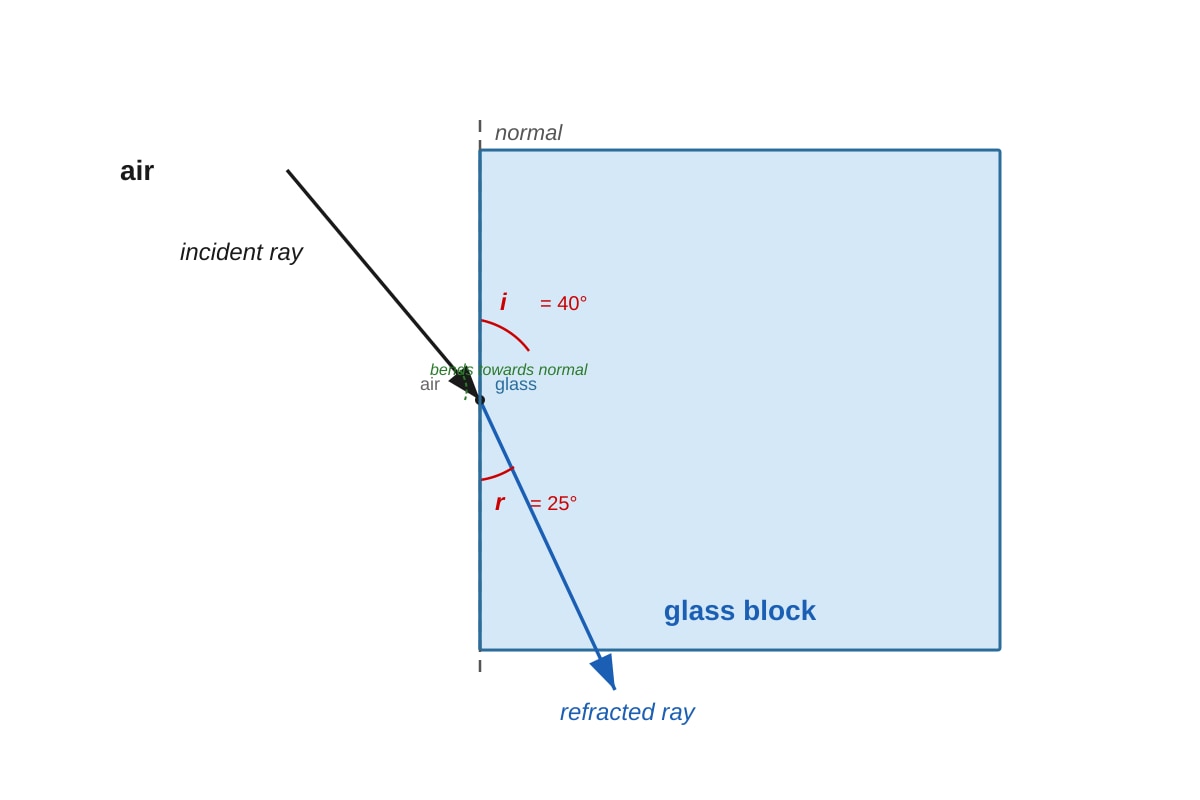
- Explanation: Light travels at different speeds in different materials. When light travels from air into a denser material like glass, it slows down. This change in speed causes the light ray to bend towards the normal (the imaginary line perpendicular to the surface). This bending is called refraction.
- Common Mistake: Students may think light speeds up (B) when entering a denser medium. The opposite is true: light slows down in denser materials.
3. Answer: B (2 marks)
- Explanation: Light travels at different speeds in air and water. When light from the pencil travels from water (denser) to air (less dense), it speeds up and bends away from the normal. This refraction of light makes the pencil appear bent or broken at the water surface.
- Common Mistake: Students may confuse this with reflection (A). Reflection would cause the pencil to appear as a mirror image, not a bent one.
4. Answer: D (2 marks)
- Explanation: A luminous object produces its own light. The Sun is a luminous object because it generates its own light through nuclear fusion. The Moon (A) reflects light from the Sun. A mirror (B) and a book (C) only reflect light from other sources; they are non-luminous objects.
- Common Mistake: Students often think the Moon is luminous because it appears bright at night. It is important to remember that the Moon only reflects sunlight.
5. Answer: B (2 marks)
- Explanation: A pinhole camera works on the principle of rectilinear propagation of light (light travels in straight lines). Light from the top of the candle travels in a straight line through the pinhole to the bottom of the screen. Light from the bottom of the candle travels to the top of the screen. This crossing of light rays produces an inverted (upside-down) image. The image is also smaller than the object because the screen is closer to the pinhole than the object is.
- Common Mistake: Students may think the image is upright (A or C). Remember that the image is always inverted in a simple pinhole camera.
Section B: Short-Answer Questions (20 marks)
6. Answer: (2 marks - 1 mark for each correct characteristic)
-
The image is upright (or virtual).
-
The image is laterally inverted (left and right are swapped).
-
The image is the same size as the object.
-
The image is as far behind the mirror as the object is in front. (Any two of the above)
-
Explanation: A plane mirror creates a virtual image that appears to be behind the mirror. The image is not real; it cannot be projected onto a screen. The image is the same size as the object and is upright, but left and right are reversed.
7. Answer: 60° (2 marks)
- Explanation: The angle of incidence is measured from the normal (an imaginary line perpendicular to the surface). If the angle between the incident ray and the mirror surface is 30°, then the angle between the incident ray and the normal is 90° - 30° = 60°. According to the Law of Reflection, the angle of incidence equals the angle of reflection. Therefore, the angle of reflection is also 60°.
- Working:
- Angle between incident ray and mirror = 30°
- Angle between incident ray and normal = 90° - 30° = 60°
- Angle of incidence = 60°
- Angle of reflection = Angle of incidence = 60°
- Common Mistake: A very common mistake is to give the answer as 30°, forgetting that the angle is measured from the normal, not the mirror surface.
8. Answer: (2 marks) A red apple appears red because it reflects red light and absorbs all other colours of light in the white light spectrum (e.g., blue, green, yellow).
- Explanation: White light is made up of all the colours of the rainbow (ROYGBIV). When white light shines on an object, the object absorbs some colours and reflects others. The colour we see is the colour that is reflected to our eyes. A red apple reflects red light and absorbs all other colours.
- Common Mistake: Students may say the apple "is red" without explaining the reflection and absorption process. The key is to mention both reflection of red and absorption of other colours.
9. Answer: (2 marks - 1 mark for correct example, 1 mark for brief explanation)
- Example 1: Using a magnifying glass (convex lens) to focus light to read small text. The lens refracts light rays to make objects appear larger.
- Example 2: Wearing glasses or contact lenses to correct vision. The lenses refract light to focus it correctly on the retina.
- Example 3: A camera lens uses refraction to focus light onto the film or sensor to form a clear image. (Any one valid example with a brief explanation)
10. Answer: 10 cm (2 marks)
- Explanation: For a plane mirror, the image appears to be the same distance behind the mirror as the object is in front of it. If the object is 10 cm in front, the image appears 10 cm behind the mirror.
- Common Mistake: Students may think the distance is 20 cm (the total distance between object and image). The question specifically asks for the distance "behind the mirror," which is 10 cm.
11. Answer: (2 marks) A rough surface causes diffuse reflection. This is because the surface has many tiny bumps and irregularities. When parallel light rays hit a rough surface, they are reflected in many different directions (scattered).
- Explanation: Diffuse reflection allows us to see non-shiny objects from any angle. The rough surface scatters the light in all directions, so some light always reaches our eyes.
- Common Mistake: Students may say a "dull" surface. The correct scientific term is a "rough" surface at a microscopic level.
12. Answer: (2 marks - 1 mark for correct mirror placement, 1 mark for correct light path)
- Diagram should show:
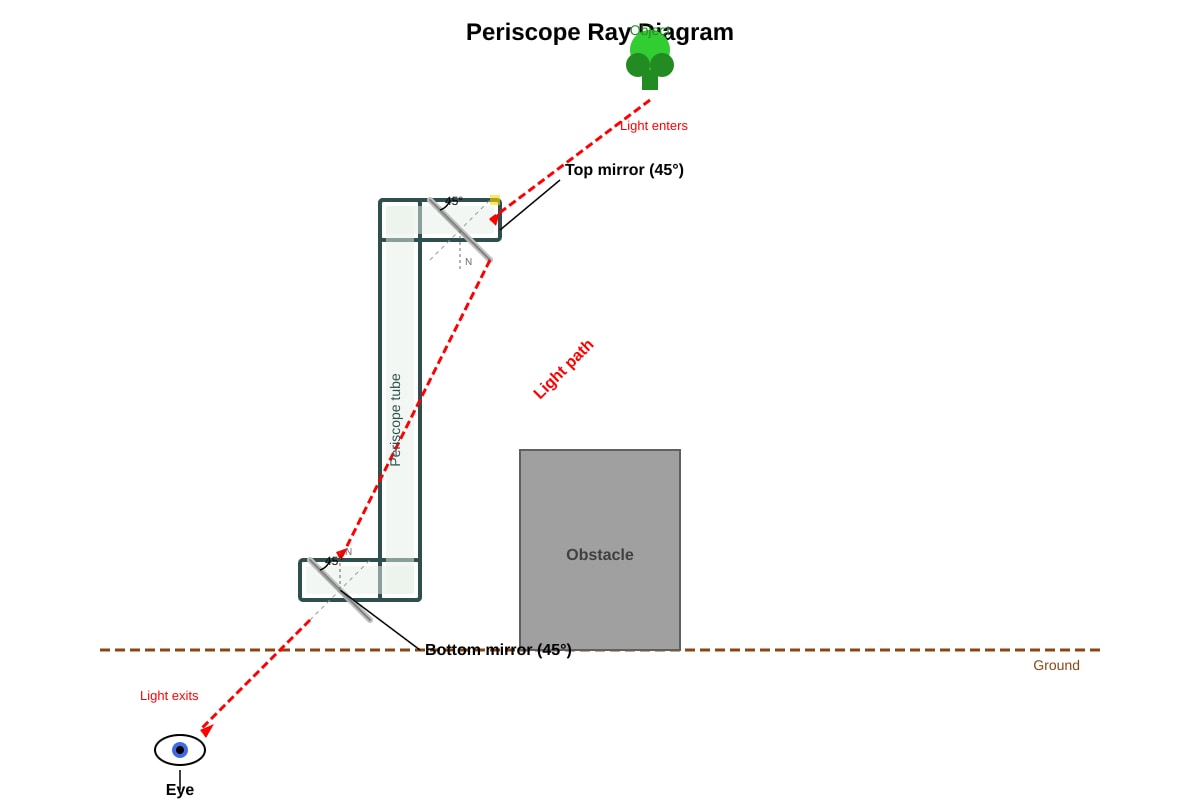
- Two plane mirrors placed at 45-degree angles to the tube.
- One mirror at the top and one at the bottom.
- An arrow showing light entering the top, reflecting off the top mirror, travelling down the tube, reflecting off the bottom mirror, and exiting to the eye.
- Explanation: A periscope uses two plane mirrors. The top mirror reflects light from the object down the tube. The bottom mirror then reflects this light into the observer's eye. Both mirrors are placed at 45° to the direction of the light to allow the light to change direction by 90° each time.
13. Answer: Regular reflection (or specular reflection) (2 marks)
- Explanation: A calm pond has a very smooth, flat surface. When light hits a smooth surface, it undergoes regular reflection, where all parallel light rays are reflected in the same direction. This produces a clear, sharp image.
- Common Mistake: Students may say "reflection" without specifying the type. The question asks for the type of reflection.
14. Answer: (2 marks) A laser pointer produces a very concentrated, parallel beam of light. When this beam enters the eye, the lens of the eye focuses it onto a very small spot on the retina. This intense concentration of light energy can damage or burn the retina, causing permanent vision loss.
- Explanation: The eye's lens acts like a magnifying glass, focusing the parallel laser beam to a tiny, intense point. This is much more dangerous than a regular light source, which spreads out more.
- Marking Note: Accept any answer that explains the danger in terms of concentrated light energy damaging the eye.
15. Answer: (2 marks - 1 mark for each)
-
A light source (e.g., the Sun, a torch).
-
An opaque object (an object that does not allow light to pass through it).
-
Explanation: A shadow is formed when an opaque object blocks the path of light from a light source. The area behind the object where light cannot reach is the shadow. A translucent object would create a faint shadow, while a transparent object would create almost no shadow.
Section C: Structured Questions (10 marks)
16. Answer: (a) The shadow will become smaller (or narrower). (1 mark) (b) When the torch is moved further away, the light rays hitting the ball become more parallel. This reduces the size of the umbra (the dark part of the shadow) and makes the shadow smaller. (1 mark)
- Explanation: When the light source is close to the object, the light rays spread out from a point source, creating a larger shadow. When the light source is far away, the rays are more parallel, creating a smaller, sharper shadow. Think of the difference between a shadow from a nearby lamp (large and blurry) and a shadow from the Sun (small and sharp).
- Marking Scheme:
- (a) Correct prediction: 1 mark.
- (b) Correct explanation mentioning light rays becoming more parallel or similar: 1 mark.
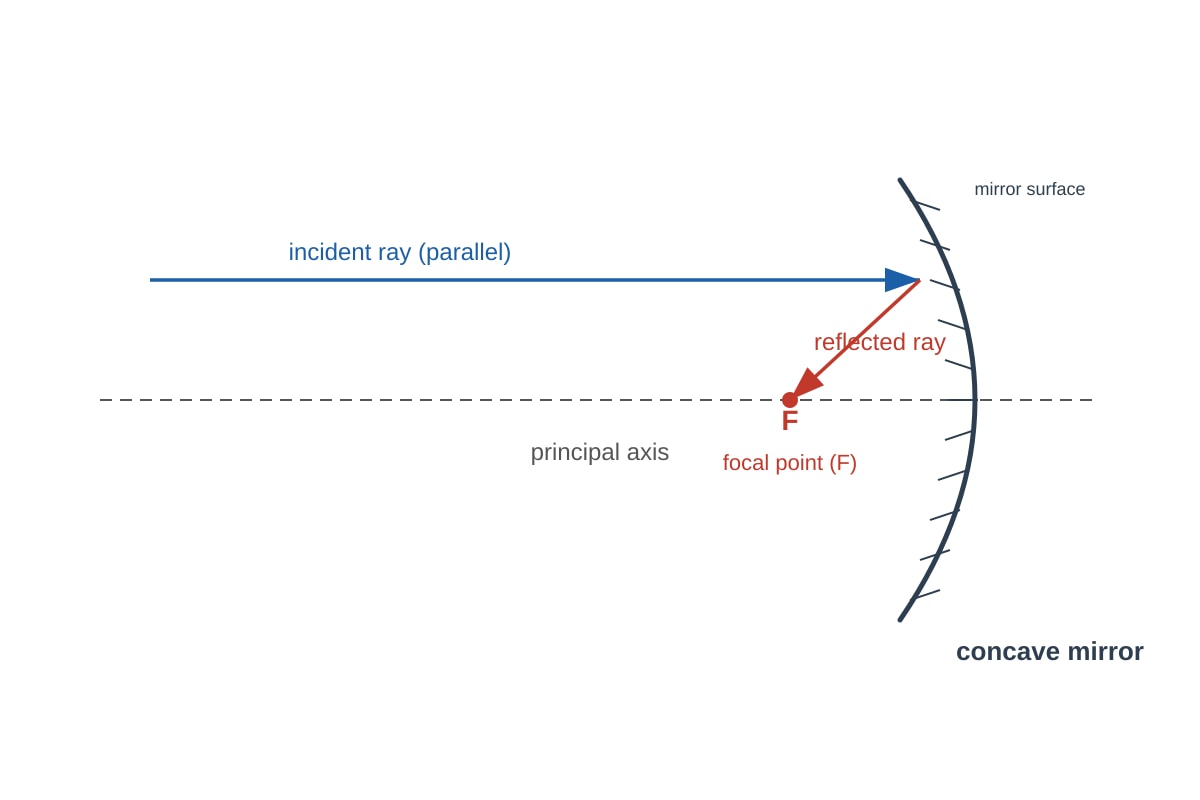
17. Answer: (a) Point F is the focal point (or focus) of the concave mirror. Parallel rays of light that hit the mirror are reflected and converge (meet) at this point. (1 mark) (b) The reflected ray should be drawn as a straight line from the point where the incident ray hits the mirror, passing through point F. (1 mark)
- Explanation: Concave mirrors are converging mirrors. They bring parallel light rays together at a single point called the focal point. This is why concave mirrors are used in telescopes and satellite dishes to collect and focus light.
- Marking Scheme:
- (a) Correctly identifying F as the focal point: 1 mark.
- (b) Correctly drawing the reflected ray through F: 1 mark.
18. Answer: (a) When water is poured into the cup, light from the coin travels from water (denser medium) to air (less dense medium). As it leaves the water, the light ray bends away from the normal (refracts). This bending changes the direction of the light, making it reach the student's eye, even though the coin is still behind the rim. The student sees an image of the coin at a higher position than its actual location. (1 mark) (b) Refraction of light. (1 mark)
- Explanation: This is a classic demonstration of refraction. The water acts like a lens, bending the light rays from the coin so they can reach the eye. The brain assumes light travels in straight lines, so it "sees" the coin at a position where the light appears to have come from, which is higher than the actual coin.
- Marking Scheme:
- (a) Correct explanation mentioning refraction and bending of light: 1 mark.
- (b) Correctly naming refraction: 1 mark.
19. Answer: (a) The convex lens converges (brings together) the parallel light rays from the Sun to a single point called the focal point. (1 mark) (b) The paper burns because all the light energy from the Sun is concentrated onto a very small area (the focal point). This concentrated energy causes the temperature of the paper to rise rapidly until it reaches its ignition point and catches fire. (1 mark)
- Explanation: A convex lens is a converging lens. It focuses parallel light rays to a point. The energy from all the light rays is concentrated at this point, making it very hot. This is the same principle as using a magnifying glass to start a fire.
- Marking Scheme:
- (a) Correctly stating that the lens converges/focuses light: 1 mark.
- (b) Correctly explaining that concentrated energy causes the paper to heat up and burn: 1 mark.
20. Answer: (a) The light energy from the torch was absorbed by the black cardboard. The absorbed light energy was converted into heat energy, causing the cardboard to feel warm. (1 mark) (b) Any other dark-coloured, matte material, e.g., a black piece of cloth, dark-coloured paper, or asphalt. (1 mark)
- Explanation: Black and dark-coloured objects are good absorbers of light. They absorb most of the light energy that hits them and convert it into heat. Light-coloured and shiny objects reflect most of the light and do not heat up as much.
- Marking Scheme:
- (a) Correctly stating that light energy was absorbed and converted to heat: 1 mark.
- (b) Correctly naming another dark, matte material: 1 mark.
END OF ANSWER KEY