From Real Exams Quiz
Primary 6 PSLE Science Light Quiz
Free P6 PSLE Science Light quiz, Exam version, with questions, answers, and PSLE-focused practice for Singapore students.
These static practice materials are generated from the site's syllabus and paper-generation workflow, with source and model context shown so students and parents can evaluate the material before use.
Questions
Free quiz and exam paper access
Enter your details to view this paper
Your access is remembered on this device.
Answers
Answer Key: Primary 6 PSLE Science Quiz - Light
Section A: Multiple-Choice Questions
1. (3) The light is reflected by the mirror.
- Marks: 2
- Explanation: A mirror has a very smooth, shiny surface. When light hits a smooth surface, it bounces off in a predictable way. This bouncing off of light is called reflection. The mirror does not absorb the light (option 1), light cannot pass through a mirror (option 2), and while some scattering might occur, the primary and most significant interaction is reflection (option 3). Option 4 describes what happens when light hits a rough surface.
2. (A) The light ray slows down and changes direction.
- Marks: 2
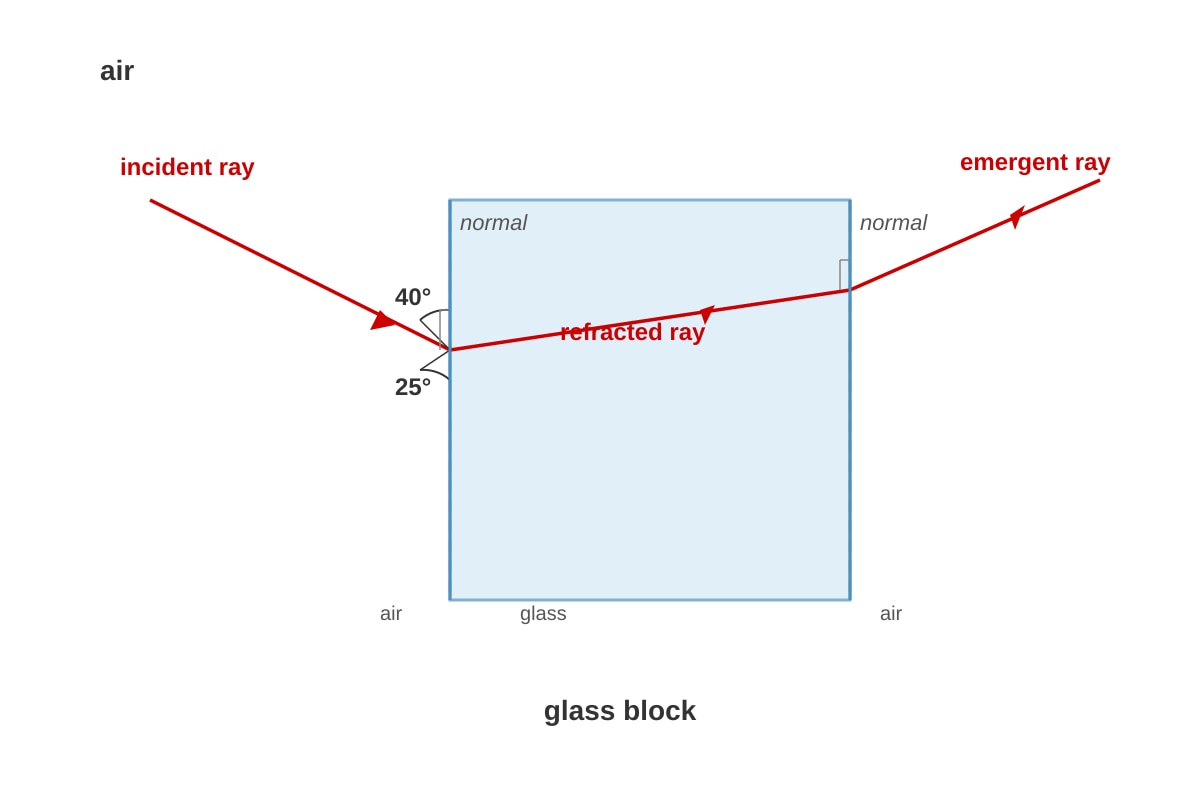
- Explanation: Light travels at different speeds in different materials. It travels fastest in air. When light enters a denser material like glass, it slows down. This change in speed causes the light ray to bend, or refract. The bending is towards the normal (the imaginary line perpendicular to the surface). Option B is incorrect because light slows down, not speeds up, when entering a denser medium. Option C is incorrect; absorption and re-emission is not how refraction works. Option D describes reflection, not refraction.
3. (C) The Moon
- Marks: 2
- Explanation: A light source is an object that produces its own light. The Sun, a candle flame, and a light bulb all produce their own light. The Moon does not produce its own light; it reflects light from the Sun. Therefore, the Moon is not a light source.
4. (B) refraction.
- Marks: 2
- Explanation: Light travels at different speeds in air and water. When light from the pencil travels from water to air, it changes speed and bends (refracts). This bending of light makes the pencil appear to be in a different position, creating the illusion that it is bent. Reflection (A) is the bouncing of light. Absorption (C) is the taking in of light energy. Scattering (D) is the spreading of light in many directions.
5. (B) 45°.
- Marks: 2
- Explanation: In a periscope, two mirrors are placed parallel to each other, each at a 45-degree angle to the direction of the light. This arrangement allows light to be reflected from the top mirror down to the bottom mirror, and then into the observer's eye, allowing them to see over an obstacle.
6. (C) The image is the same size as her face.
- Marks: 2
- Explanation: A plane mirror (a flat mirror) produces a virtual image that is the same size as the object. The image is upright (not upside down, so option B is wrong) and appears to be the same distance behind the mirror as the object is in front of it. Options A and D are incorrect as plane mirrors do not magnify or minify.
7. (A) The Sun is directly overhead.
- Marks: 2
- Explanation: The length of a shadow depends on the angle of the light source. When the Sun is directly overhead, the light hits the object from a steep angle, casting a very short shadow directly under the object. When the Sun is near the horizon (morning or evening), the light hits the object from a low angle, casting a long shadow. A cloud (D) would make the shadow less distinct but not necessarily shorter.
8. (B) 60°
- Marks: 2
- Explanation: The law of reflection states that the angle of incidence equals the angle of reflection. Both angles are measured from the normal, which is an imaginary line perpendicular to the mirror's surface. If the angle between the incident ray and the mirror is 30°, then the angle between the incident ray and the normal is 90° - 30° = 60°. Therefore, the angle of incidence is 60°, and the angle of reflection is also 60°.
9. (C) A shiny metal spoon
- Marks: 2
- Explanation: A good reflector has a smooth, shiny surface. A shiny metal spoon has a very smooth surface that reflects light in a regular, predictable way, creating a clear image. Wood (A) and paper (B) have rough surfaces that scatter light. A glass window (D) is transparent and allows most light to pass through, though it does reflect some light.
10. (D) converges the sunlight.
- Marks: 2
- Explanation: A magnifying glass is a convex lens. It is thicker in the middle than at the edges. When parallel rays of sunlight pass through the lens, they are bent (refracted) and brought together at a single point called the focus. This is called convergence. The concentrated light energy at the focus is enough to heat the paper and cause it to burn.
Section B: Open-Ended Questions
11. A white shirt reflects most of the sunlight, including the heat energy from the Sun. A black shirt absorbs most of the sunlight, including the heat energy, causing it to become hotter. Therefore, the white shirt feels cooler. [2]
- Marking Scheme:
- 1 mark for stating that white reflects light/heat.
- 1 mark for stating that black absorbs light/heat.
- Common Mistake: Students may say white reflects heat and black absorbs heat without mentioning light. Accept this as correct.
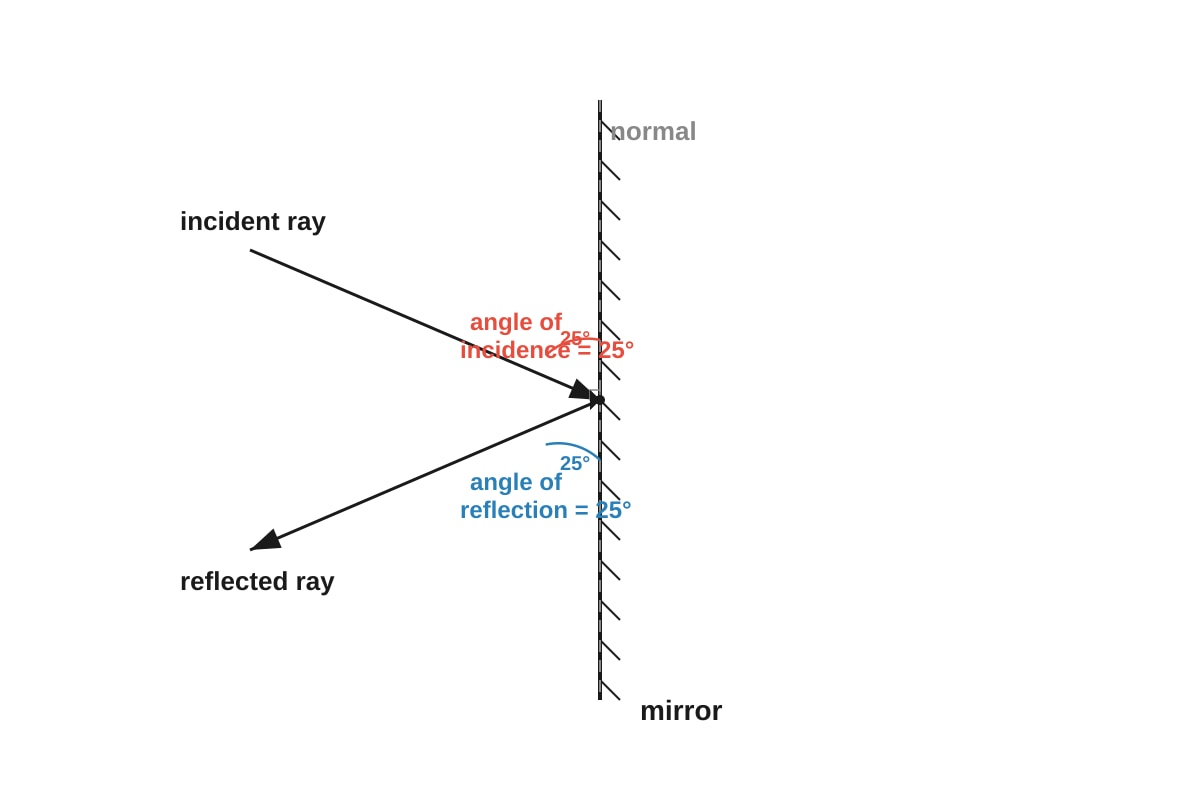
12. (a) The angle of reflection is 25°. [1]
- Explanation: The law of reflection states that the angle of incidence equals the angle of reflection.
(b) [2]
- Marking Scheme:
- 1 mark for drawing the normal as a dashed line perpendicular to the mirror.
- 1 mark for drawing the incident ray and reflected ray on opposite sides of the normal, with the angles of incidence and reflection correctly marked and labelled as 25°.
- Expected Diagram: A vertical line for the mirror. A dashed line (normal) perpendicular to the mirror. An arrow pointing towards the mirror (incident ray) making a 25° angle with the normal. An arrow pointing away from the mirror (reflected ray) making a 25° angle with the normal on the other side.
13. The apple will appear to be black. [1] This is because a red apple reflects red light and absorbs all other colours of light. When only blue light shines on it, the apple absorbs the blue light and has no red light to reflect. Since no light is reflected from the apple to the student's eyes, it appears black. [1]
- Marking Scheme:
- 1 mark for stating the apple appears black.
- 1 mark for explaining that the apple absorbs the blue light and does not reflect any light.
- Common Mistake: Students may think the apple will appear blue. Emphasise that an object's colour is determined by the light it reflects, not the light that shines on it.
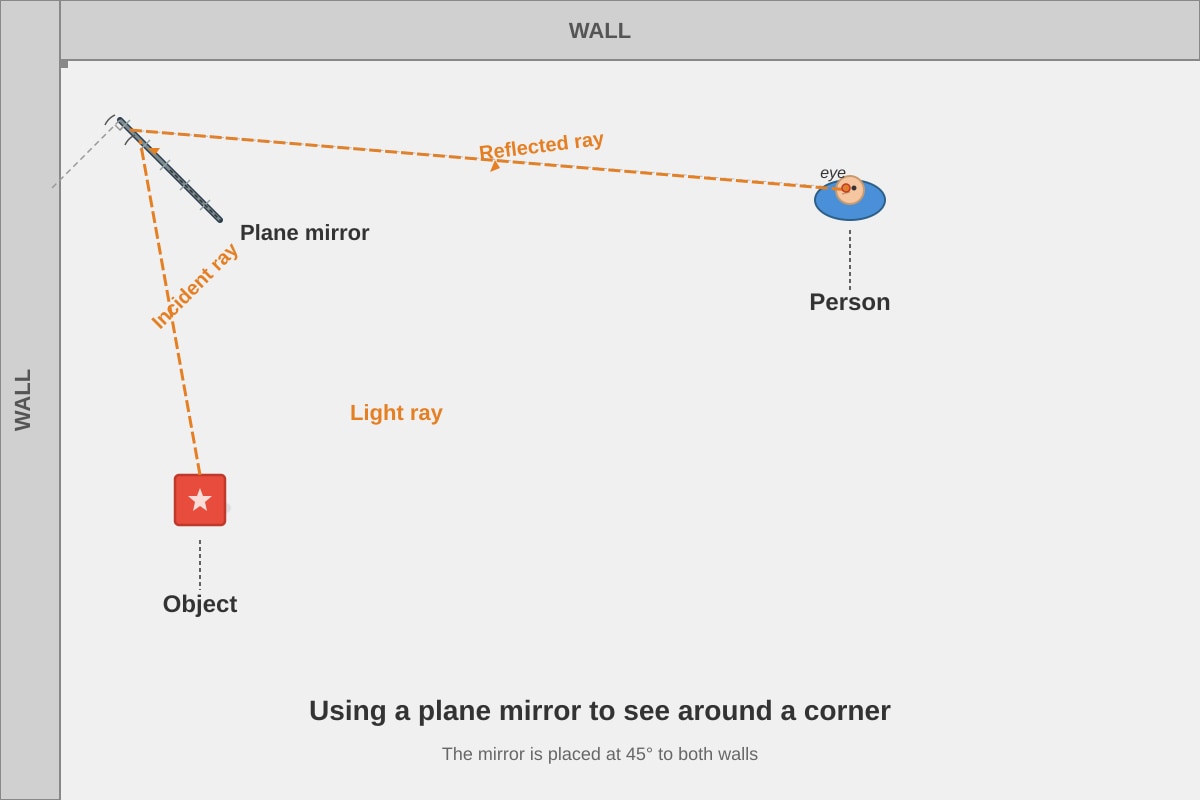
14. To see around a corner, hold a plane mirror at the corner so that it faces both the person and the object around the corner. Light from the object travels to the mirror, reflects, and then travels to the person's eye. [1]
- Marking Scheme:
- 1 mark for a clear description of the mirror's placement and how light travels.
- 1 mark for a diagram showing the mirror at a 45° angle to both walls, with a light ray reflecting from the object to the person.
- Expected Diagram: A top-down view of a corner. A mirror placed at the corner at a 45° angle. An arrow (light ray) from the object to the mirror, and another arrow from the mirror to the person's eye.
15. Light travels from the fish to the student's eye. When the light leaves the water and enters the air, it speeds up and bends (refracts) away from the normal. [1] This bending of light makes the fish appear to be at a different location, closer to the surface, than it actually is. [1]
- Marking Scheme:
- 1 mark for stating that light refracts (bends) when moving from water to air.
- 1 mark for explaining that this makes the fish appear closer to the surface.
- Common Mistake: Students may confuse this with reflection. Emphasise that the light is passing from one medium to another, which is refraction.
16. 1. Move the hand closer to the light source. [1] 2. Move the screen further away from the hand/light source. [1]
- Marking Scheme: 1 mark for each correct method.
- Explanation: The size of a shadow increases when the object is moved closer to the light source or when the screen is moved further away from the object. This is because the light rays diverge from the source, creating a larger "shadow zone" behind the object.
17. Frosted glass is a translucent material. [1] This is because it allows some light to pass through, but it scatters the light in many directions. This scattering prevents a clear image from being formed, so we cannot see clearly through it. [1]
- Marking Scheme:
- 1 mark for identifying the material as translucent.
- 1 mark for explaining that it scatters light.
- Key Concept: Materials are classified as transparent (clear image), translucent (some light passes, but no clear image), or opaque (no light passes).
18. The image formed on the screen is real, inverted (upside down), and can be larger or smaller than the object depending on the distance between the lens, object, and screen. [2]
- Marking Scheme:
- 1 mark for stating the image is real and inverted.
- 1 mark for stating it can be magnified or diminished.
- Explanation: A convex lens can project a real image onto a screen. This image is always inverted. The size of the image depends on the object's distance from the lens.
19. The student is not correct. [1] We see a book because light from a light source (like the Sun or a lamp) shines on the book. The book reflects this light, and the reflected light travels to our eyes. Our eyes do not produce light to see things. [1]
- Marking Scheme:
- 1 mark for stating the student is incorrect.
- 1 mark for explaining that light from a source reflects off the book into our eyes.
- Common Mistake: Many students have the misconception that our eyes emit light. This question directly addresses that.
20. When the cup is empty, light from the coin travels in a straight line to the student's eye, but the rim of the cup blocks this path. [1] When water is poured in, the light from the coin travels from water to air. It refracts (bends) away from the normal as it exits the water. This bending changes the direction of the light ray, allowing it to travel over the rim of the cup and into the student's eye. [1]
- Marking Scheme:
- 1 mark for stating that light is blocked by the rim of the cup.
- 1 mark for explaining that refraction of light in water allows the light to reach the eye.
- Key Concept: This is a classic demonstration of refraction. The bending of light makes the coin appear to be in a different position, allowing it to be seen over the obstacle.