From Real Exams Quiz
Primary 6 PSLE Science Life Cycles Quiz
Free P6 PSLE Science Life Cycles quiz with questions, answers, and PSLE-focused practice for Singapore students preparing for school assessments.
These static practice materials are generated from the site's syllabus and paper-generation workflow, with source and model context shown so students and parents can evaluate the material before use.
Questions
Primary 6 PSLE Science Quiz - Life Cycles
Name: ___________________________
Class: Primary 6 _______
Date: ___________________________
Score: _______ / 40
Duration: 45 minutes
Total Marks: 40
Instructions:
- Answer all questions.
- For Section A, choose the correct option and write its number (1, 2, 3, or 4) in the brackets provided.
- For Section B and C, write your answers in the spaces provided.
- The number of marks for each question is shown in brackets [ ].
Section A: Multiple-Choice Questions (10 × 1 mark = 10 marks)
For each question, choose the correct answer and write its number (1, 2, 3, or 4) in the brackets provided.
1. Which of the following animals has a three-stage life cycle?
(1) Butterfly
(2) Mosquito
(3) Grasshopper
(4) Beetle
[ ] [1]
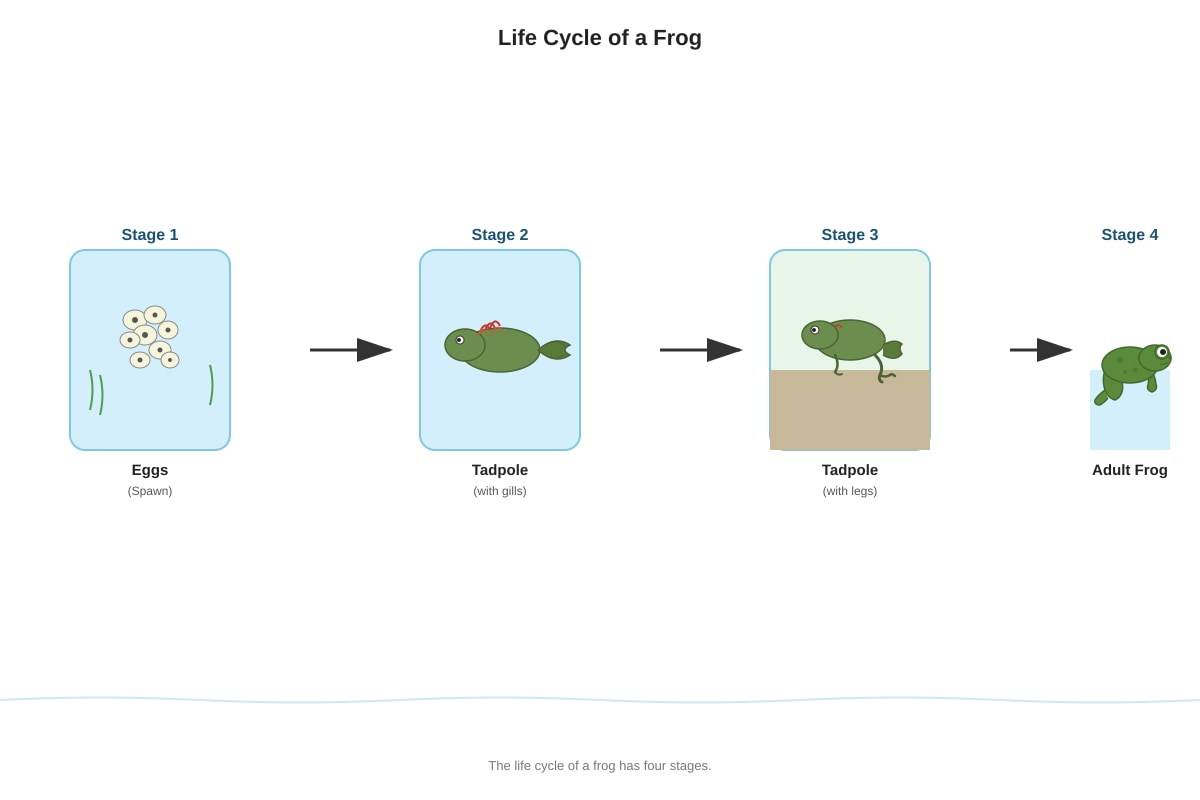
2. The diagram below shows the life cycle of a frog.
<image_placeholder>
id: Q2-fig1
type: diagram
linked_question: Q2
description: Life cycle of a frog showing four stages: eggs (spawn), tadpole with gills, tadpole with legs, and adult frog. Arrows indicate direction of development.
labels: Eggs, Tadpole (with gills), Tadpole (with legs), Adult Frog
values: None
must_show: Four distinct stages in correct sequence with arrows; gills visible on early tadpole; legs visible on later tadpole; adult frog on land/water interface.
</image_placeholder>
At which stage does the frog breathe through lungs?
(1) Eggs
(2) Tadpole with gills
(3) Tadpole with legs
(4) Adult frog
[ ] [1]
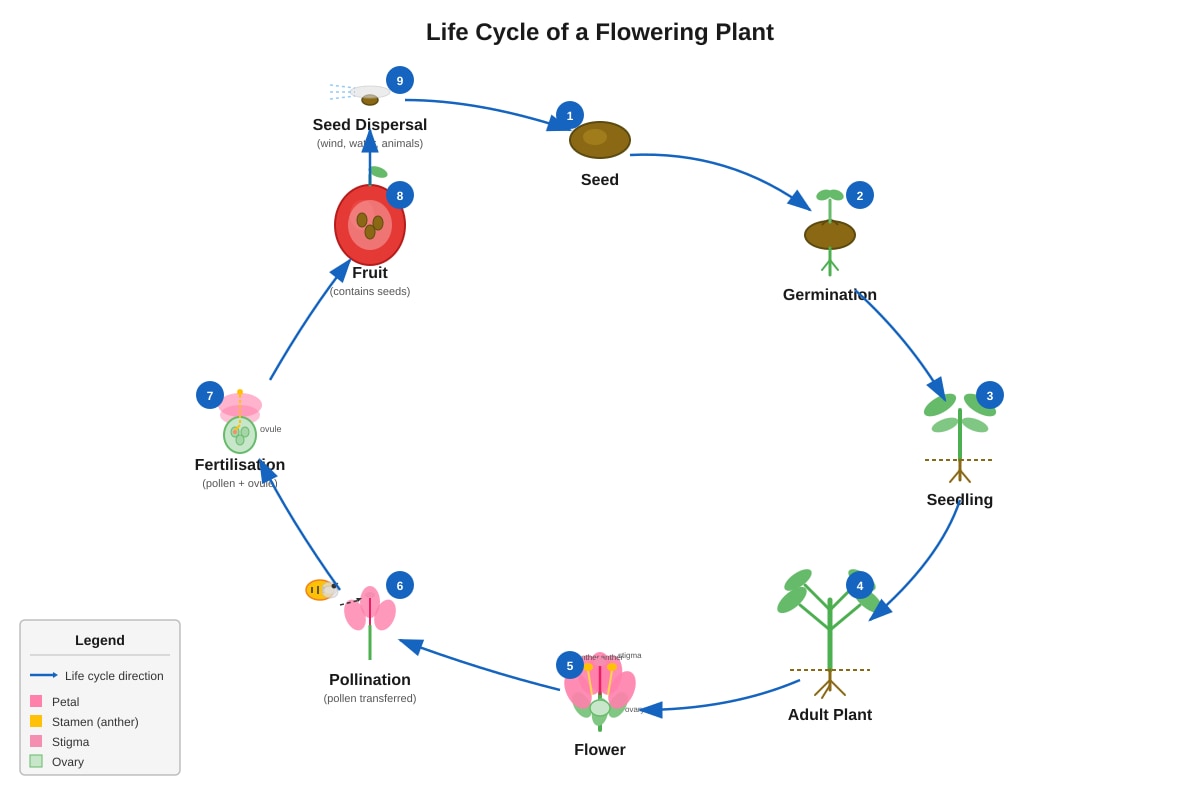
3. Study the life cycle of a flowering plant below.
<image_placeholder>
id: Q3-fig1
type: diagram
linked_question: Q3
description: Life cycle of a flowering plant showing seed, germination, seedling, adult plant with flower, pollination, fertilisation, fruit formation, and seed dispersal back to seed.
labels: Seed, Germination, Seedling, Adult Plant, Flower, Pollination, Fertilisation, Fruit, Seed Dispersal
values: None
must_show: Cyclic diagram with 8 stages in correct order; arrows showing cycle; flower structure visible (stigma, stamen, ovary); fruit containing seeds.
</image_placeholder>
Which process occurs immediately after pollination?
(1) Germination
(2) Fertilisation
(3) Seed dispersal
(4) Fruit formation
[ ] [1]
4. The table below shows the number of days for each stage in the life cycle of a mealworm beetle at 25°C.
| Stage | Number of Days |
|---|---|
| Egg | 10 |
| Larva | 60 |
| Pupa | 14 |
| Adult | 90 |
How many days does it take for the mealworm beetle to develop from egg to adult?
(1) 74
(2) 84
(3) 94
(4) 174
[ ] [1]
5. Which of the following statements about seed dispersal is correct?
(1) All seeds are dispersed by wind.
(2) Seed dispersal prevents overcrowding and competition among young plants.
(3) Seeds dispersed by water must have wings.
(4) Animals disperse seeds only by eating fruits.
[ ] [1]
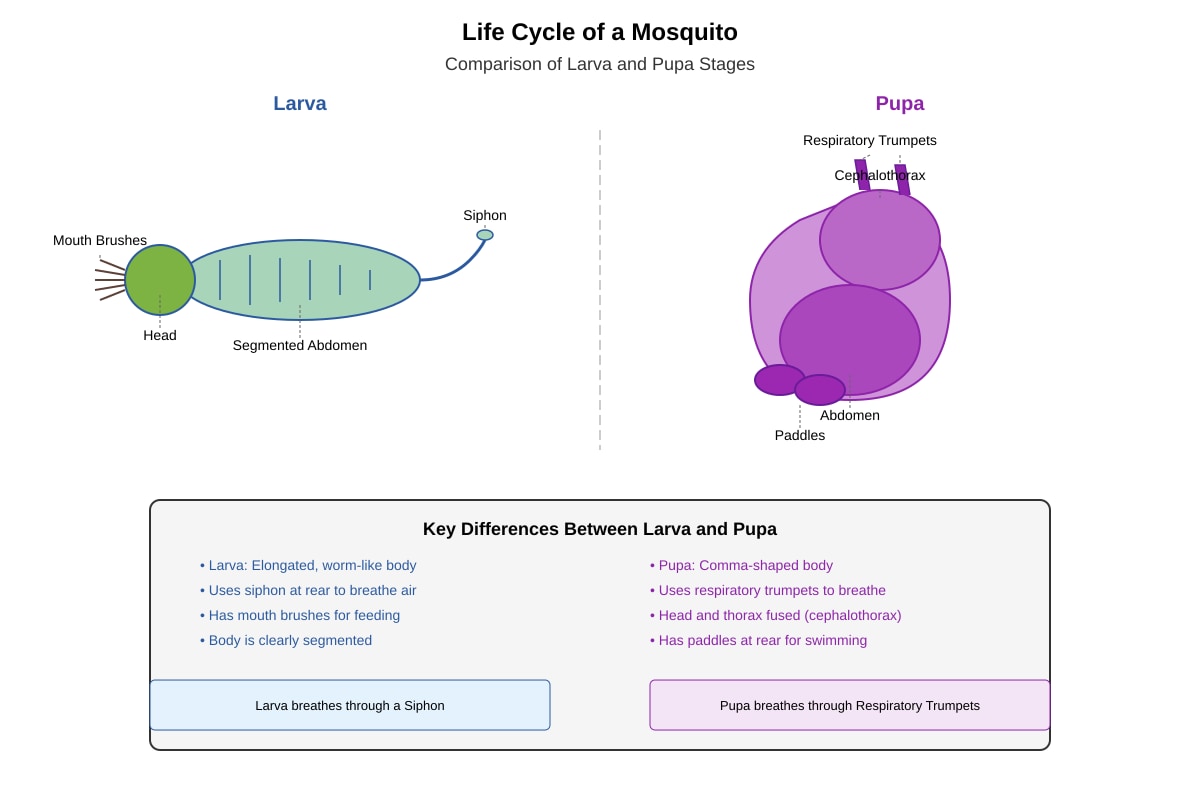
6. The diagram below shows a mosquito larva and a mosquito pupa.
<image_placeholder>
id: Q6-fig1
type: diagram
linked_question: Q6
description: Side-by-side comparison of mosquito larva and pupa. Larva: elongated, segmented body, head with mouth brushes, siphon at rear for breathing. Pupa: comma-shaped, fused cephalothorax and abdomen, two respiratory trumpets on thorax, paddles at rear.
labels: Larva - Head, Mouth Brushes, Segmented Abdomen, Siphon; Pupa - Cephalothorax, Respiratory Trumpets, Abdomen, Paddles
values: None
must_show: Clear structural differences between larva and pupa; breathing structures labelled; body shapes distinct.
</image_placeholder>
Which statement correctly describes a difference between the larva and pupa?
(1) The larva has a siphon for breathing; the pupa has respiratory trumpets.
(2) The larva is comma-shaped; the pupa is elongated.
(3) The larva does not move; the pupa swims actively.
(4) The larva has wings; the pupa does not.
[ ] [1]
7. A student observed the germination of a bean seed. Which of the following shows the correct order of appearance of structures?
(1) Shoot → Root → Seed leaves
(2) Root → Shoot → Seed leaves
(3) Seed leaves → Root → Shoot
(4) Root → Seed leaves → Shoot
[ ] [1]
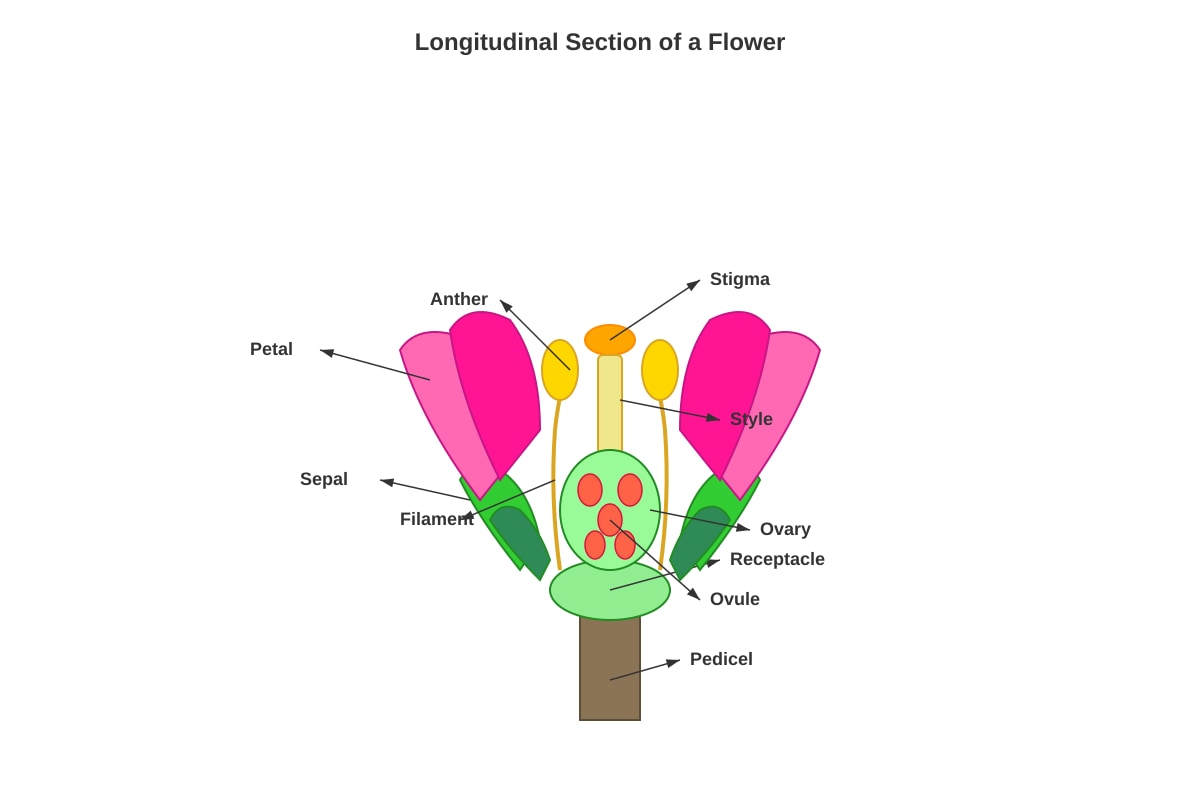
8. The diagram below shows the reproductive parts of a flower.
<image_placeholder>
id: Q8-fig1
type: diagram
linked_question: Q8
description: Longitudinal section of a flower showing sepal, petal, stamen (anther on filament), carpel (stigma, style, ovary with ovules), receptacle, and pedicel.
labels: Sepal, Petal, Anther, Filament, Stigma, Style, Ovary, Ovule, Receptacle, Pedicel
values: None
must_show: All parts clearly labelled; ovules inside ovary visible; anther positioned above stigma or at same height.
</image_placeholder>
Where are the male gametes produced?
(1) Stigma
(2) Ovary
(3) Anther
(4) Style
[ ] [1]
9. Which of the following animals undergoes complete metamorphosis?
(1) Chicken
(2) Cockroach
(3) Butterfly
(4) Grasshopper
[ ] [1]
10. The graph below shows the height of a plant over 6 weeks after germination.
<image_placeholder>
id: Q10-fig1
type: graph
linked_question: Q10
description: Line graph with x-axis: Time (weeks) from 0 to 6; y-axis: Height (cm) from 0 to 30. Curve starts at (0,2), rises slowly to (2,5), then steeply to (4,20), then levels off to (6,25).
labels: X-axis: Time (weeks), Y-axis: Height (cm)
values: (0,2), (1,3), (2,5), (3,12), (4,20), (5,23), (6,25)
must_show: Smooth curve showing lag phase, exponential growth phase, and stationary phase; axes labelled with units; data points marked.
</image_placeholder>
During which period did the plant grow the fastest?
(1) Week 0 to Week 1
(2) Week 1 to Week 2
(3) Week 2 to Week 3
(4) Week 3 to Week 4
[ ] [1]
Section B: Structured Questions (6 × 2 marks = 12 marks)
Write your answers in the spaces provided.
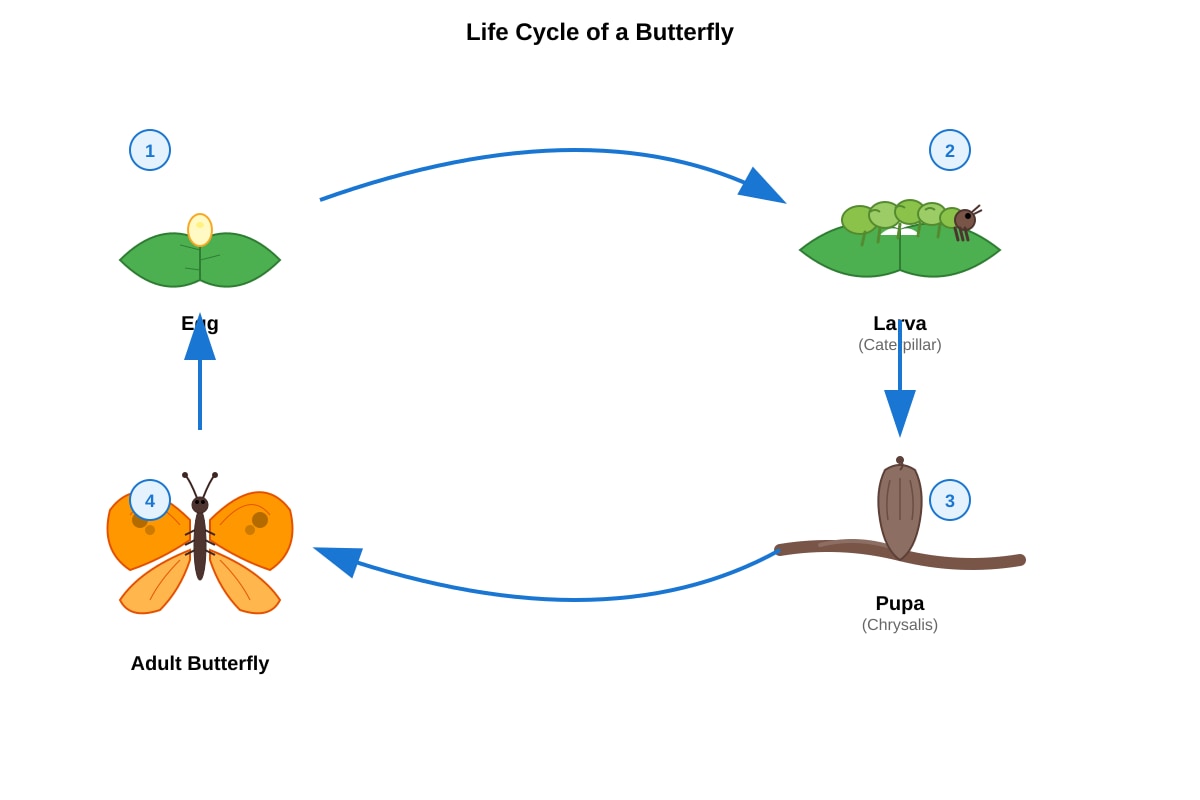
11. The diagram below shows the life cycle of a butterfly.
<image_placeholder>
id: Q11-fig1
type: diagram
linked_question: Q11
description: Four-stage life cycle of a butterfly: Egg on leaf, Larva (caterpillar) eating leaf, Pupa (chrysalis) attached to branch, Adult butterfly emerging. Arrows show cycle.
labels: Egg, Larva (Caterpillar), Pupa (Chrysalis), Adult Butterfly
values: None
must_show: Four distinct stages; caterpillar with prolegs; chrysalis hanging; adult with wings; arrows forming a cycle.
</image_placeholder>
(a) Name the two stages in the life cycle where the butterfly does not feed.
________________________________________________________________________ [1]
(b) State one difference between the larva and the adult in terms of movement.
________________________________________________________________________ [1]
12. The table below shows the conditions needed for seed germination.
| Condition | Set-up A | Set-up B | Set-up C | Set-up D |
|---|---|---|---|---|
| Water | Yes | Yes | No | Yes |
| Oxygen | Yes | No | Yes | Yes |
| Temperature | 25°C | 25°C | 25°C | 5°C |
| Germination | ? | ? | ? | ? |
(a) In which set-up(s) will germination occur?
________________________________________________________________________ [1]
(b) Explain why germination does not occur in Set-up B.
________________________________________________________________________ [1]
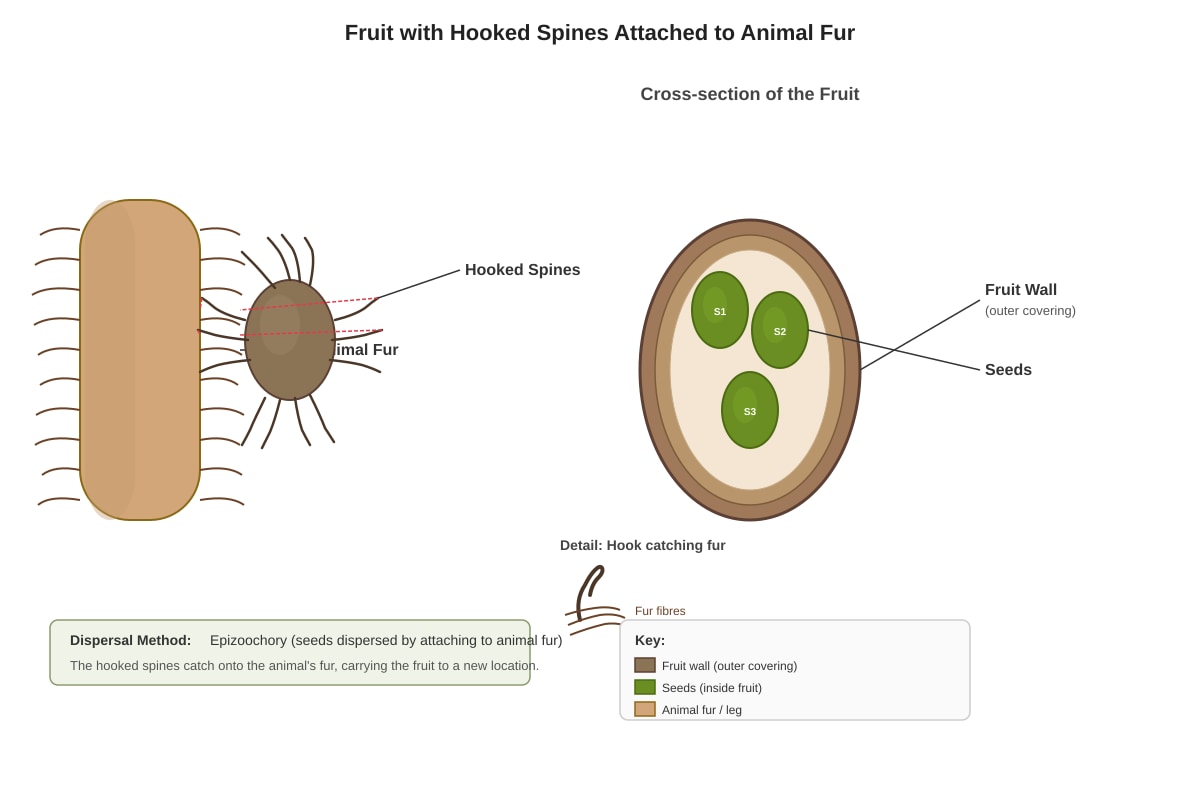
13. The diagram below shows a dispersal method of a fruit/seed.
<image_placeholder>
id: Q13-fig1
type: diagram
linked_question: Q13
description: Fruit with hooked spines (like Xanthium/burr) attached to animal fur. Cross-section shows seeds inside fruit. Animal leg with fur shown.
labels: Hooked Spines, Fruit Wall, Seeds, Animal Fur
values: None
must_show: Hooks on fruit surface clearly visible; seeds inside; fur fibres catching hooks.
</image_placeholder>
(a) Name the dispersal method shown.
________________________________________________________________________ [1]
(b) State one structural adaptation of the fruit that enables this dispersal method.
________________________________________________________________________ [1]
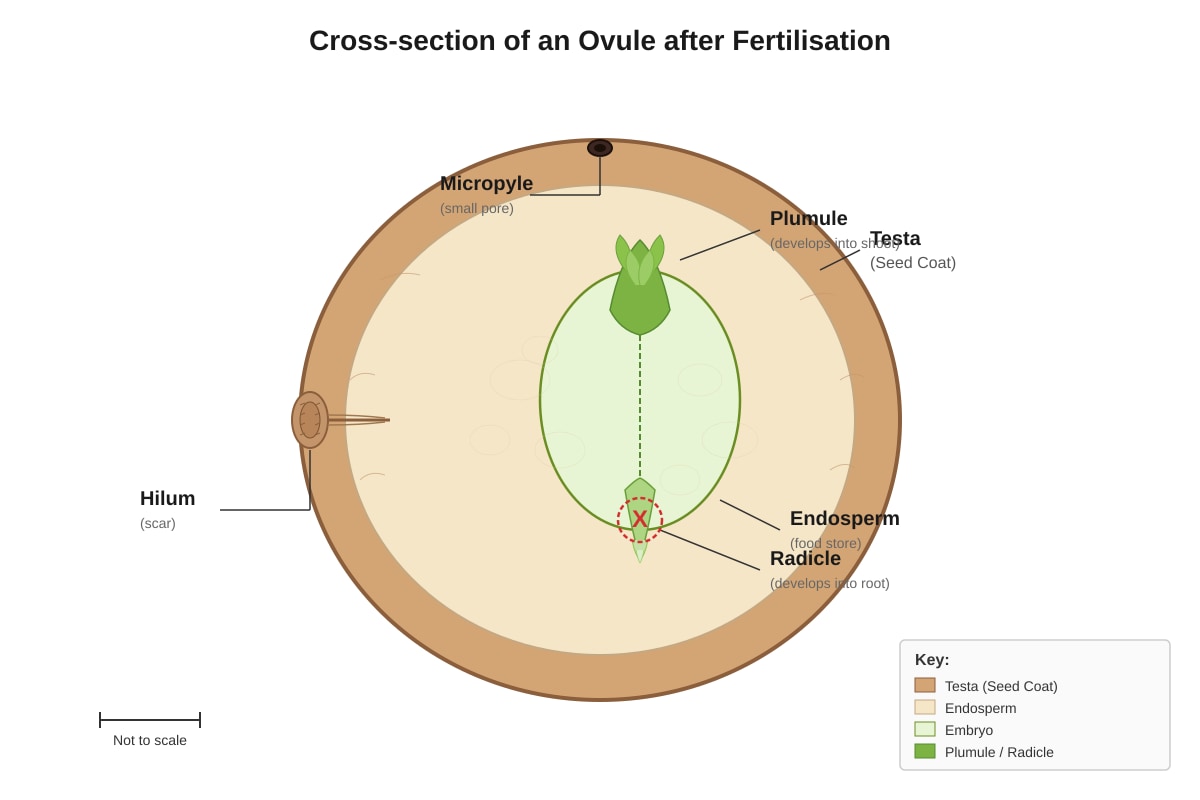
14. The diagram below shows the cross-section of an ovule after fertilisation.
<image_placeholder>
id: Q14-fig1
type: diagram
linked_question: Q14
description: Ovule structure: outer integuments forming seed coat (testa), micropyle, embryo with radicle and plumule, endosperm (food store), hilum.
labels: Testa (Seed Coat), Micropyle, Radicle, Plumule, Endosperm, Hilum
values: None
must_show: All parts labelled; embryo clearly differentiated; micropyle as small pore; hilum as scar.
</image_placeholder>
(a) Label part X (the part that develops into the root) on the diagram.
[Write "X → Radicle" here: _______________________________________________] [1]
(b) What is the function of the endosperm?
________________________________________________________________________ [1]
15. A student conducted an experiment to find out how temperature affects the rate of mealworm development. She kept mealworm eggs at four different temperatures and recorded the number of days to reach the adult stage.
| Temperature (°C) | Days to Adult |
|---|---|
| 15 | 120 |
| 20 | 80 |
| 25 | 50 |
| 30 | 40 |
(a) What is the relationship between temperature and the number of days to reach the adult stage?
________________________________________________________________________ [1]
(b) Predict the number of days to reach the adult stage at 35°C. Explain your reasoning.
________________________________________________________________________ [1]
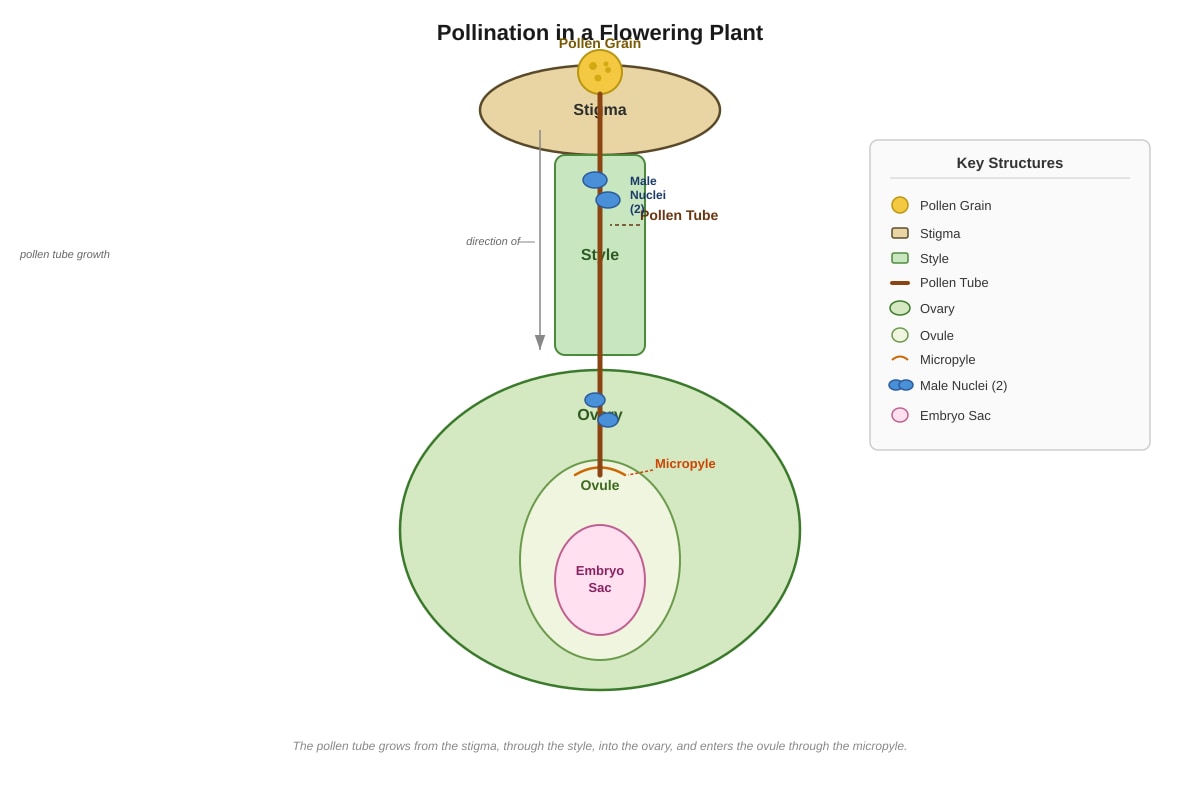
16. The diagram below shows pollination in a flowering plant.
<image_placeholder>
id: Q16-fig1
type: diagram
linked_question: Q16
description: Pollen grain on stigma, pollen tube growing down style into ovary, entering ovule through micropyle. Two male nuclei shown in pollen tube. Ovule with embryo sac.
labels: Pollen Grain, Stigma, Style, Pollen Tube, Ovary, Ovule, Micropyle, Male Nuclei (2), Embryo Sac
values: None
must_show: Pollen tube path clear; two male nuclei; micropyle entry point; embryo sac in ovule.
</image_placeholder>
(a) Name the process shown in the diagram.
________________________________________________________________________ [1]
(b) What happens to the two male nuclei after they enter the embryo sac?
________________________________________________________________________ [1]
Section C: Open-Ended Questions (3 × 6 marks = 18 marks)
Write your answers in the spaces provided. Show your working or reasoning clearly.
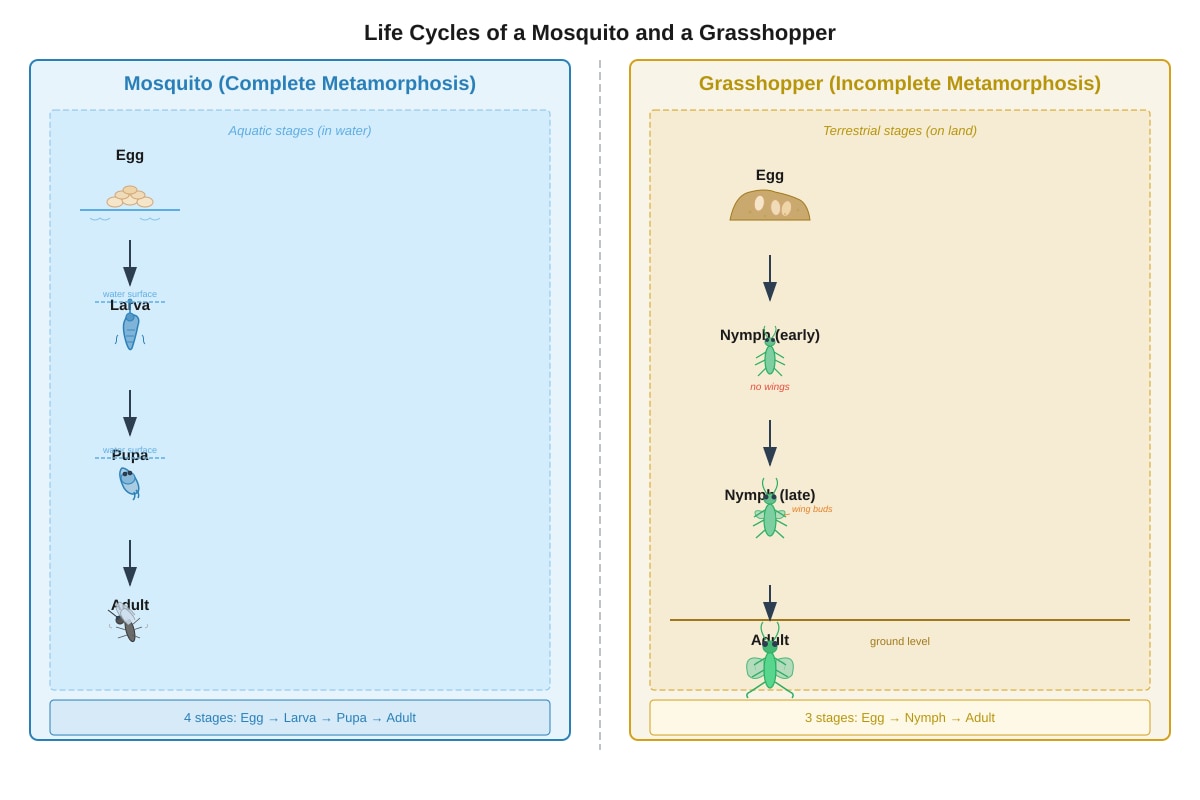
17. The diagram below shows the life cycles of a mosquito and a grasshopper.
<image_placeholder>
id: Q17-fig1
type: diagram
linked_question: Q17
description: Side-by-side life cycles. Mosquito: Egg raft on water → Larva (wiggler) in water → Pupa (tumbler) in water → Adult flying. Grasshopper: Egg in soil → Nymph (resembles small adult, no wings) → Nymph (wing buds) → Adult with wings. Both cycles have arrows.
labels: Mosquito: Egg, Larva, Pupa, Adult; Grasshopper: Egg, Nymph (early), Nymph (late), Adult
values: None
must_show: Clear contrast: mosquito aquatic larva/pupa vs grasshopper terrestrial nymphs; mosquito complete metamorphosis (4 stages); grasshopper incomplete metamorphosis (3 stages); habitat differences shown.
</image_placeholder>
(a) State one similarity between the life cycles of the mosquito and the grasshopper.
________________________________________________________________________ [1]
(b) State two differences between the life cycles of the mosquito and the grasshopper.
________________________________________________________________________ [2]
(c) The mosquito larva and pupa live in water. State one adaptation the larva has for breathing in water.
________________________________________________________________________ [1]
(d) Explain why removing stagnant water helps to control the mosquito population.
________________________________________________________________________ [2]
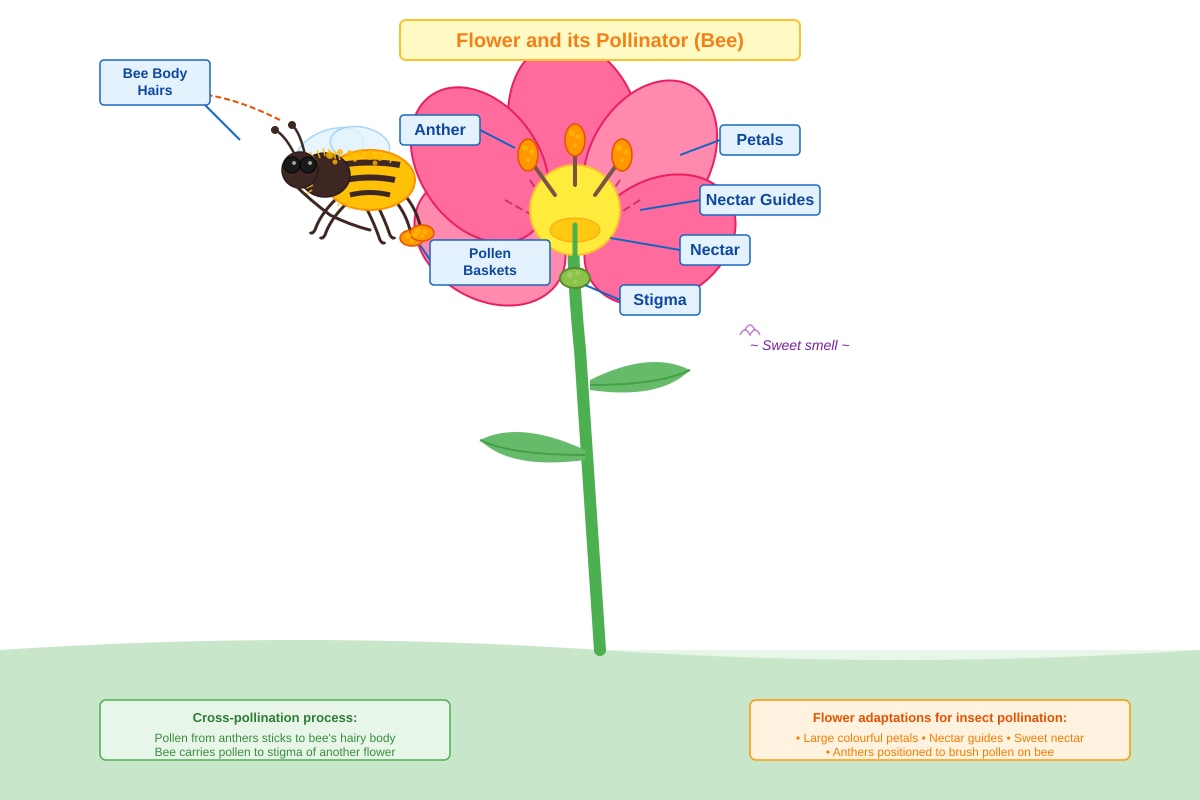
18. The diagram below shows a flower and its pollinator (a bee).
<image_placeholder>
id: Q18-fig1
type: diagram
linked_question: Q18
description: Bee on a flower. Flower has large colourful petals, nectar guide lines, sweet-smelling nectar at base, anthers positioned to brush pollen on bee's back, stigma positioned to receive pollen from another flower. Bee has hairy body, pollen baskets on hind legs.
labels: Petals, Nectar Guides, Nectar, Anther, Stigma, Bee Body Hairs, Pollen Baskets
values: None
must_show: Flower adaptations for insect pollination visible; bee adaptations for pollen collection visible; relative positioning of anther and stigma for cross-pollination.
</image_placeholder>
(a) State two characteristics of the flower that attract the bee.
________________________________________________________________________ [2]
(b) Explain how the bee transfers pollen from one flower to another.
________________________________________________________________________ [2]
(c) After pollination, the ovule develops into the seed. Describe two changes that occur in the ovule during seed formation.
________________________________________________________________________ [2]
19. A farmer wants to grow a new crop. He has two options for seed dispersal:
Option A: Seeds dispersed by wind (e.g., dandelion-like fruits with parachutes).
Option B: Seeds dispersed by animals (e.g., fleshy fruits eaten by birds).
(a) State one advantage and one disadvantage of Option A (wind dispersal) for the farmer.
Advantage: ______________________________________________________________ [1]
Disadvantage: ___________________________________________________________ [1]
(b) State one advantage and one disadvantage of Option B (animal dispersal) for the farmer.
Advantage: ______________________________________________________________ [1]
Disadvantage: ___________________________________________________________ [1]
(c) The farmer chooses Option B. Suggest one way he can encourage animals to disperse the seeds effectively.
________________________________________________________________________ [1]
(d) Explain why seed dispersal is important for the survival of the plant species.
________________________________________________________________________ [1]
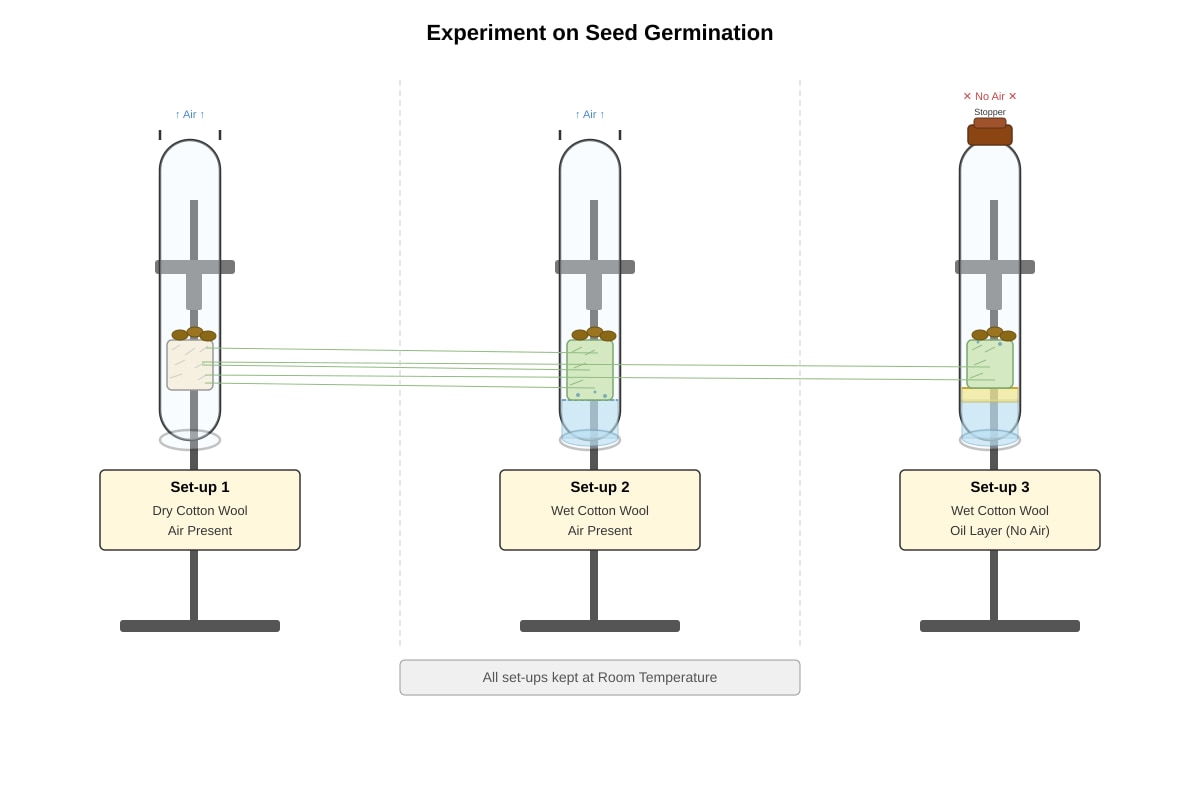
20. The diagram below shows an experiment on seed germination. Three set-ups are prepared as shown.
<image_placeholder>
id: Q20-fig1
type: experimental_setup
linked_question: Q20
description: Three boiling tubes with cotton wool and bean seeds. Set-up 1: Dry cotton wool, seeds on top, open to air, room temperature. Set-up 2: Wet cotton wool, seeds on top, open to air, room temperature. Set-up 3: Wet cotton wool, seeds on top, layer of oil on water, sealed with stopper, room temperature. All tubes clamped to stands.
labels: Set-up 1: Dry Cotton Wool, Air Present; Set-up 2: Wet Cotton Wool, Air Present; Set-up 3: Wet Cotton Wool, Oil Layer (No Air)
values: None
must_show: Three distinct set-ups; oil layer in Set-up 3 clearly sealing water surface; stoppers; seeds positioned same way; labels for conditions.
</image_placeholder>
(a) In which set-up(s) will the seeds germinate?
________________________________________________________________________ [1]
(b) What is the purpose of the oil layer in Set-up 3?
________________________________________________________________________ [1]
(c) State the three conditions necessary for seed germination.
________________________________________________________________________ [2]
(d) The seeds in Set-up 2 germinate. After a few days, the dry mass of the seedling decreases before it increases. Explain why the dry mass decreases initially.
________________________________________________________________________ [2]
End of Quiz
Answers
Primary 6 PSLE Science Quiz - Life Cycles (Answer Key)
Total Marks: 40
Section A: Multiple-Choice Questions (10 marks)
1. Answer: (3) Grasshopper
Explanation: Grasshoppers have a three-stage life cycle (egg → nymph → adult), which is incomplete metamorphosis. Butterflies, mosquitoes, and beetles have four-stage life cycles (complete metamorphosis).
Mark: 1
2. Answer: (4) Adult frog
Explanation: Frog eggs and tadpoles live in water. Tadpoles breathe through gills. As they develop into adults, they grow lungs and lose gills. Only the adult frog breathes through lungs (and also through skin).
Mark: 1
3. Answer: (2) Fertilisation
Explanation: In flowering plants, pollination (transfer of pollen to stigma) is followed by fertilisation (fusion of male and female gametes in the ovule). Fruit formation occurs after fertilisation.
Mark: 1
4. Answer: (2) 84
Working: Egg (10) + Larva (60) + Pupa (14) = 84 days. The adult stage duration (90 days) is not included in "development from egg to adult".
Mark: 1
5. Answer: (2) Seed dispersal prevents overcrowding and competition among young plants.
Explanation: Seed dispersal spreads seeds away from the parent plant, reducing competition for light, water, nutrients, and space. Not all seeds are wind-dispersed (1 is false). Water-dispersed seeds have air spaces/fibrous husks, not wings (3 is false). Animals disperse seeds by eating fruits AND by carrying hooked/spiny fruits on fur (4 is false).
Mark: 1
6. Answer: (1) The larva has a siphon for breathing; the pupa has respiratory trumpets.
Explanation: Mosquito larva breathes through a siphon at the rear; pupa breathes through two respiratory trumpets on the thorax. The larva is elongated, pupa is comma-shaped (2 is reversed). Both larva and pupa move (3 is false). Neither has wings (4 is false).
Mark: 1
7. Answer: (4) Root → Seed leaves → Shoot
Explanation: During germination, the radicle (embryonic root) emerges first to anchor and absorb water. Then the hypocotyl elongates, pulling the seed leaves (cotyledons) above ground. The plumule (shoot) then grows from between the seed leaves.
Mark: 1
8. Answer: (3) Anther
Explanation: The anther is the male reproductive part of the flower that produces pollen grains containing male gametes. The stigma receives pollen, the ovary contains ovules (female gametes), and the style connects stigma to ovary.
Mark: 1
9. Answer: (3) Butterfly
Explanation: Butterflies undergo complete metamorphosis (egg → larva → pupa → adult). Chickens have no metamorphosis. Cockroaches and grasshoppers undergo incomplete metamorphosis (egg → nymph → adult).
Mark: 1
10. Answer: (4) Week 3 to Week 4
Working: Calculate growth per week:
Week 0–1: 3–2 = 1 cm
Week 1–2: 5–3 = 2 cm
Week 2–3: 12–5 = 7 cm
Week 3–4: 20–12 = 8 cm (greatest increase)
Week 4–5: 23–20 = 3 cm
Week 5–6: 25–23 = 2 cm
Mark: 1
Section B: Structured Questions (12 marks)
11. (a) Egg and Pupa (Chrysalis) [1]
Explanation: The egg stage is dormant. The pupa (chrysalis) is a non-feeding, transformative stage. The larva (caterpillar) feeds voraciously, and the adult feeds on nectar.
11. (b) The larva crawls using legs/prolegs; the adult flies using wings. [1]
Explanation: Caterpillars have true legs and prolegs for crawling on plants. Adult butterflies have two pairs of wings for flight. Accept: "Larva moves by crawling; adult moves by flying."
12. (a) Set-up A only [1]
Explanation: Germination requires water, oxygen, and suitable temperature (warmth). Set-up A has all three. Set-up B lacks oxygen. Set-up C lacks water. Set-up D has unsuitable temperature (too cold).
12. (b) Set-up B has no oxygen. Oxygen is needed for respiration to release energy for germination. [1]
Explanation: Seeds respire aerobically during germination to obtain energy for growth. Without oxygen, aerobic respiration cannot occur, so no energy is released for metabolic processes.
13. (a) Animal dispersal (by attachment / epizoochory) [1]
Explanation: Hooked spines catch on animal fur/feathers for transport.
13. (b) The fruit has hooked spines / stiff hairs that catch onto animal fur. [1]
Explanation: Structural adaptation for external attachment. Accept: "Hooks on fruit surface" or "Spiny fruit wall".
14. (a) X → Radicle [1]
Explanation: The radicle is the embryonic root, first to emerge during germination.
14. (b) The endosperm stores food (starch, proteins, oils) for the developing embryo during germination. [1]
Explanation: Provides energy and building materials until the seedling can photosynthesise.
15. (a) As temperature increases, the number of days to reach the adult stage decreases. / Higher temperature leads to faster development. [1]
Explanation: Within the viable range, metabolic rate increases with temperature, speeding up growth and development.
15. (b) Prediction: Less than 40 days (e.g., 30–35 days). Reasoning: The trend shows decreasing days with increasing temperature, so at 35°C development would be even faster. [1]
Explanation: Extrapolating the trend. Note: At excessively high temperatures, development may slow or stop due to enzyme denaturation, but within the range shown, the trend holds. Accept reasonable prediction with correct reasoning.
16. (a) Fertilisation (in a flowering plant) [1]
Explanation: The diagram shows pollen tube growth and entry of male nuclei into the ovule — the process of fertilisation.
16. (b) One male nucleus fuses with the egg cell to form the zygote (which develops into the embryo). The other male nucleus fuses with the two polar nuclei to form the triploid nucleus (which develops into the endosperm). [1]
Explanation: This is double fertilisation, unique to flowering plants. Accept: "One forms the embryo, the other forms the endosperm/food store."
Section C: Open-Ended Questions (18 marks)
17. (a) Both life cycles begin with an egg stage. / Both have four stages. / Both undergo metamorphosis. [1]
Explanation: Any valid similarity. Most direct: both start from eggs laid by the adult female.
17. (b) Difference 1: Mosquito has a larval and pupal stage (complete metamorphosis); grasshopper has nymph stages that resemble the adult (incomplete metamorphosis).
Difference 2: Mosquito larva and pupa live in water (aquatic); grasshopper nymphs and adults live on land (terrestrial).
Difference 3: Mosquito has 4 stages; grasshopper has 3 stages (egg, nymph, adult). [2]
Explanation: Award 1 mark per distinct difference. Key contrasts: type of metamorphosis, habitat of young stages, number of stages.
17. (c) The larva has a breathing tube (siphon) at the end of its abdomen that it extends to the water surface to take in air. [1]
Explanation: Mosquito larvae are air-breathers; they hang at the water surface with the siphon breaking the surface tension.
17. (d) Mosquitoes lay eggs in stagnant water. The larvae and pupae develop in water. Removing stagnant water removes the breeding site, so eggs cannot hatch and larvae/pupae cannot survive, reducing the population. [2]
Mark breakdown: 1 mark for identifying water as breeding site for eggs/larvae/pupae; 1 mark for explaining removal breaks the life cycle.
Common mistake: Only saying "mosquitoes breed in water" without linking to life cycle stages.
18. (a) Characteristic 1: Large, brightly coloured petals to attract bees visually.
Characteristic 2: Sweet-smelling nectar / nectar guides to attract bees by scent and guide them to nectar. [2]
Explanation: Insect-pollinated flowers have visual and olfactory attractants. Accept: "Sweet nectar as food reward", "Pollen as food", "Nectar guides".
18. (b) When the bee visits the flower to collect nectar, pollen from the anther brushes onto its hairy body. When the bee visits another flower of the same species, some of this pollen rubs off onto the stigma, achieving pollination. [2]
Mark breakdown: 1 mark for pollen transfer to bee's body; 1 mark for transfer from bee to stigma of another flower.
Explanation: Emphasise cross-pollination (between flowers) and role of bee's hairy body.
18. (c) Change 1: The zygote (fertilised egg) divides and develops into the embryo (with radicle and plumule).
Change 2: The integuments (outer layers of ovule) develop into the seed coat (testa) to protect the embryo.
Change 3: The ovary develops into the fruit (though this is outside the ovule).
Change 4: The endosperm may develop (from fusion of second male nucleus with polar nuclei) to store food. [2]
Mark breakdown: 1 mark per valid change within the ovule. Best answers: embryo formation and seed coat formation.
19. (a) Advantage: Seeds can be dispersed far from the parent plant over a wide area. / No reliance on animals.
Disadvantage: Dispersal is unpredictable / dependent on wind direction and strength. / Many seeds may land in unsuitable habitats (e.g., water, concrete). / Seeds must be light/small, limiting food reserves. [2]
Explanation: Wind dispersal = wide but random; animal dispersal = targeted but requires mutualism.
19. (b) Advantage: Seeds are deposited in specific habitats (e.g., where animals defecate/roost) often with fertiliser (dung). / Seeds can be carried longer distances by mobile animals. / Seeds protected inside fruit during transport.
Disadvantage: Dependent on presence of animal dispersers. / If animals eat fruit but destroy seeds (e.g., seed predators), no dispersal. / Fruits require energy to produce flesh. [2]
19. (c) Plant the crop near natural habitats / hedgerows to attract birds. / Avoid using pesticides that harm seed-dispersing animals. / Provide perching sites / water sources for birds. [1]
Explanation: Any practical method to encourage animal dispersers.
19. (d) Seed dispersal reduces overcrowding and competition among seedlings and the parent plant for light, water, nutrients, and space. It also allows colonisation of new habitats. [1]
Explanation: Core concept: survival of species through reduced competition and range expansion.
20. (a) Set-up 2 only [1]
Explanation: Set-up 2 has water (wet cotton wool), oxygen (open to air), and suitable temperature (room temp). Set-up 1 lacks water. Set-up 3 lacks oxygen (oil layer prevents air from dissolving in water).
20. (b) The oil layer prevents oxygen from dissolving in the water / cuts off air supply to the seeds, creating anaerobic conditions. [1]
Explanation: Oil is impermeable to gases; it seals the water surface.
20. (c) Water (moisture), Oxygen (air), and Suitable Temperature (warmth). [2]
Mark breakdown: 1 mark for listing all three correctly; 1 mark for correct terminology (accept "warmth" for temperature).
Common mistake: Listing "sunlight" or "soil" — not required for germination.
20. (d) The seedling uses the stored food (in cotyledons/endosperm) for respiration to release energy for growth before it can photosynthesise. Since no new food is made yet, the dry mass (stored food) decreases as it is broken down and respired (releasing CO₂ and H₂O). [2]
Mark breakdown: 1 mark for identifying use of stored food for respiration; 1 mark for explaining loss of dry mass as CO₂/H₂O release.
Explanation: Dry mass = organic matter. Respiration converts organic matter → CO₂ + H₂O + energy. CO₂ and H₂O are lost to air, so dry mass drops until photosynthesis begins.
End of Answer Key