From Real Exams Quiz

Primary 6 PSLE Science Life Cycles Quiz

Free Exam-Derived Kimi K2 6 Free Primary 6 PSLE Science Life Cycles quiz with questions and answers for Singapore students. This page is rendered as a direct URL so the questions and answers can be discovered without pressing in-page buttons.

These static practice materials are generated from the site's syllabus and paper-generation workflow, with source and model context shown so students and parents can evaluate the material before use.

Primary 6 PSLE Science From Real Exams Generated by Kimi K2 6 Free Updated 2026-06-07

Questions

<!-- TuitionGoWhere generation metadata: stage=3-0; model=moonshotai/kimi-k2.6:free; model_label=Kimi K2.6 Free; generated=2026-06-07; Sources: Stage 2-1 real exam-derived templates and Stage 2-2 exam-enriched syllabus. -->

Primary 6 PSLE Science Quiz - Life Cycles

Name: _________________________ Class: ________ Date: ___________

Duration: 40 minutes

Total Marks: 40

Instructions: Answer all questions. Write your answers in the spaces provided. For multiple-choice questions, circle the correct answer.


Section A: Multiple Choice (Questions 1–8) [8 marks]

Circle the correct answer.

  1. Which of the following shows the correct sequence of a butterfly's life cycle?

    • A) Egg → Pupa → Larva → Adult
    • B) Egg → Larva → Pupa → Adult
    • C) Egg → Adult → Larva → Pupa
    • D) Larva → Egg → Pupa → Adult

    Answer: _____ [1]

  2. A plant reproduces by producing spores. Which stage is missing from its life cycle shown below?

<image_placeholder> id: Q2-fig1 type: diagram linked_question: Q2 description: Diagram showing a fern life cycle with two stages visible: spore and young fern. Arrow from spore points to young fern. Dashed arrow from young fern points back to spore stage with a question mark indicating missing stage. labels: "spore", "young fern", "?", arrows showing cycle direction values: none must_show: complete cycle with clear gap where mature fern stage is missing; labels on visible stages; directional arrows </image_placeholder>

  • A) Seed
  • B) Fruit
  • C) Mature fern
  • D) Flower

Answer: _____ [1]

  1. The life cycle of a frog includes a tadpole stage. What is the main advantage of this life cycle?

    • A) The frog can live on land immediately after hatching
    • B) The tadpole and adult occupy different habitats, reducing competition for food
    • C) The tadpole can fly to find new habitats
    • D) The frog does not need to reproduce

    Answer: _____ [1]

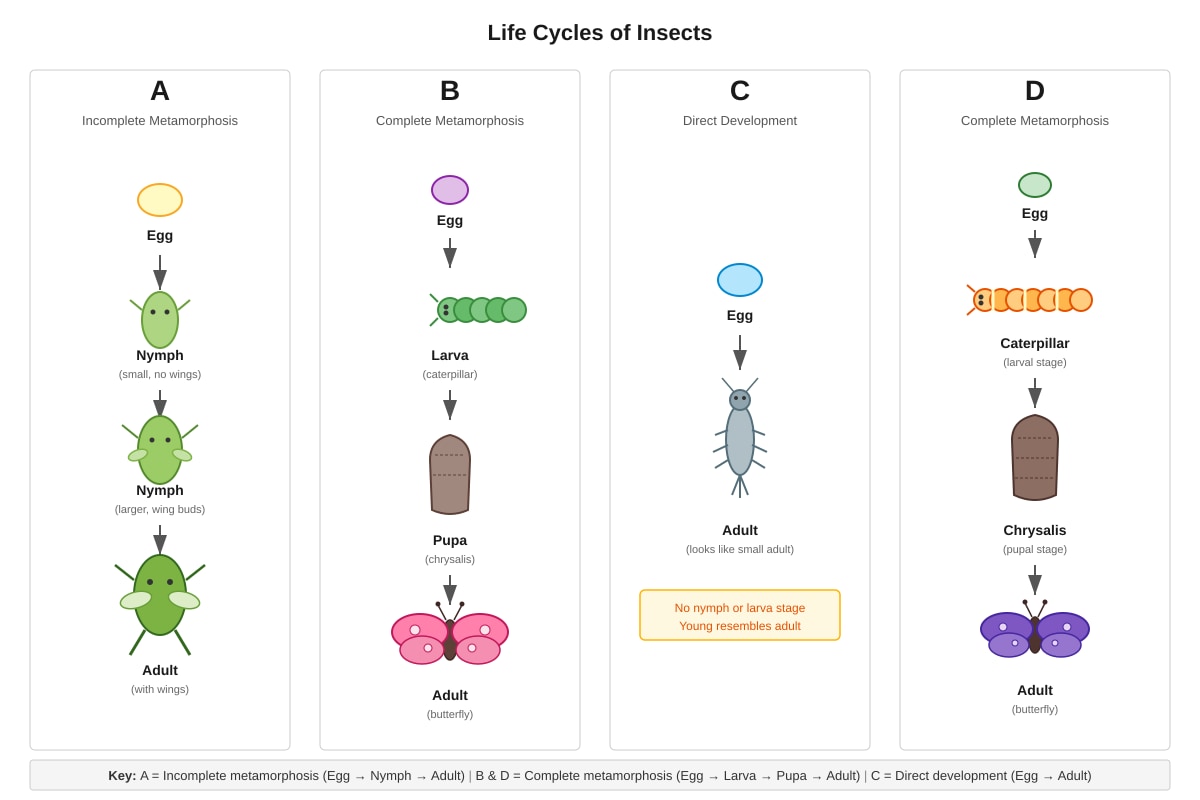
  2. Which animal undergoes incomplete metamorphosis?

<image_placeholder> id: Q4-fig1 type: diagram linked_question: Q4 description: Four labelled life cycle diagrams A-D showing different insect life cycles. A shows egg-nymph-adult (grasshopper-like). B shows egg-larva-pupa-adult (butterfly-like). C shows egg-adult only (no visible young stage). D shows egg-caterpillar-chrysalis-adult-butterfly with slightly different staging. labels: "A", "B", "C", "D" on each option; stage names labelled for each values: none must_show: four distinct life cycle diagrams clearly labelled A-D; stage names visible; A should show gradual nymph changes; B complete metamorphosis; C simple direct development; D complete metamorphosis variant </image_placeholder>

  • A) A only
  • B) B and D only
  • C) A and C only
  • D) B, C and D only

Answer: _____ [1]

  1. A farmer wants to grow many new strawberry plants quickly from one parent plant. Which method should she use?

    • A) Grow from seeds produced by sexual reproduction
    • B) Use runners to produce new plants by asexual reproduction
    • C) Cross-pollinate with another strawberry variety
    • D) Wait for fruits to fall and rot naturally

    Answer: _____ [1]

  2. Which statement about sexual and asexual reproduction is correct?

    • A) Only sexual reproduction produces offspring identical to the parent
    • B) Only asexual reproduction requires two parents
    • C) Sexual reproduction produces more genetic variation in offspring
    • D) Asexual reproduction always involves seeds

    Answer: _____ [1]

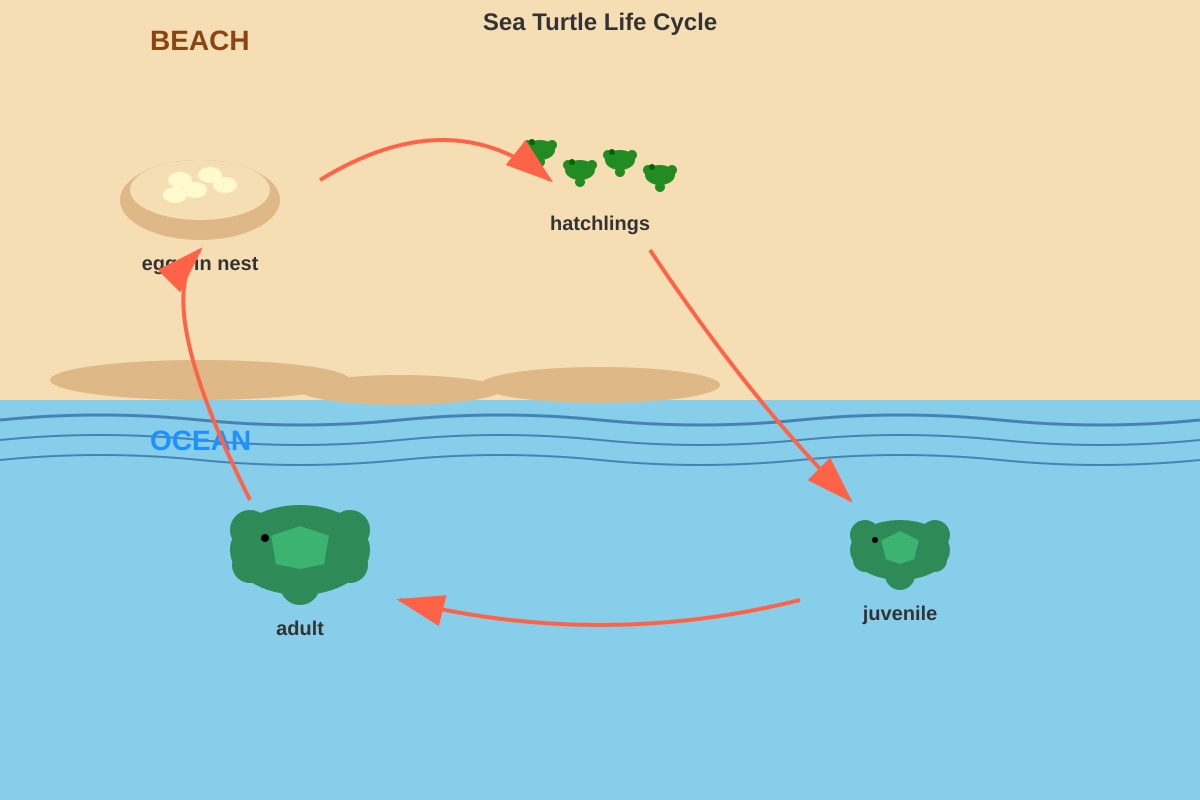
  3. The diagram shows a sea turtle's life cycle. At which stage is the turtle most vulnerable to predators on land?

<image_placeholder> id: Q7-fig1 type: diagram linked_question: Q7 description: Sea turtle life cycle diagram showing four stages in a circular arrangement: eggs buried in sand on beach, hatchlings emerging and crawling to sea, juvenile turtle swimming in ocean, adult turtle returning to beach to lay eggs. labels: "eggs in nest", "hatchlings", "juvenile", "adult", arrow showing cycle direction, "beach" and "ocean" habitat labels values: none must_show: four life stages in cycle; clear beach/ocean habitat distinction; arrows showing progression; eggs depicted underground in sand; hatchlings shown small and numerous; adult shown larger returning to shore </image_placeholder>

  • A) Eggs in the nest
  • B) Hatchlings moving to the ocean
  • C) Juvenile swimming in the ocean
  • D) Adult returning to lay eggs

Answer: _____ [1]

  1. Which of the following organisms does NOT reproduce by producing spores?

    • A) Fern
    • B) Mushroom
    • C) Moss
    • D) Grass

    Answer: _____ [1]


Section B: Structured Questions (Questions 9–16) [20 marks]

Write your answers in the spaces provided.

  1. The diagram below shows the life cycle of a mosquito.

<image_placeholder> id: Q9-fig1 type: diagram linked_question: Q9 description: Mosquito life cycle diagram showing four stages: eggs floating on water surface, larva in water (worm-like with siphon), pupa in water (comma-shaped), adult mosquito flying above water. All four stages arranged left to right with arrows. labels: "eggs", "larva", "pupa", "adult", "water surface" (dashed line), arrows between stages values: none must_show: all four metamorphosis stages; aquatic environment for first three stages; adult shown flying; clear progression arrows; water level indicated </image_placeholder>

(a) Name the type of metamorphosis shown in the mosquito's life cycle. [1]


(b) Explain why the mosquito larva and pupa stages both live in water. [2]


(c) Suggest one way to reduce the number of mosquitoes in an area by targeting a specific life cycle stage. [1]


[Total: 4]


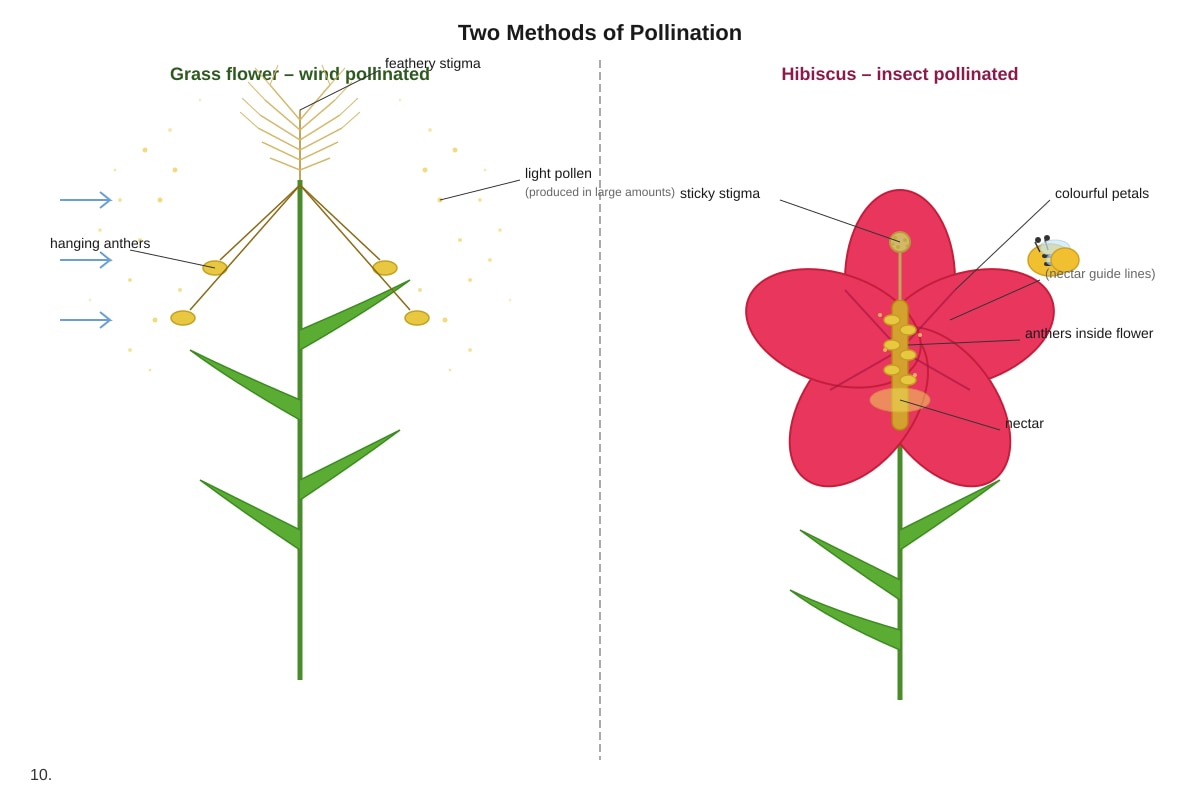
  1. The diagram shows two methods of plant reproduction.

<image_placeholder> id: Q10-fig1 type: diagram linked_question: Q10 description: Two diagrams side by side. Left: wind-pollination in a grass flower showing feathery stigma, long anthers hanging out, no petals, large amounts of pollen. Right: insect-pollination in a hibiscus flower showing large colourful petals, nectar guide lines, stigma inside flower, anthers attached to filament inside, sticky stigma. labels: Left: "Grass flower - wind pollinated", "feathery stigma", "hanging anthers", "light pollen"; Right: "Hibiscus - insect pollinated", "colourful petals", "nectar", "sticky stigma", "anthers inside flower" values: none must_show: structural differences clearly visible; feathery vs sticky stigma; external vs internal anthers; showy vs reduced petals; pollen quantity suggestion; labels pointing to key structures </image_placeholder>

(a) State two ways the grass flower is adapted for wind pollination. [2]


(b) Explain why insect-pollinated flowers produce less pollen than wind-pollinated flowers. [2]


[Total: 4]


  1. The table below shows information about the life cycles of three animals.
AnimalMethod of reproductionTime to develop into adult
ALays eggs with tough shells2 years
BGives birth to live young12 years
CLays soft eggs in water6 months

(a) Which animal (A, B or C) is most likely a mammal? Give a reason for your answer. [1]


(b) Which animal is most likely to care for its young for the longest time? Explain your answer. [2]


[Total: 3]


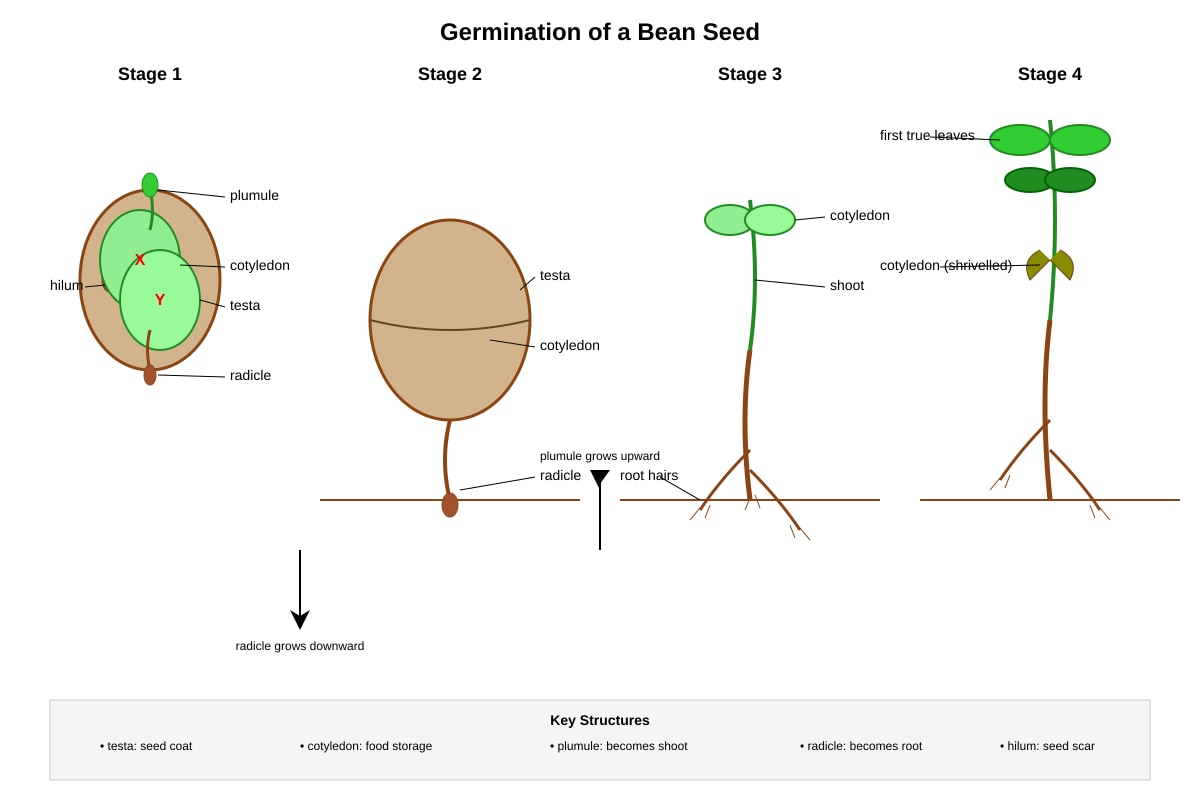
  1. The diagram shows the germination of a bean seed.

<image_placeholder> id: Q12-fig1 type: diagram linked_question: Q12 description: Cross-section and external view of bean seed germination sequence. Stage 1: Dry seed showing testa, cotyledons, plumule, radicle, hilum. Stage 2: Seed swelling, testa splitting, radicle emerging downward. Stage 3: Radicle growing as root with root hairs, plumule growing upward as shoot, cotyledons still above ground (epigeal germination). Stage 4: Young plant with first true leaves, cotyledons shrivelled. labels: "testa", "cotyledon", "plumule", "radicle", "hilum", "root hairs", "shoot", "first true leaves"; "Stage 1" through "Stage 4" values: none must_show: internal seed structure in Stage 1; progressive growth stages; direction of growth (radicle down, plumule up); cotyledon position changing; root hair development; shrivelling of cotyledons; clear labels on key structures </image_placeholder>

(a) Name the two structures labelled X and Y that provide food for the growing seedling before it can make its own food. [2]


(b) Explain why the seed must absorb water before it can germinate. [2]


[Total: 4]


  1. A student set up an experiment to investigate the conditions needed for seed germination. Four sets of seeds were prepared as shown.
SetWaterAirWarm temperatureLight
1
2
3
4

(a) Explain why seeds in Set 2 did not germinate. [1]


(b) The student noticed that seeds in Set 4 did not germinate. What conclusion can be drawn from this observation? [1]


(c) Suggest what would happen if Set 5 were set up with water, air, warm temperature but no light. Explain your answer. [2]


[Total: 4]


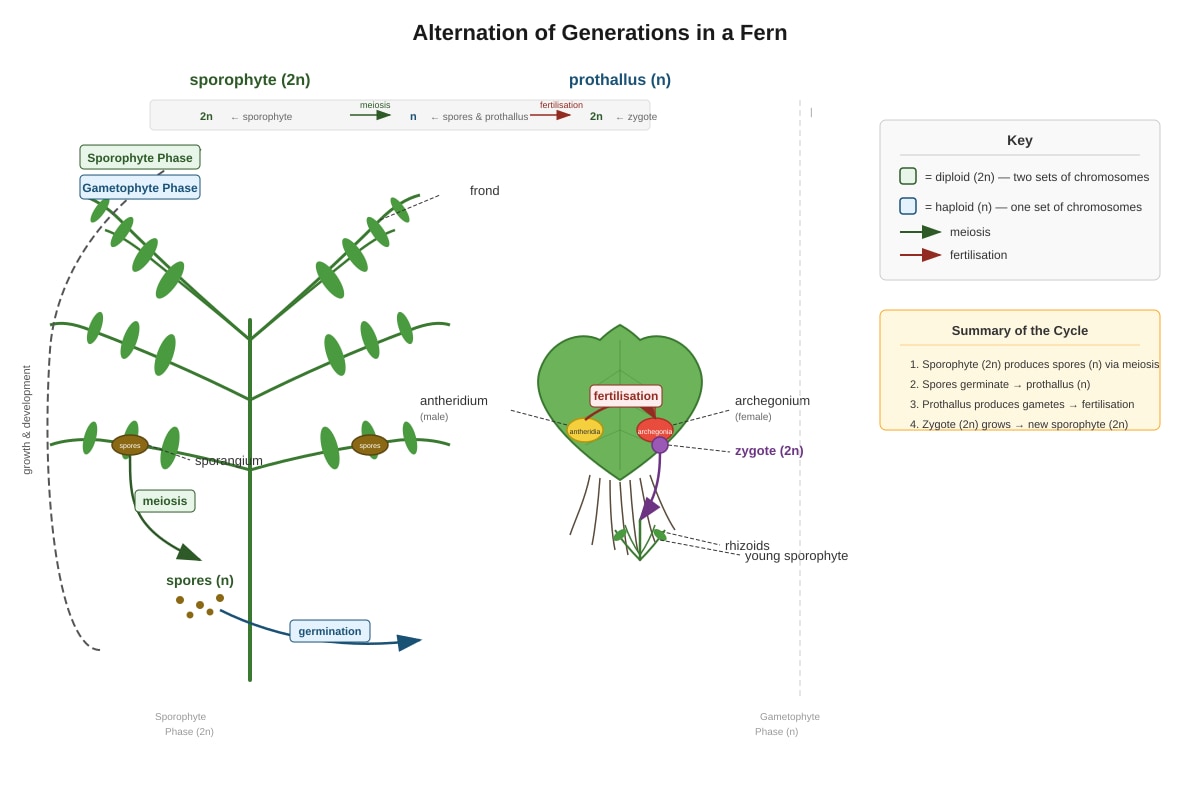
  1. The diagram shows the alternation of generations in a fern.

<image_placeholder> id: Q14-fig1 type: diagram linked_question: Q14 description: Fern alternation of generations diagram showing two distinct phases connected in cycle. Sporophyte phase: mature fern plant with fronds, sporangia on underside of fronds releasing spores. Gametophyte phase: small heart-shaped prothallus with rhizoids, antheridia (male) and archegonia (female) structures. Arrows showing: meiosis from sporophyte to spores, spore germination to prothallus, fertilisation in prothallus, zygote developing into new sporophyte. labels: "sporophyte (2n)", "frond", "sporangium", "meiosis", "spores (n)", "prothallus (n)", "rhizoids", "antheridium", "archegonium", "fertilisation", "zygote (2n)", "young sporophyte" values: ploidy levels indicated must_show: two distinct multicellular phases; sporangia on frond undersides; small heart-shaped prothallus; clear ploidy notation (2n and n); complete cycle with fertilisation step; rhizoids on prothallus; meiosis and fertilisation labels </image_placeholder>

(a) The fern plant we commonly see is the sporophyte. What is the ploidy (number of chromosome sets) of the sporophyte compared to the spores it produces? [1]


(b) Explain why the prothallus must be in a moist environment for fertilisation to occur. [2]


[Total: 3]


  1. The life cycle of a flowering plant includes pollination and fertilisation.

(a) Name the male part of a flower that produces pollen grains. [1]


(b) After pollination, pollen grains grow pollen tubes. Explain how this ensures fertilisation can occur. [2]


[Total: 3]


  1. The graph shows the survival rate of young in different animals with different numbers of offspring per reproduction.

<image_placeholder> id: Q16-fig1 type: graph linked_question: Q16 description: Scatter plot showing relationship between number of offspring per reproduction and percentage survival to adulthood. X-axis: number of offspring (1, 2, 5, 10, 50, 100, 1000). Y-axis: survival rate to adulthood (%). Data points: elephant (1 offspring, 95% survival), human (1, 99%), cat (4, 75%), dog (6, 70%), rabbit (8, 40%), frog (100, 5%), fish (1000, 0.1%), insect (50, 2%). Trend line showing negative correlation. labels: X-axis "Number of offspring per reproduction", Y-axis "Survival rate to adulthood (%)"; individual points labelled with animal names; curved trend line from top-left to bottom-right values: axes with appropriate scales; specific data point values as listed must_show: logarithmic or appropriate scale on x-axis to accommodate range; clear negative correlation pattern; labelled data points with animal names; percentages on y-axis; trend line indicating relationship </image_placeholder>

(a) Describe the pattern shown in the graph. [1]


(b) Explain why animals with many offspring per reproduction often have lower parental care. [2]


[Total: 3]


Section C: Application and Reasoning (Questions 17–20) [12 marks]

  1. A gardener noticed that her tomato plants produced many fruits but the seeds inside did not grow when planted. She observed that bees rarely visited her garden.

(a) Suggest why the tomato seeds did not grow. [2]


(b) Explain how the gardener could solve this problem without buying new seeds. [2]


[Total: 4]


  1. Scientists are concerned that some frog populations are declining. One reason is that frog eggs are laid in water, and water pollution affects the early life stages.

(a) Explain why frogs are more affected by water pollution than reptiles that lay eggs on land. [2]


(b) Suggest two reasons why the decline of frog populations would affect food webs in ecosystems. [2]


[Total: 4]


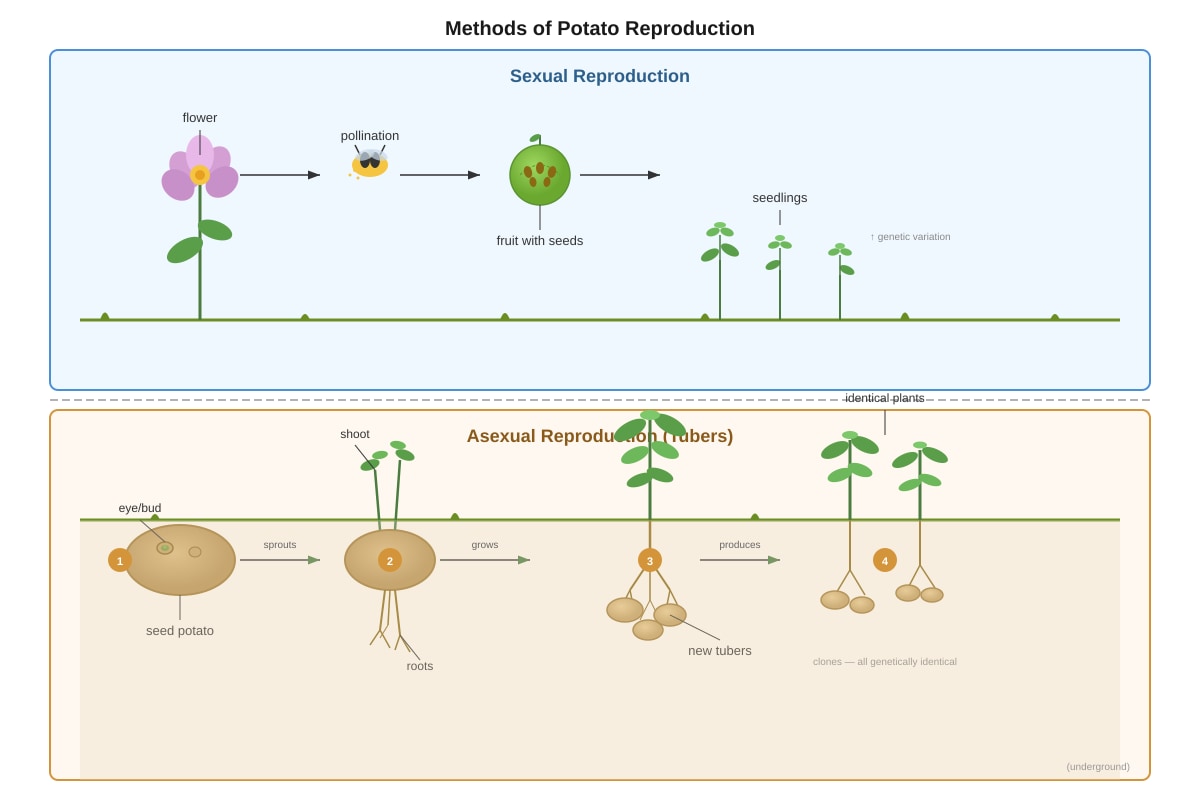
  1. Some farmers grow potato plants from "seed potatoes"—small pieces of potato tuber with buds (eyes)—rather than from seeds produced by flowers.

<image_placeholder> id: Q19-fig1 type: diagram linked_question: Q19 description: Diagram comparing two methods of potato reproduction. Top: sexual reproduction showing potato flower, pollination, fruit with true seeds inside, small seedlings. Bottom: asexual reproduction showing seed potato piece with eye/bud, sprouting shoot and roots, growing into identical plant, new tubers forming underground. labels: Top: "sexual reproduction", "flower", "pollination", "fruit with seeds", "seedlings"; Bottom: "asexual reproduction (tubers)", "seed potato", "eye/bud", "shoot", "roots", "new tubers" values: none must_show: clear two-path comparison; flower and fruit for sexual path; bud/eye detail on tuber piece for asexual path; below-ground tuber development; sprouts from eyes; distinct labels for each method </image_placeholder>

(a) State one advantage of growing potatoes from seed potatoes rather than from seeds. [1]


(b) Explain why growing many potato plants from seed potatoes could be risky if a disease affects the crop. [2]


[Total: 3]


  1. The life cycle of a jellyfish includes both a polyp stage and a medusa stage. The polyp is a small, tube-like animal attached to the sea floor. The medusa is the free-swimming "jellyfish" shape.

(a) Suggest one advantage of having a sessile (non-moving) polyp stage in the life cycle. [1]


(b) The medusa produces eggs and sperm for sexual reproduction. Explain why having two different body forms (polyp and medusa) might help the species survive better than having only one form. [2]


(c) A student claims that the polyp and medusa are different species because they look so different. Explain why this claim is incorrect. [2]


[Total: 5]


END OF QUIZ

Answers

<!-- TuitionGoWhere generation metadata: stage=3-0; model=moonshotai/kimi-k2.6:free; model_label=Kimi K2.6 Free; generated=2026-06-07; Sources: Stage 2-1 real exam-derived templates and Stage 2-2 exam-enriched syllabus. -->

Primary 6 PSLE Science Quiz - Life Cycles: Answer Key

Total Marks: 40


Section A: Multiple Choice (Questions 1–8)

QuestionAnswerExplanation
1BButterflies undergo complete metamorphosis: egg → larva (caterpillar) → pupa (chrysalis) → adult butterfly. This is the classic sequence students must memorise.
2CFerns reproduce via spores, not seeds. The missing stage is the mature fern (sporophyte), which produces spores on its fronds. The cycle goes: spore → young fern (prothallus) → mature fern → spores.
3BThe tadpole stage allows frogs to exploit aquatic habitats for food and shelter, reducing competition with adult frogs that live mainly on land. This is called resource partitioning across life stages.
4AIncomplete metamorphosis (A: egg → nymph → adult) has no pupa stage; the nymph resembles a small adult. Grasshoppers undergo this. Butterflies (B and D) show complete metamorphosis with larva and pupa stages. C shows direct development (no distinct juvenile stage).
5BRunners (stolons) are horizontal stems that grow along the ground surface, producing new plantlets at nodes. This is asexual reproduction—fast, produces genetically identical plants, and requires no seeds or pollination.
6CSexual reproduction involves fusion of gametes from two parents, creating genetic variation through recombination and independent assortment. A is wrong (asexual = identical); B is wrong (asexual needs one parent); D is wrong (asexual uses no seeds).
7BHatchlings are most vulnerable: they are small, slow-moving, must cross open beach to reach water, and face predators like birds, crabs, and foxes. While eggs are vulnerable, many predators cannot dig deep nests; adults are large and fast.
8DGrass is a flowering plant (angiosperm) that reproduces via seeds produced through pollination and fertilisation. Ferns, mushrooms (fungi), and mosses all produce spores.

Section A Total: 8 marks


Section B: Structured Questions (Questions 9–16)

Question 9 [4 marks]

(a) Complete metamorphosis [1]

Key concept: Mosquitoes have four distinct life stages (egg, larva, pupa, adult) with very different body forms, unlike incomplete metamorphosis where the nymph resembles a small adult.

(b) The larva and pupa are aquatic stages [1] that have adapted to breathe dissolved oxygen in water (larva has a siphon, pupa has trumpets) [1]. The adult mosquito is terrestrial/aerial, so early stages require water for survival and development.

Marking note: Must mention water as essential habitat and some structural adaptation (siphon/trumpets/breathing) for full marks.

(c) Remove standing water / oil on water surface to suffocate larvae / clear drains / introduce larvae-eating fish [1]

Any reasonable method targeting egg, larva, or pupa stages accepted.

Q9 Total: 4


Question 10 [4 marks]

(a) Any two from: [2]

  • Feathery/extended stigma to catch airborne pollen [1]
  • Anthers hang outside flower to release pollen into wind [1]
  • No colourful petals (not needed to attract insects) [1]
  • Produces large amounts of light, smooth pollen [1]

(b) Insect-pollinated flowers have targeted delivery [1]: insects visit flowers specifically, carrying pollen directly to another flower of the same species. Wind-pollinated flowers rely on chance; most pollen is wasted [1], so they must produce much more to ensure some reaches the right target.

Concept: Pollination efficiency—biotic pollination is more precise than abiotic pollination.

Q10 Total: 4


Question 11 [3 marks]

(a) Animal B [1]

Reason: Gives birth to live young is characteristic of mammals [1] (or long development time suggests parental care typical of mammals).

Accept: Longest development time with most parental investment.

(b) Animal B [1]

Longest development time to adulthood (12 years) [1] indicates extended parental teaching, protection, and learning needed for complex survival skills / higher chance of reaching reproductive age [1].

Concept: K-selection: fewer offspring, more parental care, longer development.

Q11 Total: 3


Question 12 [4 marks]

(a) X = cotyledon(s) [1]; Y = endosperm (if present in diagram) OR accept two cotyledons as "food store structure" [1]

For bean (dicot): cotyledons are the food stores. If "endosperm" labelled, accept. Must name two distinct food-storing structures shown.

(b) Water is needed to activate enzymes [1] that digest stored food into soluble substances [1]. Also softens testa for radicle emergence.

Marking: enzyme activation essential; food mobilisation/digestion for second mark.

Q12 Total: 4


Question 13 [4 marks]

(a) No water means enzymes cannot function / metabolic processes cannot begin / food stores cannot be mobilised [1]

(b) Warm temperature is needed for germination [1]

(c) Seeds in Set 5 would still germinate [1] because light is not required for germination in most seeds (light needed only for some small seeds like lettuce); warmth, water and air are the essential three conditions [1].

Common error: Students think light is needed because plants need light for photosynthesis later, but germination itself is independent of light.

Q13 Total: 4


Question 14 [3 marks]

(a) Sporophyte is diploid (2n) [1]; spores are haploid (n) [1] — accept "sporophyte has double the number of chromosomes" for 1 mark.

Half mark if only state "2n" without explanation.

(b) Sperm (antherozoids) must swim in water [1] from antheridium to archegonium to fertilise the egg [1]. Dry conditions would prevent this; water allows flagellated sperm movement.

Concept: Ferns retain ancestral dependence on water for fertilisation, unlike seed plants with pollen tubes.

Q14 Total: 3


Question 15 [3 marks]

(a) Stamen / anther [1] (accept filament+anther; "stamen" alone acceptable)

(b) The pollen tube grows down the style [1] to deliver male gametes (nuclei) directly to the ovule / egg cell in the ovary [1], ensuring precise fertilisation without sperm needing to swim.

Q15 Total: 3


Question 16 [3 marks]

(a) As the number of offspring per reproduction increases, survival rate to adulthood decreases [1] (negative correlation / inverse relationship).

(b) Many offspring = r-selection strategy [1]: parents cannot care for all, so invest little energy per offspring; some will survive by chance in favourable conditions [1]. Few offspring = K-selection with heavy parental investment ensuring high survival.

Accept: Energy/resources are limited; cannot care for hundreds. Quantity traded against quality of care.

Q16 Total: 3

Section B Total: 20


Section C: Application and Reasoning (Questions 17–20)

Question 17 [4 marks]

(a) Bees are needed for cross-pollination [1]. Without bee visits, pollen may not reach other flowers / self-pollination may occur but seeds are not viable / fertilisation did not occur properly [1]. Tomato flowers are typically self-fertile but benefit from buzz pollination; total failure suggests pollination mechanism not triggered.

Alternative acceptable answer: Fruits can form through parthenocarpy or incomplete fertilisation (fruit without viable seeds); seeds need fertilisation (fusion of gametes) to develop.*

(b) Introduce bee-attracting plants nearby / hand-pollinate flowers using brush to transfer pollen between flowers [1]. This ensures cross-pollination leading to fertilisation and viable seed development [1].

Q17 Total: 4


Question 18 [4 marks]

(a) Frog eggs lack a protective shell [1]; they are covered only by jelly that allows water exchange but not pollution blocking. Land reptile eggs have leathery/ hard shells that reduce pollutant entry and gas exchange with cleaner air [1]. Tadpoles also breathe through permeable skin, absorbing pollutants directly from water [1] — any two points for 2 marks.

(b) Any two: [2]

  • Frogs eat insects; decline allows insect population increase [1]
  • Frogs are prey for snakes/birds; their decline reduces food for predators [1]
  • Frogs occupy middle trophic level; removal disrupts energy flow through food web [1]
  • Frogs control pest insect populations; agricultural pest damage may increase [1]

Q18 Total: 4


Question 19 [3 marks]

(a) Any one: [1]

  • Faster growth / earlier harvest (no need to grow from seed)
  • Genetically identical to parent with desired traits
  • No need for pollination / can grow in greenhouse without insects

(b) All plants from seed potatoes are genetically identical (clones) [1]. If parent was susceptible to a disease, all offspring will lack resistance and entire crop could be destroyed simultaneously [1]. Genetic uniformity = no variation for natural selection to act upon.

Concept: Genetic diversity provides insurance against disease; monocultures are vulnerable.

Q19 Total: 3


Question 20 [5 marks]

(a) Any one: [1]

  • Polyp can filter feed continuously in one productive location
  • Corals of polyps can colonise and build reef structures
  • Protected from predators and rough water conditions
  • Asexual budding produces many new polyps in safe location

(b) Different forms exploit different niches/habitats [1]: polyp survives as sessile filter-feeder in stable locations; medusa disperses to find new habitats, mates, and escape local competition/predation [1]. This reduces intraspecific competition and spreads risk.

(c) They are same species because: [2]

  • One life stage develops into the other in a continuous life cycle [1]
  • They share identical DNA/genetic material (medusa buds off from polyp asexually; fertilised egg develops into both) [1]
  • Can interbreed (medusa produces gametes that combine to form zygote developing into polyp) [1] — any two points.

Concept: Metamorphosis changes body form but not species identity; same genetic program expressed differently in each stage.

Q20 Total: 5

Section C Total: 12


Grand Total: 40 marks


Difficulty Distribution Summary

DifficultyQuestionsMarks
Easy (direct recall)1, 2, 5, 8, 9a, 12a, 15a8
Medium (application/explanation)3, 4, 6, 7, 10a, 11, 13, 14, 15b, 16, 19, 20a16
Hard (synthesis/reasoning)9b, 9c, 10b, 12b, 17, 18, 20b, 20c16

Timing estimate: 40 minutes appropriate; 2 min/Q1–8, 3–4 min/Q9–16, 5–6 min/Q17–20, with 4 min review buffer.