From Real Exams Quiz
Primary 6 PSLE Science Heat Quiz
Free P6 PSLE Science Heat quiz, Nemo3 Exam version, with questions, answers, and PSLE-focused practice for Singapore students.
These static practice materials are generated from the site's syllabus and paper-generation workflow, with source and model context shown so students and parents can evaluate the material before use.
Questions
Free quiz and exam paper access
Enter your details to view this paper
Your access is remembered on this device.
Answers
Primary 6 PSLE Science Quiz - Heat (Answer Key)
Total Marks: 50
Section A: Multiple-Choice Questions (10 marks)
1. Answer: (2) [1]
Explanation: Heat is a form of energy (measured in joules) that flows from a hotter object to a colder one. Temperature is a measure of the degree of hotness or coldness of an object (measured in °C or K). They are related but distinct concepts.
2. Answer: (2) [1]
Explanation: Metal is a good conductor of heat. When you touch a metal spoon, it conducts heat away from your hand quickly, making it feel colder. Wood is a poor conductor, so it does not draw heat from your hand as fast. Both spoons are at the same room temperature.
3. Answer: (3) [1]
Explanation: In a solid, particles are closely packed in fixed positions. When heated, they gain kinetic energy and vibrate faster about their fixed positions. They do not expand in size, move closer together, or move freely (which happens in liquids/gases).
4. Answer: (3) [1]
Explanation: Convection is heat transfer through the movement of fluids (liquids/gases). Warm air rising above a radiator is a classic example of a convection current. (1) is radiation, (2) is conduction, (4) is conduction.
5. Answer: (2) [1]
Explanation: Radiation is heat transfer by electromagnetic waves and does not require a medium. The Sun's heat reaches Earth through the vacuum of space by radiation. The other options involve conduction or convection which require a medium.
6. Answer: (2) [1]
Explanation: Heat energy (thermal energy) depends on mass, specific heat capacity, and temperature. Both beakers have the same mass and substance (water). Beaker B is at a higher temperature (80°C vs 60°C), so its water molecules have more kinetic energy on average, giving it more thermal energy.
7. Answer: (2) [1]
Explanation: A bimetallic strip consists of two different metals bonded together. Different metals expand at different rates when heated. The metal that expands more becomes the outer curve, causing the strip to bend.
8. Answer: (3) [1]
Explanation: Copper is an excellent conductor of heat (and electricity). Metals are generally good conductors; copper is one of the best among common metals. Plastic, wood, and air are poor conductors (insulators).
9. Answer: (1) [1]
Explanation: Metal is a good conductor of heat. It conducts heat from the warmer surroundings (room temperature) to the ice cube faster than plastic, which is a poor conductor. Both trays are at the same room temperature initially.
10. Answer: (1) [1]
Explanation: Liquid-in-glass thermometers work on the principle that liquids expand when heated and contract when cooled. The liquid (mercury or alcohol) rises or falls in a narrow capillary tube. Bimetallic strips use differential expansion of solids (2), railway gaps are for solid expansion (3), and electric kettles use heating elements (4).
Section B: Structured Questions (20 marks)
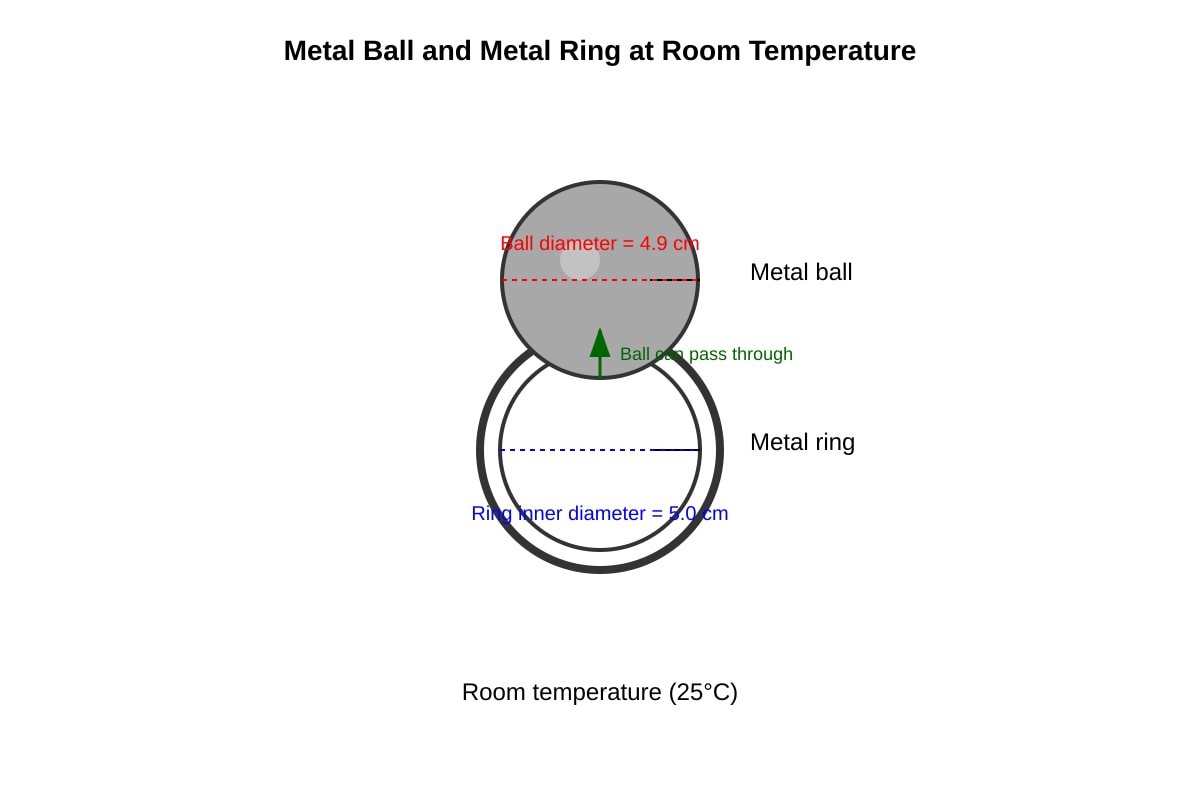
11. (a) No, the ball will not be able to pass through the ring. [1]
Explanation: When the metal ball is heated, it expands (its volume increases). The diameter of the ball becomes larger than the inner diameter of the ring, so it cannot pass through.
Marking note: Accept "No" with correct explanation about expansion of ball making it larger than ring.
11. (b) Yes, the ball will be able to pass through the ring. [1]
Explanation: When the metal ring is heated, it expands. The inner diameter of the ring increases (the hole gets larger), so the ball at room temperature can pass through more easily.
Marking note: Accept "Yes" with correct explanation about ring expanding and hole getting larger. Common misconception: hole shrinks when heated — this is incorrect.
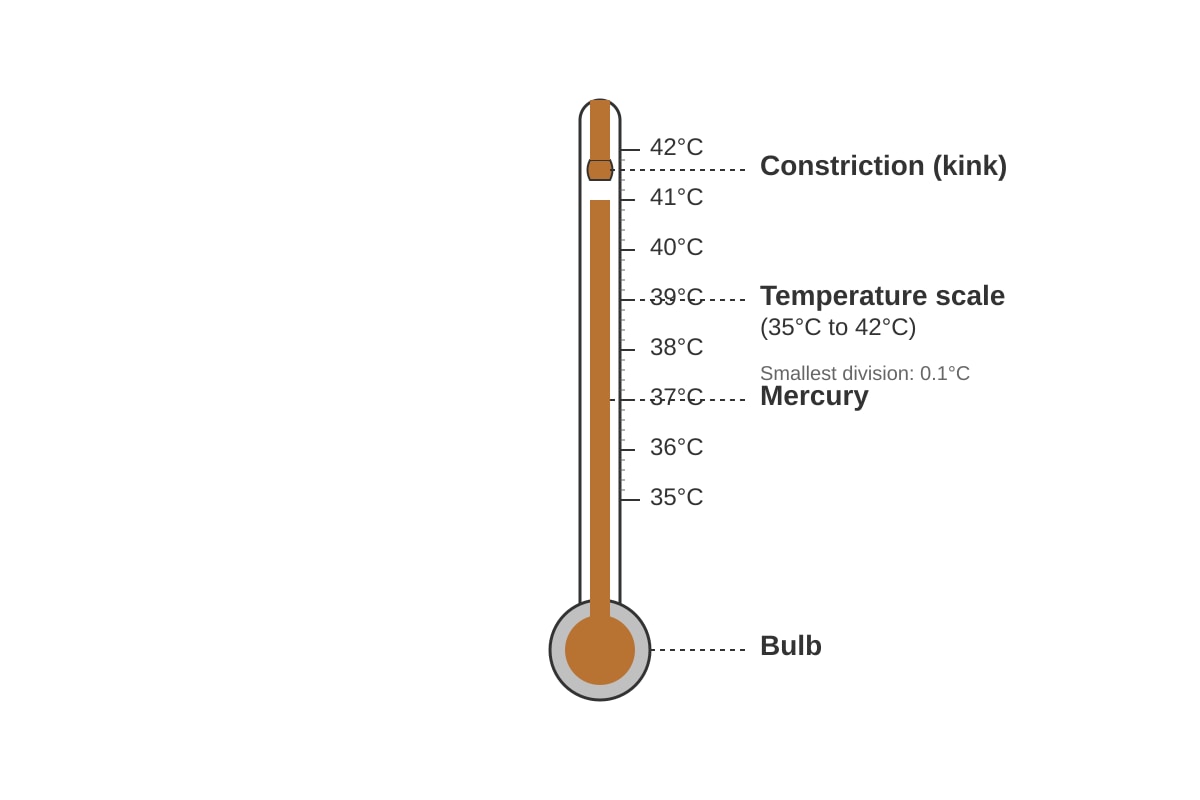
12. (a) The constriction prevents the mercury thread from falling back into the bulb when the thermometer is removed from the mouth/body, allowing the temperature reading to be taken. [1]
Explanation: The kink breaks the mercury thread when the thermometer cools, trapping the mercury at the highest temperature reached so the reading can be taken after removal.
12. (b) Shaking the thermometer forces the mercury thread back past the constriction into the bulb, resetting the thermometer to a temperature lower than body temperature so it can take a new reading. [1]
Explanation: Without shaking, the mercury would remain at the previous reading due to the constriction.
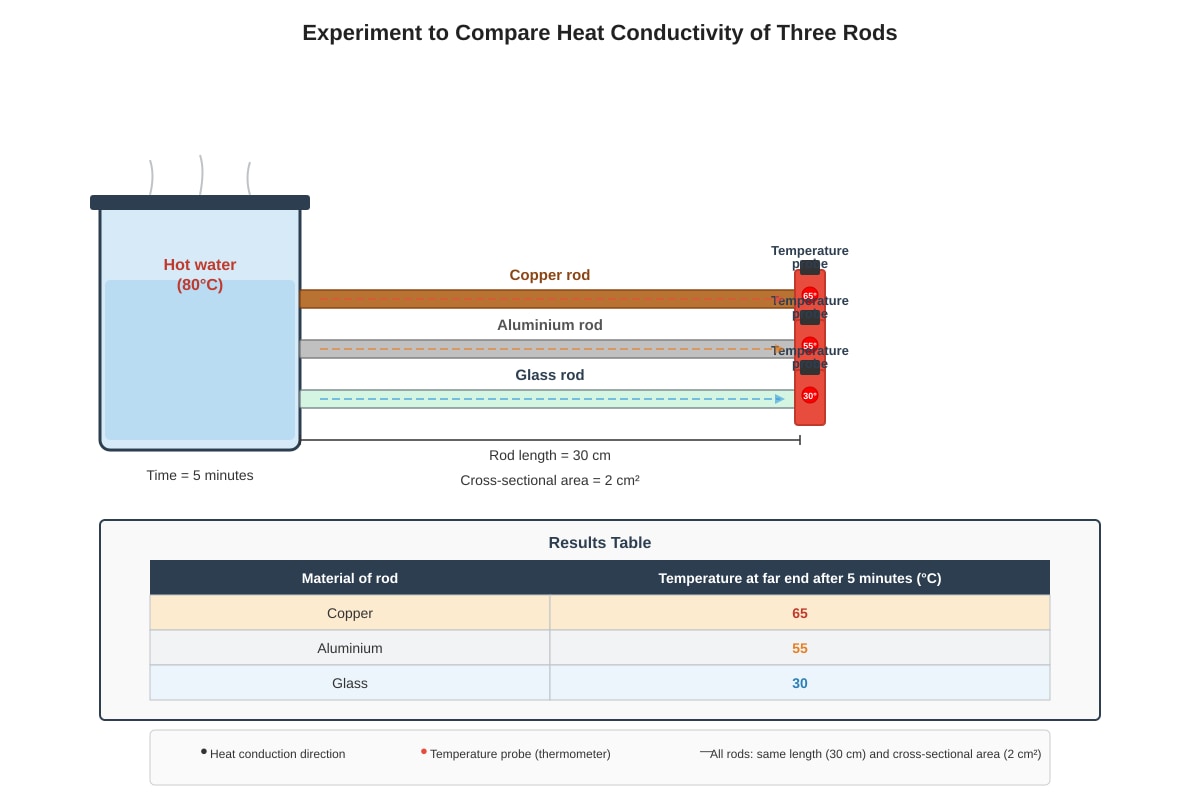
13. (a) Copper [1]
Explanation: The copper rod has the highest temperature at the far end (65°C), meaning it conducted heat from the hot water to the far end most effectively in the same time.
13. (b) Glass is a poor conductor of heat (an insulator). Its particles are not free to transfer kinetic energy efficiently, so very little heat reaches the far end in 5 minutes. [1]
Explanation: In non-metals like glass, heat transfer is mainly by lattice vibrations which is much slower than the free electron transfer in metals.
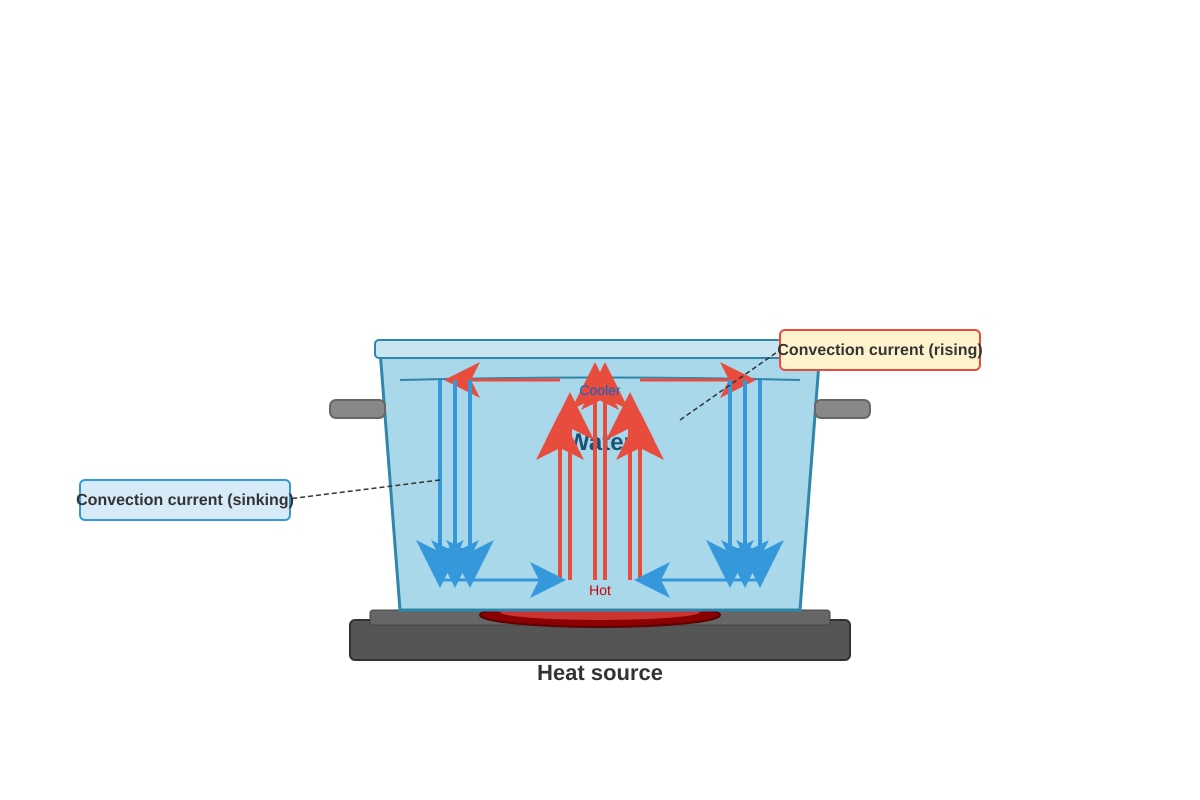
14. (a) Convection [1]
Explanation: The arrows show a circular movement of water — rising in the centre (hotter, less dense) and sinking at the sides (cooler, denser). This is a convection current.
14. (b) Water at the bottom is heated, expands, becomes less dense, and rises. Cooler, denser water at the top sinks to take its place, creating a continuous convection current. [1]
Explanation: Convection occurs because of density differences caused by temperature differences in a fluid.
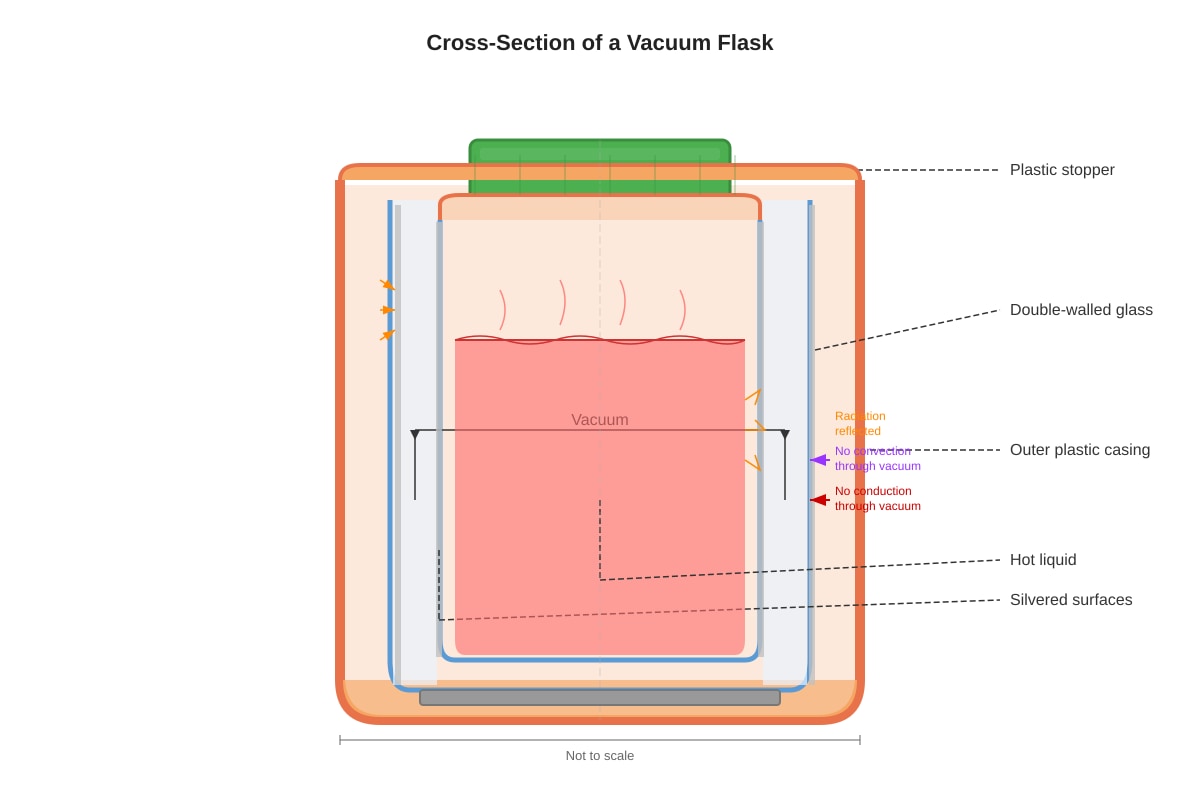
15. (a) The vacuum has no particles (or very few), so heat cannot be transferred by conduction (particle-to-particle collision) or convection (bulk movement of particles). [1]
Explanation: Both conduction and convection require a medium. A vacuum is the absence of a medium.
15. (b) The silvered surfaces are poor emitters and poor absorbers of radiant heat. They reflect radiant heat back into the flask (for hot liquids) or reflect external radiant heat away (for cold liquids). [1]
Explanation: Shiny, light-coloured surfaces reflect radiation; dull, dark surfaces absorb and emit radiation well.
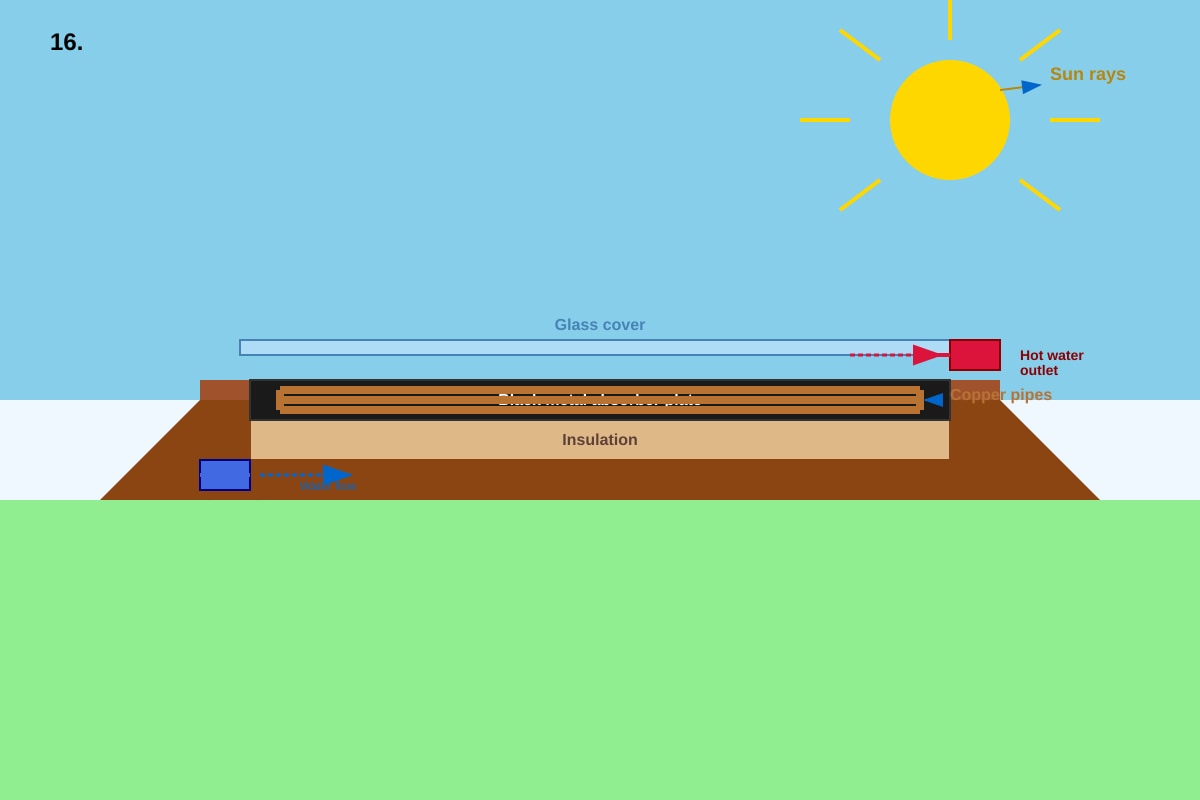
16. (a) Black surfaces are good absorbers of radiation. The black paint allows the absorber plate to absorb maximum heat from the Sun's rays. [1]
Explanation: Dull black surfaces absorb radiation better than shiny or light-coloured surfaces.
16. (b) The glass cover allows sunlight (short-wave radiation) to pass through but traps heat (long-wave infrared radiation) inside, creating a greenhouse effect. It also reduces heat loss by convection from the absorber plate. [1]
Explanation: Glass is transparent to visible light but opaque to infrared radiation. This traps heat.
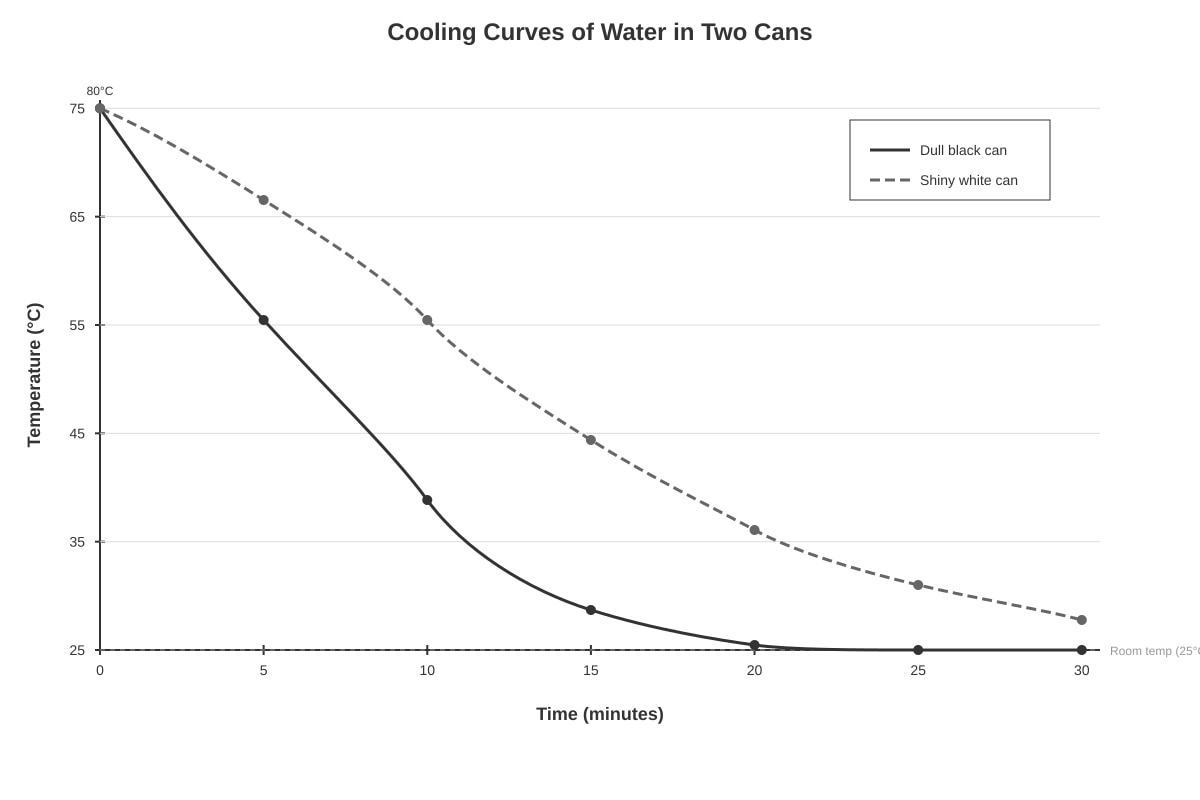
17. (a) The dull black can [1]
Explanation: Dull black surfaces are good emitters of radiation. They lose heat faster by radiating it to the surroundings.
17. (b) Dull black surfaces are good emitters of infrared radiation, so they radiate heat to the cooler surroundings faster than shiny white surfaces, which are poor emitters (good reflectors). [1]
Explanation: Emissivity: dull black > shiny white. At the same temperature, the black can radiates more power.
18. (a) The bridge would buckle / bend / crack / warp due to the expansion forces with nowhere to go. [1]
Explanation: Thermal expansion creates large forces. Without gaps, the bridge structure would be damaged.
18. (b) Railway tracks / concrete roads / pipelines / overhead power lines (any one) [1]
Explanation: All these structures expand and contract with temperature changes and need expansion gaps or loops.
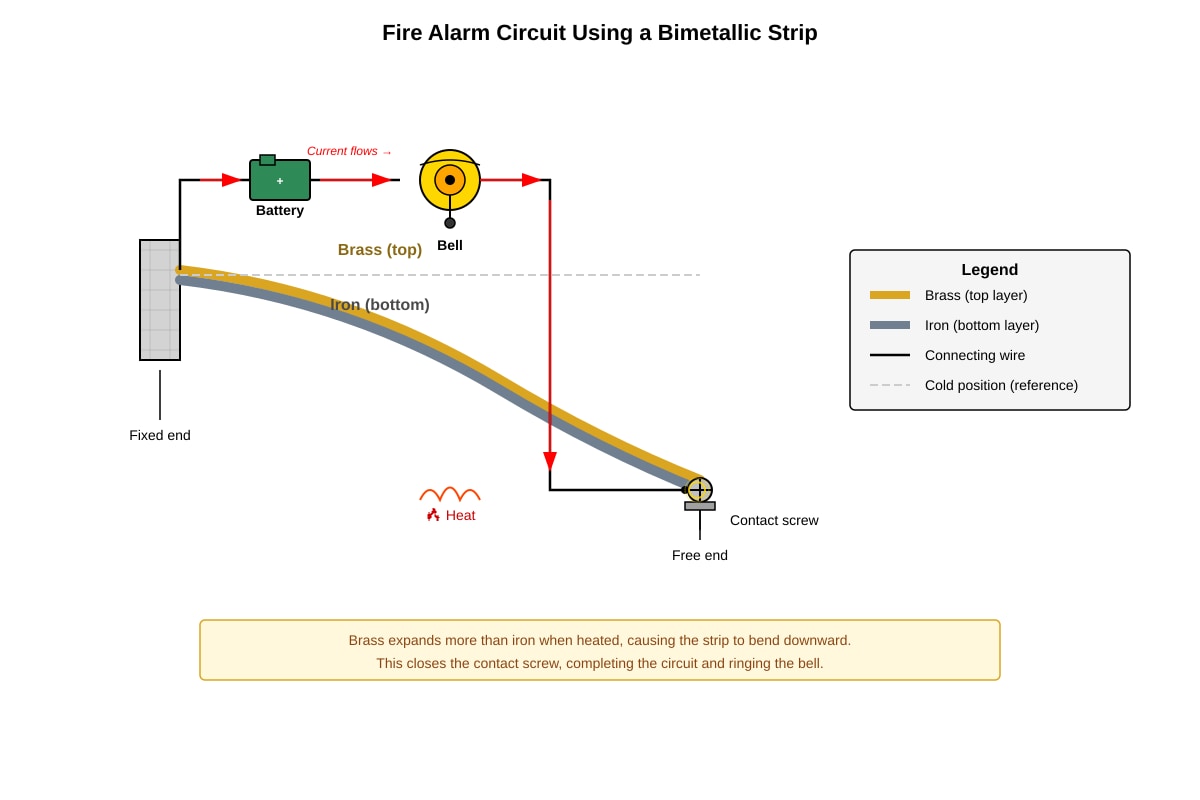
19. (a) Brass [1]
Explanation: Brass expands more than iron when heated. Since the strip bends downward (towards the iron side), the top layer (brass) must be expanding more, becoming the outer curve.
19. (b) When heated, the brass (top) expands more than the iron (bottom), causing the strip to bend downwards. The free end touches the contact screw, completing the electrical circuit and ringing the bell. [1]
Explanation: Differential expansion → bending → circuit completion → alarm sounds.
20. (a) The colour / surface finish of the can (matt black, matt white, shiny silver) [1]
Explanation: The independent variable is the one deliberately changed by the experimenter.
20. (b) Any one of: Volume of water (100 ml), initial temperature of water (25°C), size/shape/material of cans, duration of exposure (30 minutes), intensity of sunlight / position in sunlight, surrounding temperature. [1]
Explanation: Control variables must be kept the same so that only the independent variable affects the dependent variable (final temperature / temperature rise).
Section C: Open-Ended Questions (20 marks)
21. (a) (i) Conduction [1]
Explanation: Heat travels through the solid metal base from the flame to the inner surface by particle vibration and free electron movement.
(ii) Convection [1] Explanation: Heat transfers through the water by the movement of the water itself — hot water rises, cold water sinks.
(iii) Radiation [1] Explanation: The Sun's heat travels through the vacuum of space by electromagnetic waves. (Also accept: heat from the flame to the kettle base by radiation, but the primary mode from Sun is radiation through vacuum.)
Marking: 1 mark each. Must match the correct process to the correct description.
21. (b) The wooden handle is a poor conductor of heat (insulator). It prevents heat from the metal kettle body from conducting to the user's hand, allowing safe handling. [1]
Explanation: Wood has trapped air pockets and no free electrons, making it a poor conductor.
22. (a) The metal lid expands more than the glass jar when heated. The lid becomes slightly larger, loosening its grip on the jar, making it easier to twist open. [2]
Mark breakdown:
- Metal expands more than glass (1 mark)
- Lid loosens / gap increases (1 mark)
Explanation: Metals generally have higher coefficients of thermal expansion than glass. Heating the lid (not the glass) exploits this difference.
22. (b) The metal lid is a good conductor of heat. The hot water quickly heats the metal lid, causing it to expand. The glass jar, being a poor conductor and not in direct contact with the hot water (or less so), expands less. [2]
Mark breakdown:
- Metal conducts heat quickly / expands more (1 mark)
- Glass conducts poorly / expands less (1 mark)
Explanation: The difference in conductivity and expansion rate is key.
23. (a) The shiny aluminium foil reflects radiant heat from the food back into the food (reducing heat loss by radiation). It also traps a layer of air which reduces heat loss by convection and conduction. [2]
Mark breakdown:
- Reflects radiation back (1 mark)
- Traps air / reduces convection and conduction (1 mark)
Explanation: Shiny side in reflects infrared radiation. The foil also acts as a barrier to air currents.
23. (b) The shiny side should face inwards (towards the food). [1]
Explanation: The shiny side is a better reflector of radiant heat. Facing inwards, it reflects the food's radiated heat back to the food.
24. (a) The thermometer should be placed in the shade / a Stevenson screen, away from direct sunlight, at about 1.2–1.5 m above ground, over grass, with good air circulation. [2]
Mark breakdown:
- In shade / Stevenson screen / not in direct sunlight (1 mark)
- Above ground (1.2–1.5 m) / over grass / ventilated (1 mark)
Explanation: Direct sunlight heats the thermometer bulb directly (radiation), giving a false high reading. Standard meteorological practice uses a Stevenson screen.
24. (b) The thermometer measures the temperature of the air, not the Sun's radiation. In direct sunlight, the bulb absorbs radiant heat and reads higher than the actual air temperature. [2]
Mark breakdown:
- Measures air temperature, not radiation (1 mark)
- Bulb absorbs radiation / reads higher than air temp (1 mark)
Explanation: This is why weather stations use shaded, ventilated enclosures.
25. (a) The metal rails expand and become longer. [1]
Explanation: Solids expand when heated. The rails get longer in hot weather.
25. (b) If rails are laid without gaps, they would buckle / bend sideways / warp due to compressive forces from expansion, making the track unsafe for trains. [2]
Mark breakdown:
- Buckle / bend / warp (1 mark)
- Unsafe for trains / derailment risk (1 mark)
Explanation: Thermal expansion generates huge forces. Gaps allow rails to expand lengthwise without buckling.
25. (c) The gaps allow the rails to expand into them when the temperature rises, preventing compressive stress and buckling. [1]
Explanation: The gap provides space for the increased length of the rail.
Total: 50 marks
Common Mistakes to Avoid:
- Confusing heat and temperature.
- Thinking the hole in a metal ring shrinks when heated (it expands).
- Stating that metal "attracts" cold (cold is absence of heat; heat flows from hot to cold).
- Forgetting that convection only occurs in fluids (liquids and gases), not solids.
- Thinking shiny surfaces absorb heat well (they reflect it).
- Not distinguishing between conduction (solids), convection (fluids), and radiation (no medium needed).
- In experiments, not identifying the correct independent, dependent, and control variables.