From Real Exams Quiz
Primary 6 PSLE Science Heat Quiz
Free P6 PSLE Science Heat quiz, Kimi2.6 Exam version, with questions, answers, and PSLE-focused practice for Singapore students.
These static practice materials are generated from the site's syllabus and paper-generation workflow, with source and model context shown so students and parents can evaluate the material before use.
Questions

Free quiz and exam paper access
Enter your details to view this paper
Your access is remembered on this device.
Answers
Primary 6 PSLE Science Quiz - Heat: Answer Key
Total Marks: 40 marks
Section A: Multiple Choice (Questions 1-8)
Question 1 (2 marks)
Answer: C) Copper
Explanation: Copper is a metal, and metals are excellent conductors of heat. This means heat energy can pass through copper quickly and easily. The table shows copper is used for the base of an electric kettle because it needs to transfer heat from the heating element to the water efficiently. Wood, plastic, and glass are insulators—they do not conduct heat well, which is why they are used for handles or containers where you don't want heat to transfer.
Common mistake: Students sometimes think all solids conduct heat equally well. Remember: metals conduct heat; non-metals generally insulate.
Question 2 (2 marks)
Answer: B) absorbs heat from his body to evaporate
Explanation: Evaporation is the process where a liquid changes to a gas. When water evaporates from Tom's skin, it needs energy to change from liquid water to water vapour. This energy comes from Tom's body as heat. We call this "latent heat of vaporisation." Because heat is leaving his body, Tom feels cold. This is why sweating cools us down—the sweat evaporates and takes heat energy from our skin.
Key concept: Evaporation causes cooling because the substance changing state absorbs heat from its surroundings.
Common mistake: Students confuse "cold" as something that moves toward you. Cold is the absence of heat; heat moves from Tom's body to the water for evaporation.
Question 3 (2 marks)
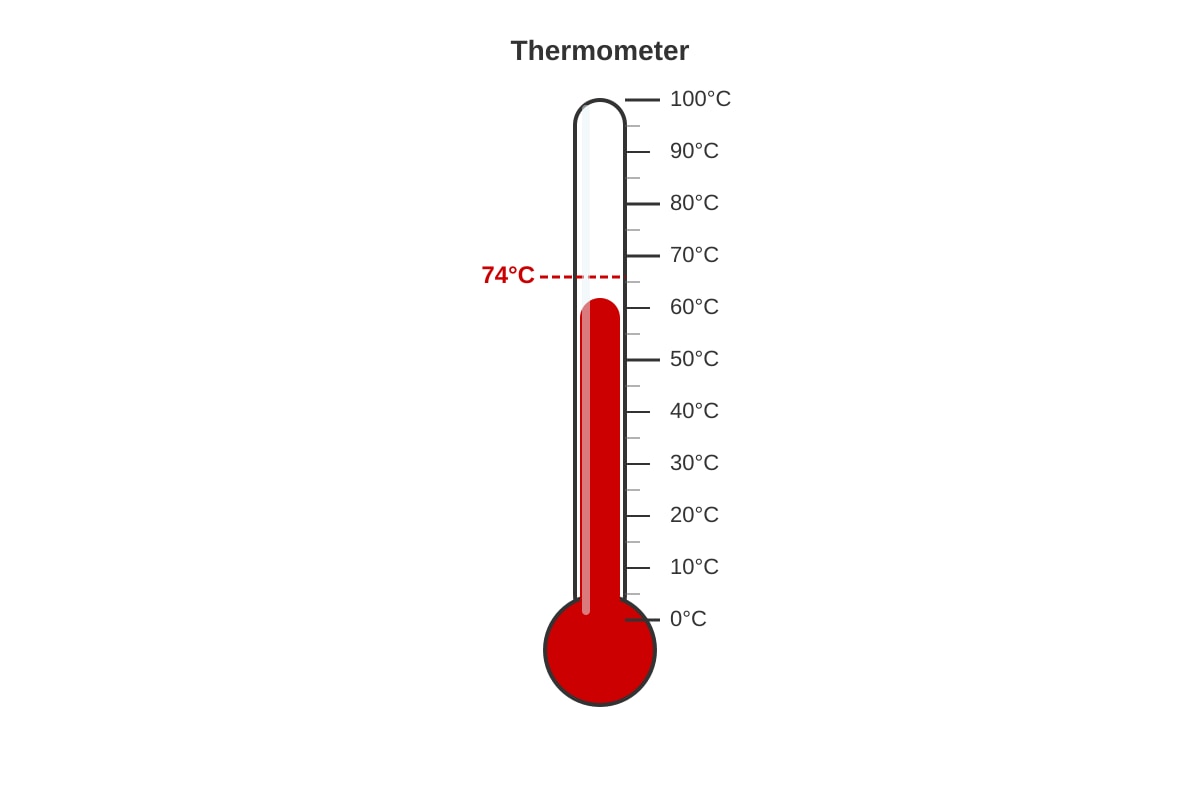
Answer: B) 74°C
Working:
- The thermometer scale shows intervals of 10°C (0, 10, 20, etc.)
- Between each 10°C mark, there are 10 small divisions, so each small division = 1°C
- The mercury level is at 4 marks above 70°C
- 70°C + 4°C = 74°C
Visual check: The mercury meniscus sits just below the middle of 70-80 range, at the fourth mark above 70.
Common mistake: Reading from the top of the mercury instead of the bottom of the meniscus (for a mercury thermometer, read the top of the convex meniscus).
Question 4 (2 marks)
Answer: A) Metal tray
Explanation: Metal is the best conductor of heat among the choices. When the ice cube sits on the metal tray, heat from the surrounding air and the tray itself transfers quickly through the metal to the ice cube. Wood, plastic, and glass are insulators or poor conductors, so heat transfers to the ice much more slowly.
Key concept: Thermal conductivity determines rate of heat transfer. Materials with high thermal conductivity (metals) transfer heat faster.
Common mistake: Some students think the metal feels cold, so it must make things cold. Actually, metal feels cold because it conducts heat AWAY from your hand quickly—this same property means it conducts heat TO the ice quickly too.
Question 5 (2 marks)
Answer: C) Most substances expand when heated and contract when cooled
Explanation: This is a fundamental property of matter. When substances are heated, their particles gain kinetic energy and move more vigorously, taking up more space. When cooled, particles lose energy and move closer together. This is true for solids, liquids, and gases (with very few exceptions, such as water between 0°C and 4°C).
- A is wrong: solids contract when cooled, expand when heated
- B is wrong: gases expand when heated, contract when cooled
- D is wrong: liquids definitely expand and contract (think of mercury in a thermometer)
Question 6 (2 marks)
Answer: C) hot afternoons
Explanation: Railway tracks expand when heated. On hot afternoons, the metal tracks expand the most. Without gaps, the tracks would have nowhere to expand to and would buckle outward, causing derailment. The gaps allow the tracks to expand into the spaces without bending. On cold nights, the tracks contract, making the gaps larger, but this doesn't cause dangerous buckling.
Key concept: Thermal expansion of solids. ΔL = αL₀ΔT (greater temperature change means greater expansion).
Question 7 (2 marks)
Answer: B) The metal spoon will feel hotter because it conducts heat better
Explanation: Both spoons are in the same hot soup, so both gain heat from the soup. However, metal is a good conductor, so heat travels quickly up the metal spoon handle to your hand. Wood is an insulator, so even though the end in the soup gets hot, heat doesn't travel easily up the handle. The metal spoon "feels" hotter because more heat energy per second reaches your hand.
Important distinction: The actual temperature at the part in the soup is the same for both spoons (the soup temperature). What differs is how quickly heat conducts to where you're holding it.
Question 8 (2 marks)
*Answer: D) A hot metal rod being cooled under running water
Explanation:
- A involves radiation: infrared radiation travels from the campfire to Tom (no medium needed)
- B involves radiation: microwaves are electromagnetic radiation that heats food
- C involves radiation: the Sun's energy reaches Earth as electromagnetic radiation through space
- D involves conduction and convection: heat transfers from the hot metal to the water by conduction (contact), and the moving water carries heat away by convection
Key concept: Radiation is heat transfer by electromagnetic waves that does NOT require a medium. Conduction needs contact; convection needs fluid movement.
Section B: Fill in the Blanks and Short Answer (Questions 9-14)
Question 9 (3 marks)
Answer: Conduction, Convection, Radiation (1 mark each, any order)
Teaching notes:
- Conduction: Heat transfer through a material without the material itself moving; mainly in solids; by particle vibration and electron movement in metals
- Convection: Heat transfer by movement of the fluid (liquid or gas) itself; warmer, less dense fluid rises; cooler, denser fluid sinks
- Radiation: Heat transfer by electromagnetic infrared waves; can travel through vacuum; no medium needed
Common mistake: Students confuse convection with conduction. Remember: CONVECTION needs movement of the whole fluid; CONDUCTION is passed from particle to particle without bulk movement.
Question 10 (2 marks)
Answer:
- Air is a poor conductor of heat/good insulator (1 mark)
- The trapped air between the panes reduces heat transfer by conduction from the warm inside to the cold outside (1 mark)
Full explanation: Air molecules are far apart, so they cannot easily pass heat energy from one to another by collision (conduction). The trapped air layer creates a barrier. Some designs use argon gas, which is an even better insulator than air. Additionally, the two panes of glass reduce heat loss by radiation from the warm room.
Alternative valid answer: Mentioning that convection is also reduced because the air space is too small for convection currents to form effectively.
Question 11 (2 marks)
Answer:
- The particles gain kinetic energy/move faster (1 mark)
- The particles vibrate more vigorously about their fixed positions, causing the solid to expand slightly (1 mark)
Key concept: In solids, particles are held in fixed positions by strong forces. They vibrate, not flow. Heating increases vibration amplitude. The average distance between particles increases slightly, leading to thermal expansion.
Common mistake: Saying particles "move around more"—in solids, particles VIBRATE in fixed positions; they do not move freely (that's liquids and gases).
Question 12 (2 marks total)
(a) (1 mark)
Answer: Black / Dark colour
(b) (1 mark)
Answer: Dark/black surfaces are good absorbers of heat radiation; they absorb more infrared radiation from the Sun than light or shiny surfaces
Teaching notes: This relates to thermal radiation properties:
- Good absorbers are good emitters (Kirchhoff's radiation law, simplified for primary level)
- Black/dark matte surfaces absorb most wavelengths of visible and infrared light
- Shiny or light surfaces reflect radiation away
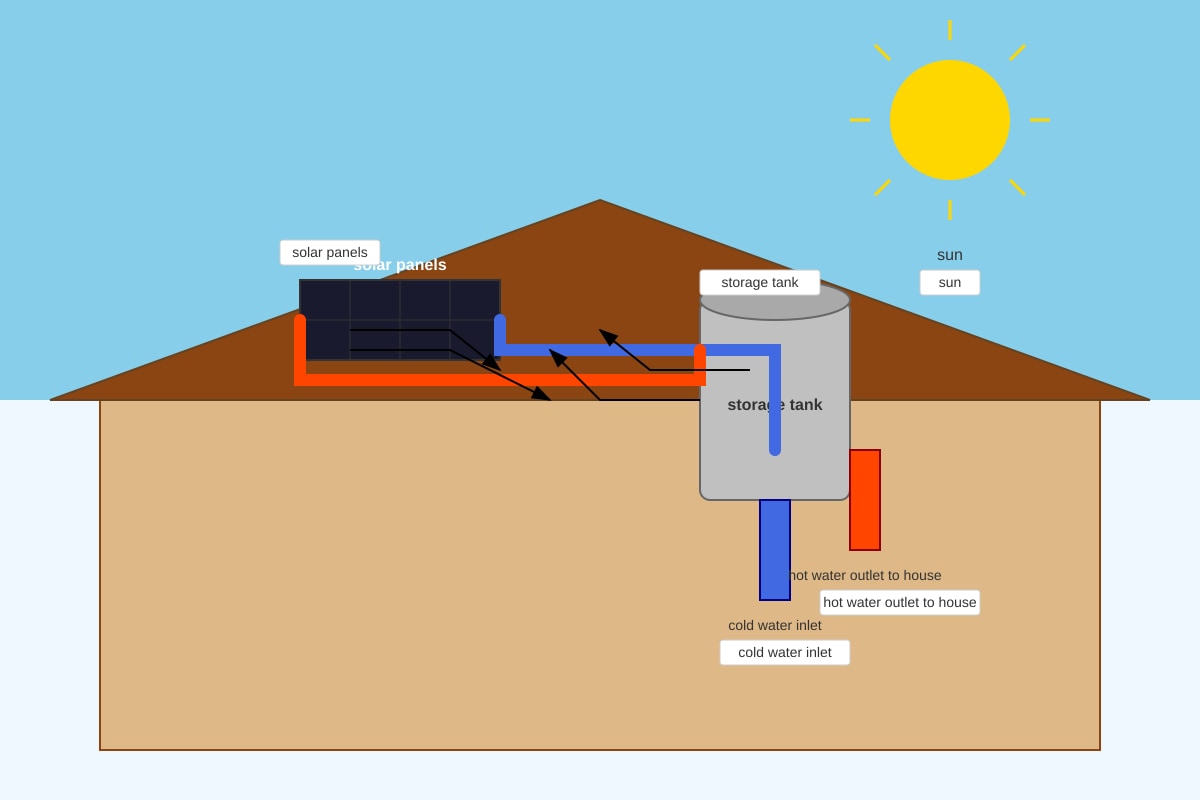
Application: Solar panels are dark to maximise heat absorption. Conversely, buildings in hot countries often use white paint to reflect heat.
Question 13 (3 marks total)
(a) (1 mark)
Answer: Substance P (or mercury, as -39°C is mercury's melting point)
Reasoning: At 25°C (room temperature), any substance with melting point BELOW 25°C is already melted (liquid). P melts at -39°C, so at 25°C it is well above its melting point and fully liquid.
(b) (2 marks)
Answer: Substance S (1 mark) Substance S has a very high melting point (1083°C), which is characteristic of metals; most metals have high melting points and are solid at room temperature (1 mark)
Note: Substance S is copper (melting point 1083°C). Substance R could be a substance like sodium (melting point 98°C, still a metal but soft metal). However, 1083°C is very typical of transition metals.
Key metal properties relevant here: High melting point, good conductor of heat and electricity, malleable, ductile, shiny when polished.
Question 14 (2 marks)
Answer:
- Fluffed feathers trap air between them (1 mark)
- Trapped air is a poor conductor/insulator, reducing heat loss from the bird's body (1 mark)
Extension: This is the same principle as:
- Wool clothing (traps air)
- Double-glazed windows (trapped air layer)
- Insulating materials like fibreglass (trapped air in fibres)
Why not "feathers are warm"? Feathers themselves are not inherently warm; it's the trapped air that provides insulation. This is an important scientific distinction.
Section C: Application and Reasoning (Questions 15-20)
Question 15 (3 marks total)
(a) (2 marks)
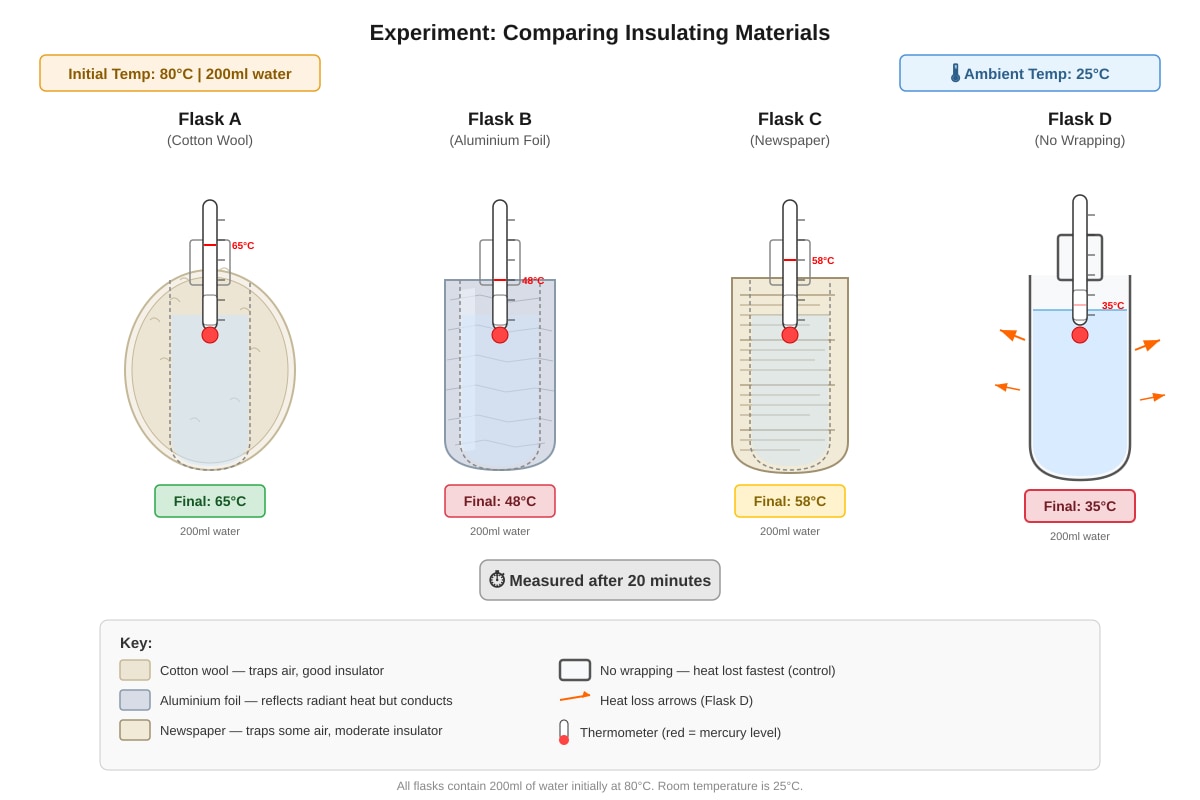
Answer: Cotton wool (1 mark) The water in Flask A (cotton wool) cooled by only 15°C (from 80°C to 65°C), which is the smallest temperature drop; this means the least heat was lost, so cotton wool is the best insulator (1 mark)
Working:
- Flask A (cotton): 80 − 65 = 15°C drop
- Flask B (foil): 80 − 48 = 32°C drop
- Flask C (newspaper): 80 − 58 = 22°C drop
- Flask D (none): 80 − 42 = 38°C drop
Smallest drop = best insulation.
(b) (1 mark)
Answer: As a control / for comparison / to show what happens without any insulation
Explanation: The "no wrapping" flask shows the baseline heat loss. Without this, we couldn't determine if the other materials were actually helping or just looked effective. This is a fundamental experimental design principle: controls allow valid comparisons.
Question 16 (4 marks total)
(a) (1 mark)
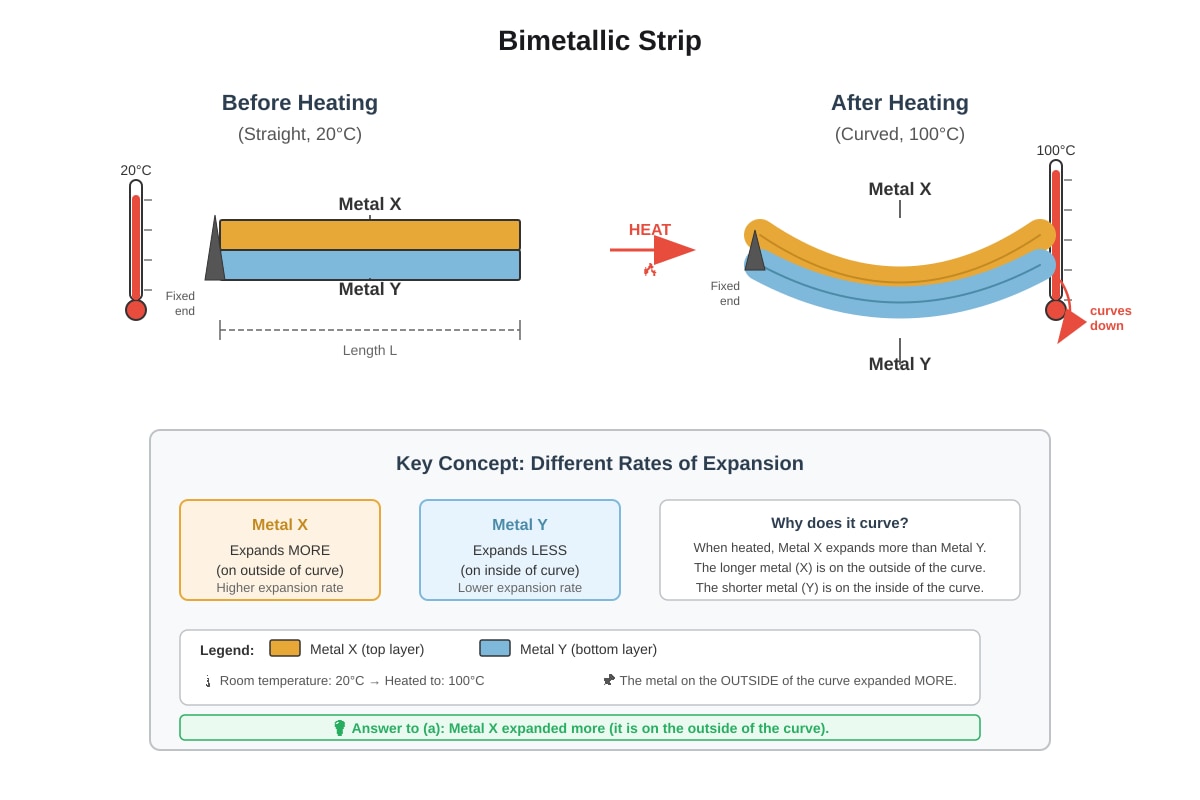
Answer: Metal Y expanded more
Reasoning: When the strip curves with Metal X on the OUTSIDE, Metal Y must be on the inside of the curve. The inside of a curve is shorter than the outside. Since Metal Y forms the shorter, inner curve, it must have expanded more (trying to become longer) and got "compressed" to the inside. Actually—let's reconsider:
Correction with clear reasoning: If Metal X is on the OUTSIDE of the curve, the strip bends toward Metal Y. This means Metal X (on outside) is longer than Metal Y (on inside). For Metal X to end up longer, Metal X must have expanded MORE. The metal that expands more ends up on the outside of the curve.
Wait—let's visualise carefully:
- Straight strip: X on top, Y on bottom
- Heated: curves DOWN with X on outside (convex side)
- Outside of curve = longer path
- So X expanded MORE to create the longer outer path
Corrected Answer: Metal X expanded more (1 mark)
Teaching point: The metal that expands more forms the OUTER curve because it "tries" to become longer, forcing the strip to bend with that metal on the outside.
(b) (3 marks)
Answer:
- In a fire alarm, a bimetallic strip is part of a circuit with a battery and bell (1 mark)
- At normal temperatures, the strip is straight and the circuit is open (no current flows) (1 mark)
- When a fire heats the air, the strip bends as the metals expand by different amounts; the bending closes the electrical circuit, allowing current to flow and the alarm to ring (1 mark)
Key design feature: The bending motion is converted into electrical switching. One metal expands more (faster response), creating reliable, temperature-triggered action.
Question 17 (4 marks total)
(a) (2 marks)
Answer:
- Air particles gain kinetic energy/move faster when heated (1 mark)
- Particles collide with the container walls more frequently and with greater force, increasing pressure (1 mark)
Particle model explanation: At constant volume, faster-moving particles hit the walls harder and more often. Pressure = force/area, so more forceful collisions mean higher pressure. This is Gay-Lussac's Law (P ∝ T at constant V), though primary students need only the particle explanation.
(b) (2 marks)
Answer: The pressure decreases (1 mark) When cooled, air particles slow down and collide with the walls less frequently and with less force, so pressure decreases (1 mark)
Question 18 (3 marks total)
(a) (2 marks)
Answer: Lower than (1 mark) Silver/white/shiny surfaces are poor absorbers of heat radiation (they reflect radiation); black surfaces are good absorbers, so the black can absorbs more heat energy from the sun, causing its water to heat up more (1 mark)
(b) (1 mark)
Answer: To ensure fair testing / control variable; only the colour should differ, so that any temperature difference is caused by colour, not by different surface areas or volumes of water
Experimental design principle: The only variable changed should be the independent variable (colour). Size, shape, water volume, starting temperature, and sun exposure must all be controlled (kept constant).
Question 19 (4 marks total)
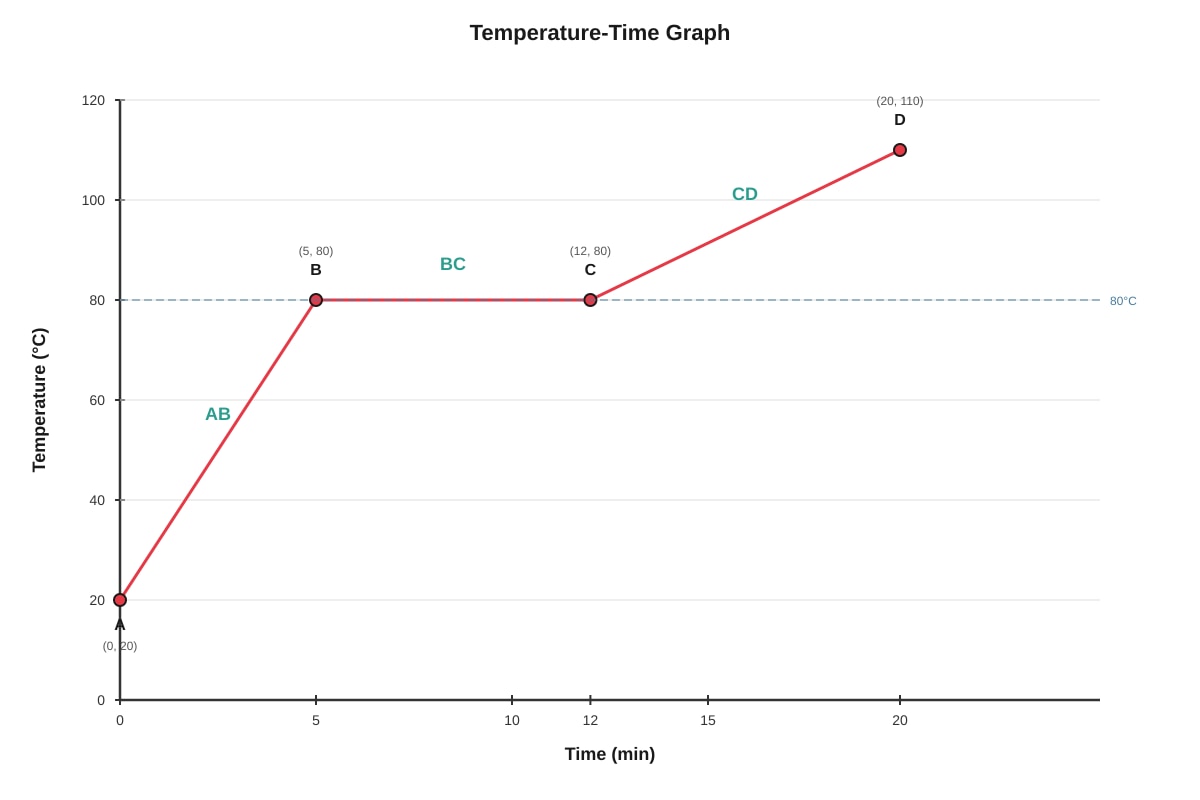
(a) (1 mark)
Answer: 80°C
Reading from graph: The horizontal plateau (section BC) occurs at 80°C. During a phase change, temperature remains constant. For a solid being heated, this plateau represents melting—solid turning to liquid.
(b) (2 marks)
Answer:
- The substance is melting/changing from solid to liquid (1 mark)
- The heat energy supplied is used to break intermolecular bonds/change state (latent heat of fusion), not to raise temperature, so temperature stays constant during this phase change (1 mark)
Key concept: "Latent heat" means "hidden heat." You add heat but don't see temperature rise because the energy goes into overcoming attractive forces between particles, not into making particles move faster.
(c) (1 mark)
Answer: Liquid (and possibly some gas if evaporation occurs)
Reasoning: After complete melting (point C), all substance is liquid. Further heating raises the temperature of the liquid. At 110°C (point D), it's definitely liquid (assuming boiling point is higher).
Question 20 (3 marks)
Answer must include:
Equipment (1 mark):
- Two identical cans/containers (same size, shape, material)
- One painted black, one painted white/silver
- Equal volumes of hot water
- Two thermometers
- Stopwatch
What to measure (1 mark):
- Temperature of water in each can at regular time intervals (e.g., every 2 minutes for 20 minutes)
- Record temperature against time
Fair test controls (1 mark):
- Same starting temperature of water
- Same volume of water in each can
- Same size/shape/material of cans (only colour differs)
- Same environment/location (same air temperature, same wind conditions)
- Same time intervals for measurement
Expected result: Water in black can cools faster (loses heat more quickly by radiation) because black surfaces are better emitters of heat radiation than shiny/white surfaces.
Why this works: Good absorbers are good emitters. Black surfaces emit infrared radiation efficiently, so heat energy leaves the water faster.
END OF ANSWER KEY