From Real Exams Quiz
Primary 6 PSLE Science Heat Quiz
Free P6 PSLE Science Heat quiz, HY3 Exam version, with questions, answers, and PSLE-focused practice for Singapore students.
These static practice materials are generated from the site's syllabus and paper-generation workflow, with source and model context shown so students and parents can evaluate the material before use.
Questions
Primary 6 PSLE Science Quiz - Heat
Name: ___________________________
Class: _________
Date: ____________
Score: _______ / 40
Duration: 50 minutes
Total Marks: 40
Instructions:
- This quiz has 20 questions on the topic of Heat.
- Section A: 10 multiple-choice questions (1 mark each).
- Section B: 6 short-answer questions (2 marks each).
- Section C: 4 structured questions (marks shown per question).
- Write your answers clearly in the spaces provided.
Section A (Questions 1–10, 1 mark each)
-
Which of the following is a form of heat transfer that does NOT need particles to carry the heat?
A) Conduction
B) Convection
C) Radiation
D) All of the aboveAnswer: ______
-
When a metal spoon is placed in a cup of hot water, the handle becomes warm. This is mainly due to:
A) Radiation
B) Conduction
C) Convection
D) EvaporationAnswer: ______
-
Which material is the best conductor of heat?
A) Wood
B) Plastic
C) Copper
D) ClothAnswer: ______
-
In which direction does heat always flow?
A) From cold to hot
B) From hot to cold
C) In all directions equally
D) It does not flowAnswer: ______
-
A teacher puts a drop of coloured ink into hot water and cold water. In which water does the ink spread faster?
A) Hot water, because particles move faster
B) Cold water, because particles move faster
C) Both at the same speed
D) Neither, ink does not spreadAnswer: ______
-
Which of these is an example of convection?
A) A metal rod heating up over a flame
B) Warm air rising from a radiator
C) Sunlight warming the ground
D) Touching a hot plateAnswer: ______
-
What happens to most liquids when they are heated?
A) They contract
B) They expand
C) They stay the same volume
D) They freezeAnswer: ______
-
Which of the following is a poor conductor of heat?
A) Iron
B) Aluminium
C) Glass
D) SilverAnswer: ______
-
A thermos flask is designed to reduce heat loss. Which process does the vacuum between walls mainly reduce?
A) Radiation only
B) Conduction and convection
C) Evaporation
D) ExpansionAnswer: ______
-
When water boils, bubbles form and rise. This is because:
A) Air dissolves in water
B) Water turns to steam and expands
C) Sugar is released
D) The cup shrinksAnswer: ______
Section B (Questions 11–16, 2 marks each)
- Explain why a wooden handle on a pot is safer to hold than a metal handle when the pot is on the stove.
- Name two everyday objects that use convection to work.
(a) _________________________
(b) _________________________
- State one way to reduce heat loss from a house in cool weather.
- A pupil says, "Dark objects are better radiators of heat than shiny objects." Is this correct? Give a reason.
- Why does a balloon expand when placed in warm sunlight?
- Give one reason why cooking pots often have a metal base and a plastic handle.
Section C (Questions 17–20)
-
(a) What is conduction? [1 mark]
(b) Why do metals conduct heat better than wood? [2 marks]
-
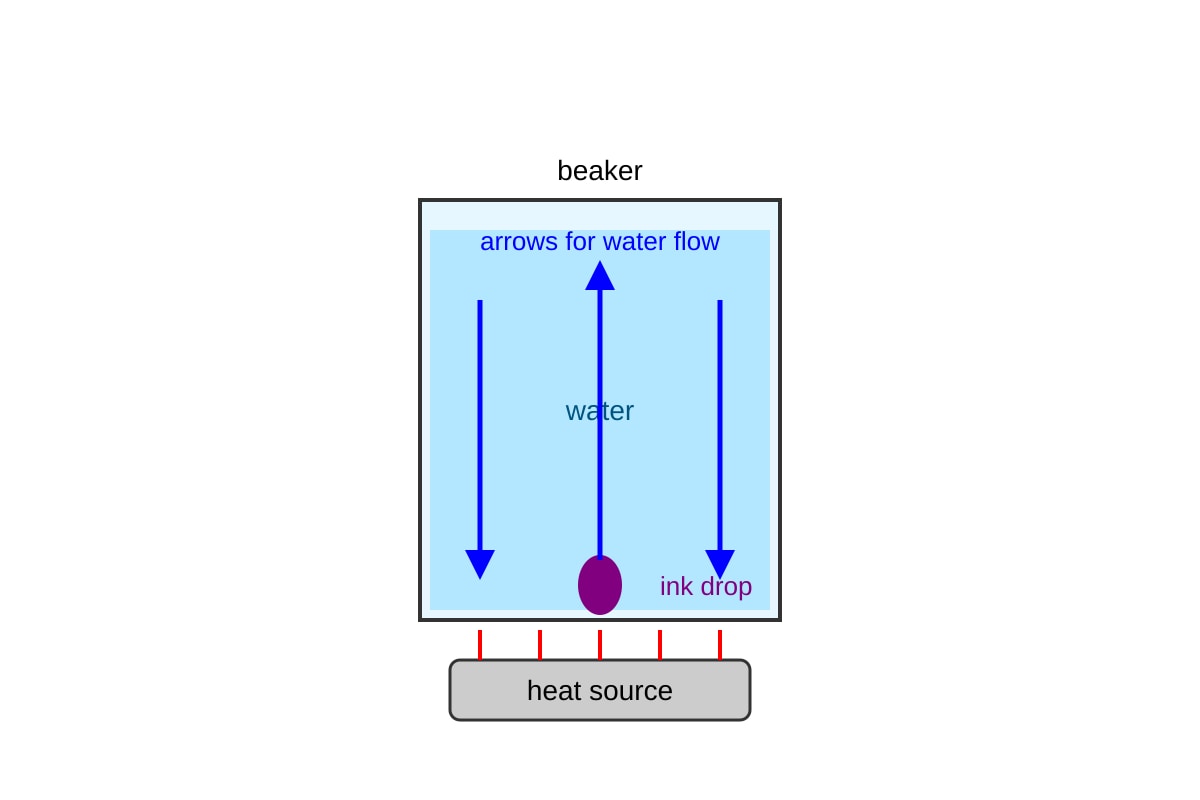
The diagram shows a simple experiment with a beaker of water heated from below and a drop of ink at the bottom.

Generated diagram for Q18.
(a) What process of heat transfer is shown? [1 mark]
_______________________________________________________
(b) Describe how the ink moves and why. [2 marks]
_______________________________________________________
_______________________________________________________
19. A pupil has three rods: iron, copper, and plastic. She puts one end of each in hot water at the same time.
(a) Predict which rod will feel hottest at the other end after 1 minute. [1 mark]
_______________________________________________________
(b) Explain your answer using the idea of conductors. [2 marks]
_______________________________________________________
_______________________________________________________
20. (a) State what radiation is in heat transfer. [1 mark]
_______________________________________________________
(b) Give two features of a shiny silver surface that make it a good reflector of heat radiation. [2 marks]
(i) _________________________
(ii) _________________________
(c) Explain why a black surface is used on a solar water heater. [1 mark]
_______________________________________________________
Answers
Primary 6 PSLE Science Quiz - Heat: Answer Key
Total Marks: 40
Topic: Heat
Section A Answers (1 mark each)
-
C) Radiation
Teaching note: Radiation is heat transfer by infrared waves and does not need particles or a medium. Conduction and convection need particles. -
B) Conduction
Teaching note: Heat travels along the metal spoon through particle collisions; this is conduction in solids. -
C) Copper
Teaching note: Metals like copper are good conductors; wood, plastic, cloth are insulators. -
B) From hot to cold
Teaching note: Heat naturally flows from a higher temperature region to a lower temperature region. -
A) Hot water, because particles move faster
Teaching note: Higher temperature means faster particle movement, so diffusion/spreading is quicker. -
B) Warm air rising from a radiator
Teaching note: Convection is movement of fluids due to density changes; warm air rises and cool air sinks. -
B) They expand
Teaching note: Heating gives particles more energy, they move apart, so volume increases (thermal expansion). -
C) Glass
Teaching note: Among the choices, glass is a poor conductor compared to iron, aluminium, silver. -
B) Conduction and convection
Teaching note: Vacuum removes particles, so conduction and convection cannot occur; radiation still possible but walls reflect it. -
B) Water turns to steam and expands
Teaching note: At boiling, liquid water becomes gas (steam), which occupies more space and forms bubbles.
Section B Answers (2 marks each)
-
Wood is a poor conductor of heat (1 mark), so it does not pass heat from the pot to the hand quickly (1 mark).
Common mistake: saying wood "blocks all heat" – it slows transfer, not absolute block. -
Any two correct: (a) radiator / heater (1), (b) boiling pot / convection oven / air conditioner vent (1).
Teaching note: Must be objects where fluid movement carries heat. -
Insulation / double glazing / thick curtains / reduce gaps (2 marks for clear valid method).
Marking: 2 marks if specific and correct; 1 mark if vague like "keep warm". -
Correct (1 mark). Dark surfaces emit and absorb radiation better than shiny ones (1 mark).
Teaching note: Shiny surfaces reflect radiation; dark matte surfaces absorb and emit well. -
Air inside balloon gains heat (1 mark), particles move faster and spread out, expanding balloon (1 mark).
Concept: Thermal expansion of gas. -
Metal base conducts heat to cook food (1 mark); plastic handle is poor conductor so safe to hold (1 mark).
Marking: Must mention both functions.
Section C Answers
(a) Conduction is transfer of heat through a solid by particles vibrating and passing energy (1 mark).
(b) Metals have free electrons / closely packed particles that pass heat quickly (1 mark); wood has trapped air / no free electrons so slow (1 mark).
Total: 3 marks
(a) Convection (1 mark).
(b) Ink rises in centre with warm water (1 mark); heated water expands, becomes less dense and rises, carrying ink (1 mark).
Image note: Expected arrows show centre up, sides down; ink should be shown moving upward.
Total: 3 marks
(a) Copper (1 mark).
(b) Copper is best conductor among the three (1 mark); plastic is insulator so stays cool, iron less conductive than copper (1 mark).
Total: 3 marks
(a) Radiation is heat transfer by electromagnetic waves needing no medium (1 mark).
(b) (i) Shiny surface reflects radiation (1 mark) (ii) Silver colour reduces absorption (1 mark).
(c) Black absorbs radiation best, so heats water efficiently (1 mark).
Total: 4 marks
Quiz total: 10 + 12 + 18 = 40 marks.
Free quiz and exam paper access
Enter your details to view this paper
Your access is remembered on this device.