AI Generated Exam Paper
Primary 6 PSLE Science Practice Paper 5
Free Kimi AI-generated P6 PSLE Science Practice Paper 5 with questions, answers, and PSLE-focused practice for Singapore students preparing for exams.
These static practice materials are generated from the site's syllabus and paper-generation workflow, with source and model context shown so students and parents can evaluate the material before use.
Questions
TuitionGoWhere Practice Paper - Science Primary 6 PSLE
TuitionGoWhere Practice Paper (AI)
| Subject: | Science |
| Level: | Primary 6 PSLE |
| Paper: | Practice Paper - Version 5 of 5 |
| Duration: | 1 hour 45 minutes |
| Total Marks: | 100 marks |
| Name: | _________________________ |
| Class: | _________________________ |
| Date: | _________________________ |
Instructions
- Answer ALL questions.
- Write your answers in the spaces provided.
- For questions requiring working, show all steps clearly.
- Use pencil for diagrams and pen for writing.
- Read each question carefully before answering.
SECTION A: Multiple Choice Questions (Questions 1–20)
20 marks (1 mark each)
Answer ALL questions. Choose the correct answer and write its letter in the bracket provided.
1. Which of the following is NOT a characteristic of living things?
A) They can grow
B) They can reproduce
C) They can rust
D) They can respond to stimuli
Answer: ( )
2. Plants are classified as living things because they can __________.
A) only make their own food
B) grow, reproduce and respond to changes
C) stay in one place throughout their lives
D) breathe in carbon dioxide only
Answer: ( )
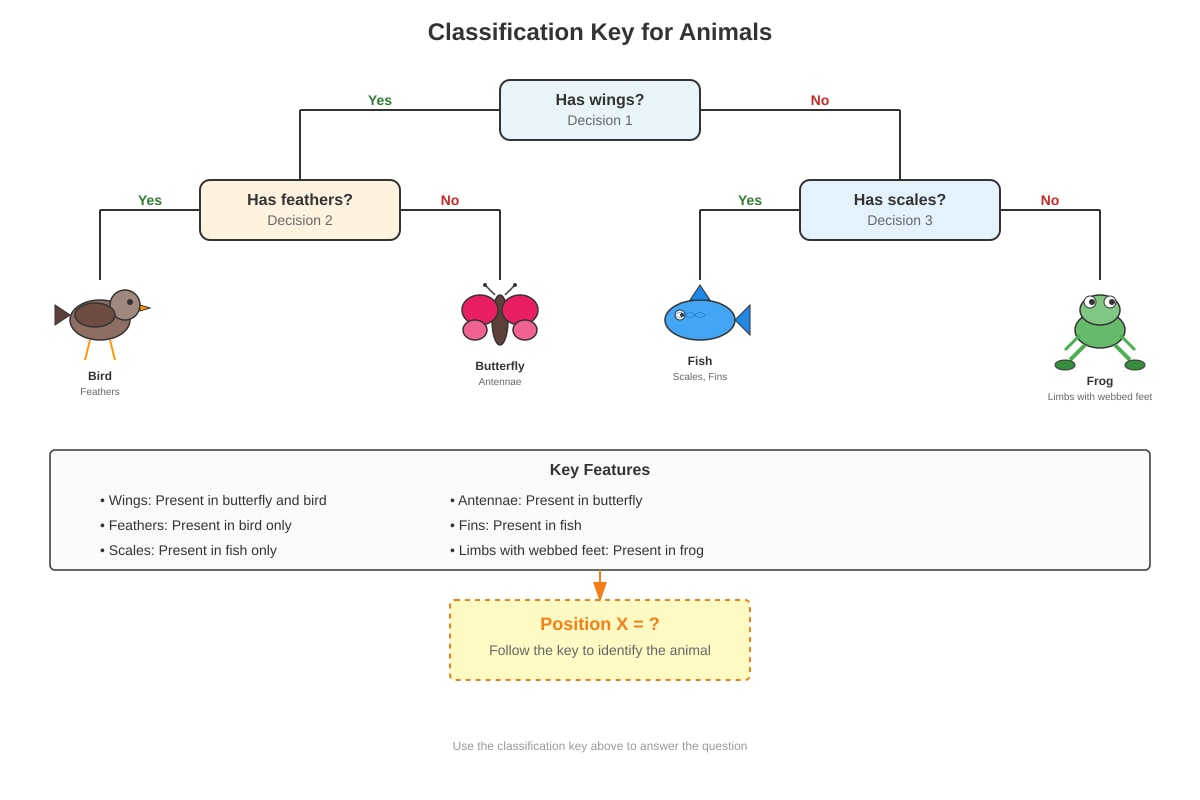
3. The diagram below shows a classification key for some animals.
<image_placeholder> id: Q3-fig1 type: diagram linked_question: Q3 description: Simple classification key (dichotomous key) with 4 animals - butterfly, fish, frog, bird. Decision nodes show: 1) Has wings? → Yes: butterfly/bird; No: fish/frog. 2) Has feathers? → Yes: bird; No: butterfly. 3) Has scales? → Yes: fish; No: frog. labels: Wings, Feathers, Scales, Limbs with webbed feet, Fins, Antennae values: NA must_show: Clear branching structure, decision questions at each node, 4 animal illustrations with labels </image_placeholder>
Which animal is classified at position X?
A) Butterfly
B) Fish
C) Frog
D) Bird
Answer: ( )
4. Which group of organisms can make their own food?
A) Fungi and bacteria
B) Ferns and mushrooms
C) Green plants and algae
D) Animals and insects
Answer: ( )
5. The table below shows some characteristics of four different organisms.
| Organism | Has backbone | Has wings | Lives in water | Has feathers |
|---|---|---|---|---|
| P | ✓ | ✓ | ✗ | ✓ |
| Q | ✗ | ✗ | ✗ | ✗ |
| R | ✓ | ✗ | ✓ | ✗ |
| S | ✗ | ✓ | ✗ | ✗ |
Which organism is most likely a fish?
A) P
B) Q
C) R
D) S
Answer: ( )
6. Spore-producing plants reproduce by __________.
A) seeds
B) spores
C) bulbs
D) runners
Answer: ( )
7. Which of the following shows the correct classification order from the largest group to the smallest?
A) Kingdom → Species → Genus → Family
B) Kingdom → Family → Genus → Species
C) Species → Genus → Family → Kingdom
D) Family → Kingdom → Genus → Species
Answer: ( )
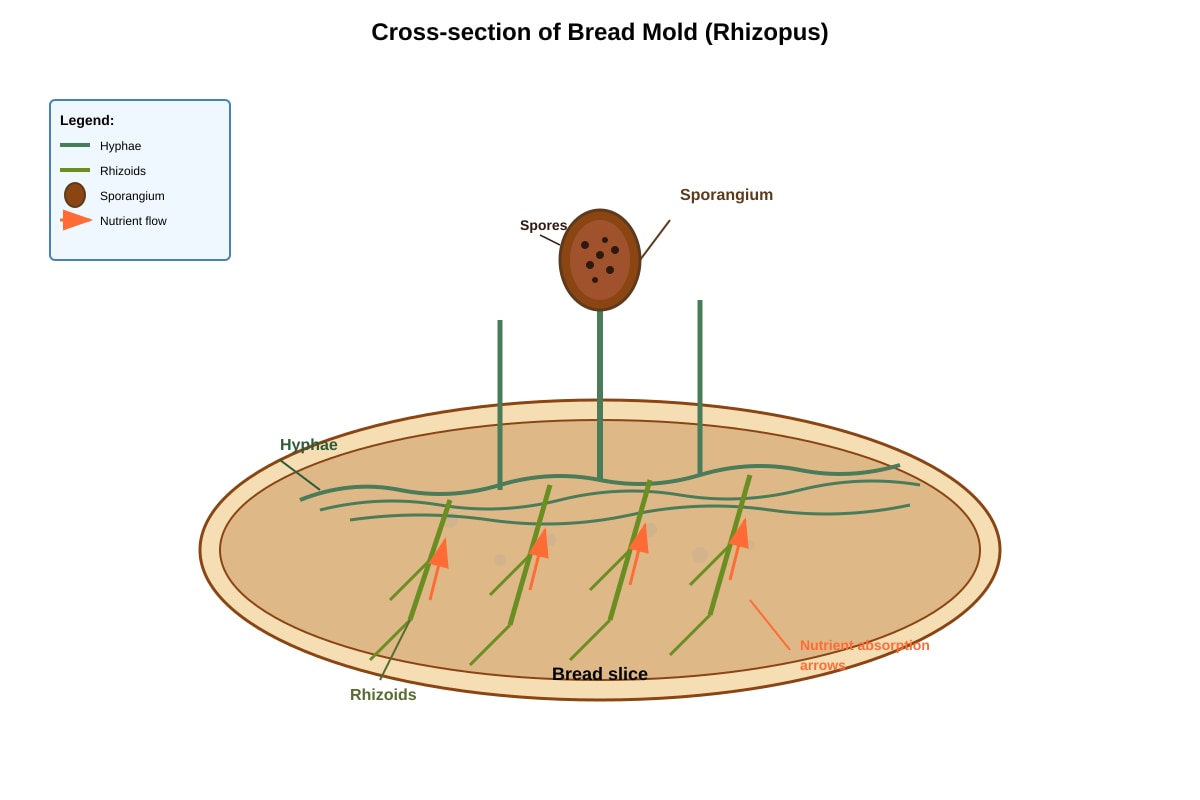
8. The diagram shows how fungi obtain their food.
<image_placeholder> id: Q8-fig1 type: diagram linked_question: Q8 description: Cross-section diagram showing bread mold (Rhizopus) growing on a slice of bread. Hyphae spreading across surface, root-like rhizoids penetrating bread, sporangium at top of upright hyphae. Arrows showing nutrients being absorbed from bread into hyphae. labels: Hyphae, Rhizoids, Sporangium, Bread slice, Nutrient absorption arrows, Spores values: NA must_show: Clear structure of fungal body, direction of nutrient flow, all labelled parts </image_placeholder>
Fungi are different from green plants because fungi __________.
A) cannot make their own food
B) do not need water to survive
C) can only grow on living things
D) reproduce using seeds
Answer: ( )
9. Which of the following is a correct pair of flowering plants and their method of seed dispersal?
| Plant | Method of seed dispersal | |
|---|---|---|
| A | Coconut | Wind |
| B | Dandelion | Animal |
| C | Mango | Water |
| D | Touch-me-not | Explosion |
Answer: ( )
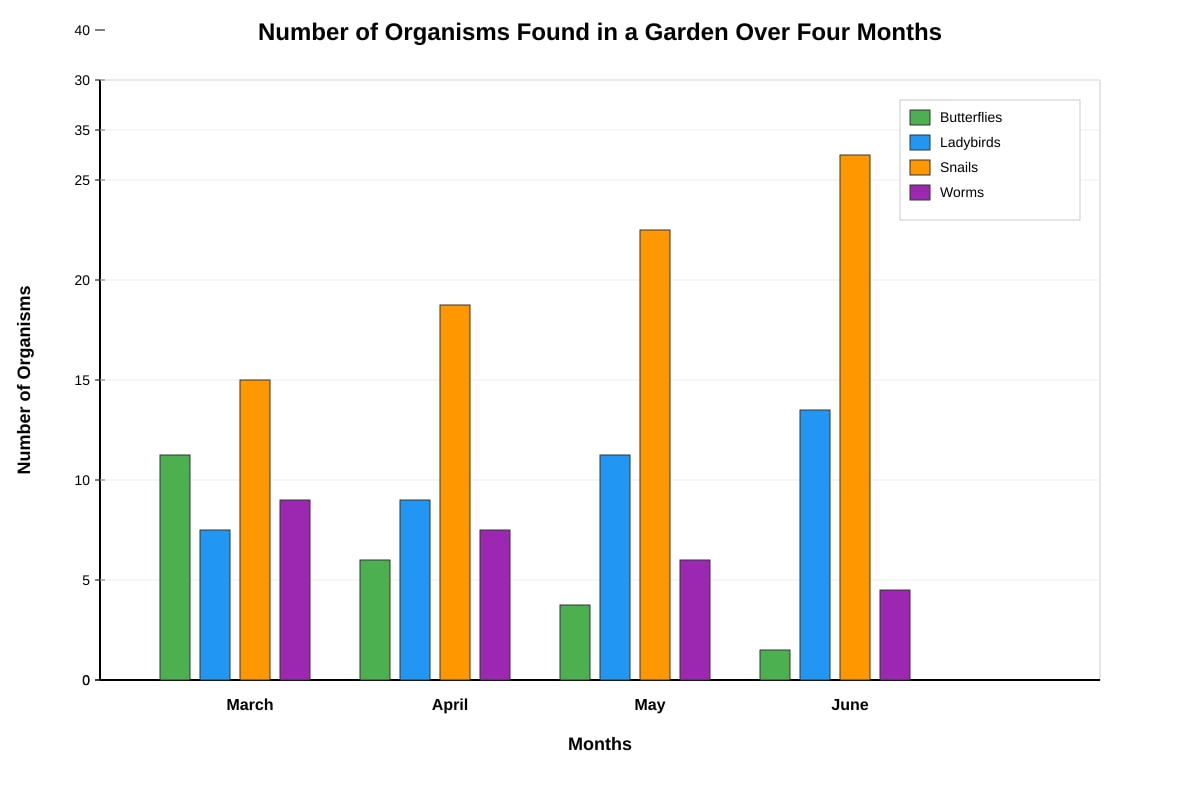
10. The graph shows the number of different organisms found in a garden over four months.
<image_placeholder> id: Q10-fig1 type: graph linked_question: Q10 description: Bar graph showing population counts of butterflies, ladybirds, snails, and worms across 4 months (March to June). Butterfly: 15, 8, 5, 2. Ladybird: 10, 12, 15, 18. Snail: 20, 25, 30, 35. Worm: 12, 10, 8, 6. Y-axis: Number of organisms. X-axis: Months. labels: Butterflies, Ladybirds, Snails, Worms; March, April, May, June values: Butterfly 15/8/5/2, Ladybird 10/12/15/18, Snail 20/25/30/35, Worm 12/10/8/6 must_show: All four organism bars per month, clear scale on y-axis from 0 to 40, labelled axes, legend </image_placeholder>
Based on the graph, which statement is correct?
A) The number of all organisms decreased over the four months
B) Snail population increased while butterfly population decreased
C) Ladybirds were the most numerous in March
D) Worms and butterflies had the same population in June
Answer: ( )
11. Bacteria are used to make yoghurt because they can __________.
A) cause diseases in milk
B) break down milk sugar into simpler substances
C) produce oxygen from milk
D) remove water from milk completely
Answer: ( )
12. Which of the following materials will NOT decay easily?
A) Paper
B) Vegetable peel
C) Plastic bottle
D) Banana skin
Answer: ( )
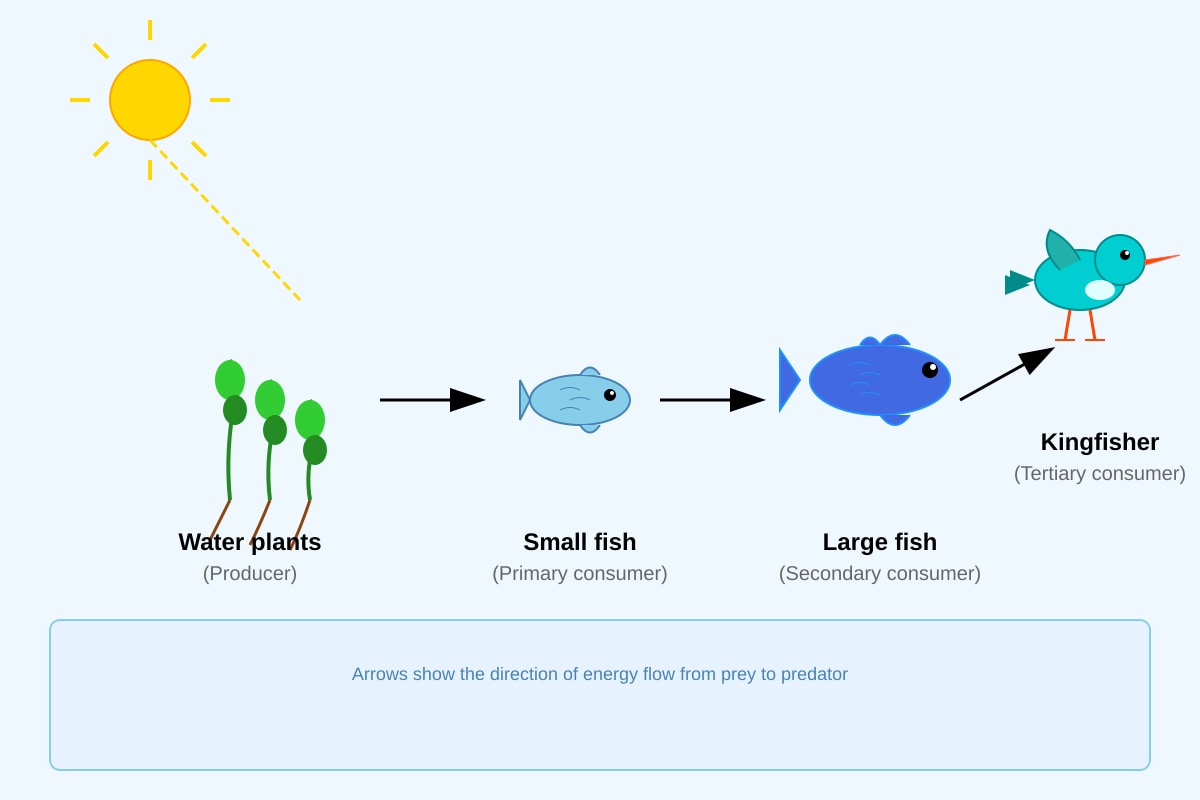
13. The diagram shows a food chain in a pond.
<image_placeholder> id: Q13-fig1 type: diagram linked_question: Q13 description: Food chain diagram in a pond ecosystem. Water plants → Small fish → Large fish → Kingfisher. Arrows pointing from prey to predator showing energy flow. Simple illustrations of each organism. labels: Water plants (Producer), Small fish (Primary consumer), Large fish (Secondary consumer), Kingfisher (Tertiary consumer); sun symbol pointing at water plants values: NA must_show: All 4 organisms in sequence, arrows showing energy flow direction, sun symbol, clear labels </image_placeholder>
Which organism is the producer in this food chain?
A) Small fish
B) Large fish
C) Kingfisher
D) Water plants
Answer: ( )
14. A scientist discovered a new organism. It has the following features:
- Made of many cells
- Cannot make its own food
- Has a backbone
- Body covered with hair
To which group does this organism belong?
A) Bird
B) Mammal
C) Reptile
D) Fish
Answer: ( )
15. Which of the following is an example of a non-living thing that was once part of a living thing?
A) Glass cup
B) Plastic bag
C) Wooden table
D) Metal coin
Answer: ( )
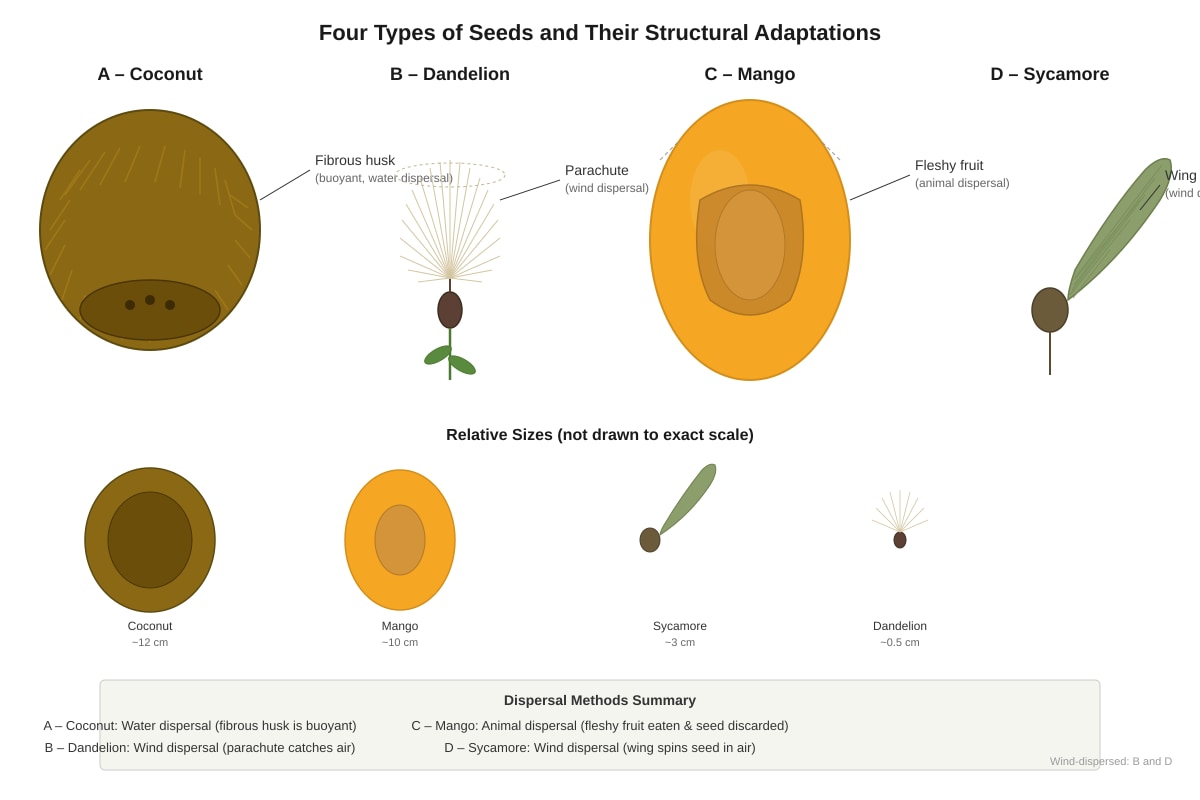
16. The diagram shows four different types of seeds.
<image_placeholder> id: Q16-fig1 type: diagram linked_question: Q16 description: Four seed illustrations showing different structural adaptations. A: Coconut with fibrous husk, B: Dandelion with parachute-like pappus, C: Mango with fleshy fruit surrounding seed, D: Sycamore with wing-like extension. Scale indicator for relative sizes. labels: A-Coconut, B-Dandelion, C-Mango, D-Sycamore; Fibrous husk, Parachute, Fleshy fruit, Wing values: NA must_show: Distinct structural features for each seed type, clear labels, approximate relative sizes </image_placeholder>
Which seeds are adapted for dispersal by wind?
A) A and B
B) B and D
C) C and D
D) A and C
Answer: ( )
17. Yeast is used in bread-making because it produces __________ during respiration.
A) oxygen
B) carbon dioxide
C) nitrogen
D) hydrogen
Answer: ( )
18. The diagram shows a mould growing on a piece of orange left in a warm, damp place for five days.
<image_placeholder> id: Q18-fig1 type: experimental_setup linked_question: Q18 description: Time-lapse style diagram showing progression of mould growth on orange slice over 5 days. Day 1: fresh orange. Day 2-3: small white spots appearing. Day 4-5: extensive green/blue fuzzy growth covering most of surface. Temperature and humidity indicators: 30°C, 85% humidity. labels: Day 1 through Day 5, temperature 30°C, humidity 85%, mould colonies, orange slice on plate values: Days 1-5, 30°C, 85% must_show: Progressive mould growth, environmental condition labels, clear day-by-day progression </image_placeholder>
Which two factors are most likely responsible for the rapid growth of mould?
A) Light and temperature
B) Temperature and moisture
C) Light and air
D) Air and dryness
Answer: ( )
19. Which statement about the diversity of living things is correct?
A) All living things need oxygen to survive
B) All living things can move from place to place
C) All living things need energy to carry out life processes
D) All living things reproduce by laying eggs
Answer: ( )
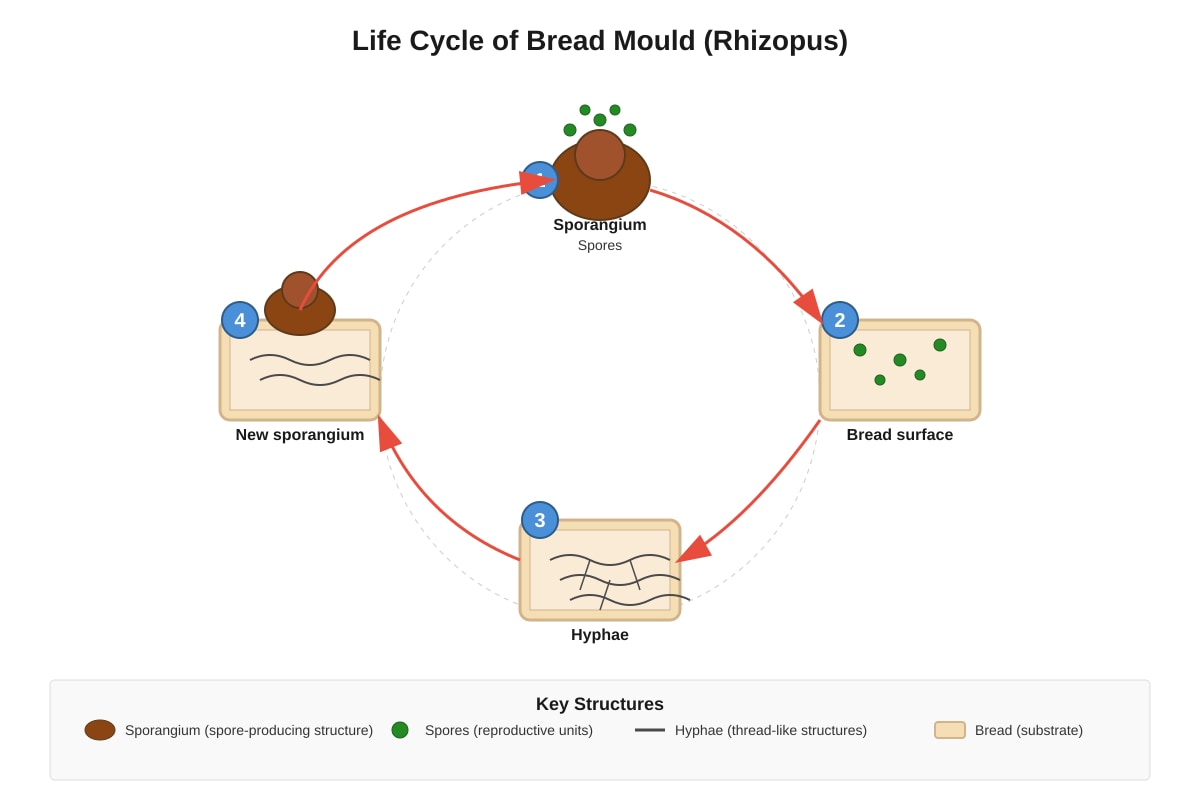
20. The diagram shows how bread mould reproduces.
<image_placeholder> id: Q20-fig1 type: diagram linked_question: Q20 description: Life cycle diagram of bread mould (Rhizopus). Showing: 1) Sporangium releases spores, 2) Spores land on bread, 3) Hyphae grow and spread, 4) New sporangium develops. Circular cycle format with numbered stages and arrows. labels: Sporangium, Spores, Bread surface, Hyphae, New sporangium; Numbers 1-4 showing cycle stages values: NA must_show: Complete cycle, all labelled structures, directional arrows, bread as substrate </image_placeholder>
Bread mould reproduces by releasing __________ into the air.
A) seeds
B) eggs
C) spores
D) buds
Answer: ( )
SECTION B: Short Answer Questions (Questions 21–35)
40 marks
Answer ALL questions. Write your answers in the spaces provided.
21. Sarah observed an unknown organism in a pond. She recorded the following observations:
- It has no backbone
- It has six legs
- It has wings
- It has feelers (antennae)
(a) To which group of animals does this organism belong?
[1 mark]
(b) Give two reasons for your answer in part (a).
[2 marks]
(c) Name one example of such an animal.
[1 mark]
Total: [4 marks]
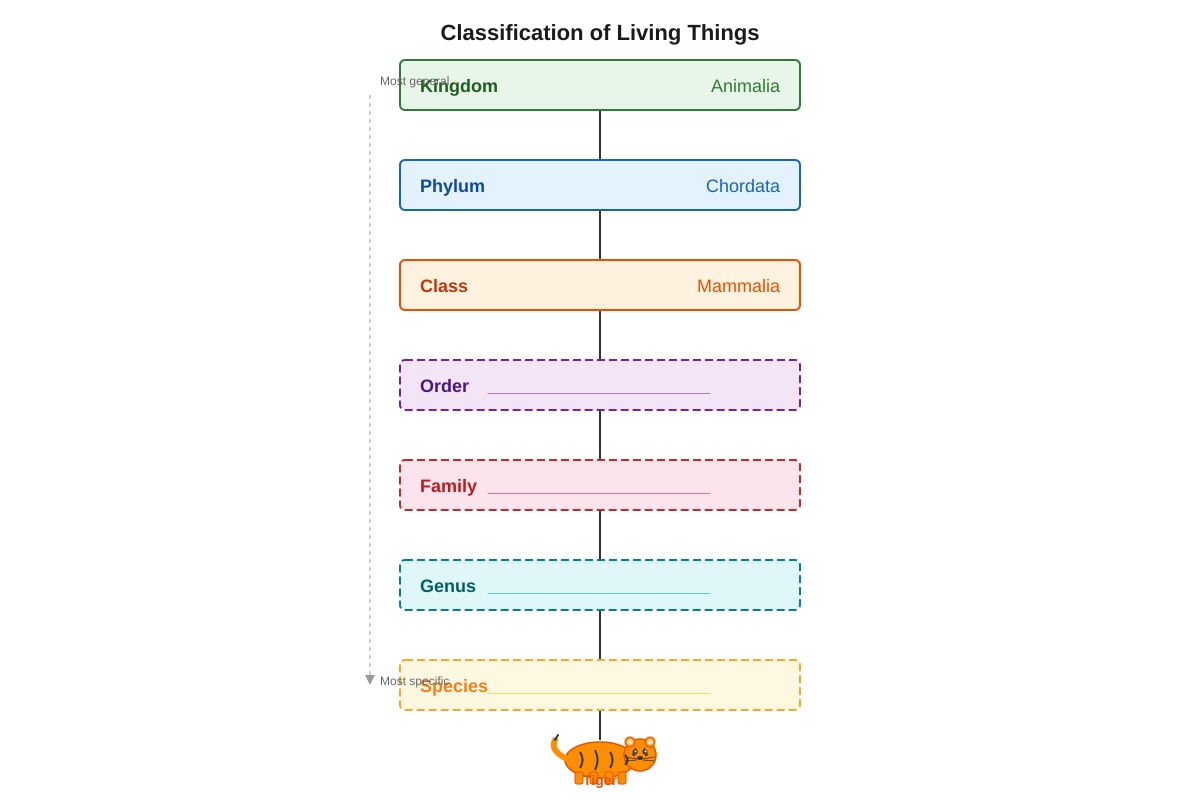
22. The diagram shows how living things are classified into groups.
<image_placeholder> id: Q22-fig1 type: diagram linked_question: Q22 description: Classification hierarchy diagram showing Kingdom at top branching down through Phylum, Class, Order, Family, Genus, Species at bottom. Partially filled with examples: Kingdom-Animalia, Phylum-Chordata, Class-Mammalia, then blank spaces for Order, Family, Genus, Species. Tiger image at species level. labels: Kingdom (Animalia), Phylum (Chordata), Class (Mammalia), Order [blank], Family [blank], Genus [blank], Species [blank]; Tiger illustration values: NA must_show: Hierarchical pyramid/tree structure, all seven levels clearly labelled, tiger as example organism, four blank spaces for student to fill </image_placeholder>
(a) Using the example of the tiger, fill in the four missing levels in the classification of the tiger.
[4 marks]
Order: _______________________________________
Family: ______________________________________
Genus: _______________________________________
Species: _____________________________________
(b) What is the scientific name of the tiger?
[1 mark]
(c) Why do scientists use scientific names instead of common names?
[2 marks]
Total: [7 marks]
23. The table shows some characteristics of five different organisms: P, Q, R, S, and T.
| Characteristic | P | Q | R | S | T |
|---|---|---|---|---|---|
| Can make own food | ✓ | ✗ | ✓ | ✗ | ✗ |
| Has backbone | ✗ | ✓ | ✗ | ✓ | ✗ |
| Has wings | ✗ | ✓ | ✗ | ✗ | ✗ |
| Has feathers | ✗ | ✓ | ✗ | ✗ | ✗ |
| Lives in water | ✓ | ✗ | ✗ | ✗ | ✓ |
(a) Which organism is most likely to be a bird? Give a reason for your answer.
[2 marks]
(b) Which organisms are most likely to be plants or plant-like organisms?
[2 marks]
Give a reason for your answer.
(c) Organism S has a backbone but cannot make its own food. It does not have wings or feathers. Suggest what animal group S might belong to.
[2 marks]
Give a reason for your answer.
Total: [6 marks]
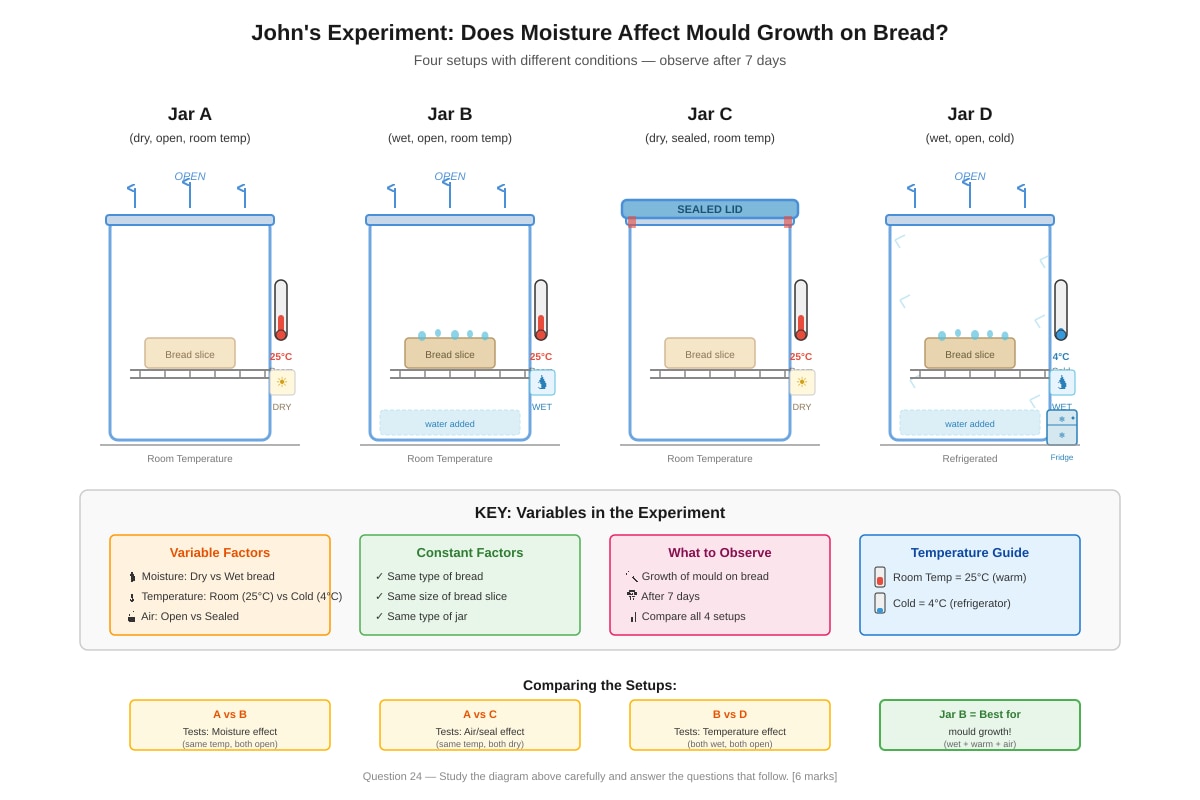
24. John carried out an experiment to find out if moisture affects the growth of mould on bread. He used four slices of bread and set up the experiment as shown below.
<image_placeholder> id: Q24-fig1 type: experimental_setup linked_question: Q24 description: Four identical glass jars arranged side by side, each containing a slice of bread on a wire rack. Jar A: Dry bread, open jar, room temperature. Jar B: Wet bread, open jar, room temperature. Jar C: Dry bread, sealed jar, room temperature. Jar D: Wet bread, open jar, refrigerated. Thermometer icon showing room temperature vs cold. Water droplets on Jar B and D bread. labels: Jar A (dry, open, room temp), Jar B (wet, open, room temp), Jar C (dry, sealed, room temp), Jar D (wet, open, cold); Bread slice, Wire rack, Temperature indicators, Moisture indicators values: Room temperature ~25°C, Cold ~4°C must_show: All four setups clearly distinguished by conditions, bread visible in each, temperature and moisture indicators, control and variable factors shown </image_placeholder>
After 7 days, John observed the following results:
| Setup | Condition of bread after 7 days |
|---|---|
| A | No mould |
| B | Covered with mould |
| C | No mould |
| D | Small patches of mould |
(a) What is the aim of this experiment?
[1 mark]
(b) Give two factors that John kept the same in this experiment to make it a fair test.
[2 marks]
(c) Which two setups should John compare to find out if moisture affects mould growth? Explain your choice.
[3 marks]
(d) Based on the results, what conclusion can John draw?
[2 marks]
Total: [8 marks]
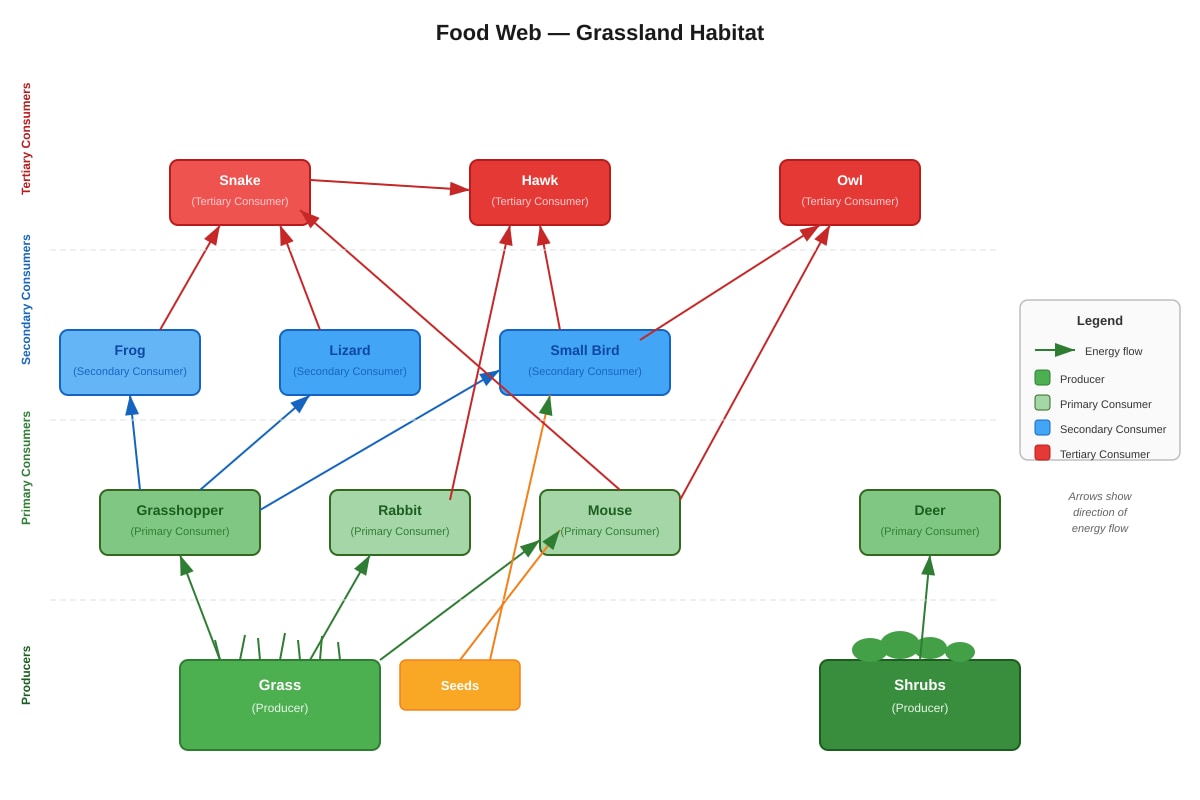
25. The diagram shows a food web in a grassland habitat.
<image_placeholder> id: Q25-fig1 type: diagram linked_question: Q25 description: Food web diagram for grassland ecosystem. Producers: Grass and shrubs. Primary consumers: Grasshopper, rabbit, mouse, deer. Secondary consumers: Frog, lizard, small bird. Tertiary consumers: Snake, hawk, owl. Multiple feeding relationships shown with arrows. Mouse eats grass and seeds; rabbit eats grass; deer eats shrubs; grasshopper eats grass; frog eats grasshopper; lizard eats grasshopper; small bird eats seeds and grasshopper; snake eats frog, lizard, mouse; hawk eats snake, small bird, rabbit; owl eats mouse, small bird. labels: All organisms named, arrows showing energy flow direction, grass/shrubs at bottom as producers values: NA must_show: At least 10 organisms, minimum 8 interconnections, clear arrow directions, producers at base, consumers in trophic levels </image_placeholder>
(a) Name the producer in this food web.
[1 mark]
(b) Write down one food chain from this food web that contains four organisms.
[2 marks]
(c) What would happen to the population of frogs if all the grasshoppers were removed? Explain your answer.
[3 marks]
(d) Explain why a food web is a more accurate representation of feeding relationships than a single food chain.
[2 marks]
Total: [8 marks]
26. Mary observed three different organisms and recorded their characteristics in the table below.
| Organism | Where found | How it feeds | How it reproduces |
|---|---|---|---|
| X | On rotting log | Absorbs nutrients through hyphae | Spores |
| Y | In soil | Feeds on dead organic matter | Binary fission |
| Z | On pond surface | Makes own food using sunlight | Spores |
(a) Which organism (X, Y, or Z) is most likely a bacterium? Give a reason for your answer.
[2 marks]
(b) Which organism is most likely a green plant? Give a reason for your answer.
[2 marks]
(c) Explain one way in which organisms X and Y are similar.
[2 marks]
Total: [6 marks]
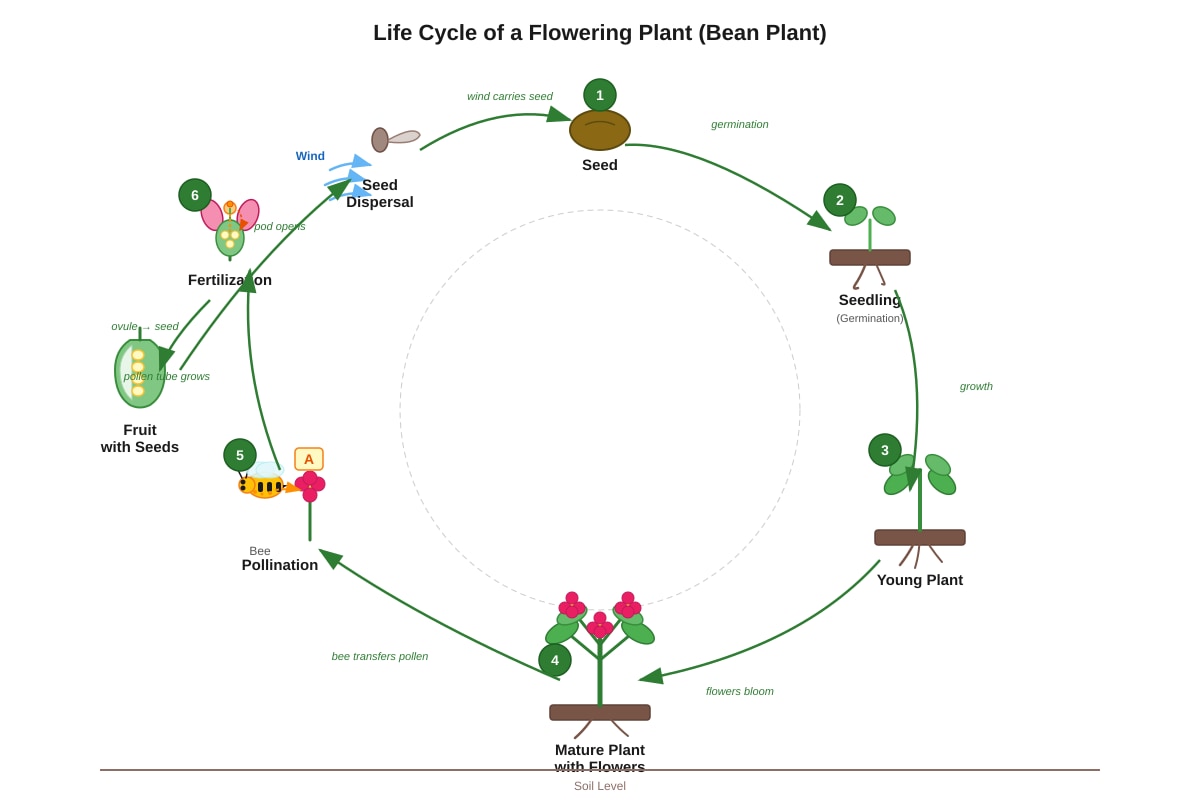
27. The diagram shows the life cycle of a flowering plant.
<image_placeholder> id: Q27-fig1 type: diagram linked_question: Q27 description: Life cycle diagram of flowering plant (bean plant example). Circular cycle showing: Seed → Seedling (germination) → Young plant → Mature plant with flowers → Pollination (bee shown) → Fertilization → Fruit with seeds → Seed dispersal (wind shown) → Back to seed. Numbered stages 1-6. labels: Seed, Seedling, Young plant, Mature plant/Flowers, Pollination, Fertilization, Fruit/Seeds, Seed dispersal; Bee, Wind arrows values: NA must_show: Complete cycle with all stages, pollination and seed dispersal mechanisms illustrated, numbered progression, relevant animal/wind agents </image_placeholder>
(a) What is the process labelled A where the pollen grain is transferred to the stigma?
[1 mark]
(b) What happens after pollination that leads to the formation of seeds?
[2 marks]
(c) Explain why seed dispersal is important for the survival of the plant species.
[2 marks]
Total: [5 marks]
28. Sam wants to find out which type of seed dispersal is most common in his school garden. He collected data over one month and recorded his findings in the table below.
| Seed type | Number found | Features observed |
|---|---|---|
| A | 45 | Light, has fluffy hairs |
| B | 12 | Round, hard coat, found near parent plant |
| C | 28 | Has wing-like structure |
| D | 8 | Fleshy, sweet-smelling |
| E | 15 | Small, smooth, round |
(a) Which seed type (A, B, C, D, or E) is most likely dispersed by animals? Give a reason for your answer.
[2 marks]
(b) Sam found that most seeds in his garden were dispersed by wind. How does the data support this conclusion?
[2 marks]
(c) Sam noticed that Type B seeds were found mostly directly beneath the parent plant. Explain why this might be a disadvantage for Type B plants.
[2 marks]
Total: [6 marks]
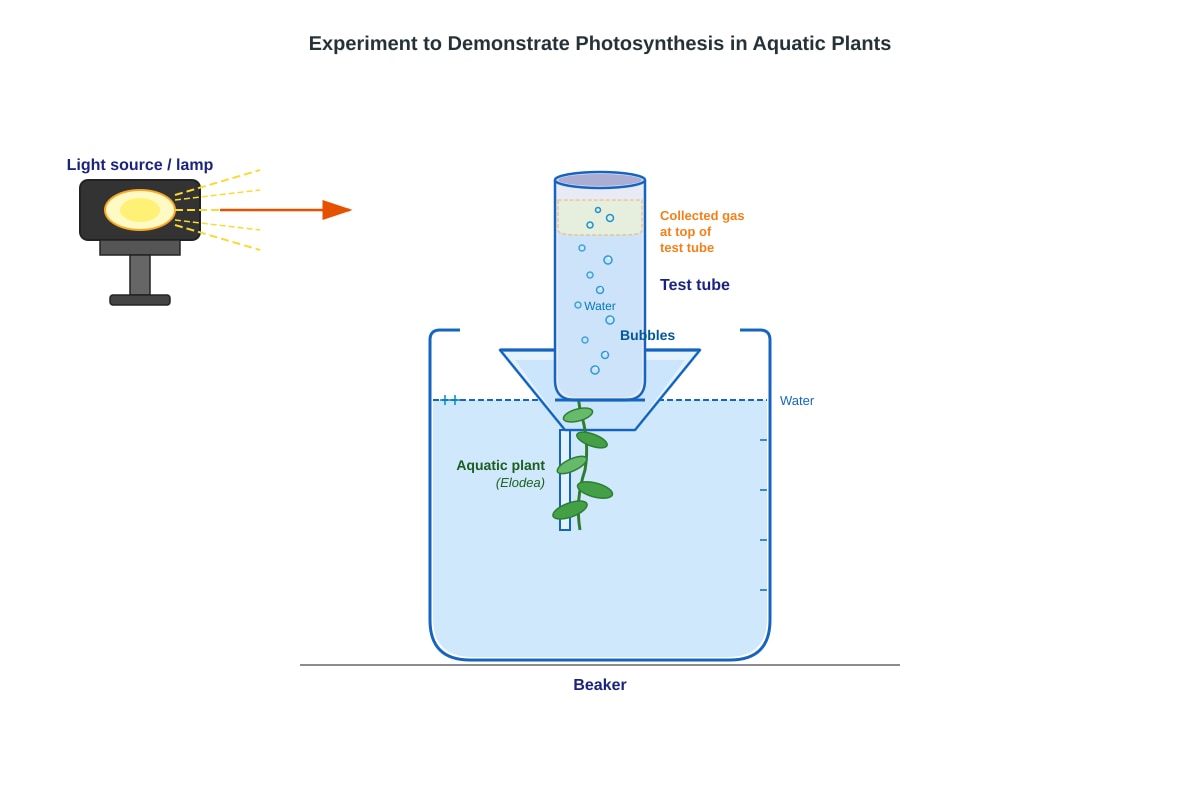
29. The diagram shows an experiment to demonstrate that plants produce oxygen during photosynthesis.
<image_placeholder> id: Q29-fig1 type: experimental_setup linked_question: Q29 description: Experiment setup showing aquatic plant (Elodea/pondweed) in test tube filled with water, inverted in beaker of water. Funnel over plant leading to inverted test tube. Bright lamp shining on setup. Bubbles visible rising from plant and collecting at top of inverted test tube. Bunsen or heat source not shown - room temperature setup. labels: Aquatic plant (Elodea), Test tube, Funnel, Water, Beaker, Bubbles, Collected gas at top of test tube, Light source/lamp values: NA must_show: Complete apparatus, bubbles originating from plant, gas collection at top of inverted tube, light source direction, water levels </image_placeholder>
(a) Why is the test tube filled with water and placed upside down over the funnel?
[2 marks]
(b) What gas collects at the top of the test tube? How can this gas be tested?
[3 marks]
(c) What would happen to the rate of bubble production if the lamp were moved further away from the plant? Explain why.
[3 marks]
Total: [8 marks]
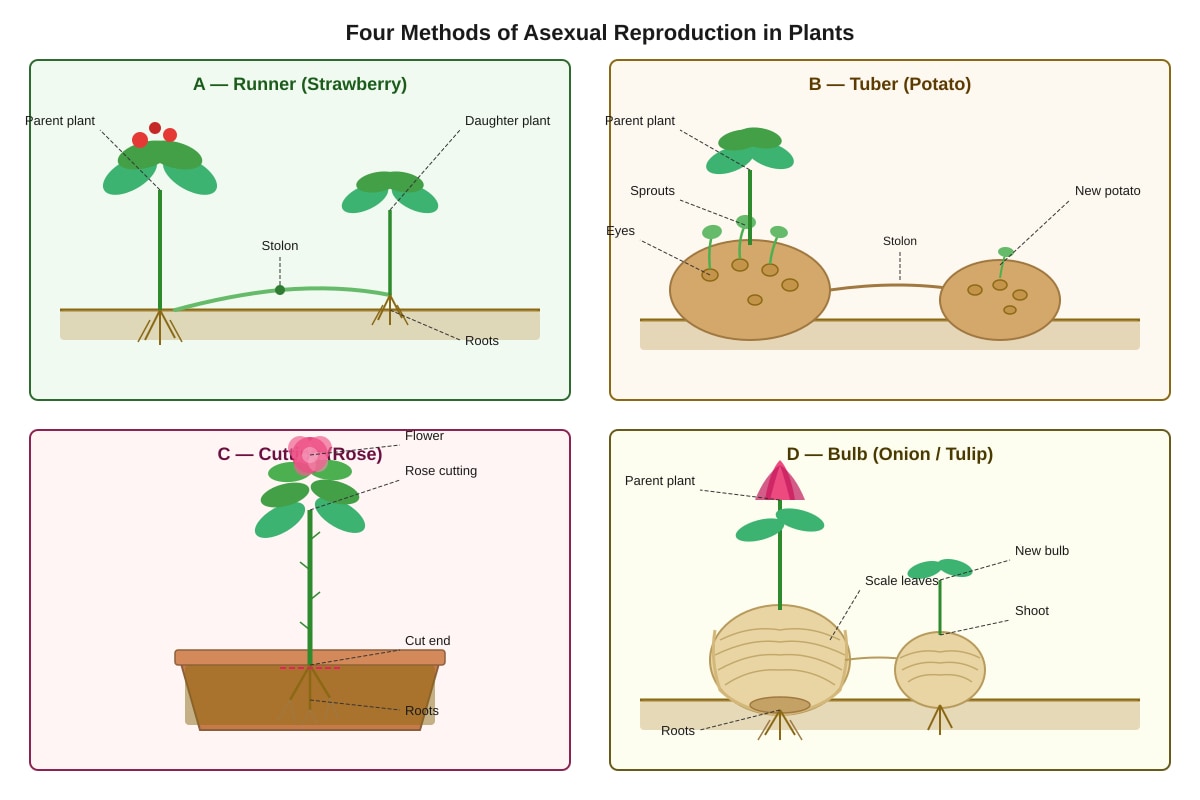
30. The diagram shows four different ways that flowering plants can reproduce without seeds.
<image_placeholder> id: Q30-fig1 type: diagram linked_question: Q30 description: Four methods of asexual reproduction in plants illustrated. A: Runner/strawberry plant with daughter plant connected by stolon. B: Tuber/potato showing eyes/sprouts and new potato formation. C: Cutting/rose stem in soil developing roots. D: Bulb/onion or tulip showing layered scale leaves and new bulb development. Each method labelled with name. labels: A-Runner (Strawberry), B-Tuber (Potato), C-Cutting (Rose), D-Bulb (Onion/Tulip); Stolon, Daughter plant, Eyes, Sprouts, Roots, Scale leaves, New bulb values: NA must_show: All four methods clearly illustrated, parent and offspring structures, labels identifying each method and key structures </image_placeholder>
(a) Name the type of reproduction shown in all four methods above.
[1 mark]
(b) What is one advantage of this type of reproduction over seed reproduction for the parent plant?
[2 marks]
(c) A farmer wants to grow many identical strawberry plants quickly. Which method (A, B, C, or D) should the farmer use? Explain your answer.
[3 marks]
Total: [6 marks]
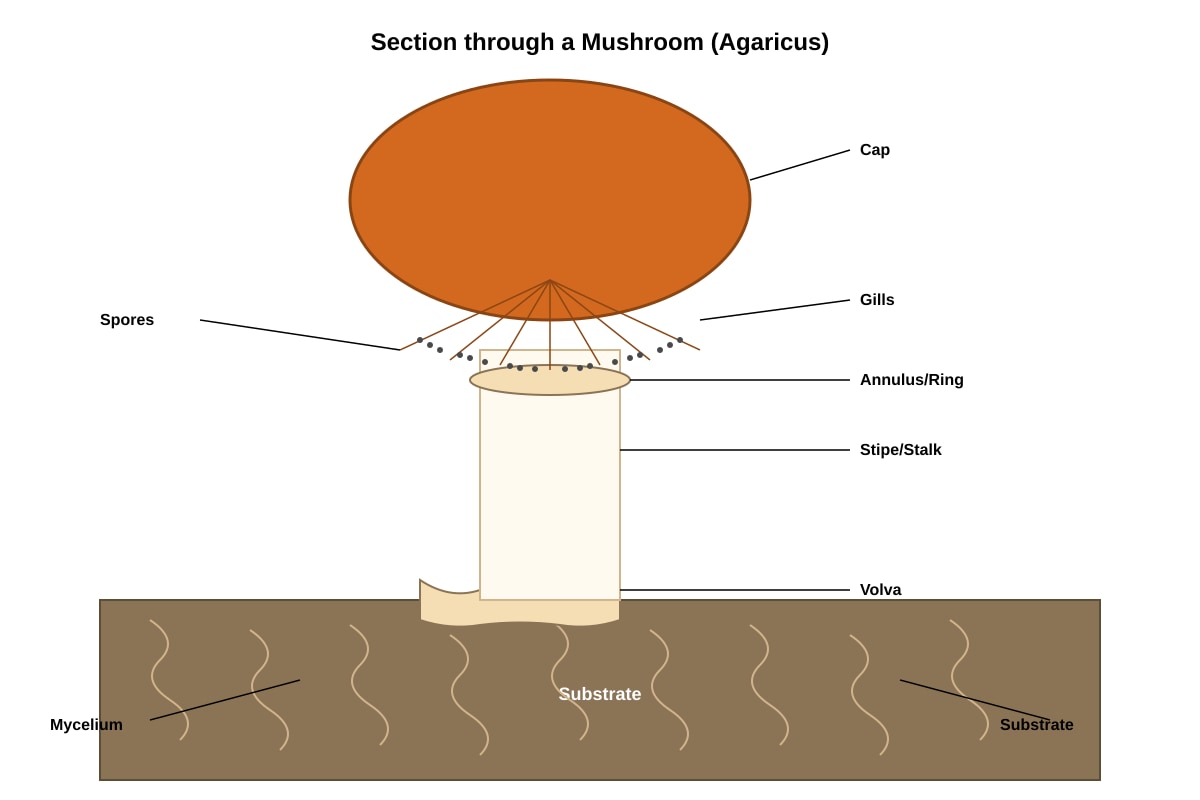
31. The diagram shows a section through a mushroom.
<image_placeholder> id: Q31-fig1 type: diagram linked_question: Q31 description: Detailed cross-section diagram of mushroom (Agaricus). Showing cap with radiating gills on underside, stipe/stalk, annulus/ring, volva/cup at base, mycelium threads in substrate below. Spores on gills indicated with dots. Section cut to show internal structure. labels: Cap, Gills, Stipe/Stalk, Annulus/Ring, Volva, Mycelium, Spores, Substrate values: NA must_show: Internal structure through partial section, all labelled parts, spore location on gills, mycelium in growing medium </image_placeholder>
(a) On which part of the mushroom are spores produced?
[1 mark]
(b) Explain why mushrooms are usually found in dark, damp places.
[3 marks]
(c) Mushrooms are classified as fungi, not plants. Give two differences between fungi and green plants.
[2 marks]
Total: [6 marks]
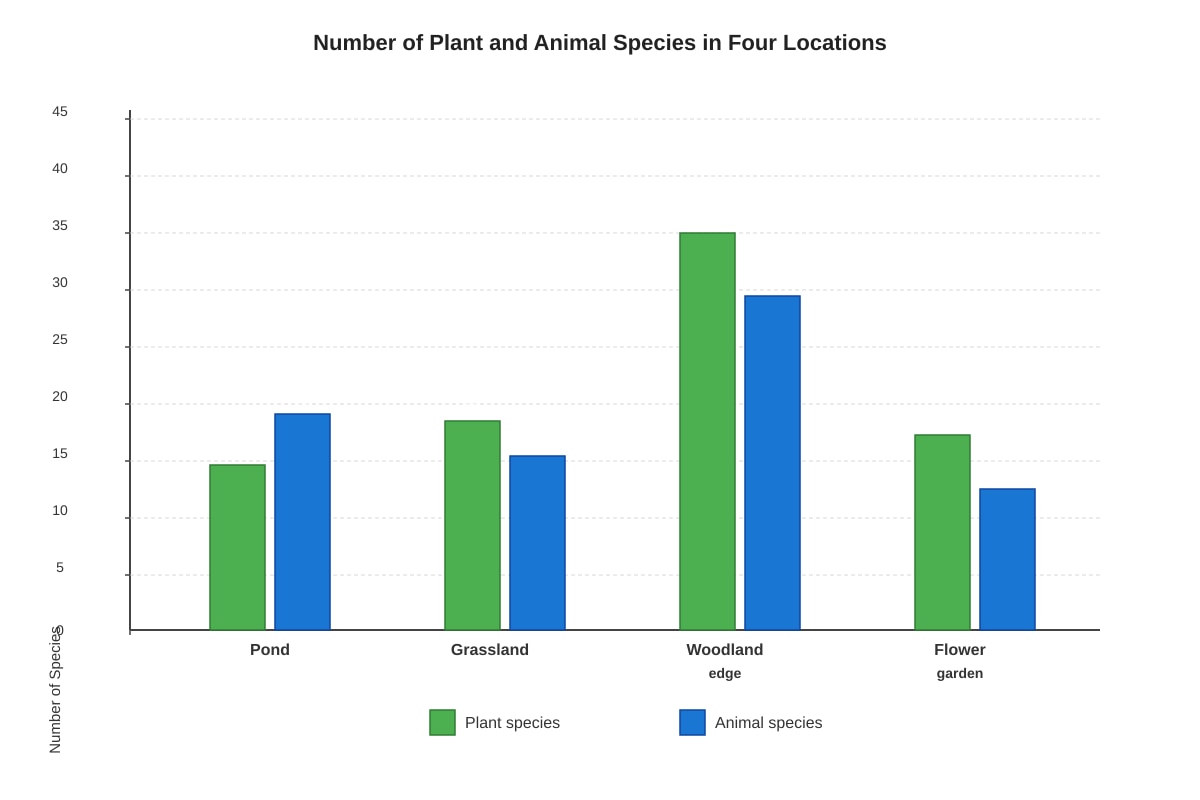
32. The diagram shows a habitat survey conducted in four different locations around a park.
<image_placeholder> id: Q32-fig1 type: chart linked_question: Q32 description: Pictograph or bar chart showing number of plant and animal species found in four locations: Pond, Grassland, Woodland edge, Flower garden. Plant species: Pond-15, Grassland-25, Woodland edge-35, Flower garden-20. Animal species: Pond-22, Grassland-18, Woodland edge-28, Flower garden-15. Double bar chart or grouped bars. labels: Pond, Grassland, Woodland edge, Flower garden; Plant species (green bars), Animal species (blue bars) values: Plants: 15, 25, 35, 20; Animals: 22, 18, 28, 15 must_show: Grouped bars for each location, clear legend for plant/animal, y-axis scale from 0 to 40, all values readable from chart </image_placeholder>
(a) Which location has the greatest biodiversity? Explain how the data supports your answer.
[3 marks]
(b) Suggest one reason why the pond has more animal species than plant species.
[2 marks]
(c) A new playground is going to be built in the woodland edge area. Predict how this might affect the biodiversity of that area. Explain your answer.
[3 marks]
Total: [8 marks]
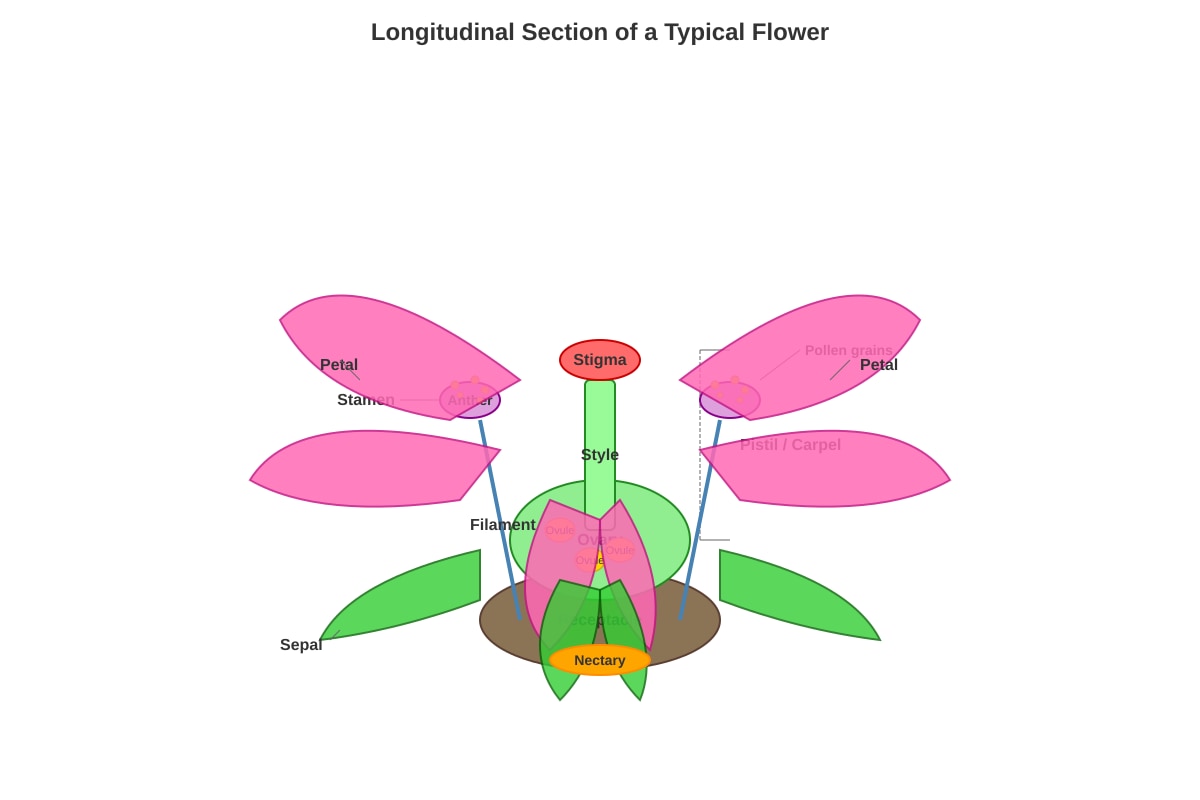
33. The diagram shows the structure of a typical flower.
<image_placeholder> id: Q33-fig1 type: diagram linked_question: Q33 description: Longitudinal section through typical flower (hibiscus or similar). Showing sepals, petals, stamens (anther and filament), pistil/carpel (stigma, style, ovary with ovules), receptacle. Pollen grains on anther indicated. Nectar gland at base of petals. labels: Sepal, Petal, Anther, Filament, Stamen, Stigma, Style, Ovary, Ovule, Pistil/Carpel, Nectary, Receptacle, Pollen grains values: NA must_show: Complete longitudinal section, all reproductive and non-reproductive parts labelled, pollen location, ovules inside ovary </image_placeholder>
(a) Name the male reproductive part of the flower.
[1 mark]
(b) Explain how the structure of the stigma helps in pollination.
[2 marks]
(c) After fertilization, what happens to the ovules and the ovary?
[2 marks]
Total: [5 marks]
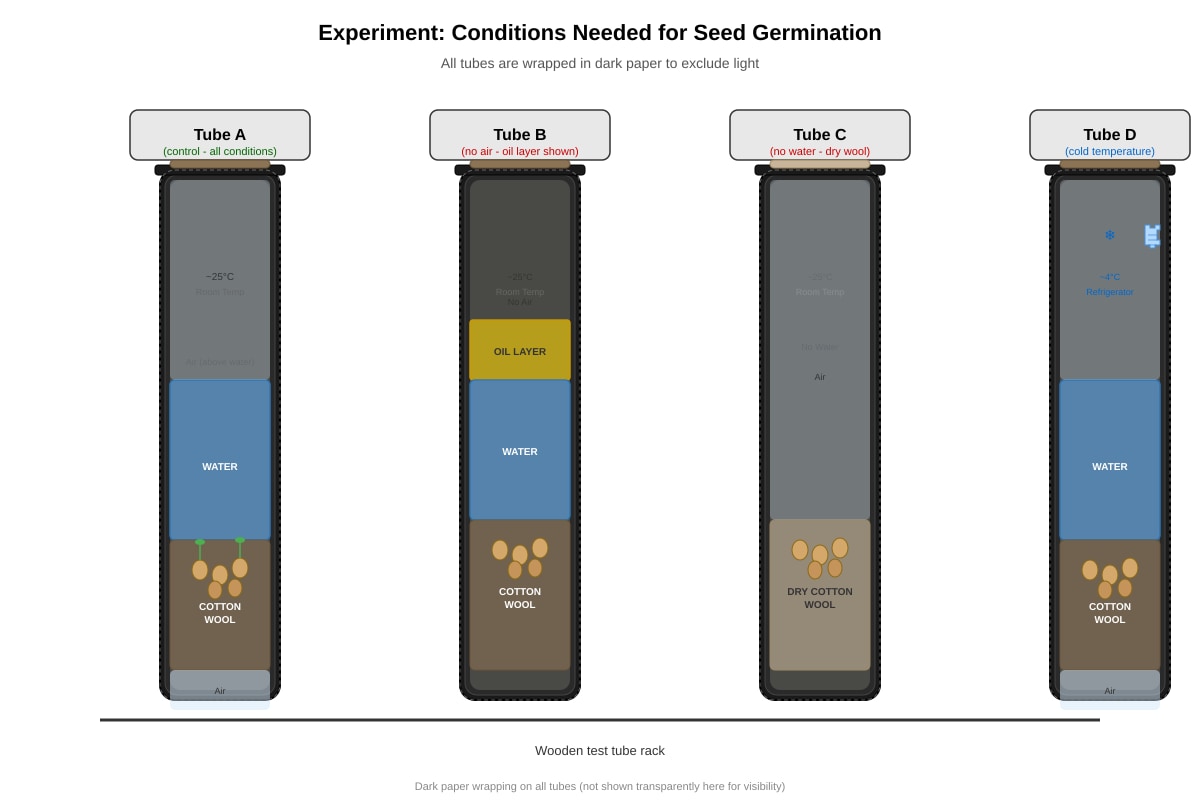
34. The diagram shows a simple experiment to compare the conditions needed for germination.
<image_placeholder> id: Q34-fig1 type: experimental_setup linked_question: Q34 description: Four test tubes with cotton wool and seeds (beans). Tube A: Seeds, cotton wool, water, air, room temperature. Tube B: Seeds, cotton wool, water, no air (oil layer on water), room temperature. Tube C: Seeds, dry cotton wool, air, room temperature. Tube D: Seeds, cotton wool, water, air, in refrigerator. All tubes wrapped in dark paper to exclude light. labels: Tube A (control - all conditions), Tube B (no air - oil layer shown), Tube C (no water - dry wool), Tube D (cold temperature - ice/refrigerator symbol), Dark paper wrapping values: Room temperature ~25°C, Cold ~4°C must_show: All four tubes with clear condition differences, oil layer in B, dry wool in C, temperature indicator in D, dark paper on all tubes, seeds visible </image_placeholder>
After one week, the results were as follows:
| Setup | Conditions | Result |
|---|---|---|
| A | Water, air, suitable temperature | Seeds germinated |
| B | Water, no air, suitable temperature | Seeds did not germinate |
| C | No water, air, suitable temperature | Seeds did not germinate |
| D | Water, air, cold temperature | Seeds did not germinate |
(a) Why were all the test tubes wrapped in dark paper?
[1 mark]
(b) What is the purpose of Setup A in this experiment?
[1 mark]
(c) Explain why seeds need water to germinate.
[2 marks]
(d) Based on this experiment, what three conditions are necessary for seeds to germinate?
[3 marks]
Total: [7 marks]
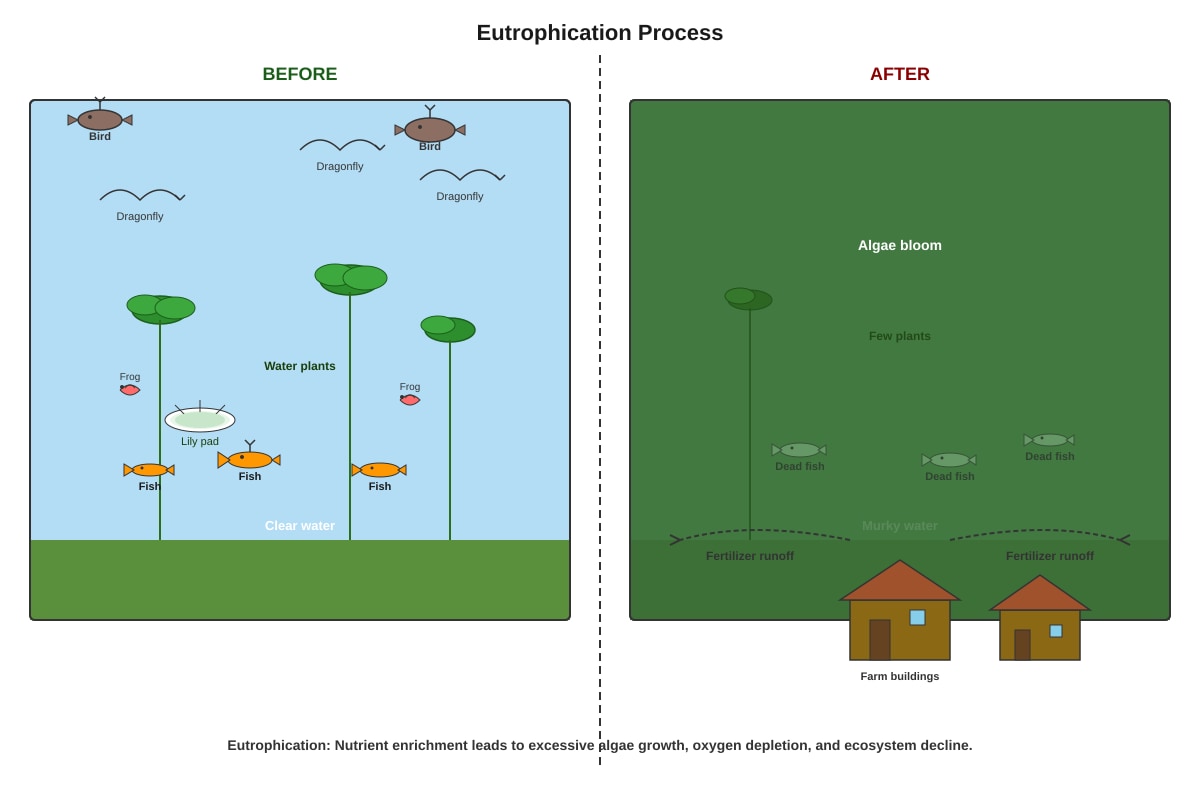
35. The diagram shows a pond ecosystem that has been affected by fertilizer runoff from nearby farms.
<image_placeholder> id: Q35-fig1 type: diagram linked_question: Q35 description: Before-and-after comparison diagram of pond ecosystem. Left side (Before): Clear water, diverse plants, fish, frogs, dragonflies, water birds, healthy appearance. Right side (After): Green algae covering surface, murky water, few visible animals, dead fish floating, reduced plant diversity. Arrows showing fertilizer runoff from farms entering pond. Labelled "Eutrophication process." labels: Before: Clear water, Water plants, Fish, Frogs, Dragonfly, Bird; After: Algae bloom, Murky water, Dead fish, Few plants, Fertilizer runoff arrows; Farm buildings in background values: NA must_show: Clear before/after contrast, visible algae bloom, dead fish indicator, fertilizer source, same pond perspective for comparison </image_placeholder>
(a) Describe two changes that have occurred in the pond after the fertilizer runoff.
[2 marks]
(b) Explain how the fertilizer runoff causes the growth of algae.
[2 marks]
(c) Explain why many fish die when there is excessive algae growth in the pond.
[3 marks]
(d) Suggest two ways to prevent this problem from occurring.
[2 marks]
Total: [9 marks]
SECTION C: Structured Application Questions (Questions 36–40)
40 marks
Answer ALL questions.
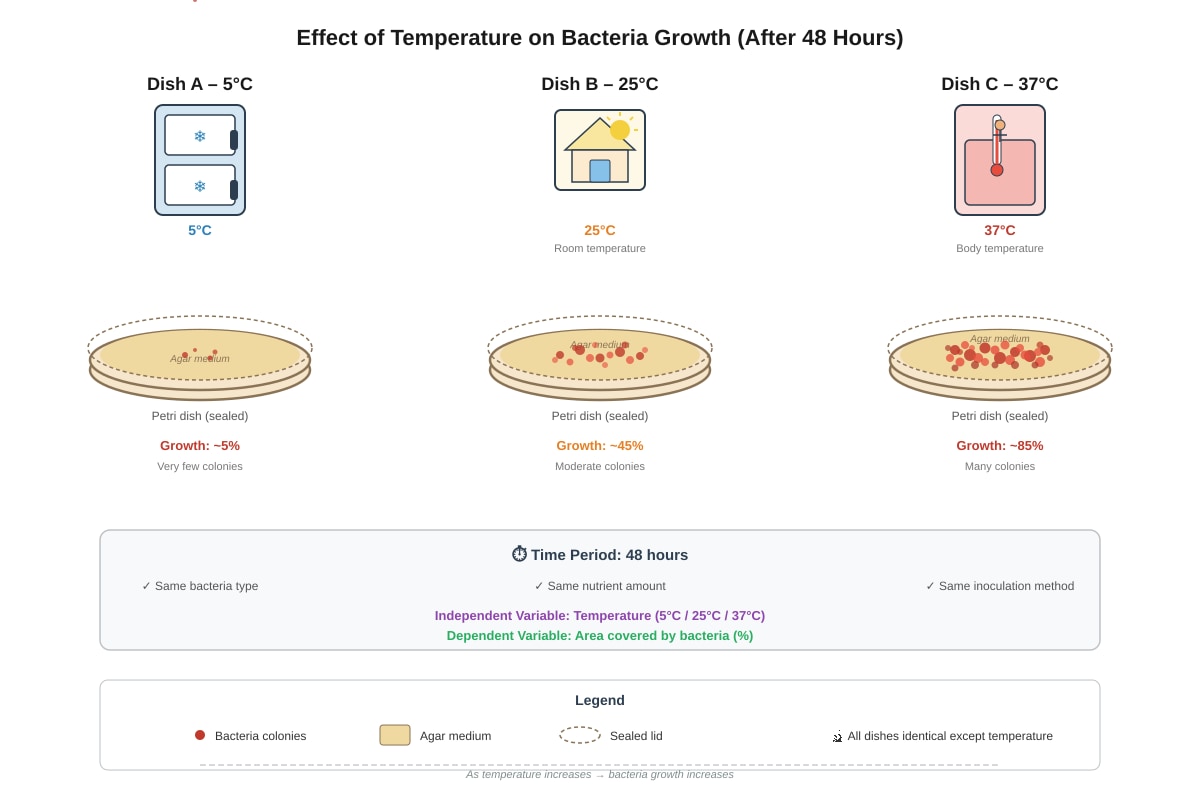
36. Ahmad investigated the effect of temperature on the growth of bacteria. He set up the experiment as shown below.
<image_placeholder> id: Q36-fig1 type: experimental_setup linked_question: Q36 description: Three petri dishes with nutrient agar, each inoculated with bacteria and placed in different temperature environments. Dish A: Incubator at 5°C (refrigerator symbol). Dish B: Room temperature 25°C. Dish C: Incubator at 37°C (body temperature). All dishes sealed, same bacteria type, same nutrient amount, same inoculation method. Time period: 48 hours. labels: Dish A - 5°C, Dish B - 25°C, Dish C - 37°C; Temperature indicators, Petri dish, Agar medium, Bacteria colonies (shown as dots after growth) values: 5°C, 25°C, 37°C, 48 hours must_show: Three identical setups with clear temperature differences, bacterial colony growth patterns visible (none/few at 5°C, moderate at 25°C, many at 37°C), sealed dishes </image_placeholder>
After 48 hours, Ahmad observed and measured the areas covered by bacteria in each dish.
| Temperature | Area covered by bacteria (%) |
|---|---|
| 5°C | 5% |
| 25°C | 45% |
| 37°C | 85% |
(a) Suggest a hypothesis for this experiment.
[2 marks]
(b) Identify the independent variable, dependent variable, and three controlled variables in this experiment.
[5 marks]
Independent variable: _______________________________________
Dependent variable: _______________________________________
Controlled variables:
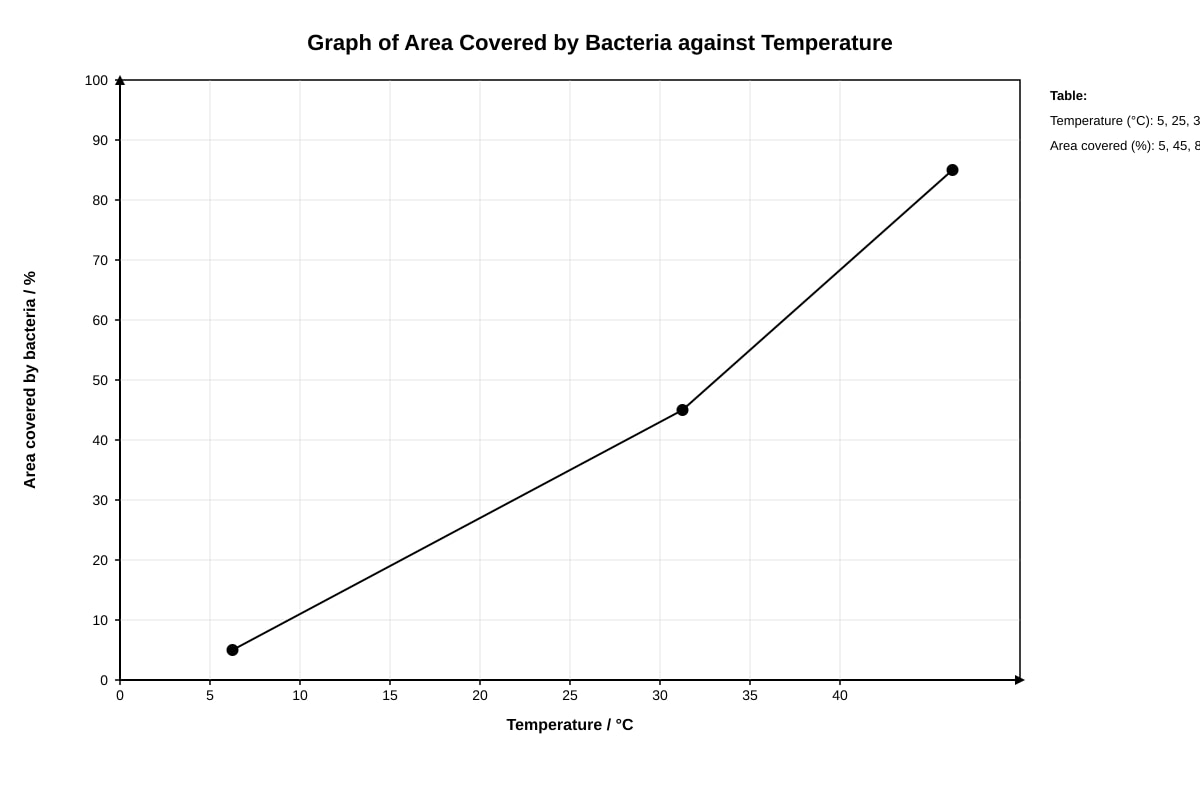
(c) Plot a line graph of the results on the grid below.
[4 marks]
<image_placeholder> id: Q36-fig2 type: graph linked_question: Q36 description: Blank grid for student to plot line graph. X-axis: Temperature (°C) with scale 0 to 40 in increments of 5. Y-axis: Area covered by bacteria (%) with scale 0 to 100 in increments of 10. Pre-drawn axes with labels. Grid lines. labels: X-axis: Temperature / °C, Y-axis: Area covered by bacteria / % values: X: 5, 25, 37; Y: 5, 45, 85 must_show: Clearly labelled axes with units, appropriate scale, grid lines for plotting, title space </image_placeholder>
(d) Describe the pattern shown by your graph.
[2 marks]
(e) Explain why bacteria grow best at 37°C.
[2 marks]
(f) Ahmad repeated the experiment at 60°C. Predict the result and explain your prediction.
[3 marks]
(g) Explain why Ahmad sealed the petri dishes during the experiment.
[2 marks]
Total: [20 marks]
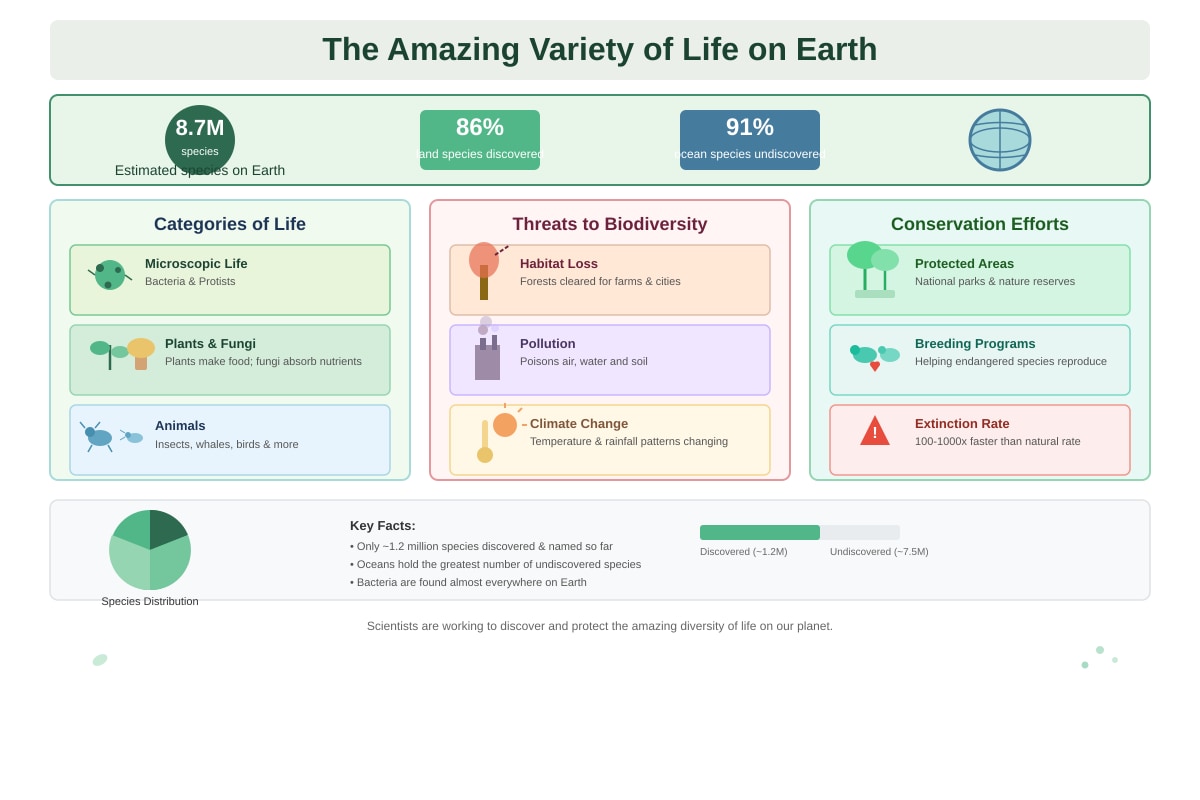
37. Read the following passage about the diversity of life and answer the questions that follow.
<image_placeholder> id: Q37-fig1 type: source_image linked_question: Q37 description: Infographic-style passage with small illustrations. Title: "The Amazing Variety of Life on Earth." Content about biodiversity with icons of different organisms. Statistics: estimated 8.7 million species on Earth, 86% land species, 91% ocean species undiscovered. Three categories: Microscopic life (bacteria, protists), Plants and fungi, Animals. Threats section with habitat loss icon, pollution icon, climate change icon. Conservation section with protected areas and breeding programs. labels: Title, Species estimate 8.7 million, Land/ocean percentages, Category icons, Threat icons, Conservation icons values: 8.7 million species, 86% land, 91% ocean, percentages for categories must_show: All text content readable, relevant icons for each section, clear visual hierarchy, statistics prominent </image_placeholder>
Passage:
The Earth is home to an astonishing variety of living organisms. Scientists estimate that there are about 8.7 million different species on our planet. However, we have only discovered and named a small fraction of these—roughly 1.2 million species. The vast majority remain unknown, especially in the oceans where 91% of species may not yet be discovered.
Living organisms can be grouped into several major categories. Microscopic life includes bacteria, which are found almost everywhere, and protists, which often live in water. Plants and fungi form another major group. While plants can make their own food using sunlight, fungi cannot—they must absorb nutrients from their surroundings. Animals make up the remaining category, from tiny insects to enormous whales.
This amazing diversity is now under threat. Every day, habitats are destroyed to make way for farms, roads, and cities. Pollution poisons air, water, and soil. Climate change is altering temperature and rainfall patterns faster than many species can adapt. Scientists estimate that species are now going extinct at 100 to 1,000 times the natural rate.
Conservation efforts aim to protect biodiversity. National parks and nature reserves preserve habitats. Captive breeding programs help endangered species recover. Scientists also keep seed banks to preserve plant genetic material for the future.
(a) According to the passage, why do scientists think there are many undiscovered species in the oceans?
[1 mark]
(b) Explain why fungi are not classified as plants. Use information from the passage.
[2 marks]
(c) List three threats to biodiversity mentioned in the passage.
[3 marks]
(d) Explain how destroying habitats to build cities reduces biodiversity.
[3 marks]
(e) Suggest why seed banks are useful for protecting plant diversity even if the plants are not currently endangered.
[2 marks]
Total: [11 marks]
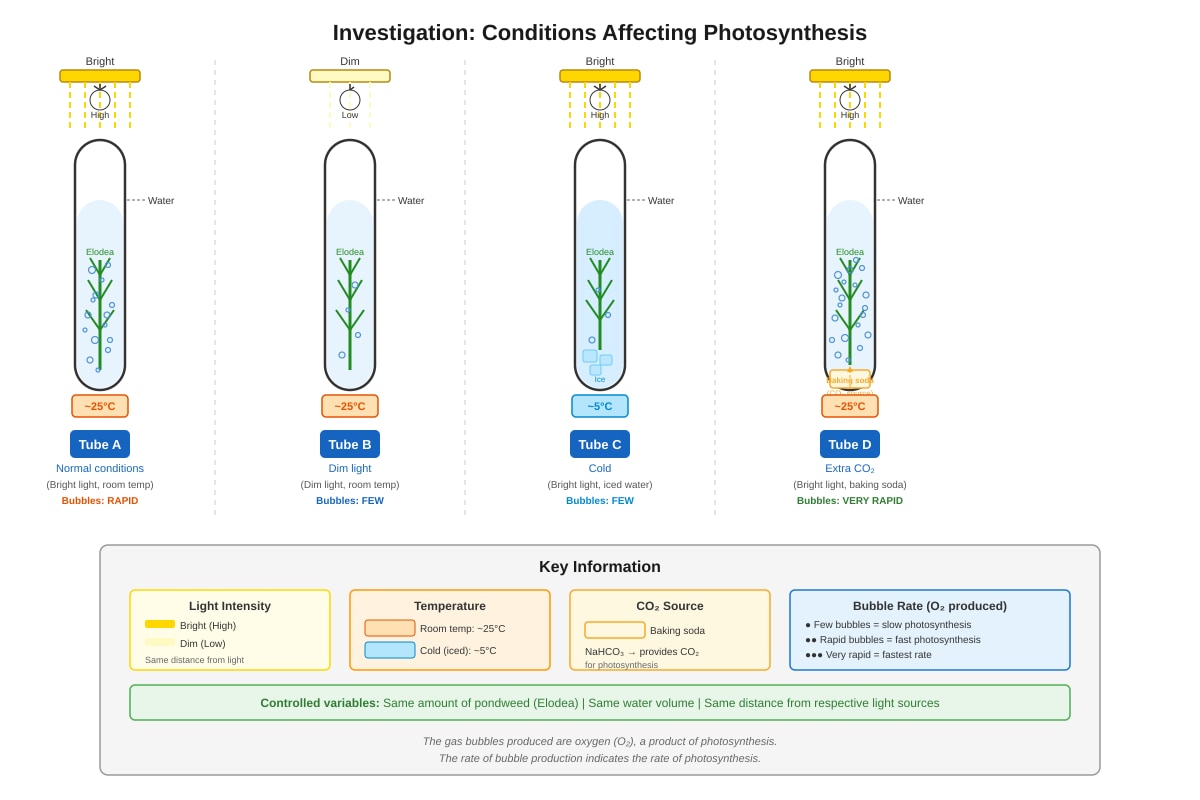
38. The diagram shows an investigation into the conditions affecting photosynthesis in water plants.
<image_placeholder> id: Q38-fig1 type: experimental_setup linked_question: Q38 description: Four boiling tubes with water and pondweed (Elodea) set up differently for photosynthesis investigation. Tube A: Bright light, water at room temperature, bubbles rapidly. Tube B: Dim light, water at room temperature, few bubbles. Tube C: Bright light, iced water, few bubbles. Tube D: Bright light, water with added baking soda (CO2 source), bubbles very rapidly. All at same distance from respective light sources, same amount of pondweed, same water volume. labels: Tube A - Normal conditions, Tube B - Dim light, Tube C - Cold, Tube D - Extra CO2; Light meter symbols, Temperature indicators, Baking soda label, Bubbles (quantity shown by number/density) values: Room temp ~25°C, Cold ~5°C; Bubble rates: A-rapid, B-few, C-few, D-very rapid must_show: All four tubes with clear condition differences, light intensity indicators, temperature differences, CO2 source in D, varying bubble production, equal amounts of pondweed </image_placeholder>
(a) What is the purpose of the bubbles produced by the pondweed?
[1 mark]
(b) Explain why Tube A was included in this investigation.
[2 marks]
(c) Compare the results of Tube A and Tube B. What does this tell you about the effect of light intensity on photosynthesis?
[3 marks]
(d) Explain the result in Tube C where few bubbles were produced despite bright light.
[2 marks]
(e) Why did Tube D produce the most bubbles? Explain your answer fully.
[3 marks]
(f) Name one other factor that could affect the rate of photosynthesis in this investigation.
[1 mark]
Total: [12 marks]
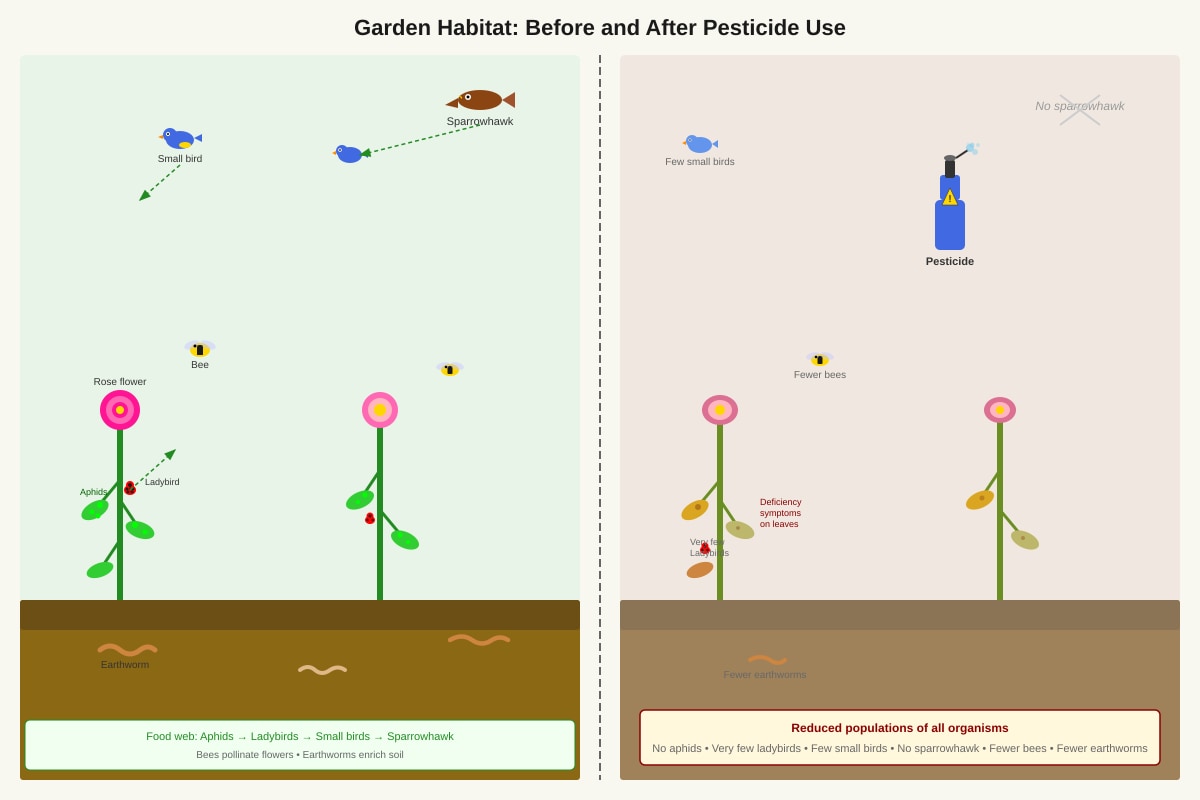
39. The diagram shows a garden habitat before and after a new pesticide was used.
<image_placeholder> id: Q39-fig1 type: diagram linked_question: Q39 description: Before-and-after diagram of garden ecosystem. Before: Rose bushes with aphids (small green insects) on them, ladybirds eating aphids, small birds eating ladybirds, sparrowhawk occasionally seen, bees pollinating flowers, earthworms in soil. After using pesticide: No aphids, very few ladybirds, few small birds, no sparrowhawk, fewer bees, fewer earthworms, roses initially healthy then showing nutrient deficiency signs. Pesticide spray bottle shown. labels: Before: Aphids, Ladybird, Small bird, Sparrowhawk, Bee, Earthworm, Rose flower; After: Pesticide, Deficiency symptoms on leaves, Reduced populations of all organisms values: NA must_show: Clear before/after comparison, visible food web relationships before pesticide, dramatic population reductions after, initial healthy appearance then nutrient deficiency of roses </image_placeholder>
(a) Draw a food chain from this garden that includes the sparrowhawk.
[2 marks]
(b) Explain why the number of ladybirds decreased after the pesticide was used.
[3 marks]
(c) The roses initially appeared healthier after the pesticide killed the aphids. However, after a few months, the roses showed nutrient deficiency signs. Suggest and explain why this happened.
[3 marks]
(d) Explain why there were fewer bees in the garden after pesticide use.
[2 marks]
Total: [10 marks]
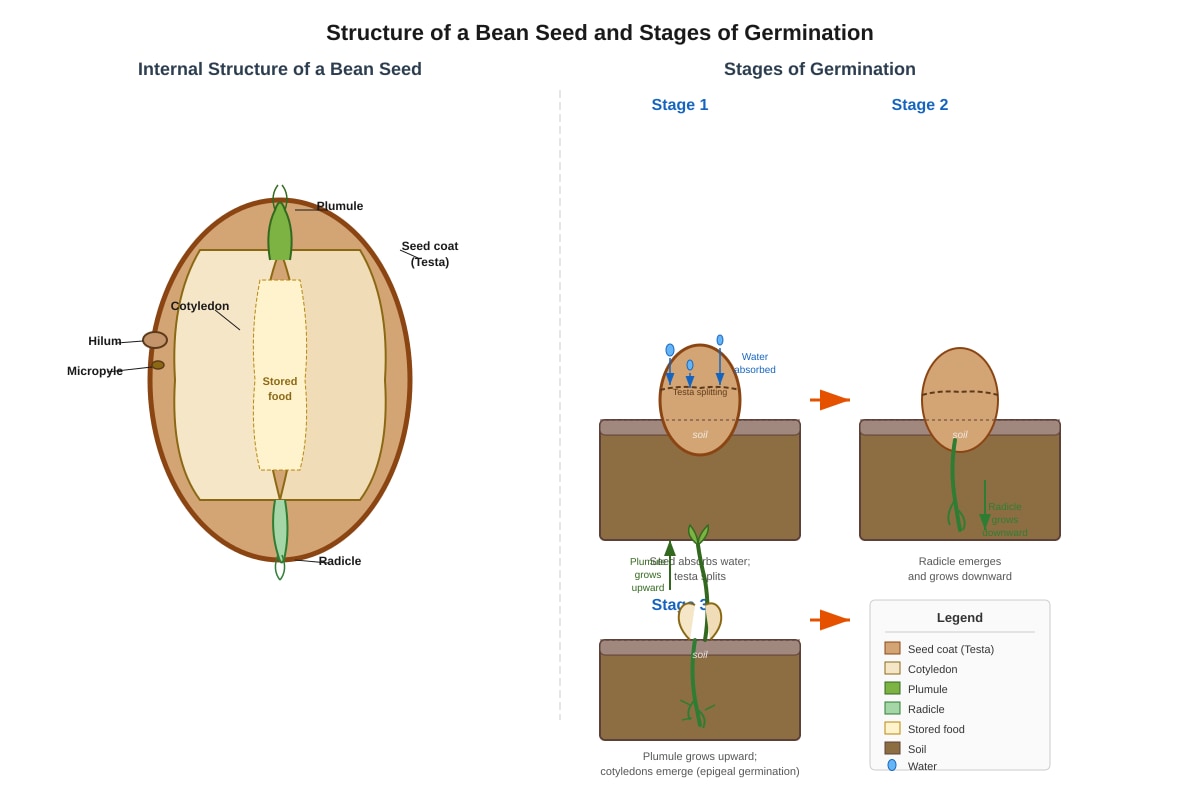
40. The diagram shows the internal structure of a seed and the early stages of germination.
<image_placeholder> id: Q40-fig1 type: diagram linked_question: Q40 description: Detailed diagram showing bean seed structure and germination stages. Left: Longitudinal section of dry bean seed showing testa/seed coat, hilum, micropyle, cotyledons, plumule, radicle, stored food. Right: Sequence of three stages showing germination - Stage 1: Seed in soil with water absorbed, testa splitting. Stage 2: Radicle emerging and growing downward. Stage 3: Plumule emerging and growing upward, cotyledons may emerge above ground (epigeal germination). labels: Seed coat/Testa, Hilum, Micropyle, Cotyledon, Plumule, Radicle, Stored food; Stages 1-3 with arrows showing progression values: NA must_show: Complete internal structure of seed, all labelled parts, clear germination sequence with directional growth (radicle down, plumule up), soil context for germination stages </image_placeholder>
(a) Name the parts labelled X, Y, and Z in the seed diagram.
[3 marks]
X: _______________________________________
Y: _______________________________________
Z: _______________________________________
(b) Explain how the stored food in the cotyledons helps the germinating seed.
[2 marks]
(c) Explain why the radicle grows downward while the plumule grows upward.
[3 marks]
(d) Suggest why gardeners sometimes soak seeds in water before planting them.
[2 marks]
(e) A student planted two identical seeds. One was planted 1 cm deep in soil and the other was placed on the soil surface. Explain which seed you would expect to germinate better.
[3 marks]
Total: [13 marks]
END OF PAPER
Total Marks: 100
Check your work before handing in your paper.
Answers
TuitionGoWhere Practice Paper - Science Primary 6 PSLE
Answer Key - Version 5 of 5
SECTION A: Multiple Choice Questions (Questions 1–20)
20 marks
| Question | Answer | Explanation |
|---|---|---|
| 1 | C | Rusting is a chemical process that happens to non-living things like iron. Living things show characteristics such as growth, reproduction, and response to stimuli, but they cannot "rust." |
| 2 | B | Plants are living things that can grow, reproduce (by seeds, spores, or other methods), and respond to changes in their environment (such as growing toward light). While plants do make their own food (photosynthesis), this alone does not define them as living—bacteria and some protists also make their own food but are not plants. |
| 3 | C | Following the key: No wings leads to fish or frog; no scales indicates frog. Position X must be the frog. The key uses dichotomous (either/or) choices at each step. |
| 4 | C | Green plants and algae contain chlorophyll and can carry out photosynthesis to make their own food. Fungi and animals cannot make their own food. |
| 5 | C | Fish have a backbone (vertebrate), live in water, and do NOT have wings or feathers. Organism R matches all these characteristics. |
| 6 | B | Spore-producing plants, such as ferns and mosses, reproduce using spores—not seeds, bulbs, or runners. |
| 7 | B | The correct classification order from largest to smallest is: Kingdom → Phylum → Class → Order → Family → Genus → Species. This is the Linnaean system used worldwide by scientists. |
| 8 | A | Fungi lack chlorophyll and cannot photosynthesize. They must absorb nutrients from dead or decaying organic matter through their hyphae. Plants can make their own food using chlorophyll and sunlight. |
| 9 | D | Touch-me-not (Balsam) disperses seeds by explosion of the seed pod. Coconut by water, dandelion by wind, mango by animal (fleshy fruit eaten). |
| 10 | B | Snail population increased from 20 to 35, while butterfly population decreased from 15 to 2. Snails were not most numerous in March (20 vs worms 12, but ladybirds 10—though snails were indeed highest, option B is definitively correct about the trend). |
| 11 | B | Bacteria (Lactobacillus) ferment milk sugar (lactose) into lactic acid, which thickens milk and gives yoghurt its texture and tangy taste. |
| 12 | C | Plastic is a man-made material that microorganisms cannot easily break down. It is non-biodegradable. Paper, vegetable peel, and banana skin are biodegradable. |
| 13 | D | Producers are organisms that can make their own food through photosynthesis. Water plants are the only producers in this food chain. |
| 14 | B | Mammals have backbones (vertebrates), cannot make their own food, have hair or fur, and most give birth to live young. The description matches mammal characteristics perfectly. |
| 15 | C | A wooden table is made from wood, which comes from trees that were once living. Glass, plastic, and metal are non-living materials that were never part of living things (though some metals are extracted from mineral ores, the ore itself was never alive). |
| 16 | B | Dandelion (parachute/pappus) and sycamore (wing) are both adapted for wind dispersal. Coconut floats and is water-dispersed; mango is animal-dispersed through its fleshy fruit. |
| 17 | B | Yeast respires anaerobically, producing carbon dioxide and ethanol. The carbon dioxide gas creates bubbles that make bread rise and become light and fluffy. |
| 18 | B | Mould grows best in warm (around 20-30°C), moist conditions. The graph shows 30°C and 85% humidity—ideal for rapid fungal growth. |
| 19 | C | All living things need energy to carry out life processes such as growth, reproduction, movement, and repair. Some bacteria do not need oxygen (anaerobic), not all can move (plants cannot), and not all reproduce by eggs (binary fission, budding, spores are alternatives). |
| 20 | C | Bread mould (Rhizopus) reproduces asexually by producing spores in sporangia. When the sporangium bursts, spores are released into the air and can land on new food sources to grow. |
SECTION B: Short Answer Questions (Questions 21–35)
40 marks
21. [4 marks]
(a) Insects [1 mark]
Teaching note: Insects are a class of invertebrates (animals without backbones) within the arthropod phylum.
(b) Any two from: [2 marks]
- It has no backbone (invertebrate)
- It has six legs (characteristic of insects—3 pairs)
- It has wings (most adult insects have wings)
- It has feelers/antennae (sensory organs typical of insects)
Marking note: Must give two distinct characteristics that match insect features.
(c) Any correct example: Butterfly / Bee / Ant / Grasshopper / Housefly / Mosquito [1 mark]
22. [7 marks]
(a) [4 marks]
- Order: Carnivora
- Family: Felidae
- Genus: Panthera
- Species: tigris
Teaching note: The complete classification is Kingdom Animalia → Phylum Chordata → Class Mammalia → Order Carnivora → Family Felidae → Genus Panthera → Species tigris. The scientific name is Panthera tigris.
(b) Panthera tigris [1 mark]
Accept: Panthera tigris (either underlined or italicized, or written clearly as two words)
(c) [2 marks]
- Common names vary between languages and regions (e.g., "tiger" in English, "老虎" in Chinese, "harimau" in Malay)
- Scientific names are universal and used by all scientists worldwide
- Prevents confusion between different species that might share common names
- Every species has exactly one unique scientific name
Marking note: Any two valid reasons, 1 mark each.
23. [6 marks]
(a) Organism Q [1 mark] Reason: It has a backbone, has wings, AND has feathers [1 mark]
Teaching note: Feathers are unique to birds among living animals. The combination of backbone (vertebrate), wings, and feathers specifically identifies birds.
(b) Organisms P and R [1 mark] Reason: They can make their own food / they are producers [1 mark]
Teaching note: Only plants, algae, and some bacteria can carry out photosynthesis to make their own food. The presence of this ability strongly indicates plant or plant-like organisms.
(c) Mammals / Amphibians / Reptiles / Fish [1 mark] Acceptable answer with reason: It could be a mammal because mammals have backbones, cannot make their own food, and do not have wings or feathers (or it could be a fish, reptile, or most amphibians).
Reason: [1 mark] must link to the characteristics given—backbone present, no food-making, no wings, no feathers.
24. [8 marks]
(a) To find out if moisture/water affects the growth of mould on bread. [1 mark]
Must mention moisture/water as the factor being tested.
(b) Any two from: [2 marks]
- Same type/brand of bread
- Same size/thickness of bread slice
- Same type of mould spores present initially
- Same duration (7 days)
- Same location/exposure to light
(c) Setups A and B [1 mark] Explanation: [2 marks]
- Both have air and are at room temperature (same conditions)
- Only difference is moisture (A = dry, B = wet)
- This makes it a fair test because only one variable differs
Teaching note: This is the controlled variable principle. To test one factor, all other factors must be kept constant.
(d) [2 marks]
- Moisture/water is needed for mould growth (B had mould, A did not)
- Mould grows better/faster when there is moisture present
Also accept: Temperature affects mould growth too (comparing B and D shows less mould in cold).
25. [8 marks]
(a) Grass and shrubs (either or both) [1 mark]
(b) Any valid four-organism chain, e.g.: [2 marks]
- Grass → Grasshopper → Frog → Snake
- Grass → Grasshopper → Lizard → Snake
- Grass → Mouse → Snake → Hawk
- Shrubs → Deer → ? (no deer predator shown as 4th, so check web)
Must trace actual arrows in diagram. 1 mark for correct sequence, 1 mark for all arrows correct.
(c) [3 marks]
- The population of frogs would decrease [1 mark]
- Frogs feed on grasshoppers / grasshoppers are frogs' food source [1 mark]
- With no grasshoppers, frogs would starve / lack food / not survive [1 mark]
Alternative: If student mentions frogs might eat other things (lizards, etc.), accept if plausible within the food web.
(d) [2 marks]
- A food web shows many interconnected food chains
- Organisms often eat more than one type of food / have multiple food sources
- If one organism is removed, the web shows alternative pathways
- A single food chain is too simple and does not show these complex relationships
26. [6 marks]
(a) Organism Y [1 mark] Reason: It reproduces by binary fission / it feeds on dead organic matter in soil [1 mark]
Teaching note: Binary fission is the characteristic method of reproduction for bacteria. Bacteria are decomposers that break down dead organic matter.
(b) Organism Z [1 mark] Reason: It makes its own food using sunlight / it carries out photosynthesis [1 mark]
Teaching note: Making food using sunlight is the defining characteristic of photosynthetic organisms—plants and algae. Being found on pond surface suggests it may be duckweed or similar aquatic plant.
(c) [2 marks]
- Both are decomposers / feed on dead organic matter / absorb nutrients (if comparing X and Y by feeding method)
- OR: Both reproduce using spores (if comparing X and Z—though Y uses binary fission)
Better answer: Organisms X and Y are both decomposers that break down dead organic matter to obtain nutrients. They help in nutrient recycling in ecosystems.
27. [5 marks]
(a) Pollination [1 mark]
(b) [2 marks]
- After pollination, fertilization occurs
- The pollen tube grows down the style to the ovary
- The male gamete fuses with the female gamete (ovule)
- This fusion of gametes forms a zygote, which develops into an embryo within the seed
Accept key terms: fertilization, fusion of male and female gametes, formation of seeds/embryo.
(c) [2 marks]
- Prevents overcrowding near the parent plant
- Reduces competition for light, water, and nutrients
- Allows plants to colonize new areas / spread to suitable habitats
- Increases chances of survival of the species
Any two points, 1 mark each.
28. [6 marks]
(a) Type D [1 mark] Reason: It has a fleshy, sweet-smelling fruit that attracts animals [1 mark]
Teaching note: Animal-dispersed seeds often have fleshy, tasty, or brightly colored fruits. The animal eats the fruit and excretes the seeds elsewhere.
(b) [2 marks]
- Type A (45 found): fluffy hairs for wind dispersal
- Type C (28 found): wing-like structure for wind dispersal
- Together: 73 out of 108 seeds (about 68%) had wind dispersal features
- This is more than half / the majority of seeds found
(c) [2 marks]
- Seeds beneath parent plant must compete with parent for resources
- Limited space for growth
- Less light available due to parent plant shading
- Greater chance of disease/pest transfer from parent
- Reduced genetic diversity in population
Any two valid points, 1 mark each.
29. [8 marks]
(a) [2 marks]
- To collect the gas produced by the plant
- The water prevents the gas from escaping
- The inverted position traps gas at the top as bubbles rise
(b) Oxygen [1 mark] Test: Insert a glowing splint into the gas [1 mark] Result: The glowing splint relights / bursts into flame [1 mark]
Teaching note: Oxygen supports combustion, so it rekindles a glowing splint. This is the standard test for oxygen.
(c) [3 marks]
- The rate would decrease / fewer bubbles would be produced [1 mark]
- Light intensity decreases as distance increases [1 mark]
- Photosynthesis requires light energy; less light means slower rate of photosynthesis / less oxygen produced [1 mark]
Teaching note: Light intensity follows the inverse square law; students at P6 level need only understand that more distance = less light = slower photosynthesis.
30. [6 marks]
(a) Asexual reproduction / Vegetative reproduction [1 mark]
Either term acceptable. "Asexual" preferred.
(b) [2 marks]
- Faster than growing from seeds (no need for pollination, fertilization, seed formation)
- Identical/clone offspring—preserves desirable characteristics of parent
- More reliable success rate than seeds in some conditions
Any one advantage with explanation, 2 marks.
(c) Method A (Runners) [1 mark] Explanation: [2 marks]
- Strawberries naturally produce runners/stolons that grow along the ground
- At nodes on the runner, new daughter plants develop with roots and shoots
- These can be separated and planted as genetically identical copies of the parent
- This is faster than growing from seed and ensures all plants have the same desirable traits (taste, size, disease resistance)
31. [6 marks]
(a) Gills [1 mark]
Teaching note: The gills (lamellae) on the underside of the cap are lined with basidia that produce spores.
(b) [3 marks]
- Mushrooms need moisture for spore germination and hyphal growth [1 mark]
- Darkness prevents desiccation/drying out [1 mark]
- Decomposers grow where there is dead organic matter (rotting wood, leaf litter, soil) which is typically found in damp, shaded areas [1 mark]
- Warm temperatures speed up metabolic processes [additional, not required]
Any three valid points, 1 mark each.
(c) [2 marks] Any two from:
- Fungi cannot make their own food (no chlorophyll); plants can photosynthesize
- Fungi absorb nutrients through hyphae; plants make food in leaves
- Fungi have cell walls made of chitin; plants have cell walls made of cellulose
- Fungi reproduce by spores (not seeds like most plants)
- Fungi are not green in color (lack chlorophyll)
Any two distinct differences, 1 mark each.
32. [8 marks]
(a) Woodland edge [1 mark] Evidence: [2 marks]
- Has the highest total number of species: 35 plant + 28 animal = 63 species
- Higher than Pond (15+22=37), Grassland (25+18=43), Flower garden (20+15=35)
- Has highest in both categories (plants AND animals)
Must show evidence of calculation or clear comparison to get both marks.
(b) [2 marks]
- Ponds contain many different microhabitats (surface, open water, bottom mud, plants, edges)
- Aquatic animals include insects, fish, amphibians, crustaceans, mollusks, larvae, etc.
- Some animals are temporary visitors (birds, mammals coming to drink)
- Aquatic ecosystems support diverse food webs
Any two valid points, 1 mark each.
(c) [3 marks]
- Biodiversity would decrease [1 mark]
- Habitats would be destroyed/cleared for construction [1 mark]
- Plants would be removed, removing food sources and shelter for animals
- Noise and human activity would disturb/displace animals
- Pollution from construction might affect remaining organisms
Prediction: decrease, 1 mark. Two valid explanations, 1 mark each.
33. [5 marks]
(a) Stamen [1 mark]
Teaching note: The stamen consists of anther + filament and is the male reproductive part.
(b) [2 marks]
- The stigma is sticky / has a rough surface
- This helps trap/catch pollen grains when they land on it
- Often feathery or broad to increase surface area for catching pollen
Structure feature, 1 mark; function linked to pollination, 1 mark.
(c) [2 marks]
- Ovules develop into seeds (after fertilization)
- Ovary develops into a fruit (to protect and disperse the seeds)
34. [7 marks]
(a) To exclude light / control for light as a variable / to ensure light does not affect the results [1 mark]
Teaching note: Light is needed for photosynthesis, not germination. By excluding light, the experiment tests only water, air, and temperature.
(b) It acts as a control / to compare with the other setups / to show normal germination conditions [1 mark]
(c) [2 marks]
- Seeds need water to activate enzymes that break down stored food
- Water is needed for chemical reactions to begin
- Stored food must be transported in solution to growing embryo
- Water softens the seed coat to allow the radicle to emerge
Any two points, 1 mark each.
(d) [3 marks]
- Water [1 mark]
- Air/oxygen [1 mark]
- Suitable/warm temperature [1 mark]
35. [9 marks]
(a) [2 marks] Any two from:
- Algae bloom covering the water surface
- Water became murky/green
- Fish died / floating dead fish
- Fewer visible animals
- Reduced plant diversity / fewer water plants
(b) [2 marks]
- Fertilizers contain nitrogen and phosphorus / minerals / nutrients
- These are food for algae
- Excess nutrients cause rapid algae growth / algal bloom
(c) [3 marks]
- Algae cover the surface, blocking sunlight [1 mark]
- Submerged plants cannot photosynthesize and die [1 mark]
- Bacteria decompose dead plants and algae, using up oxygen in the water [1 mark]
- Fish suffocate / lack oxygen and die
Alternative pathway: Respiration by excessive algae at night uses up oxygen; decomposition of dead algae uses oxygen.
(d) [2 marks] Any two from:
- Use less fertilizer on farms / apply fertilizer more carefully
- Create buffer zones / vegetation strips between farms and water
- Treat farm runoff before it enters waterways
- Use organic farming methods / slow-release fertilizers
- Regularly monitor water quality
SECTION C: Structured Application Questions (Questions 36–40)
40 marks
36. [20 marks]
(a) [2 marks]
- The higher the temperature, the faster bacteria grow (up to a certain limit)
- OR: Bacteria grow fastest at 37°C and slowest at 5°C
- Must state a clear testable relationship between temperature and bacterial growth
(b) [5 marks]
Independent variable: Temperature [1 mark]
Dependent variable: Area covered by bacteria / percentage of dish covered / amount of bacterial growth [1 mark]
Controlled variables (any three): [3 marks]
- Same type/strain of bacteria
- Same amount/type of nutrient agar
- Same size of petri dish
- Same duration of incubation (48 hours)
- Same method of inoculation / same starting amount of bacteria
- Same sealing method / same air exposure
(c) [4 marks]
Marking for graph:
- Correctly labelled axes with units [1 mark]
- Correct scale on both axes [1 mark]
- All three points accurately plotted [1 mark]
- Line drawn correctly (straight line or smooth curve through points) [1 mark]
Expected shape: upward trend from 5°C to 37°C, showing positive correlation between temperature and bacterial growth rate.
(d) [2 marks]
- As temperature increases, the area covered by bacteria increases
- The relationship is directly proportional / positive correlation
- The rate of increase becomes steeper as temperature rises
- OR: Growth is slow at low temperatures and rapid at higher temperatures
(e) [2 marks]
- 37°C is body temperature / near human body temperature
- Many bacteria that affect humans are adapted to this temperature
- Enzymes in bacteria work most efficiently / optimally at this temperature
- Metabolic reactions occur fastest at this temperature
(f) [3 marks]
- Prediction: Very little/no growth / 0-5% coverage [1 mark]
- 60°C is too hot for most bacteria to survive [1 mark]
- Enzymes are denatured / damaged at high temperatures [1 mark]
- Proteins lose their shape and metabolism stops / cells die
(g) [2 marks]
- To prevent contamination from other microorganisms in the air
- To prevent the escape of bacteria into the environment (safety)
- To maintain sterile conditions inside the dish
- To keep the same air/moisture conditions in each dish
37. [11 marks]
(a) The passage states that 91% of ocean species may not yet be discovered / most ocean species are undiscovered. [1mark]
(b) [2 marks]
- Plants can make their own food using sunlight (photosynthesis) [1 mark]
- Fungi cannot make their own food — they must absorb nutrients from their surroundings [1 mark]
Must use information from passage—direct quote or clear paraphrase.
(c) [3 marks]
- Habitat destruction / habitats destroyed for farms, roads, cities
- Pollution (of air, water, soil)
- Climate change / altering temperature and rainfall patterns
1 mark each. Must be from passage.
(d) [3 marks]
- Destroying habitats removes homes/food sources/breeding places for organisms [1 mark]
- Organisms may die or be forced to move to unsuitable areas [1 mark]
- Many specialist species cannot survive elsewhere / biodiversity decreases when habitats are lost [1 mark]
- Food webs are disrupted / populations cannot be sustained
(e) [2 marks]
- To preserve genetic diversity for future use
- To allow breeding/restoration if species become endangered later
- Climate change might make currently common plants vulnerable in future
- Unknown future benefits — medicinal, agricultural, or ecological uses
38. [12 marks]
(a) To show the rate of photosynthesis / as an indicator of how much photosynthesis is occurring [1 mark]
Teaching note: More bubbles = faster rate of photosynthesis. The bubbles are oxygen released as a byproduct.
(b) [2 marks]
- Tube A has all normal conditions for photosynthesis
- It acts as a control / standard for comparison
- It shows the normal rate with which other setups can be compared
- Without it, we cannot tell if changed conditions increase or decrease photosynthesis
(c) [3 marks]
- Tube A (bright light): many/rapid bubbles [1 mark]
- Tube B (dim light): few/slow bubbles [1 mark]
- Conclusion: Greater light intensity increases rate of photosynthesis / photosynthesis needs light; more light = faster rate
(d) [2 marks]
- Enzymes work slowly at low temperatures / cold slows down chemical reactions [1 mark]
- Temperature affects enzyme activity / metabolic rate of plant cells [1 mark]
- Even with sufficient light, the chemical reactions of photosynthesis cannot proceed quickly when cold
Teaching note: The light-dependent reactions may still occur, but the Calvin cycle (light-independent) is enzyme-controlled and temperature-sensitive.
(e) [3 marks]
- Baking soda provides extra carbon dioxide (sodium bicarbonate releases CO₂ in water) [1 mark]
- Carbon dioxide is a raw material / reactant for photosynthesis [1 mark]
- More CO₂ available means more glucose can be produced, so faster rate / more oxygen released as byproduct [1 mark]
(f) Amount of chlorophyll / type of plant / water availability / pH / mineral nutrients [1 mark]
Any valid factor not already tested in the experiment.
39. [10 marks]
(a) [2 marks] Example: Rose → Aphid → Ladybird → Small bird → Sparrowhawk [2 marks]
Or any valid chain ending with sparrowhawk. Must be traceable from food web. 1 mark if one organism/link wrong but direction correct.
(b) [3 marks]
- Pesticide killed the aphids (or ladybirds directly if contact pesticide) [1 mark]
- Aphids were the food source for ladybirds [1 mark]
- Without aphids, ladybirds starved / lacked food / could not survive / reproduced less [1 mark]
Alternative: If pesticide killed ladybirds directly: poison absorbed through exoskeleton / contact with pesticide residues.
(c) [3 marks]
- Pesticide killed earthworms and other soil organisms [1 mark]
- These organisms normally break down organic matter / recycle nutrients in the soil [1 mark]
- Without them, nutrients were not returned to the soil / soil became poor, causing nutrient deficiency in roses [1 mark]
Alternative pathway: Pesticide may have killed nitrogen-fixing bacteria or mycorrhizal fungi that help nutrient uptake.
(d) [2 marks]
- Bees may have been killed by direct contact with pesticide [1 mark]
- Or: Fewer flowers / nectar sources as other plants affected
- Or: Pesticide accumulated in system, affecting insects
- Bees are insects—the pesticide targets insects (aphids), so affects beneficial insects too
40. [13 marks]
(a) [3 marks]
- X: Seed coat / Testa
- Y: Radicle
- Z: Plumule
1 mark each. Must match labelling—accept close equivalents (e.g., "protective outer layer" for testa).
(b) [2 marks]
- The stored food (starch, oils, proteins) provides energy for the growing embryo [1 mark]
- Before the seedling can make its own food by photosynthesis, it depends on stored reserves in the cotyledons [1 mark]
(c) [3 marks]
- The radicle grows downward due to gravitropism / geotropism (positive) [1 mark]
- Roots grow toward gravity to anchor the plant and absorb water and minerals from the soil [1 mark]
- The plumule grows upward due to negative gravitropism / phototropism [1 mark]
- Shoots grow away from gravity / toward light to reach above ground for photosynthesis
Teaching note: Tropisms are growth responses. Positive gravitropism = growth with gravity (roots); negative gravitropism = growth against gravity (shoots).*
(d) [2 marks]
- Soaking speeds up germination by providing water immediately [1 mark]
- Ensures uniform hydration of all seeds [1 mark]
- Softens the seed coat to allow embryo to emerge more easily
- Activates enzymes needed to break down stored food
Any two valid points, 1 mark each.
(e) [3 marks]
- The seed planted 1 cm deep would germinate better [1 mark]
- The surface seed may dry out / be eaten by birds or animals / be washed away by rain [1 mark]
- Soil provides protection, moisture retention, and stable temperature for the buried seed [1 mark]
- However, too deep is also bad—the seed may run out of energy before reaching the surface
Teaching note: Optimal planting depth varies by seed size, but 1 cm is reasonable for medium seeds. The key concept is that surface conditions are harsher than protected soil conditions.*
END OF ANSWER KEY
Total Marks: 100
Note: This answer key provides teaching-oriented explanations suitable for students learning the Diversity topic. All content is syllabus-aligned with the Singapore Primary Science curriculum and PSLE preparation standards.