AI Generated Exam Paper
Primary 6 PSLE Science Practice Paper 5
Free P6 PSLE Science Practice Paper 5, HY3 AI version, with questions, answers, and PSLE-focused practice for Singapore students.
These static practice materials are generated from the site's syllabus and paper-generation workflow, with source and model context shown so students and parents can evaluate the material before use.
Questions
TuitionGoWhere Practice Paper - Science Primary 6 PSLE
TuitionGoWhere Practice Paper (AI) — Version 5
Subject: Science
Level: Primary 6 PSLE
Paper: Practice Paper (Topic: Diversity)
Duration: 45 minutes
Total Marks: 40
Name: ______________________
Class: ______
Date: __________
Instructions:
- This practice paper has 20 questions on the topic of Diversity.
- Answer all questions in the spaces provided.
- Section A: 10 multiple-choice questions (1 mark each).
- Section B: 6 short-answer questions (2 marks each).
- Section C: 4 structured questions (total 8 marks).
- Marks for sections: Section A = 10, Section B = 12, Section C = 18. Total = 40.
Note: This paper is generated from syllabus-first LLM templates. No past-year PSLE Science papers were used as evidence for this Diversity topic set.
Section A (10 marks)
Answer all questions. Each question carries 1 mark.
1. Which of the following best describes "diversity" in living things?
A) All animals look the same
B) The variety of different living things in an environment
C) Only plants growing in a garden
D) One type of organism in a pond
2. Which group of organisms can make their own food using light energy?
A) Consumers
B) Decomposers
C) Producers
D) Predators
3. A population is best described as:
A) All living things in a forest
B) A group of the same kind of organisms living together
C) One rabbit in a field
D) Dead leaves on the ground
4. Which of these is a structural adaptation?
A) A bird migrating south in winter
B) A lizard basking in the sun
C) A cactus storing water in thick stems
D) A dog barking at strangers
5. In a food chain, the arrow shows:
A) The animal that dies
B) The direction of energy flow
C) The strongest animal
D) The direction of water flow
6. Which habitat is most likely to support a community of fish, water plants, and frogs?
A) Desert
B) Pond
C) Mountain top
D) Car park
7. Decomposers are important because they:
A) Eat only live plants
B) Break down dead organisms and return nutrients
C) Produce oxygen
D) Hunt other animals
8. Which of the following is a behavioural adaptation?
A) Thick fur on a bear
B) A snake shedding its skin
C) A squirrel storing nuts for winter
D) Sharp claws on a cat
9. Man's negative impact on the environment includes:
A) Planting trees
B) Cleaning rivers
C) Deforestation
D) Building nature reserves
10. A food web is different from a food chain because it:
A) Has only one path of energy
B) Shows many interconnected food chains
C) Has no producers
D) Only shows decomposers
Section B (12 marks)
Answer all questions. Each question carries 2 marks.
11. Name two physical characteristics of the environment that can affect whether an organism survives.
12. State one way friction can be useful and one way it can be problematic for living things or machines.
13. Explain why a community in a mangrove swamp is different from a community in a field.
14. Give one example of a producer, one consumer, and one decomposer found in a garden.
15. Describe two things that may happen to organisms when their environment becomes unfavourable.
16. State one positive and one negative impact of man on the environment.
Section C (18 marks)
Answer all questions.
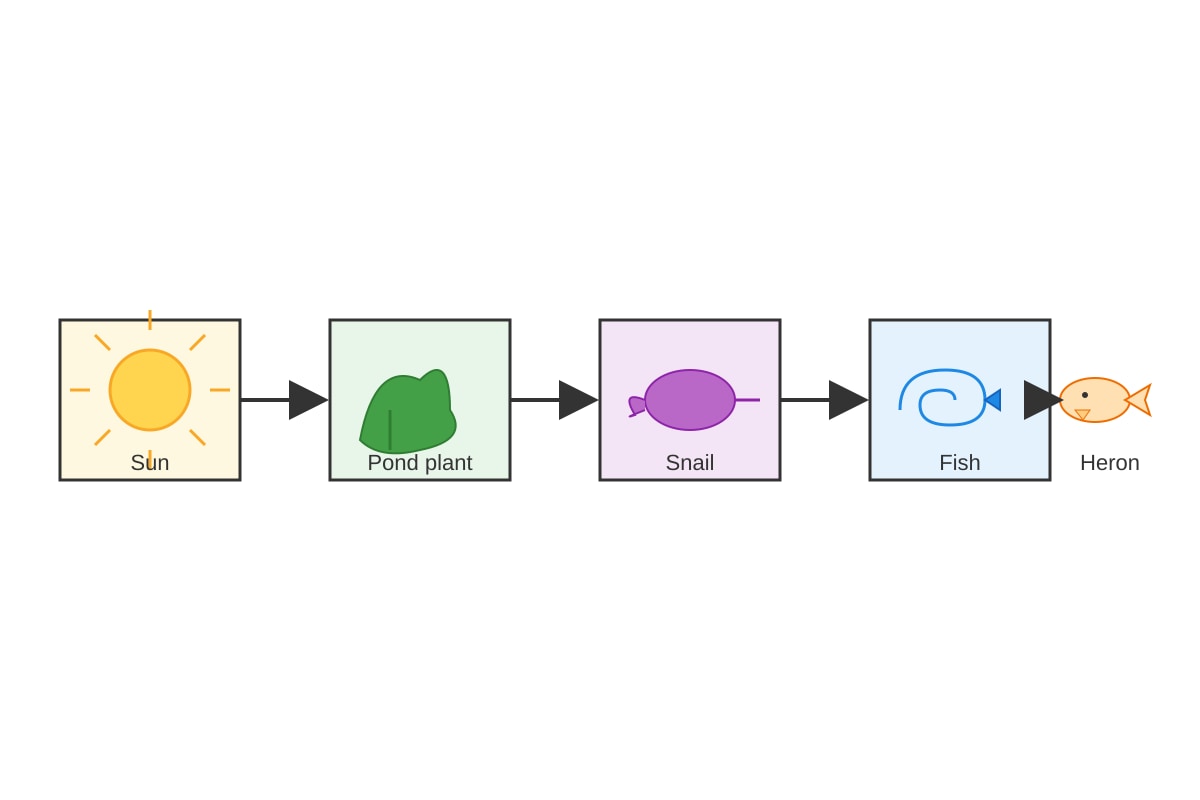
17. The diagram below shows a simple food chain in a pond.
Image pending generation: diagram for Q17.
(a) Name the producer in this food chain. [1]
(b) State the direction of energy flow. [1]
(c) What would happen to the fish if all the snails died? Explain. [2]
18. A student observed a garden and recorded the following organisms: rose plant, grasshopper, frog, mushroom, earthworm, butterfly.
(a) Group the organisms into producers, consumers, and decomposers. [3]
Producers: ______________________
Consumers: ______________________
Decomposers: ______________________
(b) Explain why decomposers are needed in this garden. [1]
19. Study the table below showing two habitats.
| Habitat | Temperature | Water available | Organisms seen |
|---|---|---|---|
| Desert | Hot, dry | Very little | Cactus, lizard |
| Pond | Cool, wet | Plenty | Lily, tadpole |
(a) Name one adaptation of the cactus for its habitat. [1]
(b) Why can tadpoles live in a pond but not in a desert? [2]
(c) State one way the desert community and pond community are different. [1]
20. A new factory is built next to a forest.
(a) Give two negative impacts this may have on the forest community. [2]
(b) Suggest one positive action man can take to reduce the impact. [1]
(c) Explain how a food web helps us predict the effect of losing one species. [2]
Answers
TuitionGoWhere Practice Paper — Science Primary 6 PSLE (Version 5) Answer Key
Topic: Diversity
Total Marks: 40
Section A (10 marks)
1. B [1]
Teaching note: Diversity means the variety of different living things. Option B is correct. A is wrong (they are not all same). C and D are too narrow.
2. C [1]
Producers (e.g. plants) make food using light energy (photosynthesis). Consumers eat others; decomposers break down dead matter; predators are a type of consumer.
3. B [1]
Population = same kind of organisms living and reproducing together. A is community; C is organism; D is non-living.
4. C [1]
Structural adaptation = body feature. Cactus thick stem stores water (structural). A, B, D are actions (behavioural).
5. B [1]
Arrow shows energy flow (Sun → producer → consumer). Not death or water.
6. B [1]
Pond supports fish, water plants, frogs. Desert/ mountain/ car park lack water community.
7. B [1]
Decomposers break down dead organisms, returning nutrients to soil. Not hunters or oxygen producers.
8. C [1]
Behavioural = action. Storing nuts is behaviour. A, D structural; B is natural process not adaptation type asked.
9. C [1]
Deforestation is negative. A, B, D are positive.
10. B [1]
Food web = many interconnected food chains. A describes chain; C, D false.
Section B (12 marks)
11. [2] Any two of: temperature, light, water, availability of food, types of other organisms.
(1 mark each) Teaching: Physical characteristics are non-living conditions.
12. [2] Useful: friction gives grip for walking/braking. Problematic: causes wear/heat in machines. (1+1)
Teaching: Friction opposes motion; can help or harm.
13. [2] Mangrove community has salty water, special roots, crabs, fish nurseries; field has grass, rabbits, dry soil. (1 for difference in organisms, 1 for environment)
Teaching: Different habitats support different communities.
14. [2] Producer: rose plant; Consumer: grasshopper/butterfly/frog; Decomposer: mushroom/earthworm. (2 correct pairs = 2 marks, 1 mark if only one correct)
Teaching: Producers make food, consumers eat, decomposers break down.
15. [2] May adapt and survive; may move away; may die. (any 2 = 1+1)
Teaching: Unfavourable environment threatens survival.
16. [2] Positive: conservation/reforestation; Negative: pollution/deforestation/global warming. (1+1)
Section C (18 marks)
17. [4]
(a) Pond plant [1]
(b) Sun → pond plant → snail → fish → heron [1]
(c) Fish would lose food source, population drops or die. [2: 1 for effect, 1 for reason]
Teaching: Snail is food for fish; removing it breaks energy flow.
18. [4]
(a) Producers: rose plant [1]; Consumers: grasshopper, frog, butterfly [1]; Decomposers: mushroom, earthworm [1]
(b) They break down dead matter, return nutrients to soil. [1]
19. [4]
(a) Thick stem stores water / spines reduce loss. [1]
(b) Tadpoles need water to breathe and live; desert has no water. [2: 1 need, 1 desert lack]
(c) Desert has few organisms, pond has more / different types. [1]
20. [5]
(a) Pollution, habitat loss, fewer birds. [2: 1 each]
(b) Plant trees, reduce waste, build green belt. [1]
(c) Food web shows links; losing one species affects others that eat or are eaten by it. [2: 1 link, 1 effect]
Teaching: Interconnected chains mean ripple effects.
Paper generated from syllabus-first templates. No past-year evidence claimed.
Free quiz and exam paper access
Enter your details to view this paper
Your access is remembered on this device.