AI Generated Exam Paper
Primary 6 PSLE Science Practice Paper 4
Free P6 PSLE Science Practice Paper 4, Kimi2.6 AI version, with questions, answers, and PSLE-focused practice for Singapore students.
These static practice materials are generated from the site's syllabus and paper-generation workflow, with source and model context shown so students and parents can evaluate the material before use.
Questions
Free quiz and exam paper access
Enter your details to view this paper
Your access is remembered on this device.
Answers
TuitionGoWhere Practice Paper - Science Primary 6 PSLE
Answer Key and Marking Scheme
Version: 4 of 5
SECTION A: Multiple-Choice Questions (40 marks)
2 marks each. No part marks.
Question 1
Answer: C
Explanation:
- A is incorrect: Many bacteria are helpful to humans, such as those in our gut that aid digestion or bacteria used to make yoghurt and cheese. Not all bacteria should be eliminated.
- B is incorrect: Fungi can be found in many places, not just damp dark places. Yeast (a fungus) is used in baking, and some fungi grow on bread left in the open.
- C is correct: Classification of living things is based on observable characteristics such as whether they have a backbone, how they reproduce, or their cell structure. This is the basis of scientific classification.
- D is incorrect: There are at least five kingdoms of living things: Animalia, Plantae, Fungi, Prokaryota (bacteria), and Protista. Plants and animals are just two of these kingdoms.
Marking note: Students may be confused by option A if they only associate bacteria with disease. Emphasize that biodiversity includes useful microorganisms.
Question 2
Answer: B
Explanation:
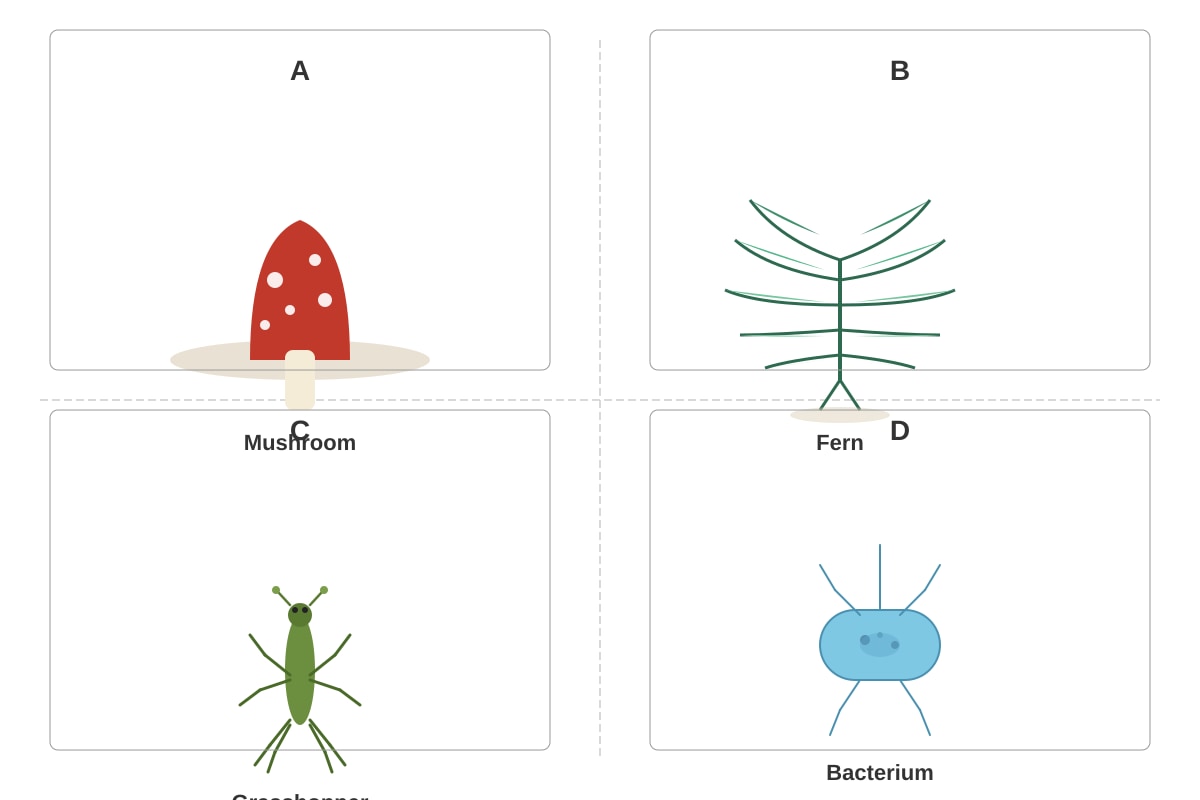
- A (Mushroom) belongs to Kingdom Fungi — it is a decomposer, not a plant.
- B (Fern) belongs to Kingdom Plantae — it is a green plant that makes its own food through photosynthesis.
- C (Grasshopper) belongs to Kingdom Animalia — it is an insect that eats other organisms.
- D (Bacterium) belongs to Kingdom Prokaryota — it is a single-celled organism without a nucleus.
The different kingdom is Plantae (the fern). All others are non-plant kingdoms.
Marking note: Check that students do not confuse fungi with plants. Mushrooms do NOT photosynthesize.
Question 3
Answer: B
Explanation:
- Apple, cherry, and peach are all stone fruits or pomes where seeds are inside the fruit flesh.
- Banana, pineapple, and watermelon have seeds distributed throughout or on the outside (watermelon seeds are visible throughout the flesh; pineapple has seeds in the eyes; banana seeds are tiny specks distributed through the fruit).
Actually, re-checking: The key characteristic is whether seeds are inside one central pit/core versus distributed throughout or on the outside. The classification is based on seed placement/fruit structure.
A more precise answer: Group X fruits have seeds enclosed in a central core/pit. Group Y fruits have seeds not enclosed in a single central structure.
Alternative acceptable reasoning: "Whether the fruit is a simple fruit with central seeds versus a complex fruit with distributed seeds."
Marking note: Accept any biologically valid classification basis that distinguishes these groups. The key learning point is that classification uses observable structural features.
Question 4
Answer: B
Explanation:
| Feature | Fish characteristics | Analysis of options |
|---|---|---|
| Has backbone | Fish are vertebrates | All except S |
| Lives in water | Fish are aquatic | Q and S |
| Has fur/hair | Mammals only | P is mammal |
| Has feathers | Birds only | R is bird |
- P has fur → Mammal (e.g., rabbit, cat)
- Q has backbone, no feathers, no fur, lives in water → Fish
- R has feathers → Bird
- S has no backbone, lives in water → Invertebrate (e.g., shrimp, squid, jellyfish)
Answer: B (Q)
Marking note: Students must eliminate mammals and birds first, then distinguish vertebrate fish from invertebrate aquatic animals by the backbone.
Question 5
Answer: A
Explanation: The correct order of biological classification from largest to smallest is:
Kingdom → Phylum → Class → Order → Family → Genus → Species
A useful mnemonic: "King Phillip Came Over For Good Spaghetti"
- B is reversed (smallest to largest)
- C has Class and Phylum swapped
- D has Order and Class swapped
Marking note: Students should memorize this hierarchy. The mnemonic helps with recall.
Question 6
Answer: C
Explanation:
| Kingdom | Cell structure | Food source |
|---|---|---|
| Plantae | Cell wall, chlorophyll | Make own food |
| Animalia | No cell wall, no chlorophyll | Eat other organisms |
| Fungi | Cell wall, NO chlorophyll | Absorb nutrients (decomposers) |
| Prokaryota | No true nucleus | Various |
The organism has:
- Many cells (eliminates single-celled prokaryotes as the main category, though some prokaryotes form colonies)
- Cell wall
- Cannot make its own food and no chlorophyll
This matches Fungi: they have cell walls (made of chitin, not cellulose), no chlorophyll, and cannot photosynthesize. They absorb nutrients from decaying matter.
C is correct.
Marking note: Do not accept Plantae (needs chlorophyll to make food). The absence of chlorophyll and inability to make food are the key discriminators.
Question 7
Answer: A
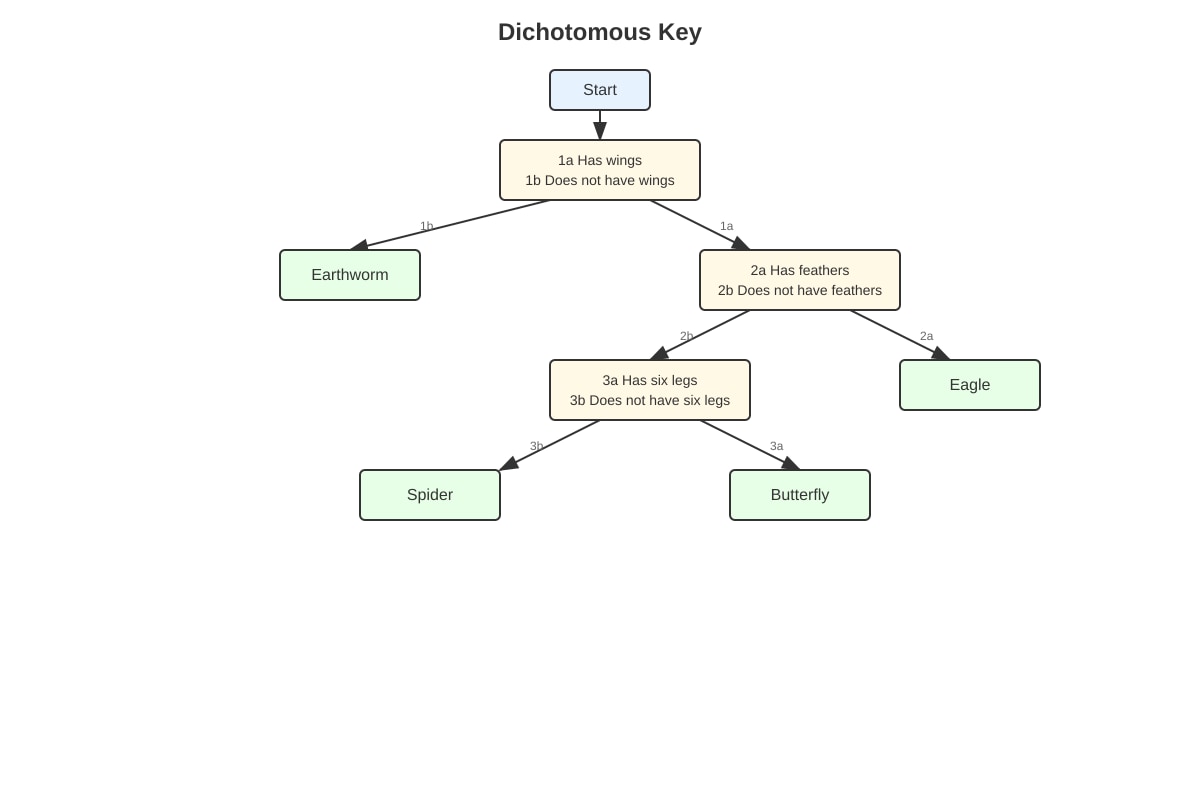
Explanation: Following the dichotomous key:
1a. Has wings → goes to 2
- 2a. Has feathers → Eagle
- 2b. Does not have feathers → Butterfly (insects have wings but no feathers)
1b. Does not have wings → goes to 3
- 3a. Has six legs → Spider (wait — spiders have 8 legs, so this would actually be insects like ants; the key seems to have an error or Spider is placed incorrectly. Re-reading: if 3a is "has six legs" this should lead to insects, not spiders. Assuming the diagram shows Spider at 3b "does not have six legs" → Spider or Earthworm)
Actually with the given labels: 2a = Has feathers, this leads to Eagle.
Answer: A (Eagle)
Marking note: The dichotomous key tests logical following of branches. Students should trace carefully from the starting question.
Question 8
Answer: C
Explanation:
- A is correct: Singapore's tropical climate (warm temperatures, high rainfall) supports diverse plant life including rainforest species.
- B is correct: Deforestation for development has destroyed habitats of native species like the Singapore ginger or certain orchids.
- C is NOT correct: Many plants in Singapore were introduced from other countries for gardens, agriculture, or landscaping. Examples: rubber trees from Brazil, mango from India, many ornamental plants.
- D is correct: Gardens by the Bay conserves and displays plants from around the world, including cooled conservatories for non-tropical species.
Marking note: This tests understanding that "native" biodiversity is different from total biodiversity. Singapore has both native and introduced species.
Question 9
Answer: B
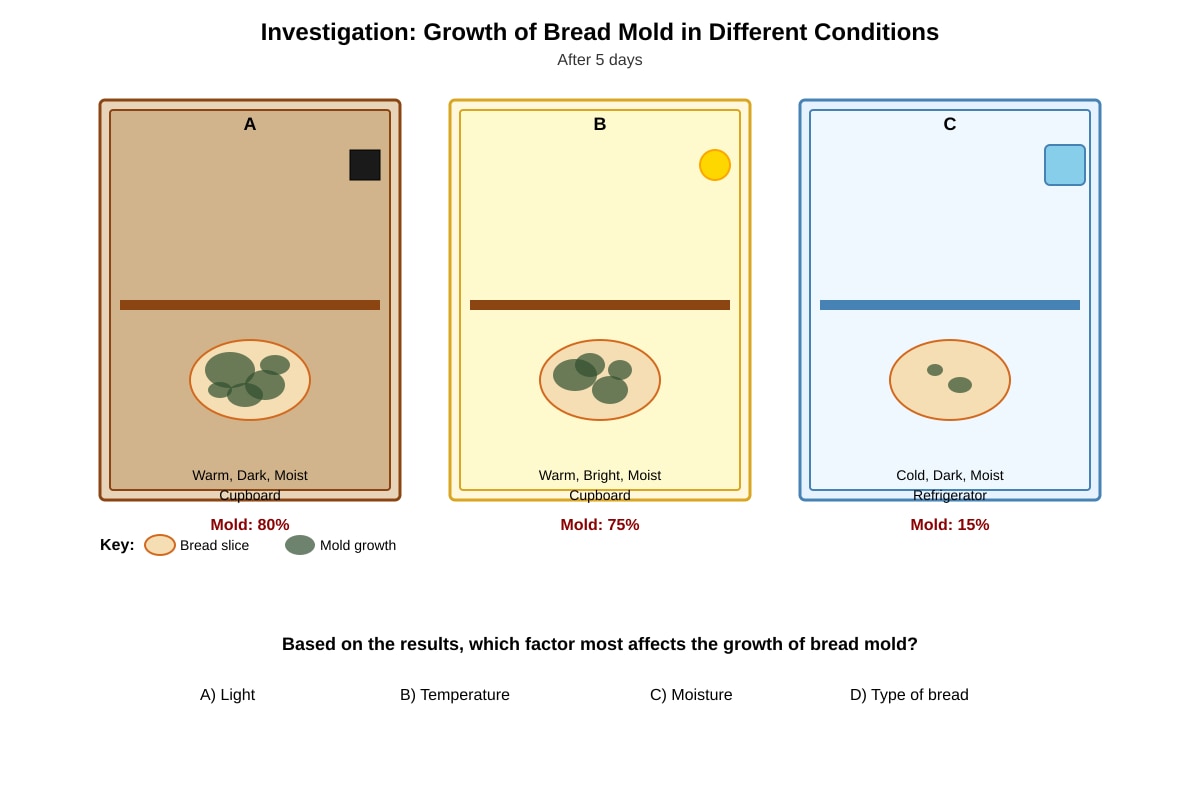
Explanation: Compare setups:
- A vs B: Both warm and moist; A is dark, B is bright → mold growth similar (80% vs 75%)
- A vs C: Both moist and dark; A is warm, C is cold → huge difference (80% vs 15%)
The biggest difference is temperature. The warm conditions allow bread mold (fungi) to grow much faster. Light has minimal effect (comparing A and B).
B is correct: Temperature
Marking note: This tests fair test reasoning. Students must identify which variable shows the greatest effect while other variables are controlled. Moisture is the same in all three (all moist), so cannot be the answer.
Question 10
Answer: A
Explanation:
| Feature | Viruses | Bacteria |
|---|---|---|
| Size | Very small (20-300 nm) | Larger (0.5-5 μm) — about 10-100× bigger |
| Living thing? | Debate — need host to reproduce | Yes, single-celled living organisms |
| Cause disease? | Yes (flu, COVID-19) | Yes (tuberculosis, food poisoning) |
| Antibiotics? | No — antivirals used | Yes |
- A is correct: Viruses are indeed smaller than bacteria. This is a key difference.
- B is incorrect as a "difference": Both CAN cause disease (this is a similarity, not difference)
- C is incorrect: Viruses CANNOT be treated with antibiotics. This is a difference but the statement says "both can be treated" which is false.
- D is incorrect: Viruses are not considered living things by many scientists (no cell structure, cannot reproduce independently).
Marking note: Option C contains a false statement about viruses, not a correct difference. Option A states a true, distinguishing feature.
Question 11
Answer: C
Explanation:
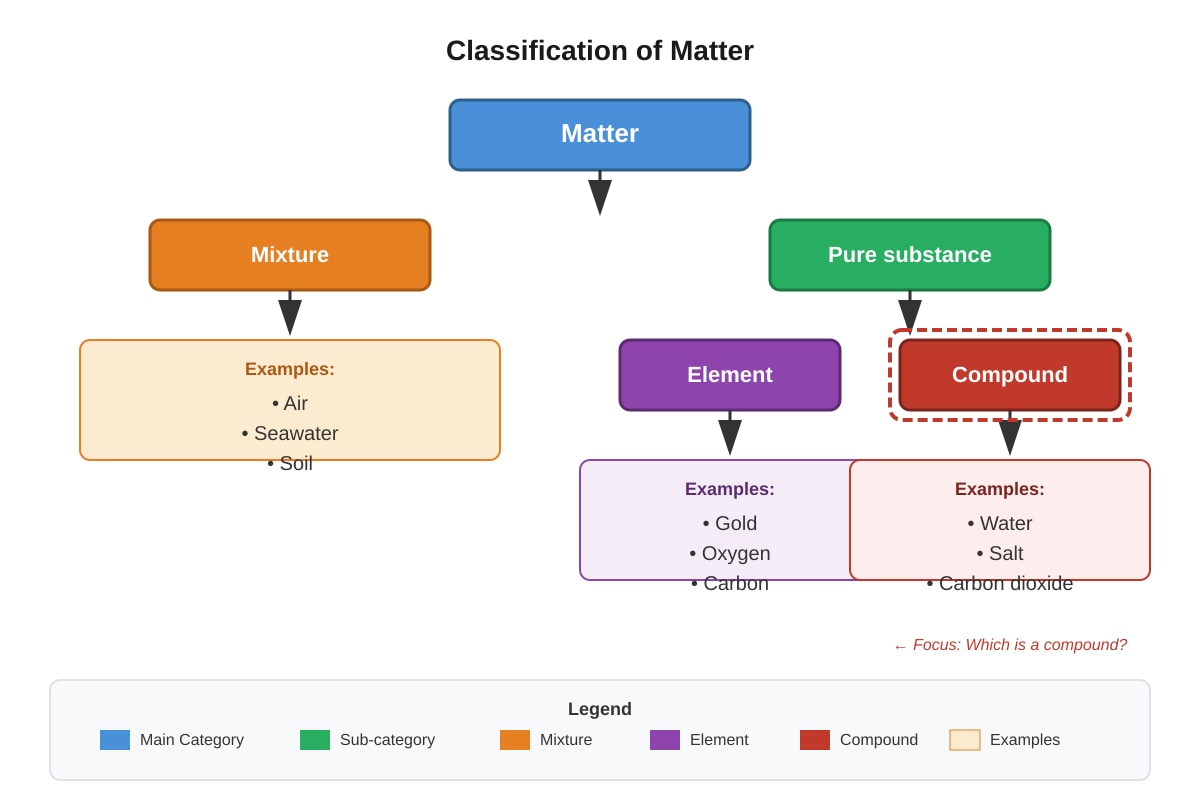
- Gold (A) = Element (single type of atom: Au)
- Air (B) = Mixture (mixture of nitrogen, oxygen, carbon dioxide, etc.)
- Water (C) = Compound (H₂O — two hydrogen atoms chemically bonded to one oxygen atom)
- Seawater (D) = Mixture (water with dissolved salts and other substances)
C is correct.
Marking note: Students often confuse mixtures and compounds. Emphasize that compounds have chemically bonded elements in fixed ratios; mixtures are physical combinations.
Question 12
Answer: B
Explanation: The classification is based on electrical conductivity — whether the material allows electricity to pass through (conductors) or not (insulators).
-
Copper, iron, aluminium → metals that allow electricity to pass through → conductors
-
Rubber, plastic, wood → do not allow electricity to pass through → insulators
-
A is incorrect: While all in Group P are metals, not all metals are magnetic (aluminium is not magnetic, copper is not magnetic). Also, iron is magnetic but the grouping doesn't use magnetism as the criterion.
Actually, wait — iron IS magnetic. But the group includes copper and aluminium which are NOT magnetic. So the group is NOT "magnetic materials."
The consistent property is electrical conductivity.
Answer: B
Marking note: Test understanding that "metal" is a material type while "conductor/insulator" is a functional property. Some metals are poor conductors (though common metals are good conductors).
Question 13
Answer: C
Explanation: For wrapping food to keep fresh and prevent spills, need:
- Transparent — to see the food inside (✓ for glass and plastic wrap)
- Flexible — to wrap around food shapes (✓ for paper, plastic wrap, cotton)
- Waterproof — to prevent liquid spills (✓ for glass and plastic wrap)
- NOT essential: Biodegradability for this purpose
| Material | Transparent | Flexible | Waterproof | Suitable? |
|---|---|---|---|---|
| Glass | ✓ | ✗ | ✓ | No — not flexible, breaks easily |
| Paper | ✗ | ✓ | ✗ | No — not waterproof, gets soggy |
| Plastic wrap | ✓ | ✓ | ✓ | Yes |
| Cotton cloth | ✗ | ✓ | ✗ | No — not waterproof, not transparent |
C is correct.
Marking note: This tests selection of materials based on required properties. Students must consider ALL necessary properties, not just one.
Question 14
Answer: C
Explanation:
- A is incorrect: Not all metals are magnetic. For example, copper, aluminium, and gold are not attracted to magnets.
- B is incorrect: Plastics are generally INSULATORS (poor conductors) of electricity. This is why they're used for electrical wire coatings.
- C is correct: Composite materials like fibreglass (glass fibres + plastic), carbon fibre, or reinforced concrete combine useful properties of different materials. For example, fibreglass is strong like glass but flexible and shatter-resistant like plastic.
- D is incorrect: Neither natural nor synthetic materials are "always better." The best material depends on the purpose. For example, synthetic plastic wrap is better than natural leaves for keeping food fresh, but natural cotton is better than synthetic fibre for some clothing.
Marking note: Composite materials are an important P6 topic. Students should understand that materials are chosen for specific properties, not general "goodness."
Question 15
Answer: C
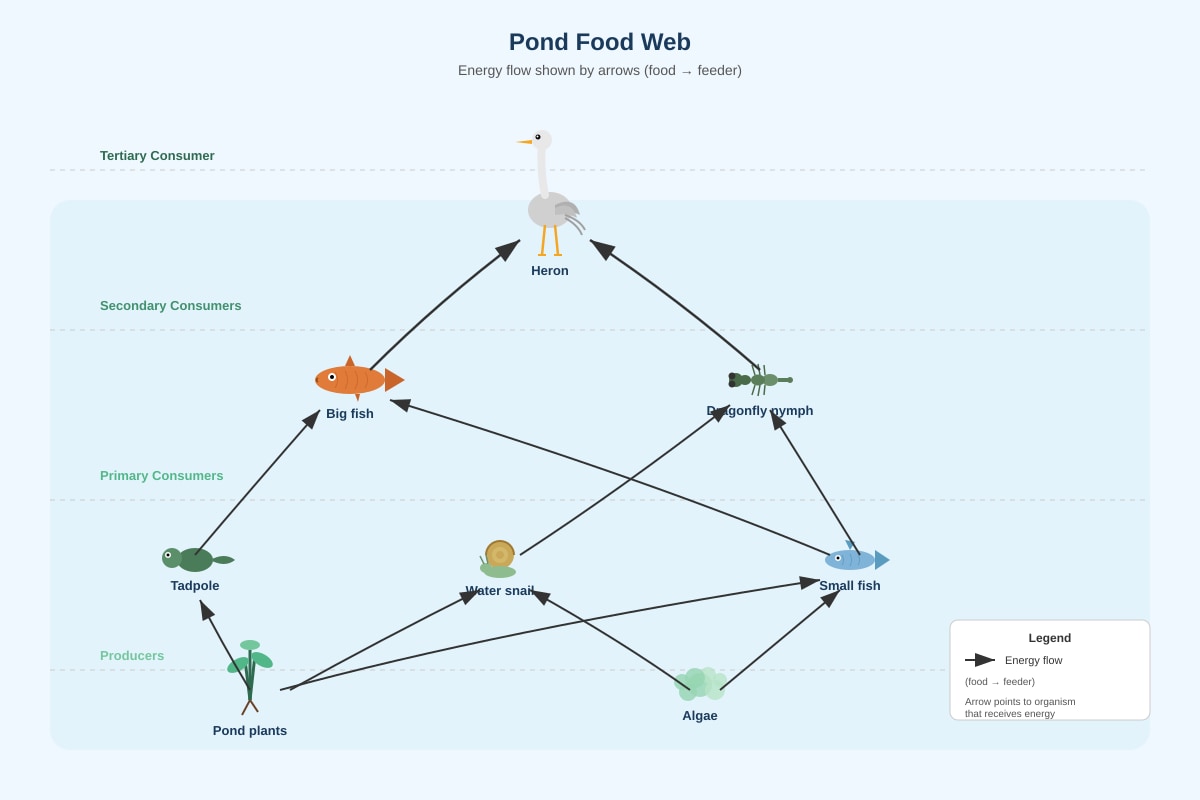
Explanation: Trophic levels:
- Producers (pond plants, algae) — make own food
- Primary consumers (tadpole, water snail, small fish) — eat producers
- Secondary consumers (big fish, dragonfly nymph) — eat primary consumers
- Tertiary consumer (heron) — at top, eats secondary consumers
For an organism to be both secondary consumer AND prey:
- Must eat primary consumers (secondary consumer)
- Must be eaten by another organism (prey)
| Organism | Level | Is it prey? |
|---|---|---|
| Pond plants | Producer | Eaten by primary consumers, but not a consumer |
| Tadpole | Primary consumer | Eaten by others, but not secondary consumer |
| Big fish | Secondary consumer | Eaten by heron = YES, prey ✓ |
| Heron | Tertiary consumer | Not preyed upon (apex) |
C is correct: Big fish
Marking note: The heron eats big fish, and big fish eats small fish. Students must trace two levels of the food web.
Question 16
Answer: C
Explanation:
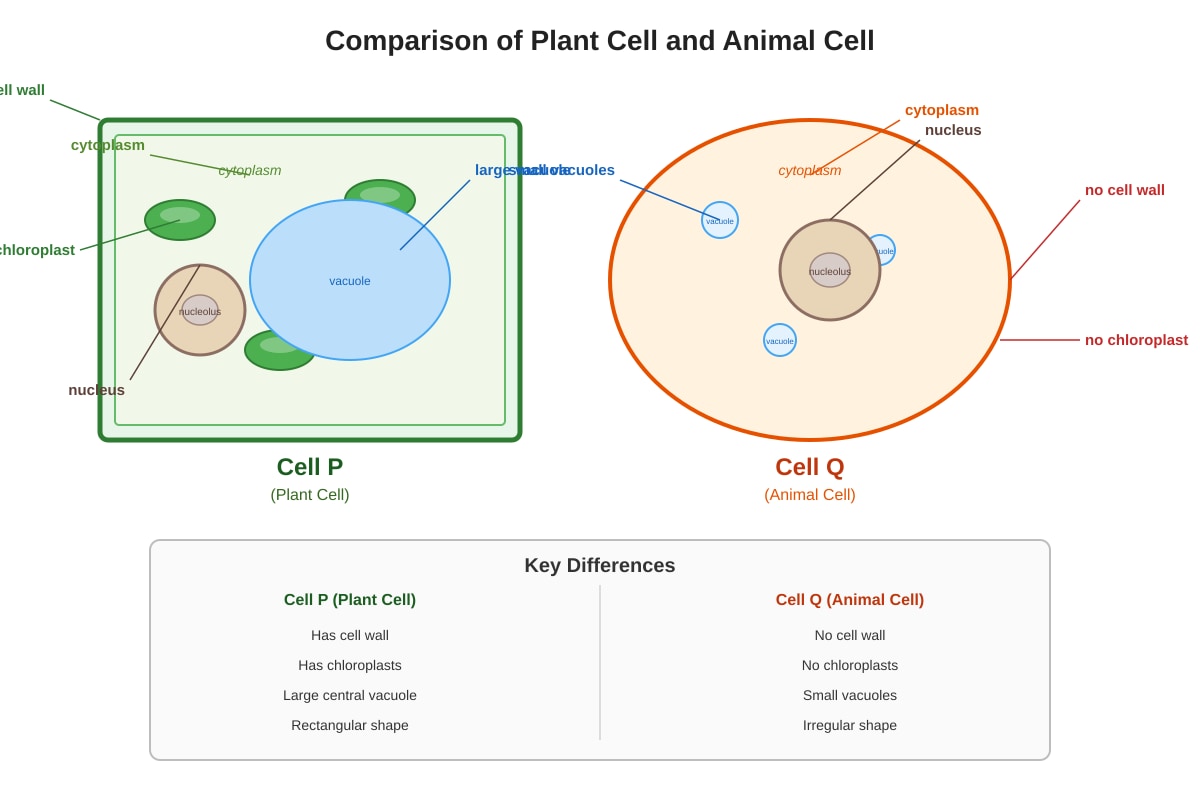
| Feature | Cell P | Cell Q |
|---|---|---|
| Has cell wall | ✓ | ✗ |
| Has chloroplast | ✓ | ✗ |
| Has large vacuole | ✓ | ✗ |
| Has nucleus | ✓ | ✓ |
| Has cytoplasm | ✓ | ✓ |
- Cell P = Plant cell (cell wall, chloroplast, large vacuole)
- Cell Q = Animal cell (no cell wall, no chloroplast, small vacuoles)
Checking options:
- A: Incorrect — cell wall means plant cell, not animal cell
- B: Incorrect — large vacuole is plant cell feature, Cell Q is animal
- C: Correct — both have nucleus and cytoplasm (common features of ALL living cells)
- D: Incorrect — only Cell P (plant) has chloroplasts for photosynthesis
Marking note: Students must know the three distinguishing features of plant cells: cell wall, chloroplast, large central vacuole.
Question 17
Answer: B
Explanation:
- A is incorrect: Conservation should not be only for human benefit. All species have intrinsic value and roles in ecosystems.
- B is correct: Nature reserves protect habitats and allow species to live and reproduce naturally. Singapore has many nature reserves (Bukit Timah, Sungei Buloh, etc.).
- C is incorrect: Introduced foreign species can become invasive, outcompete native species, and reduce biodiversity. Example: red-eared slider turtles in Singapore ponds.
- D is incorrect: Even with replanting, deforestation destroys complex ecosystems. Young planted trees don't immediately replace mature forest habitat. Biodiversity loss can be permanent.
Marking note: Tests understanding of conservation principles and common misconceptions about introduced species and reforestation.
Question 18
Answer: A
Explanation:
| Feature | Reptile | Amphibian | Bird |
|---|---|---|---|
| Has scales | ✓ | Some have moist skin, some rough | ✗ (have feathers) |
| Has moist skin | ✗ (dry, scaly skin) | ✓ | ✗ |
| Has feathers | ✗ | ✗ | ✓ |
| Lays eggs | ✓ (leathery or hard shells) | ✓ (soft, jelly-like, in water) | ✓ (hard shells) |
- Animal X: scales, lays eggs, NOT moist skin → Reptile (snake, lizard, crocodile)
- Animal Y: moist skin, lays eggs, NO scales/feathers → Amphibian (frog, toad, salamander)
- Animal Z: feathers, lays eggs → Bird
A is correct: X = reptile, Y = amphibian, Z = bird
Marking note: Moist skin is the key amphibian feature. Scales are reptilian. Feathers are unique to birds among vertebrates.
Question 19
Answer: C
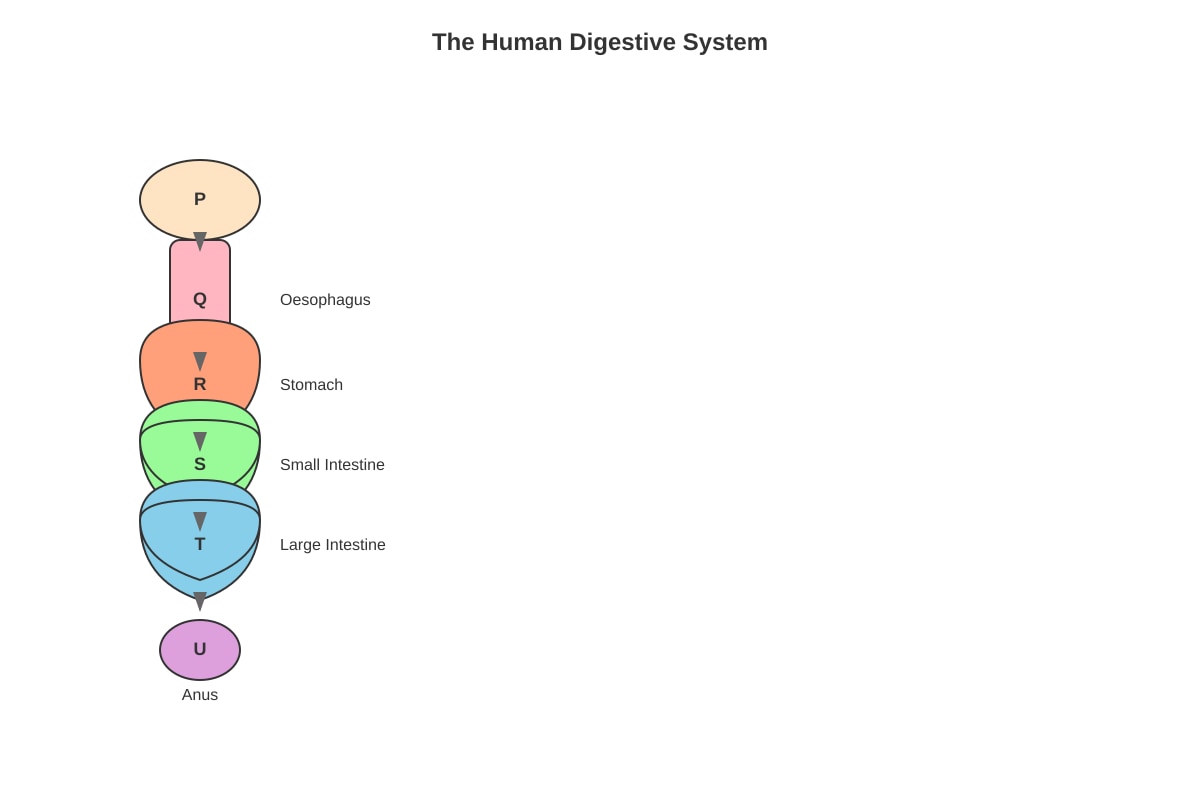
Explanation: Digestive system parts:
- P (Mouth) — mechanical digestion (chewing), start of chemical digestion (salivary amylase)
- Q (Oesophagus) — transport food to stomach, no absorption
- R (Stomach) — chemical digestion with acid and enzymes; some absorption of water and alcohol
- S (Small intestine) — MAIN SITE of absorption — has villi that increase surface area; digested food (glucose, amino acids, fatty acids) absorbed into blood
- T (Large intestine) — absorption of water, formation of faeces
- U (Anus) — elimination of faeces
C is correct: S (small intestine)
Marking note: The small intestine's structure (villi, microvilli) gives it a huge surface area for efficient absorption. This is a key concept.
Question 20
Answer: D
Explanation: Sexual reproduction requires two parents (male and female gametes) combining to form offspring with genetic variation.
| Option | Method | Type |
|---|---|---|
| A | Runners | Asexual — one parent, clone of parent |
| B | Eyes of potato | Asexual — tuber budding, one parent |
| C | Spores | Asexual in fungi — one parent, genetically identical |
| D | Fertilized egg | Sexual — requires male + female, fertilization |
A fertilized egg means sperm fused with egg — the definition of sexual reproduction.
D is correct.
Marking note: The presence of "fertilized" is the key clue. Students must understand that sexual reproduction involves gamete fusion; asexual uses only one parent's genetic material.
SECTION B: Structured Questions (60 marks)
Question 21 (5 marks)
(a) [1 mark]
Answer: Aluminium foil (or coin that is actually copper — if coin is copper, then aluminium foil is the clear answer)
Accept: Aluminium foil, glass marble (but glass marble is NOT metal... rechecking diagram)
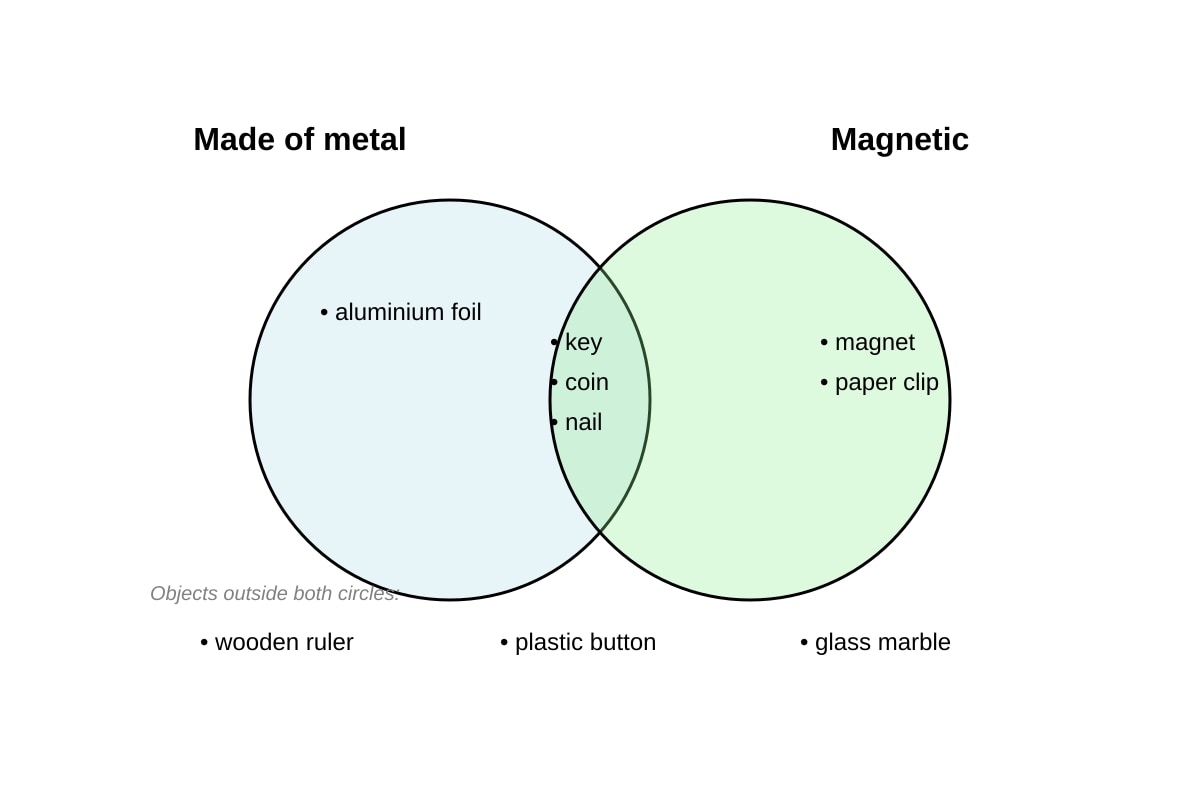
Looking at Venn diagram: Left circle is "Made of metal": key, coin, aluminium foil, nail. Right circle is "Magnetic": key, coin, nail, paper clip.
Objects in "Made of metal" only (not in overlap): aluminium foil.
Actually, check coin: If coin is in overlap, it must be magnetic. Singapore coins contain nickel and are slightly magnetic. So:
- Key, coin, nail = BOTH metal AND magnetic (in overlap)
- Aluminium foil = metal only (left circle, not right)
- Paper clip = magnetic only (wait, paper clip should be in right circle but not left? Actually paper clips are made of steel = metal. The diagram shows it only in "Magnetic"?)
Given the diagram as described: "overlapping region contains key, coin, nail" — so these are both.
Left circle only (metal, not magnetic): aluminium foil
Answer: Aluminium foil [1]
(b) [1 mark]
Answer: Key / Coin / Nail (any one) [1]
(c) [1 mark]
Answer: Wood is not a metal / Wood is not magnetic / Wood is an insulator, not a conductor of electricity / Wood is not attracted to magnets [1]
(d) [2 marks]
Answer: The copper wire should be placed in the "Made of metal" circle only (or: in the left circle but NOT in the overlap). [1]
Explanation: Copper is a metal, so it belongs in the "Made of metal" circle. However, copper is not magnetic (it is not attracted to magnets), so it does not belong in the "Magnetic" circle. [1]
Marking scheme: 1 mark for correct region, 1 mark for correct explanation about copper's properties.
Question 22 (6 marks)
(a) [1 mark]
Answer:
- Group A has narrow leaves with parallel veins; Group B has broad leaves with net-like veins [1] OR
- Group A has fibrous roots; Group B has tap root [1]
(b) [2 marks]
Answer: Coconut tree belongs to Group A. [1]
Explanation: Coconut trees are monocots. They have parallel leaf veins (long, straight veins running lengthwise in leaves) and fibrous root systems (many thin roots spreading out near the surface). These match the characteristics of Group A. [1]
(c) [1 mark]
Answer: The classification table uses two characteristics together (leaf type AND root type). This new plant has a mixture — one characteristic from Group A (fibrous roots) and one from Group B (broad leaves with net-like veins). You need consistent characteristics to place it clearly in one group. / Some plants may have variations that don't fit the simple two-group system. [1]
(d) [2 marks]
Answer: Any two from:
- Tap root grows deep into the soil to anchor the plant firmly [1]
- Tap root can reach water deep underground during dry periods [1]
- Some tap roots store food (e.g., carrot, sweet potato), providing energy for the plant [1]
- Tap root system is stronger for taller plants needing more support [1]
Question 23 (6 marks)
(a) [1 mark]
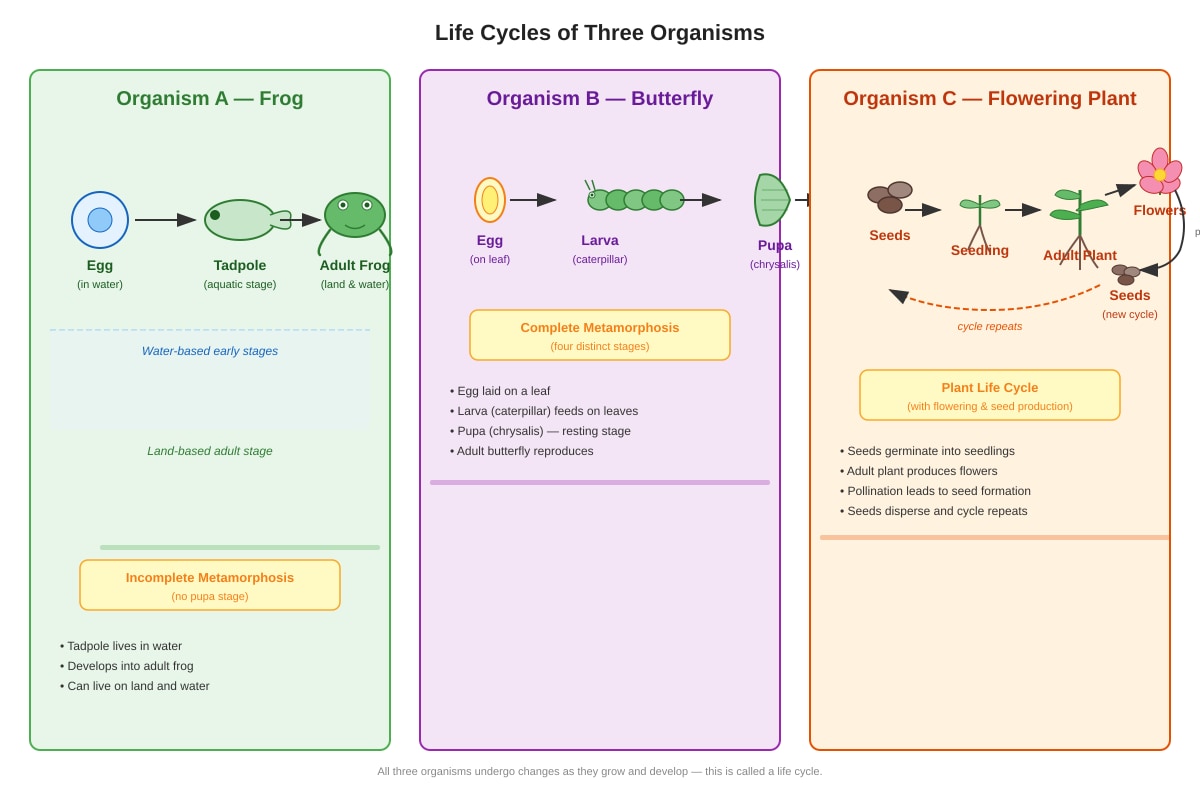
Answer: Complete metamorphosis [1]
(b) [2 marks]
Answer: Any two differences:
- Organism A (frog) has three stages in its life cycle (egg → tadpole → adult); Organism B (butterfly) has four stages (egg → larva → pupa → adult) [1]
- Organism A's young (tadpole) lives in water and breathes with gills; Organism B's young (larva) lives on land and breathes with air holes/spiracles [1]
- Organism A's tadpole looks very different but gradually changes; Organism B has a pupa stage where dramatic transformation (metamorphosis) happens inside a cocoon/chrysalis [1]
- The adult frog can live both in water and on land; the adult butterfly only lives on land [1]
(c) [1 mark]
Answer: The main function of flowers is reproduction / to produce seeds. [1] (Or: Flowers attract pollinators like bees and butterflies; flowers contain male and female parts for making seeds.)
(d) [2 marks]
Answer: It would be better to use grafting (or another asexual method like taking cuttings). [1]
Explanation: Grafting produces plants that are genetically identical to the parent plant (clones), so all the new apple trees will have the same desirable characteristics (taste, size, disease resistance) as the parent. Growing from seeds involves sexual reproduction with genetic variation, so the new trees might not produce the same quality of apples. Also, grafting produces fruit faster — seed-grown trees take many years to bear fruit. [1]
Alternative answer: If student says "seeds" with valid reasoning: "Seeds are easier to store and transport, and sexual reproduction creates genetic diversity which might produce even better varieties." Accept if well-reasoned, but grafting is the standard horticultural answer.
Question 24 (5 marks)
(a) [1 mark]
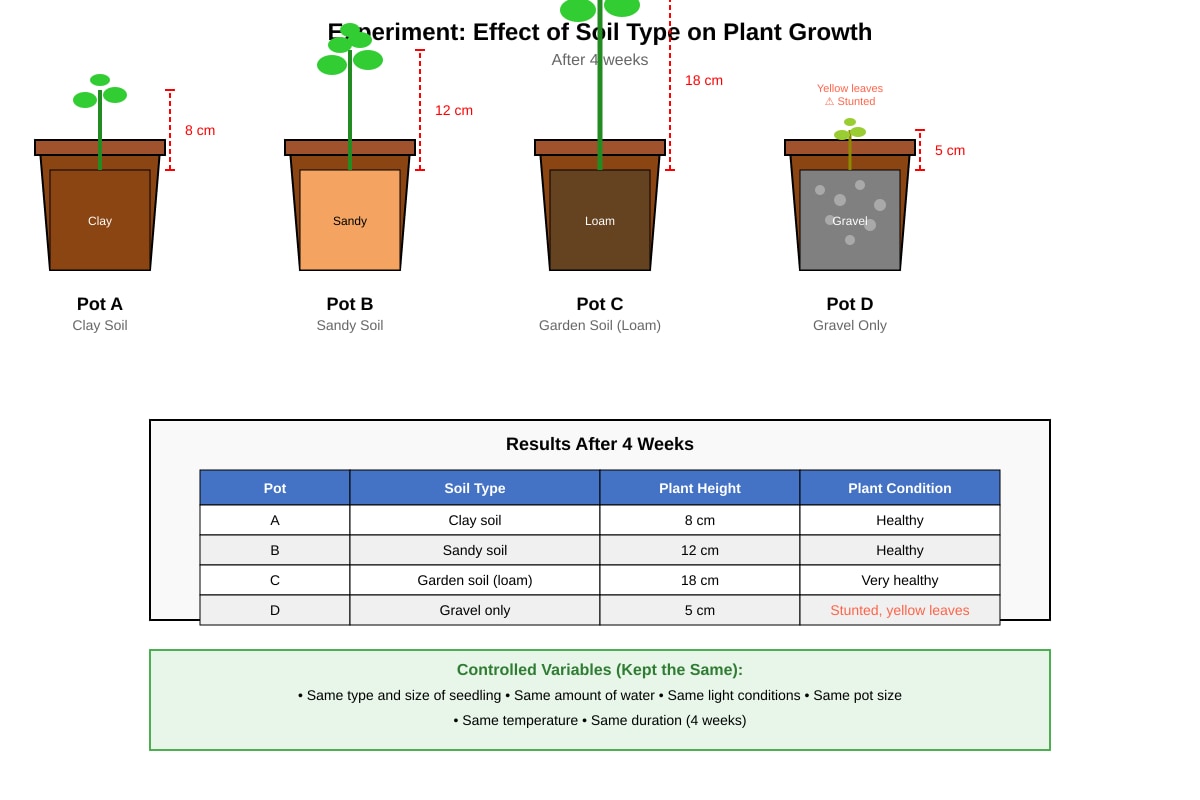
Answer: The type of soil / Different types of soil (clay, sandy, garden soil/loam, gravel) [1]
(b) [1 mark]
Answer: Any one from:
- Same type of seedling / same plant species [1]
- Same size/age of seedling [1]
- Same amount of water given [1]
- Same amount of light / same location [1]
- Same size of pot [1]
- Same temperature conditions [1]
(c) [2 marks]
Answer: Gravel has large air spaces between the particles. [1] Water and dissolved minerals drain through too quickly for the plant roots to absorb them. Also, gravel cannot hold nutrients — the plant cannot get enough water or minerals to grow well. The roots cannot anchor properly in gravel. [Any one additional point, 1 mark]
(d) [1 mark]
Answer: Garden soil / loam (Pot C). [1]
Explanation: Loam contains a mixture of sand, clay, and organic matter (humus). It holds water well but also has enough air spaces for roots to breathe. It contains nutrients from decaying matter that plants need to grow.
Question 25 (7 marks)
(a) [2 marks]
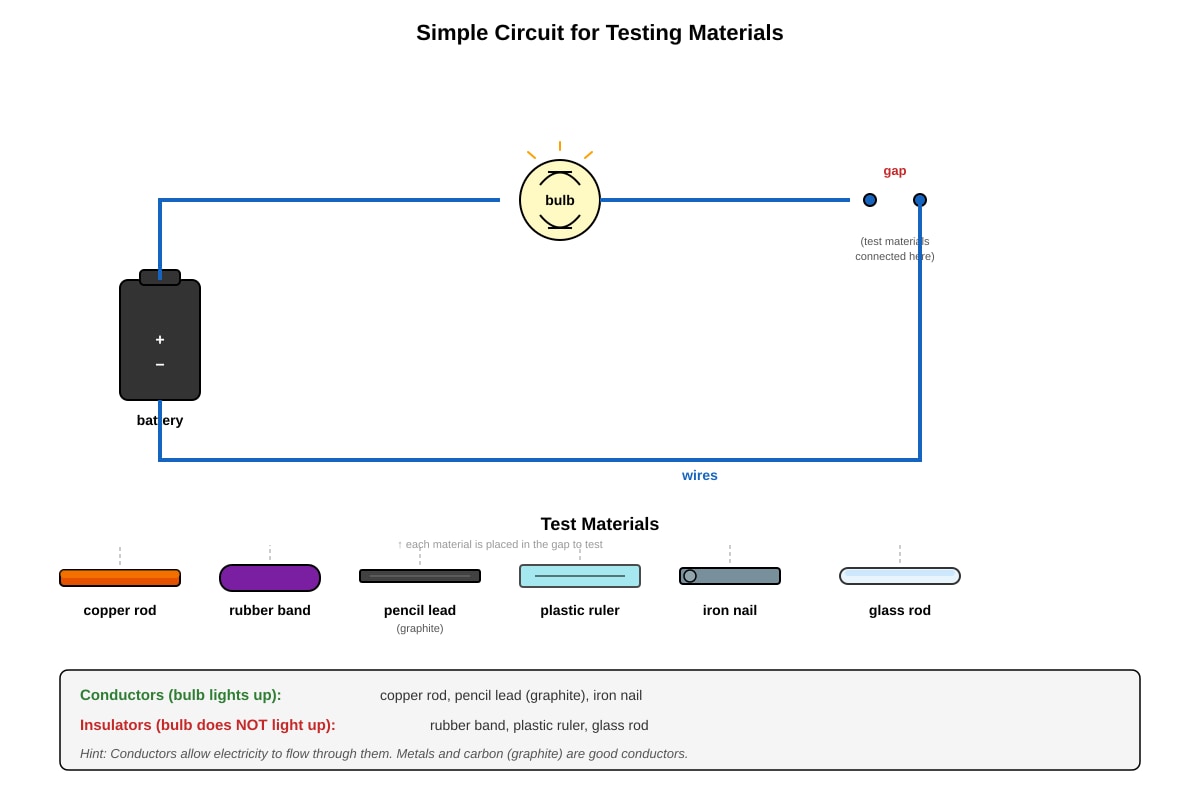
Answer: Any two from: Copper rod, pencil lead/graphite, iron nail [2] (1 mark each, max 2 marks)
(b) [1 mark]
Answer: These materials contain free-moving electrons / charged particles that can carry electric current. [1] (Or: They allow electric current to pass through them / they are electrical conductors.)
(c) [2 marks]
Answer: When electric current passes through the iron nail, the nail has electrical resistance. [1] Resistance converts some electrical energy into heat energy. This is why the nail becomes warm — electrical energy is transformed to heat energy due to the resistance in the material. [1]
(d) [2 marks]
Answer: Rubber is an electrical insulator. [1] It does not allow electricity to pass through it, so the electrician is protected from electric shock when touching live wires. Rubber is also flexible, allowing the electrician to move their hands freely while working. [1]
Question 26 (6 marks)
(a) [2 marks]
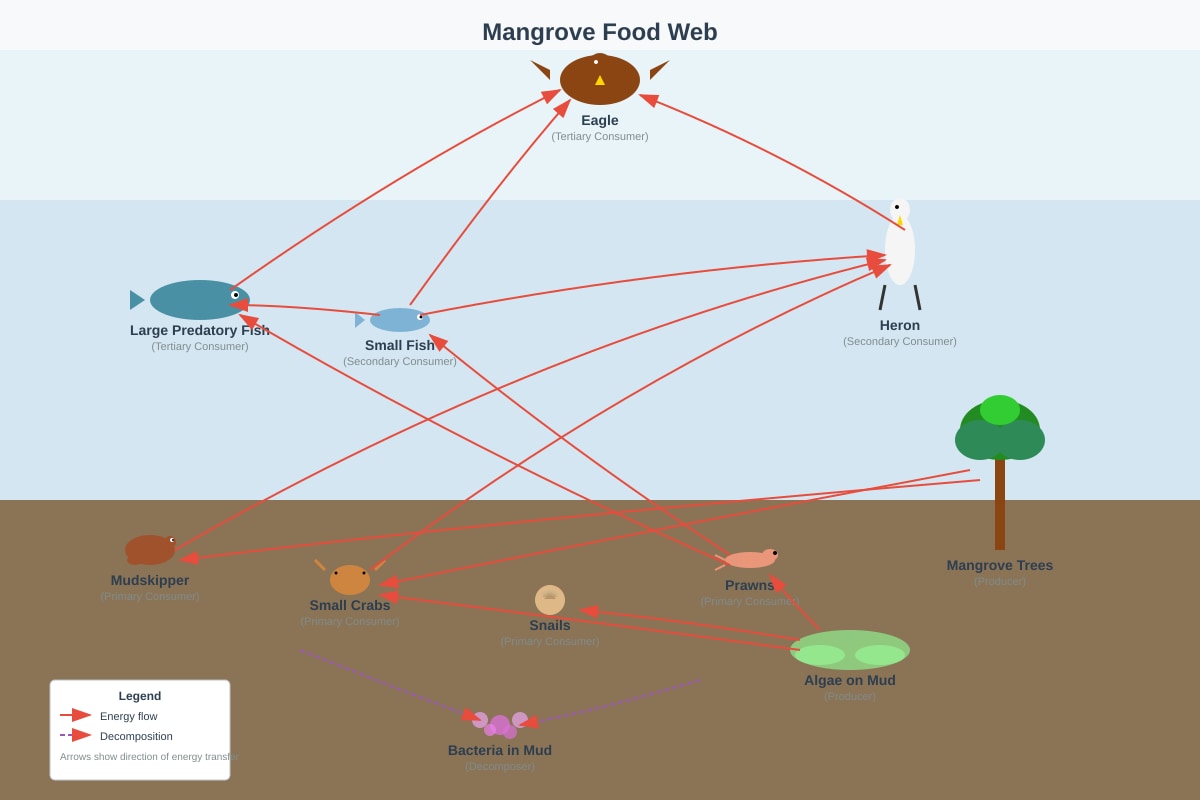
Producer: Mangrove trees / Algae on mud [1]
Consumer: Mudskipper / Small crabs / Snails / Prawns / Small fish / Heron / Large predatory fish / Eagle [1]
(b) [2 marks]
Answer: Small fish eat prawns (prawns are their food). [1] If prawns are removed, small fish lose a food source and would decrease in number due to lack of food / starvation. Some small fish might die or move away. [1]
Alternative: If small fish have OTHER food sources (algae), their number might decrease less. Accept either if logically explained.
(c) [2 marks]
Answer: Bacteria are decomposers. [1] They break down dead plants and animals into simple substances that return to the soil/mud. These substances provide nutrients for the mangrove trees and algae to grow. Without decomposers, dead matter would accumulate and nutrients would be locked away, making the ecosystem unhealthy. [1]
Question 27 (6 marks)
(a) [1 mark]
Answer: Genus [1]
(b) [2 marks]
Answer: Humans and chimpanzees share the same classification up to and including Family (Hominidae). [1] They only differ at the Genus level (Homo vs Pan). The more classification levels two organisms share, the more closely related they are. [1]
(c) [2 marks]
Answer: Scientific names are used worldwide and are the same in every language, so scientists from different countries can communicate clearly about the same organism. [1] Common names vary by language and region — for example, "human" might be called different names in different languages. Also, one common name might refer to different species in different places. [1]
(d) [1 mark]
Answer: The new species is more closely related to gorillas (or: neither — actually it is equally distant/similar).
Wait: Humans are Family Hominidae, new species is Family Cercopithecidae. Gorillas are Family Hominidae. The new species differs from humans at Family level, same as it differs from gorillas.
Actually re-reading: The new species is Family Cercopithecidae (old world monkeys — like baboons, macaques). Humans and gorillas are both Family Hominidae (great apes). So the new species is in a DIFFERENT family from both humans and gorillas.
But the question asks: "more closely related to humans or to gorillas?" Since both humans AND gorillas are in Family Hominidae, and the new species is in a different family... the answer is that it's equally related/unrelated to both, OR it's more related to neither.
However, gorillas and humans are both in Family Hominidae. The new species is NOT in that family. So compared to humans vs gorillas: the new species is equally distant from both (both are in different family).
But if we must choose: The question may intend that since gorillas and humans share Family Hominidae, and the new species is in a different family, it's not closer to either.
Expected answer: It is not more closely related to either / It is equally distant from both humans and gorillas. [1]
OR if the student recognizes that gorillas and humans are in the same family: "It cannot be determined from given information" — but actually we CAN say it's in a different family from both.
Accept: "Neither — the new species is in a different family from both humans and gorillas, so it is equally distant from both."
Question 28 (5 marks)
(a) [2 marks]
Answer: Xylem [1]
Function: To transport water and dissolved minerals from the roots to the other parts of the plant (stems and leaves). [1]
(b) [2 marks]
Answer: Root hairs are tiny extensions of root cells that increase the surface area of the root. [1] This larger surface area allows more water and mineral ions to be absorbed from the soil into the plant. [1]
(c) [2 marks]
Answer: The stomata (stomata is plural, stoma singular). [1]
How they work: Stomata are tiny pores on the leaf surface that can open and close. When conditions are hot and dry, the guard cells close the stomata to reduce water loss through evaporation/transpiration. [1]
Question 29 (7 marks)
(a) [2 marks]
Park B: 78 + 45 = 123 [1]
New Housing Estate C: 12 + 8 = 20 [1]
(b) [3 marks]
Answer: Nature Reserve A has the highest biodiversity. [1]
Reasons: Any two from:
- Nature reserves have protected habitats that are not disturbed by human activities, allowing many species to thrive [1]
- Nature reserves have been established for longer time, allowing ecosystems to develop complex food webs supporting more species [1]
- Nature reserves contain varied habitats (forest, water, open areas) supporting different types of organisms [1]
- Nature reserves have less pollution and more natural resources (water, nutrients, space) [1]
- Less human disturbance means less habitat destruction and introduced species [1]
(c) [2 marks]
Way housing estate reduced biodiversity: Any one from:
- Deforestation/clearing of natural vegetation destroyed habitats [1]
- Construction and concrete surfaces replaced natural soil and plants [1]
- Pollution from construction and human activities harmed organisms [1]
- Introduction of non-native plants reduced space for native species [1]
Action to restore biodiversity: Any one from:
- Plant native trees and create green corridors/connecting habitats [1]
- Create pocket gardens or green roofs on buildings [1]
- Establish a community garden with native plant species [1]
- Reduce pesticide use and allow natural pest control [1]
- Create small ponds or water features for wildlife [1]
Question 30 (7 marks)
(a) [1 mark]
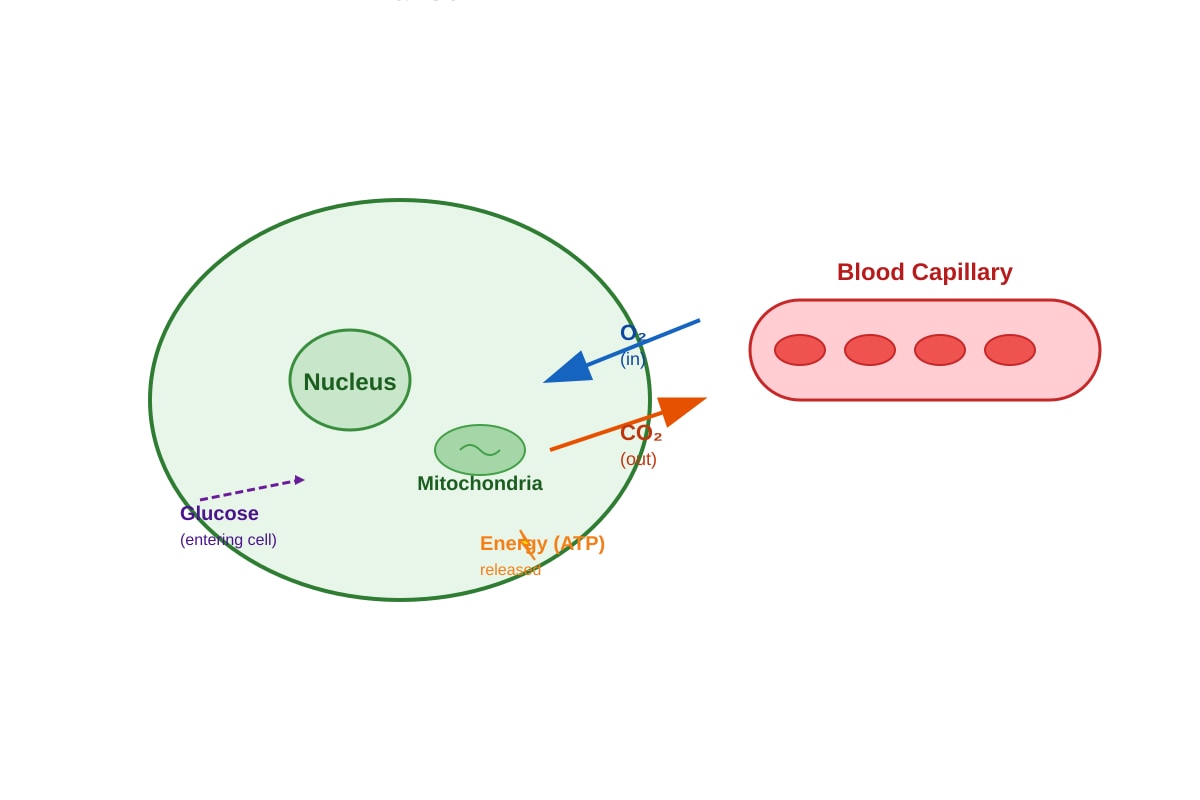
Answer: Oxygen [1]
(b) [1 mark]
Answer: Mitochondrion / Mitochondria [1]
(c) [2 marks]
Answer:
Or in words: Glucose + Oxygen → Carbon dioxide + Water + Energy [2]
1 mark if correct reactants (glucose and oxygen), 1 mark if correct products (carbon dioxide, water, energy). Deduct 1 if energy/ATP is omitted.
(d) [2 marks]
Answer: During exercise, muscles contract more frequently and forcefully. [1] This requires more energy. More respiration is needed to release energy, and aerobic respiration requires oxygen to break down glucose. Therefore, exercising muscles need increased oxygen supply to produce the extra energy required. [1]
(e) [1 mark]
Answer: Lactic acid [1]
(Also accept: lactate, or "a substance that causes muscle cramps/fatigue")
Note: The "product that causes discomfort" is lactic acid buildup. Water is also a product but does not cause discomfort.
Mark Allocation Summary
| Section | Marks | Questions |
|---|---|---|
| Section A | 40 marks | Q1–Q20 (2 marks each) |
| Section B | 60 marks | Q21–Q30 (various marks) |
| TOTAL | 100 marks |
Section B Breakdown
| Question | Marks |
|---|---|
| Q21 | 5 |
| Q22 | 6 |
| Q23 | 6 |
| Q24 | 5 |
| Q25 | 7 |
| Q26 | 6 |
| Q27 | 6 |
| Q28 | 5 |
| Q29 | 7 |
| Q30 | 7 |
| Section B Total | 60 |
Time Check:
- Section A: 20 questions × ~1.5 min = 30 min + 5 min review = 35 min ✓
- Section B: 10 questions, varying complexity ≈ 65 min + 5 min review = 70 min ✓
- Total: 105 min = 1 hour 45 minutes ✓
END OF ANSWER KEY