AI Generated Exam Paper
Primary 6 PSLE Science Practice Paper 4
Free P6 PSLE Science Practice Paper 4, HY3 AI version, with questions, answers, and PSLE-focused practice for Singapore students.
These static practice materials are generated from the site's syllabus and paper-generation workflow, with source and model context shown so students and parents can evaluate the material before use.
Questions
TuitionGoWhere Practice Paper - Science Primary 6 PSLE
TuitionGoWhere Practice Paper (AI) — Version 4
Subject: Science
Level: Primary 6 PSLE
Paper: Practice Paper (Topic: Diversity)
Duration: 45 minutes
Total Marks: 40
Name: ______________________
Class: _________
Date: ___________
Instructions:
- This practice paper has 20 questions on the topic of Diversity.
- Answer all questions in the spaces provided.
- Section A: 10 multiple-choice questions (1 mark each).
- Section B: 6 short-answer questions (2 marks each).
- Section C: 4 structured questions (total 8 marks).
- Marks for each question are shown in brackets [ ].
- No past-year exam evidence was used; this is syllabus-first AI-generated practice content.
Section A (10 marks)
Answer all questions. Each question carries 1 mark.
1. Which of the following best describes biodiversity? [1]
A. The number of animals in a zoo
B. The variety of living things in a habitat
C. The size of the largest tree in a forest
D. The amount of water in a pond
2. A student groups organisms as follows: Group 1 — rose, fern, mango tree; Group 2 — dog, frog, eagle. What characteristic is used for grouping? [1]
A. Whether they can fly
B. Whether they are plants or animals
C. Whether they live on land
D. Whether they are big or small
3. Which of these is a structural adaptation of a cactus in a dry habitat? [1]
A. Bright flowers
B. Thick stem to store water
C. Broad leaves
D. Deep roots for shade
4. In a freshwater pond, which organism is most likely a producer? [1]
A. Tadpole
B. Mosquito larva
C. Algae
D. Dragonfly
5. A food chain is: algae → snail → fish → heron. What does the arrow mean? [1]
A. The animal on the right eats the one on the left
B. Energy moves from right to left
C. The animal on the left eats the right
D. They are the same size
6. Which of these is NOT a way that man can have a negative impact on the environment? [1]
A. Planting trees in a park
B. Dumping rubbish into the sea
C. Cutting down forests for timber
D. Releasing smoke from factories
7. A community in a science context means: [1]
A. A group of the same kind of organism
B. Many populations living together in a place
C. One single living thing
D. The non-living things in a habitat
8. Which habitat would most likely have organisms adapted to low light and moist soil? [1]
A. Desert
B. Mangrove swamp
C. Open field
D. Rooftop garden
9. Decomposers are important because they: [1]
A. Make food using sunlight
B. Break down dead organisms and return nutrients
C. Hunt other animals for food
D. Produce oxygen for the pond
10. Which of the following is an example of behavioural adaptation? [1]
A. A bird having a sharp beak
B. A lizard having green skin
C. A bear hibernating in winter
D. A fish having gills
Section B (12 marks)
Answer all questions. Each question carries 2 marks.
11. Name two physical characteristics of the environment that can affect whether an organism survives. [2]
12. Explain why a food web gives more information than a single food chain. [2]
13. A garden has butterflies, grass, caterpillars, spiders, and birds. Draw a simple food chain with three organisms showing energy flow from producer to consumer. [2]
14. Give one positive and one negative impact of man on a mangrove swamp. [2]
15. State one structural and one behavioural adaptation of a frog living near a pond. [2]
16. Why is the Sun called the primary source of energy for most ecosystems? [2]
Section C (8 marks)
Answer all questions.
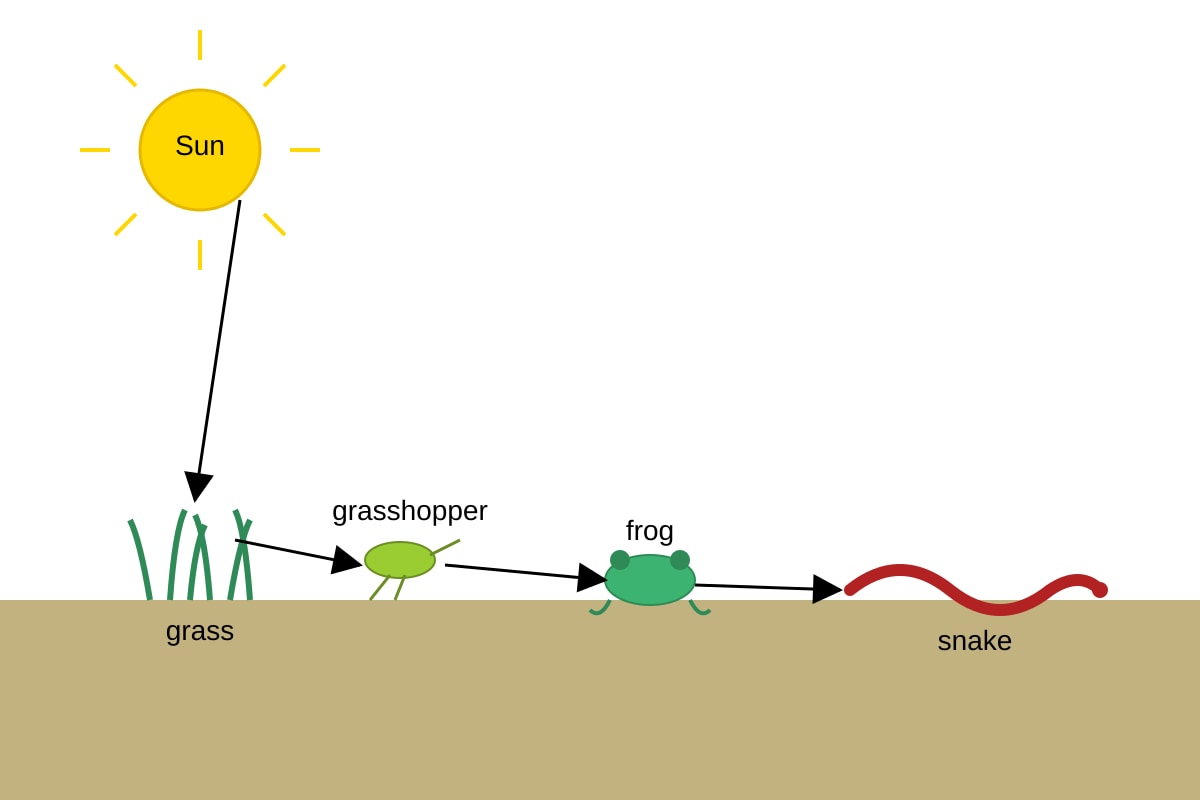
17. The diagram shows a small field habitat. [3]
Image pending generation: diagram for Q17.
(a) Name the producer in the diagram. [1]
(b) Write a food chain from the diagram with three organisms. [1]
(c) What would happen to the frog population if all snakes were removed? Explain. [1]
18. A student counted organisms in two habitats. [2]
| Habitat | Number of species found |
|---|---|
| Pond | 12 |
| Field | 7 |
Which habitat shows greater biodiversity? Give a reason.
19. Explain how deforestation can cause other organisms to die, using the idea of unfavourable environment. [2]
20. A mangrove has roots above water, soft soil, and many crabs. [1]
State one way the mangrove community is different from a community in a desert.
Answers
TuitionGoWhere Practice Paper — Science Primary 6 PSLE (Version 4) Answer Key
Topic: Diversity
Total Marks: 40
Note: Syllabus-first AI-generated content. Not derived from past-year papers.
Section A (10 marks)
1. B [1]
Teaching note: Biodiversity means the variety of living things (plants, animals, microorganisms) in a habitat. A zoo or single tree size does not show variety.
2. B [1]
Teaching note: Rose, fern, mango tree are plants; dog, frog, eagle are animals. Grouping is by plant vs animal.
3. B [1]
Teaching note: Cactus stores water in thick stem — structural adaptation for dry habitat. Broad leaves lose water, so not suitable.
4. C [1]
Teaching note: Algae make their own food using sunlight → producer. Others are consumers.
5. A [1]
Teaching note: Arrow means "is eaten by" — energy passes from left organism to right organism.
6. A [1]
Teaching note: Planting trees is positive impact. Others are negative (pollution, deforestation).
7. B [1]
Teaching note: Community = different populations living together. Same kind = population; one = organism.
8. B [1]
Teaching note: Mangrove swamp is shaded, wet; desert is dry, bright. Low light + moist → mangrove.
9. B [1]
Teaching note: Decomposers break down dead matter, returning nutrients to soil/water.
10. C [1]
Teaching note: Hibernating is an action (behavioural). Beak, skin, gills are body structures.
Section B (12 marks)
11. [2]
Answers: Any two of: temperature, light, water availability, air, soil type.
(1 mark each)
Teaching note: Physical characteristics are non-living conditions. Organisms need suitable temperature, water etc. to survive.
12. [2]
Answer: A food web shows many linked food chains / many feeding relationships; a single food chain shows only one path. (1 mark for "many links", 1 mark for contrast)
Teaching note: Food web = interconnected chains; shows what eats what in a community more fully.
13. [2]
Example: grass → caterpillar → bird. (1 mark producer correctly placed, 1 mark correct order/arrow)
Teaching note: Grass is producer; caterpillar eats grass; bird eats caterpillar. Arrow = energy flow.
14. [2]
Positive: conservation, replanting mangroves. Negative: pollution, clearing for buildings. (1 + 1)
Teaching note: Man can help (care) or harm (clear, pollute) mangrove.
15. [2]
Structural: webbed feet / moist skin / strong legs. Behavioural: croaking to attract mate / hiding in day. (1 + 1)
Teaching note: Structural = body part; behavioural = action.
16. [2]
Answer: Because plants use sunlight to make food by photosynthesis; energy starts from Sun and passes to animals. (1 mark Sun used by plants, 1 mark energy passes to consumers)
Teaching note: Sun → producer → consumer is the energy pathway.
Section C (8 marks)
17. [3]
(a) Producer: grass [1]
(b) Example: grass → grasshopper → frog [1]
(c) Frog population may increase because fewer are eaten by snakes; but later may drop if grasshoppers reduce. [1]
Teaching note: Image must show Sun→grass→grasshopper→frog→snake. Removing top predator changes balance.
18. [2]
Answer: Pond shows greater biodiversity (12 species > 7). Reason: more species = more variety of living things. (1 + 1)
Teaching note: Biodiversity = number of different species.
19. [2]
Answer: Deforestation removes trees → animals lose home/food → environment unfavourable → they may die. (1 mark loss of home/food, 1 mark link to death)
Teaching note: Unfavourable environment = cannot survive, move, or die.
20. [1]
Answer: Mangrove community has crabs and water plants; desert has cacti and lizards, less water. (any valid difference)
Teaching note: Communities differ by organisms and conditions.
Free quiz and exam paper access
Enter your details to view this paper
Your access is remembered on this device.