AI Generated Exam Paper

Primary 6 PSLE Science Practice Paper 3

Free AI-Generated NVIDIA Nemotron 3 Ultra 550B A55B Free Primary 6 PSLE Science Practice Paper 3 practice paper with questions and answers for Singapore students. This page is rendered as a direct URL so the questions and answers can be discovered without pressing in-page buttons.

These static practice materials are generated from the site's syllabus and paper-generation workflow, with source and model context shown so students and parents can evaluate the material before use.

Primary 6 PSLE Science AI Generated Generated by NVIDIA Nemotron 3 Ultra 550B A55B Free Updated 2026-06-07

Questions
<!-- TuitionGoWhere generation metadata: stage=5-2; model=nvidia/nemotron-3-ultra-550b-a55b:free; model_label=NVIDIA Nemotron 3 Ultra 550B A55B Free; generated=2026-06-06; Sources: Stage 4-0 LLM templates, syllabus context, and Stage 2 evidence where available. -->

TuitionGoWhere Practice Paper - Science Primary 6 PSLE

TuitionGoWhere Practice Paper (AI) Subject: Science
Level: Primary 6 PSLE
Paper: Practice Paper 3 (Version 3 of 5)
Duration: 1 h 45 min
Total Marks: 100

Name: _______________________
Class: _______________________
Date: _______________________


INSTRUCTIONS TO CANDIDATES

  1. Do not open this booklet until you are told to do so.
  2. Follow all instructions carefully.
  3. Answer all questions.
  4. The number of marks is given in brackets [ ] at the end of each question or part question.
  5. For Section A, shade your answers on the Optical Answer Sheet (OAS) provided.
  6. For Section B, write your answers in the spaces provided in this booklet.
  7. The total marks for this paper is 100.

SECTION A (56 marks)

For each question from 1 to 28, four options are given. One of them is the correct answer. Make your choice (1, 2, 3 or 4) and shade the correct oval on the Optical Answer Sheet (OAS).

Question 1 [2 marks]

Which of the following statements about living things is correct?

(1) All living things can make their own food. (2) All living things reproduce by laying eggs. (3) All living things respond to changes in their surroundings. (4) All living things need oxygen to survive.

Question 2 [2 marks]

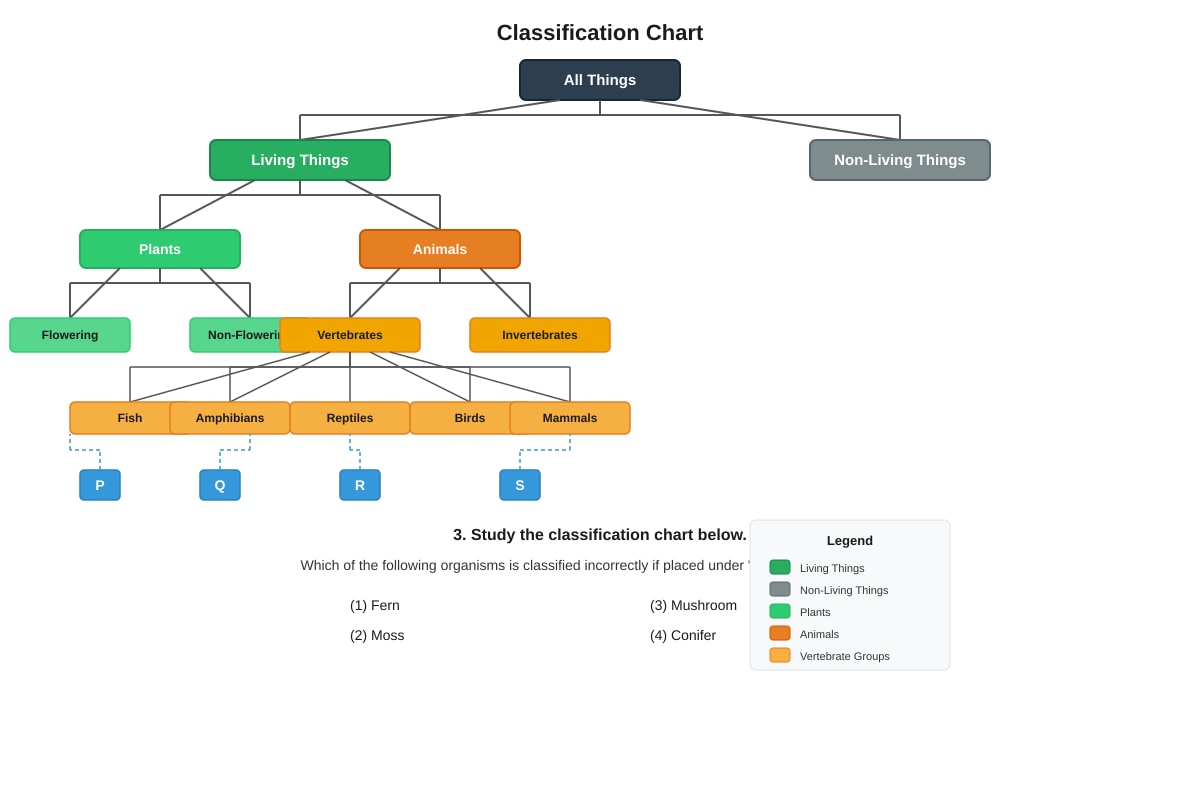
Study the classification chart below.

Living Things
├── Group X
│   ├── Mushroom
│   ├── Yeast
│   └── Mould
└── Group Y
    ├── Rose plant
    ├── Balsam plant
    └── Moss

Which of the following correctly identifies Group X and Group Y?

Group XGroup Y
(1)FungiPlants
(2)BacteriaFungi
(3)PlantsFungi
(4)FungiBacteria

Question 3 [2 marks]

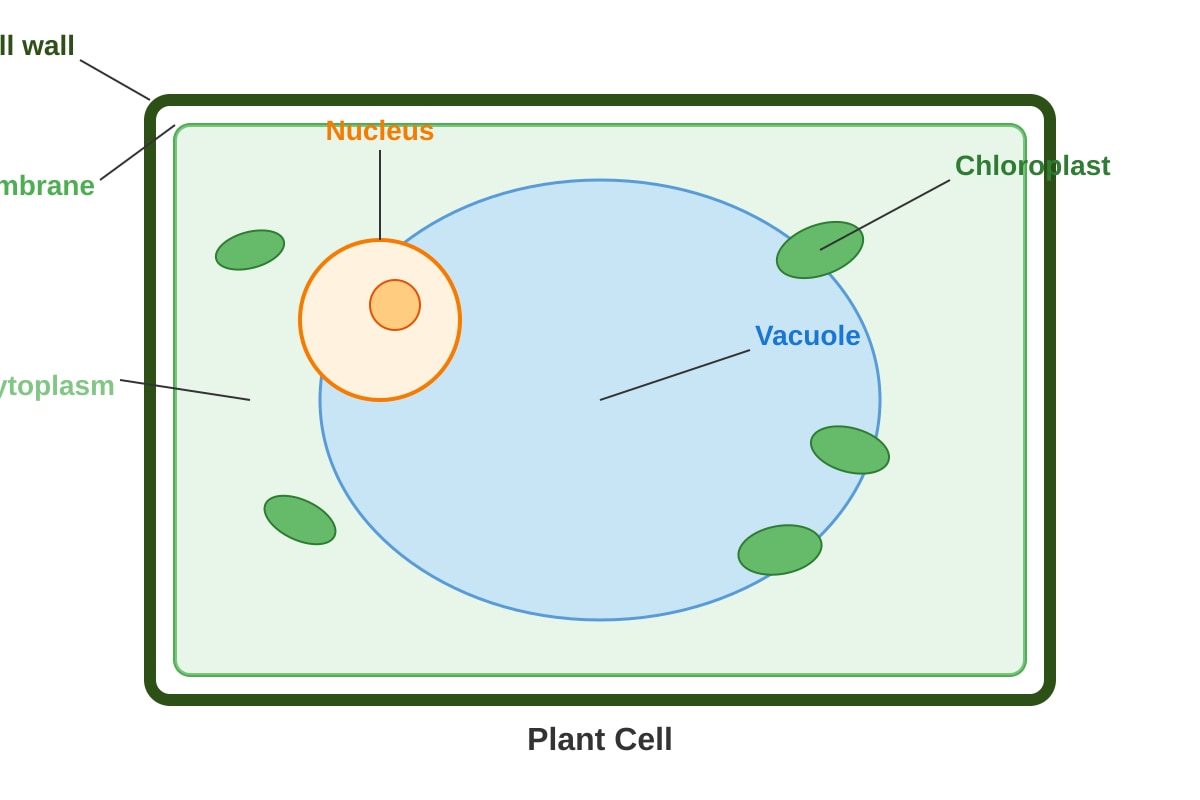
The diagram below shows a cell.

<image_placeholder> id: Q3-fig1 type: diagram linked_question: Q3 description: A typical plant cell with labelled parts: cell wall, cell membrane, cytoplasm, nucleus, chloroplast, vacuole labels: cell wall, cell membrane, cytoplasm, nucleus, chloroplast, vacuole values: None must_show: Rectangular shape, cell wall outside cell membrane, large central vacuole, chloroplasts in cytoplasm </image_placeholder>

Which part of the cell controls all activities in the cell?

(1) Cell wall (2) Nucleus (3) Chloroplast (4) Vacuole

Question 4 [2 marks]

Which of the following groups of organisms are all microorganisms?

(1) Bacteria, yeast, mushroom (2) Bacteria, virus, amoeba (3) Mould, fern, moss (4) Algae, protozoa, grass

Question 5 [2 marks]

Study the flowchart below.

Organism A
   │
   ├── Has chlorophyll? → Yes → Organism B
   │
   └── No → Reproduces by spores? → Yes → Organism C
                │
                └── No → Organism D

Based on the flowchart, which of the following could Organism A, B, C and D be?

Organism AOrganism BOrganism COrganism D
(1)MouldFernYeastBacteria
(2)YeastMossMouldAmoeba
(3)BacteriaAlgaeMushroomVirus
(4)AmoebaBalsamYeastMould

Question 6 [2 marks]

Which of the following is not a characteristic of fungi?

(1) They reproduce by spores. (2) They cannot make their own food. (3) They have chlorophyll. (4) They feed on dead or living organisms.

Question 7 [2 marks]

The diagram below shows a bacterium.

<image_placeholder> id: Q7-fig1 type: diagram linked_question: Q7 description: A typical bacterial cell showing cell wall, cell membrane, cytoplasm, genetic material (no nucleus), flagellum labels: cell wall, cell membrane, cytoplasm, genetic material, flagellum values: None must_show: No nucleus, genetic material in cytoplasm, flagellum for movement </image_placeholder>

Which of the following statements about bacteria is correct?

(1) All bacteria are harmful to humans. (2) Bacteria have a nucleus. (3) Bacteria can only be seen under a microscope. (4) Bacteria reproduce by binary fission only in favourable conditions.

Question 8 [2 marks]

Which of the following pairs of organisms belong to the same group?

(1) Whale and shark (2) Bat and bird (3) Frog and toad (4) Snake and earthworm

Question 9 [2 marks]

Study the classification table below.

GroupCharacteristicsExamples
PHave feathers, lay eggs, breathe with lungsEagle, Penguin
QHave scales, lay eggs, breathe with lungsSnake, Lizard
RHave hair/fur, give birth to young alive, breathe with lungsWhale, Bat
SHave moist skin, lay eggs in water, breathe with gills when youngFrog, Salamander

Which group represents mammals?

(1) P (2) Q (3) R (4) S

Question 10 [2 marks]

The diagram below shows a plant.

<image_placeholder> id: Q10-fig1 type: diagram linked_question: Q10 description: A flowering plant with roots, stem, leaves, flowers, and fruits clearly labelled labels: roots, stem, leaves, flowers, fruits values: None must_show: Complete flowering plant with all parts visible </image_placeholder>

Which part of the plant takes in water and mineral salts from the soil?

(1) Leaves (2) Stem (3) Roots (4) Flowers

Question 11 [2 marks]

Which of the following plants reproduce by spores?

(1) Fern and moss (2) Balsam and rose (3) Mushroom and yeast (4) Algae and bacteria

Question 12 [2 marks]

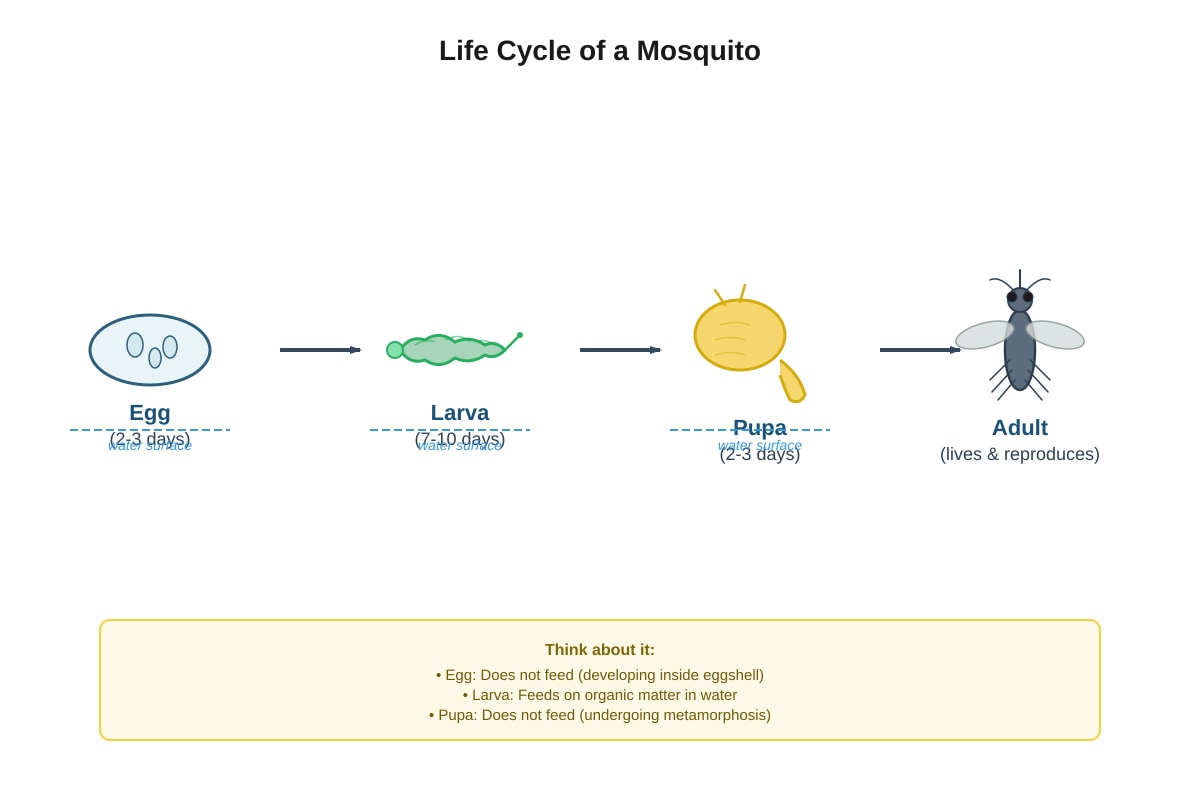
The diagram below shows the life cycle of a mosquito.

<image_placeholder> id: Q12-fig1 type: diagram linked_question: Q12 description: Four-stage life cycle of mosquito: Egg → Larva → Pupa → Adult, with arrows showing cycle labels: Egg, Larva, Pupa, Adult values: None must_show: Complete metamorphosis cycle with all four stages </image_placeholder>

At which stage does the mosquito not feed?

(1) Egg (2) Larva (3) Pupa (4) Adult

Question 13 [2 marks]

Which of the following statements about the life cycle of a flowering plant is correct?

(1) The seed grows into a seedling immediately after pollination. (2) Fertilisation occurs before pollination. (3) The fruit develops from the ovary after fertilisation. (4) The seed contains the embryo and food store before fertilisation.

Question 14 [2 marks]

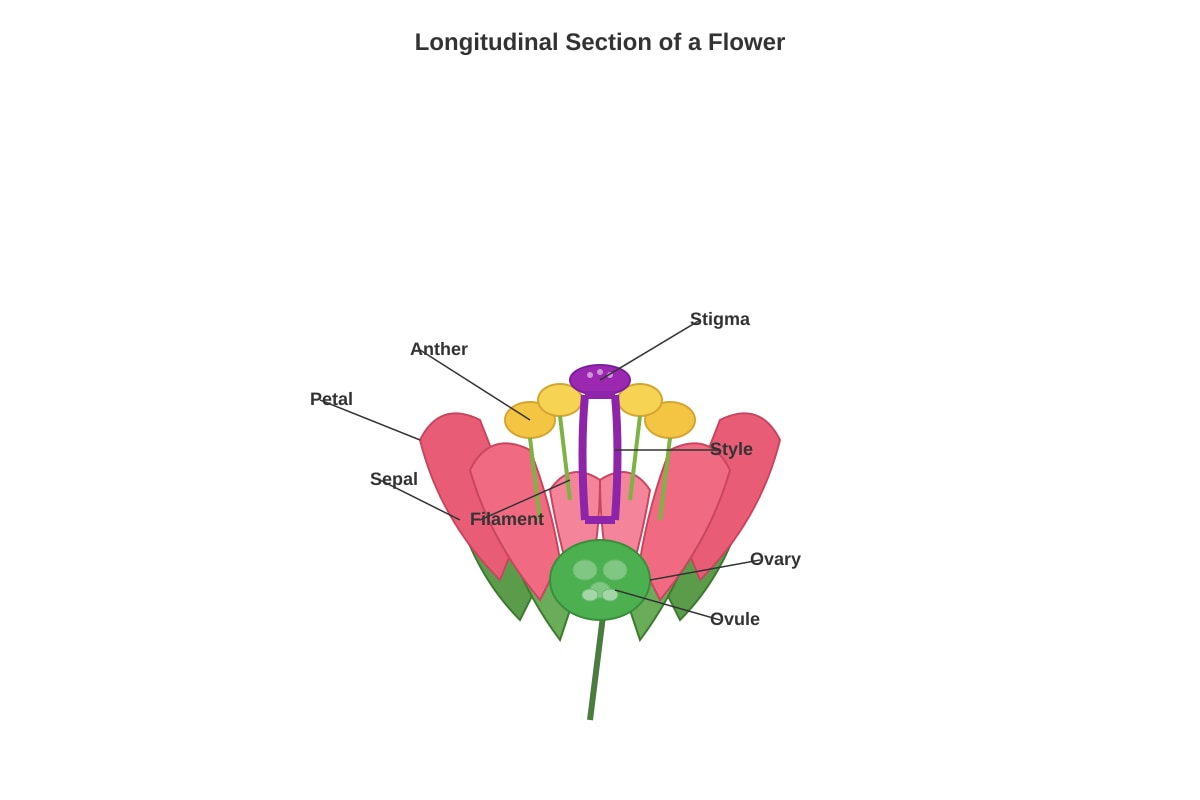
Study the diagram below.

<image_placeholder> id: Q14-fig1 type: diagram linked_question: Q14 description: Cross-section of a flower showing sepal, petal, stamen (anther, filament), pistil (stigma, style, ovary, ovule) labels: sepal, petal, anther, filament, stigma, style, ovary, ovule values: None must_show: All reproductive parts clearly labelled </image_placeholder>

Which part produces pollen grains?

(1) Stigma (2) Anther (3) Ovary (4) Style

Question 15 [2 marks]

The diagram below shows a seed.

<image_placeholder> id: Q15-fig1 type: diagram linked_question: Q15 description: Longitudinal section of a dicotyledonous seed showing seed coat, cotyledons, plumule, radicle labels: seed coat, cotyledon, plumule, radicle values: None must_show: Two cotyledons, plumule (shoot), radicle (root) clearly visible </image_placeholder>

What is the function of the cotyledon?

(1) Protects the embryo (2) Stores food for the embryo (3) Develops into the shoot (4) Develops into the root

Question 16 [2 marks]

Which of the following shows the correct order of stages in the life cycle of a butterfly?

(1) Egg → Pupa → Larva → Adult (2) Egg → Larva → Pupa → Adult (3) Egg → Adult → Larva → Pupa (4) Larva → Egg → Pupa → Adult

Question 17 [2 marks]

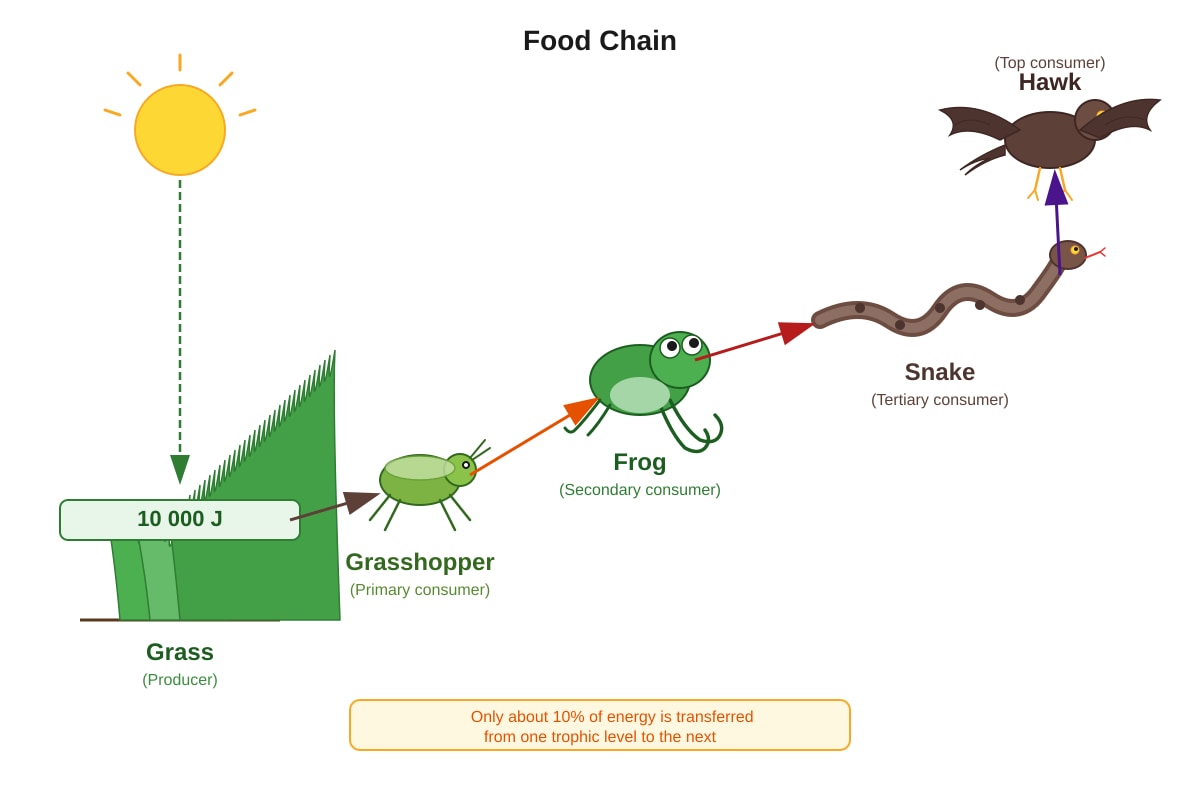
The diagram below shows a food chain.

<image_placeholder> id: Q17-fig1 type: diagram linked_question: Q17 description: Food chain: Grass → Grasshopper → Frog → Snake → Eagle labels: Grass (producer), Grasshopper (primary consumer), Frog (secondary consumer), Snake (tertiary consumer), Eagle (quaternary consumer) values: None must_show: Arrows pointing from food to consumer, 5 organisms </image_placeholder>

Which organism is both a predator and a prey?

(1) Grass (2) Grasshopper (3) Frog (4) Eagle

Question 18 [2 marks]

Which of the following adaptations helps a polar bear survive in a cold environment?
(1) Thick fur and a thick layer of fat (2) Long legs for running fast (3) Brightly coloured feathers (4) Gills for breathing underwater

Question 19 [2 marks]

Study the food web below.

<image_placeholder> id: Q19-fig1 type: diagram linked_question: Q19 description: Food web with: Plants → (Rabbit, Grasshopper, Mouse) → (Fox, Snake, Hawk) and Decomposers (Bacteria, Fungi) breaking down all dead organisms labels: Plants, Rabbit, Grasshopper, Mouse, Fox, Snake, Hawk, Bacteria, Fungi values: None must_show: Multiple interconnected food chains, decomposers shown </image_placeholder>

If all the snakes are removed from this food web, what is the most likely immediate effect?

(1) The population of mice will decrease. (2) The population of hawks will increase. (3) The population of grasshoppers will increase. (4) The population of foxes will decrease.

Question 20 [2 marks]

Which of the following is a structural adaptation of a cactus to survive in the desert?

(1) Deep roots to absorb water (2) Broad leaves to catch sunlight (3) Spines instead of leaves to reduce water loss (4) Bright flowers to attract pollinators

Question 21 [2 marks]

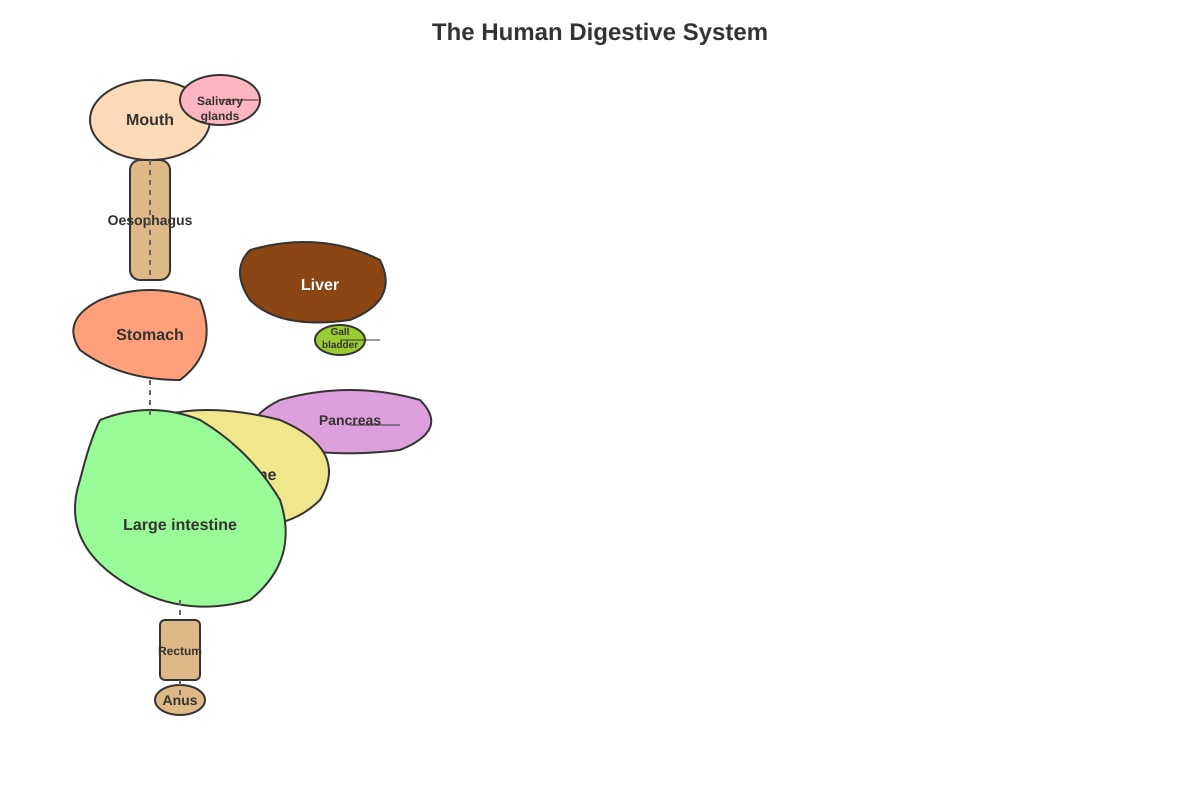
The diagram below shows the human digestive system.

<image_placeholder> id: Q21-fig1 type: diagram linked_question: Q21 description: Human digestive system showing mouth, oesophagus, stomach, small intestine, large intestine, anus, with liver, pancreas, gall bladder labels: mouth, oesophagus, stomach, small intestine, large intestine, anus, liver, pancreas, gall bladder values: None must_show: All major organs labelled correctly </image_placeholder>
In which organ is most of the digested food absorbed into the blood?

(1) Stomach (2) Small intestine (3) Large intestine (4) Liver

Question 22 [2 marks]

Which of the following systems work together to allow a person to move?

(1) Skeletal system and muscular system (2) Digestive system and circulatory system (3) Respiratory system and circulatory system (4) Nervous system and digestive system

Question 23 [2 marks]

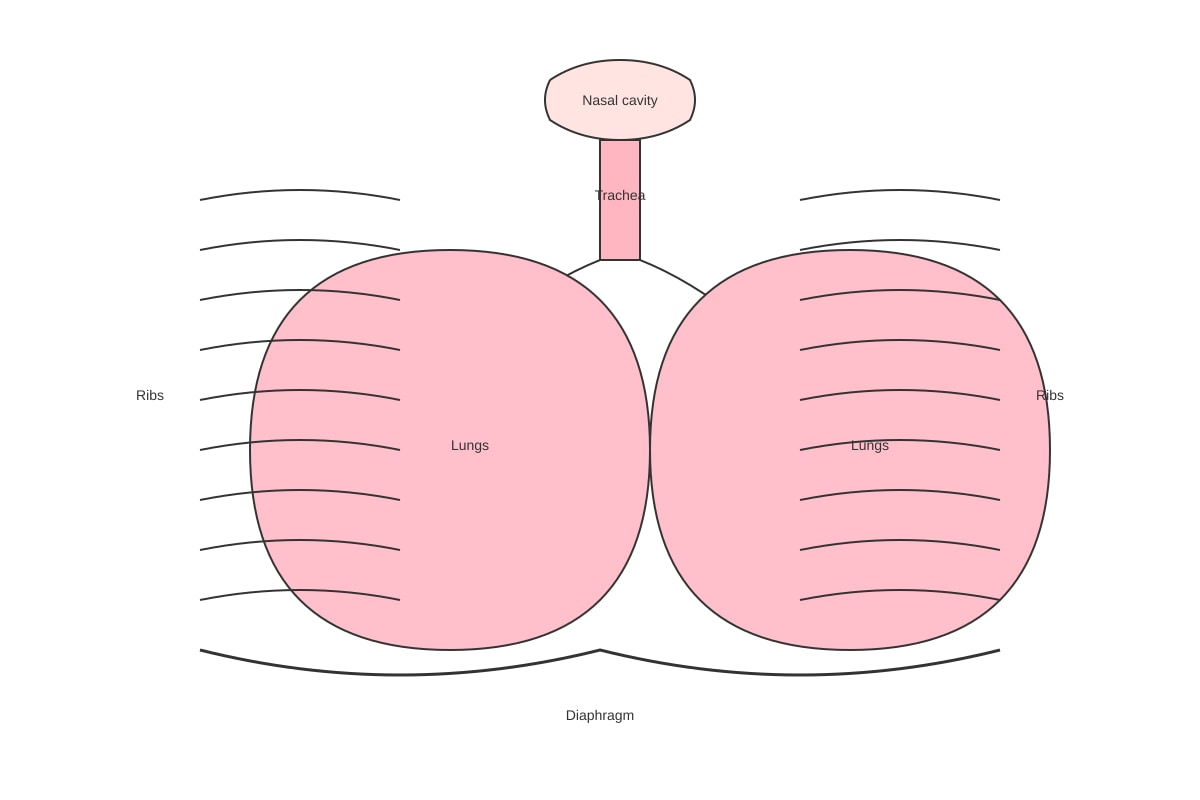
The diagram below shows a human respiratory system.

<image_placeholder> id: Q23-fig1 type: diagram linked_question: Q23 description: Human respiratory system showing nose, trachea, bronchi, lungs, alveoli, diaphragm labels: nose, trachea, bronchi, lungs, alveoli, diaphragm values: None must_show: Branching bronchi, alveoli clusters, diaphragm position </image_placeholder>

Where does gaseous exchange take place?

(1) Trachea (2) Bronchi (3) Alveoli (4) Diaphragm

Question 24 [2 marks]

Which of the following shows the correct path of air during inhalation?

(1) Nose → Trachea → Bronchi → Lungs → Alveoli (2) Nose → Bronchi → Trachea → Lungs → Alveoli (3) Nose → Trachea → Lungs → Bronchi → Alveoli (4) Nose → Lungs → Trachea → Bronchi → Alveoli

Question 25 [2 marks]

The diagram below shows the human circulatory system.

<image_placeholder> id: Q25-fig1 type: diagram linked_question: Q25 description: Simplified heart and circulation: Right atrium → Right ventricle → Lungs → Left atrium → Left ventricle → Body → Right atrium labels: Right atrium, Right ventricle, Left atrium, Left ventricle, Lungs, Body values: None must_show: Four chambers, pulmonary and systemic circulation arrows </image_placeholder>

Which blood vessel carries oxygen-rich blood from the heart to the rest of the body?

(1) Pulmonary artery (2) Pulmonary vein (3) Aorta (4) Vena cava

Question 26 [2 marks]

Which of the following is a function of the skeletal system?

(1) Pumps blood around the body (2) Breaks down food into simpler substances (3) Protects internal organs (4) Removes waste from the body

Question 27 [2 marks]

Study the diagram below.

<image_placeholder> id: Q27-fig1 type: diagram linked_question: Q27 description: A cell with arrows showing oxygen and glucose entering, carbon dioxide and water leaving, energy (ATP) produced labels: Oxygen in, Glucose in, Carbon dioxide out, Water out, Energy (ATP) values: None must_show: Mitochondria highlighted as site of respiration </image_placeholder>

The process shown in the diagram takes place in which part of the cell?

(1) Nucleus (2) Chloroplast (3) Mitochondria (4) Cell membrane

Question 28 [2 marks]

Which of the following statements about photosynthesis is correct?

(1) Photosynthesis occurs in animal cells. (2) Carbon dioxide and water are the products of photosynthesis. (3) Chlorophyll traps light energy for photosynthesis. (4) Photosynthesis takes place in the mitochondria.


SECTION B (44 marks)

Write your answers in the spaces provided. The number of marks is given in brackets [ ] at the end of each question or part question.

Question 29 [3 marks]

The diagram below shows two organisms, P and Q.

<image_placeholder> id: Q29-fig1 type: diagram linked_question: Q29 description: Two organisms side by side: Organism P - a fern plant with fronds, roots, stem; Organism Q - a mushroom with cap, gills, stalk, mycelium labels: P: frond, root, stem; Q: cap, gills, stalk, mycelium values: None must_show: Clear structural differences between plant and fungus </image_placeholder>

(a) State one similarity between Organism P and Organism Q. [1]


(b) State two differences between Organism P and Organism Q. [2]

Difference 1: _________________________________________________________________

Difference 2: _________________________________________________________________

Question 30 [3 marks]

The diagram below shows a plant cell and an animal cell.

<image_placeholder> id: Q30-fig1 type: diagram linked_question: Q30 description: Side-by-side comparison: Plant cell (rectangular, cell wall, chloroplast, large vacuole) and Animal cell (irregular, no cell wall, no chloroplast, small vacuoles) labels: Plant cell: cell wall, cell membrane, cytoplasm, nucleus, chloroplast, large vacuole; Animal cell: cell membrane, cytoplasm, nucleus, small vacuoles values: None must_show: Clear structural differences </image_placeholder>

(a) Identify the cell part labelled X that is present in the plant cell but absent in the animal cell. [1]


(b) State the function of the cell part labelled X. [1]


(c) Name one cell part that is present in both plant and animal cells. [1]


Question 31 [4 marks]

The flowchart below shows the classification of some organisms.

Organism
   │
   ├── Makes its own food? → Yes → Has flowers? → Yes → A
   │                           │
   │                           └── No → B
   │
   └── No → Reproduces by spores? → Yes → C
                │
                └── No → D

(a) Based on the flowchart, state the group that Organism A belongs to. [1]


(b) Give an example of Organism B. [1]


(c) State one characteristic of Organism C. [1]


(d) Organism D is a bacterium. State one difference between a bacterium and a fungus. [1]


Question 32 [4 marks]

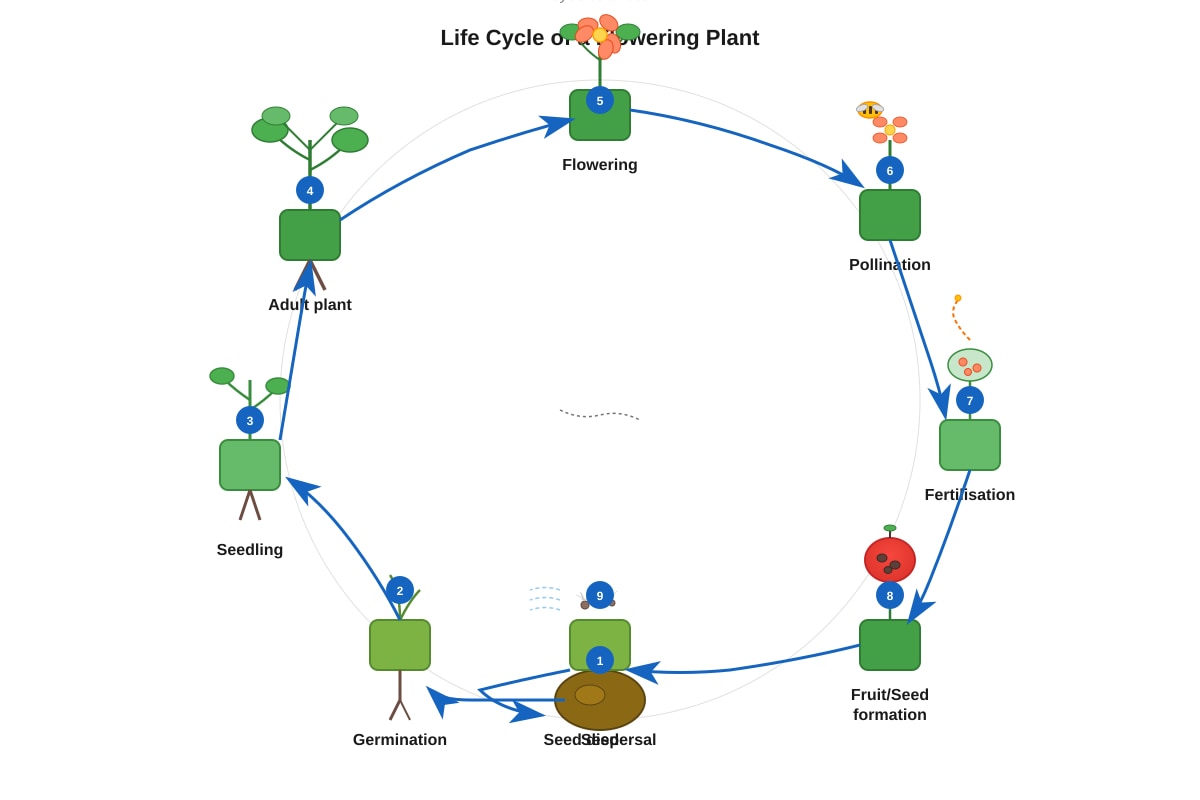
The diagram below shows the life cycle of a flowering plant.

<image_placeholder> id: Q32-fig1 type: diagram linked_question: Q32 description: Life cycle stages: Seed → Germination → Seedling → Adult plant → Flowering → Pollination → Fertilisation → Fruit/Seed formation → Seed dispersal labels: All stages labelled with arrows showing cycle values: None must_show: Complete cycle with pollination, fertilisation, fruit formation, seed dispersal </image_placeholder>

(a) Name the process that occurs between pollination and fertilisation. [1]


(b) After fertilisation, the ovary develops into the _______________ and the ovule develops into the _______________. [2]

(c) State one way by which seeds can be dispersed. [1]


Question 33 [4 marks]

The diagram below shows the life cycle of a mealworm beetle.

<image_placeholder> id: Q33-fig1 type: diagram linked_question: Q33 description: Complete metamorphosis: Egg → Larva (mealworm) → Pupa → Adult beetle, with time labels: Egg (4-19 days), Larva (3-4 months), Pupa (7-18 days), Adult (2-3 months) labels: Egg, Larva, Pupa, Adult, time durations values: Egg: 4-19 days, Larva: 3-4 months, Pupa: 7-18 days, Adult: 2-3 months must_show: Four distinct stages with time durations </image_placeholder>

(a) The mealworm beetle undergoes complete metamorphosis. State one difference between complete and incomplete metamorphosis. [1]


(b) At which stage does the mealworm beetle cause the most damage to stored grains? [1]


(c) The larva moults several times before becoming a pupa. Explain why moulting is necessary. [1]


(d) State one similarity between the life cycle of a mealworm beetle and a butterfly. [1]


Question 34 [4 marks]

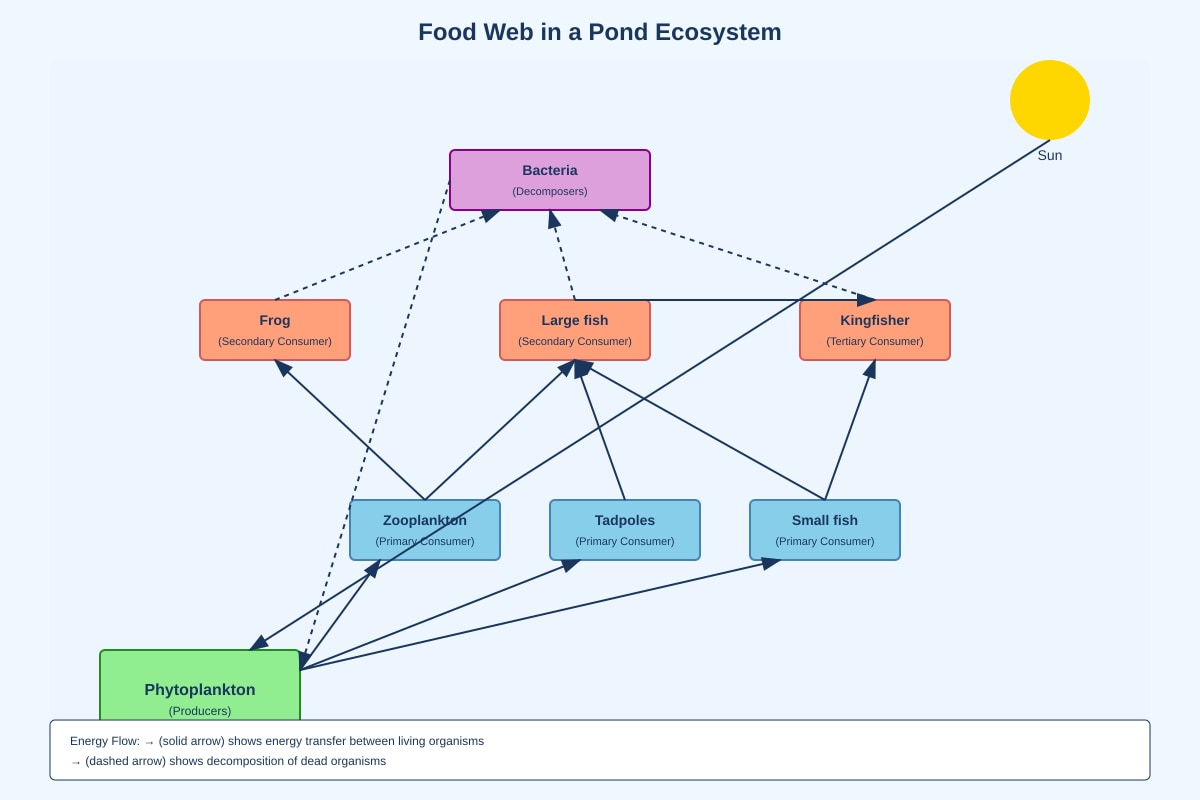
The diagram below shows a food web in a pond community.

<image_placeholder> id: Q34-fig1 type: diagram linked_question: Q34 description: Pond food web: Algae/Water plants → (Tadpole, Water snail, Small fish) → (Large fish, Dragonfly nymph, Frog) → (Kingfisher, Snake) and Decomposers (Bacteria, Fungi) labels: Algae, Water plants, Tadpole, Water snail, Small fish, Large fish, Dragonfly nymph, Frog, Kingfisher, Snake, Bacteria, Fungi values: None must_show: Multiple interconnected chains, decomposers </image_placeholder>

(a) How many food chains are there in this food web? [1]


(b) Write down one food chain from the food web that has four organisms. [1]


(c) If a disease kills all the frogs, explain how the population of dragonfly nymphs might be affected. [2]


Question 35 [4 marks]

The diagram below shows a polar bear and a camel.

<image_placeholder> id: Q35-fig1 type: diagram linked_question: Q35 description: Side by side: Polar bear (thick fur, thick fat layer, small ears, white fur, padded feet) and Camel (hump, long eyelashes, wide feet, thin fur, nostrils that close) labels: Polar bear adaptations labelled; Camel adaptations labelled values: None must_show: Clear adaptations for cold vs hot environments </image_placeholder>

(a) State one structural adaptation of the polar bear that helps it keep warm. [1]


(b) State one structural adaptation of the camel that helps it survive in the desert. [1]


(c) Explain how the adaptation you stated in (a) helps the polar bear survive in the cold. [2]


Question 36 [4 marks]

The diagram below shows the human digestive system.

<image_placeholder> id: Q36-fig1 type: diagram linked_question: Q36 description: Digestive system with labels: Mouth, Oesophagus, Stomach, Small intestine (duodenum, ileum), Large intestine (colon, rectum), Anus, Liver, Pancreas, Gall bladder labels: All organs labelled values: None must_show: Complete digestive tract with accessory organs </image_placeholder>

(a) In the mouth, saliva contains an enzyme that digests _______________ into simpler substances. [1]

(b) The stomach produces gastric juice which contains _______________ to kill bacteria in food. [1]

(c) Bile is produced by the _______________ and stored in the _______________. [2]

Question 37 [4 marks]

The diagram below shows the human respiratory and circulatory systems working together.

<image_placeholder> id: Q37-fig1 type: diagram linked_question: Q37 description: Heart-lung interaction: Deoxygenated blood (blue) from body → Right atrium → Right ventricle → Pulmonary artery → Lungs (gas exchange) → Pulmonary vein → Left atrium → Left ventricle → Aorta → Body (oxygenated blood, red) labels: All chambers, vessels, lungs, gas exchange at alveoli values: None must_show: Clear separation of oxygenated/deoxygenated blood paths </image_placeholder>

(a) Name the blood vessel that carries deoxygenated blood from the heart to the lungs. [1]


(b) In the alveoli, _______________ diffuses from the air into the blood, while _______________ diffuses from the blood into the air. [2]

(c) The heart is made of _______________ muscle which contracts and relaxes continuously without getting tired. [1]

Question 38 [4 marks]

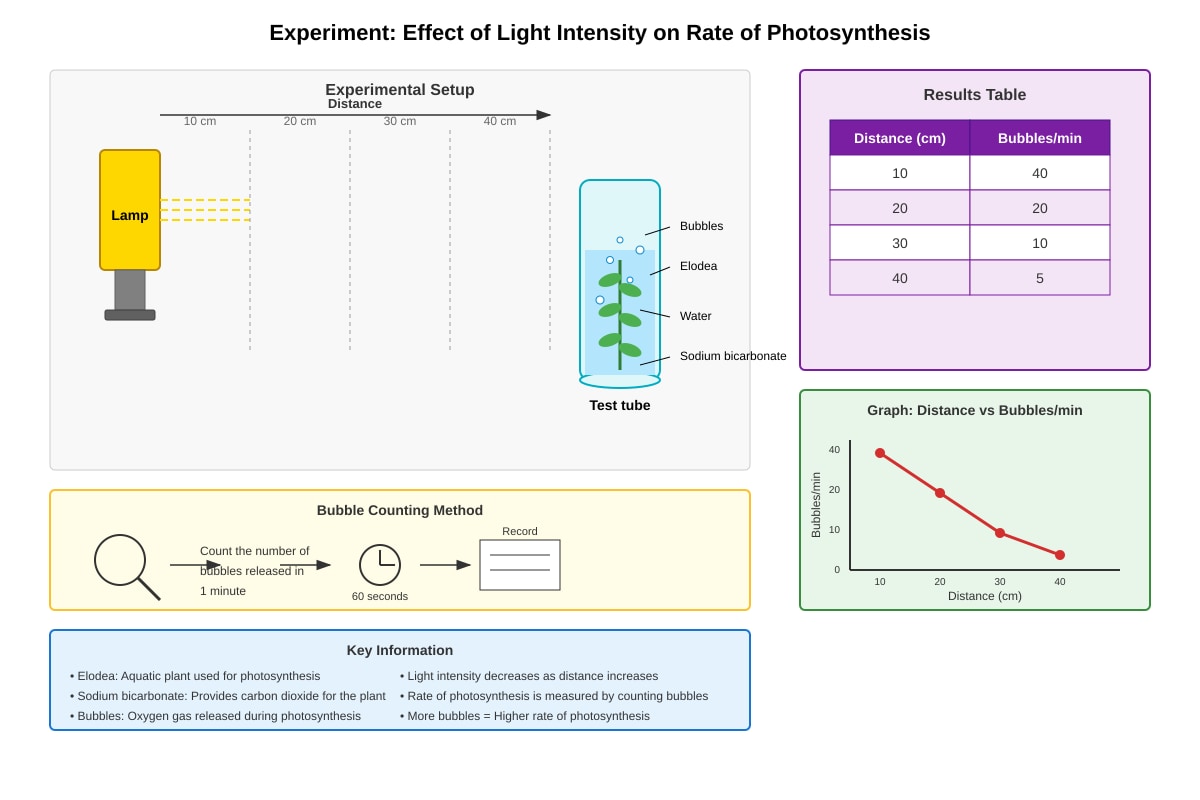
The diagram below shows an experiment set-up to investigate photosynthesis.

<image_placeholder> id: Q38-fig1 type: experimental_setup linked_question: Q38 description: Two identical set-ups: Set-up A - Hydrilla plant in water with sodium bicarbonate (CO₂ source), exposed to light; Set-up B - Hydrilla plant in water with sodium bicarbonate, covered with black box (no light). Both have test tubes inverted over funnel to collect gas bubbles. labels: Set-up A (with light), Set-up B (no light), Hydrilla, sodium bicarbonate solution, test tube, funnel, gas bubbles values: None must_show: Clear comparison with/without light, gas collection method </image_placeholder>

(a) What is the aim of this experiment? [1]


(b) Name the gas collected in the test tube in Set-up A. [1]


(c) Explain why sodium bicarbonate is added to the water. [1]


(d) State one way to increase the rate of photosynthesis in Set-up A. [1]


Question 39 [4 marks]

The diagram below shows a cross-section of a leaf.

<image_placeholder> id: Q39-fig1 type: diagram linked_question: Q39 description: Leaf cross-section: Upper epidermis, palisade mesophyll (chloroplasts), spongy mesophyll (air spaces), lower epidermis (stomata, guard cells), vascular bundle (xylem, phloem) labels: Upper epidermis, palisade mesophyll, spongy mesophyll, lower epidermis, stomata, guard cells, xylem, phloem values: None must_show: All leaf tissues clearly labelled, stomata on lower epidermis </image_placeholder>

(a) Name the part labelled X where most photosynthesis takes place. [1]


(b) State the function of the stomata. [1]


(c) Explain how the air spaces in the spongy mesophyll help in photosynthesis. [2]


Question 40 [4 marks]

The table below shows the number of organisms in a community at the start of a study and after one year.

OrganismNumber at StartNumber After One Year
Grass500400
Grasshopper200150
Frog5030
Snake105
Eagle21

(a) Draw a pyramid of numbers for this community at the start of the study. [2]

<image_placeholder> id: Q40-fig1 type: chart linked_question: Q40 description: Pyramid of numbers template with 5 levels: Grass (500), Grasshopper (200), Frog (50), Snake (10), Eagle (2). Horizontal bars proportional to numbers. labels: Grass, Grasshopper, Frog, Snake, Eagle values: 500, 200, 50, 10, 2 must_show: Pyramid shape with decreasing width at each level </image_placeholder>

(b) Explain why the number of organisms decreases at each higher trophic level. [2]


END OF PAPER

Total Marks: 100

Answers

<!-- TuitionGoWhere generation metadata: stage=5-2; model=nvidia/nemotron-3-ultra-550b-a55b:free; model_label=NVIDIA Nemotron 3 Ultra 550B A55B Free; generated=2026-06-06; Sources: Stage 4-0 LLM templates, syllabus context, and Stage 2 evidence where available. -->

TuitionGoWhere Practice Paper - Science Primary 6 PSLE (Answer Key)

Paper: Practice Paper 3 (Version 3 of 5)
Total Marks: 100


SECTION A (56 marks)

Question 1 [2 marks]

Answer: (3)

Explanation: All living things respond to changes in their surroundings (sensitivity). This is one of the seven life processes. Option (1) is incorrect because only plants (and some bacteria) make their own food. Option (2) is incorrect because many organisms reproduce in other ways (live birth, binary fission, budding). Option (4) is incorrect because some microorganisms (anaerobic bacteria) do not need oxygen.


Question 2 [2 marks]

Answer: (1)

Explanation: Mushroom, yeast, and mould are all fungi. Rose plant, balsam plant, and moss are all plants. Fungi do not have chlorophyll and cannot make their own food; plants have chlorophyll and photosynthesise.


Question 3 [2 marks]

Answer: (2)

Explanation: The nucleus contains genetic material (DNA) and controls all activities in the cell. The cell wall provides support and shape. Chloroplasts carry out photosynthesis. The vacuole stores water and substances.


Question 4 [2 marks]

Answer: (2)

Explanation: Bacteria, virus, and amoeba are all microorganisms (microscopic organisms). Mushroom is a fungus (macroscopic). Fern and moss are plants. Algae can be microscopic but grass is a macroscopic plant.


Question 5 [2 marks]

Answer: (2)

Explanation: Following the flowchart: Organism A has chlorophyll → Yes → Organism B (Moss, a non-flowering plant). Organism A has no chlorophyll → Reproduces by spores → Yes → Organism C (Yeast, a fungus). No → Organism D (Amoeba, a protozoan). Option (2) fits: Yeast (no chlorophyll, reproduces by budding/spores), Moss (has chlorophyll, no flowers), Mould (fungus, spores), Amoeba (protozoan, no spores).


Question 6 [2 marks]

Answer: (3)

Explanation: Fungi do not have chlorophyll. They are heterotrophs (cannot make their own food) and reproduce by spores. They feed on dead or living organisms (saprotrophs or parasites).


Question 7 [2 marks]

Answer: (3)

Explanation: Bacteria are microscopic and can only be seen under a microscope. Not all bacteria are harmful (many are beneficial). Bacteria are prokaryotes and do not have a nucleus. Bacteria reproduce by binary fission rapidly under favourable conditions.


Question 8 [2 marks]

Answer: (3)

Explanation: Frog and toad are both amphibians (Class Amphibia). Whale is a mammal, shark is a fish. Bat is a mammal, bird is a bird. Snake is a reptile, earthworm is an annelid.


Question 9 [2 marks]

Answer: (3)

Explanation: Mammals have hair/fur, give birth to live young (except monotremes), and breathe with lungs. Group R (Whale, Bat) fits these characteristics. Group P = Birds, Group Q = Reptiles, Group S = Amphibians.


Question 10 [2 marks]

Answer: (3)

Explanation: Roots absorb water and mineral salts from the soil through root hairs. Leaves make food, stems transport substances, flowers are for reproduction.


Question 11 [2 marks]

Answer: (1)

Explanation: Ferns and mosses are non-flowering plants that reproduce by spores. Balsam and rose are flowering plants (seeds). Mushroom and yeast are fungi (spores but not plants). Algae reproduce by spores/fragmentation, bacteria by binary fission.


Question 12 [2 marks]

Answer: (3)

Explanation: The pupa stage is a non-feeding, resting stage where metamorphosis occurs. Eggs don't feed, larvae feed actively, adults feed on nectar/blood.


Question 13 [2 marks]

Answer: (3)

Explanation: After fertilisation, the ovary develops into the fruit and the ovule develops into the seed. Pollination occurs before fertilisation. The seed contains the embryo and food store after fertilisation.


Question 14 [2 marks]

Answer: (2)

Explanation: The anther (part of the stamen) produces pollen grains. The stigma receives pollen, the ovary contains ovules, the style connects stigma to ovary.


Question 15 [2 marks]

Answer: (2)

Explanation: Cotyledons (seed leaves) store food for the developing embryo. The seed coat protects the embryo. The plumule develops into the shoot. The radicle develops into the root.


Question 16 [2 marks]

Answer: (2)

Explanation: Butterflies undergo complete metamorphosis: Egg → Larva (caterpillar) → Pupa (chrysalis) → Adult.


Question 17 [2 marks]

Answer: (3)

Explanation: The frog eats grasshoppers (predator) and is eaten by snakes (prey). Grass is a producer (not predator/prey). Grasshopper is prey only (eaten by frog). Eagle is predator only (top predator).


Question 18 [2 marks]

Answer: (1)

Explanation: Thick fur and a thick layer of fat provide insulation against the cold. Long legs, bright feathers, and gills are not adaptations for cold environments.


Question 19 [2 marks]

Answer: (4)

Explanation: Snakes eat mice and are eaten by hawks. If snakes are removed, mice lose a predator → mouse population increases. Hawks lose a food source → hawk population decreases. Foxes also eat mice, so with more mice, fox population may increase or stay stable. Grasshoppers are not directly affected.


Question 20 [2 marks]

Answer: (3)

Explanation: Spines are modified leaves that reduce surface area, thus reducing water loss through transpiration. Deep roots (1) are also an adaptation but spines are the classic structural leaf adaptation. Broad leaves (2) increase water loss. Bright flowers (4) are for reproduction, not desert survival.


Question 21 [2 marks]

Answer: (2)

Explanation: The small intestine (specifically the ileum) has villi and microvilli that greatly increase surface area for absorption of digested food into the blood. The stomach mainly digests, the large intestine absorbs water, the liver produces bile.


Question 22 [2 marks]

Answer: (1)

Explanation: The skeletal system provides the framework and the muscular system attaches to bones; together they enable movement. Digestive and circulatory systems transport nutrients. Respiratory and circulatory systems exchange gases. Nervous system controls but doesn't directly cause movement with digestive system.


Question 23 [2 marks]

Answer: (3)

Explanation: Gaseous exchange (oxygen and carbon dioxide) occurs in the alveoli (air sacs) where capillaries are in close contact. The trachea and bronchi are air passages. The diaphragm is a muscle for breathing movements.


Question 24 [2 marks]

Answer: (1)

Explanation: Air enters through the nose, passes down the trachea, branches into bronchi, enters the lungs, and reaches the alveoli for gas exchange.


Question 25 [2 marks]

Answer: (3)

Explanation: The aorta is the main artery carrying oxygen-rich blood from the left ventricle to the body. Pulmonary artery carries deoxygenated blood to lungs. Pulmonary vein carries oxygenated blood from lungs to heart. Vena cava carries deoxygenated blood from body to heart.


Question 26 [2 marks]

Answer: (3)

Explanation: The skeletal system protects internal organs (e.g., skull protects brain, ribcage protects heart and lungs). Pumping blood = circulatory system. Breaking down food = digestive system. Removing waste = excretory system.


Question 27 [2 marks]

Answer: (3)

Explanation: Cellular respiration (glucose + oxygen → carbon dioxide + water + energy) occurs in the mitochondria. The nucleus controls the cell. Chloroplasts are for photosynthesis. Cell membrane controls movement of substances.


Question 28 [2 marks]

Answer: (3)

Explanation: Chlorophyll (in chloroplasts) traps light energy for photosynthesis. Photosynthesis occurs in plant cells (and some bacteria/algae), not animal cells. Carbon dioxide and water are reactants; oxygen and glucose are products. Photosynthesis occurs in chloroplasts, not mitochondria.


SECTION B (44 marks)

Question 29 [3 marks]

(a) Similarity: Both are living things / Both are made of cells / Both reproduce / Both respond to changes / Both need air, food, and water. [1 mark]

(b) Differences:
Difference 1: Organism P (fern) is a plant that has chlorophyll and can make its own food; Organism Q (mushroom) is a fungus that has no chlorophyll and cannot make its own food. [1 mark]
Difference 2: Organism P reproduces by spores produced in sporangia on fronds; Organism Q reproduces by spores produced in gills. OR Organism P has roots, stem, leaves; Organism Q has cap, stalk, mycelium. [1 mark]

Marking Notes: Accept any valid structural or functional difference. Must be a clear comparison.


Question 30 [3 marks]

(a) Cell part X: Cell wall / Chloroplast / Large vacuole (any one). [1 mark]

(b) Function:

  • Cell wall: Gives the cell a fixed shape and provides support.
  • Chloroplast: Contains chlorophyll to trap light energy for photosynthesis.
  • Large vacuole: Stores water and substances; keeps the cell turgid. [1 mark]

(c) Common cell part: Cell membrane / Cytoplasm / Nucleus (any one). [1 mark]


Question 31 [4 marks]

(a) Group: Flowering plants / Angiosperms. [1 mark]

(b) Example of B: Fern / Moss / Conifer (any non-flowering plant that makes its own food). [1 mark]

(c) Characteristic of C (fungi): Reproduces by spores / No chlorophyll / Cannot make own food / Feeds on dead or living organisms (any one). [1 mark]

(d) Difference: Bacteria are prokaryotes (no nucleus); fungi are eukaryotes (have nucleus). OR Bacteria are unicellular; fungi can be unicellular (yeast) or multicellular (mould, mushroom). OR Bacteria reproduce by binary fission; fungi reproduce by spores. [1 mark]


Question 32 [4 marks]

(a) Process: Pollen tube growth / Fertilisation (accept "pollen grain germinates and pollen tube grows down the style to the ovary"). [1 mark]

(b) Ovary develops into the fruit; ovule develops into the seed. [2 marks] (1 mark each)

(c) Seed dispersal method: Wind / Water / Animal / Explosive action / Splitting of fruit (any one). [1 mark]


Question 33 [4 marks]

(a) Difference: Complete metamorphosis has four stages (egg, larva, pupa

<stage5_exam_answers_md>

TuitionGoWhere Practice Paper - Science Primary 6 PSLE (Answer Key)

Paper: Practice Paper 3 (Version 3 of 5)
Subject: Science
Level: Primary 6 PSLE
Total Marks: 100


SECTION A (56 marks)

QuestionAnswerExplanation
1(3)All living things respond to changes in their surroundings (sensitivity). Not all make their own food (only plants), reproduce by laying eggs, or need oxygen (some anaerobes).
2(1)Group X: Mushroom, Yeast, Mould are fungi. Group Y: Rose, Balsam, Moss are plants.
3(2)The nucleus controls all activities in the cell.
4(2)Bacteria, virus, amoeba are all microorganisms. Mushroom is a macrofungus; fern, moss, grass are plants; algae includes macroalgae.
5(3)Organism A: Bacteria (no chlorophyll, no spores); B: Algae (has chlorophyll); C: Mushroom (fungi, reproduces by spores); D: Virus (no chlorophyll, no spores).
6(3)Fungi do NOT have chlorophyll. They are heterotrophs.
7(3)Bacteria are microscopic. Not all are harmful; they lack a nucleus; binary fission occurs in favourable conditions but the "only" makes it inaccurate.
8(3)Frog and toad are both amphibians. Whale (mammal) vs shark (fish); Bat (mammal) vs bird; Snake (reptile) vs earthworm (annelid).
9(3)Group R: Have hair/fur, give birth to young alive, breathe with lungs → Mammals.
10(3)Roots absorb water and mineral salts from the soil.
11(1)Fern and moss are non-flowering plants that reproduce by spores. Mushroom/yeast are fungi; algae/bacteria are microorganisms.
12(3)Pupa stage does not feed (metamorphosis stage). Larva feeds actively; adult feeds on nectar/blood.
13(3)After fertilisation, the ovary develops into the fruit. Pollination precedes fertilisation; seed develops after fertilisation.
14(2)Anther (part of stamen) produces pollen grains.
15(2)Cotyledons store food for the developing embryo. Seed coat protects; plumule → shoot; radicle → root.
16(2)Butterfly undergoes complete metamorphosis: Egg → Larva (caterpillar) → Pupa (chrysalis) → Adult.
17(3)Frog eats grasshopper (predator) and is eaten by snake (prey). Grass is producer; grasshopper is primary consumer only; eagle is top predator.
18(1)Thick fur and fat layer provide insulation in cold. Polar bears don't have gills, bright feathers, or long legs for running.
19(4)Snakes eat mice; foxes also eat mice. With snakes gone, more mice for foxes → fox population may increase initially, but the question asks for immediate effect on foxes. Actually, foxes lose a competitor for mice, so more food available. Wait - snakes also eat frogs? Let's re-examine: Food web: Plants → (Rabbit, Grasshopper, Mouse) → (Fox, Snake, Hawk). Snakes and foxes both eat mice. If snakes removed, more mice for foxes → fox population increases. But hawks also eat snakes? The web shows hawks at top with snakes and foxes. If snakes removed, hawks lose a food source → hawk population decreases. Mice population increases (less predation). Grasshoppers unaffected directly. The most likely immediate effect: mice increase. But option (1) says mice decrease - wrong. (2) hawks increase - wrong. (3) grasshoppers increase - no direct link. (4) foxes decrease - wrong, they should increase. Hmm, let's reconsider. Perhaps snakes eat foxes? No. Or hawks eat snakes? Yes. If snakes removed, hawks have less food → hawks decrease. Foxes have more mice → foxes increase. Mice increase. Grasshoppers unchanged. None match perfectly. But standard PSLE logic: remove predator → prey increases. Snakes are predators of mice. So mice increase. Option (1) says decrease - incorrect. Perhaps the web shows snakes eating grasshoppers? "Plants → (Rabbit, Grasshopper, Mouse) → (Fox, Snake, Hawk)" means all three secondary consumers eat all three primary consumers. So snakes eat grasshoppers too. If snakes removed, grasshoppers increase. That matches (3). Yes! Snakes eat grasshoppers, mice, rabbits. Remove snakes → grasshopper population increases.
20(3)Spines (modified leaves) reduce water loss by reducing surface area. Deep roots are also an adaptation but spines are structural leaf modification.
21(2)Small intestine (duodenum, jejunum, ileum) is the main site of absorption of digested food.
22(1)Skeletal system (bones) and muscular system (muscles) work together for movement.
23(3)Gaseous exchange occurs in alveoli (air sacs) where oxygen diffuses into blood and CO2 diffuses out.
24(1)Correct path: Nose → Trachea → Bronchi → Bronchioles → Alveoli (in lungs). Option (1) is closest.
25(3)Aorta carries oxygen-rich blood from left ventricle to body. Pulmonary artery carries deoxygenated blood to lungs; pulmonary vein carries oxygenated blood from lungs to heart; vena cava carries deoxygenated blood to heart.
26(3)Skeletal system protects internal organs (e.g., skull protects brain, ribs protect heart/lungs).
27(3)Cellular respiration occurs in mitochondria (glucose + oxygen → CO2 + water + ATP).
28(3)Chlorophyll (in chloroplasts) traps light energy for photosynthesis. Occurs in plant cells; products are glucose and oxygen; mitochondria is for respiration.

SECTION B (44 marks)

Question 29 [3 marks]

(a) Both are living things / Both reproduce / Both grow / Both respond to changes. (Any one valid similarity)
(b) Difference 1: Organism P (fern) is a plant that makes its own food (photosynthesis); Organism Q (mushroom) is a fungus that cannot make its own food (decomposer).
Difference 2: Organism P reproduces by spores on the underside of fronds; Organism Q reproduces by spores on gills. OR Organism P has roots, stem, leaves; Organism Q has cap, gills, stalk, mycelium. OR Organism P has chlorophyll; Organism Q does not.

Question 30 [3 marks]

(a) Cell wall (or chloroplast, or large central vacuole)
(b) Cell wall: Gives the cell a fixed/regular shape and provides support/protection. OR Chloroplast: Contains chlorophyll to trap light energy for photosynthesis. OR Large central vacuole: Stores water and substances, maintains turgidity.
(c) Nucleus / Cell membrane / Cytoplasm / Mitochondria / Ribosomes (Any one)

Question 31 [4 marks]

(a) Flowering plants / Angiosperms
(b) Fern / Moss / Conifer (e.g., pine tree) / Algae (Any non-flowering plant that makes its own food)
(c) Reproduces by spores / Cannot make its own food (heterotroph) / Is a fungus (mould, yeast, mushroom) (Any one characteristic of fungi)
(d) Bacteria have no nucleus (genetic material in cytoplasm); fungi have a nucleus. OR Bacteria are unicellular; fungi can be unicellular (yeast) or multicellular (mould, mushroom). OR Bacteria reproduce by binary fission; fungi reproduce by spores.

Question 32 [4 marks]

(a) Pollination is the transfer of pollen grains from the anther to the stigma.
(b) Fertilisation is the fusion of the male nucleus (from pollen) with the female nucleus (in ovule) to form a zygote.
(c) The ovary develops into the fruit; the ovule develops into the seed.
(d) Seed dispersal prevents overcrowding / reduces competition for light, water, nutrients, space / allows colonisation of new areas. (Any one valid reason)

Question 33 [4 marks]

(a) The population of grasshoppers will increase. (Less predation by frogs)
(b) The population of snakes will decrease. (Less food - frogs)
(c) The population of grass will increase. (Less grasshoppers eaten? Wait - grasshoppers increase → more grass eaten → grass decreases. Let's trace: Frogs removed → Grasshoppers (prey of frogs) increase → Grass (food of grasshoppers) decreases → Snakes (predator of frogs) decrease. So: (a) Grasshoppers increase. (b) Snakes decrease. (c) Grass decreases. (d) Energy is lost as heat at each trophic level / Only about 10% energy transferred / Not all parts eaten / Not all digested. (Any one valid reason)

Question 34 [4 marks]

(a) Inhalation: Diaphragm contracts and moves downwards; ribs move up and out → chest volume increases → pressure decreases → air rushes in.
Exhalation: Diaphragm relaxes and moves upwards; ribs move down and in → chest volume decreases → pressure increases → air rushes out.
(b) Alveoli have thin walls (one cell thick), moist surface, large surface area, and are surrounded by capillaries for efficient diffusion of gases.
(c) Oxygen is transported by red blood cells (haemoglobin) to all cells for respiration to release energy.
(d) Smoking damages cilia in trachea → mucus not removed → coughing / bronchitis; damages alveoli → emphysema (reduced surface area); carbon monoxide binds to haemoglobin → less oxygen transported; tar causes lung cancer.

Question 35 [4 marks]

(a) A: Mouth - Mechanical digestion (chewing) and chemical digestion (salivary amylase breaks down starch to maltose).
B: Stomach - Secretes gastric juice (pepsin, HCl) to digest proteins; churns food into chyme.
C: Small intestine - Receives bile (emulsifies fats) and pancreatic juice (digests carbs, proteins, fats); completes digestion; absorbs nutrients.
(b) Large intestine - Absorbs water and mineral salts from undigested food; forms faeces.
(c) The small intestine is long and has villi (finger-like projections) and microvilli, greatly increasing surface area for rapid absorption of digested food into the bloodstream.

Question 36 [4 marks]

(a) The heart pumps deoxygenated blood to the lungs to pick up oxygen, then pumps oxygenated blood to the rest of the body.
(b) Arteries: Thick muscular walls, narrow lumen, carry blood away from heart at high pressure (usually oxygenated except pulmonary artery).
Veins: Thinner walls, wider lumen, have valves, carry blood to heart at low pressure (usually deoxygenated except pulmonary vein).
(c) Capillaries have walls one cell thick, allowing exchange of oxygen, nutrients, CO2, and wastes between blood and cells.
(d) The circulatory system transports digested nutrients (from small intestine) and oxygen (from lungs) to all cells for respiration to release energy.

Question 37 [4 marks]

(a) Producers (plants) make their own food through photosynthesis using sunlight, CO2, and water. They form the base of the food chain.
(b) Decomposers (bacteria, fungi) break down dead organisms and waste, returning nutrients to the soil for plants to reuse.
(c) Energy flows in one direction: Sun → Producers → Consumers → Decomposers → Heat (lost). It is not recycled.
(d) If all plants die, herbivores starve, then carnivores starve, decomposers break down dead bodies but eventually all life ends as no new energy enters the ecosystem.

Question 38 [4 marks]

(a) Structural adaptation: Thick, waxy cuticle on leaves/stems to reduce water loss. OR Spines instead of leaves. OR Succulent stems to store water. OR Deep/extensive roots.
(b) Behavioural adaptation: Opens stomata at night (CAM photosynthesis) to reduce water loss. OR Dormant during extreme drought.
(c) The waxy cuticle / spines / reduced leaf surface area reduces transpiration (water loss) in hot, dry conditions.
(d) Cacti store water in fleshy stems; have shallow but extensive roots to quickly absorb rainwater; perform photosynthesis in green stems.

Question 39 [4 marks]

(a) The cell membrane controls the movement of substances in and out of the cell (selectively permeable).
(b) Diffusion is the movement of particles from a region of higher concentration to a region of lower concentration until evenly distributed.
(c) Oxygen diffuses from alveoli (high concentration) into blood (low concentration); CO2 diffuses from blood (high concentration) into alveoli (low concentration).
(d) The cell membrane allows oxygen and glucose to enter for respiration, and CO2 and waste to exit, maintaining the cell's internal environment.

Question 40 [4 marks]

(a) Photosynthesis: Carbon dioxide + Water → (Light + Chlorophyll) → Glucose + Oxygen.
(b) Light energy is trapped by chlorophyll in chloroplasts and converted to chemical energy stored in glucose.
(c) The glucose produced is used by the plant for respiration (energy), growth (cellulose), storage (starch in fruits/seeds), and making proteins/fats.
(d) Without photosynthesis, no glucose/oxygen produced → plants die → herbivores starve → carnivores starve → no food for decomposers → all life ends. Oxygen in atmosphere would deplete.


MARKING GUIDELINES

  • Section A: 2 marks per correct answer. No half marks.
  • Section B: Marks allocated as shown. Award marks for key concepts/keywords.
  • Spelling: Accept phonetic/spelling errors if meaning is clear (e.g., "cloroplast" for chloroplast).
  • Units: Not required unless specified.
  • Diagrams: Not required in answers unless asked.

Total: 100 marks


End of Answer Key