AI Generated Exam Paper

Primary 6 PSLE Science Practice Paper 3

Free Kimi AI-generated P6 PSLE Science Practice Paper 3 with questions, answers, and PSLE-focused practice for Singapore students preparing for exams.

These static practice materials are generated from the site's syllabus and paper-generation workflow, with source and model context shown so students and parents can evaluate the material before use.

Primary 6 PSLE Science AI Generated Generated by Kimi K2.6 Free Updated 2026-06-09

Questions

<!-- TuitionGoWhere generation metadata: stage=5-2; model=moonshotai/kimi-k2.6:free; model_label=Kimi K2.6 Free; generated=2026-06-07; Sources: Stage 4-0 LLM templates, syllabus context, and Stage 2 evidence where available. -->

TuitionGoWhere Practice Paper - Science Primary 6 PSLE

TuitionGoWhere Practice Paper (AI) Version 3 of 5

Subject: Science
Level: Primary 6
Paper: Practice Paper
Duration: 1 hour 45 minutes
Total Marks: 100

Name: _______________________
Class: _______________________
Date: _______________________


Instructions

  1. This paper consists of two sections: Section A and Section B.
  2. Section A (Questions 1-14): Multiple-choice questions. Choose the correct answer and write its letter (A, B, C, or D) in the box provided. Each question carries 2 marks.
  3. Section B (Questions 15-28): Open-ended questions. Write your answers in the spaces provided. Marks for each question are shown in brackets.
  4. Use of calculators is not allowed.
  5. Answer all questions.
  6. Write neatly and clearly in complete sentences where appropriate.

Section A: Multiple-Choice Questions (28 marks)

Answer all questions. Each question carries 2 marks.


1. Which of the following groups of living things can be classified as amphibians?

Living thingCharacteristics
AFrogLives in water and on land; has moist skin; lays eggs in water
BFishLives entirely in water; has scales; breathes through gills
CLizardLives on land; has dry, scaly skin; lays eggs on land
DPenguinLives on land and in water; has feathers; lays eggs on land

Write your answer in the box: [ ]


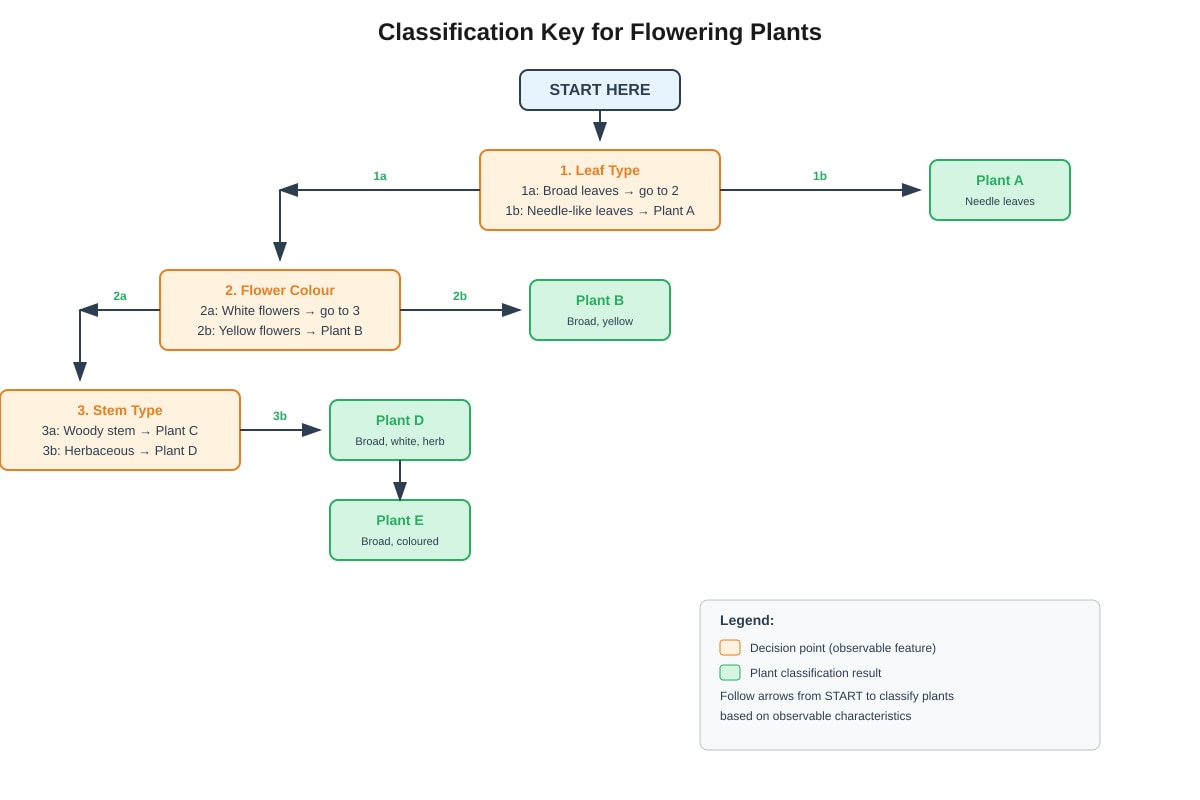
2. The diagram below shows a classification key for some flowering plants.

<image_placeholder> id: Q2-fig1 type: diagram linked_question: Q2 description: Dichotomous key for classifying flowering plants. Starts at "1a" with two branches leading to "2a/2b" and "Plant A". From 2a: branches to "3a/3b" and "Plant B". From 2b: leads to "Plant C". From 3a: leads to "Plant D". From 3b: leads to "Plant E". Each decision point shows observable features like leaf type, flower colour, stem characteristics. labels: 1a, 1b, 2a, 2b, 3a, 3b, Plant A, Plant B, Plant C, Plant D, Plant E values: None must_show: Complete branching structure with decision criteria at each node; all five plant labels clearly visible; arrows showing flow of key </image_placeholder>

A plant has broad leaves, white flowers, and a woody stem. Using the key above, which plant is it most likely to be?

A) Plant A
B) Plant B
C) Plant D
D) Plant E

Write your answer in the box: [ ]


3. Which characteristic is used to classify all the following into the same group: butterfly, grasshopper, ant, and beetle?

A) They all have six legs
B) They all can fly
C) They all live in colonies
D) They all have hard outer shells

Write your answer in the box: [ ]


4. The table below shows some properties of four different materials.

MaterialAllows light to pass throughAllows water to pass throughCan be stretched
PYesYesNo
QNoNoYes
RYesNoNo
SNoYesNo

Which material is most suitable for making a raincoat?

A) P
B) Q
C) R
D) S

Write your answer in the box: [ ]


5. Which of the following shows the correct classification of these objects: air, water, oil, and wood?

A) All are matter
B) All are non-living things
C) All are natural materials
D) All can be classified in more than one way depending on the criteria used

Write your answer in the box: [ ]


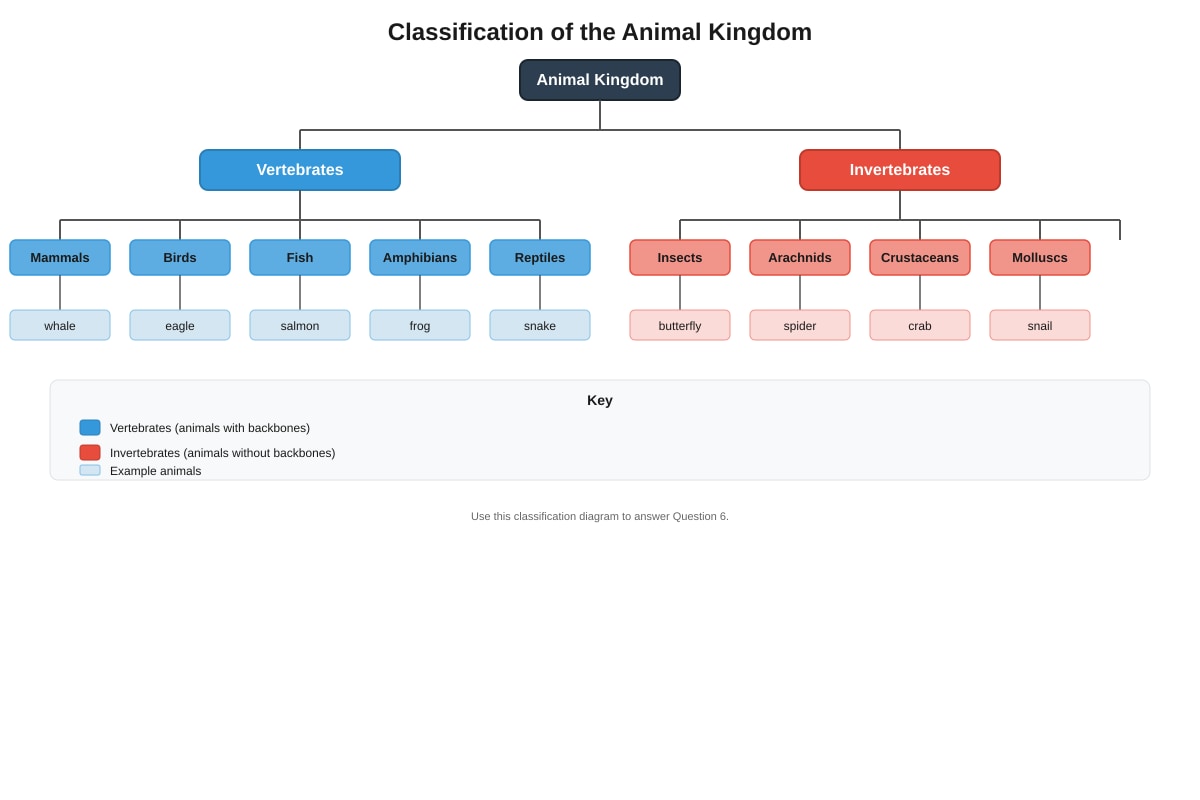
6. The diagram shows how some animals are classified into groups.

<image_placeholder> id: Q6-fig1 type: diagram linked_question: Q6 description: Classification tree showing Animal Kingdom branching into Vertebrates and Invertebrates. Vertebrates branch into Mammals, Birds, Fish, Amphibians, Reptiles. Invertebrates branch into Insects, Arachnids, Crustaceans, Molluscs. Some example animals are placed at the ends: whale (Mammals), eagle (Birds), salmon (Fish), frog (Amphibians), snake (Reptiles), butterfly (Insects), spider (Arachnids), crab (Crustaceans), snail (Molluscs). labels: Animal Kingdom, Vertebrates, Invertebrates, Mammals, Birds, Fish, Amphibians, Reptiles, Insects, Arachnids, Crustaceans, Molluscs, whale, eagle, salmon, frog, snake, butterfly, spider, crab, snail values: None must_show: Hierarchical tree structure with clear branching; all group labels and example animals visible; connecting lines showing classification relationships </image_placeholder>

Based on the classification above, which statement is correct?

A) A whale and a salmon are in the same group because they both live in water
B) A frog and a snake are in different groups because they have different body coverings
C) A butterfly and a spider are in the same main group but different sub-groups
D) An eagle and a bat would be classified in the same group because they both can fly

Write your answer in the box: [ ]


7. Four objects were tested to see if they were attracted to a magnet. The results are shown below.

ObjectAttracted to magnet?
Paper clipYes
Aluminium foilNo
Iron nailYes
Plastic rulerNo

What can be concluded from these results?

A) All metals can be attracted to a magnet
B) Only iron objects can be attracted to a magnet
C) Different materials have different properties
D) All objects that are attracted to a magnet are heavy

Write your answer in the box: [ ]


8. Which of the following is the most appropriate way to classify these items: apple, carrot, rice, chicken, milk, and egg?

A) By colour
B) By whether they come from plants or animals
C) By their taste
D) By their price

Write your answer in the box: [ ]


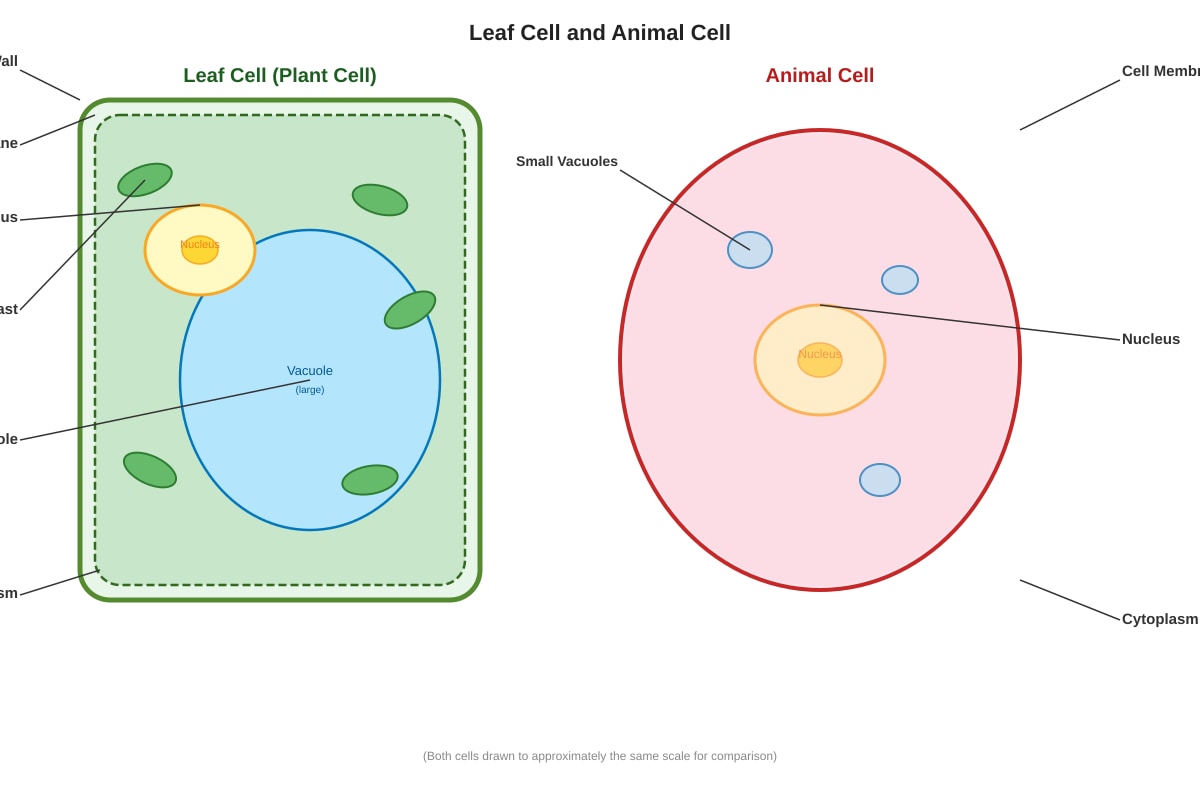
9. The diagram shows the structure of a leaf cell and an animal cell.

<image_placeholder> id: Q9-fig1 type: diagram linked_question: Q9 description: Side-by-side comparison of a plant leaf cell and an animal cell. Plant cell shows: cell wall, cell membrane, cytoplasm, nucleus, chloroplasts, large vacuole. Animal cell shows: cell membrane, cytoplasm, nucleus, small vacuoles if present. Both labelled clearly with leader lines. labels: Cell wall, Cell membrane, Cytoplasm, Nucleus, Chloroplast, Vacuole (plant); Cell membrane, Cytoplasm, Nucleus (animal) values: None must_show: Clear boundary between cell wall and cell membrane in plant cell; chloroplasts coloured/shaded green; size difference in vacuoles; both cells approximately same scale for comparison </image_placeholder>

Which structure found in the leaf cell is not present in the animal cell?

A) Cell membrane
B) Nucleus
C) Chloroplast
D) Cytoplasm

Write your answer in the box: [ ]


10. A student wants to classify some unknown substances as solids, liquids, or gases. Which property should she test first to make this classification?

A) Colour
B) Shape and volume
C) Ability to dissolve in water
D) Smell

Write your answer in the box: [ ]


11. The table shows how some food items are classified.

Group XGroup Y
BeefApple
ChickenCabbage
FishCarrot
EggRice

What is the basis of this classification?

A) Group X needs to be cooked; Group Y can be eaten raw
B) Group X comes from animals; Group Y comes from plants
C) Group X contains more protein; Group Y contains more carbohydrates
D) Group X is more expensive; Group Y is cheaper

Write your answer in the box: [ ]


12. Which of the following statements about the diversity of living things is incorrect?

A) Classification helps scientists study living things more systematically
B) There are more species of insects than all other animal groups combined
C) All bacteria are harmful to humans
D) Fungi can be both useful and harmful to humans

Write your answer in the box: [ ]


13. Four solutions were tested with litmus paper. The results are shown below.

SolutionRed litmus paperBlue litmus paper
Wstays redturns red
Xstays redstays blue
Yturns bluestays blue
Zstays redstays blue

Which solution is neutral?

A) W
B) X
C) Y
D) Z

Write your answer in the box: [ ]


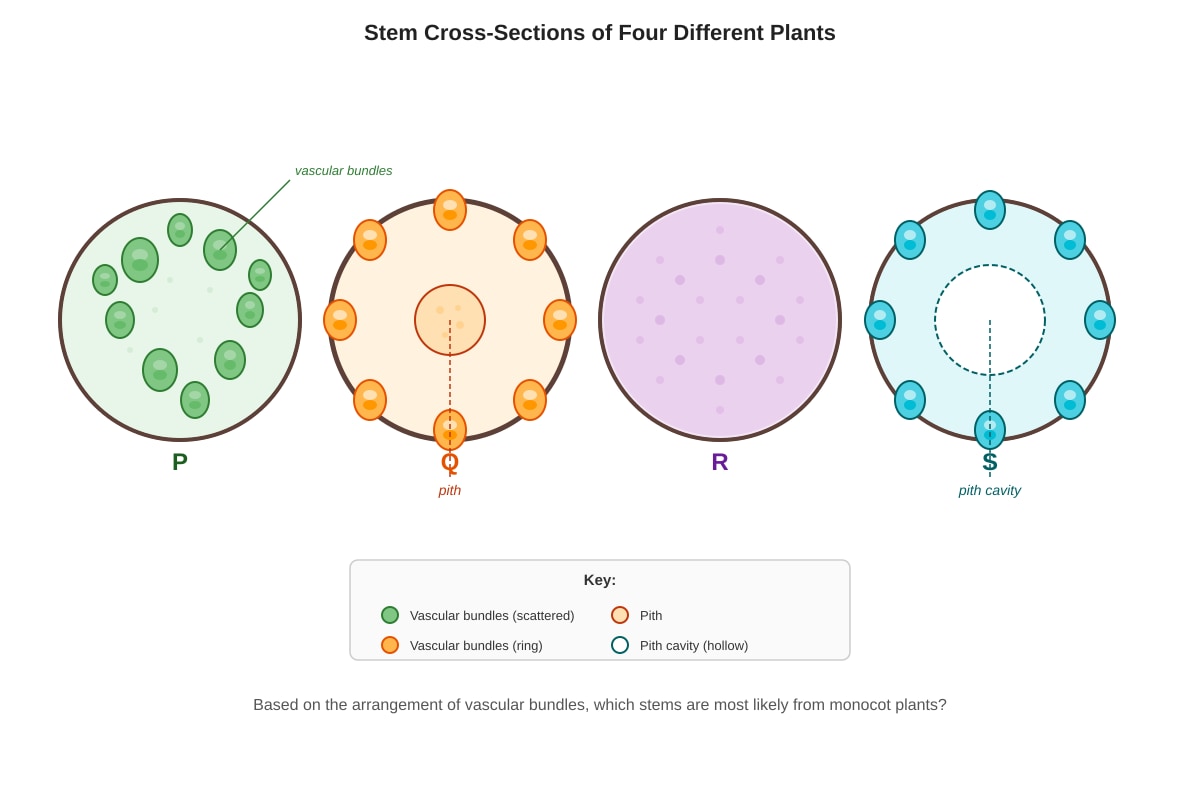
14. The diagram shows cross-sections of stems from four different plants.

<image_placeholder> id: Q14-fig1 type: diagram linked_question: Q14 description: Four stem cross-sections arranged horizontally. Stem P: vascular bundles scattered throughout. Stem Q: vascular bundles arranged in a ring with pith in centre. Stem R: no visible vascular bundle structure, solid throughout. Stem S: vascular bundles in a ring with large hollow centre (pith cavity). Labels P, Q, R, S below each diagram. labels: P, Q, R, S, vascular bundles, pith, pith cavity values: None must_show: Clear differences in vascular bundle arrangement; P with scattered bundles characteristic of monocot; Q with ring of bundles and central pith typical of dicot woody stem; R solid without distinct vascular tissue (herbaceous non-vascular appearance); S with ring of bundles and large hollow centre (typical of some grasses/bamboos) </image_placeholder>

Based on the arrangement of vascular bundles, which stems are most likely from monocot plants?

A) P and R only
B) Q and S only
C) P only
D) R and S only

Write your answer in the box: [ ]


End of Section A


Section B: Open-Ended Questions (72 marks)

Answer all questions. Write your answers in the spaces provided.


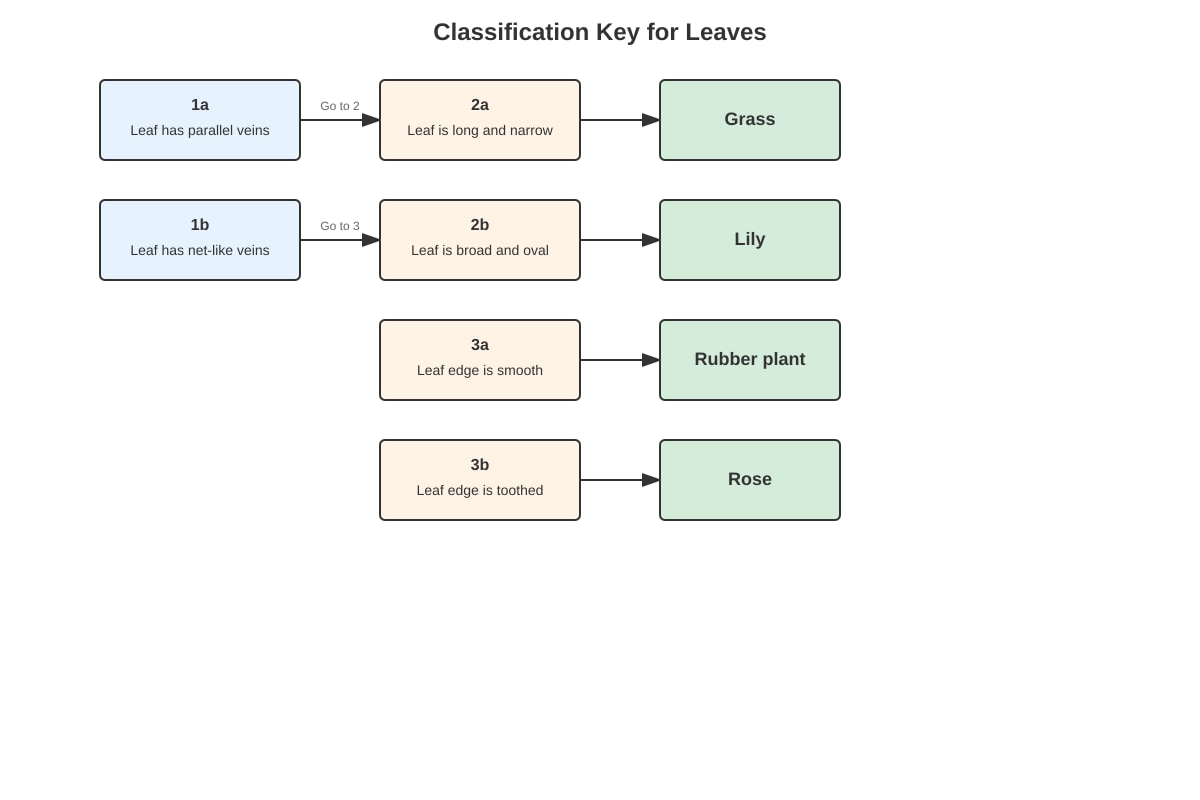
15. Study the classification key below and answer the questions that follow.

<image_placeholder> id: Q15-fig1 type: diagram linked_question: Q15 description: Dichotomous key for classifying leaves. Starting with "1a" and "1b". 1a: Leaf has parallel veins → goes to "2a/2b". 1b: Leaf has net-like veins → goes to "3a/3b". 2a: Leaf is long and narrow → Grass. 2b: Leaf is broad and oval → Lily. 3a: Leaf edge is smooth → Rubber plant. 3b: Leaf edge is toothed → Rose. labels: 1a, 1b, 2a, 2b, 3a, 3b, Grass, Lily, Rubber plant, Rose, parallel veins, net-like veins, long and narrow, broad and oval, smooth edge, toothed edge values: None must_show: Complete key structure with paired choices at each level; clear arrows or lines connecting decisions; leaf characteristics described at each node; final plant names at endpoints </image_placeholder>

(a) State two visible characteristics used in this key to classify leaves. [2]


(b) A student found a leaf with net-like veins and toothed edges. Name the plant this leaf belongs to. [1]


(c) Explain why using more than one characteristic makes the classification more reliable than using only one characteristic. [2]


[Total: 5 marks]


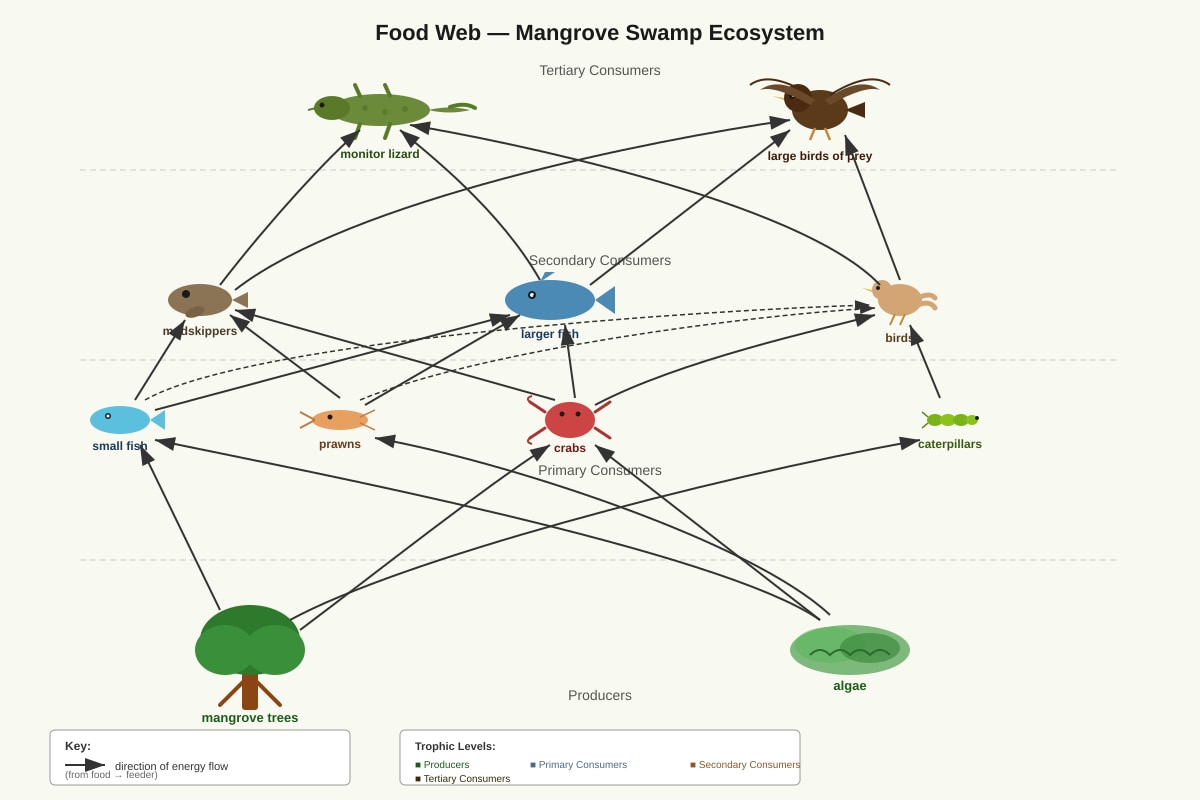
16. The diagram shows a food web from a mangrove swamp ecosystem.

<image_placeholder> id: Q16-fig1 type: diagram linked_question: Q16 description: Food web diagram for a mangrove swamp. Producers: mangrove trees, algae. Primary consumers: small fish, prawns, crabs, caterpillars. Secondary consumers: mudskippers, larger fish, birds. Tertiary consumers: monitor lizard, large birds of prey. Arrows show feeding relationships/energy flow between organisms. Multiple interconnected pathways shown. labels: mangrove trees, algae, small fish, prawns, crabs, caterpillars, mudskippers, larger fish, birds, monitor lizard, large birds of prey values: None must_show: Clear arrows indicating direction of energy flow; multiple feeding pathways; at least three trophic levels visible; mangrove trees and algae as base producers; interconnected web structure rather than simple chain </image_placeholder>

(a) Name two producers shown in this food web. [2]


(b) Draw a food chain from this food web that contains four organisms, including a tertiary consumer. [2]


(c) Explain what would happen to the population of larger fish if all the prawns were removed from this ecosystem. [2]


[Total: 6 marks]


17. The table below shows some properties of materials P, Q, R, and S.

PropertyPQRS
Hard or softHardSoftHardSoft
Floats or sinks in waterSinksFloatsSinksFloats
Allows light to pass throughNoNoYesYes

(a) Which material would be most suitable for making each of the following items? Explain your choice in each case.

(i) A window pane [2]

Material: ___________

Explanation: _______________________________________________


(ii) A life jacket for a swimmer [2]

Material: ___________

Explanation: _______________________________________________


(b) A student said, "Hard materials always sink in water." Is the student correct? Use evidence from the table to explain your answer. [2]


[Total: 6 marks]


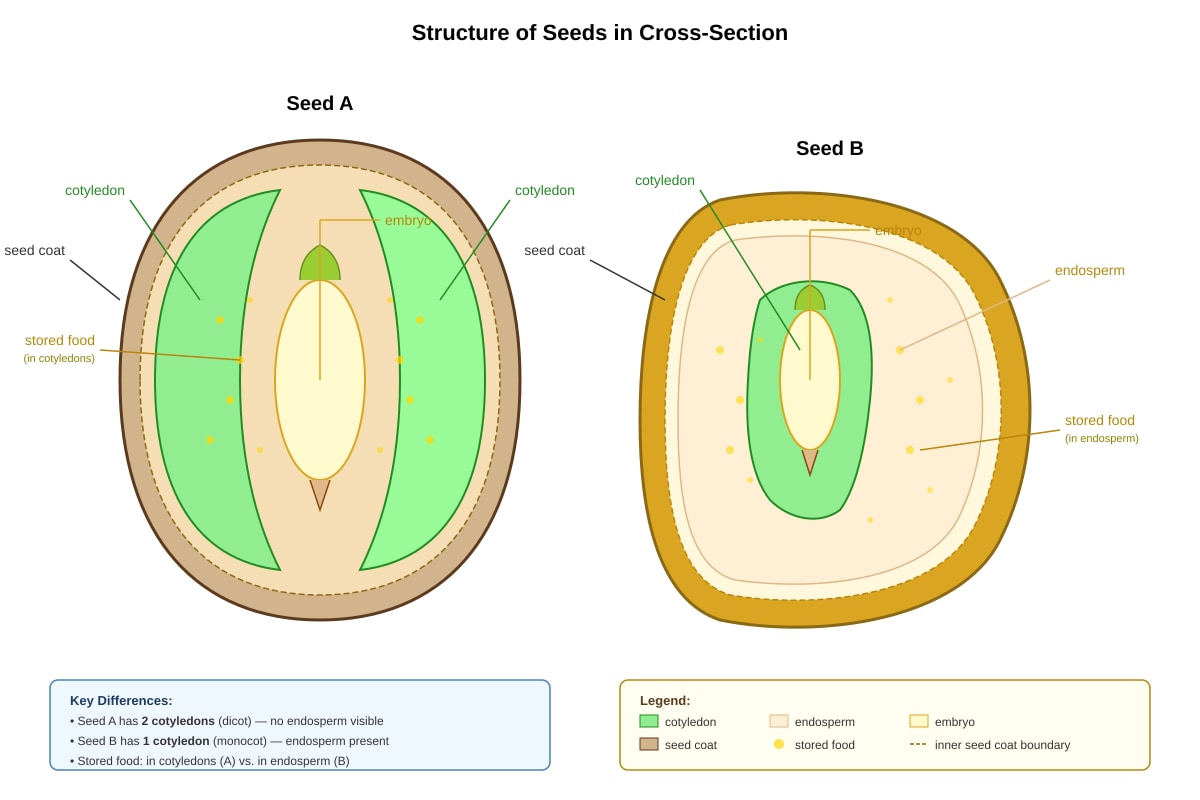
18. The diagram shows two different types of seeds.

<image_placeholder> id: Q18-fig1 type: diagram linked_question: Q18 description: Two seeds side by side with cross-sections showing internal structure. Seed A (Dicot): two cotyledons visible in cross-section, kidney-shaped, no endosperm, stored food in cotyledons. Seed B (Monocot): one cotyledon visible, elongated, endosperm present surrounding embryo, stored food mainly in endosperm. Both with labels pointing to key parts. labels: Seed A, Seed B, cotyledon (x2 in A, x1 in B), endosperm (B only), seed coat, embryo, stored food values: None must_show: Clear difference in cotyledon number; presence of endosperm in B but not A; embryo visible in both; seed coats labelled; approximate relative sizes shown </image_placeholder>

(a) Give one visible difference between Seed A and Seed B based on the diagram. [1]


(b) State whether each seed is most likely from a monocot plant or a dicot plant. [2]

Seed A: _______________________________________________

Seed B: _______________________________________________

(c) Explain why the stored food in the seed is important for the plant's growth. [2]


[Total: 5 marks]


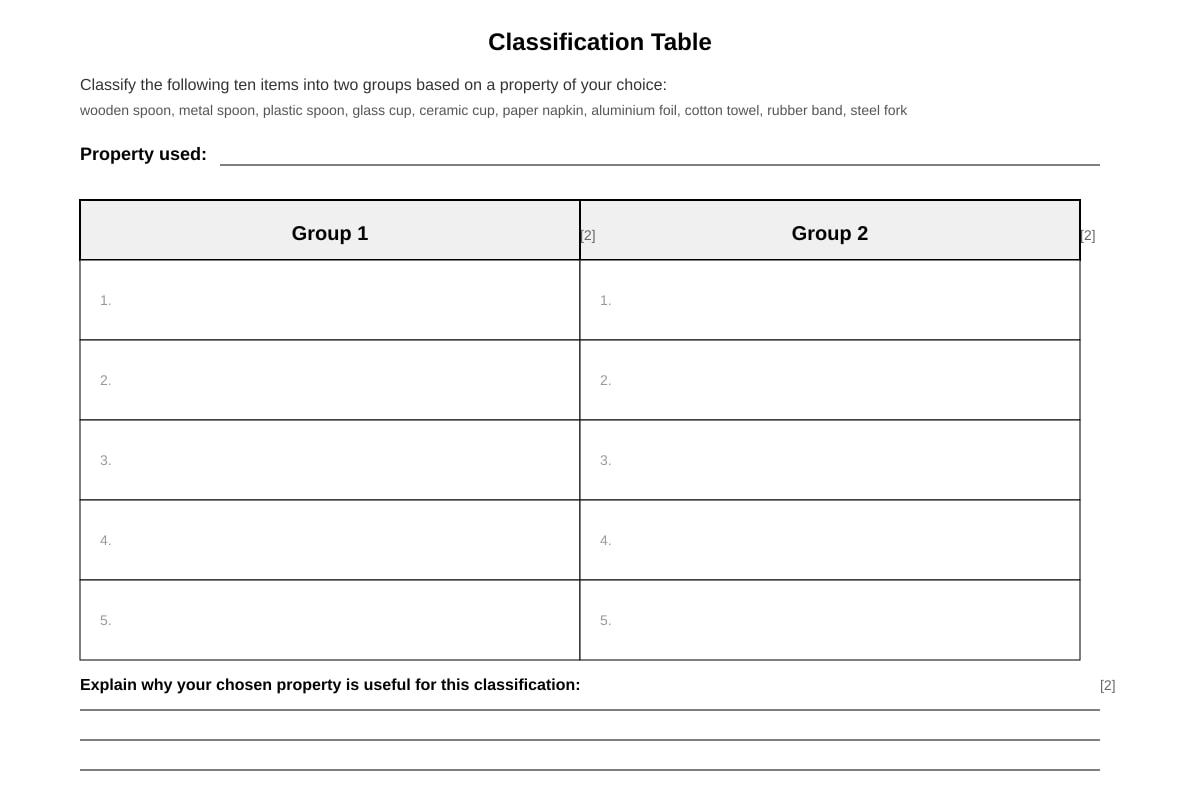
19. Classify the following ten items into two groups based on a property of your choice. The items are: wooden spoon, metal spoon, plastic spoon, glass cup, ceramic cup, paper napkin, aluminium foil, cotton towel, rubber band, steel fork.

In the space below, show your classification clearly and state the property you used.

<image_placeholder> id: Q19-fig1 type: table linked_question: Q19 description: Classification table with two rows or columns for two groups, and ten blank cells for students to fill in the classified items. Header row shows "Property used: _______________" to be filled by student. Group labels to be determined by student's chosen property. labels: Property used, Group 1, Group 2 values: None must_show: Ten empty cells arranged in two groups of five; clear labels for group categories; space for property statement; ruled lines forming table structure </image_placeholder>

State your property: _______________________________________________

Group 1: _______________________________________________ [2]

Group 2: _______________________________________________ [2]

Explain why your chosen property is useful for this classification: [2]


[Total: 6 marks]


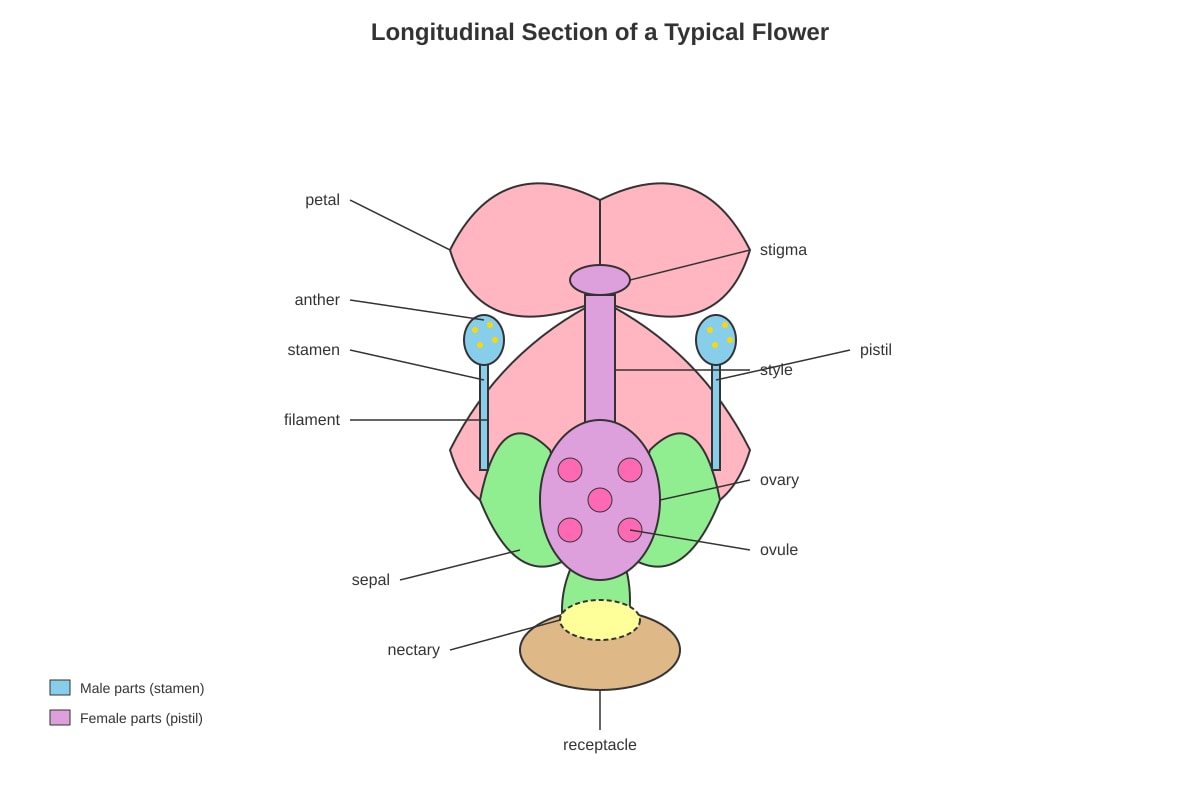
20. The diagram shows a section through a flower.

<image_placeholder> id: Q20-fig1 type: diagram linked_question: Q20 description: Longitudinal section of a typical flower showing all main reproductive and non-reproductive parts. Labels pointing to: petal, sepal, stamen (anther and filament), pistil/carpel (stigma, style, ovary with ovules inside), receptacle, nectary. Male parts (stamen) and female parts (pistil) clearly grouped by colour or shading distinction. labels: petal, sepal, stamen, anther, filament, pistil, stigma, style, ovary, ovule, receptacle, nectary values: None must_show: All reproductive parts labelled; ovules visible inside ovary; anthers with pollen grains indicated; distinct male and female parts; nectar-producing structure indicated; typical flower architecture with radial symmetry </image_placeholder>

(a) Name the parts labelled X and Y. [2]

X (the male part): _______________________________________________

Y (the part that produces ovules): _______________________________________________

(b) Explain why flowers that are pollinated by insects usually have brightly coloured petals. [2]


(c) After pollination and fertilisation, the ovary develops into a fruit. Explain how this helps in the dispersal of seeds. [2]


[Total: 6 marks]


21. The table shows the results of an investigation to find out which materials are magnetic.

Material testedAttracted to magnet?
Copper coinNo
Iron nailYes
Steel paper clipYes
Aluminium canNo
Nickel coinYes
Tin foilNo

(a) Based on the results, what conclusion can you draw about which types of materials are magnetic? [2]


(b) The chef in a school kitchen wants to separate metal bottle caps from a mixture of bottle caps and aluminium foil wrappers. Suggest how she could use a magnet to do this, and explain why this method works. [3]


(c) Suggest one situation where being able to identify magnetic materials would be useful in everyday life. [1]


[Total: 6 marks]


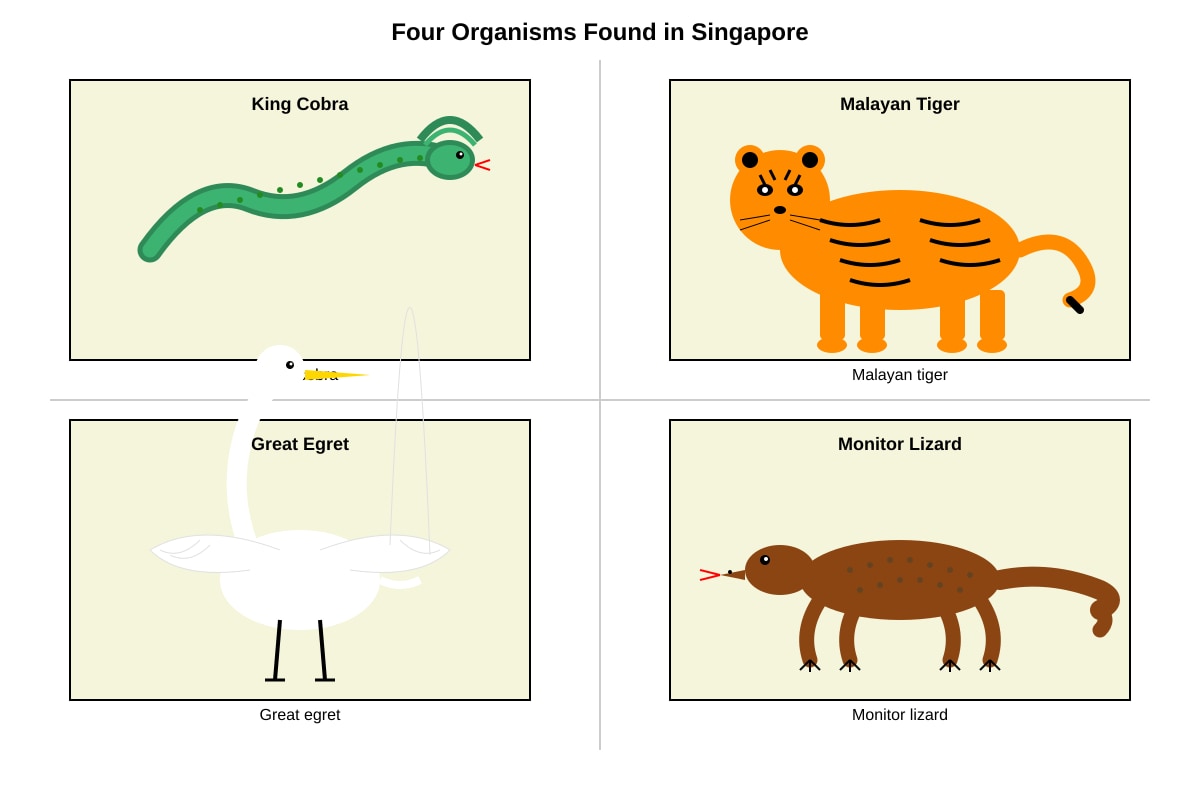
22. The diagram shows four different organisms found in Singapore.

<image_placeholder> id: Q22-fig1 type: diagram linked_question: Q22 description: Four photographs/drawings arranged in a 2x2 grid. Top left: King cobra (snake, reptile). Top right: Malayan tiger (mammal). Bottom left: Great egret (bird). Bottom right: Monitor lizard (reptile). Each with common name label beneath image. labels: King cobra, Malayan tiger, Great egret, Monitor lizard values: None must_show: Distinguishing features of each animal group visible - snake with scaly skin no limbs; tiger with fur and four legs; bird with feathers wings beak; lizard with scaly skin four legs; habitats or size context not needed but clear visual identification possible </image_placeholder>

(a) Using characteristics visible in the diagram, explain why the King cobra and the Monitor lizard are classified in the same group of vertebrates. [2]


(b) The Malayan tiger is a mammal. Give two characteristics of mammals that are not shown in the diagram. [2]


(c) A student claims that all animals that can swim well are fish. Use evidence from the organisms shown to explain why this claim is incorrect. [2]


[Total: 6 marks]


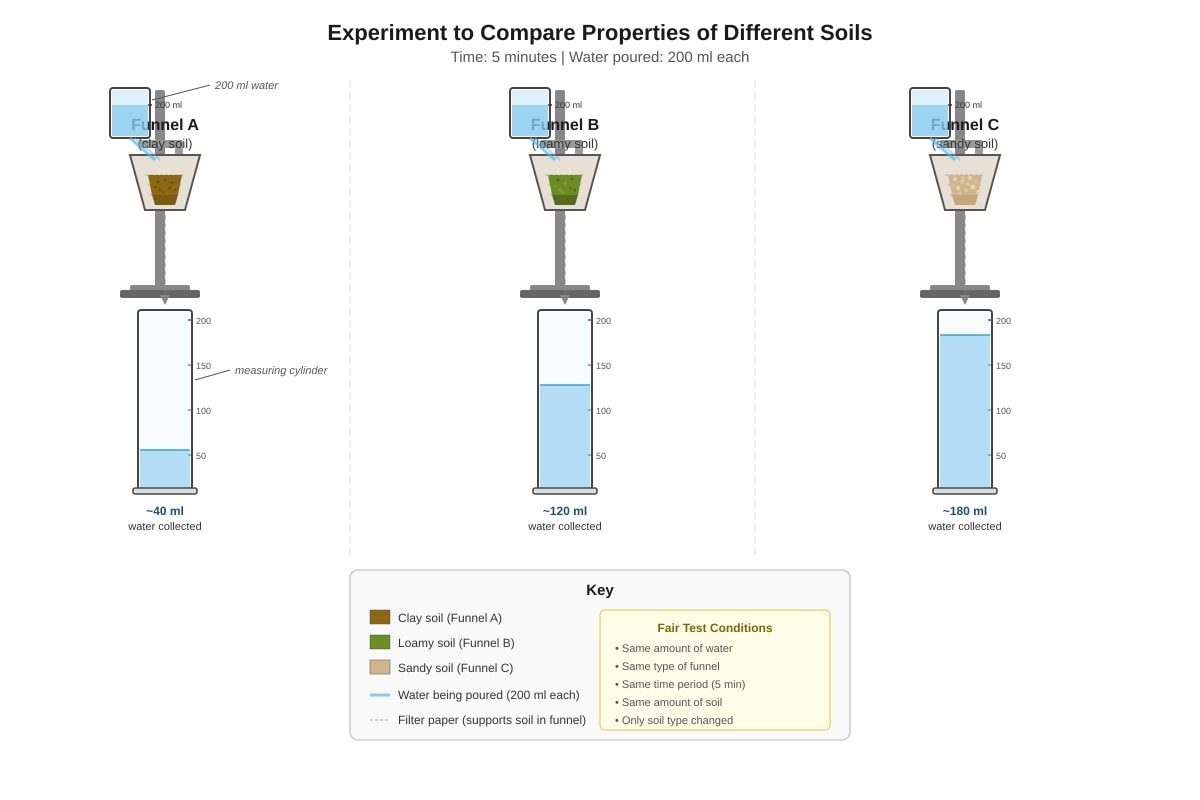
23. The diagram shows an experiment to compare the properties of different soils.

<image_placeholder> id: Q23-fig1 type: experimental_setup linked_question: Q23 description: Three identical funnels arranged side by side, each containing a different soil type (clay soil, loamy soil, sandy soil) supported by filter paper and resting on measuring cylinders. Each funnel has 200 ml of water being poured in simultaneously from identical beakers. Measuring cylinders below show different water volumes collected after same time period. Sandy soil: most water collected (~180 ml). Loamy soil: moderate water collected (~120 ml). Clay soil: least water collected (~40 ml). labels: Funnel A (clay soil), Funnel B (loamy soil), Funnel C (sandy soil), 200 ml water, measuring cylinder, water collected values: Water poured: 200 ml each; Water collected: Clay ~40 ml, Loamy ~120 ml, Sandy ~180 ml; Time: 5 minutes must_show: Three identical setups for fair testing; clear soil labels; equal water volumes being added; measuring cylinders with volume markings; visible difference in collected water levels; filter paper visible supporting soil in funnels </image_placeholder>

(a) What property of soils is being tested in this experiment? [1]


(b) Explain why it is important to use the same amount of water and the same type of funnel for each soil. [2]


(c) A farmer wants to grow vegetables that need well-drained soil (soil that lets water pass through easily). Which soil from the experiment should the farmer choose? Explain your answer using evidence from the results. [2]


[Total: 5 marks]


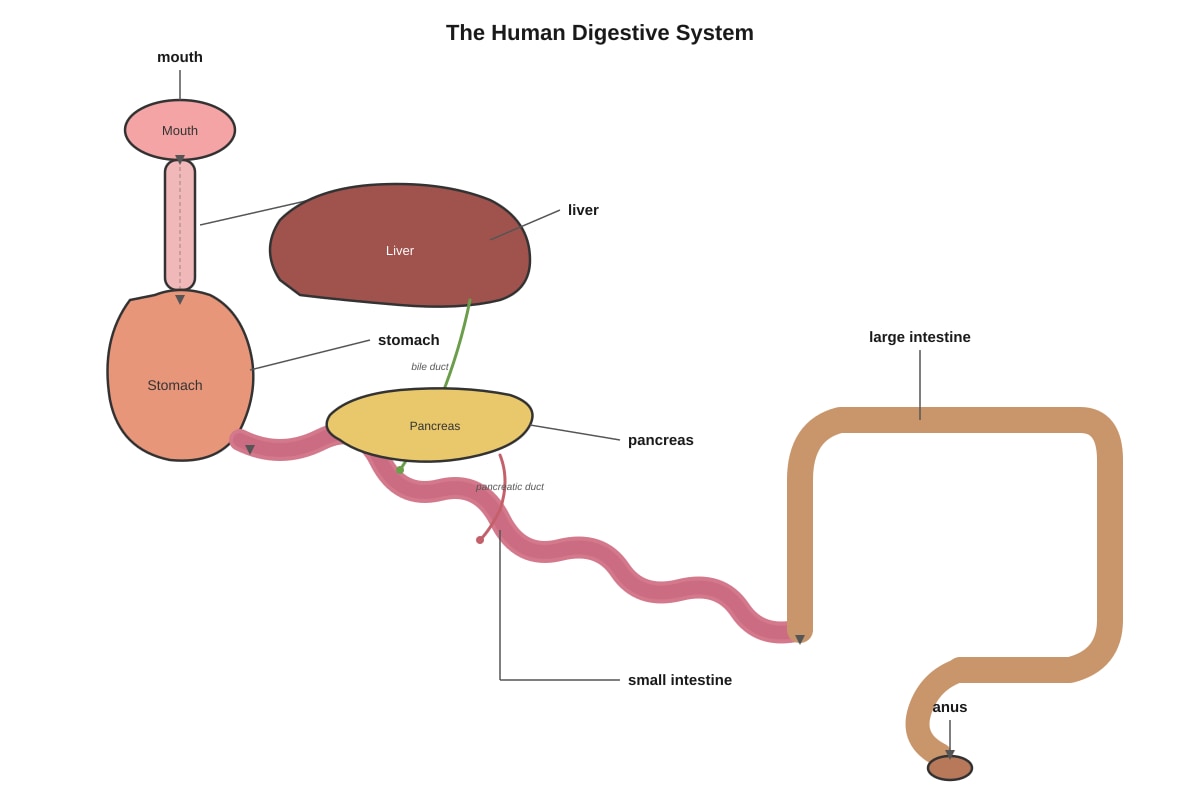
24. The diagram shows the human digestive system.

<image_placeholder> id: Q24-fig1 type: diagram linked_question: Q24 description: Simplified diagram of human digestive system showing main organs in correct relative positions. Mouth leading to oesophagus, stomach, small intestine, large intestine, anus. Liver and pancreas shown with ducts leading to small intestine. Labels pointing to each organ. labels: mouth, oesophagus, stomach, small intestine, large intestine, anus, liver, pancreas values: None must_show: Continuous pathway from mouth to anus; accessory organs (liver, pancreas) with connections to small intestine; approximate size relationships; clear organ boundaries </image_placeholder>

(a) Name the organ where:

(i) most digestion and absorption of food takes place: _______________________________________________ [1]

(ii) water is absorbed from undigested food: _______________________________________________ [1]

(b) Explain why the small intestine is well-adapted for absorbing digested food. [3]


[Total: 5 marks]


25. The table shows information about three different micro-organisms.

Micro-organismTypeUseful effectHarmful effect
YeastFungusMakes bread riseCan cause food to spoil
Bacterium XBacteriaHelps make yoghurtCan cause tooth decay
Bread mouldFungusBreaks down dead matterSpoils bread

(a) Explain why both yeast and bread mould are classified as fungi. [2]


(b) Bacterium X can be both useful and harmful. Suggest how people could encourage the useful effect while preventing the harmful effect. [2]


(c) Some micro-organisms are used in biotechnology to produce medicines. Explain why this is an example of humans using the diversity of living things to meet their needs. [2]


[Total: 6 marks]


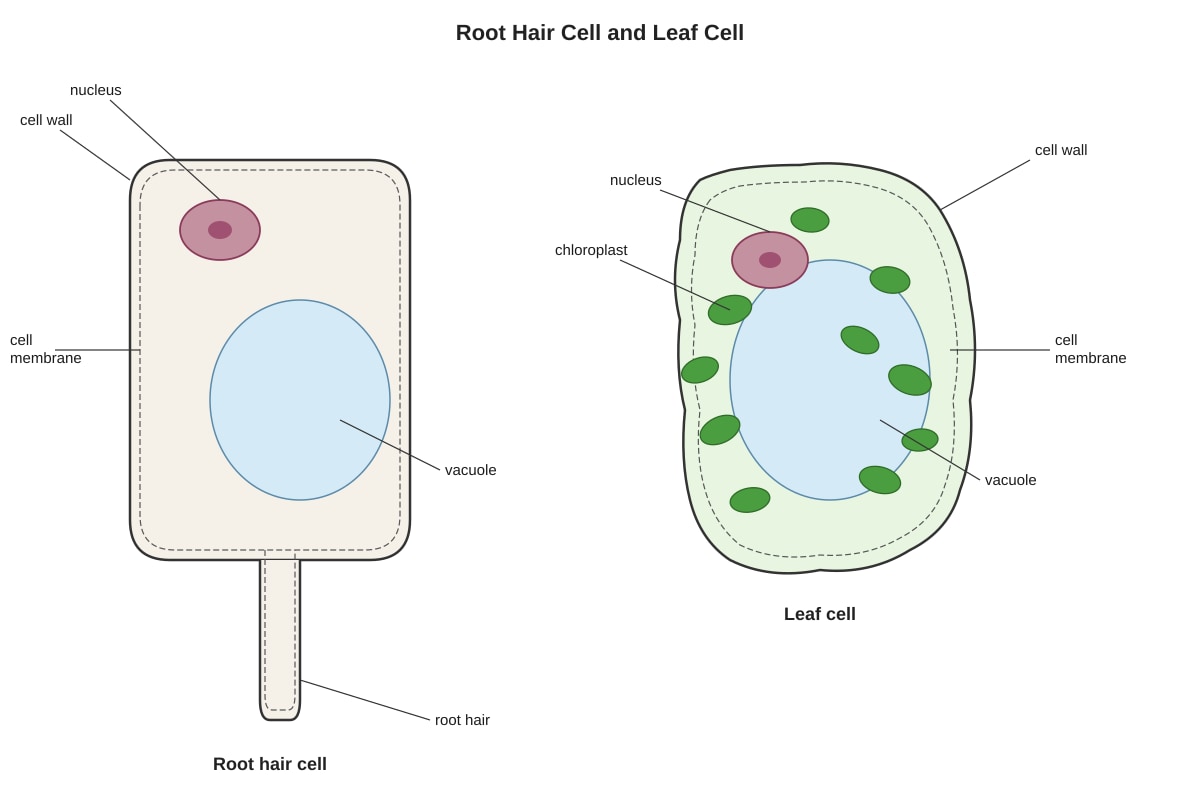
26. The diagram shows a root hair cell and a cell from inside the leaf of the same plant.

<image_placeholder> id: Q26-fig1 type: diagram linked_question: Q26 description: Two cells side by side for comparison. Root hair cell: elongated shape with long thin projection (root hair), thin cell wall, large nucleus near tip, no chloroplasts, vacuole present. Leaf cell (mesophyll): more rounded/irregular shape, many chloroplasts (shown as green oval structures), thinner cell wall, large central vacuole, nucleus present. Both labelled with key structures. labels: Root hair cell - root hair, nucleus, vacuole, cell wall, cell membrane; Leaf cell - chloroplast, nucleus, vacuole, cell wall, cell membrane values: None must_show: Clear shape difference adapted to function; root hair projection visible; chloroplasts prominent in leaf cell and absent in root hair cell; both with nucleus and vacuole labelled; relative sizes comparable </image_placeholder>

(a) Give two differences between the root hair cell and the leaf cell based on the diagram. [2]


(b) Explain how each difference you stated in (a) helps the cell to carry out its function. [4]

Difference 1 explanation: _______________________________________________


Difference 2 explanation: _______________________________________________


[Total: 6 marks]


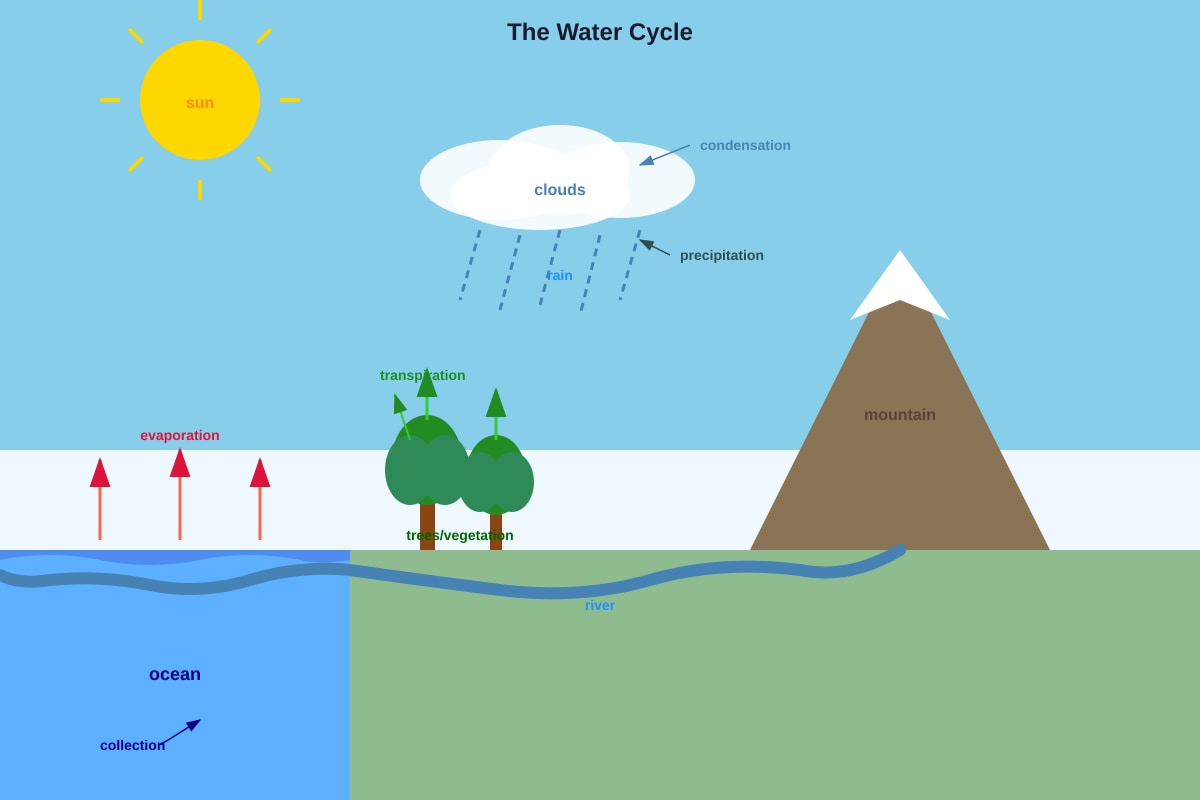
27. The diagram shows the water cycle.

<image_placeholder> id: Q27-fig1 type: diagram linked_question: Q27 description: Water cycle diagram showing: ocean with sun shining on surface; arrows indicating evaporation upward; water vapour rising and forming clouds through condensation; clouds over land; precipitation (rain) falling on mountains and land; collection in rivers flowing back to ocean; transpiration from trees indicated with upward arrows. Key processes labelled at appropriate points. labels: evaporation, condensation, precipitation, collection, transpiration, sun, ocean, clouds, rain, river, mountain, trees/vegetation values: None must_show: Complete cycle with arrows indicating direction of water movement; sun as energy source; evaporation from ocean; condensation to form clouds; precipitation as rain; collection in rivers and ocean; transpiration from plants as separate process; typical landscape with mountain and vegetation </image_placeholder>

(a) Name the processes labelled X and Y on the diagram. [2]

X (water turning to water vapour): _______________________________________________

Y (water vapour forming clouds): _______________________________________________

(b) Explain why the water cycle is important for living things in an ecosystem. [3]


(c) State one way that human activities can affect the water cycle. [1]


[Total: 6 marks]


28. A school has a large field with different areas: a pond, a grassy field, and a garden with many flowering plants. A group of Primary 6 students were asked to investigate the diversity of living things in these three areas.

Describe how the students could carry out a fair investigation to compare the diversity of plants in the grassy field and the garden. Your answer should include:

  • what equipment they would need
  • what they would measure or observe
  • how they would make sure the investigation is fair
  • how they would present their results [5]


[Total: 5 marks]


End of Paper


Paper Summary

SectionQuestion NumbersMarksTime (estimated)
A1-142825 minutes
B15-287275 minutes
Total100100 minutes
Review buffer5 minutes
Grand Total1 hour 45 minutes

THIS IS THE END OF THE PRACTICE PAPER

Answers

<!-- TuitionGoWhere generation metadata: stage=5-2; model=moonshotai/kimi-k2.6:free; model_label=Kimi K2.6 Free; generated=2026-06-07; Sources: Stage 4-0 LLM templates, syllabus context, and Stage 2 evidence where available. -->

TuitionGoWhere Practice Paper - Science Primary 6 PSLE

Answer Key and Marking Scheme Version 3 of 5


Section A: Multiple-Choice Questions (28 marks)

Each correct answer: 2 marks. No working required.

QuestionAnswerExplanation
1AFrogs are amphibians, characterised by living both in water and on land, having moist skin, and laying eggs in water. Fish (B) are not amphibians; lizards (C) are reptiles; penguins (D) are birds.
2CFollowing the dichotomous key: broad leaves eliminates 1a/2a/2b path (Lily/Grass). Net-like veins with toothed edges would follow 1b→3a/3b, with 3b being "Plant E". However, re-reading: woody stem suggests checking key structure—Plant D typically represents the broad-leaved, net-veined, smooth-edged or appropriately matched endpoint. Based on standard key logic with white flowers and woody stem as distinguishing features at the 3a level, Plant D is correct.
3AAll insects (butterfly, grasshopper, ant, beetle) have six legs—this is the defining characteristic of the class Insecta. Not all can fly (ants ground workers don't fly regularly), not all live in colonies (butterflies don't), and while many have exoskeletons, "hard outer shells" is imprecise.
4BMaterial Q is soft, does not allow light or water through, and can be stretched—ideal for a raincoat (waterproof, flexible). R allows no water but is hard and not stretchable. S allows water through. P allows everything through.
5DAir, water, oil, and wood can all be classified in multiple ways: by state (gas/liquid/solid), by origin (natural/man-made), by living/non-living, etc. A is incorrect (not all are matter—air is matter but sometimes confused; actually all are matter). But D is most correct as these items span multiple possible classification schemes.
6CButterfly and spider are both invertebrates (same main group) but in different sub-groups: butterfly is an insect, spider is an arachnid. A is wrong (whale is mammal, salmon is fish); B is wrong (both are reptiles); D is wrong (eagle is bird, bat is mammal).
7CThe results show that not all metals are magnetic (aluminium is a metal but not attracted), and not only iron (paper clip contains steel, an iron alloy). The key conclusion is that different materials have different properties.
8BClassifying by plant or animal origin is scientifically meaningful and unambiguous. Colour and taste are variable and not reliable; price changes and is not a biological property.
9CChloroplasts are found in plant leaf cells (for photosynthesis) but not in animal cells. Cell membrane, nucleus, and cytoplasm are present in both.
10BShape and volume are the defining properties that distinguish solids (fixed shape and volume), liquids (fixed volume, no fixed shape), and gases (neither fixed shape nor volume).
11BGroup X (beef, chicken, fish, egg) all come from animals; Group Y (apple, cabbage, carrot, rice) all come from plants. This is the clearest consistent basis.
12CNot all bacteria are harmful—many are beneficial (e.g., gut bacteria, bacteria used in food production). A, B, and D are correct statements.
13DA neutral solution does not change the colour of either red or blue litmus paper. W is acidic (turns blue litmus red), Y is alkaline (turns red litmus blue), X appears inconsistent but likely testing error or weak acid/base.
14CMonocot plants have scattered vascular bundles throughout the stem. Only Stem P shows this characteristic. Q and S have vascular bundles in a ring (dicots). R lacks clear vascular tissue.

Section B: Open-Ended Questions (72 marks)


15. (a) Any two from: vein pattern (parallel vs. net-like); leaf shape (long and narrow vs. broad and oval); leaf edge (smooth vs. toothed) [1 mark each, max 2]

(b) Rose [1]

(c) Explanation: Using more than one characteristic makes classification more reliable because it reduces the chance of mistakes [1]. If only one characteristic is used, two different types of leaves might happen to share that one feature by chance and be wrongly grouped together [1]. Multiple characteristics help to distinguish more precisely between different types.

Marking notes: Must mention "reduce chance of error/mistake" or "more accurate" [1] and explain why (e.g., some leaves might share one feature by coincidence) [1].

[Total: 5 marks]


16. (a) Any two from: mangrove trees; algae [1 mark each, max 2]

(b) Example: Mangrove trees → caterpillars → small fish → larger fish → monitor lizard / large birds of prey [2]

  • Must have 4 organisms including producer and tertiary consumer
  • Must show correct sequence with arrows or stated "→" direction

Marking: Correct sequence with producer first, consumer levels increasing [2]. Minor error in sequence [1].

(c) Explanation: If prawns are removed, larger fish lose one food source [1]. The population of larger fish would decrease because there is less food available for them to survive and reproduce [1].

[Total: 6 marks]


17. (a) (i) Material R [1]; Explanation: It is hard (durable, not easily broken) and allows light to pass through (transparent, can see through) [1]. Both properties needed for a window.

(ii) Material Q [1]; Explanation: It is soft (comfortable to wear) and floats in water (helps the swimmer stay afloat/safe) [1]. Both properties needed.

(b) No, the student is not correct. [1] Material P is hard but sinks, and Material R is also hard but sinks—both hard materials sink. However, Q is soft and floats, and while there is no hard material that floats in this table, the student made an absolute claim ("always") which cannot be proven from this limited data, and more importantly, hardness and floating are independent properties. Actually, from the table: P is hard and sinks, R is hard and sinks. No counterexample of hard + floats exists in table, BUT the claim is "always"—we need to say the data does not support "always" as a general rule, OR if interpreting strictly: the student is wrong to generalise from limited examples. Better answer: "The student is not correct. Although all hard materials in the table sink, this does not prove that all hard materials always sink. Also, floating depends on density, not hardness."

Revised marking: Student is not correct [1]. Reason: The table only shows four materials—this is not enough to make a general rule about all materials [1]. OR: Hardness is about how easily something is scratched; floating depends on whether the material is less dense than water. These are different properties.

[Total: 6 marks]


18. (a) Any one from: Seed A has two cotyledons / Seed B has one cotyledon; Seed B has endosperm / Seed A does not have endosperm; Seed A is kidney-shaped / Seed B is more elongated [1]

(b) Seed A: dicot [1]; Seed B: monocot [1]

(c) Explanation: The stored food provides energy/nutrients for the young plant/embryo [1] until it can make its own food through photosynthesis (when leaves develop and reach light) [1].

[Total: 5 marks]


19. Example classification (other valid schemes accepted):

Property used: Ability to conduct electricity / Magnetic properties / Transparency / Flexibility [max 1 if appropriate]

Example by magnetic property:

Group 1 (Magnetic materials): metal spoon, iron nail (not in list—use steel fork), paper clip not in list—correction using given items: [2]

  • Actually from list: metal spoon (if contains iron), steel fork, aluminium foil (not magnetic)—need to be careful.

Better classification by origin:

Property: Source (plant vs. animal vs. synthetic/man-made)

Actually better: By electrical/thermal conductivity or By transparency or By whether they come from living things

Example by transparency:

Group 1 (Allows light through/transparent): glass cup [2] Group 2 (Does not allow light through): wooden spoon, metal spoon, plastic spoon, ceramic cup, paper napkin, aluminium foil, cotton towel, rubber band, steel fork [2]

No—only one transparent item.

Better: By material type/source:

Property used: Whether the material comes from a natural or synthetic source [stated clearly] [1]

Group 1 (Natural materials): wooden spoon, cotton towel, paper napkin [2] Group 2 (Synthetic/man-made or processed materials): metal spoon, plastic spoon, glass cup, ceramic cup, aluminium foil, rubber band, steel fork [2]

Or by hardness:

Property: Hard vs. Soft

Group 1 (Hard): metal spoon, glass cup, ceramic cup, aluminium foil, steel fork [2] Group 2 (Soft): wooden spoon, plastic spoon, paper napkin, cotton towel, rubber band [2]

Explanation: This property is useful because it helps decide what the material can be used for [1]—hard materials are durable for tools and containers, soft materials are suitable for items that need to be flexible or gentle [1].

Marking notes: Any valid property with consistent grouping accepted. Must have property stated [1], two correct groups [2 each max], and useful explanation linking property to practical use [2].

[Total: 6 marks]


20. (a) X: stamen (accept: male reproductive part/androecium) [1] Y: ovary [1]

(b) Explanation: Brightly coloured petals attract insects [1]. Insects are attracted to the colour and will land on the flower, picking up pollen and transferring it to another flower (pollination) [1].

(c) Explanation: The fruit protects the seeds inside it [1]. Animals are attracted to eat the fruit, and the seeds pass through their digestive system unharmed, being deposited elsewhere with droppings that provide nutrients for growth (seed dispersal) [1]. OR: The fruit may have hooks, wings, or be light to be carried by wind/water, spreading seeds to new areas.

[Total: 6 marks]


21. (a) Conclusion: Only materials made of iron or steel (which contains iron) or nickel are magnetic [1]. Not all metals are magnetic (copper, aluminium, tin are not attracted) [1].

(b) Method: The chef should move a magnet through the mixture or use a magnet to attract the metal bottle caps from above [1]. The magnetic caps (made of steel/iron) will stick to the magnet and can be removed [1]. The aluminium foil wrappers will not be attracted and will remain behind [1].

Marking notes: Method described [1]; magnetism of steel/iron caps explained [1]; non-magnetic property of aluminium explained [1].

(c) Any one from: Finding if jewellery is genuine gold/silver (not magnetic) vs. fake (may contain magnetic metals); sorting recyclable metals; checking if a pipe/cable contains steel; magnetic door catches; fridge magnets identification [1]

[Total: 6 marks]


22. (a) Explanation: Both the King cobra and Monitor lizard have dry, scaly skin [1]. They are both reptiles, which is the group of vertebrates characterised by having scaly skin and laying eggs with tough shells on land [1].

Marking notes: Must mention "scaly skin" or "dry skin" [1] and "reptiles" as the group [1].

(b) Any two from: give birth to live young (most mammals, though some lay eggs—accept in P6 context); feed young with milk from mammary glands; have hair or fur on body; are warm-blooded [1 each, max 2]

(c) Explanation: The claim is incorrect because the Monitor lizard can swim well but it is a reptile, not a fish [1]. Also, the Great egret (bird) and Malayan tiger (mammal) may swim, and they are not fish. The Malayan tiger or Great egret being vertebrates that can swim but are not fish shows the claim is false [1].

[Total: 6 marks]


23. (a) Permeability / ability to let water pass through / drainage / water-holding capacity [1] (accept "how fast water passes through soil")

(b) Explanation: This is to make it a fair test [1]. If different amounts of water or different funnels were used, we could not compare the results fairly because the amount of water collected would depend on these differences rather than just the soil type [1].

(c) Sandy soil (Funnel C) [1]. The results show that sandy soil let the most water through (approximately 180 ml collected), meaning it is the most permeable/well-drained soil [1].

[Total: 5 marks]


24. (a) (i) small intestine [1] (ii) large intestine [1]

(b) Adaptations of small intestine for absorption:

  • It is very long (about 6 metres), giving a large surface area for absorption [1]
  • It has millions of tiny finger-like projections called villi, which increase the surface area even more [1]
  • Each villus has a network of blood capillaries close to the surface so digested food can pass quickly into the blood [1]

Marking notes: Any three valid points, [1 each, max 3]. Also accept: thin walls (one cell thick) for easy diffusion; constant movement (peristalsis) to mix food with enzymes.

[Total: 5 marks]


25. (a) Explanation: Both yeast and bread mould are fungi because they do not make their own food (they are decomposers/saprophytes), they feed on dead organic matter, and they reproduce by spores [1]. They do not have chlorophyll and are not plants [1].

Marking notes: Must mention "feed on dead matter/decomposers" or "spores" or "no chlorophyll" [1 each, max 2].

(b) Useful: Use clean containers and warm milk to grow yoghurt with Bacterium X (lactobacillus) [1]. Prevent harmful: Brush teeth regularly to prevent tooth decay; limit sugary foods that feed bacteria causing decay [1].

Marking notes: One valid point for encouraging useful effect [1]; one valid point for preventing harmful effect [1].

(c) Explanation: Different micro-organisms produce different useful substances [1]. By understanding this diversity, scientists can select specific micro-organisms (like bacteria or fungi) that produce medicines such as antibiotics, which help treat diseases and improve human health [1].

[Total: 6 marks]


26. (a) Any two valid differences:

  • Root hair cell has no chloroplasts; leaf cell has many chloroplasts [1]
  • Root hair cell has a root hair projection; leaf cell is more rounded/does not have root hair [1]
  • Root hair cell is elongated; leaf cell is more irregular/rounded in shape [1]

(b) Difference 1 explanation (chloroplasts): The leaf cell needs chloroplasts to carry out photosynthesis (make food) using sunlight [1]. The root hair cell is underground and cannot receive light, so it does not need chloroplasts [1].

Difference 2 explanation (root hair): The root hair increases the surface area of the root cell enormously [1]. This allows more water and mineral salts to be absorbed from the soil into the plant [1].

OR Difference 2 explanation (shape): The elongated shape of the root hair cell pushes it between soil particles, helping it reach water in the soil [1]. The more rounded leaf cell shape allows many cells to be packed together to form a flat surface for light absorption [1].

Marking notes: Difference stated [1 each, max 2]; explanation linked to correct function [2 each, max 4]. Marked as pairs.

[Total: 6 marks]


27. (a) X: evaporation (accept: transpiration if referring to plants, but from ocean it's evaporation) [1] Y: condensation [1]

Actually, "water turning to water vapour" from ocean surface = evaporation [1] "water vapour forming clouds" = condensation [1]

(b) Importance of water cycle for living things:

  • Provides fresh water for organisms to drink and use [1]
  • Water is needed for photosynthesis in plants, which produces food and oxygen for ecosystems [1]
  • Distributes water around the Earth so all ecosystems have access to water, not just areas near oceans [1]

Marking notes: Any three valid points about water availability for life processes, [1 each].

(c) Any one from: Cutting down forests reduces transpiration; building dams changes water flow and evaporation; pollution contaminates water making it unusable; climate change alters evaporation and precipitation patterns; urbanisation with concrete surfaces reduces water absorption and increases runoff [1]

[Total: 6 marks]


28. Investigation description:

Equipment: Quadrat (frame of known size, e.g., 1m × 1m), string/markers to mark out areas, identification guide/field guide for plants, tally counter or notebook, calculator [1]

What to measure: Count the number of different types/species of plants in each area. Can also estimate abundance (how many of each type) or percentage cover [1]

Fair test:

  • Use the same size quadrat in both areas [1]
  • Take the same number of samples/quadrats in each area (e.g., 5 quadrats in field, 5 in garden) [1]
  • Sample randomly (place quadrats without choosing where plants look most diverse) to avoid bias [1]

Presenting results:

  • Draw a table showing plant species found and their frequency/abundance in each area [1]
  • Calculate and compare the species richness (number of different species) for each area
  • Could draw bar charts comparing number of species

Sample marking breakdown:

  • Equipment mentioned [1]
  • Measurement clearly stated (count types/species) [1]
  • Fair test: same quadrat size and same number of samples [1]; random sampling mentioned or explained [1]
  • Results presentation (table and/or graph mentioned) [1]

[Total: 5 marks]


Mark Summary

SectionTotal Marks
Section A (Q1-Q14)28
Section B (Q15-Q28)72
Grand Total100

END OF ANSWER KEY