AI Generated Exam Paper
Primary 6 PSLE Science Practice Paper 2
Free P6 PSLE Science Practice Paper 2, Kimi2.6 AI version, with questions, answers, and PSLE-focused practice for Singapore students.
These static practice materials are generated from the site's syllabus and paper-generation workflow, with source and model context shown so students and parents can evaluate the material before use.
Questions
Free quiz and exam paper access
Enter your details to view this paper
Your access is remembered on this device.
Answers
TuitionGoWhere Practice Paper - Science Primary 6 PSLE
ANSWER KEY (Version 2 of 5)
Subject: Science
Level: Primary 6 PSLE
Paper: Practice Paper
Total Marks: 100
SECTION A: MULTIPLE-CHOICE QUESTIONS (40 marks)
1. Answer: B
Explanation: Diversity means having many different types of living things. While A, C, and D describe similarities or characteristics shared by groups, B correctly describes diversity—different plants have different methods of seed dispersal, showing variety within the plant kingdom. This reflects the concept of biodiversity in ecosystems.
2. Answer: C
Explanation:
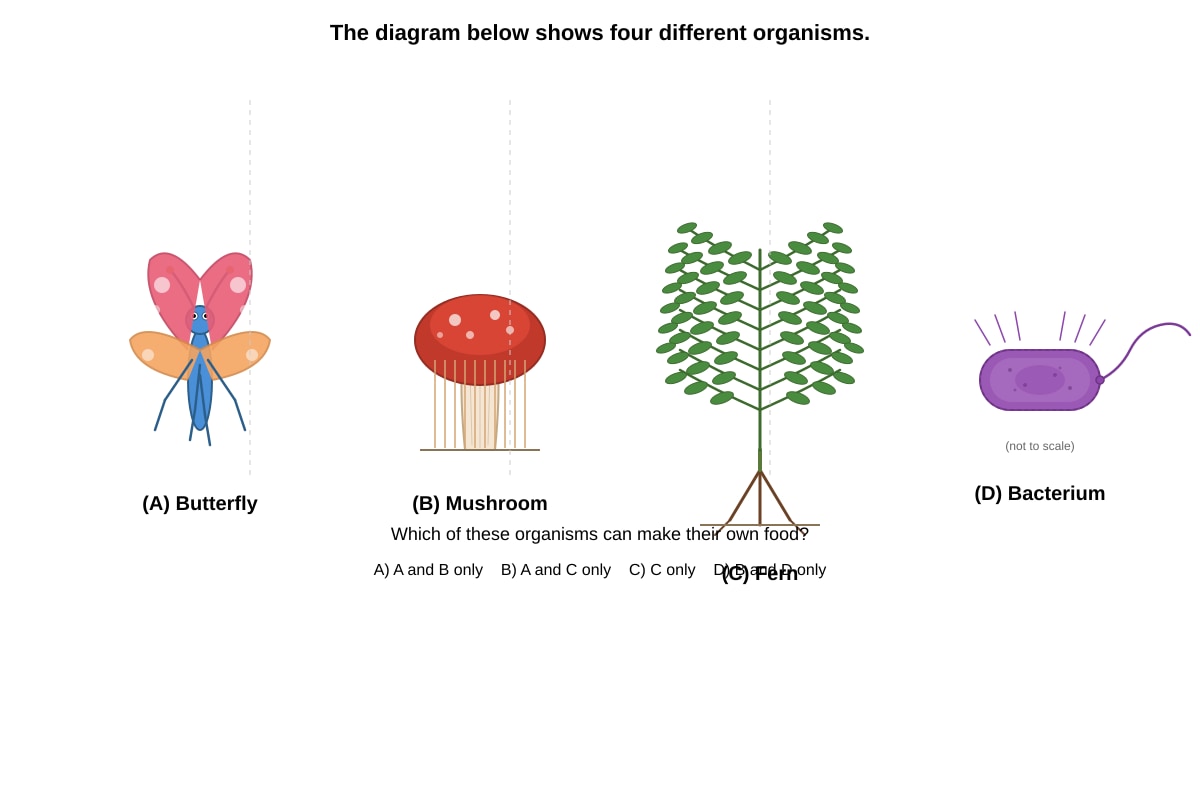
- A (Butterfly): Consumer—feeds on nectar, cannot make own food
- B (Mushroom): Decomposer/fungus—feeds on dead matter, no chlorophyll
- C (Fern): Producer—has chlorophyll, makes food by photosynthesis ✓
- D (Bacterium): Decomposer or other feeding types—no chlorophyll
Only the fern (C) can perform photosynthesis. The key skill is identifying producers (usually plants and algae) versus consumers and decomposers.
3. Answer: B
Explanation: The defining characteristic of the plant kingdom is the ability to make their own food through photosynthesis using chlorophyll, sunlight, water, and carbon dioxide. Animals (A, movement) and birds (C, wings) are in other kingdoms. Feeding on others (D) describes consumers/animals.
4. Answer: A
Explanation: Algae are plant-like protists or simple plants that:
- Can make their own food (photosynthesis) ✓ (P and R)
- Have no backbone (they're not animals) ✓ (eliminates Q and S)
- Many live in water ✓ (P matches)
Group R lives on land (not ✗ for lives in water = incorrect). Therefore P is algae.
Common mistake: Students confuse algae with plants—many algae are aquatic and lack true roots/stems/leaves.
5. Answer: D
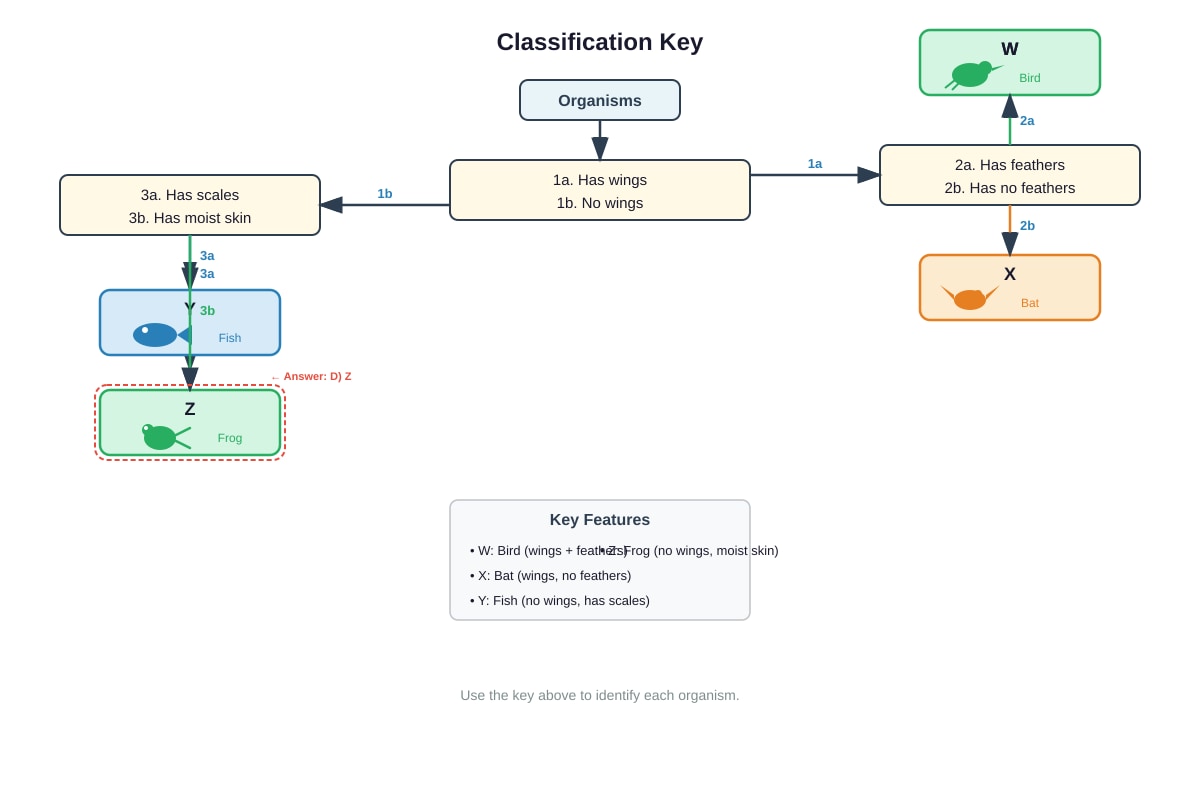
Explanation: Working through the dichotomous key:
- W: Has wings + has feathers = bird (not frog)
- X: Has wings + no feathers = insect (not frog)
- Y: No wings + has scales = fish or reptile (not frog)
- Z: No wings + moist skin = amphibian (FROG!) ✓
Frogs are amphibians with moist, permeable skin (no scales, no feathers, no wings). Dichotomous keys use paired, opposite characteristics to narrow down identification.
6. Answer: B
Explanation: Fungi feed on dead or decaying matter (saprotrophic nutrition). They lack chlorophyll (A is wrong), so they cannot photosynthesise. They do not have flowers or seeds (C—those are plant features). They have no backbone (D—those are vertebrate animal features). Mushrooms, moulds, and yeasts are all fungi.
7. Answer: A
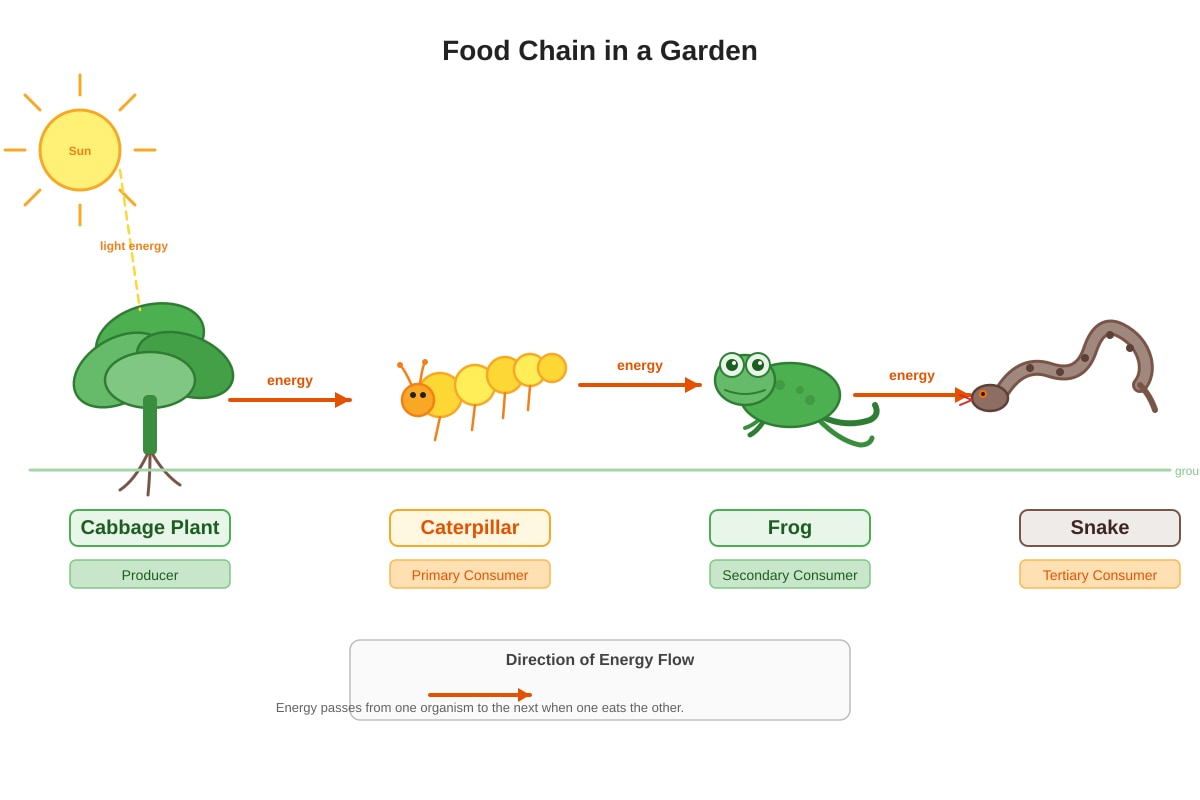
Explanation: In any food chain, the producer is the organism that makes its own food through photosynthesis. The cabbage plant is the only organism in this chain that can do this. The arrows show energy flow: food passes from producer → primary consumer (caterpillar) → secondary consumer (frog) → tertiary consumer (snake).
Key concept: Energy enters the food chain through producers. All other organisms are consumers that obtain energy by eating other organisms.
8. Answer: C
Explanation: The features gills, fins, scales, and living in water are the defining characteristics of fish:
- Amphibians (e.g., frogs): Have moist skin, no scales, undergo metamorphosis
- Reptiles (e.g., lizards): Have lungs and scales, but no gills/fins
- Mammals (e.g., whales): Have lungs, no scales (whales have smooth skin or blubber)
Gills for breathing underwater + fins for swimming + scales for protection = fish.
9. Answer: A
Explanation: The correct order from smallest/simplest to largest/most complex:
- Bacteria: Single-celled, no true nucleus (prokaryote), simplest cellular organisation
- Amoeba: Single-celled, has nucleus (eukaryote), more complex than bacteria
- Ant: Multi-celled insect, specialised tissues and organs, more complex
- Human: Multi-celled mammal, most complex organ systems (brain, heart, etc.)
B is wrong (bacteria are simpler than amoeba). C is reverse order. D is wrong (ants are more complex than amoeba).
10. Answer: B
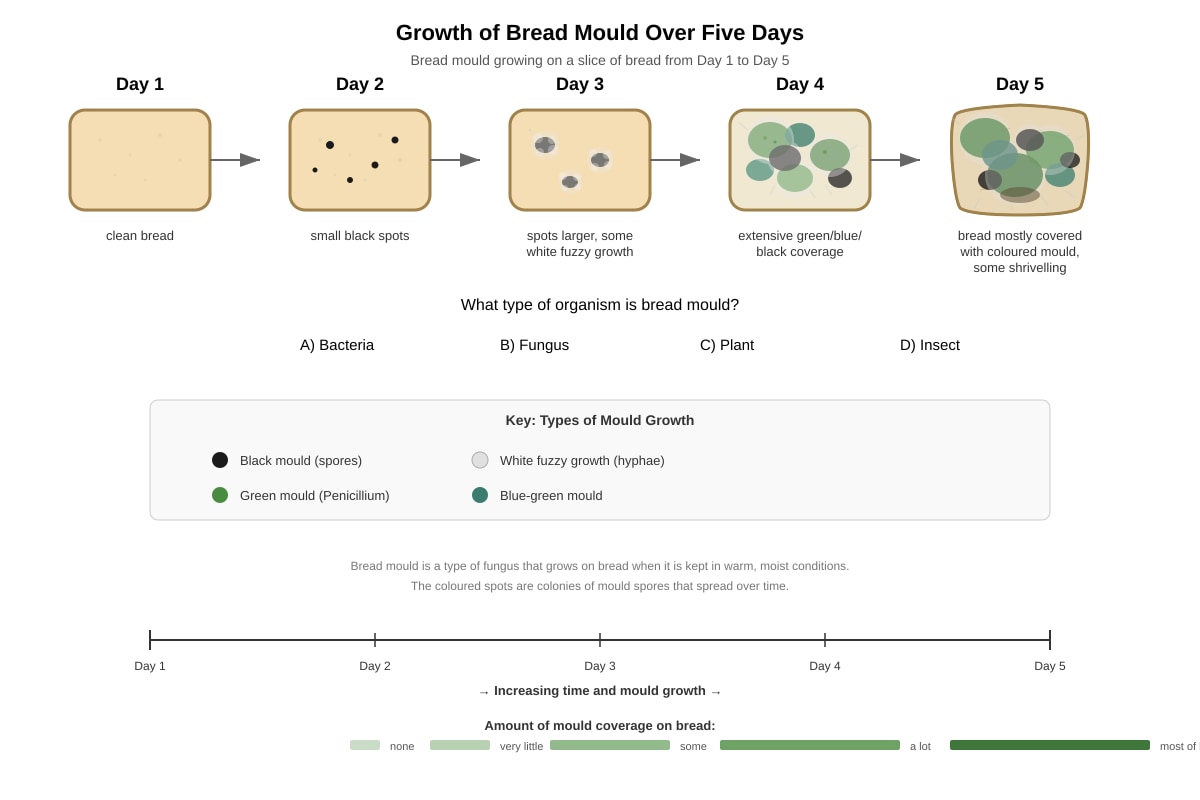
Explanation: Bread mould is a fungus (to be precise, usually Rhizopus species, a common bread mould). Fungi grow as thread-like hyphae that spread across surfaces. The different colours visible (black sporangia, white/grey mycelium, green/blue of other moulds) are reproductive spores.
Why not the others?
- Bacteria: Too small to see individual colonies this colourfully without magnification
- Plant: Needs chlorophyll and light—grows on soil, not bread
- Insect: Has legs, antennae, clearly animal features—doesn't spread as fuzzy growth
11. Answer: A
Explanation: The question asks about reproduction method.
- A: Butterfly (insect) and bird both lay eggs = same reproduction method ✓
- B: Fish and frog both live in water = habitat, not reproduction
- C: Human and lizard both have backbones = body structure (vertebrates), not reproduction
- D: Grass and mushroom both do not move = movement, not reproduction
Both butterfly and bird are oviparous (egg-laying), though they differ in other ways.
12. Answer: B
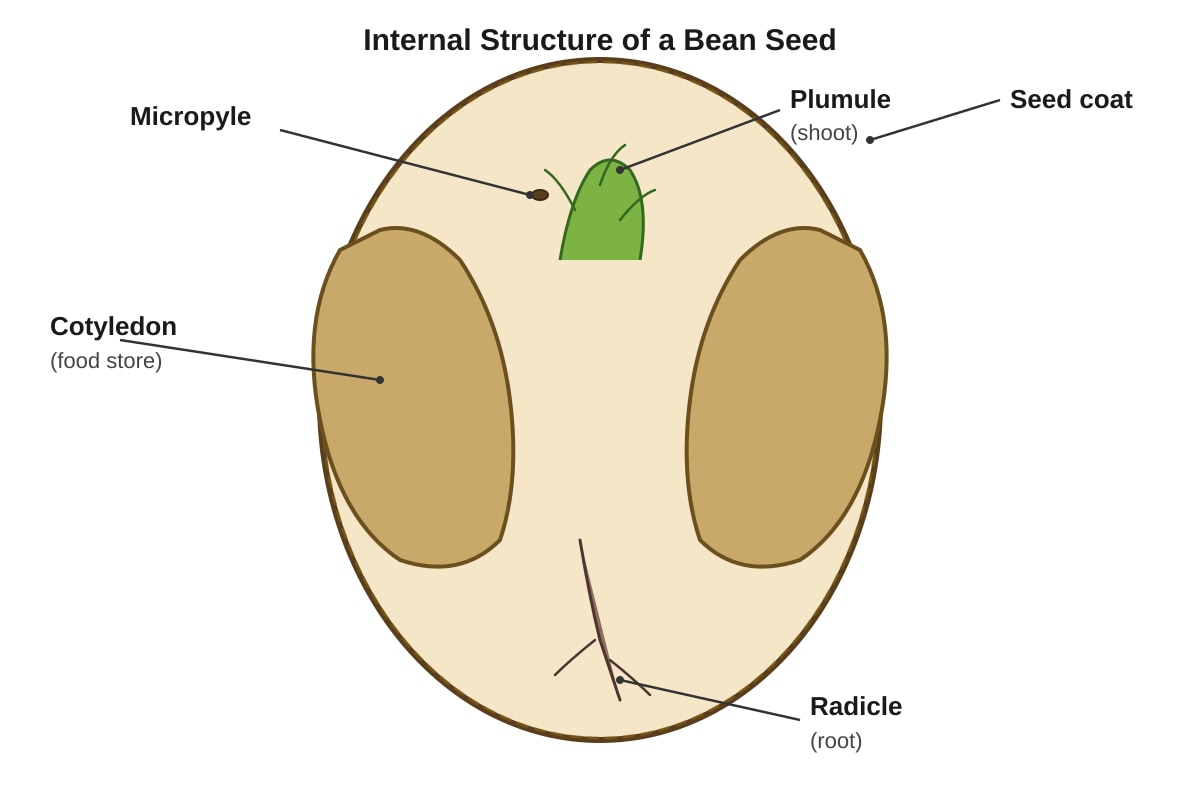
Explanation: The cotyledon is the food storage structure in a seed. It provides nutrients (food) to the developing embryo before the seedling can make its own food through photosynthesis. In bean seeds (dicots), there are two cotyledons that are large and fleshy.
- A = seed coat function
- C = root hairs function
- D = anther function (part of flower, not seed)
13. Answer: B
Explanation: Cacti are adapted to hot, dry (arid) environments:
- Thick, waxy stem: Reduces water loss through transpiration and provides water storage ✓
- Broad leaves (A): Would increase water loss, unsuitable for desert—cacti have spines instead
- Shallow roots (C): Actually cacti have deep AND shallow roots; this alone isn't the key adaptation
- Bright flowers (D): True for pollination, but not a survival adaptation to dry conditions
The waxy cuticle on stems (and reduced leaves → spines) are classic xerophyte adaptations.
14. Answer: C
Explanation: Plant R has:
- Thick, fleshy leaves: For water storage (succulent adaptation)
- Desert habitat: Dry environment where water conservation is essential
Water loss reduction features: Thick cuticle, fleshy tissues, sunken stomata, reduced leaf surface area.
- P (cold mountain): Needle-like leaves reduce snow accumulation, waxy coating reduces cold damage
- Q (rainforest): Broad leaves maximise light in dense canopy
- S (grassland): Adapted to grazing and moderate rainfall
15. Answer: C
Explanation: This is the false statement. Animal-dispersed seeds actually have features that help them stick to animals or be eaten:
- Hooks or burrs to attach to fur/feathers (e.g., burs, hitchhiker seeds)
- Fleshy, coloured fruits to attract animals to eat them (not large and heavy!)
Correct statements:
- A: Wind seeds—light, winged/feathery (e.g., saga seeds, dandelion)
- B: Water seeds—air spaces for buoyancy (e.g., coconut)
- D: Self-dispersal—explosive pods that burst when dry (e.g., balsam, pea pods)
16. Answer: B
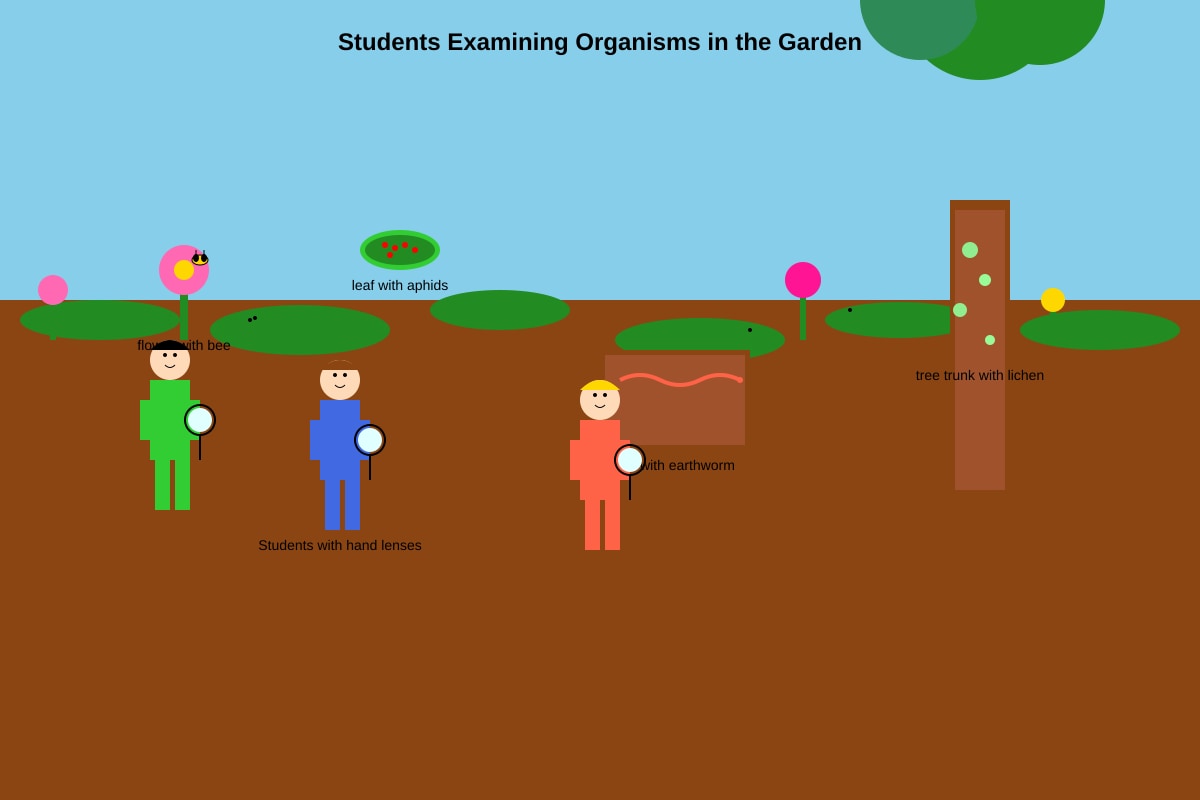
Explanation: A magnifying glass (hand lens) is a simple magnifier that enlarges the appearance of objects. It helps students see small details of organisms that are too small to see clearly with the naked eye—such as the shape of aphid bodies, segments on earthworms, or mouthparts of insects.
- A: Colours are visible to naked eye; magnification helps detail, not colour
- C: Magnifying glasses don't take photographs
- D: Measuring requires a ruler or tape measure, not a lens
17. Answer: C
Explanation: Goldfish → Amphibian is incorrect. Goldfish are fish, not amphibians. Fish:
- Have scales, fins, gills throughout life
- Live entirely in water (most species)
- Do not undergo metamorphosis
Amphibians (e.g., frogs, salamanders) have:
- Moist skin (no scales)
- Lungs and/or skin breathing as adults
- Metamorphosis from aquatic larva to adult
Correct pairings: Mushroom-Fungi ✓, Earthworm-Invertebrate ✓, Fern-Plant ✓
18. Answer: B
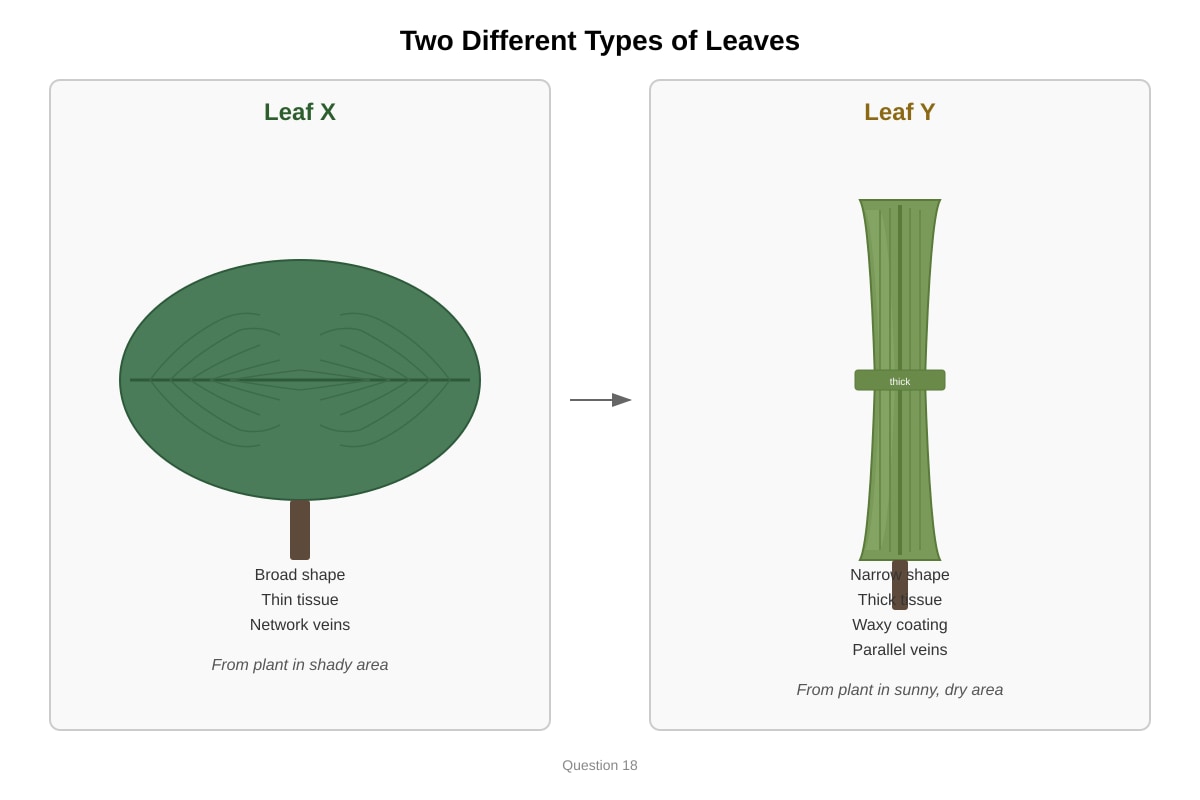
Explanation: Leaf Y (narrow, thick, waxy, parallel veins) is adapted to sunny, dry conditions:
- Thick surface/cuticle: Reduces transpiration (water loss) ✓
- Waxy coating: Reflects light and waterproofs surface
- Narrow shape: Reduces surface area exposed to sun and wind
Leaf X (broad, thin, network veins) is adapted to maximise light absorption in shady conditions.
Why not others:
- A: Broad leaves (X) have larger surface area, not Y
- C: Thin tissue would increase water loss, not reduce it
- D: More stomata would increase water loss; xerophytes have fewer, sunken stomata
19. Answer: C
Explanation: The organism is bacteria based on these key features:
- Microscopic, no nucleus: Bacteria are prokaryotes—their DNA floats freely, not enclosed in a membrane-bound nucleus
- Electron microscope needed: At 0.5–5 μm, most bacteria need high magnification (light microscope minimum ×400, but EM for detailed structure)
Why not others:
- Protozoa (A): Have nuclei (eukaryotes)
- Fungi (B): Have nuclei, visible as mould/filaments
- Viruses (D): Much smaller (0.02–0.3 μm), not cells at all, need EM; but the description says "organism" with cellular hints
20. Answer: B
Explanation: Genetic diversity in crops is crucial for food security. If all plants are genetically identical (monoculture), one disease can wipe out entire harvests. Different varieties may have:
- Resistance to different diseases
- Tolerance to different climates/soils
- Different nutritional qualities
The Irish Potato Famine (1840s) is a historical example: over-reliance on one potato variety led to mass starvation when blight struck.
Why not others:
- A: Colour is irrelevant to survival/value
- C: Diversity doesn't necessarily reduce land needed
- D: Mixed varieties may actually complicate harvesting
SECTION B: STRUCTURED QUESTIONS (60 marks)
QUESTION 21 (6 marks)
(a) Answer: Water lily and pond weed (both correct needed or accept either for 1 mark if two required)
Explanation (2 marks):
- Producers are organisms that make their own food using sunlight through photosynthesis
- The table states: "Makes own food using sunlight" for both water lily and pond weed
- Both contain chlorophyll in their cells and use carbon dioxide + water + sunlight → glucose + oxygen
Marking scheme:
- [1 mark] Name both correct organisms
- [1 mark] Explain that they make their own food using sunlight/photosynthesis
(b) Answer: The water snail scrapes algae off rocks, and the tadpole eats plants and small organisms.
Explanation (2 marks):
- Consumers cannot make their own food; they must eat other organisms to obtain energy
- Water snail: feeds on algae (producer) — gains energy by eating
- Tadpole: eats plants and small organisms — gains energy by eating
- Both obtain energy by consuming other living things, not by photosynthesis
Marking scheme:
- [1 mark] Identify that both eat other organisms (consumers feed on others)
- [1 mark] Use specific evidence from table (algae / plants and small organisms)
(c) Answer: Ferns / Mosses / Fungi (any one correct, though fungi technically use spores too)
Explanation: These non-flowering plants reproduce using spores instead of seeds. Ferns produce spores in sori (spore cases) on the underside of fronds.
(d) Answer (2 marks):
Experiment: She could place the water lily in a beaker of water with a layer of oil on top, or test a leaf for starch using iodine solution:
Method:
- Take a leaf from the water lily
- Boil it in water to kill the cells and break cell walls
- Boil in ethanol to remove chlorophyll (water bath for safety)
- Rinse in water
- Add iodine solution
Result: The leaf turns blue-black if starch is present, showing photosynthesis occurred.
OR
Place water lily in bright light for a few hours, then test for oxygen bubbles (gas test with glowing splint relights).
Marking scheme:
- [1 mark] Describe a valid test (starch test / oxygen test / carbon dioxide uptake)
- [1 mark] State correct expected result (blue-black with iodine / oxygen gas relights glowing splint / hydrogencarbonate indicator changes)
QUESTION 22 (6 marks)
(a) Answer (3 marks):
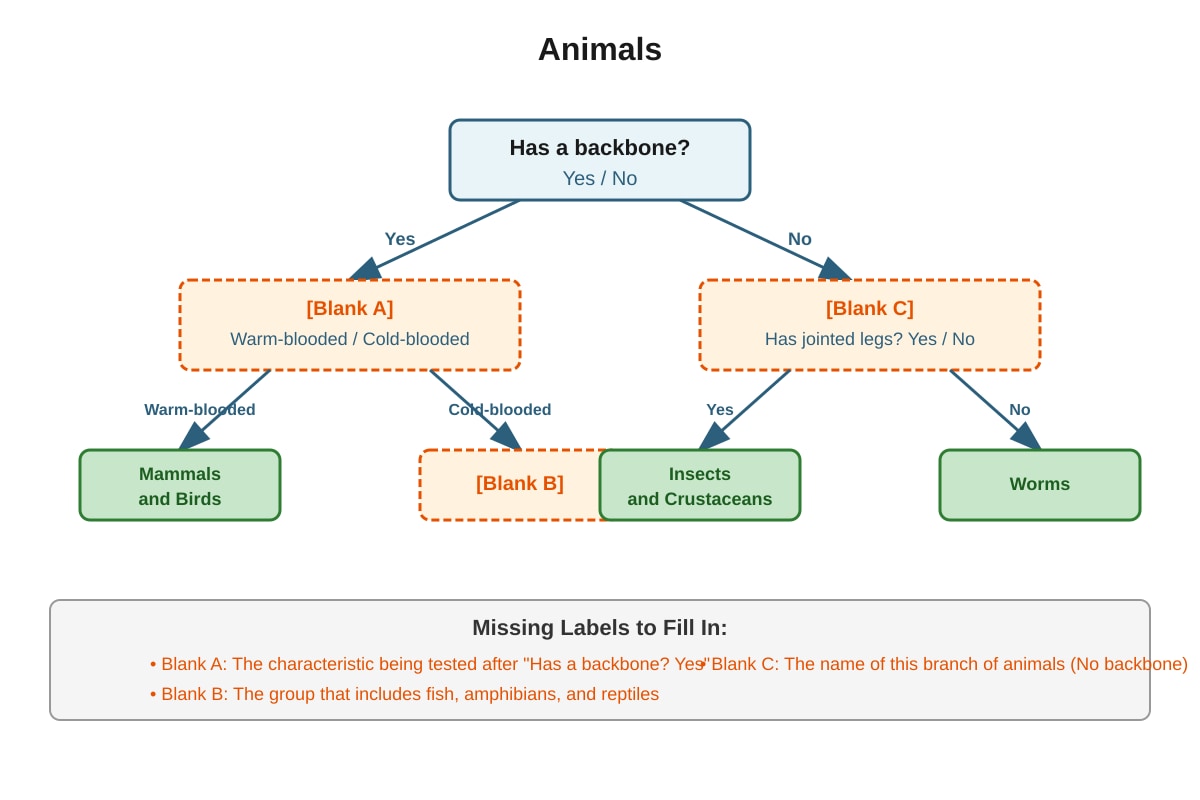
- Blank A: Warm-blooded / Cold-blooded (or Homoeothermic / Poikilothermic)
- Blank B: Fish, Amphibians and Reptiles (or "Cold-blooded vertebrates" / "Pisces, Amphibia, Reptilia")
- Blank C: Invertebrates (or "Animals without backbones")
Explanation: Vertebrates have a backbone (vertebral column). They split into:
- Warm-blooded (endotherms): Birds and mammals — maintain constant body temperature
- Cold-blooded (ectotherms): Fish, amphibians, reptiles — body temperature changes with environment
Animals without backbones = invertebrates — the vast majority of animal species.
Marking scheme:
- [1 mark each] Three correct labels
(b) Answer (2 marks):
The statement is incorrect because:
- Fish, amphibians, and reptiles are all cold-blooded vertebrates
- They have a backbone but are NOT warm-blooded
- For example, a snake needs to bask in the sun to warm up; a goldfish has body temperature matching the water around it
Marking scheme:
- [1 mark] Name examples of cold-blooded vertebrates from flowchart
- [1 mark] Explain they have backbones but are cold-blooded (body temperature varies with environment)
(c) Answer (1 mark):
Example: Earthworm / Flatworm / Roundworm / Leech
Feature: Has no backbone (soft body, bilaterally symmetrical, hydrostatic skeleton, segmented body in earthworms)
QUESTION 23 (5 marks)
(a) Answer: The type of soil / different soil types
Explanation: The independent variable is what the experimenter deliberately changes. Rahim chose different soil types to test their effect on growth.
(b) Answer (1 mark):
To make the test fair — so that any difference in growth is caused by the soil type, not by different seeds. Using the same type of seed controls genetic variation so it's a fair test.
(c) Answer (1 mark):
Clay soil (2.1 cm lowest height). It is least suitable because seedlings grew shortest in it, suggesting poor drainage, compaction, or lack of air spaces for roots.
(d) Answer (1 mark):
Sandy soil has large particles with big air spaces — water drains through too quickly, so seeds may not get enough water to germinate. OR: Sandy soil has few nutrients as they wash away easily.
(e) Answer (1 mark):
Any one of: Amount of light / Temperature / Same size pot / Same volume/mass of soil / Same initial seed size/condition
QUESTION 24 (6 marks)
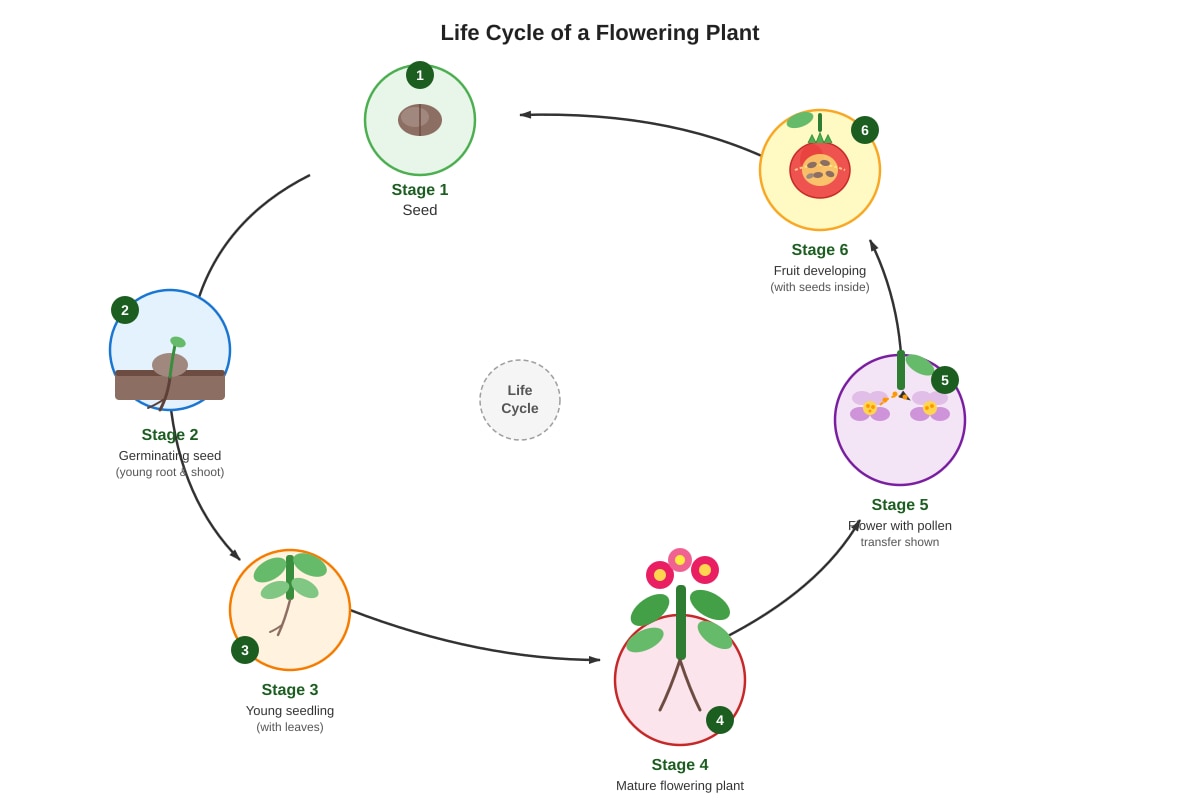
(a) Answer: Pollination
(b) Explanation (2 marks):
Pollination is essential for sexual reproduction in flowering plants. Without pollen transfer:
- The egg cell in the ovule cannot be fertilised
- Seeds cannot form without fertilisation
- Without seeds, the plant cannot complete its life cycle and produce the next generation
Marking scheme:
- [1 mark] Fertilisation requires pollen to reach stigma
- [1 mark] Seeds develop from fertilised ovules; seeds needed for next generation
(c) Answer: Stage 3 (young seedling with leaves) or Stage 4 (mature plant)
Explanation (2 marks):
- Photosynthesis requires chlorophyll in green leaves to absorb light energy
- Stage 3 is when the first true leaves appear with chlorophyll (seed leaves/cotyledons in some plants store food but may not be green)
- Stage 4 definitely has functional leaves
Accept Stage 3 or 4 with valid explanation — Stage 3 minimum as this is when green photosynthetic tissue is actively functioning beyond seed reserves.
Marking scheme:
- [1 mark] Correct stage identified
- [1 mark] Explanation that leaves contain chlorophyll needed for photosynthesis
(d) Answer (1 mark):
Any one: By wind / By water / By animals (eating/dropping) / Self-dispersal (explosion)
QUESTION 25 (7 marks)
(a) Answer (3 marks):
| Organism | Group |
|---|---|
| Tall trees with broad leaves | Producer |
| Butterflies feeding on flower nectar | Consumer |
| Mushrooms growing on rotting logs | Decomposer |
Marking scheme: [1 mark each]
(b) Answer (2 marks):
Not always. Ants are omnivores — they eat both plants and animals.
- Sometimes they act as consumers (eating other insects, collecting honeydew from aphids)
- Sometimes they act as decomposers (feeding on dead matter)
- In the activity described, they carry dead insects → this is scavenging/decomposer role, not just consumer
Marking scheme:
- [1 mark] Identify that ants can be decomposers too / omniovores / feed on dead matter
- [1 mark] Reference to carrying dead insects as decomposer behaviour
(c) Explanation (2 marks):
Decomposers break down dead organisms and waste:
- Return nutrients to the soil (nitrogen, phosphorus, etc.)
- These nutrients are reused by producers (plants) to grow
- Without decomposers, dead matter would accumulate and nutrients would be locked away
- They maintain nutrient cycling in the ecosystem
Marking scheme:
- [1 mark] Break down dead matter / recycle nutrients
- [1 mark] Nutrients become available for producers/plants to use
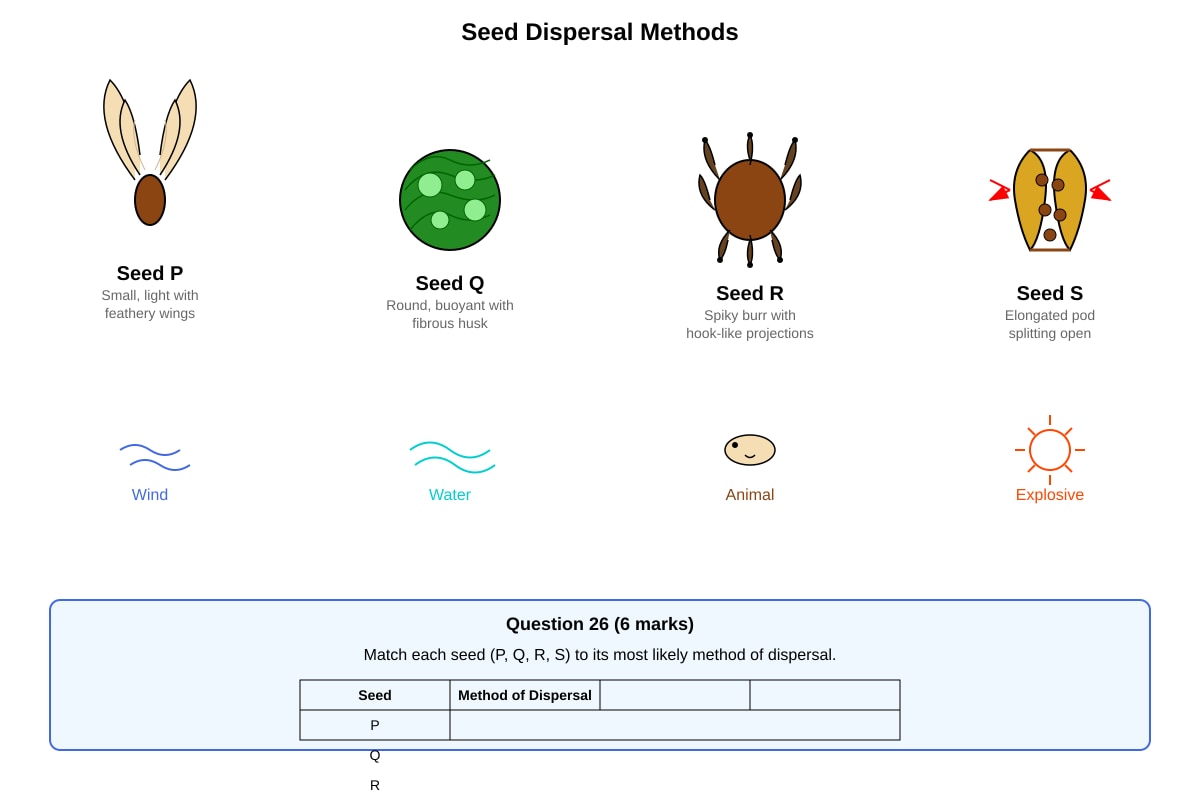
QUESTION 26 (6 marks)
(a) Answer (2 marks):
| Seed | Method of Dispersal |
|---|---|
| P | Wind |
| Q | Water |
| R | Animal |
| S | Self-dispersal / Explosive mechanism |
Marking scheme: [0.5 mark each; accept "by animals" for R]
(b) Explanation (2 marks):
Two features of P (wind-dispersed):
- Small and light: Easy to be carried by air currents over long distances
- Wing/feathery structure: Increases surface area, acts like a parachute to catch wind, keeps seed aloft longer
Marking scheme:
- [1 mark each] Any two valid features linked to wind dispersal
(c) Answer (2 marks):
Environmental condition: Water / Rain / Flood / Near water source
Explanation:
- Seed Q has fibrous husk and air spaces for floating
- Needs water to carry it away from parent plant
- Water levels rise during rain, allowing buoyant fruits to float to new locations
OR Coastal/wetland habitat where water currents distribute seeds.
Marking scheme:
- [1 mark] Identify water/rain/flooding as helpful condition
- [1 mark] Explain how buoyant structure works with water to disperse seed
QUESTION 27 (6 marks)
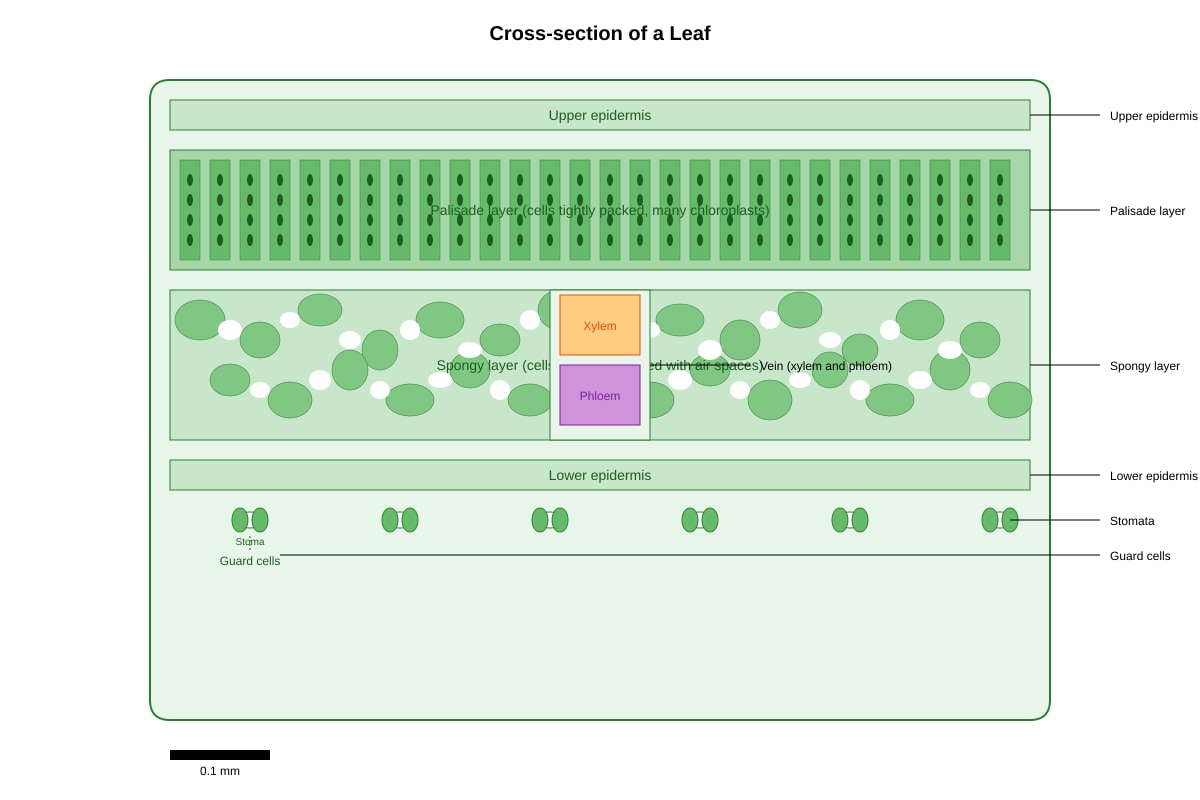
(a) Answer (2 marks):
- Palisade layer (palisade mesophyll cells)
- Spongy layer (spongy mesophyll cells) — or accept "leaf cells containing chloroplasts"
Both layers contain chloroplasts with chlorophyll for photosynthesis.
(b) Explanation (2 marks):
The palisade layer is best because:
- Cells are tightly packed and column-shaped (elongated), fitting many cells in the space
- Cells contain the most chloroplasts of any leaf tissue → maximum chlorophyll concentration
- Positioned near the upper epidermis → receives maximum light entering the leaf
Marking scheme:
- [1 mark] Tightly packed / many chloroplasts / near top surface
- [1 mark] Linked explanation of why this maximises light absorption (most chlorophyll, best light exposure)
(c) Explanation (2 marks):
The spongy layer has:
- Loosely arranged cells with large air spaces between them
- These air spaces allow carbon dioxide to diffuse quickly and easily throughout the leaf
- CO₂ reaches all cells for photosynthesis
- Also allows oxygen (product) to diffuse out efficiently
Marking scheme:
- [1 mark] Describe loose arrangement / air spaces
- [1 mark] Explain gas exchange function (CO₂ in, O₂ out) aids photosynthesis
QUESTION 28 (7 marks)
(a) Answer (2 marks):
Viruses (and some might argue none are non-cellular, but viruses definitely)
Two reasons:
- Bacteria, yeast, mould, and protozoa are all made of cells — they have cell membranes, cytoplasm, and carry out life processes in cells
- Viruses are not cells — they are particles made only of genetic material (DNA or RNA) inside a protein coat; they cannot live independently and must infect host cells to reproduce
Marking scheme:
- [1 mark] Identify virus as non-cellular
- [1 mark] Explain viruses lack cell structure / are genetic material + protein only / need host cells
(b) Explanation (2 marks):
The school microscope may not be fully suitable:
- Bacteria are 1–5 micrometres long
- At ×400 magnification, they would appear 0.25–1.25 mm — visible as tiny dots but internal structure unclear
- To see shape (rods, spheres, spirals) and arrangement, ×1000 with oil immersion is typically needed
- Students might see bacteria as small moving dots, but detailed identification is difficult
Marking scheme:
- [1 mark] bacteria are very small / at the limit of light microscopy
- [1 mark] ×400 may show they exist but fine details hard to see / need higher magnification for clear observation
(c) Explanation (3 marks):
Why yeast is useful in bread-making:
- Yeast carries out aerobic respiration then anaerobic respiration (fermentation) in dough
- Produces carbon dioxide gas (and ethanol)
- CO₂ forms bubbles that get trapped in the elastic gluten network
- This makes the bread rise and gives it a light, airy texture
Conditions needed:
- Warm temperature (~30–35°C) — yeast enzymes work best here, too hot kills yeast, too cold slows activity
- Moisture — for chemical reactions and yeast to absorb nutrients
- Sugar/flour — food source for respiration
- No/some oxygen initially, then anaerobic conditions develop in dough centre
Marking scheme:
- [1 mark] Yeast produces carbon dioxide (and explanation of rising)
- [1 mark] Warm temperature needed (with valid range or explanation)
- [1 mark] One other valid condition with explanation (sugar/food, moisture, absence of too much salt)
QUESTION 29 (6 marks)
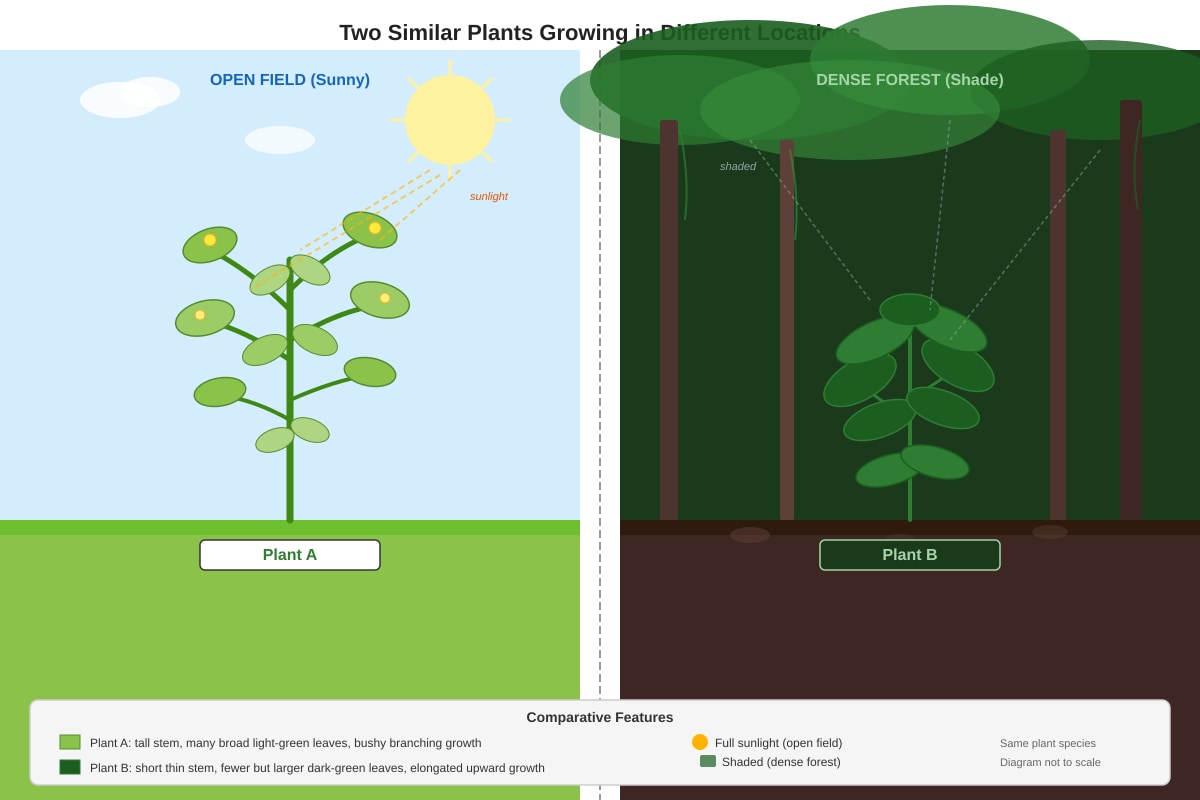
(a) Answer (2 marks): Any two valid differences:
| Feature | Plant A | Plant B |
|---|---|---|
| Stem height | Tall, sturdy | Short, elongated reaching upward |
| Leaf number | Many leaves | Fewer leaves |
| Leaf colour | Light green | Dark green |
| Leaf size | Smaller, compact | Larger, thinner/elongated |
| Growth pattern | Bushy, branching | Single stem dominant |
Marking scheme: [1 mark each valid difference; must be comparative]
(b) Explanation (2 marks):
Example: Larger, darker green leaves
- Dark green = more chlorophyll to absorb the limited light in shady forest understory
- Larger surface area = captures more light from scarce, filtered sunlight
- This compensates for low light intensity in shaded environment
OR: Elongated upward growth
- Reaches toward light gaps in the canopy (positive phototropism)
- Competes more effectively for available light
Marking scheme:
- [1 mark] Describe the adaptive feature clearly
- [1 mark] Explain how it improves survival in shade (more light capture / reach light / efficiency)
(c) Explanation (2 marks):
The student is incorrect because:
- Both plants are the same species — they show phenotypic plasticity (different appearances due to environment, not genes)
- The differences are adaptive responses to different environmental conditions (light availability)
- Same species can have different morphology in different habitats — this is diversity within a species, not different species
- To confirm different species, need to check if they can interbreed to produce fertile offspring, or examine genetic similarity
Marking scheme:
- [1 mark] Explain that environment causes differences, not different species / phenotypic plasticity
- [1 mark] Mention that same species can look different in different conditions / same species can interbreed
QUESTION 30 (8 marks)
(a) Answer (2 marks): Organism Z
Two reasons:
- No nucleus in cells — bacteria are prokaryotes, their DNA is not enclosed in a nuclear membrane
- Single-celled and very small — bacteria are unicellular prokaryotes, much simpler than multi-celled organisms
Additional evidence: Can be seen with naked eye = ✗ (actually most bacteria cannot, but table says ✗, supporting microscopic nature)
Marking scheme:
- [1 mark] Correct organism Z identified
- [1 mark] Both reasons valid (no nucleus + single-celled / prokaryote features)
(b) Answer (2 marks):
Reproduction method: Seeds / Spores / Vegetative reproduction (cuttings, runners, bulbs)
Example answer with seeds:
- Produces many seeds with genetic variation (from sexual reproduction with two parents)
- Variation means some offspring may survive if conditions change — natural selection can occur
- Maintains genetic diversity in the population, making species more resilient
Marking scheme:
- [1 mark] Name appropriate reproduction method
- [1 mark] Explain how it maintains diversity (variation / multiple offspring / different traits / adaptation potential)
(c) Explanation (2 marks):
DNA analysis is more reliable because:
- Organisms may look similar but be genetically different (cryptic species)
- Convergent evolution — unrelated species may develop similar features when adapting to similar environments (e.g., dolphins and sharks both streamlined)
- DNA shows evolutionary relationships directly — shared ancestry is revealed by similar DNA sequences
- Observable features can be misleading — influenced by environment, age, or damage
Marking scheme:
- [1 mark] DNA reveals true genetic relationships / ancestry
- [1 mark] Organisms can look similar but be unrelated (convergent evolution) OR look different but be related (divergent evolution)
(d) Answer (2 marks):
Example food chain:
Grass (Producer) → Caterpillar/Leaf-eating insect (Consumer, like Organism X) → Bird (Consumer)
OR
Lettuce/Plant (Producer) → Snail/Rabbit (Consumer) → Fox/Snake (Consumer)
Requirements:
- Three organisms in correct order
- Arrows showing energy flow (pointing from food to eater)
- Producer correctly labeled
- Consumers correctly labeled
- Organism X type (consumer that eats plants = herbivore/primary consumer) accurately depicted
Marking scheme:
- [1 mark] Valid food chain with producer and two consumers in correct order with arrows
- [1 mark] Correct labels (producer + consumer) for each organism
END OF ANSWER KEY
Section A Total: 40 marks
Section B Total: 60 marks
GRAND TOTAL: 100 marks