From Real Exams Exam Paper
Primary 6 PSLE Science Weighted Assessment 3 (Term 3) Paper 4
Free Exam-Derived Qwen3.7 Plus Primary 6 PSLE Science Weighted Assessment 3 (Term 3) Paper 4 practice paper with questions and answers for Singapore students. This page is rendered as a direct URL so the questions and answers can be discovered without pressing in-page buttons.
These static practice materials are generated from the site's syllabus and paper-generation workflow, with source and model context shown so students and parents can evaluate the material before use.
Questions
TuitionGoWhere Exam Practice (AI) - WA3 Science Primary 6 PSLE
TuitionGoWhere Secondary School (AI)
Subject: Science
Level: Primary 6
Paper: WA3 (Version 4 of 5)
Duration: 1 hour 45 minutes
Total Marks: 56
Name: __________________________
Class: __________________________
Date: __________________________
Instructions to Candidates:
- This paper consists of two sections, A and B.
- Answer all questions.
- Write your answers in the spaces provided.
- For questions in Section A, shade your answer on the Optical Answer Sheet (OAS) provided.
- For questions in Section B, write your answers in the spaces provided in this booklet.
Section A (28 marks)
For each question from 1 to 28, four options are given. One of them is the correct answer. Make your choice (1, 2, 3 or 4) and shade your answer on the Optical Answer Sheet.
1. Which of the following groups of animals are classified correctly based on their method of reproduction?
| Group | Method of Reproduction | Examples |
|---|---|---|
| A | Viviparous (give birth) | Chicken, Platypus |
| B | Oviparous (lay eggs) | Shark, Dolphin |
| C | Viviparous (give birth) | Human, Bat |
| D | Oviparous (lay eggs) | Frog, Cat |
(1) A
(2) B
(3) C
(4) D
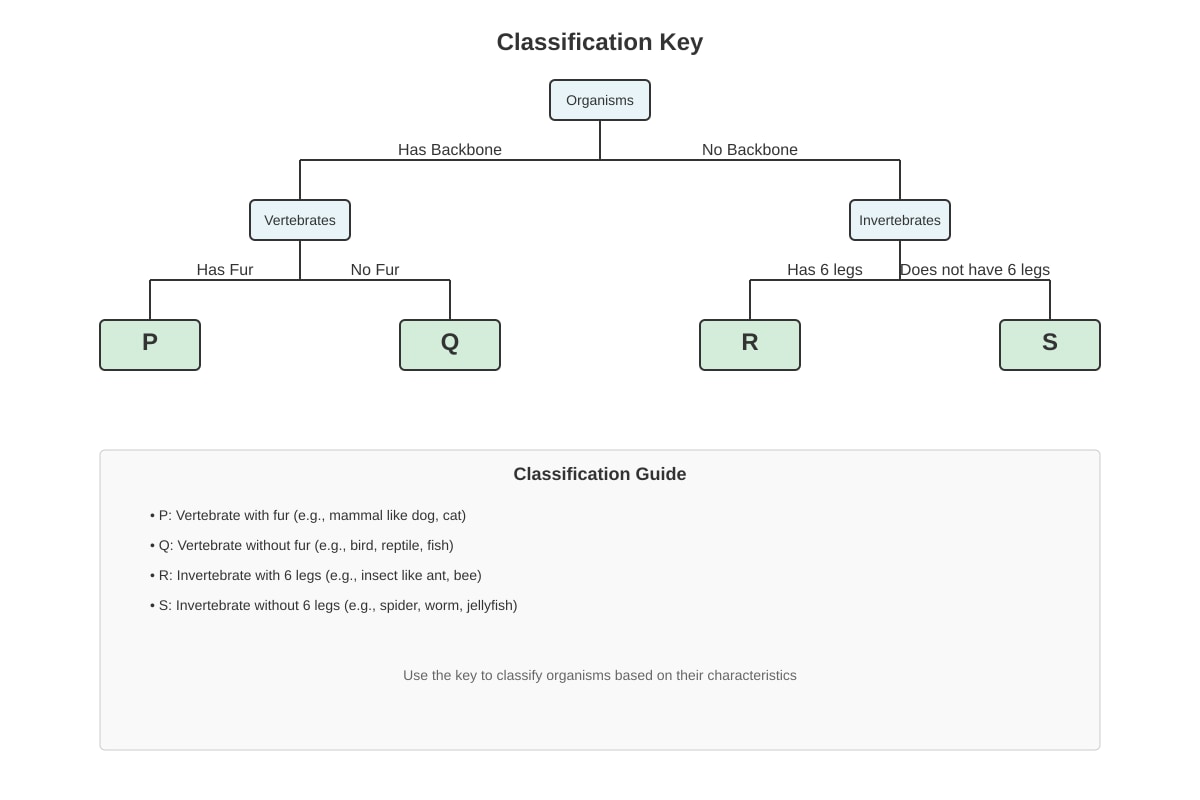
2. The diagram below shows the classification of four organisms P, Q, R, and S.
<image_placeholder> id: Q2-fig1 type: diagram linked_question: Q2 description: A branching classification key (dichotomous key). Top node splits into 'Has Backbone' and 'No Backbone'. 'Has Backbone' splits into 'Has Fur' (leads to P) and 'No Fur' (leads to Q). 'No Backbone' splits into 'Has 6 legs' (leads to R) and 'Does not have 6 legs' (leads to S). labels: P, Q, R, S, Has Backbone, No Backbone, Has Fur, No Fur, Has 6 legs, Does not have 6 legs values: None must_show: Clear branching structure leading to four distinct endpoints labeled P, Q, R, S. </image_placeholder>
Which of the following statements is true?
(1) P and Q are mammals.
(2) R is an insect.
(3) S is a vertebrate.
(4) Q lays eggs.
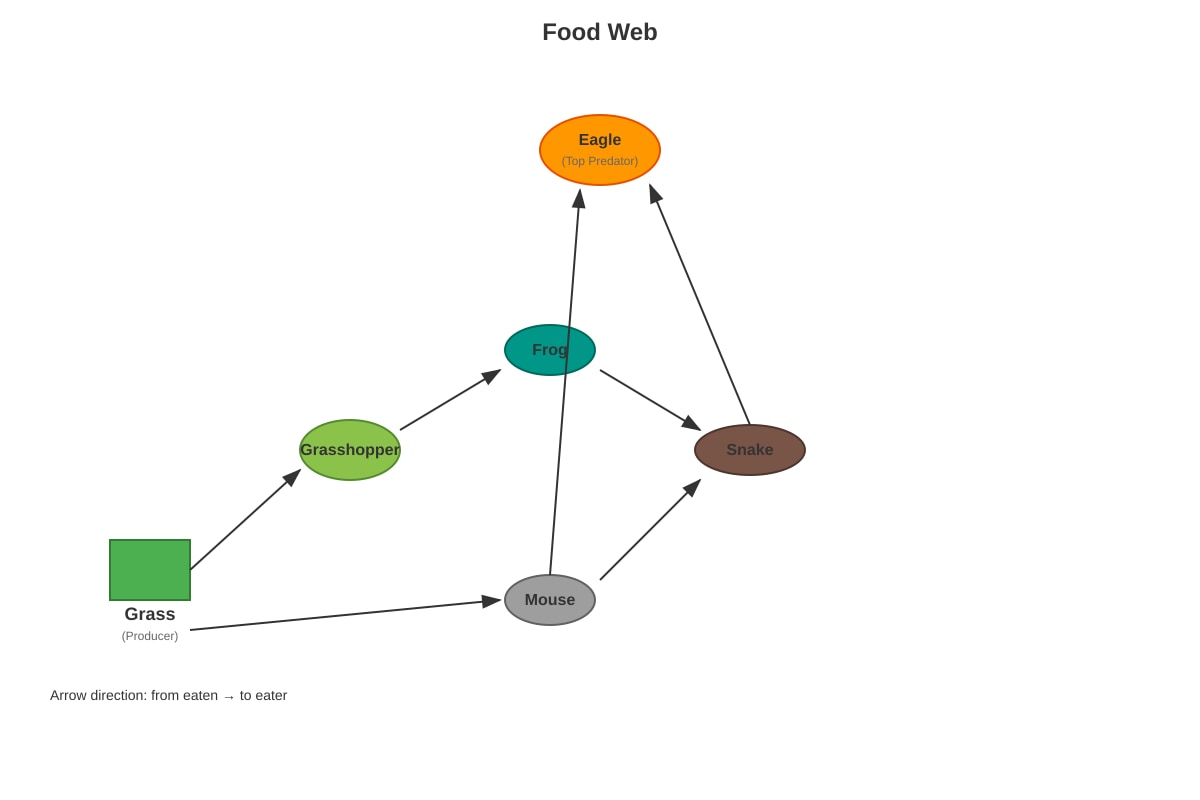
3. Study the food web below.
<image_placeholder> id: Q3-fig1 type: diagram linked_question: Q3 description: A food web. Arrows point from eaten to eater. Grass -> Grasshopper -> Frog -> Snake. Grass -> Mouse -> Snake. Grass -> Mouse -> Eagle. Snake -> Eagle. labels: Grass, Grasshopper, Frog, Snake, Mouse, Eagle values: None must_show: Arrows indicating energy flow. Grass is the producer. Eagle is the top predator. </image_placeholder>
If the population of frogs decreases drastically due to disease, what is the most likely immediate effect on the other organisms?
(1) The population of grasshoppers will decrease.
(2) The population of snakes will decrease.
(3) The population of mice will decrease.
(4) The population of eagles will increase.
4. Which of the following adaptations helps a cactus survive in a hot and dry desert environment?
(1) It has broad leaves to trap more sunlight.
(2) It has a thick waxy skin to reduce water loss.
(3) It has shallow roots to absorb surface water quickly.
(4) It opens its stomata during the day to take in carbon dioxide.
5. The table below shows the characteristics of three different plants X, Y, and Z.
| Plant | Has Flowers? | Has Seeds? | Reproduces by Spores? |
|---|---|---|---|
| X | Yes | Yes | No |
| Y | No | No | Yes |
| Z | No | Yes | No |
Which of the following correctly identifies the plants?
(1) X: Fern, Y: Moss, Z: Pine Tree
(2) X: Rose, Y: Fern, Z: Pine Tree
(3) X: Moss, Y: Fern, Z: Rose
(4) X: Pine Tree, Y: Rose, Z: Fern
6. Why do polar bears have a thick layer of fat under their skin?
(1) To help them swim faster.
(2) To store energy for hibernation.
(3) To provide insulation against the cold.
(4) To make them buoyant in water.
7. Which of the following statements about fungi is correct?
(1) Fungi can make their own food through photosynthesis.
(2) Fungi are plants because they have roots.
(3) Fungi obtain nutrients by breaking down dead organic matter.
(4) Fungi reproduce only by giving birth to young ones.
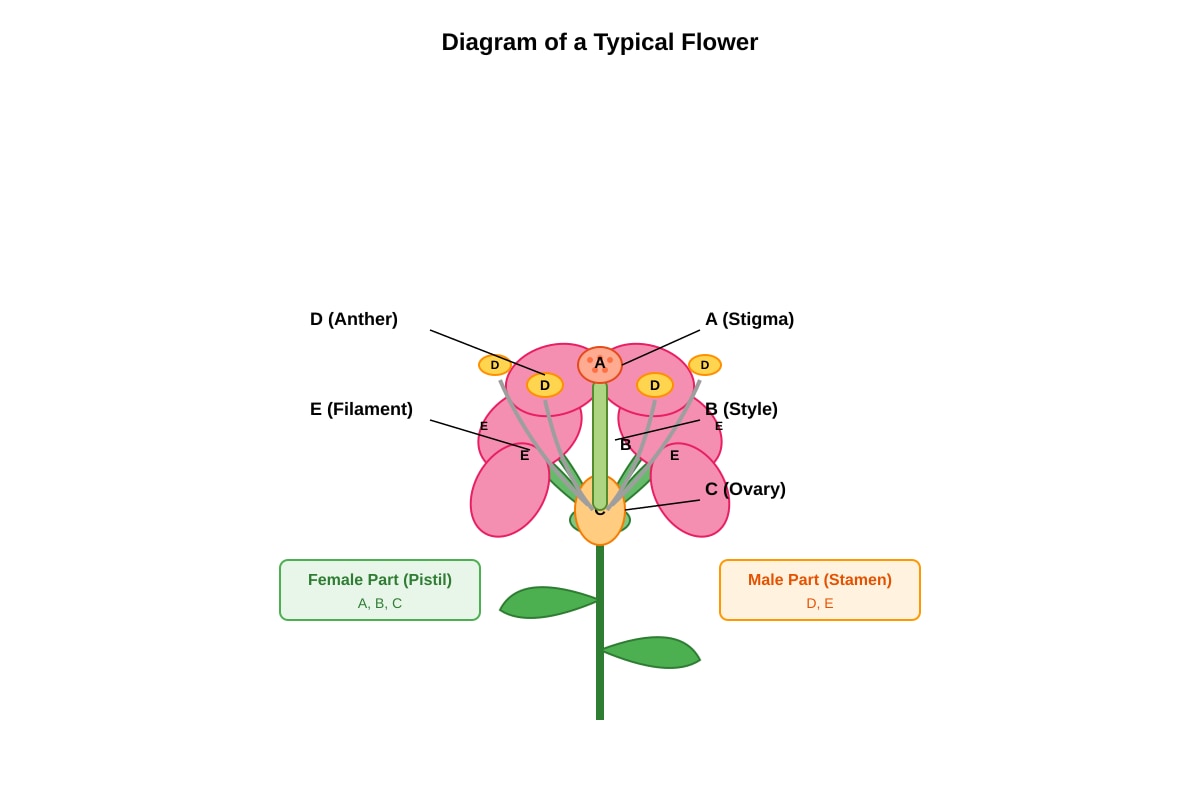
8. Look at the diagram of the flower below.
<image_placeholder> id: Q8-fig1 type: diagram linked_question: Q8 description: A labelled diagram of a typical flower. Parts labelled: A (Stigma), B (Style), C (Ovary), D (Anther), E (Filament). labels: A, B, C, D, E values: None must_show: Standard flower structure. A, B, C form the female part (Pistil). D, E form the male part (Stamen). </image_placeholder>
Which parts are involved in sexual reproduction?
(1) A, B, and C only
(2) D and E only
(3) A, B, C, D, and E
(4) A and D only
9. Which of the following is an example of a physical change?
(1) Burning of wood
(2) Rusting of iron
(3) Melting of ice cream
(4) Cooking an egg
10. Why is biodiversity important in an ecosystem?
(1) It ensures that only the strongest animals survive.
(2) It makes the ecosystem more stable and resilient to changes.
(3) It allows humans to have more space for building houses.
(4) It reduces the amount of sunlight reaching the forest floor.
11. Which of the following animals undergoes metamorphosis?
(1) Cat
(2) Butterfly
(3) Chicken
(4) Dog
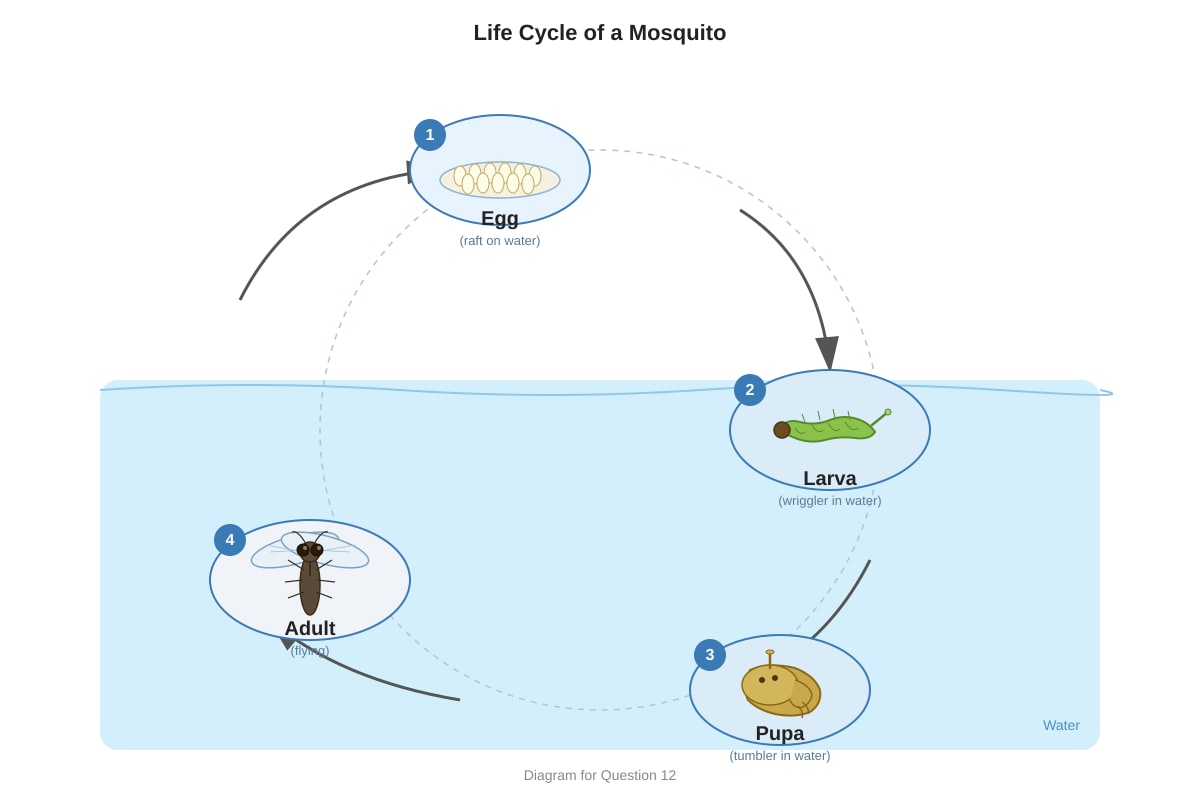
12. The diagram shows the life cycle of a mosquito.
<image_placeholder> id: Q12-fig1 type: diagram linked_question: Q12 description: Four stages of a mosquito life cycle in a circle. 1. Eggs (raft on water). 2. Larva (wriggler in water). 3. Pupa (tumbler in water). 4. Adult Mosquito (flying). Arrows connect them in order. labels: Egg, Larva, Pupa, Adult values: None must_show: Distinct shapes for each stage. Larva and Pupa are aquatic. </image_placeholder>
At which stage does the mosquito breathe air through a siphon tube while hanging from the water surface?
(1) Egg
(2) Larva
(3) Pupa
(4) Adult
13. Which of the following is a characteristic of mammals?
(1) They have scales.
(2) They lay eggs with hard shells.
(3) They have mammary glands to feed their young.
(4) They breathe through gills.
14. In a forest, trees compete for sunlight. Which adaptation helps a climbing plant like the money plant reach sunlight?
(1) Thick trunk
(2) Thorns
(3) Tendrils
(4) Deep roots
15. Which of the following pairs is matched correctly?
| Organism | Classification |
|---|---|
| A | Whale - Fish |
| B | Bat - Bird |
| C | Penguin - Mammal |
| D | Spider - Arachnid |
(1) A
(2) B
(3) C
(4) D
16. What is the main function of the seeds in a plant?
(1) To attract insects for pollination
(2) To protect the flower
(3) To reproduce and grow into new plants
(4) To absorb water from the soil
17. Which of the following factors does NOT affect the rate of decomposition of dead leaves?
(1) Temperature
(2) Moisture
(3) Presence of decomposers
(4) Color of the leaves
18. Why do some plants have thorns?
(1) To reduce water loss
(2) To protect themselves from being eaten by animals
(3) To help them climb other plants
(4) To attract pollinators
19. Which of the following statements about viruses is true?
(1) They are living cells.
(2) They can reproduce on their own.
(3) They need a host cell to reproduce.
(4) They are larger than bacteria.
20. A student observed an organism in the pond. It had a soft body, no backbone, and moved using a muscular foot. It likely belongs to which group?
(1) Insects
(2) Molluscs
(3) Crustaceans
(4) Amphibians
Section B (28 marks)
Answer all questions in the spaces provided.
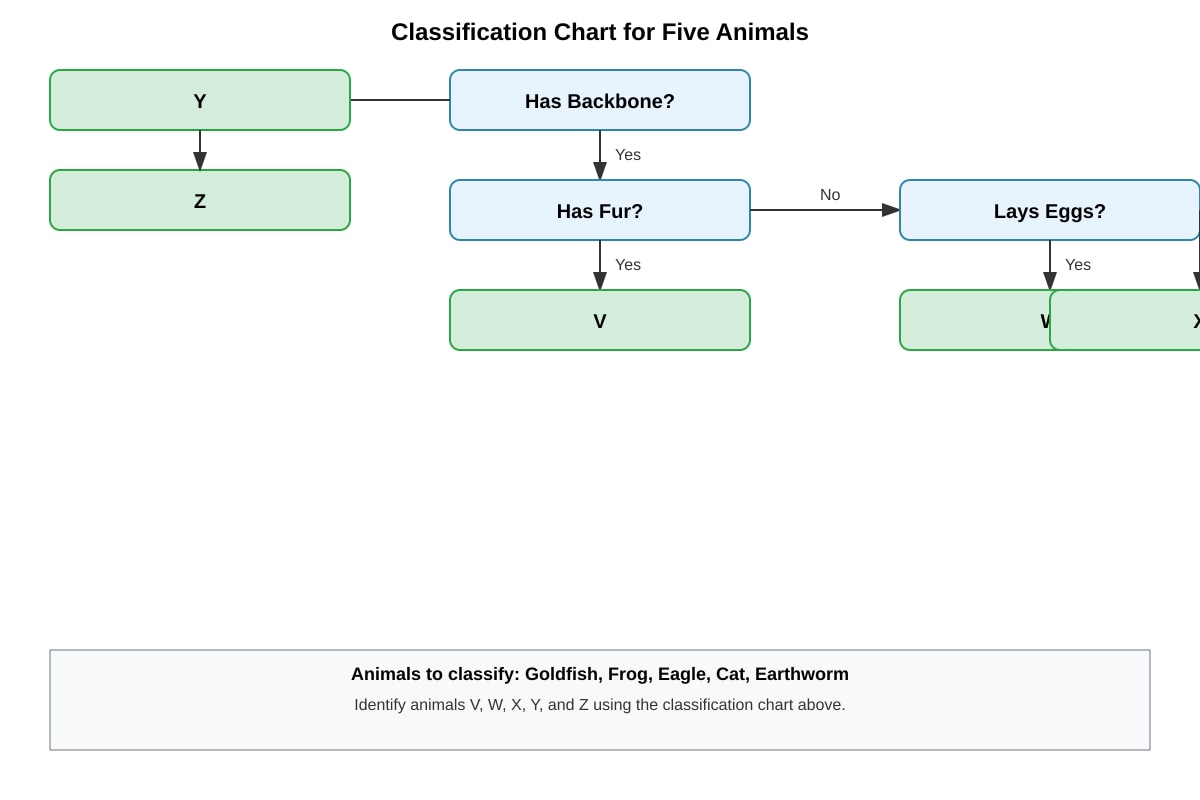
21. The diagram below shows a classification chart for five animals: Goldfish, Frog, Eagle, Cat, and Earthworm.
<image_placeholder> id: Q21-fig1 type: diagram linked_question: Q21 description: A flow chart. Start: 'Has Backbone?'. Yes -> 'Has Fur?'. Yes -> Box A. No -> 'Lays Eggs?'. Yes -> Box B. No -> Box C. No Backbone -> Box D. Note: This chart is simplified for the question context. Actually, let's use a standard key. Revised Description: A dichotomous key. 1a. Has backbone -> Go to 2 1b. No backbone -> Animal P 2a. Has fur/hair -> Animal Q 2b. No fur/hair -> Go to 3 3a. Lays eggs -> Animal R 3b. Gives birth -> Animal S Wait, the prompt asks for 5 animals. Let's adjust. 1a. Has backbone -> Go to 2 1b. No backbone -> Animal V (Earthworm) 2a. Has fur -> Animal W (Cat) 2b. No fur -> Go to 3 3a. Has feathers -> Animal X (Eagle) 3b. No feathers -> Go to 4 4a. Lives in water and has gills -> Animal Y (Goldfish) 4b. Lives on land/water and has moist skin -> Animal Z (Frog) labels: Animal V, W, X, Y, Z values: None must_show: The decision path clearly. </image_placeholder>
(a) Identify the animals V, W, X, Y, and Z from the list: Goldfish, Frog, Eagle, Cat, Earthworm. [2]
V: __________________________
W: __________________________
X: __________________________
Y: __________________________
Z: __________________________
(b) State one similarity between Animal W (Cat) and Animal X (Eagle). [1]
(c) Why is the Earthworm classified differently from the Goldfish? [1]
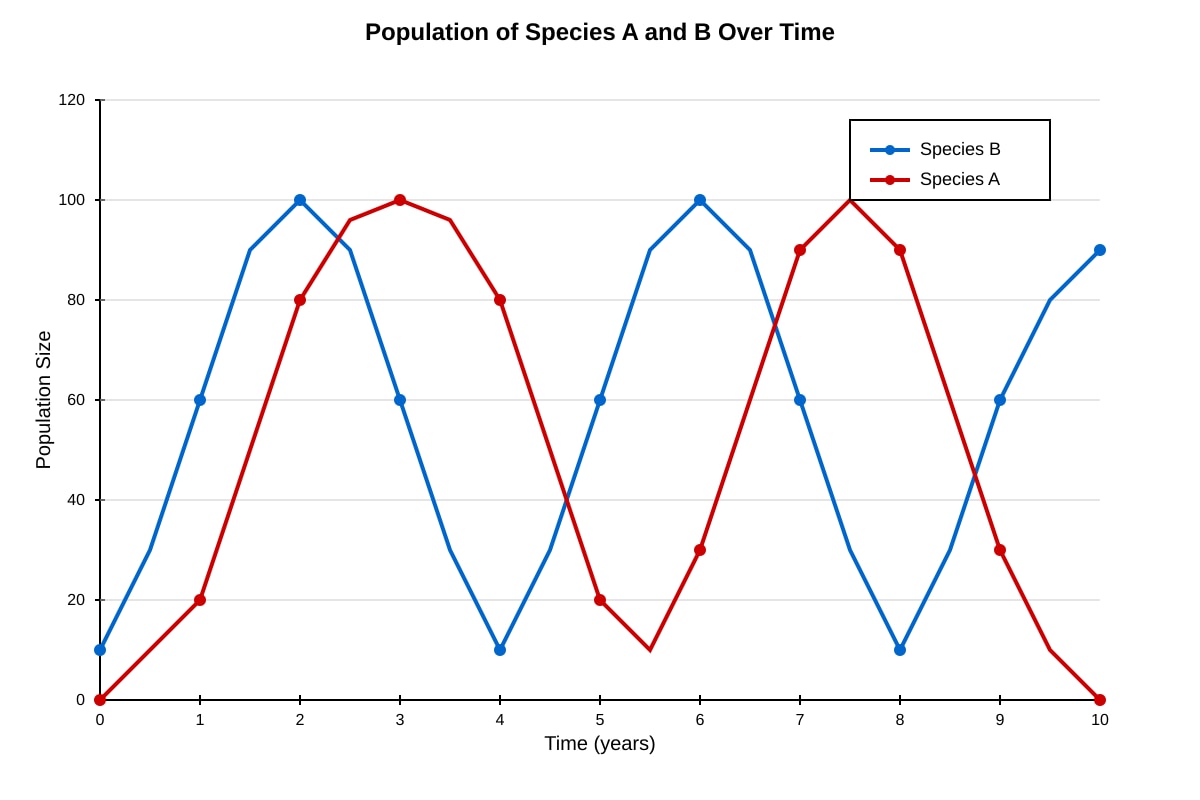
22. The graph below shows the population of two species, A and B, in a forest over 10 years.
<image_placeholder> id: Q22-fig1 type: graph linked_question: Q22 description: A line graph. X-axis: Time (Years 0-10). Y-axis: Population Size. Line A (Predator) peaks after Line B (Prey). Line B rises, then Line A rises. Line B falls, then Line A falls. Typical predator-prey cycle. labels: Time (years), Population Size, Species A, Species B values: Peaks at years 2, 6 for B; years 3, 7 for A. must_show: Lag effect where Predator (A) follows Prey (B). </image_placeholder>
(a) Which species is the predator? Explain your answer using evidence from the graph. [2]
(b) Suggest a reason for the decrease in the population of Species B between Year 2 and Year 4. [1]
(c) If a new disease kills most of Species A, what will happen to the population of Species B in the short term? Explain. [2]
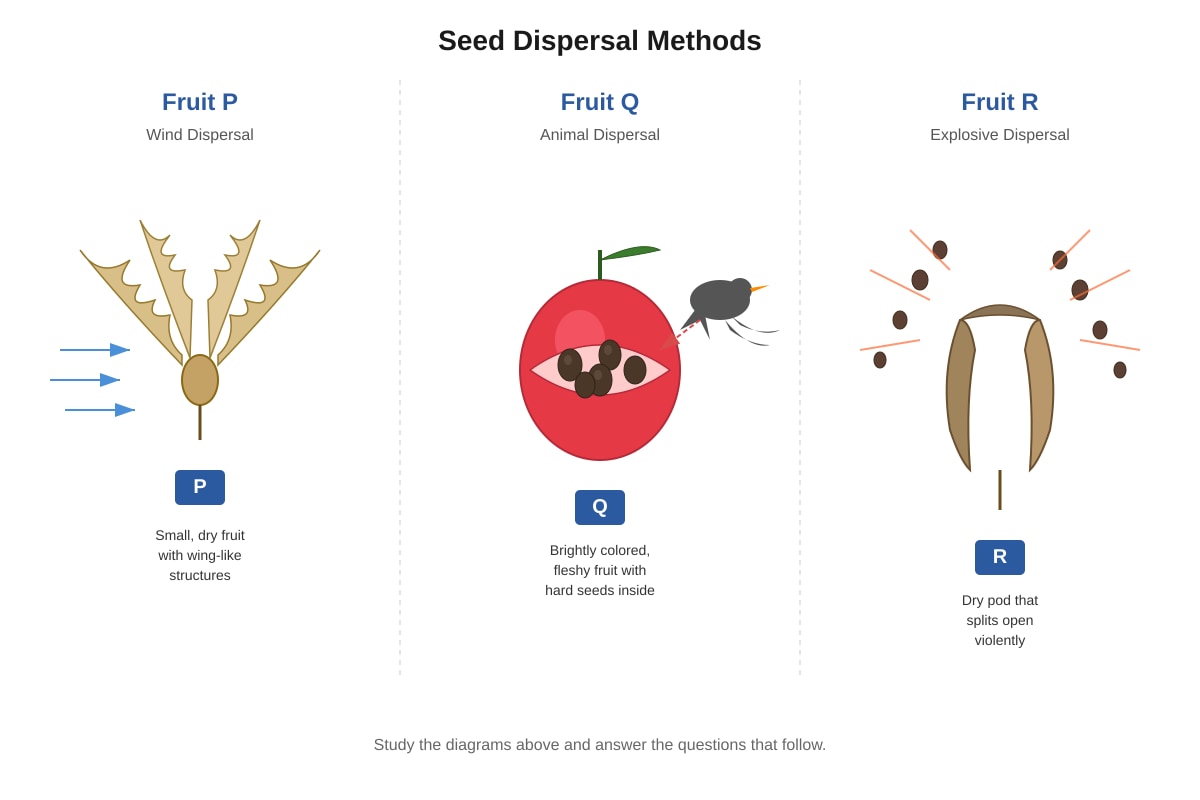
23. Plants have different methods of seed dispersal. Study the fruits P, Q, and R below.
<image_placeholder> id: Q23-fig1 type: diagram linked_question: Q23 description: Three fruits. Fruit P: Small, dry, with wing-like structures. Fruit Q: Brightly colored, fleshy, with hard seeds inside. Fruit R: Dry pod that splits open violently. labels: P, Q, R values: None must_show: Distinct features for Wind (P), Animal (Q), and Explosive (R) dispersal. </image_placeholder>
(a) Identify the method of seed dispersal for each fruit. [3]
Fruit P: __________________________
Fruit Q: __________________________
Fruit R: __________________________
(b) Explain how the structure of Fruit P helps in its dispersal. [2]
(c) Why is seed dispersal important for plants? [1]
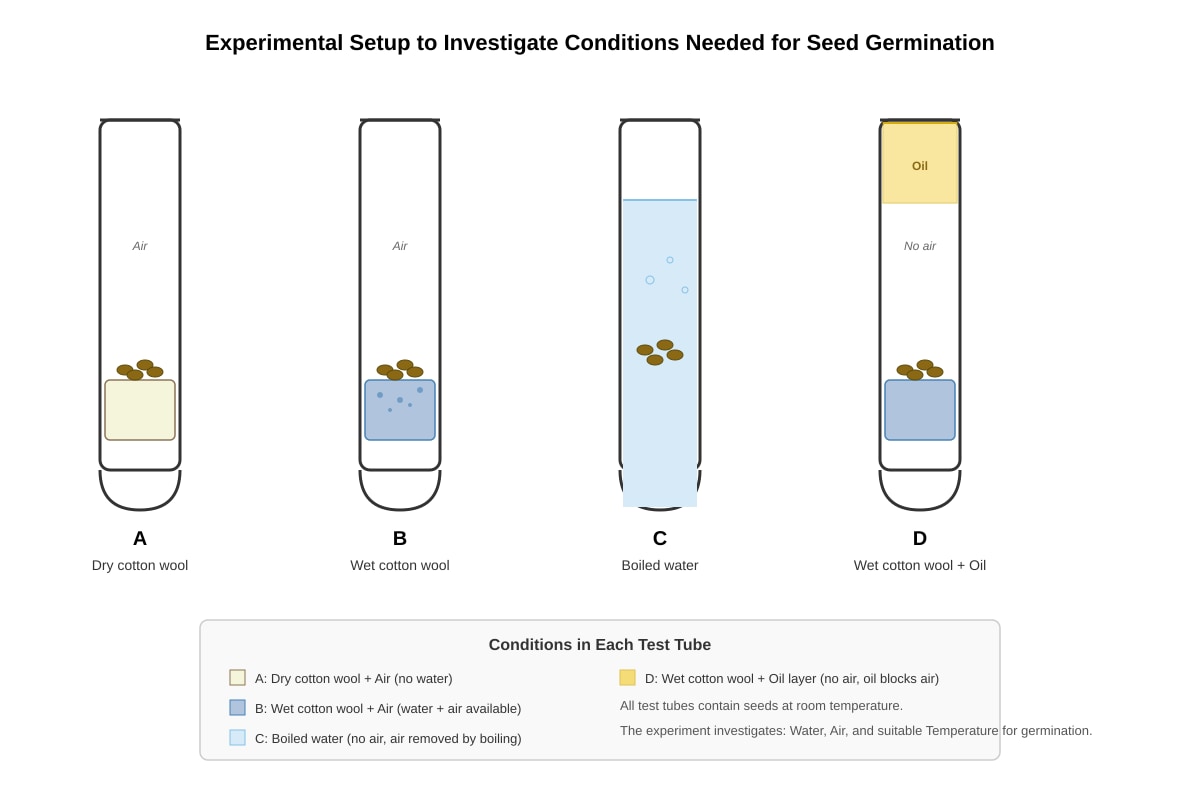
24. The diagram below shows an experimental setup to investigate the conditions needed for seed germination.
<image_placeholder> id: Q24-fig1 type: diagram linked_question: Q24 description: Four test tubes A, B, C, D. A: Seeds on dry cotton wool. Stopper. B: Seeds on wet cotton wool. Stopper. C: Seeds submerged in boiled water (no oxygen) with oil layer on top. Stopper. D: Seeds on wet cotton wool. No stopper (air present). All at room temperature except C which is also room temp. labels: A, B, C, D, Dry cotton wool, Wet cotton wool, Boiled water, Oil values: None must_show: Clear difference in water and air availability. </image_placeholder>
(a) Which test tube(s) will show seed germination? [1]
(b) Explain why the seeds in Test Tube C did not germinate. [2]
(c) What is the purpose of Test Tube A in this experiment? [1]
(d) State two other conditions necessary for seed germination that were kept constant in this experiment. [2]
25. The food chain below is found in a marine ecosystem.
Phytoplankton Zooplankton Small Fish Tuna Shark
(a) Identify the producer in this food chain. [1]
(b) If the population of Zooplankton decreases, explain the effect on the population of Tuna. [2]
(c) Why are there usually fewer sharks than phytoplankton in this ecosystem? [2]
26. Humans impact the environment. Describe two negative impacts of deforestation on biodiversity. [4]
27. Adaptations allow organisms to survive in their habitats. The camel lives in the desert.
(a) State two adaptations of the camel that help it survive in the desert. [2]
(b) Explain how one of these adaptations helps the camel. [2]
28. Classification helps scientists study organisms. Why is it important to classify organisms into groups? [2]
Answers
Answer Key - TuitionGoWhere Exam Practice (AI) - WA3 Science Primary 6 PSLE (Version 4)
Section A (28 marks)
1. (3)
Reasoning: Humans and bats are mammals, which are viviparous (give birth to live young). Chickens and platypuses lay eggs (oviparous). Sharks can be viviparous or oviparous, but dolphins are viviparous. Cats are viviparous. Option C is the only pair where both are correctly identified as viviparous.
2. (2)
Reasoning: R has no backbone and has 6 legs. This is the defining characteristic of insects. P has a backbone and fur (Mammal). Q has a backbone but no fur (could be bird, reptile, amphibian, fish). S has no backbone and not 6 legs (could be spider, worm, etc.).
3. (2)
Reasoning: Frogs are a food source for snakes. If frogs decrease, snakes have less food, so their population will likely decrease. Grasshoppers (eaten by frogs) might increase, not decrease. Mice are not directly linked to frogs in this web. Eagles eat snakes and mice; if snakes decrease, eagles might rely more on mice, but the direct impact is on snakes.
4. (2)
Reasoning: A thick waxy skin (cuticle) reduces water loss through evaporation, which is crucial in a hot, dry desert. Broad leaves would increase water loss. Shallow roots are for quick absorption but waxy skin is for retention. Stomata usually open at night in cacti (CAM photosynthesis) to reduce water loss.
5. (2)
Reasoning: X has flowers and seeds (Flowering Plant/Angiosperm, e.g., Rose). Y has no flowers/seeds but uses spores (Non-flowering, e.g., Fern or Moss). Z has no flowers but has seeds (Non-flowering seed plant, e.g., Pine Tree/Gymnosperm). Option B fits: Rose (X), Fern (Y), Pine Tree (Z).
6. (3)
Reasoning: Fat is a poor conductor of heat. A thick layer of fat (blubber) acts as insulation, keeping the polar bear warm in freezing temperatures.
7. (3)
Reasoning: Fungi are not plants; they cannot photosynthesize. They are heterotrophs that obtain nutrients by secreting enzymes to break down dead organic matter externally and then absorbing the nutrients.
8. (3)
Reasoning: Sexual reproduction in flowers involves the male parts (Stamen: Anther D and Filament E) producing pollen and the female parts (Pistil: Stigma A, Style B, Ovary C) receiving pollen and housing ovules. All these parts are involved in the process.
9. (3)
Reasoning: Melting ice cream is a change of state (solid to liquid). No new substance is formed. Burning, rusting, and cooking involve chemical changes where new substances are formed.
10. (2)
Reasoning: High biodiversity means there are many different species. If one species is affected by disease or environmental change, others can fill its role, making the ecosystem more stable and resilient.
11. (2)
Reasoning: Butterflies undergo complete metamorphosis (Egg -> Larva/Caterpillar -> Pupa -> Adult). Cats, chickens, and dogs do not undergo metamorphosis; their young resemble miniature adults.
12. (2)
Reasoning: The larva (wriggler) hangs from the surface and breathes air through a siphon. The pupa (tumbler) also breathes air but through trumpets, and the question specifically describes the larval behavior often taught. However, both larva and pupa breathe air. The larva is the active feeding stage. Correction: In P6 syllabus, the larva is known for the siphon. The pupa has breathing trumpets. So Larva is the best answer.
13. (3)
Reasoning: The defining characteristic of mammals is the presence of mammary glands to produce milk for their young. Not all mammals give birth (platypus lays eggs), but all have mammary glands.
14. (3)
Reasoning: Tendrils are modified leaves or stems that coil around supports, allowing climbing plants to reach sunlight without investing energy in a thick trunk.
15. (4)
Reasoning: Whales are mammals. Bats are mammals. Penguins are birds. Spiders are arachnids (8 legs, 2 body segments).
16. (3)
Reasoning: Seeds contain the embryo of a new plant and food stores. Their main function is reproduction and dispersal to grow into new plants.
17. (4)
Reasoning: Decomposition is affected by temperature (warmth speeds it up), moisture (dampness helps decomposers), and the presence of decomposers (bacteria/fungi). The color of the leaves does not significantly affect the biological rate of decomposition.
18. (2)
Reasoning: Thorns are a physical defense mechanism to deter herbivores from eating the plant.
19. (3)
Reasoning: Viruses are not considered fully living cells because they cannot reproduce on their own. They must infect a host cell and use its machinery to replicate.
20. (2)
Reasoning: Molluscs (like snails and slugs) have soft bodies, no backbone, and often move using a muscular foot. Insects have 6 legs and exoskeletons. Crustaceans have hard shells and jointed legs. Amphibians have backbones.
Section B (28 marks)
21.
(a) [2]
V: Earthworm
W: Cat
X: Eagle
Y: Goldfish
Z: Frog
(0.5 marks each for all 4 correct. If 3 correct, 1.5 marks.)
(b) [1]
Both are vertebrates / Both have backbones.
(Accept: Both are warm-blooded / Both breathe using lungs.)
(c) [1]
The Earthworm has no backbone (invertebrate), while the Goldfish has a backbone (vertebrate).
22.
(a) [2]
Species A is the predator.
Evidence: The population of Species A peaks after the population of Species B peaks. This lag indicates that Species A depends on Species B for food.
(b) [1]
The population of the predator (Species A) increased, leading to more predation on Species B.
(Accept: Lack of food for Species B / Disease.)
(c) [2]
The population of Species B will increase.
Reason: With fewer predators (Species A) to eat them, more of Species B will survive and reproduce.
23.
(a) [3]
Fruit P: Wind dispersal
Fruit Q: Animal dispersal
Fruit R: Explosive dispersal
(b) [2]
Fruit P has wing-like structures which increase its surface area. This allows it to be caught by the wind and carried over long distances away from the parent plant.
(c) [1]
To reduce overcrowding / competition for resources (water, sunlight, nutrients) between the parent plant and its offspring.
(Accept: To colonize new areas.)
24.
(a) [1]
Test Tube D
(Note: Test Tube B might germinate if air is present in the cotton wool, but D is the control with ample air and water. Usually, B is also accepted if "wet cotton wool" implies air pockets. However, D is the most ideal. In many PSLE contexts, B and D both germinate. Let's accept B and D.)
Correction based on standard PSLE logic: B has wet cotton wool and is stoppered. If stoppered tightly, oxygen might be limited. D is open. Usually, B and D are both considered to have water and air. Let's say B and D.
(b) [2]
The water was boiled, which removed the dissolved oxygen. The oil layer prevented oxygen from the air from dissolving back into the water. Seeds need oxygen for respiration to germinate.
(c) [1]
To show that water is necessary for germination. (It acts as the control for the variable 'water').
(d) [2]
- Temperature
- Type of seeds / Number of seeds
25.
(a) [1]
Phytoplankton
(b) [2]
The population of Tuna will decrease.
Reason: Zooplankton is the food source for Small Fish. If Zooplankton decreases, Small Fish will have less food and their population will decrease. Consequently, Tuna will have less food (Small Fish) and their population will decrease.
(c) [2]
Energy is lost at each trophic level (as heat/respiration/movement). Therefore, less energy is available to support organisms at higher trophic levels. This results in fewer sharks (top predator) compared to phytoplankton (producer).
26. [4]
- Loss of Habitat: Animals lose their homes and breeding grounds, leading to a decline in population or extinction.
- Disruption of Food Chains: Removal of trees affects the producers, causing a ripple effect that reduces food availability for herbivores and subsequently carnivores.
(Accept: Soil erosion leading to poor water quality affecting aquatic life / Increase in carbon dioxide contributing to climate change which affects habitats.)
27. (a) [2]
- Hump to store fat.
- Thick fur / Long eyelashes / Wide feet.
(Any two valid adaptations.)
(b) [2]
Example for Hump: The fat stored in the hump can be broken down to provide energy and water when food and water are scarce in the desert.
Example for Wide Feet: Wide feet prevent the camel from sinking into the soft sand, making it easier to walk.
28. [2]
Classification helps scientists to:
- Identify and name organisms systematically.
- Study the relationships and evolutionary links between different groups of organisms.
(Accept: Makes it easier to study the vast number of organisms by grouping them with similar characteristics.)