From Real Exams Exam Paper

Primary 6 PSLE Science Weighted Assessment 2 (Term 3) Paper 5

Free Exam-Derived Qwen3.7 Plus Primary 6 PSLE Science Weighted Assessment 2 (Term 3) Paper 5 practice paper with questions and answers for Singapore students. This page is rendered as a direct URL so the questions and answers can be discovered without pressing in-page buttons.

These static practice materials are generated from the site's syllabus and paper-generation workflow, with source and model context shown so students and parents can evaluate the material before use.

Primary 6 PSLE Science From Real Exams Generated by Qwen3.7 Plus Updated 2026-06-04

Questions

<!-- TuitionGoWhere generation metadata: stage=3-1; model=qwen/qwen3.7-plus; model_label=Qwen3.7 Plus; generated=2026-06-04; Sources: Stage 2-1 real exam-derived templates and Stage 2-2 exam-enriched syllabus. -->

TuitionGoWhere Practice Paper - Science Primary 6 PSLE

TuitionGoWhere Exam Practice (AI)

Subject: Science
Level: Primary 6
Paper: WA2 (Practice) - Version 5
Duration: 1 hour 45 minutes
Total Marks: 56
Name: __________________________
Class: __________________________
Date: __________________________

Instructions to Candidates:

  1. This paper consists of two sections: Section A and Section B.
  2. Answer all questions.
  3. Write your answers in the spaces provided.
  4. For questions in Section A, write the number (1, 2, 3 or 4) of your answer in the brackets provided.
  5. The use of calculators is not allowed.

Section A (28 marks)

For each question from 1 to 14, four options are given. One of them is the correct answer. Make your choice (1, 2, 3 or 4) and write it in the brackets provided. Each question carries 2 marks.

  1. Which of the following groups of animals are all mammals? (1) Bat, Whale, Penguin (2) Dolphin, Seal, Platypus (3) Crocodile, Lizard, Turtle (4) Frog, Toad, Salamander [____]

  2. The table below shows the characteristics of four different organisms, P, Q, R, and S.

    OrganismHas ChlorophyllReproduces by SporesHas Flowers
    PYesNoYes
    QYesYesNo
    RNoYesNo
    SNoNoNo

    Which organism is most likely a fern? (1) P (2) Q (3) R (4) S [____]

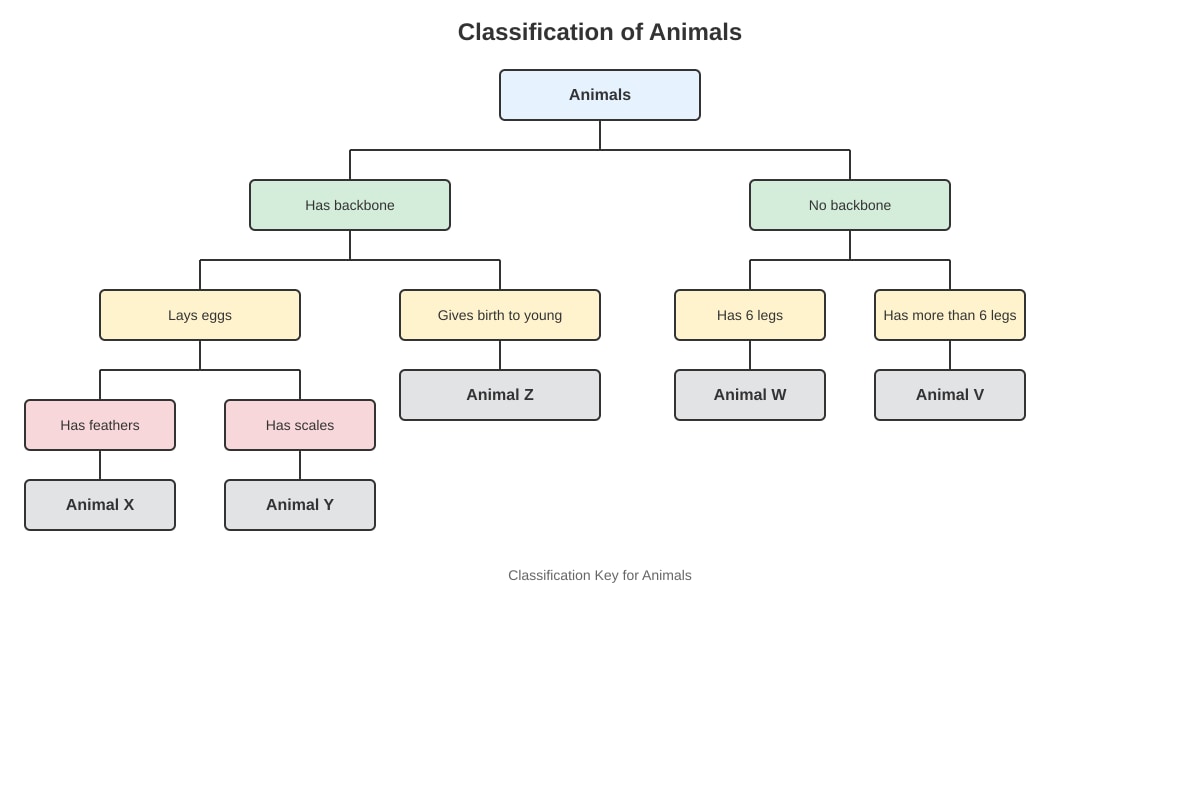
  3. Study the classification chart below.

    <image_placeholder> id: Q3-fig1 type: diagram linked_question: Q3 description: A simple branching classification key. Top box splits into 'Has backbone' and 'No backbone'. 'Has backbone' splits into 'Lays eggs' and 'Gives birth to young'. 'Lays eggs' splits into 'Has feathers' (Animal X) and 'Has scales' (Animal Y). 'Gives birth to young' is Animal Z. 'No backbone' splits into 'Has 6 legs' (Animal W) and 'Has more than 6 legs' (Animal V). labels: Animal X, Animal Y, Animal Z, Animal W, Animal V must_show: The branching structure clearly distinguishing the animals based on the stated characteristics. </image_placeholder>

    Which of the following statements about the animals is correct? (1) Animal X and Animal Y are both mammals. (2) Animal Z breathes through gills. (3) Animal W is an insect. (4) Animal V is a spider. [____]

  4. Which of the following is a correct food chain found in a garden ecosystem? (1) Sun → Caterpillar → Leaf → Bird (2) Leaf → Caterpillar → Bird → Hawk (3) Hawk → Bird → Caterpillar → Leaf (4) Leaf → Bird → Caterpillar → Hawk [____]

  5. In a forest, the population of deer increased rapidly. What is the most likely immediate effect on the ecosystem? (1) The population of grass decreased. (2) The population of lions decreased. (3) The amount of sunlight reaching the ground increased. (4) The number of decomposers in the soil decreased. [____]

  6. Which of the following adaptations helps a cactus survive in a hot and dry desert? (1) Broad leaves to capture more sunlight. (2) Thick waxy skin to reduce water loss. (3) Shallow roots to absorb surface rain quickly. (4) Bright flowers to attract insects for pollination. [____]

  7. Why do polar bears have a thick layer of fat under their skin? (1) To help them float in water. (2) To store energy for hibernation. (3) To keep them warm in cold climates. (4) To protect them from predators. [____]

  8. Which of the following statements about fungi is true? (1) They make their own food using sunlight. (2) They have roots, stems, and leaves. (3) They obtain nutrients from dead or decaying matter. (4) They reproduce using seeds. [____]

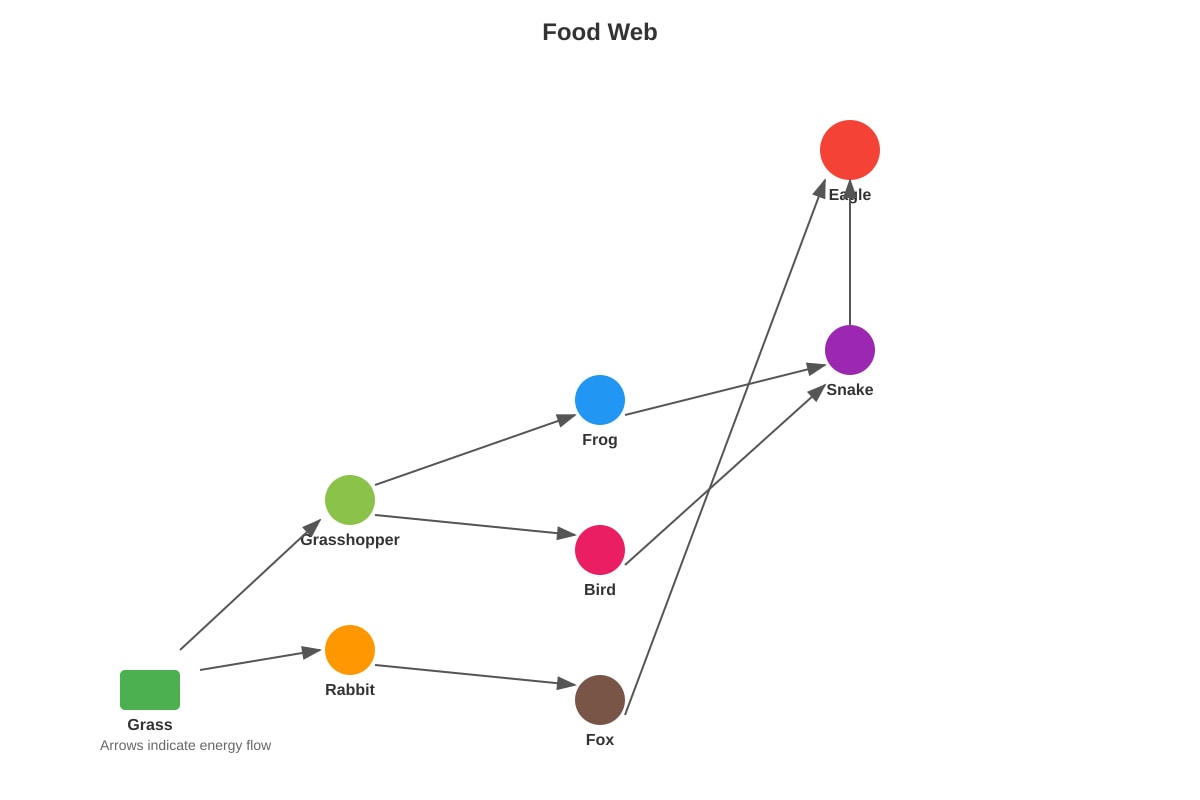
  9. Look at the food web below.

    <image_placeholder> id: Q9-fig1 type: diagram linked_question: Q9 description: A food web diagram. Arrows point from food source to consumer. Grass is eaten by Grasshopper and Rabbit. Grasshopper is eaten by Frog and Bird. Rabbit is eaten by Fox. Frog is eaten by Snake. Bird is eaten by Snake. Snake is eaten by Eagle. Fox is eaten by Eagle. labels: Grass, Grasshopper, Rabbit, Frog, Bird, Fox, Snake, Eagle values: Arrows indicate energy flow. must_show: Clear directional arrows showing the feeding relationships. </image_placeholder>

    If the population of frogs decreases significantly due to disease, what is the most likely effect? (1) The population of grasshoppers will decrease. (2) The population of snakes will increase. (3) The population of birds will increase due to less competition for food. (4) The population of eagles will increase immediately. [____]

  10. Which of the following is an example of a physical change? (1) Burning of wood (2) Rusting of iron (3) Melting of ice cream (4) Cooking an egg [____]

  11. Why are decomposers important in an ecosystem? (1) They produce oxygen for animals to breathe. (2) They break down dead organisms and return nutrients to the soil. (3) They provide food for primary consumers. (4) They control the population of predators. [____]

  12. Which of the following pairs of organisms have a symbiotic relationship where both benefit? (1) Tick and Dog (2) Bee and Flower (3) Lion and Zebra (4) Mistletoe and Tree [____]

  13. A student observed a pond ecosystem. He noted that the water was green and murky. What is the most likely cause? (1) Too many fish in the pond. (2) Excessive growth of algae due to high nutrient levels. (3) Lack of sunlight reaching the bottom of the pond. (4) Presence of large rocks in the pond. [____]

  14. Which of the following human activities has a positive impact on biodiversity? (1) Deforestation for agriculture. (2) Building nature reserves and parks. (3) Dumping industrial waste into rivers. (4) Using pesticides extensively on farms. [____]


Section B (28 marks)

Answer all questions in this section. Write your answers in the spaces provided. The number of marks available for each question or part is indicated in brackets [ ].

  1. Study the diagram of two different plants, Plant A and Plant B, growing in different environments.

    <image_placeholder> id: Q15-fig1 type: diagram linked_question: Q15 description: Side-by-side comparison. Plant A has broad, thin green leaves and a shallow root system. It is shown in a rainy, shaded forest setting. Plant B has small, needle-like leaves covered in wax and a very deep, extensive root system. It is shown in a dry, sandy desert setting. labels: Plant A, Plant B, Broad leaves, Needle-like leaves, Shallow roots, Deep roots must_show: Distinct leaf shapes and root depths corresponding to their environments. </image_placeholder>

    (a) State one difference between the leaves of Plant A and Plant B. [1]


    (b) Explain how the root system of Plant B helps it survive in its environment. [2]


    (c) Why does Plant A have broad leaves? [1]


  2. The table below shows the number of organisms found in a specific area over a period of three years.

    YearNumber of Grass PlantsNumber of RabbitsNumber of Foxes
    2021500020020
    2022300035025
    2023150010010

    (a) Construct a food chain involving the organisms in the table. [1]


    (b) Explain why the number of grass plants decreased from 2021 to 2022. [2]


    (c) Suggest a reason for the decrease in the number of foxes in 2023. [2]


  3. A group of students investigated how the amount of light affects the growth of bean plants. They set up three pots with the same type of soil and same number of seeds.

    • Pot X: Placed in a dark cupboard.
    • Pot Y: Placed near a window with indirect sunlight.
    • Pot Z: Placed under a bright grow light.

    After two weeks, they recorded the height of the plants and the color of the leaves.

    PotAverage Height (cm)Leaf Color
    X15Pale yellow
    Y10Green
    Z8Dark green

    (a) Why did the students use the same type of soil and same number of seeds in each pot? [1]


    (b) Explain why the plants in Pot X grew taller than those in Pot Z, even though they were pale and weak. [2]


    (c) Which pot contained the healthiest plants? Give a reason for your answer. [2]


  4. Study the classification key below for five different animals: P, Q, R, S, and T.

    1. Does the animal have a backbone?
      • Yes: Go to 2
      • No: Go to 3
    2. Does the animal lay eggs?
      • Yes: It is a Bird (P)
      • No: It is a Mammal (Q)
    3. Does the animal have 6 legs?
      • Yes: It is an Insect (R)
      • No: Go to 4
    4. Does the animal have a hard shell?
      • Yes: It is a Mollusc (S)
      • No: It is a Worm (T)

    (a) Identify the animal that is a mammal. [1]


    (b) Animal R is an ant. State two characteristics of insects. [2]


    (c) Why is a spider not classified as an insect? [1]


  5. Read the passage below about the Mangrove Forest.

    Mangrove forests are found in coastal areas where saltwater meets freshwater. The soil is often muddy and lacks oxygen. Mangrove trees have special roots called "pneumatophores" that stick out of the mud to absorb air. Many animals, such as crabs, monkeys, and birds, live in the mangroves. The trees provide shelter and food for these animals. However, mangroves are threatened by coastal development and pollution.

    (a) What is the function of pneumatophores? [1]


    (b) Explain how the mangrove tree helps the crab survive. [2]


    (c) Suggest one way humans can protect mangrove forests. [1]


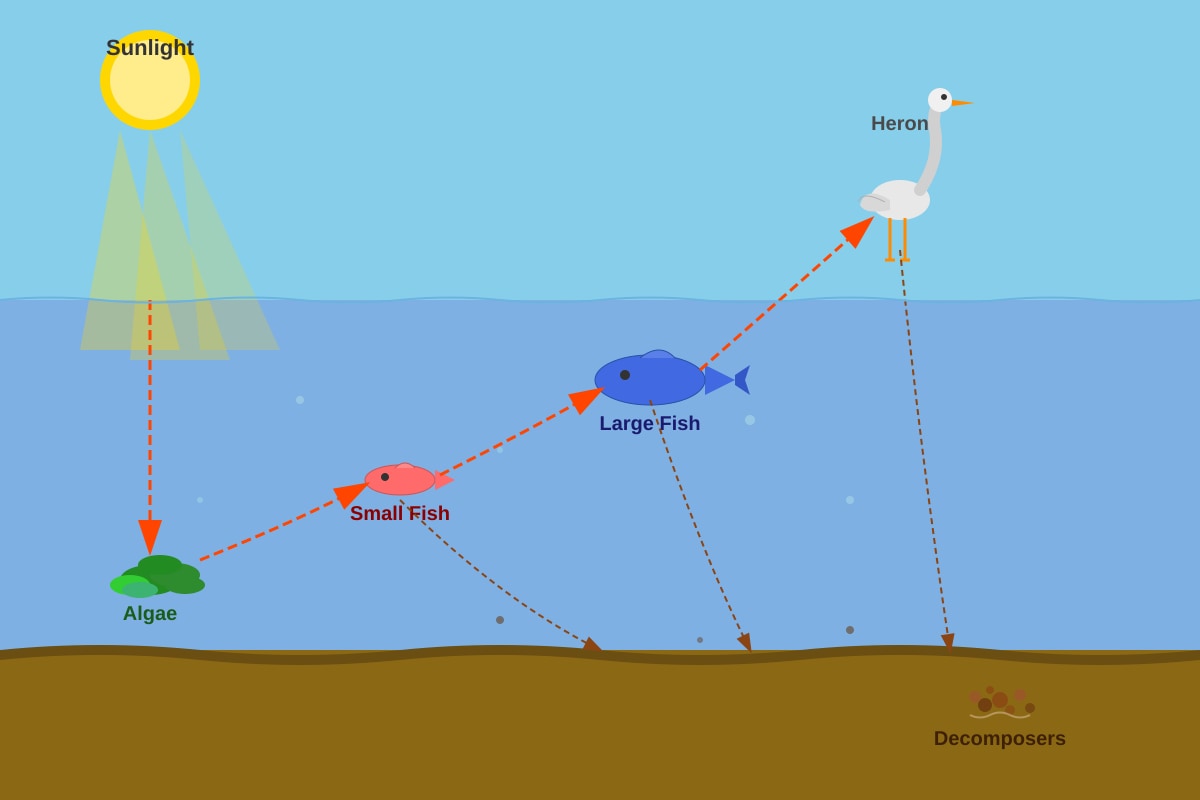
  6. The diagram below shows a simple ecosystem in a lake.

    <image_placeholder> id: Q20-fig1 type: diagram linked_question: Q20 description: A lake ecosystem diagram. Sunlight enters the water. Algae are at the bottom. Small fish eat algae. Large fish eat small fish. Herons (birds) eat large fish. Decomposers are shown in the mud at the bottom, breaking down dead matter from all levels. labels: Sunlight, Algae, Small Fish, Large Fish, Heron, Decomposers must_show: Energy flow from sun to algae to fish to bird, and decomposers recycling nutrients. </image_placeholder>

    (a) Identify the producer in this ecosystem. [1]


    (b) What would happen to the population of large fish if all the herons were removed from the ecosystem? Explain your answer. [3]


    (c) Explain the role of decomposers in this lake ecosystem. [2]


End of Paper

Answers

<!-- TuitionGoWhere generation metadata: stage=3-1; model=qwen/qwen3.7-plus; model_label=Qwen3.7 Plus; generated=2026-06-04; Sources: Stage 2-1 real exam-derived templates and Stage 2-2 exam-enriched syllabus. -->

Answer Key - Science Primary 6 PSLE (WA2 Practice - Version 5)

Section A (28 marks)

  1. (2)

    • Reasoning: Dolphins, seals, and platypuses are all mammals. Penguins are birds, crocodiles/lizards/turtles are reptiles, and frogs/toads/salamanders are amphibians.
    • Note: The platypus is a unique mammal that lays eggs but still produces milk and has fur.
  2. (2)

    • Reasoning: Ferns have chlorophyll (make their own food), reproduce by spores, and do not have flowers. Organism Q fits this description. P is a flowering plant, R is likely a fungus (no chlorophyll), and S is likely an animal or non-photosynthetic organism.
  3. (3)

    • Reasoning: Animal W has no backbone and 6 legs, which is the defining characteristic of insects. Animal X is a bird (feathers), Y is a reptile (scales), Z is a mammal (gives birth), and V is likely an arachnid or crustacean (more than 6 legs, no backbone).
  4. (2)

    • Reasoning: A food chain must start with a producer (Leaf) and arrows must point in the direction of energy flow (from eaten to eater). Leaf → Caterpillar → Bird → Hawk is the correct sequence.
  5. (1)

    • Reasoning: Deer are herbivores that eat grass. An increase in deer population leads to more consumption of grass, causing the grass population to decrease.
  6. (2)

    • Reasoning: A thick waxy skin (cuticle) reduces water loss through transpiration, which is crucial for survival in hot, dry deserts. Broad leaves would increase water loss.
  7. (3)

    • Reasoning: The thick layer of fat (blubber) acts as an insulator, reducing heat loss from the body to the cold environment.
  8. (3)

    • Reasoning: Fungi are heterotrophs; they cannot make their own food. They secrete enzymes to break down dead or decaying organic matter and absorb the nutrients.
  9. (3)

    • Reasoning: Frogs and birds both eat grasshoppers. If the frog population decreases, there is less competition for grasshoppers, so the bird population may increase due to more available food.
  10. (3)

    • Reasoning: Melting is a change of state from solid to liquid. No new substance is formed, so it is a physical change. Burning, rusting, and cooking involve chemical changes where new substances are formed.
  11. (2)

    • Reasoning: Decomposers break down dead plants and animals into simpler substances, returning essential nutrients (like nitrogen and phosphorus) to the soil for plants to use.
  12. (2)

    • Reasoning: Bees get nectar (food) from flowers, and flowers get pollinated by bees. Both benefit. Ticks harm dogs, lions kill zebras, and mistletoe takes nutrients from trees (parasitism).
  13. (2)

    • Reasoning: Green, murky water is often caused by an algal bloom. This happens when there are excess nutrients (like nitrates from fertilizers) in the water, causing algae to grow rapidly.
  14. (2)

    • Reasoning: Nature reserves provide protected habitats for wildlife, helping to maintain and increase biodiversity. The other options harm the environment.

Section B (28 marks)

  1. (a) Plant A has broad leaves, while Plant B has needle-like leaves. [1]

    • Teaching Note: Accept any clear comparison of leaf shape or size.

    (b) Plant B has deep roots to reach water deep underground. [1] This helps it survive in the dry desert where surface water is scarce. [1]

    • Teaching Note: Must link the structure (deep roots) to the function (accessing water) and the environment (dry).

    (c) To capture as much sunlight as possible for photosynthesis. [1]

    • Teaching Note: Broad leaves provide a larger surface area for light absorption.
  2. (a) Grass → Rabbit → Fox [1]

    • Teaching Note: Arrows must point in the correct direction.

    (b) The number of rabbits increased from 200 to 350. [1] Since rabbits eat grass, the larger rabbit population consumed more grass, causing the grass population to decrease. [1]

    • Teaching Note: Must mention the increase in predators/consumers (rabbits) as the cause.

    (c) The number of rabbits decreased significantly (from 350 to 100). [1] With fewer rabbits to eat, the fox population had less food, leading to a decrease in their numbers. [1]

    • Teaching Note: Must link the decrease in prey (rabbits) to the decrease in predators (foxes).
  3. (a) To ensure a fair test. [1]

    • Teaching Note: Only the amount of light should be changed; other variables must be kept constant.

    (b) The plants in Pot X grew taller because they were stretching towards any available light source (etiolation) in the dark. [1] However, they could not perform photosynthesis due to lack of light, so they remained pale and weak. [1]

    • Teaching Note: Distinguish between growth in height (search for light) and health (photosynthesis).

    (c) Pot Z. [1] The plants were dark green, indicating high chlorophyll content, and they were sturdy, indicating healthy growth due to sufficient light for photosynthesis. [1]

    • Teaching Note: Pot Y is also acceptable if justified well, but Z is "healthiest" due to dark green color indicating robust photosynthesis. Pot X is definitely unhealthy.
  4. (a) Q [1]

    (b) 1. They have 6 legs. [1] 2. They have 3 body parts (head, thorax, abdomen). [1] * Alternative: They have one pair of antennae.

    (c) Spiders have 8 legs, while insects have 6 legs. [1] * Teaching Note: Number of legs is the primary distinction in this key.

  5. (a) To absorb oxygen/air from the atmosphere. [1]

    • Teaching Note: The muddy soil lacks oxygen, so the roots stick out to breathe.

    (b) The mangrove trees provide shelter/hiding places for crabs from predators. [1] They may also provide food (fallen leaves/detritus) for the crabs. [1]

    • Teaching Note: Accept either shelter or food, but shelter is more direct from the text.

    (c) Stop dumping waste/pollution into the coastal areas. [1] * Alternative: Create laws to prevent cutting down mangrove trees. / Educate the public about the importance of mangroves.

  6. (a) Algae [1]

    (b) The population of large fish would increase. [1] This is because herons are predators of large fish. [1] With no herons to eat them, fewer large fish will die, so their numbers will grow. [1]

    • Teaching Note: Must state the direction of change (increase) and explain the removal of predation pressure.

    (c) Decomposers break down dead organisms (plants and animals) and waste products. [1] This releases nutrients back into the water/soil, which are then used by producers (algae) to grow. [1]

    • Teaching Note: Key concepts are "break down dead matter" and "recycle nutrients".