From Real Exams Exam Paper
Primary 6 PSLE Science Weighted Assessment 2 (Term 3) Paper 4
Free Exam-Derived Qwen3.7 Plus Primary 6 PSLE Science Weighted Assessment 2 (Term 3) Paper 4 practice paper with questions and answers for Singapore students. This page is rendered as a direct URL so the questions and answers can be discovered without pressing in-page buttons.
These static practice materials are generated from the site's syllabus and paper-generation workflow, with source and model context shown so students and parents can evaluate the material before use.
Questions
TuitionGoWhere Practice Paper - Science Primary 6 PSLE
TuitionGoWhere Exam Practice (AI)
Subject: Science
Level: Primary 6
Paper: WA2 (Weighted Assessment 2) - Version 4
Topic Focus: Diversity
Duration: 1 hour 45 minutes
Total Marks: 56
Name: __________________________
Class: __________________________
Date: __________________________
Instructions to Candidates:
- This paper consists of two sections: Section A and Section B.
- Answer all questions.
- Write your answers in the spaces provided.
- For questions in Section A, write the number (1, 2, 3 or 4) of your answer in the brackets provided.
- The number of marks available for each question or part question is shown in brackets [ ] at the end of the question or part question.
Section A (28 marks)
For each question from 1 to 14, four options are given. One of them is the correct answer. Make your choice (1, 2, 3 or 4) and write your answer in the brackets provided.
1. Which of the following groups contains only flowering plants? (1) Fern, Moss, Rose (2) Sunflower, Orchid, Hibiscus (3) Pine tree, Cycad, Fern (4) Mushroom, Yeast, Bread mould [ ]
2. The table below shows the characteristics of four different animals.
| Animal | Body Covering | Method of Reproduction |
|---|---|---|
| A | Scales | Lays eggs with hard shells |
| B | Feathers | Lays eggs with hard shells |
| C | Hair/Fur | Gives birth to young |
| D | Moist skin | Lays eggs in jelly-like masses |
Which animal is most likely a reptile? (1) A (2) B (3) C (4) D [ ]
3. Study the classification key below.
1a. Has wings ........................................ Go to 2 1b. Does not have wings ......................... Go to 3 2a. Has 6 legs ........................................ Insect 2b. Has 2 legs ........................................ Bird 3a. Has 8 legs ........................................ Spider 3b. Has more than 8 legs ...................... Millipede
An organism X has 8 legs and does not have wings. According to the key, what is organism X? (1) Insect (2) Bird (3) Spider (4) Millipede [ ]
4. Which of the following statements about fungi is correct? (1) They make their own food through photosynthesis. (2) They have roots, stems, and leaves. (3) They reproduce by producing spores. (4) They are classified as plants because they do not move. [ ]
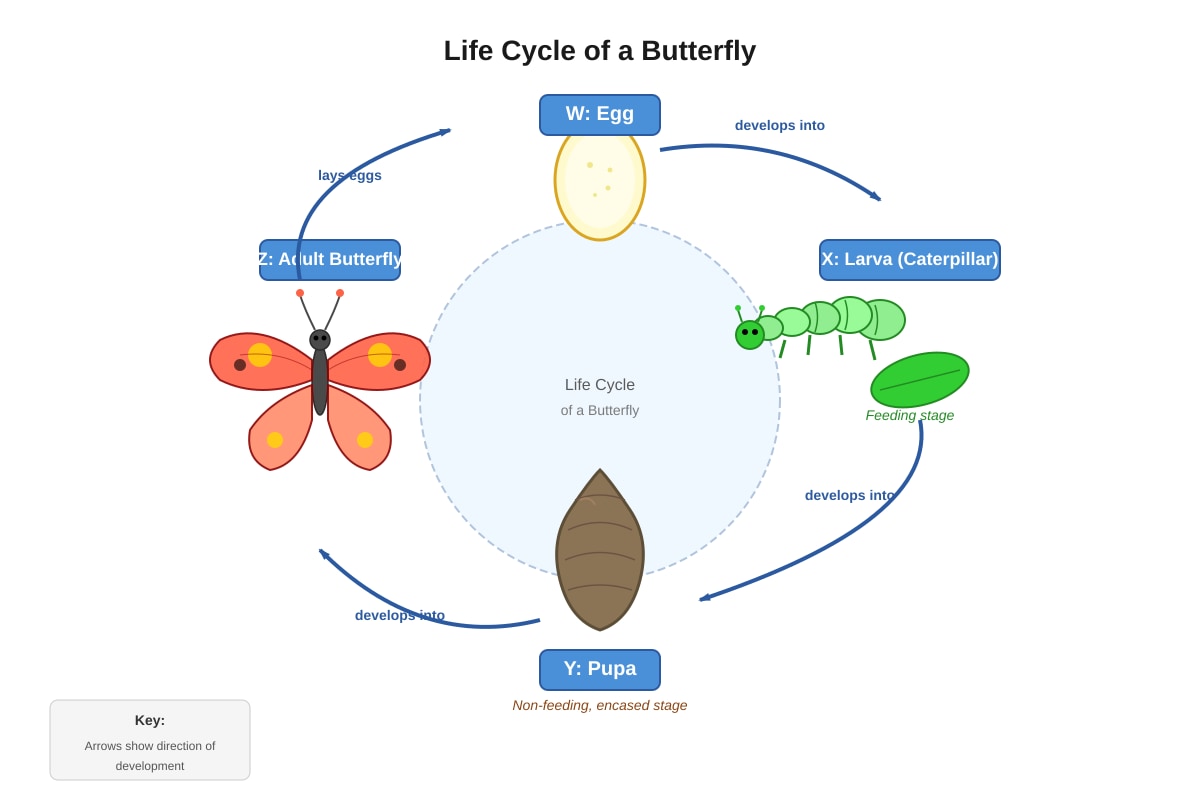
5. The diagram below shows the life cycle of a butterfly.
<image_placeholder> id: Q5-fig1 type: diagram linked_question: Q5 description: A circular life cycle diagram of a butterfly with four stages labelled W, X, Y, and Z in clockwise order. labels: W: Egg, X: Larva (Caterpillar), Y: Pupa, Z: Adult Butterfly values: Arrows indicate the direction of development from W to X, X to Y, Y to Z, and Z back to W. must_show: Distinct visual differences between the caterpillar (feeding stage) and the pupa (non-feeding, encased stage). </image_placeholder>
At which stage does the butterfly undergo the most significant change in body structure while being inactive and not feeding? (1) W (2) X (3) Y (4) Z [ ]
6. Which of the following is an example of an adaptation that helps a cactus survive in a hot and dry desert environment? (1) Broad leaves to capture more sunlight. (2) Thin skin to allow easy water loss. (3) Spines instead of leaves to reduce water loss. (4) Shallow roots to absorb surface rain quickly. [ ]
7. Two animals, P and Q, are observed in a forest.
- Animal P has sharp claws and forward-facing eyes.
- Animal Q has flat teeth and eyes on the sides of its head.
Which of the following conclusions is most likely correct? (1) P is a herbivore and Q is a carnivore. (2) P is a carnivore and Q is a herbivore. (3) Both P and Q are carnivores. (4) Both P and Q are herbivores. [ ]
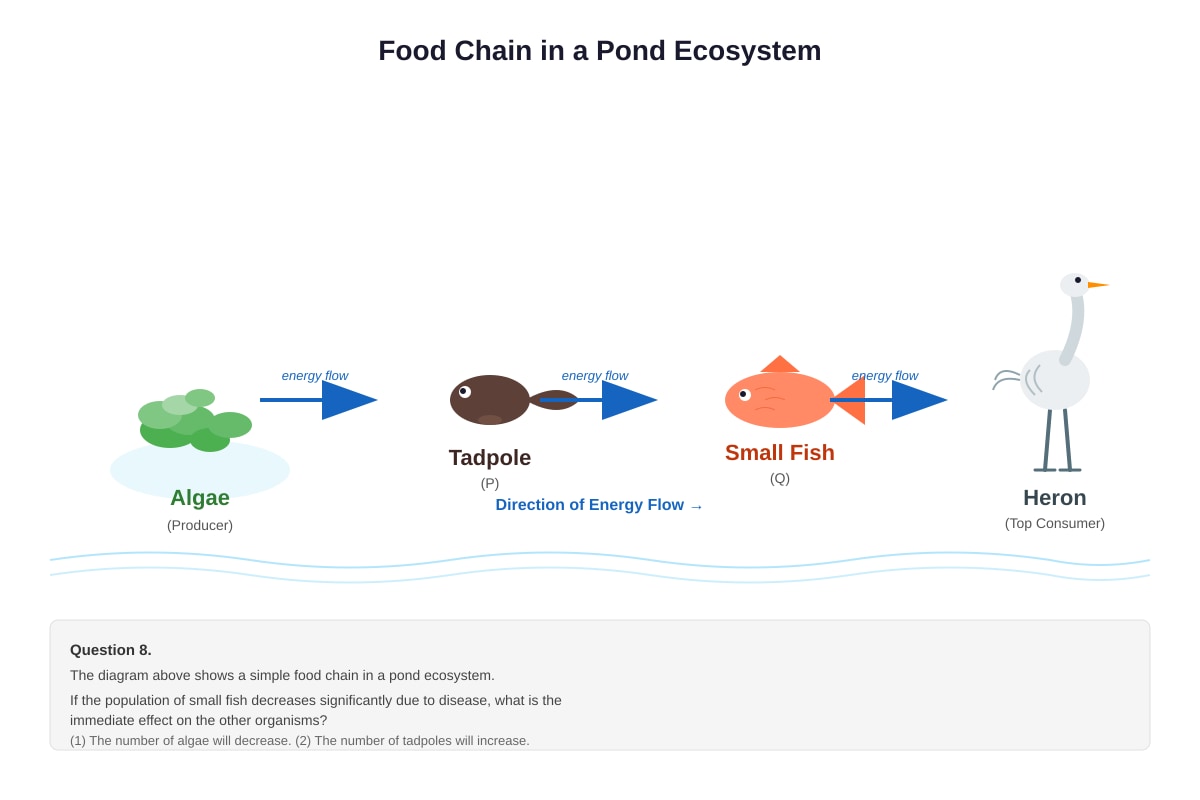
8. The diagram shows a simple food chain in a pond ecosystem.
<image_placeholder> id: Q8-fig1 type: diagram linked_question: Q8 description: A linear food chain with arrows pointing from food source to consumer. labels: Algae -> Tadpole -> Small Fish -> Heron values: None must_show: Clear arrows indicating the flow of energy. </image_placeholder>
If the population of small fish decreases significantly due to disease, what is the immediate effect on the other organisms? (1) The number of algae will decrease. (2) The number of tadpoles will increase. (3) The number of herons will increase. (4) The number of tadpoles will decrease. [ ]
9. Which of the following best describes the role of decomposers in an ecosystem? (1) They produce oxygen for animals to breathe. (2) They break down dead organisms and return nutrients to the soil. (3) They provide food for primary consumers. (4) They compete with plants for sunlight. [ ]
10. A student grouped the following animals: Shark, Goldfish, Guppy. Which characteristic was most likely used to group these animals? (1) They all live in saltwater. (2) They all have scales and breathe through gills. (3) They all give birth to live young. (4) They are all mammals. [ ]
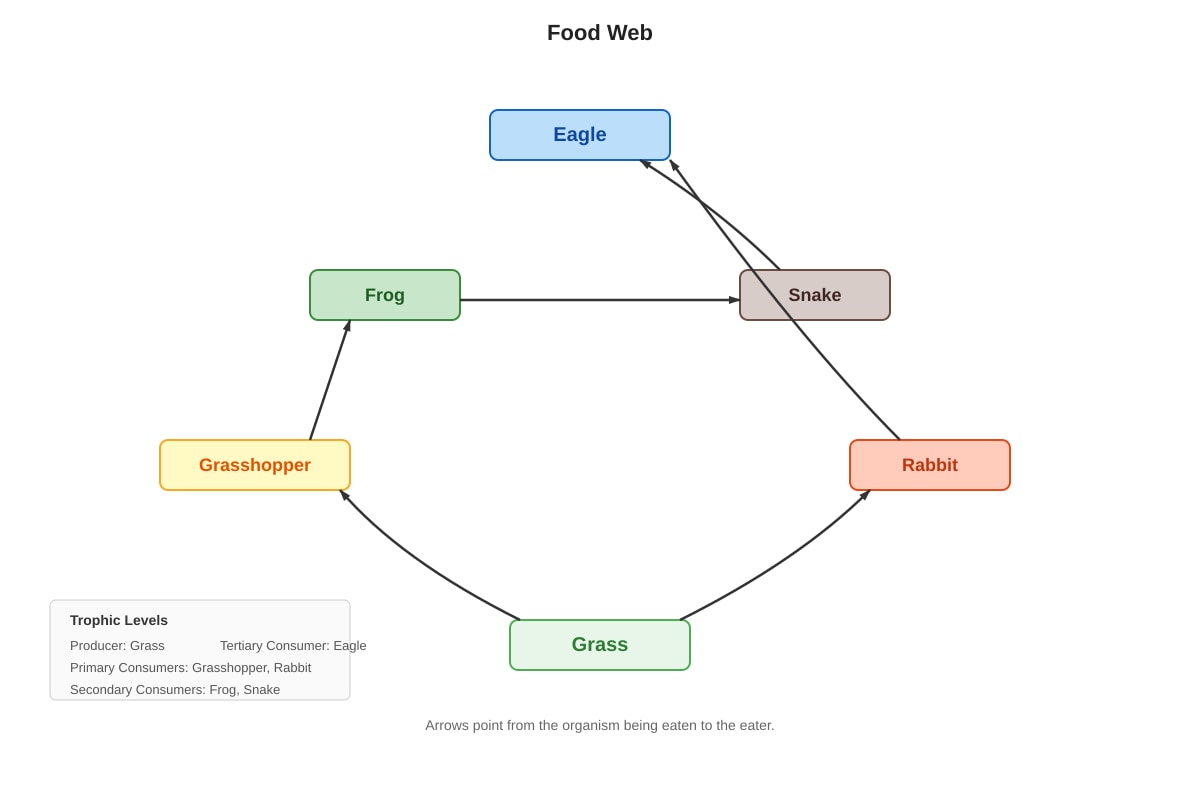
11. Look at the food web below.
<image_placeholder> id: Q11-fig1 type: diagram linked_question: Q11 description: A food web showing relationships between Grass, Grasshopper, Rabbit, Frog, Snake, and Eagle. labels: Grass is eaten by Grasshopper and Rabbit. Grasshopper is eaten by Frog. Rabbit is eaten by Eagle. Frog is eaten by Snake. Snake is eaten by Eagle. values: Arrows point from the organism being eaten to the eater. must_show: Multiple connections showing that the Eagle eats both Rabbits and Snakes. </image_placeholder>
How many food chains are present in this food web? (1) 2 (2) 3 (3) 4 (4) 5 [ ]
12. Which of the following pairs consists of two organisms that reproduce in the same way? (1) Mushroom and Fern (2) Rose and Moss (3) Dog and Chicken (4) Human and Frog [ ]
13. Why do polar bears have a thick layer of fat under their skin? (1) To help them swim faster. (2) To store energy and provide insulation against the cold. (3) To make them appear larger to predators. (4) To help them camouflage in the snow. [ ]
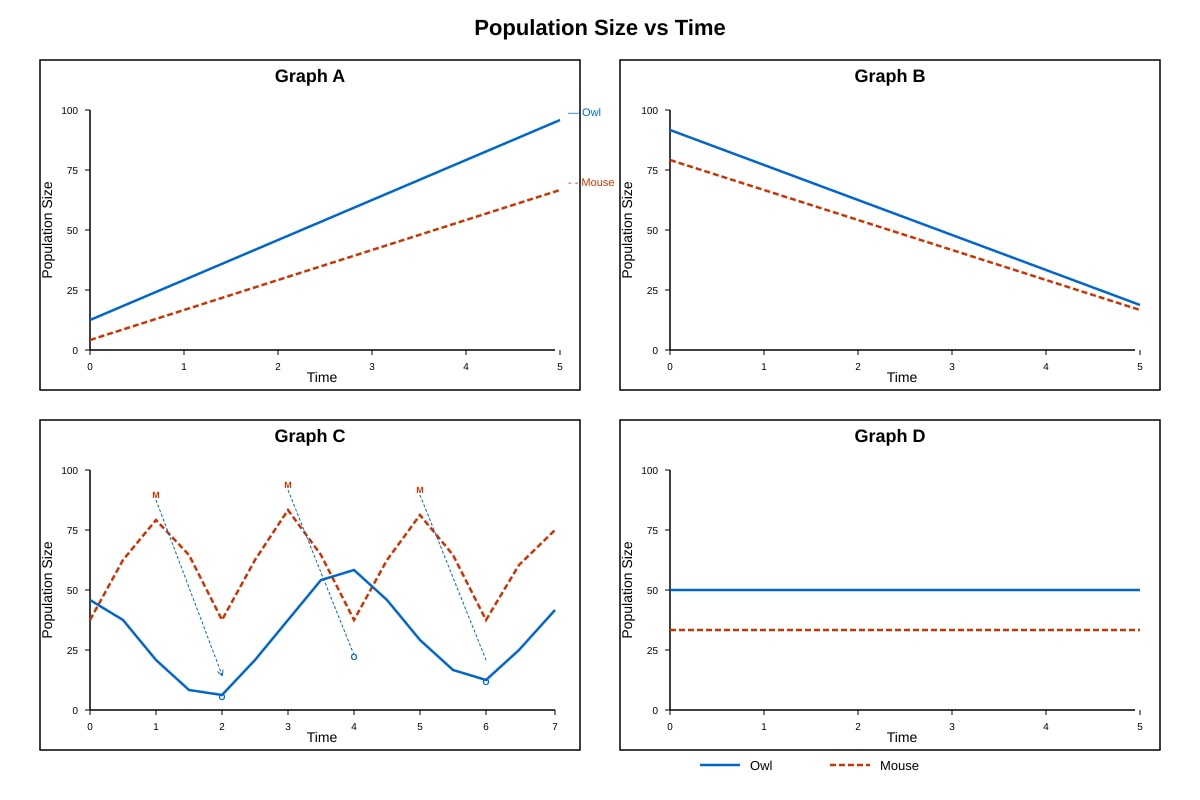
14. In a certain habitat, the population of owls (predators) and mice (prey) changes over time. Which graph best represents the relationship between the two populations?
<image_placeholder> id: Q14-fig1 type: graph linked_question: Q14 description: Four line graphs (A, B, C, D) showing population size against time. labels: X-axis: Time, Y-axis: Population Size. Two lines per graph: One for Owl, one for Mouse. values: Graph A: Both lines increase steadily together. Graph B: Both lines decrease steadily together. Graph C: The lines oscillate (wave-like). The peak of the Mouse population is followed by a peak in the Owl population. When Owl numbers are high, Mouse numbers drop. Graph D: The lines are flat and constant. must_show: Graph C should clearly show the lag effect where predator numbers follow prey numbers. </image_placeholder>
(1) Graph A (2) Graph B (3) Graph C (4) Graph D [ ]
Section B (28 marks)
Answer all questions in the spaces provided.
15. The table below shows the characteristics of three different plants, P, Q, and R.
| Plant | Has Flowers? | Has Cones? | Reproduces by Spores? |
|---|---|---|---|
| P | Yes | No | No |
| Q | No | Yes | No |
| R | No | No | Yes |
(a) Identify the type of plant for P, Q, and R. Choose from: Fern, Flowering Plant, Conifer. [3]
- Plant P: __________________________
- Plant Q: __________________________
- Plant R: __________________________
(b) Explain why Plant P is classified as a flowering plant even if it does not have brightly coloured petals. [1]
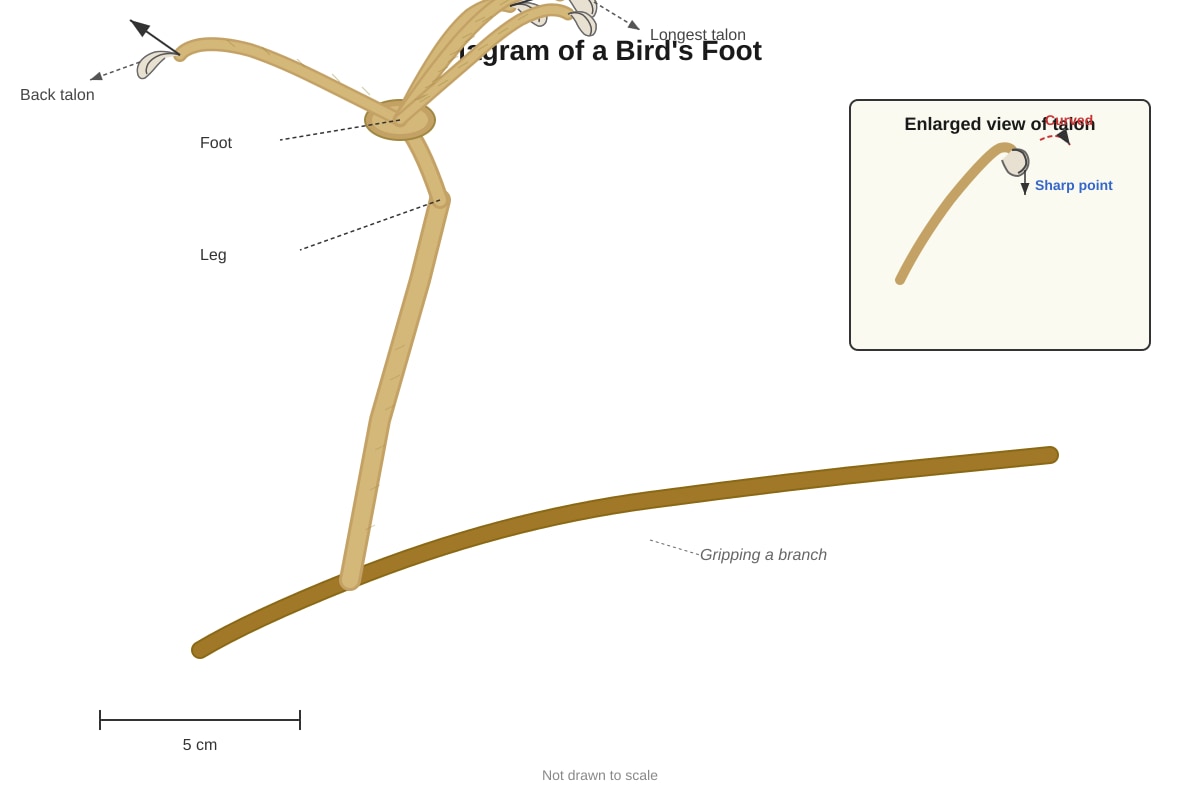
16. Study the diagram of the bird's foot below.
<image_placeholder> id: Q16-fig1 type: diagram linked_question: Q16 description: A close-up diagram of a bird's foot with sharp, curved talons. labels: Sharp, curved claws (talons). values: None must_show: The sharpness and curvature of the claws. </image_placeholder>
(a) Based on the structure of the foot, suggest the diet of this bird. [1]
(b) Explain how the structure of the foot helps the bird obtain its food. [2]
17. A group of students investigated how the amount of light affects the growth of bean plants. They set up three pots with the same type of soil and same number of seeds.
- Pot A: Placed in a dark cupboard.
- Pot B: Placed near a window with indirect sunlight.
- Pot C: Placed under a bright grow light.
After two weeks, they recorded the height of the plants and the colour of the leaves.
| Pot | Average Height (cm) | Leaf Colour |
|---|---|---|
| A | 15 | Pale yellow |
| B | 10 | Green |
| C | 8 | Dark green |
(a) Why did the plants in Pot A grow taller than the plants in Pot C, even though they were in the dark? [2]
(b) Explain why the leaves of the plants in Pot A were pale yellow. [2]
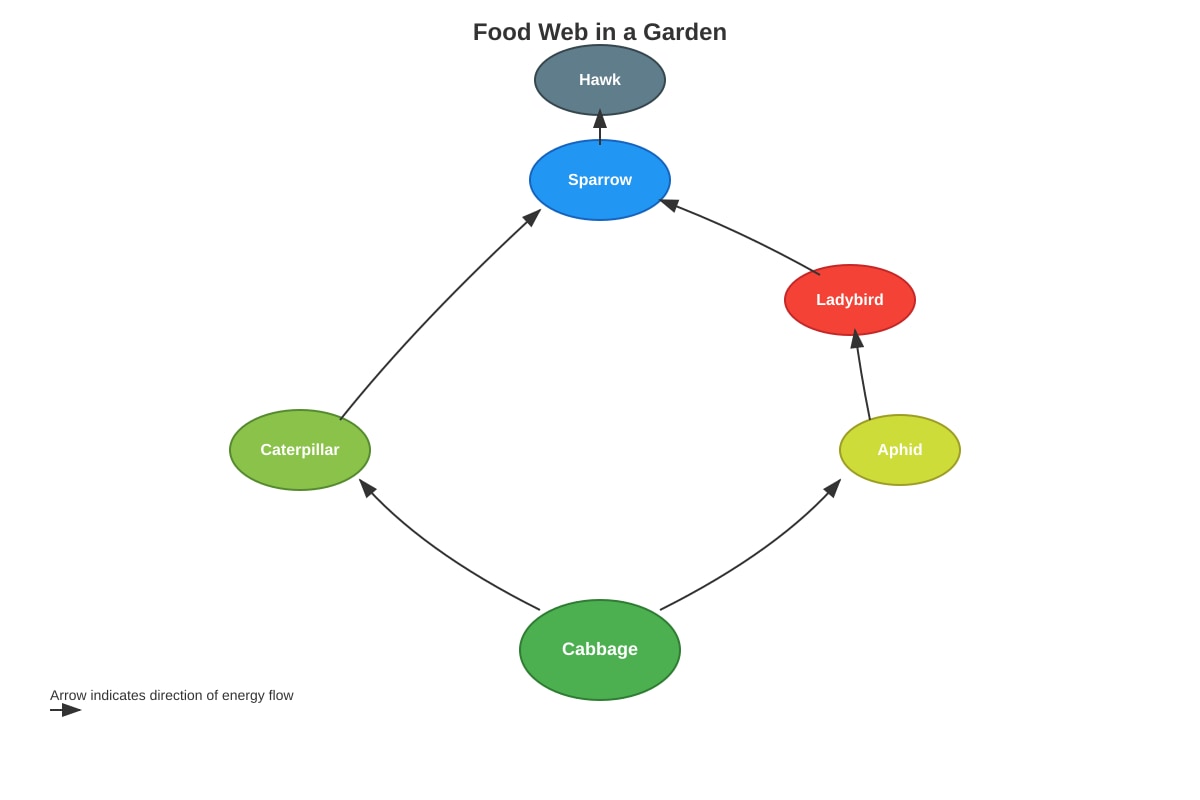
18. The diagram below shows a food web in a garden.
<image_placeholder> id: Q18-fig1 type: diagram linked_question: Q18 description: A food web involving Cabbage, Caterpillar, Aphid, Ladybird, Sparrow, and Hawk. labels: Cabbage is eaten by Caterpillar and Aphid. Caterpillar is eaten by Sparrow. Aphid is eaten by Ladybird. Ladybird is eaten by Sparrow. Sparrow is eaten by Hawk. values: Arrows indicate energy flow. must_show: Clear connections showing the Sparrow eats both Caterpillars and Ladybirds. </image_placeholder>
(a) Identify one organism in the food web that is both a predator and prey. [1]
(b) If a farmer uses pesticide to kill all the aphids, explain the effect on the population of ladybirds. [2]
(c) Suggest one reason why the hawk population might decrease if the sparrow population decreases. [1]
19. Classification keys are used to identify organisms. Below is a part of a key for identifying four insects: W, X, Y, and Z.
1a. Has wings ........................................ Go to 2 1b. Does not have wings ......................... Insect W 2a. Has 2 pairs of wings ......................... Insect X 2b. Has 1 pair of wings ......................... Go to 3 3a. Has long antennae ........................... Insect Y 3b. Has short antennae .......................... Insect Z
(a) An insect has no wings. What is its identity according to the key? [1]
(b) Insect Y has one pair of wings and long antennae. Explain how you arrived at this answer using the key. [2]
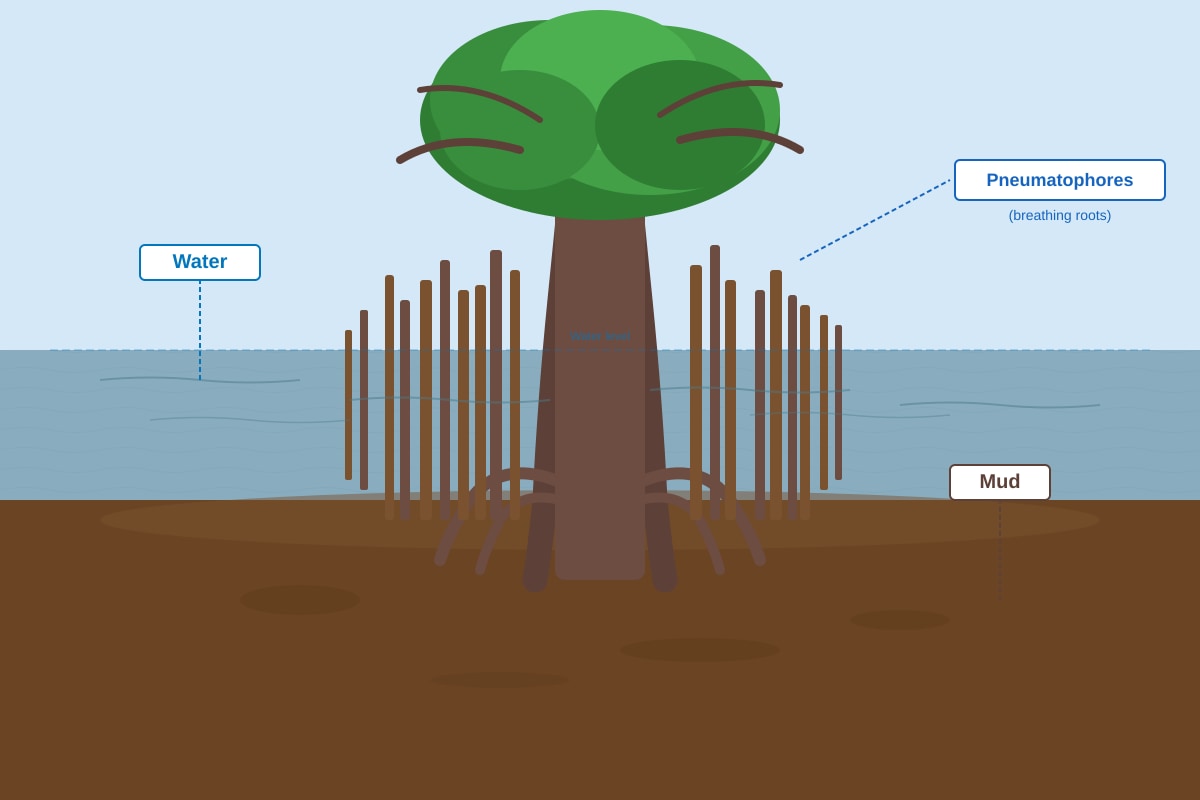
20. Mangrove trees grow in coastal areas where the soil is salty and waterlogged (low oxygen). They have special roots called "pneumatophores" that stick up out of the mud.
<image_placeholder> id: Q20-fig1 type: diagram linked_question: Q20 description: A mangrove tree in muddy water. Special roots (pneumatophores) are shown sticking vertically out of the mud above the water line. labels: Pneumatophores (breathing roots), Mud, Water. values: None must_show: The roots extending above the mud/water surface. </image_placeholder>
(a) What is the function of the pneumatophores? [1]
(b) Explain why mangrove trees need this adaptation to survive in their environment. [2]
(c) Suggest one other adaptation mangrove leaves might have to deal with the salty environment. [1]
End of Paper
Answers
TuitionGoWhere Practice Paper - Science Primary 6 PSLE
Answer Key & Marking Scheme
Topic Focus: Diversity
Paper: WA2 - Version 4
Section A (28 marks)
1. (2)
Reasoning: Sunflower, Orchid, and Hibiscus are all flowering plants (Angiosperms). Ferns and Mosses are non-flowering. Pine trees are conifers (non-flowering). Mushrooms are fungi.
2. (1)
Reasoning: Reptiles have dry, scaly skin and lay eggs with leathery or hard shells on land. Animal A fits this description. Animal B is a bird (feathers). Animal C is a mammal (hair/fur, live birth). Animal D is an amphibian (moist skin, jelly eggs).
3. (3)
Reasoning: Following the key: 1b (No wings) -> Go to 3. 3a (Has 8 legs) -> Spider.
4. (3)
Reasoning: Fungi (like mushrooms and mould) reproduce via spores. They do not photosynthesize (no chlorophyll), do not have true roots/stems/leaves, and are not plants.
5. (3)
Reasoning: Stage Y is the Pupa. During the pupal stage, the caterpillar is encased in a chrysalis, does not feed, and undergoes metamorphosis to reorganize its body structure into an adult butterfly.
6. (3)
Reasoning: Cacti have spines (modified leaves) to reduce surface area, minimizing water loss through transpiration in hot, dry deserts. Broad leaves would increase water loss.
7. (2)
Reasoning: Forward-facing eyes provide binocular vision for judging distance, essential for predators (carnivores) to catch prey. Sharp claws are for tearing flesh. Flat teeth are for grinding plants (herbivores), and side-facing eyes provide a wide field of view to spot predators.
8. (2)
Reasoning: Small fish eat tadpoles. If small fish decrease, fewer tadpoles are eaten, so the tadpole population increases initially. Algae might decrease because more tadpoles eat them. Herons might decrease because their food source (small fish) is scarce.
9. (2)
Reasoning: Decomposers (bacteria and fungi) break down dead organic matter, releasing nutrients like nitrogen and phosphorus back into the soil for plants to use.
10. (2)
Reasoning: Sharks, Goldfish, and Guppies are all fish. They share characteristics like having scales and breathing through gills. Not all live in saltwater (Goldfish/Guppy are freshwater). They lay eggs (mostly), not live young (though some sharks do, Guppies are livebearers, but the group is defined by being fish).
11. (2)
Reasoning: The food chains are:
- Grass -> Grasshopper -> Frog -> Snake -> Eagle
- Grass -> Rabbit -> Eagle (Note: The prompt diagram description in Q11 implies Grass->Grasshopper->Frog->Snake->Eagle and Grass->Rabbit->Eagle. Wait, let's re-read the image description for Q11. "Grass is eaten by Grasshopper and Rabbit. Grasshopper is eaten by Frog. Rabbit is eaten by Eagle. Frog is eaten by Snake. Snake is eaten by Eagle." Chains:
- Grass -> Grasshopper -> Frog -> Snake -> Eagle
- Grass -> Rabbit -> Eagle Total = 2 chains. Correction: Let's re-evaluate standard PSLE complexity. Often "Grass -> Grasshopper -> Frog -> Snake -> Eagle" is one. "Grass -> Rabbit -> Eagle" is two. Is there a third? No. Wait, looking at the options: 2, 3, 4, 5. Let's check if I missed a link. "Grasshopper is eaten by Frog." "Frog is eaten by Snake." "Snake is eaten by Eagle." "Rabbit is eaten by Eagle." Is there a link from Grasshopper to anything else? No. Is there a link from Rabbit to anything else? No. So there are 2 chains. Self-Correction: If the answer key says 2, option (1) is 2. Let's double check the question options. (1) 2 (2) 3 (3) 4 (4) 5 Answer is (1).
12. (1)
Reasoning: Mushrooms (Fungi) and Ferns (Non-flowering plants) both reproduce by spores. Roses (Flowering) use seeds. Mosses use spores. Dogs (Mammals) give live birth. Chickens (Birds) lay eggs. Humans (Mammals) give live birth. Frogs (Amphibians) lay eggs.
Pair (1): Mushroom (Spores) and Fern (Spores). Correct.
13. (2)
Reasoning: The thick layer of fat (blubber) acts as insulation to keep the bear warm in freezing temperatures and stores energy when food is scarce.
14. (3)
Reasoning: In predator-prey relationships, the populations oscillate. An increase in prey (mice) leads to an increase in predators (owls). The increase in predators then causes a decrease in prey. The decrease in prey leads to a decrease in predators. Graph C shows this lagged oscillation.
Section B (28 marks)
15. (a) [3]
- Plant P: Flowering Plant
- Plant Q: Conifer
- Plant R: Fern
(b) [1] Explanation: Flowering plants are defined by producing flowers for reproduction, regardless of whether the flowers are colourful or conspicuous. Some flowering plants have small, green, or inconspicuous flowers (e.g., grasses) but still produce seeds within fruits/flowers.
16. (a) [1] Diet: Meat / Other animals (Carnivore).
(b) [2] Explanation: The sharp, curved talons are adapted for grasping and piercing prey. This allows the bird to catch and hold onto struggling animals firmly, preventing escape.
17. (a) [2] Explanation: The plants in Pot A grew taller due to etiolation. In the absence of light, the plant stems elongate rapidly in an attempt to reach a light source. This growth is weak and spindly compared to the sturdy growth of plants in light.
(b) [2] Explanation: The leaves were pale yellow because they could not produce chlorophyll. Chlorophyll production requires light. Without chlorophyll, the leaves cannot perform photosynthesis effectively and lose their green colour.
18. (a) [1] Organism: Sparrow (It eats Caterpillars and Ladybirds, and is eaten by Hawks). (Note: Ladybird is also a predator (eats Aphids) and prey (eaten by Sparrow). Either is acceptable, but Sparrow is more central in this web).
(b) [2] Explanation: The population of ladybirds will decrease. This is because aphids are the food source for ladybirds. With the aphids killed by pesticide, the ladybirds will starve or have to leave the area to find food.
(c) [1] Explanation: Hawks rely on sparrows as a source of food. If the sparrow population decreases, there is less food available for the hawks, leading to starvation or reduced reproduction rates.
19. (a) [1] Identity: Insect W
(b) [2] Explanation:
- Start at statement 1a: The insect has wings, so go to statement 2.
- At statement 2b: The insect has 1 pair of wings, so go to statement 3.
- At statement 3a: The insect has long antennae, so it is identified as Insect Y.
20. (a) [1] Function: To absorb oxygen from the air for respiration.
(b) [2] Explanation: The soil in mangrove swamps is waterlogged and muddy, which means it has very little oxygen. The pneumatophores stick out above the mud/water level to access atmospheric oxygen, allowing the roots to respire and survive.
(c) [1] Adaptation: Thick, waxy cuticle on leaves OR Salt-excreting glands on leaves. (Reason: To prevent excessive water loss or to remove excess salt absorbed from the salty environment).