From Real Exams Exam Paper
Primary 6 PSLE Science Weighted Assessment 1 (Term 1) Paper 2
Free Exam-Derived Qwen3.7 Plus Primary 6 PSLE Science Weighted Assessment 1 (Term 1) Paper 2 practice paper with questions and answers for Singapore students. This page is rendered as a direct URL so the questions and answers can be discovered without pressing in-page buttons.
These static practice materials are generated from the site's syllabus and paper-generation workflow, with source and model context shown so students and parents can evaluate the material before use.
Questions
TuitionGoWhere Practice Paper - Science Primary 6 PSLE
School: TuitionGoWhere Exam Practice (AI) Subject: Science Level: Primary 6 Paper: WA1 (Version 2 of 5) Topic Focus: Diversity Duration: 1 hour 45 minutes Total Marks: 56
Name: __________________________
Class: __________
Date: ________________
Instructions to Candidates:
- This paper consists of two sections, A and B.
- Answer all questions.
- Write your answers in the spaces provided.
- For questions in Section A, write the number (1, 2, 3 or 4) of your answer in the brackets provided.
- The use of an approved calculator is allowed.
Section A (28 marks)
For each question from 1 to 14, four options are given. One of them is the correct answer. Make your choice (1, 2, 3 or 4) and write it in the brackets provided. Each question carries 2 marks.
- Which of the following groups of organisms are classified correctly based on their method of reproduction?
| Group | Method of Reproduction | Examples |
|---|---|---|
| 1 | Sexual | Fern, Moss |
| 2 | Asexual | Yeast, Hydra |
| 3 | Sexual | Bacteria, Amoeba |
| 4 | Asexual | Rose, Hibiscus |
( )
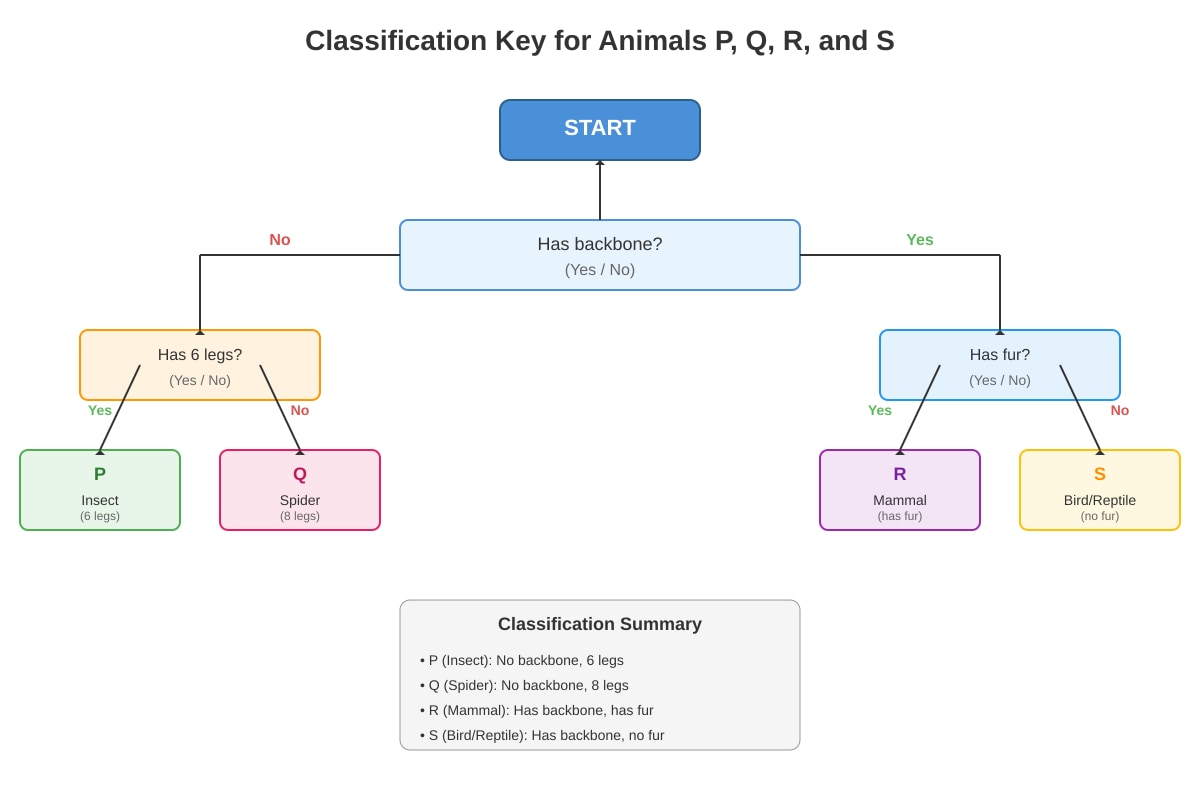
- The diagram below shows the classification of four animals P, Q, R, and S.
<image_placeholder> id: Q2-fig1 type: diagram linked_question: Q2 description: A branching classification key (dichotomous key) diagram. labels: Start -> Has backbone? (Yes/No). No -> Has 6 legs? (Yes: P, No: Q). Yes -> Has fur? (Yes: R, No: S). values: P: Insect, Q: Spider/Arachnid, R: Mammal, S: Bird/Reptile must_show: The branching structure clearly separating animals into two main groups (with/without backbone) and further subgroups. </image_placeholder>
Which of the following statements is true? (1) P and Q are both insects. (2) R gives birth to young ones. (3) S lays eggs with hard shells. (4) Q has a backbone.
( )
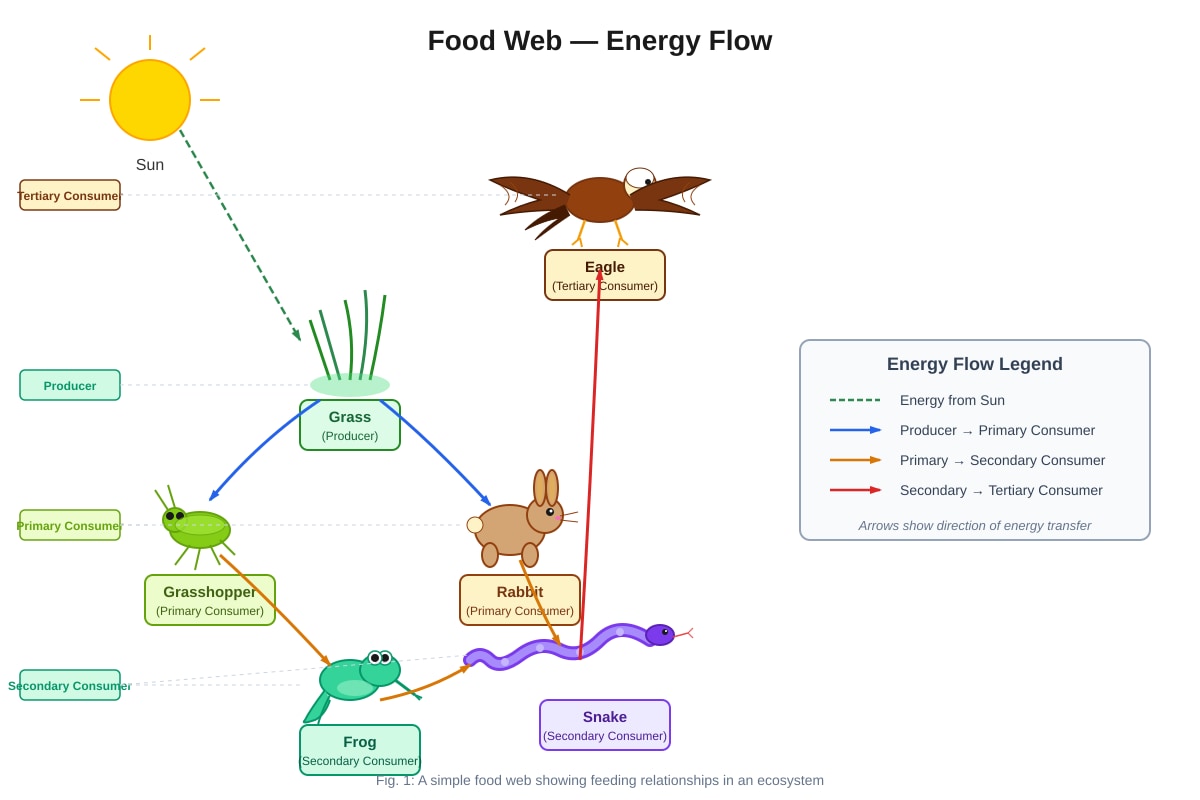
- Study the food web below.
<image_placeholder> id: Q3-fig1 type: diagram linked_question: Q3 description: A food web showing energy flow. labels: Producer: Grass. Primary Consumers: Grasshopper, Rabbit. Secondary Consumers: Frog, Snake. Tertiary Consumer: Eagle. values: Arrows point from Grass to Grasshopper and Rabbit. Arrows from Grasshopper to Frog. Arrows from Rabbit and Frog to Snake. Arrow from Snake to Eagle. must_show: Clear arrows indicating the direction of energy transfer. </image_placeholder>
If the population of frogs decreases significantly due to disease, what is the most likely immediate effect on the food web? (1) The population of grasshoppers will decrease. (2) The population of snakes will increase. (3) The population of eagles will decrease. (4) The population of rabbits will decrease.
( )
- Which of the following adaptations helps a cactus survive in a hot and dry desert environment? (1) Broad leaves to trap more sunlight. (2) Thick, waxy skin to reduce water loss. (3) Shallow roots to absorb surface rainwater quickly. (4) Large surface area to release excess heat.
( )
- The table below shows the characteristics of three different plants X, Y, and Z.
| Plant | Has Flowers? | Has Seeds? | Has Spores? |
|---|---|---|---|
| X | Yes | Yes | No |
| Y | No | No | Yes |
| Z | No | Yes | No |
Which of the following correctly identifies plants X, Y, and Z? (1) X: Fern, Y: Moss, Z: Pine Tree (2) X: Rose, Y: Fern, Z: Pine Tree (3) X: Moss, Y: Fern, Z: Rose (4) X: Rose, Y: Pine Tree, Z: Fern
( )
- Which of the following statements about cells is correct? (1) All cells have a cell wall. (2) The nucleus controls the activities of the cell. (3) Chloroplasts are found in all plant cells. (4) Animal cells are generally larger than plant cells.
( )
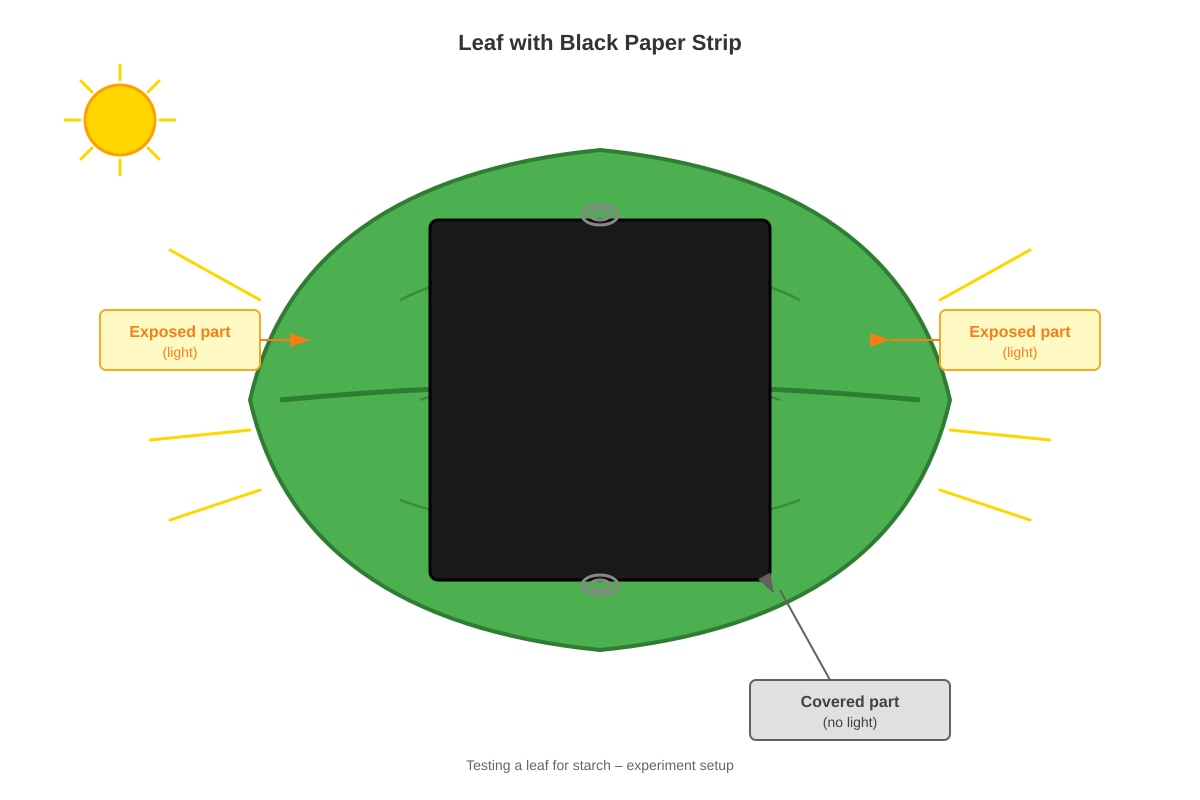
- In an experiment, a student placed a potted plant in a dark cupboard for 48 hours. He then covered part of a leaf with black paper and exposed the plant to sunlight for 6 hours. He tested the leaf for starch.
<image_placeholder> id: Q7-fig1 type: diagram linked_question: Q7 description: A leaf with a strip of black paper covering the middle section. labels: Covered part (no light), Exposed part (light). values: None. must_show: The contrast between the covered and uncovered areas of the leaf. </image_placeholder>
What is the purpose of keeping the plant in the dark for 48 hours before the experiment? (1) To kill the plant. (2) To remove existing starch from the leaves. (3) To increase the amount of chlorophyll. (4) To stop the plant from respiring.
( )
- Which of the following sequences correctly shows the flow of energy in an ecosystem? (1) Sun → Producer → Consumer → Decomposer (2) Producer → Sun → Consumer → Decomposer (3) Sun → Consumer → Producer → Decomposer (4) Decomposer → Producer → Consumer → Sun
( )
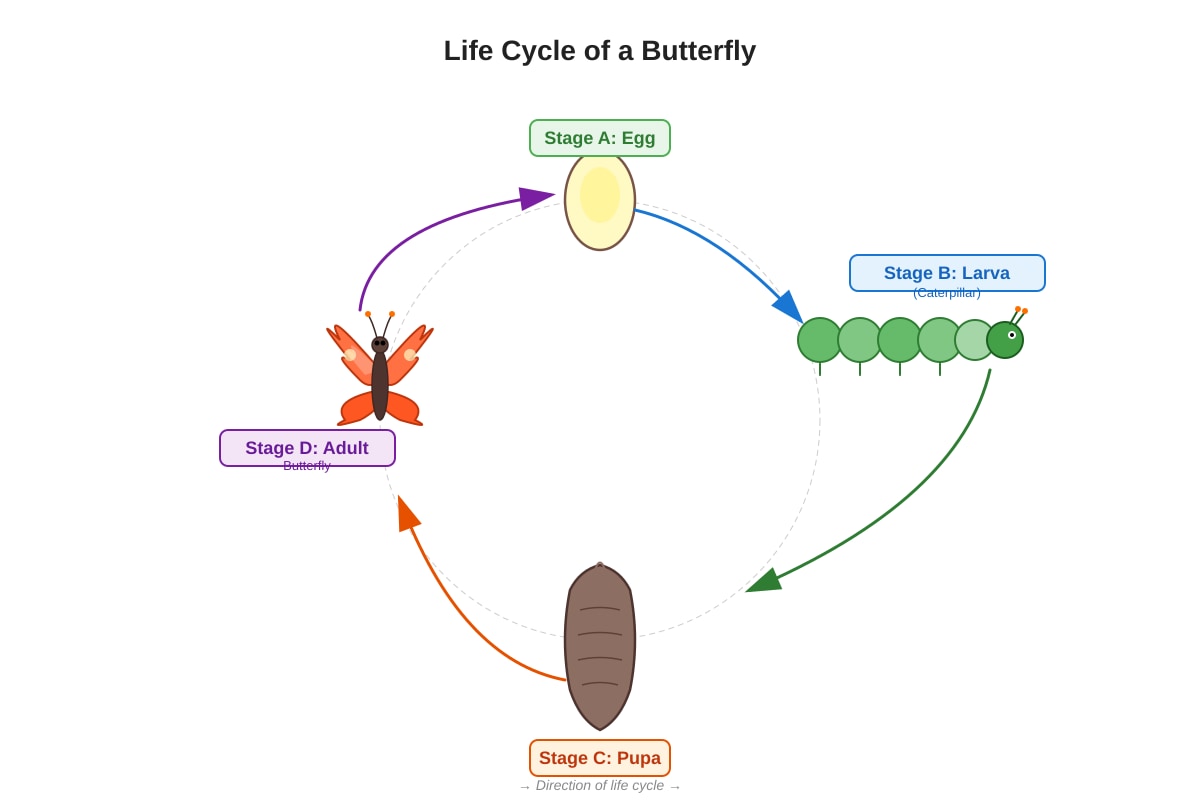
- The diagram below shows the life cycle of a butterfly.
<image_placeholder> id: Q9-fig1 type: diagram linked_question: Q9 description: A circular life cycle diagram with 4 stages. labels: Stage A: Egg, Stage B: Larva (Caterpillar), Stage C: Pupa, Stage D: Adult Butterfly. values: Arrows connect A->B->C->D->A. must_show: Distinct visual representations of each stage. </image_placeholder>
During which stage does the butterfly feed the most to store energy for reproduction? (1) Stage A (2) Stage B (3) Stage C (4) Stage D
( )
- Which of the following is an example of a physical change? (1) Burning of wood (2) Rusting of iron (3) Melting of ice (4) Cooking of an egg
( )
- Why do polar bears have a thick layer of fat under their skin? (1) To help them swim faster. (2) To store food for winter. (3) To provide insulation against the cold. (4) To make them buoyant in water.
( )
- Which of the following pairs of organisms have a symbiotic relationship where both benefit? (1) Tick and Dog (2) Bee and Flower (3) Lion and Zebra (4) Mistletoe and Tree
( )
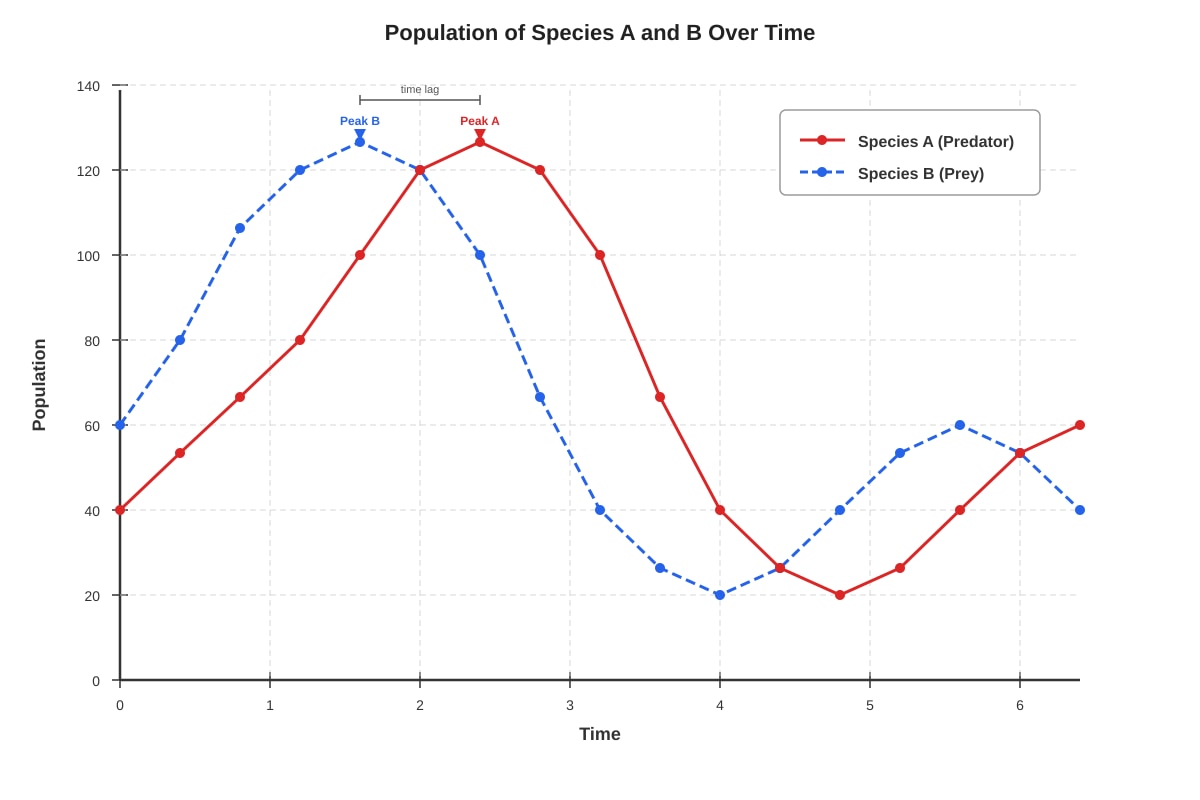
- The graph below shows the population of two species, A and B, in a closed ecosystem over time.
<image_placeholder> id: Q13-fig1 type: graph linked_question: Q13 description: A line graph with Time on x-axis and Population on y-axis. labels: Line A: Predator, Line B: Prey. values: Line B peaks slightly before Line A. When Line B drops, Line A drops later. must_show: The cyclical nature of predator-prey populations with a time lag. </image_placeholder>
What can be inferred from the graph? (1) Species A is the prey and Species B is the predator. (2) Species B depends on Species A for food. (3) An increase in Species A leads to a decrease in Species B. (4) Species A and B compete for the same food source.
( )
- Which of the following is NOT a characteristic of all living things? (1) Growth (2) Reproduction (3) Movement from place to place (4) Response to changes
( )
Section B (28 marks)
Answer all questions in the spaces provided. The number of marks available is shown in brackets [ ] at the end of each question or part-question.
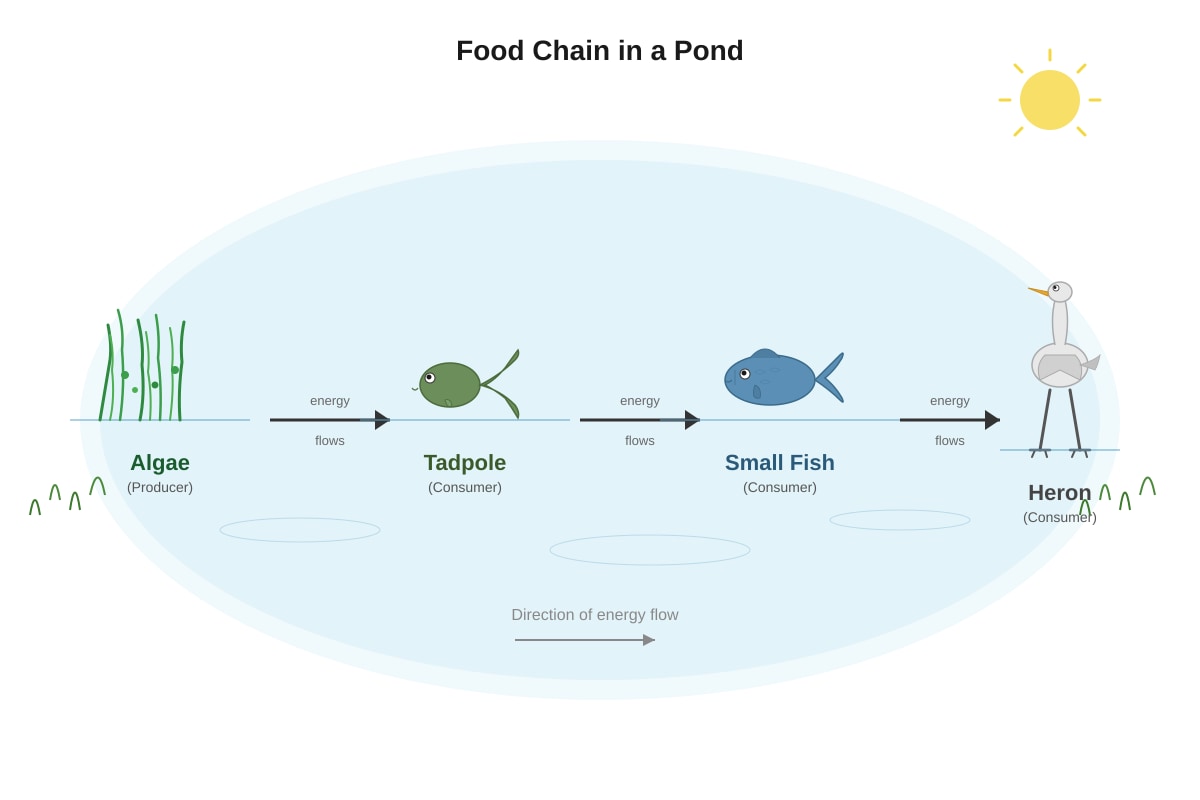
- The diagram below shows a simple food chain in a pond.
<image_placeholder> id: Q15-fig1 type: diagram linked_question: Q15 description: A linear food chain. labels: Algae → Tadpole → Small Fish → Heron. values: Arrows indicate energy flow. must_show: Clear labels for each organism. </image_placeholder>
(a) Identify the producer in this food chain. [1]
(b) If a large number of small fish are removed from the pond, explain what will happen to the population of tadpoles and herons. [2]
(c) Why is the number of herons usually much smaller than the number of algae in this ecosystem? [1]
- Students investigated how light intensity affects the rate of photosynthesis in a water plant (Hydrilla). They counted the number of bubbles produced in one minute at different distances from a lamp.
| Distance from lamp (cm) | Number of bubbles per minute |
|---|---|
| 10 | 45 |
| 20 | 30 |
| 30 | 15 |
| 40 | 5 |
| 50 | 1 |
(a) What is the independent variable in this experiment? [1]
(b) Describe the relationship between the distance from the lamp and the number of bubbles produced. [1]
(c) Explain why the number of bubbles decreases as the distance increases. [2]
(d) Suggest one way to make the results of this experiment more reliable. [1]
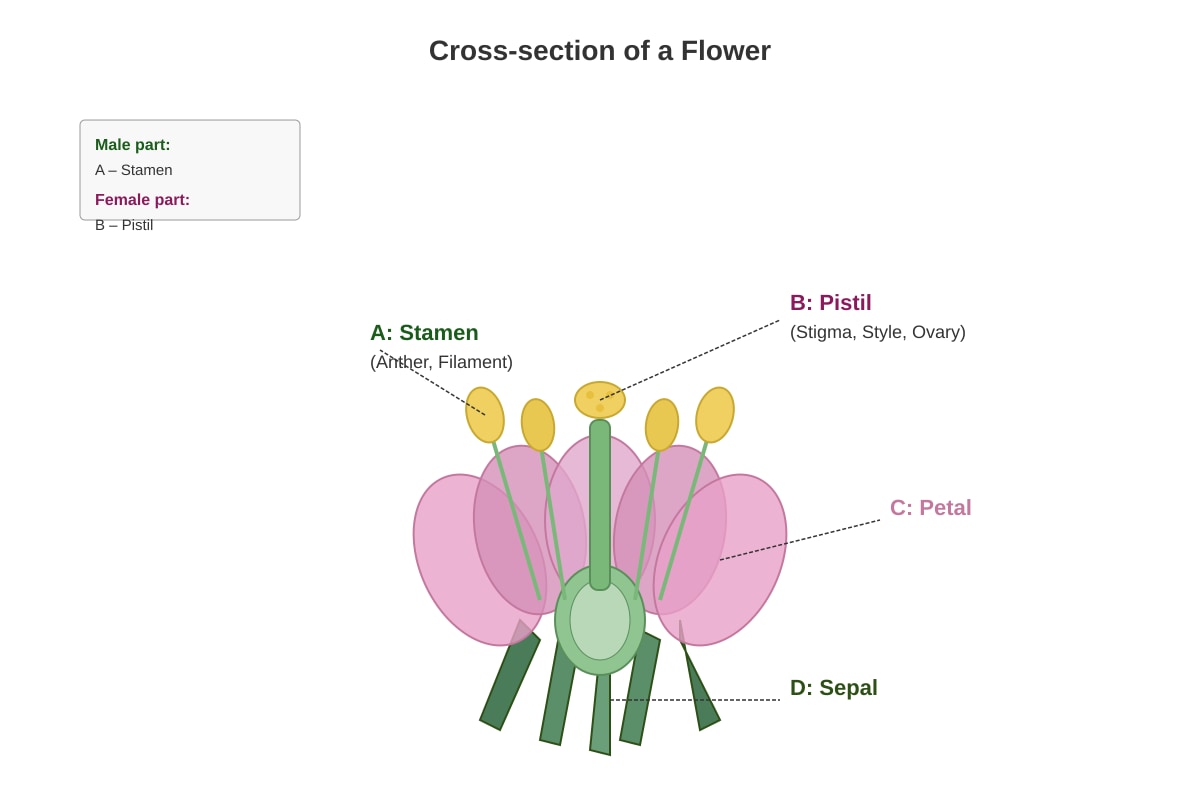
- The diagram below shows the reproductive parts of a flower.
<image_placeholder> id: Q17-fig1 type: diagram linked_question: Q17 description: A cross-section of a flower showing male and female parts. labels: A: Stamen (Anther, Filament), B: Pistil (Stigma, Style, Ovary), C: Petal, D: Sepal. values: None. must_show: Clear distinction between male (A) and female (B) reproductive organs. </image_placeholder>
(a) Name part B. [1]
(b) State the function of part A. [1]
(c) After fertilization, which part of the flower will develop into the fruit? [1]
(d) Why are petals often brightly colored? [1]
- The table below shows the characteristics of three animals: Bat, Penguin, and Dolphin.
| Animal | Has Wings/Flippers? | Lays Eggs? | Has Fur/Feathers? | Breathes with Lungs? |
|---|---|---|---|---|
| Bat | Yes (Wings) | No | Yes (Fur) | Yes |
| Penguin | Yes (Flippers) | Yes | Yes (Feathers) | Yes |
| Dolphin | Yes (Flippers) | No | No (Smooth Skin) | Yes |
(a) Although bats have wings, they are classified as mammals. Give one reason from the table to support this classification. [1]
(b) Penguins are birds. State one characteristic from the table that confirms this. [1]
(c) Dolphins live in water but are not fish. Explain why, using evidence from the table. [2]
- Decomposers play an important role in the ecosystem.
(a) Name one example of a decomposer. [1]
(b) Explain the role of decomposers in the carbon cycle. [2]
(c) What would happen to an ecosystem if there were no decomposers? [1]
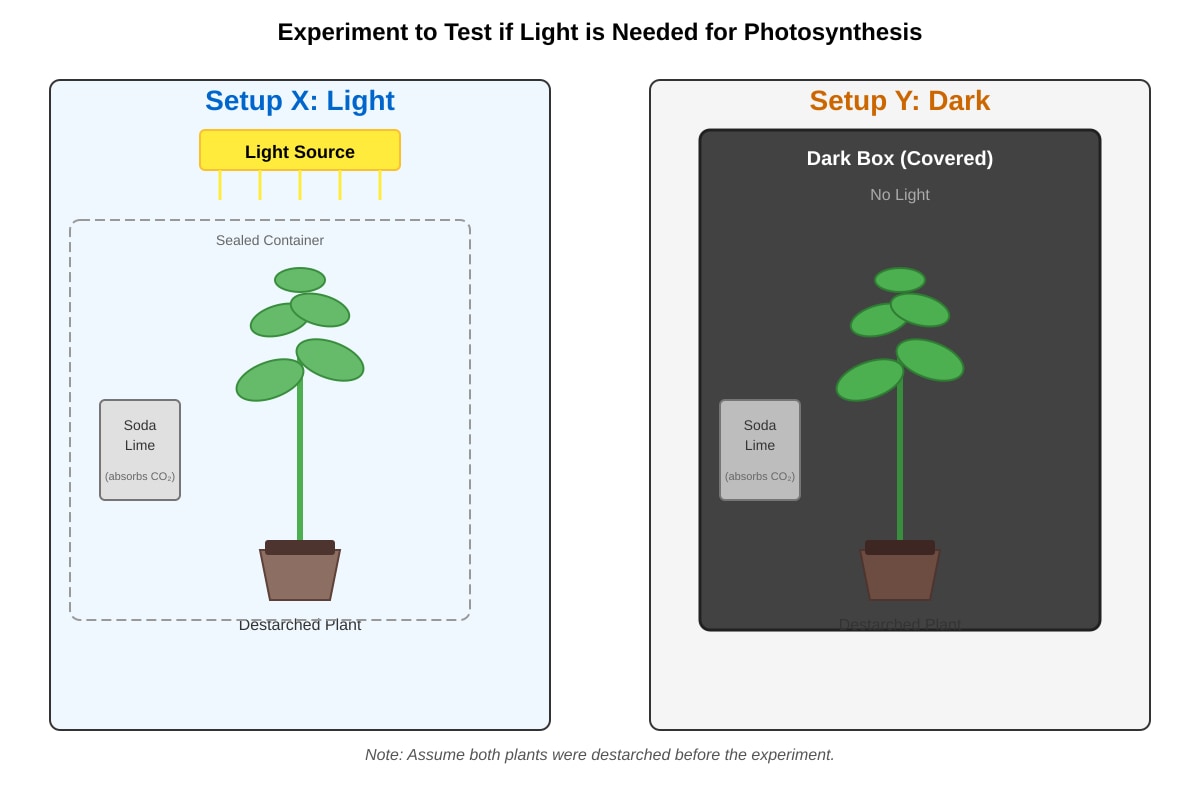
- The diagram below shows an experiment to test if light is needed for photosynthesis.
<image_placeholder> id: Q20-fig1 type: diagram linked_question: Q20 description: Two setups. Setup X: Plant in light. Setup Y: Plant in dark box. labels: Setup X: Light, Setup Y: Dark. Both have soda lime (to absorb CO2) or just sealed? Let's assume standard destarched plant setup. values: Setup X has light source. Setup Y is covered. must_show: The difference in light exposure. </image_placeholder>
Note: Assume both plants were destarched before the experiment.
(a) Why is it important to use destarched plants at the start of the experiment? [1]
(b) After 6 hours, leaves from both plants were tested for starch. Predict the results for Setup X and Setup Y. [2] Setup X: _________________________________________________________________ Setup Y: _________________________________________________________________
(c) Explain your prediction for Setup Y. [2]
End of Paper
Answers
TuitionGoWhere Practice Paper - Science Primary 6 PSLE
Answer Key & Marking Scheme Paper: WA1 (Version 2 of 5) Topic Focus: Diversity
Section A (28 marks)
-
(2)
- Reasoning: Yeast reproduces by budding (asexual) and Hydra reproduces by budding (asexual). Ferns and Mosses reproduce by spores (often considered asexual in primary context regarding seeds/flowers, but strictly spores are distinct; however, Bacteria/Amoeba are asexual, so 3 is wrong. Rose/Hibiscus are sexual, so 4 is wrong. Fern/Moss do not have flowers/seeds, so 1 is wrong in the context of "sexual" usually implying seeds/flowers in primary syllabus, but technically spores are asexual reproduction methods in terms of gamete fusion visibility. However, Option 2 is the most clearly correct pair for asexual methods taught at P6: Budding). Correction: In P6, Ferns/Mosses are often grouped separately. Yeast/Hydra are classic asexual examples.
-
(2)
- Reasoning: R has a backbone and fur, which are characteristics of mammals. Mammals give birth to young ones. P is an insect (6 legs), Q is an arachnid (no 6 legs, no backbone in this key logic? Wait, key says "Has backbone? No -> Has 6 legs?"). If Q has no backbone and not 6 legs, it could be a spider. Spiders do not have backbones. So (4) is false. P is insect, Q is not necessarily insect (could be spider). So (1) is false. S has backbone, no fur. Could be bird or reptile. Not all lay hard shells (some reptiles have leathery). But (2) is definitely true for mammals.
-
(3)
- Reasoning: Frogs are food for snakes. If frogs decrease, snakes have less food. Snakes might eat more rabbits, but the direct impact on the next trophic level up (Eagle) is that their food source (Snake) might struggle or decrease eventually. However, the most immediate and direct effect in these questions is often on the predator of the removed species. If Frogs decrease, Snakes have less food, so Snake population may decrease. If Snakes decrease, Eagles have less food, so Eagle population decreases. Option 3 is the most logical downstream effect. Option 1 is wrong (Grasshoppers would increase). Option 2 is wrong (Snakes would decrease). Option 4 is wrong (Rabbits might decrease if Snakes eat more of them, but Eagle decrease is a more standard "energy flow" answer). Refinement: If Frogs decrease, Snakes lose a food source. Snake population decreases. Eagles eat Snakes. Eagle population decreases.
-
(2)
- Reasoning: Thick, waxy skin (cuticle) reduces water loss through transpiration, which is crucial in dry environments.
-
(2)
- Reasoning: X has flowers and seeds (Flowering Plant, e.g., Rose). Y has no flowers/seeds but has spores (Non-flowering, e.g., Fern). Z has no flowers but has seeds (Non-flowering seed plant, e.g., Pine Tree/Conifer).
-
(2)
- Reasoning: The nucleus contains genetic material and controls cell activities. (1) is wrong (animal cells don't have cell walls). (3) is wrong (root cells don't have chloroplasts). (4) is wrong (plant cells are often larger due to vacuole).
-
(2)
- Reasoning: Destarching ensures that any starch detected after the experiment was produced during the experiment, not stored from before.
-
(1)
- Reasoning: Energy flows from the Sun to Producers (plants), then to Consumers (animals), and finally to Decomposers.
-
(2)
- Reasoning: The larva (caterpillar) stage is the main feeding stage where it grows rapidly and stores energy for the pupal and adult stages.
-
(3)
- Reasoning: Melting of ice is a change of state (solid to liquid) without forming a new substance. The others are chemical changes.
-
(3)
- Reasoning: Fat acts as an insulator to reduce heat loss to the cold environment.
-
(2)
- Reasoning: Bees get nectar (food) and flowers get pollinated (reproduction). Both benefit. (1) is parasitic. (3) is predator-prey. (4) is parasitic.
-
(3)
- Reasoning: In predator-prey graphs, an increase in predators (A) leads to a decrease in prey (B) due to predation. The graph shows A peaking after B, and B dropping as A rises.
-
(3)
- Reasoning: Not all living things move from place to place (e.g., plants). They all respond to changes, grow, and reproduce.
Section B (28 marks)
-
(a) Algae [1]
- Teaching Note: Producers are organisms that make their own food, usually through photosynthesis. Algae are plant-like producers.
(b) The population of tadpoles will increase because there are fewer small fish to eat them. The population of herons will decrease because there are fewer small fish for them to eat. [2]
- Marking: 1 mark for correct direction of tadpole change + reason. 1 mark for correct direction of heron change + reason.
(c) Energy is lost at each trophic level (as heat/waste/movement). Therefore, less energy is available to support a large population of top consumers like herons. [1]
- Teaching Note: Only about 10% of energy is transferred to the next level.
-
(a) Distance from the lamp (or Light intensity). [1]
(b) As the distance from the lamp increases, the number of bubbles produced decreases. [1]
(c) As distance increases, light intensity decreases. Photosynthesis requires light. With less light, the rate of photosynthesis slows down, producing less oxygen (bubbles). [2]
- Marking: 1 mark for linking distance to light intensity. 1 mark for linking light intensity to rate of photosynthesis/oxygen production.
(d) Repeat the experiment and take the average. [1]
- Teaching Note: Repeating reduces the effect of random errors.
-
(a) Pistil (or Female reproductive part). [1]
(b) To produce pollen (male gametes). [1]
- Teaching Note: The anther produces pollen.
(c) Ovary. [1]
(d) To attract pollinators (such as insects or birds) for pollination. [1]
-
(a) It has fur and gives birth to young ones (does not lay eggs). [1]
- Note: Either characteristic is acceptable, but "gives birth" is the definitive mammalian trait vs birds/reptiles. Fur is also key.
(b) It has feathers and lays eggs. [1]
(c) Dolphins breathe with lungs (fish use gills) and do not lay eggs (most fish lay eggs, though some don't, but the lung feature is definitive for mammals vs fish). Also, they have smooth skin, not scales. [2]
- Marking: 1 mark for mentioning lungs. 1 mark for contrasting with fish (gills) or mentioning live birth/smooth skin.
-
(a) Bacteria / Fungi / Mushrooms. [1]
(b) Decomposers break down dead organisms and waste materials. This releases carbon dioxide back into the atmosphere through respiration, which is then used by plants for photosynthesis. [2]
- Marking: 1 mark for breaking down dead matter. 1 mark for releasing CO2/carbon cycle link.
(c) Dead organisms and waste would accumulate, and nutrients would not be recycled back into the soil/atmosphere. [1]
-
(a) To ensure that any starch found in the leaf after the experiment was produced during the experiment and not stored from before. [1]
(b) Setup X: Starch is present (Leaf turns blue-black). [1] Setup Y: No starch is present (Leaf remains brownish/yellow). [1]
(c) Setup Y was kept in the dark. Light is necessary for photosynthesis. Without light, the plant cannot make food (starch). [2]
- Marking: 1 mark for stating light is needed for photosynthesis. 1 mark for linking absence of light to no starch production.