From Real Exams Exam Paper
Primary 6 PSLE Science Semestral Assessment 2 (End of Year) Paper 5
Free Exam-Derived Qwen3.7 Plus Primary 6 PSLE Science Semestral Assessment 2 (End of Year) Paper 5 practice paper with questions and answers for Singapore students. This page is rendered as a direct URL so the questions and answers can be discovered without pressing in-page buttons.
These static practice materials are generated from the site's syllabus and paper-generation workflow, with source and model context shown so students and parents can evaluate the material before use.
Questions
TuitionGoWhere Practice Paper - Science Primary 6 PSLE
TuitionGoWhere Exam Practice (AI)
Subject: Science
Level: Primary 6
Paper: SA2 Practice Paper (Version 5 of 5)
Topic Focus: Diversity
Duration: 1 hour 45 minutes
Total Marks: 56
Name: __________________________
Class: __________________________
Date: __________________________
Instructions to Candidates:
- This paper consists of two sections, A and B.
- Answer all questions.
- For Section A, write your answer (1, 2, 3 or 4) in the brackets provided.
- For Section B, write your answers in the spaces provided.
- The number of marks available for each question or part is given in brackets [ ] at the end of the question or part.
Section A (28 marks)
For each question from 1 to 28, four options are given. One of them is the correct answer. Make your choice (1, 2, 3 or 4) and write your answer in the brackets provided. Each question carries 1 mark.
1. Which of the following groups of animals are all mammals? (1) Bat, Whale, Dolphin (2) Penguin, Ostrich, Kiwi (3) Shark, Ray, Eel (4) Frog, Toad, Newt [ ]
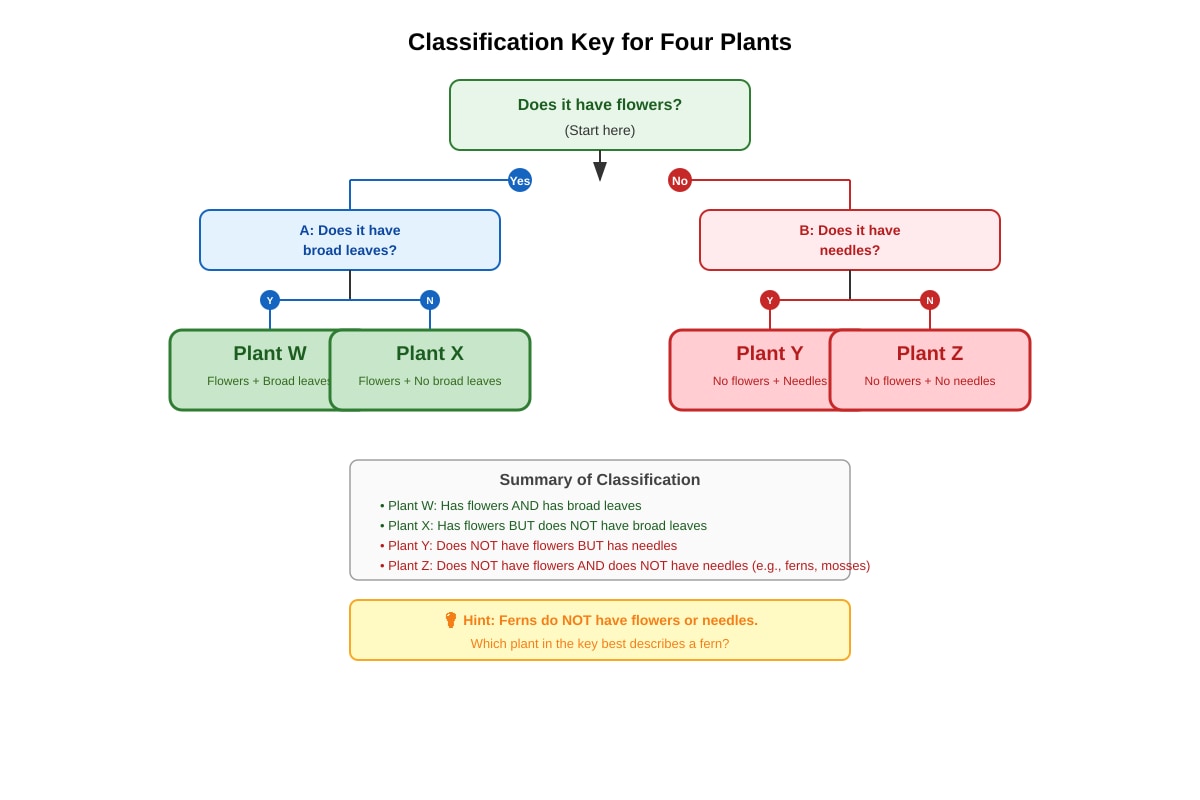
2. The diagram below shows the classification key for four different plants.
<image_placeholder> id: Q2-fig1 type: diagram linked_question: Q2 description: A dichotomous key flowchart. Start: Does it have flowers? Yes -> Go to A. No -> Go to B. A: Does it have broad leaves? Yes -> Plant W. No -> Plant X. B: Does it have needles? Yes -> Plant Y. No -> Plant Z. labels: Plant W, Plant X, Plant Y, Plant Z must_show: The branching structure of the key clearly distinguishing the four plants based on flowers, leaf shape, and needles. </image_placeholder>
Based on the key, which plant is most likely a fern? (1) Plant W (2) Plant X (3) Plant Y (4) Plant Z [ ]
3. Which of the following characteristics is used to classify fungi separately from plants? (1) Fungi cannot make their own food. (2) Fungi have roots. (3) Fungi reproduce by seeds. (4) Fungi have chlorophyll. [ ]
4. Study the food chain below: Grass Grasshopper Frog Snake Eagle
If the population of frogs decreases significantly due to disease, what is the most likely immediate effect on the other organisms? (1) The population of grasshoppers will decrease. (2) The population of snakes will decrease. (3) The population of eagles will increase. (4) The population of grass will decrease. [ ]
5. Which of the following adaptations helps a cactus survive in a hot and dry desert environment? (1) Broad leaves to capture more sunlight. (2) Thick waxy skin to reduce water loss. (3) Shallow roots to absorb surface rain quickly. (4) Bright flowers to attract insects. [ ]
6. The table below shows the characteristics of four different microorganisms.
| Microorganism | Has Cell Wall | Has Chlorophyll | Reproduces by Spores |
|---|---|---|---|
| A | Yes | Yes | No |
| B | Yes | No | Yes |
| C | No | No | No |
| D | Yes | Yes | Yes |
Which microorganism is most likely a bacterium? (1) A (2) B (3) C (4) D [ ]
7. Why are decomposers important in an ecosystem? (1) They provide food for predators. (2) They recycle nutrients back into the soil. (3) They produce oxygen for animals to breathe. (4) They control the population of herbivores. [ ]
8. Which of the following pairs of organisms has a symbiotic relationship where both benefit? (1) Tick and Dog (2) Remora fish and Shark (3) Bee and Flower (4) Mistletoe and Tree [ ]
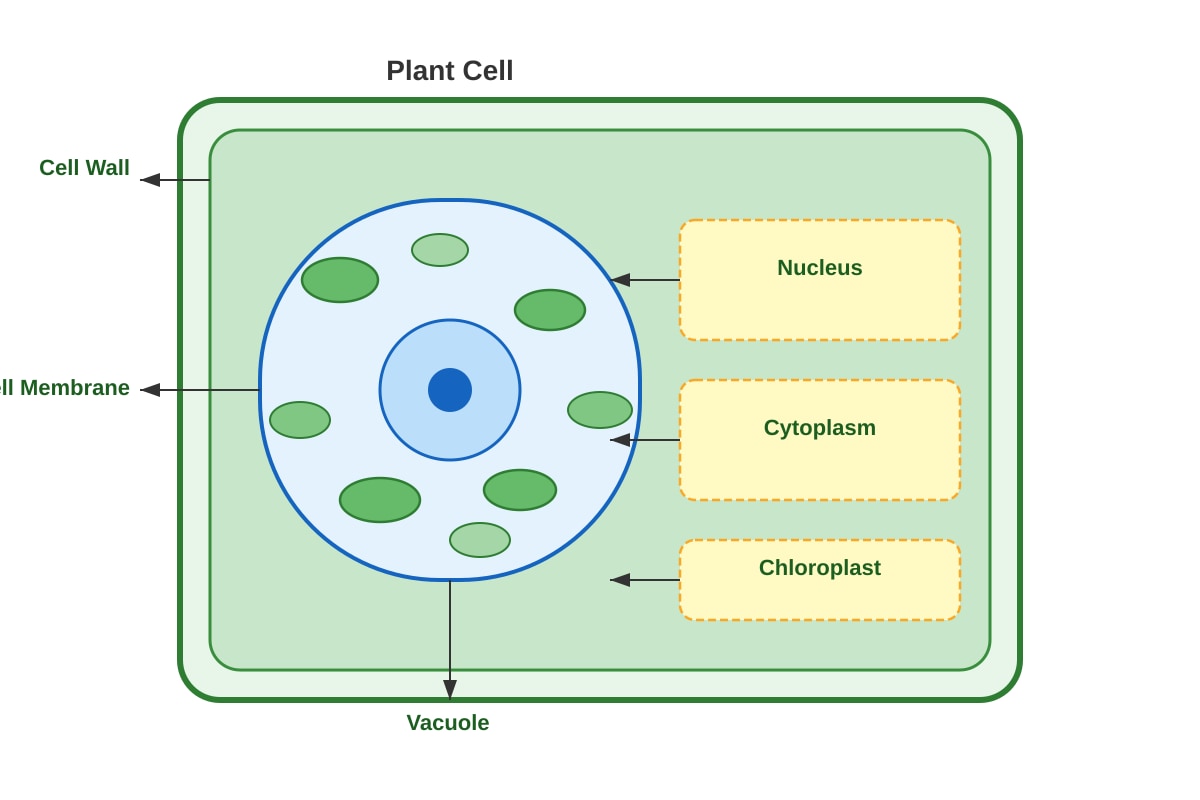
9. Look at the diagram of the cell below.
<image_placeholder> id: Q9-fig1 type: diagram linked_question: Q9 description: A diagram of a plant cell. Labels point to: Cell Wall, Cell Membrane, Cytoplasm, Nucleus, Chloroplast, Vacuole. labels: Cell Wall, Chloroplast, Nucleus, Vacuole must_show: Distinct rectangular shape of plant cell, large central vacuole, and green chloroplasts. </image_placeholder>
Which part of the cell is responsible for photosynthesis? (1) Nucleus (2) Cell Wall (3) Chloroplast (4) Vacuole [ ]
10. Which of the following statements about viruses is true? (1) They are living organisms because they can reproduce on their own. (2) They are non-living because they cannot reproduce without a host cell. (3) They have cells with a nucleus. (4) They can make their own food using sunlight. [ ]
11. In a forest ecosystem, trees provide shelter for birds. The birds eat insects that damage the trees. This relationship is an example of: (1) Competition (2) Mutualism (3) Parasitism (4) Predation [ ]
12. Which of the following is an example of an abiotic factor in an ecosystem? (1) Bacteria (2) Sunlight (3) Fungi (4) Plants [ ]
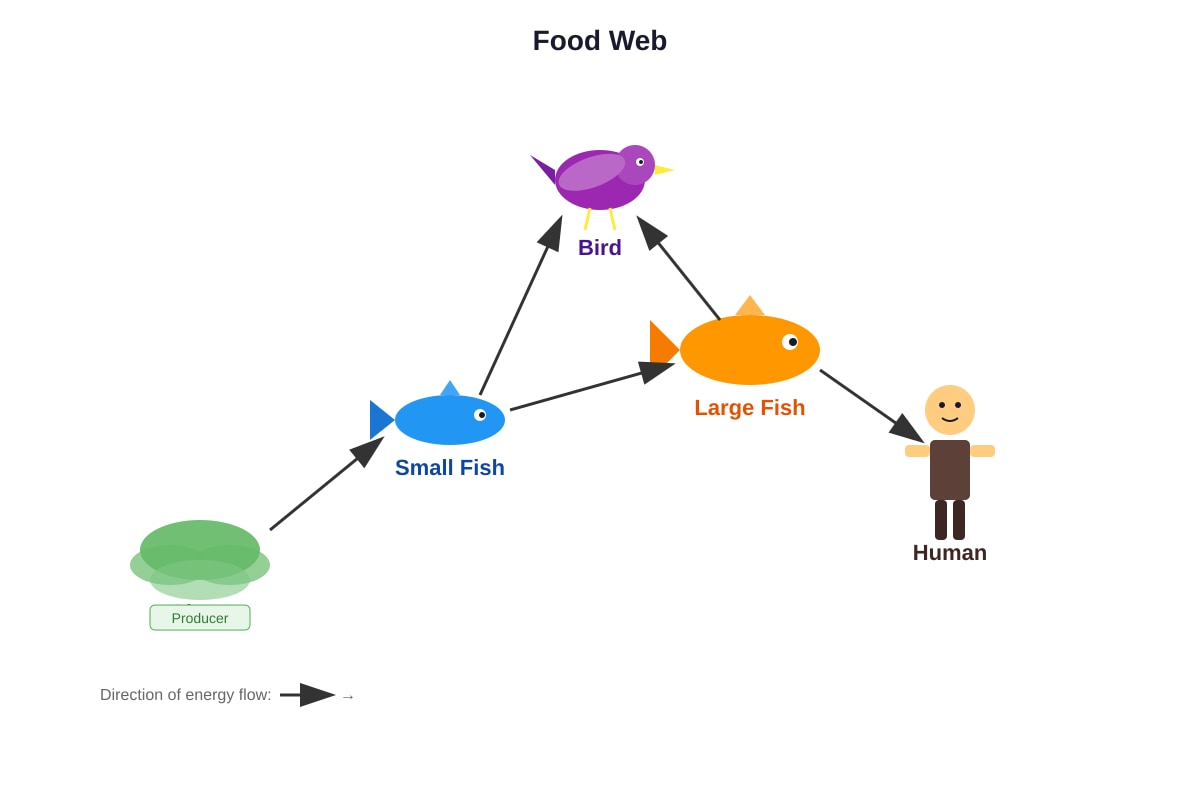
13. The diagram shows a simple food web.
<image_placeholder> id: Q13-fig1 type: diagram linked_question: Q13 description: A food web. Arrows point from: Algae to Small Fish; Small Fish to Large Fish; Small Fish to Bird; Large Fish to Bird; Large Fish to Human. labels: Algae, Small Fish, Large Fish, Bird, Human must_show: Clear directional arrows showing energy flow. </image_placeholder>
If the water becomes polluted and the algae die, which organism will be affected first? (1) Human (2) Bird (3) Large Fish (4) Small Fish [ ]
14. Which characteristic is unique to birds? (1) They have feathers. (2) They lay eggs. (3) They have wings. (4) They are warm-blooded. [ ]
15. Why do polar bears have white fur? (1) To attract mates. (2) To camouflage in the snow. (3) To absorb more heat from the sun. (4) To repel water. [ ]
16. Which of the following groups contains only invertebrates? (1) Spider, Scorpion, Crab (2) Snake, Lizard, Turtle (3) Eagle, Bat, Butterfly (4) Frog, Fish, Worm [ ]
17. What is the main function of the roots of a mangrove tree that grow above the ground? (1) To perform photosynthesis. (2) To obtain oxygen from the air. (3) To store food. (4) To attract pollinators. [ ]
18. Which of the following is a correct sequence of energy flow in an ecosystem? (1) Consumer Producer Decomposer (2) Producer Consumer Decomposer (3) Decomposer Producer Consumer (4) Producer Decomposer Consumer [ ]
19. Two plants, X and Y, are grown in the same pot. Plant X grows taller and blocks sunlight from reaching Plant Y. Plant Y eventually dies. This is an example of: (1) Mutualism (2) Commensalism (3) Competition (4) Parasitism [ ]
20. Which of the following statements about classification is correct? (1) All animals with backbones are mammals. (2) All plants with flowers are angiosperms. (3) All insects have 8 legs. (4) All fungi are plants. [ ]
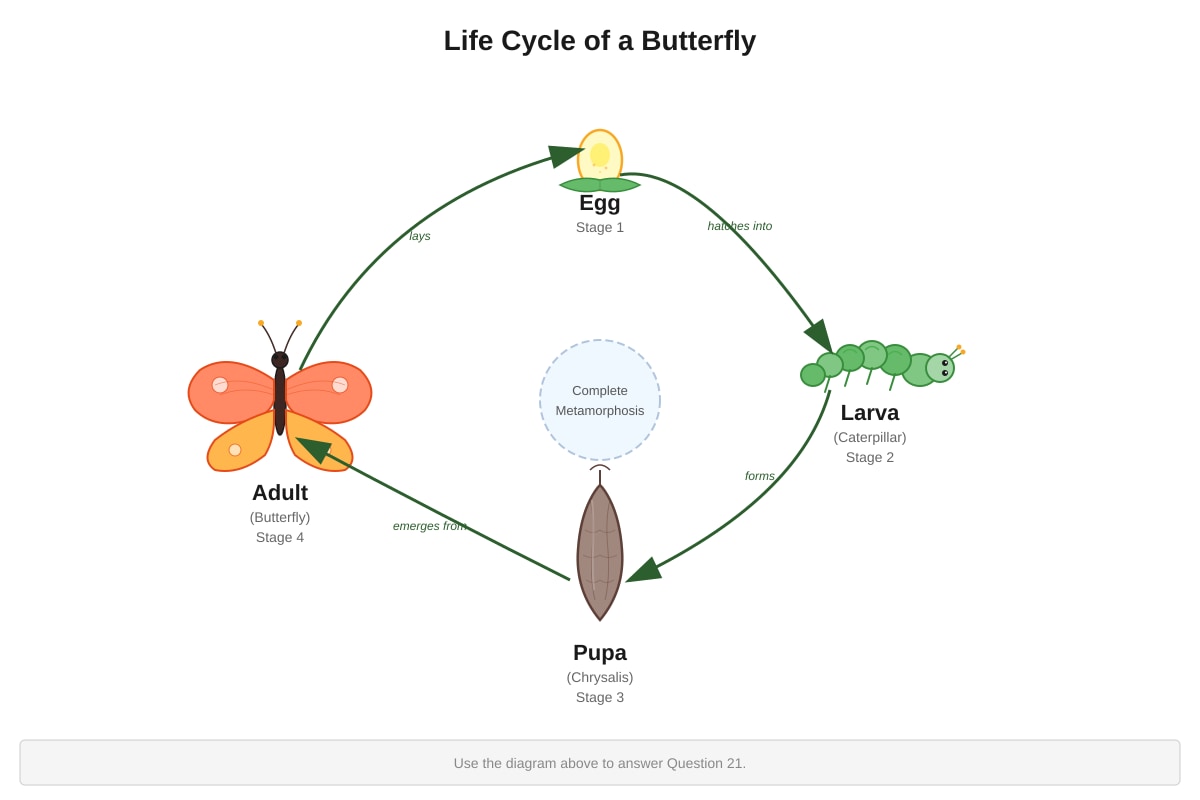
21. The diagram shows the life cycle of a butterfly.
<image_placeholder> id: Q21-fig1 type: diagram linked_question: Q21 description: Four stages of a butterfly life cycle arranged in a circle: Egg, Larva (Caterpillar), Pupa (Chrysalis), Adult Butterfly. Arrows connect them in order. labels: Egg, Larva, Pupa, Adult must_show: Distinct visual differences between the caterpillar, chrysalis, and butterfly. </image_placeholder>
At which stage does the butterfly undergo metamorphosis? (1) Egg (2) Larva (3) Pupa (4) Adult [ ]
22. Which of the following is an adaptation of a fish for living in water? (1) Lungs for breathing air. (2) Scales to reduce friction. (3) Legs for walking on the riverbed. (4) Fur to keep warm. [ ]
23. In a food chain, what role do green plants play? (1) Primary Consumer (2) Secondary Consumer (3) Producer (4) Decomposer [ ]
24. Which of the following organisms reproduces by spores? (1) Rose plant (2) Mushroom (3) Cat (4) Bacteria [ ]
25. Why do desert animals like the fennec fox have large ears? (1) To hear predators from far away. (2) To release excess body heat. (3) To store fat. (4) To attract mates. [ ]
26. Which of the following is a biotic factor? (1) Temperature (2) Water (3) Soil pH (4) Bacteria [ ]
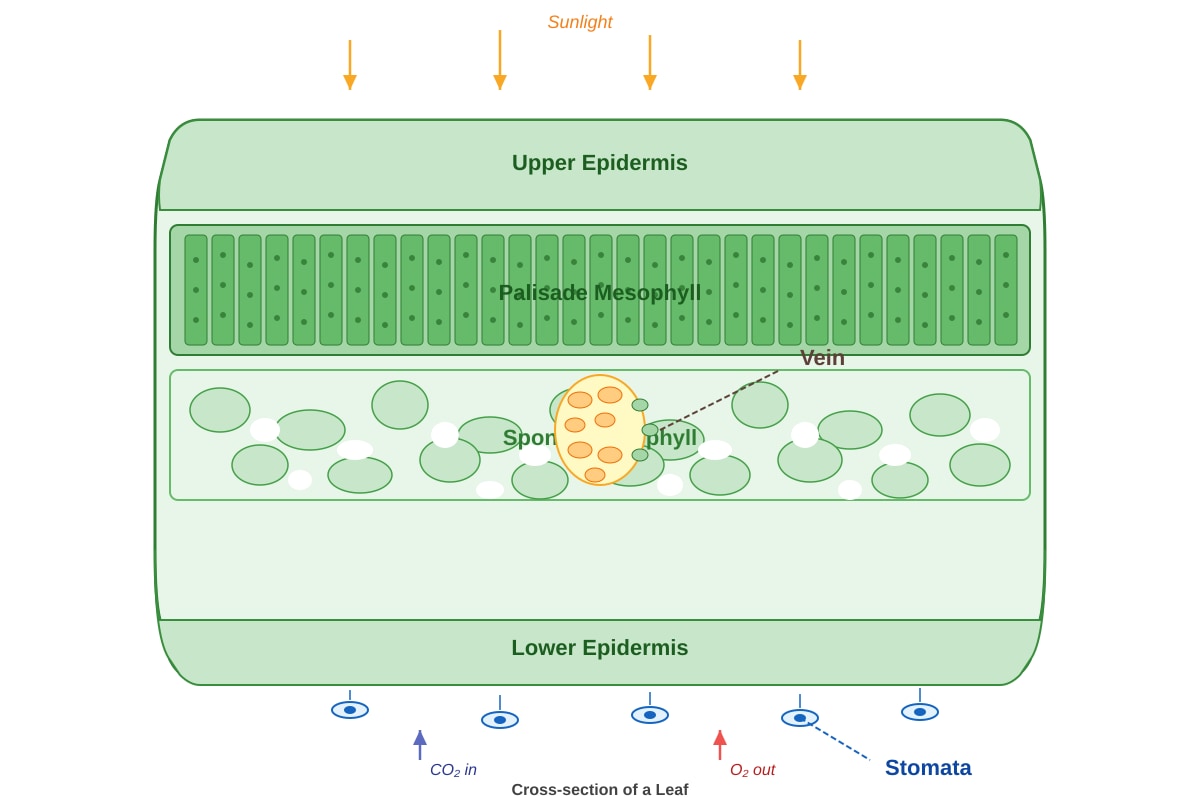
27. The diagram shows a cross-section of a leaf.
<image_placeholder> id: Q27-fig1 type: diagram linked_question: Q27 description: Cross-section of a leaf showing Upper Epidermis, Palisade Mesophyll, Spongy Mesophyll, Lower Epidermis, Stomata, Vein. labels: Palisade Mesophyll, Stomata, Vein must_show: Tightly packed cells in palisade layer, air spaces in spongy layer, and openings (stomata) at the bottom. </image_placeholder>
Where does most photosynthesis take place? (1) Upper Epidermis (2) Palisade Mesophyll (3) Spongy Mesophyll (4) Lower Epidermis [ ]
28. Which of the following statements about biodiversity is true? (1) High biodiversity makes an ecosystem less stable. (2) Low biodiversity makes an ecosystem more resistant to disease. (3) High biodiversity increases the chances of survival for the ecosystem. (4) Biodiversity refers only to the number of animals in an area. [ ]
Section B (28 marks)
Answer all questions. Write your answers in the spaces provided. The number of marks available for each question or part is given in brackets [ ].
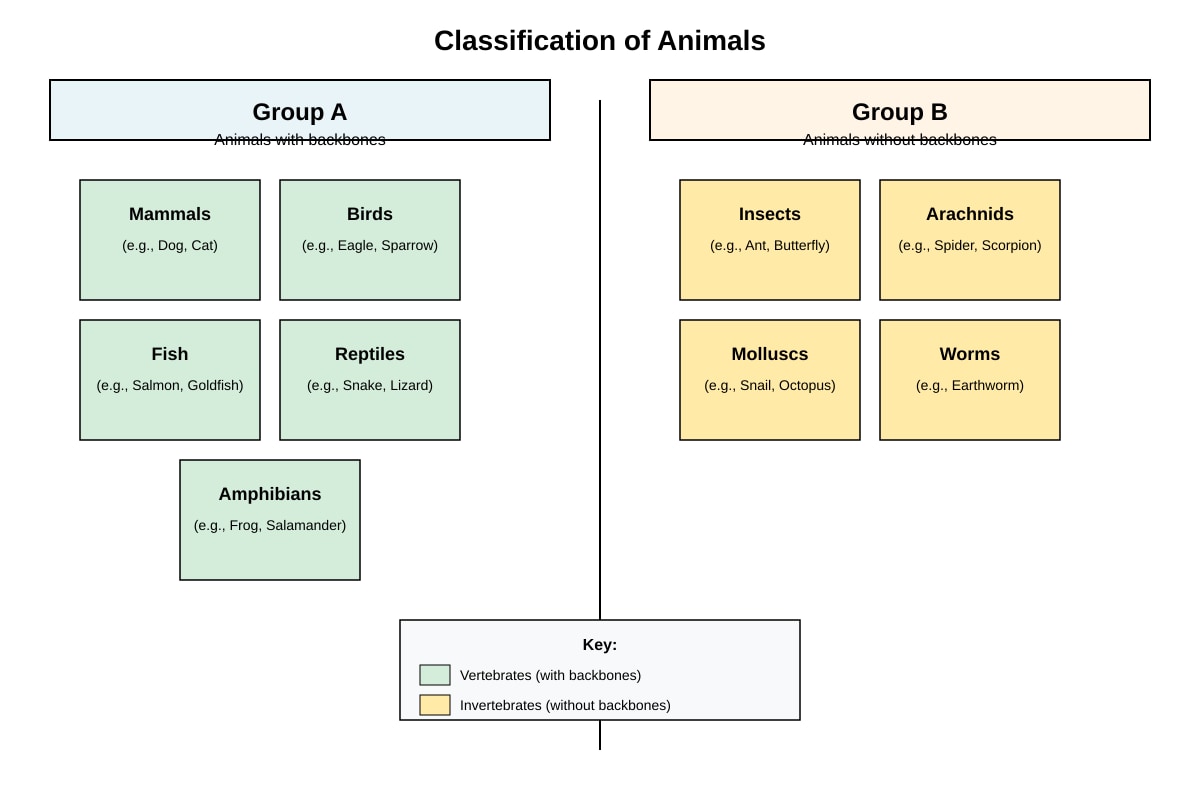
29. Study the classification chart below.
<image_placeholder> id: Q29-fig1 type: diagram linked_question: Q29 description: A chart showing two groups. Group A: Animals with backbones. Group B: Animals without backbones. Under Group A: Mammals, Birds, Fish, Reptiles, Amphibians. Under Group B: Insects, Arachnids, Molluscs, Worms. labels: Group A, Group B, Mammals, Insects must_show: Clear division between vertebrates and invertebrates with examples. </image_placeholder>
(a) State one characteristic that all animals in Group A have. [1]
(b) Explain why a spider is placed in Group B and not in Group A. [2]
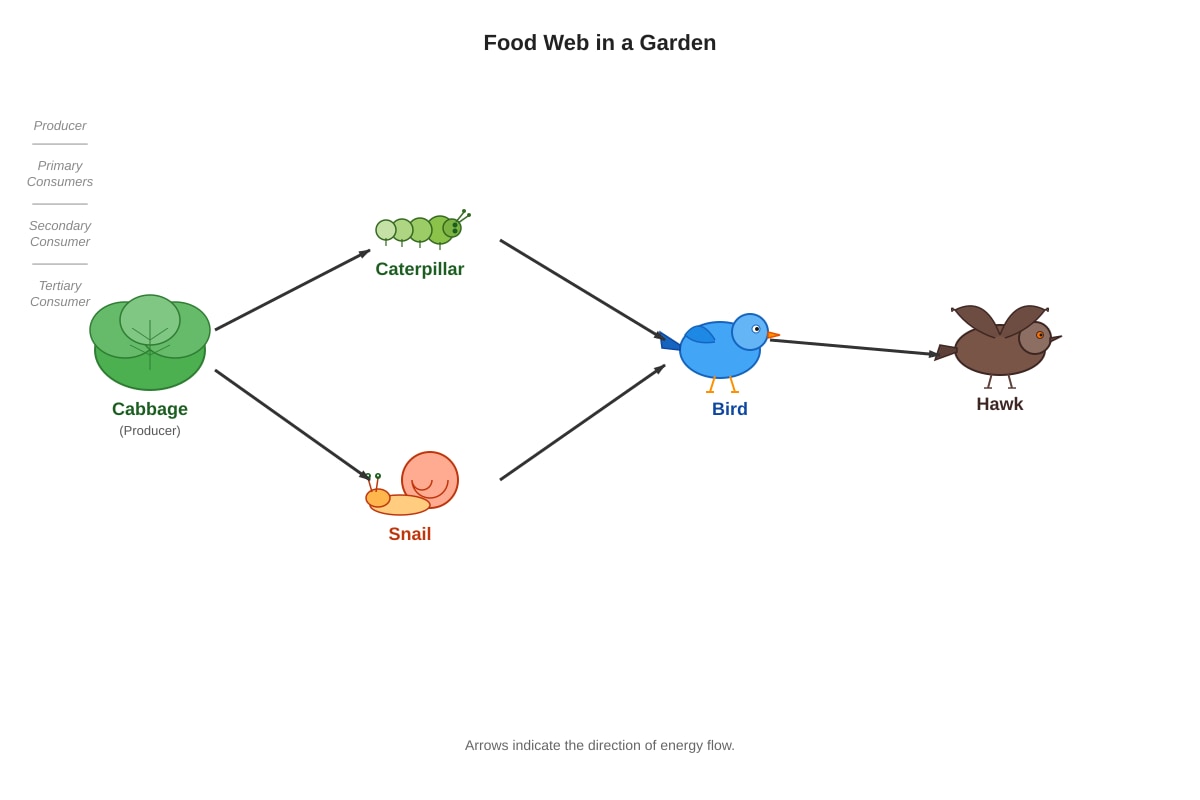
30. The diagram shows a food web in a garden.
<image_placeholder> id: Q30-fig1 type: diagram linked_question: Q30 description: Food web. Cabbage Caterpillar Bird. Cabbage Snail Bird. Bird Hawk. labels: Cabbage, Caterpillar, Snail, Bird, Hawk must_show: Arrows indicating energy flow from producers to consumers. </image_placeholder>
(a) Identify the producer in this food web. [1]
(b) If all the snails are removed from the garden, explain what might happen to the population of caterpillars. [2]
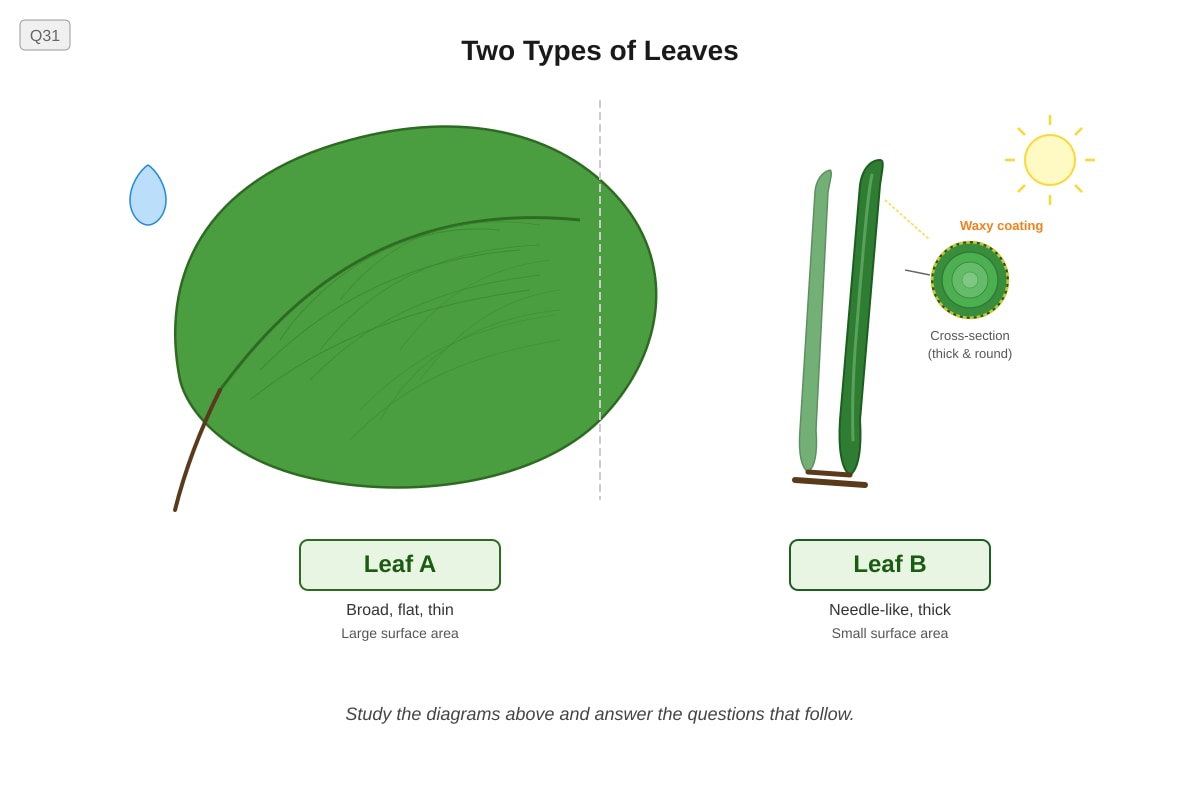
31. Scientists studied two types of leaves, Leaf A and Leaf B.
<image_placeholder> id: Q31-fig1 type: figure linked_question: Q31 description: Two leaf images. Leaf A: Broad, flat, thin. Leaf B: Needle-like, thick waxy coating, small surface area. labels: Leaf A, Leaf B must_show: Contrast in shape and texture. </image_placeholder>
(a) Which leaf is adapted to a hot and dry environment? [1]
(b) Explain how the structure of this leaf helps the plant survive in such an environment. [2]
32. The table shows the number of different species of birds found in two forests, Forest X and Forest Y.
| Type of Bird | Forest X | Forest Y |
|---|---|---|
| Sparrow | 50 | 10 |
| Eagle | 2 | 5 |
| Owl | 3 | 8 |
| Pigeon | 40 | 5 |
| Total Species | 4 | 4 |
(a) Which forest has higher biodiversity? Explain your answer. [2]
(b) Why is high biodiversity important for the stability of an ecosystem? [2]
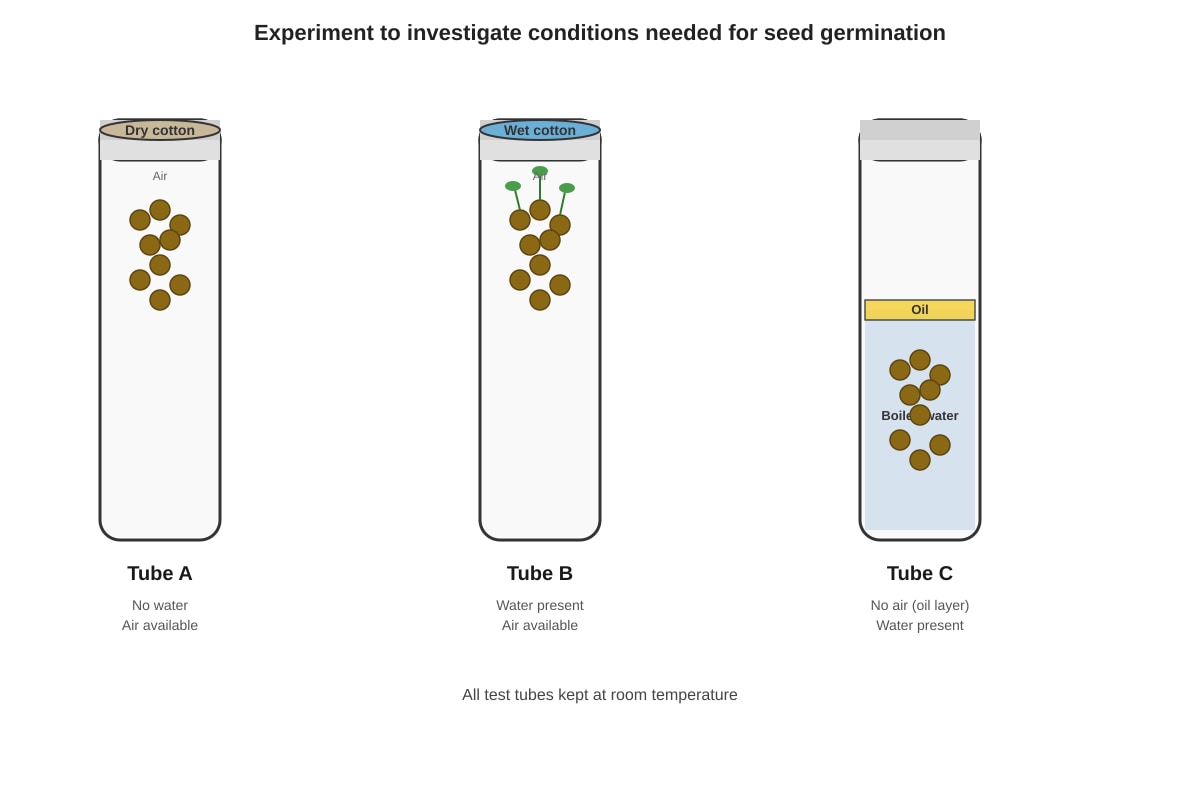
33. The diagram shows an experiment to investigate the conditions needed for seed germination.
<image_placeholder> id: Q33-fig1 type: experimental_setup linked_question: Q33 description: Three test tubes. Tube A: Seeds on dry cotton wool. Tube B: Seeds on wet cotton wool, open to air. Tube C: Seeds submerged in boiled water with a layer of oil on top. All at room temperature. labels: Tube A, Tube B, Tube C, Dry cotton, Wet cotton, Boiled water, Oil must_show: Clear difference in water and air availability for each tube. </image_placeholder>
(a) In which test tube will the seeds germinate? [1]
(b) Explain why the seeds in Tube C did not germinate. [2]
34. Study the food chain below: Phytoplankton Zooplankton Small Fish Tuna Shark
(a) What is the source of energy for this food chain? [1]
(b) If the population of zooplankton decreases, what will happen to the population of tuna? Explain your answer. [2]
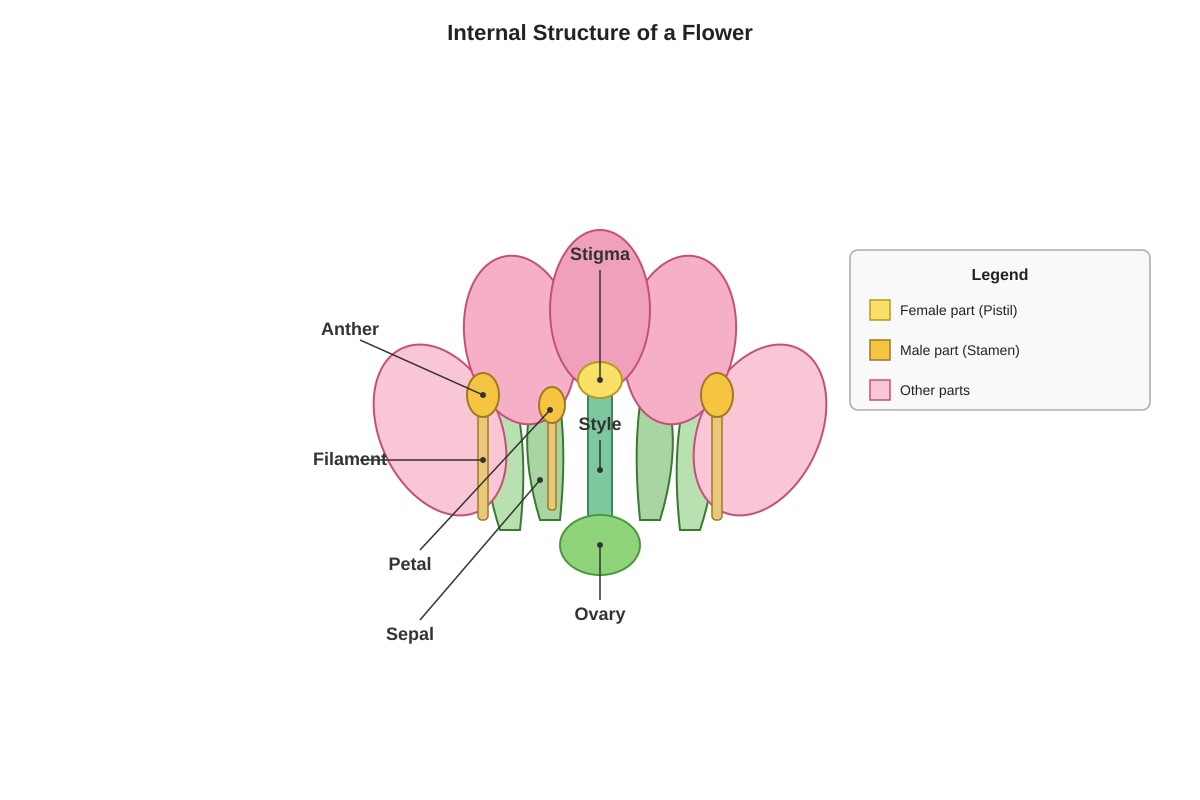
35. The diagram shows the internal structure of a flower.
<image_placeholder> id: Q35-fig1 type: diagram linked_question: Q35 description: Labeled diagram of a flower. Parts: Stigma, Style, Ovary, Petal, Sepal, Anther, Filament. labels: Stigma, Ovary, Anther must_show: Female parts (pistil) and male parts (stamen) clearly distinguished. </image_placeholder>
(a) Name the part of the flower that produces pollen. [1]
(b) Explain the function of the stigma. [2]
36. A student observed a pond ecosystem. He noted the following organisms: Water lily, Dragonfly larva, Frog, Algae, and Heron.
(a) Construct a food chain using four of these organisms. [2]
(b) Why are water lilies considered producers? [1]
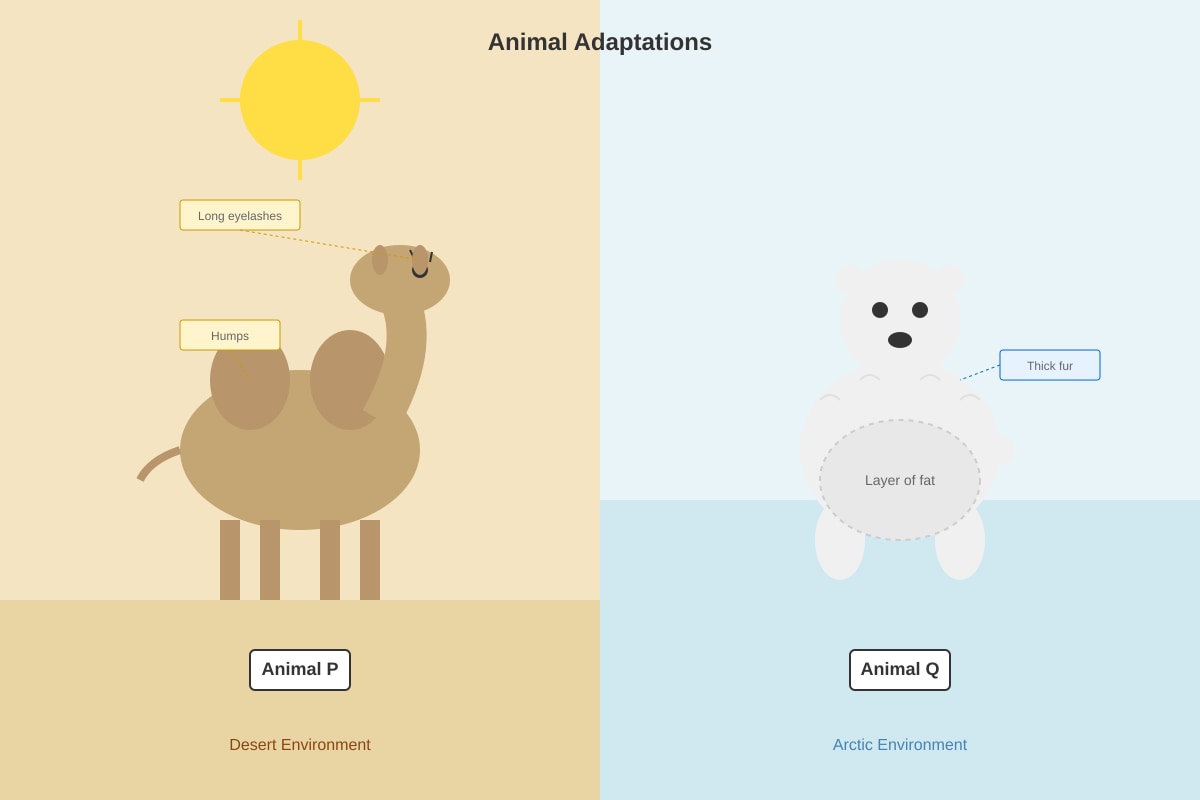
37. The diagram shows two animals, Animal P and Animal Q.
<image_placeholder> id: Q37-fig1 type: figure linked_question: Q37 description: Animal P: A camel with humps and long eyelashes. Animal Q: A polar bear with thick fur and a layer of fat. labels: Animal P, Animal Q must_show: Distinct adaptations for desert and arctic environments. </image_placeholder>
(a) State one adaptation of Animal P that helps it survive in the desert. [1]
(b) How does the thick fur of Animal Q help it survive in the Arctic? [2]
38. The table shows the characteristics of three microorganisms.
| Microorganism | Size | Cell Structure | Reproduction |
|---|---|---|---|
| X | Very Small | No Nucleus | Binary Fission |
| Y | Small | Has Nucleus | Budding |
| Z | Microscopic | No Cell Structure | Needs Host Cell |
(a) Identify Microorganism Z. [1]
(b) Why is Microorganism X classified as a bacterium? [2]
39. Explain why decomposers are essential for the cycling of nutrients in an ecosystem. [3]
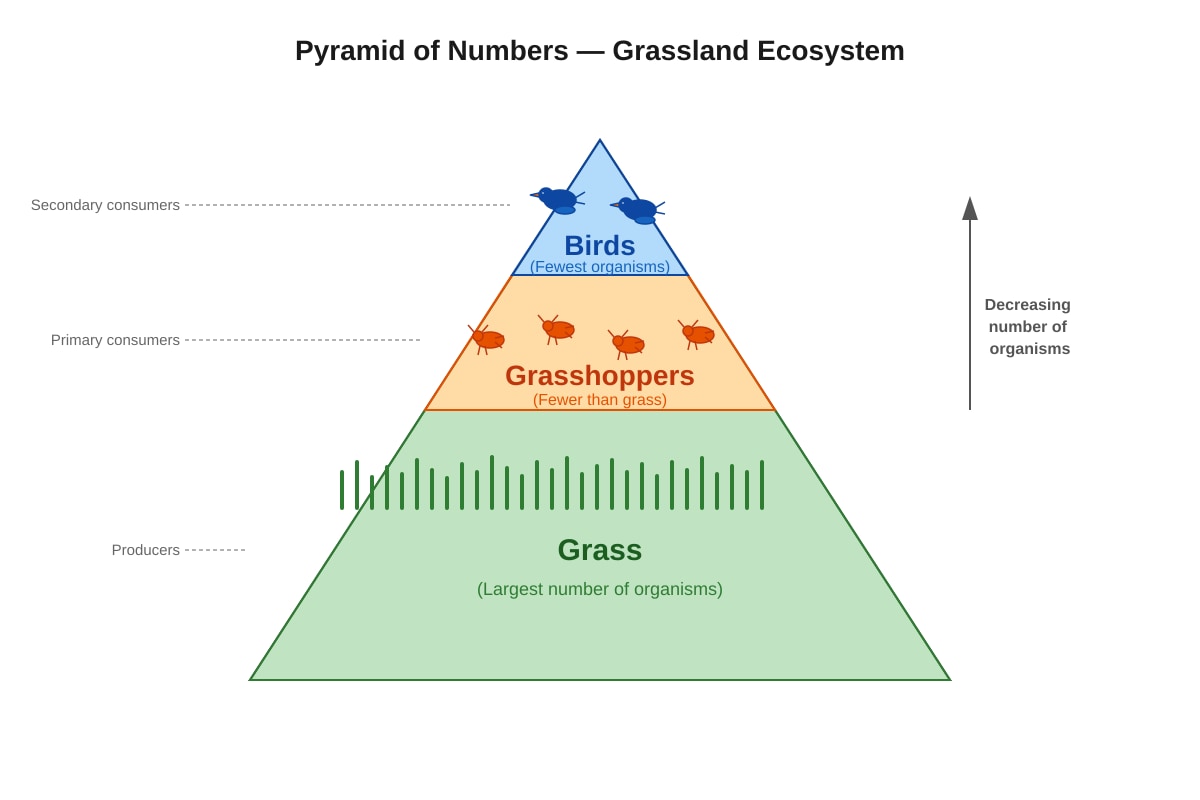
40. The diagram shows a pyramid of numbers for a grassland ecosystem.
<image_placeholder> id: Q40-fig1 type: chart linked_question: Q40 description: A pyramid shape. Bottom layer (widest): Grass. Middle layer: Grasshoppers. Top layer (narrowest): Birds. labels: Grass, Grasshoppers, Birds must_show: Decreasing number of organisms at each trophic level. </image_placeholder>
(a) Why is the base of the pyramid the widest? [2]
(b) If a new predator that eats birds is introduced, what will happen to the population of grass? Explain your answer. [3]
Answers
TuitionGoWhere Practice Paper - Science Primary 6 PSLE (Version 5)
Answer Key and Marking Scheme
Section A (28 marks)
| Qn | Answer | Qn | Answer |
|---|---|---|---|
| 1 | 1 | 15 | 2 |
| 2 | 4 | 16 | 1 |
| 3 | 1 | 17 | 2 |
| 4 | 2 | 18 | 2 |
| 5 | 2 | 19 | 3 |
| 6 | 2 | 20 | 2 |
| 7 | 2 | 21 | 3 |
| 8 | 3 | 22 | 2 |
| 9 | 3 | 23 | 3 |
| 10 | 2 | 24 | 2 |
| 11 | 2 | 25 | 2 |
| 12 | 2 | 26 | 4 |
| 13 | 4 | 27 | 2 |
| 14 | 1 | 28 | 3 |
Section B (28 marks)
29. (a) They have a backbone / vertebral column. [1] (b) A spider does not have a backbone. [1] It is an invertebrate. [1] Teaching Note: Group A represents vertebrates. Group B represents invertebrates. The key distinguishing feature is the presence of a backbone.
30. (a) Cabbage [1] (b) The population of caterpillars will increase. [1] Because there is less competition for food (cabbage) from snails. [1] Teaching Note: Removing one consumer (snail) reduces competition for the producer (cabbage), allowing the other consumer (caterpillar) to thrive initially.
31. (a) Leaf B [1] (b) It has a small surface area to reduce water loss through transpiration. [1] It has a thick waxy coating to prevent water loss. [1] Teaching Note: Adaptations for dry environments focus on water conservation. Small surface area and waxy cuticles are key features.
32. (a) Forest Y [1] Because the number of individuals is more evenly distributed among the species, indicating a more balanced ecosystem. [1] Alternative Answer: Forest Y has higher biodiversity because it supports a more stable population of different species, whereas Forest X is dominated by a few species. (b) It makes the ecosystem more resistant to diseases and environmental changes. [1] If one species dies out, others can take its place in the food web. [1] Teaching Note: Biodiversity provides resilience. A monoculture (low diversity) is vulnerable to collapse if a specific threat targets the dominant species.
33. (a) Tube B [1] (b) The boiled water has no dissolved oxygen. [1] The layer of oil prevents oxygen from the air from dissolving into the water. Seeds need oxygen to germinate. [1] Teaching Note: Germination requires water, warmth, and oxygen. Tube C lacks oxygen.
34. (a) The Sun [1] (b) The population of tuna will decrease. [1] Because there will be fewer small fish for the tuna to eat as the small fish population decreases due to lack of zooplankton. [1] Teaching Note: Energy flows up the food chain. A decrease at a lower level causes a decrease at higher levels due to food scarcity.
35. (a) Anther [1] (b) The stigma is sticky to trap pollen grains. [1] This allows pollination to occur. [1] Teaching Note: The stigma is part of the female reproductive organ (pistil) and is adapted to catch pollen.
36. (a) Algae Dragonfly larva Frog Heron [2] Accept any valid chain starting with a producer (Algae or Water lily) and ending with a top consumer. Arrows must be in the correct direction. (b) They can make their own food through photosynthesis. [1]
37. (a) It has humps to store fat (which can be converted to water/energy). OR It has long eyelashes to keep sand out of its eyes. [1] (b) The thick fur traps a layer of air. [1] Air is a poor conductor of heat, so it reduces heat loss from the body to the cold environment. [1] Teaching Note: Adaptations for cold environments focus on heat retention. Fur/fat acts as insulation.
38. (a) Virus [1] (b) It has no nucleus. [1] It reproduces by binary fission. [1] Teaching Note: Bacteria are prokaryotes (no nucleus). Viruses are non-living and need a host. Fungi have nuclei and reproduce by spores/budding.
39. Decomposers break down dead organisms and waste materials. [1] This releases nutrients (such as nitrogen and minerals) back into the soil. [1] Plants then absorb these nutrients to grow, completing the nutrient cycle. [1] Teaching Note: Decomposers are the recyclers of the ecosystem. Without them, nutrients would remain locked in dead matter.
40. (a) Because there are the most producers (grass) to support the consumers above them. [1] Energy is lost at each trophic level, so fewer organisms can be supported at higher levels. [1] (b) The population of grass will decrease. [1] If birds are eaten by a new predator, the bird population decreases. [1] This leads to an increase in the grasshopper population (less predation), which then eats more grass. [1] Teaching Note: This tests understanding of trophic cascades. Removing a top predator often leads to an explosion of primary consumers and a decline in producers.