From Real Exams Exam Paper

Primary 6 PSLE Science Semestral Assessment 2 (End of Year) Paper 5

Free Exam-Derived NVIDIA Nemotron 3 Ultra 550B A55B Free Primary 6 PSLE Science Semestral Assessment 2 (End of Year) Paper 5 practice paper with questions and answers for Singapore students. This page is rendered as a direct URL so the questions and answers can be discovered without pressing in-page buttons.

These static practice materials are generated from the site's syllabus and paper-generation workflow, with source and model context shown so students and parents can evaluate the material before use.

Primary 6 PSLE Science From Real Exams Generated by NVIDIA Nemotron 3 Ultra 550B A55B Free Updated 2026-06-07

Questions

<!-- TuitionGoWhere generation metadata: stage=3-1; model=nvidia/nemotron-3-ultra-550b-a55b:free; model_label=NVIDIA Nemotron 3 Ultra 550B A55B Free; generated=2026-06-06; Sources: Stage 2-1 real exam-derived templates and Stage 2-2 exam-enriched syllabus. -->

TuitionGoWhere Practice Paper - Science Primary 6 PSLE

TuitionGoWhere Exam Practice (AI)

Subject: Science
Level: Primary 6 PSLE
Paper: SA2 (Version 5)
Duration: 1 h 45 min
Total Marks: 100

Name: ________________________
Class: Primary 6 ______
Date: _______________


Instructions to Candidates

  1. Do not open this booklet until you are told to do so.
  2. Follow all instructions carefully.
  3. Answer all questions.
  4. For Section A, shade your answers on the Optical Answer Sheet (OAS) provided.
  5. For Section B, write your answers in the spaces provided in this booklet.
  6. The number of marks is given in brackets [ ] at the end of each question or part question.
  7. The total marks for this paper is 100.

Section A: Multiple-Choice Questions (56 marks)

For each question from 1 to 28, four options are given. One of them is the correct answer. Make your choice (1, 2, 3 or 4) and shade the correct oval on the OAS.

Question 1 [2 marks]

Which of the following groups of living things are classified correctly?

GroupLiving Things
(1)Mushroom, Yeast, Mould
(2)Fern, Moss, Hibiscus
(3)Bat, Whale, Shark
(4)Toad, Salamander, Lizard

Question 2 [2 marks]

Study the classification chart below.

<image_placeholder> id: Q2-fig1 type: diagram linked_question: Q2 description: A classification chart showing two main branches: 'Living Things' and 'Non-living Things'. Under 'Living Things', it branches into 'Plants' and 'Animals'. Under 'Plants', it branches into 'Flowering' and 'Non-flowering'. Under 'Animals', it branches into 'Vertebrates' and 'Invertebrates'. Examples are given for each final branch. labels: Living Things, Non-living Things, Plants, Animals, Flowering, Non-flowering, Vertebrates, Invertebrates values: Examples: Flowering - Rose, Hibiscus; Non-flowering - Fern, Moss; Vertebrates - Guppy, Frog, Lizard, Bird; Invertebrates - Butterfly, Spider, Earthworm, Snail must_show: Clear hierarchical branching with all labels and examples visible </image_placeholder>

Which of the following statements about the classification chart is correct?

(1) All flowering plants produce fruits.
(2) All vertebrates lay eggs.
(3) Mould and yeast are classified under non-flowering plants.
(4) Spiders and insects are both invertebrates.


Question 3 [2 marks]

Four pupils made the following statements about microorganisms.

PupilStatement
AliBacteria can only be seen with a microscope.
BalaAll microorganisms are harmful.
CindyYeast is a microorganism that reproduces by budding.
DeviMould grows well in dry and cold places.

Which two pupils made correct statements?

(1) Ali and Bala
(2) Ali and Cindy
(3) Bala and Cindy
(4) Cindy and Devi


Question 4 [2 marks]

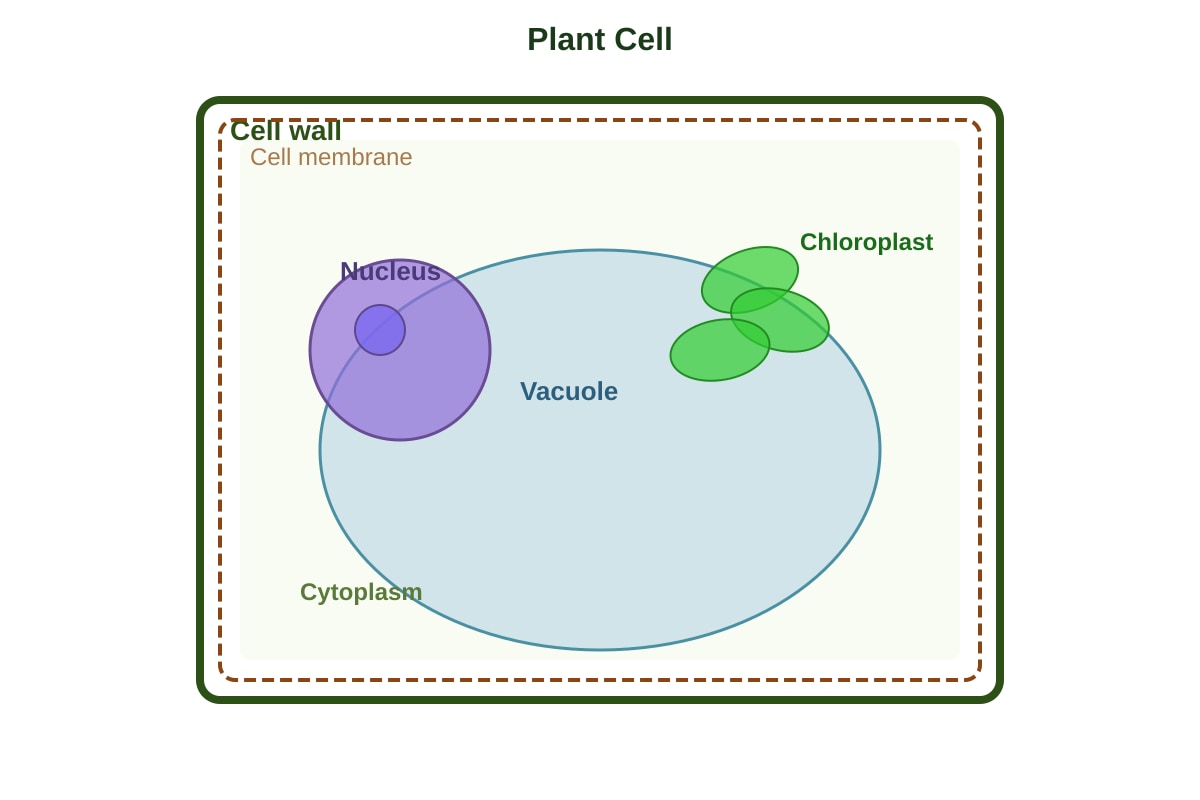
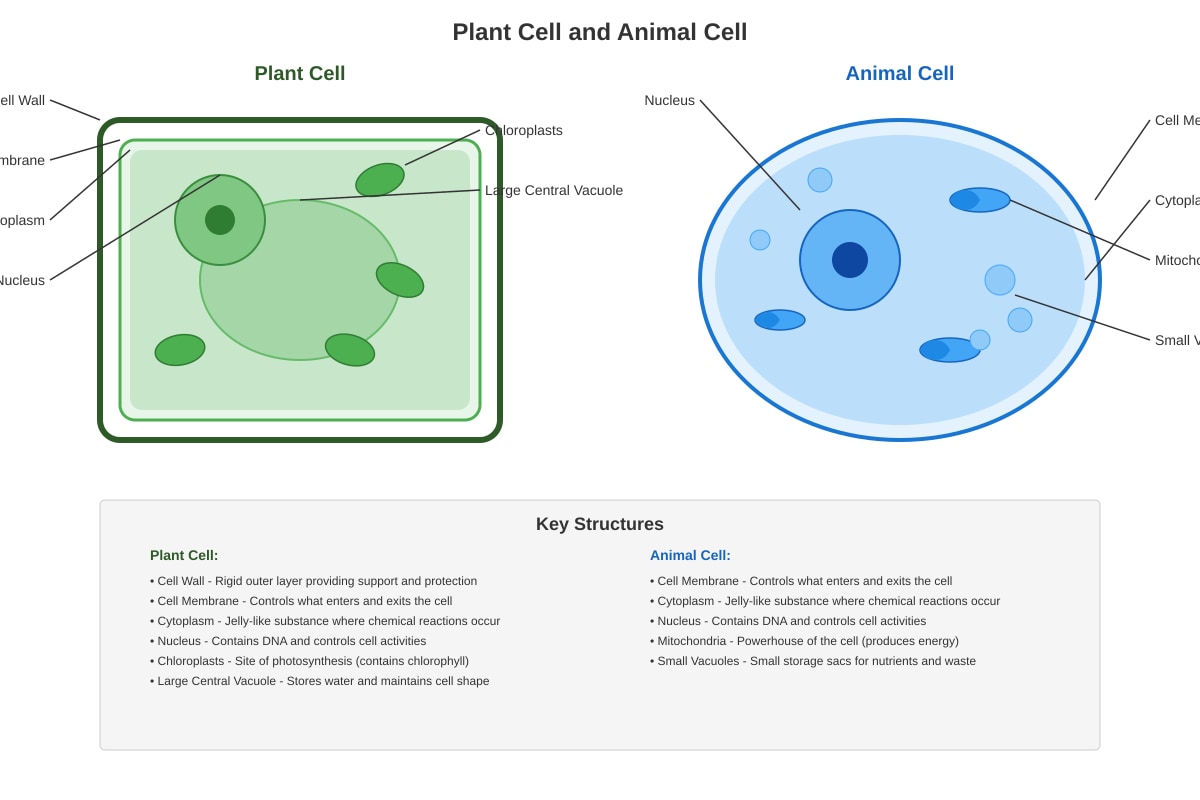
The diagram below shows a cell.

<image_placeholder> id: Q4-fig1 type: diagram linked_question: Q4 description: A diagram of a plant cell showing cell wall, cell membrane, cytoplasm, nucleus, chloroplasts, and a large central vacuole. All structures are labelled. labels: Cell wall, Cell membrane, Cytoplasm, Nucleus, Chloroplasts, Vacuole values: N/A must_show: All listed organelles clearly drawn and labelled </image_placeholder>

Which of the following statements about the cell is correct?

(1) It is an animal cell because it has a nucleus.
(2) It is a plant cell because it has chloroplasts.
(3) It is a bacterial cell because it has a cell wall.
(4) It is a fungal cell because it has a vacuole.


Question 5 [2 marks]

Which of the following shows the correct order of organisation in a multicellular organism, from simplest to most complex?

(1) Cell → Tissue → Organ → Organ System → Organism
(2) Tissue → Cell → Organ → Organ System → Organism
(3) Cell → Organ → Tissue → Organ System → Organism
(4) Organ → Tissue → Cell → Organ System → Organism


Question 6 [2 marks]

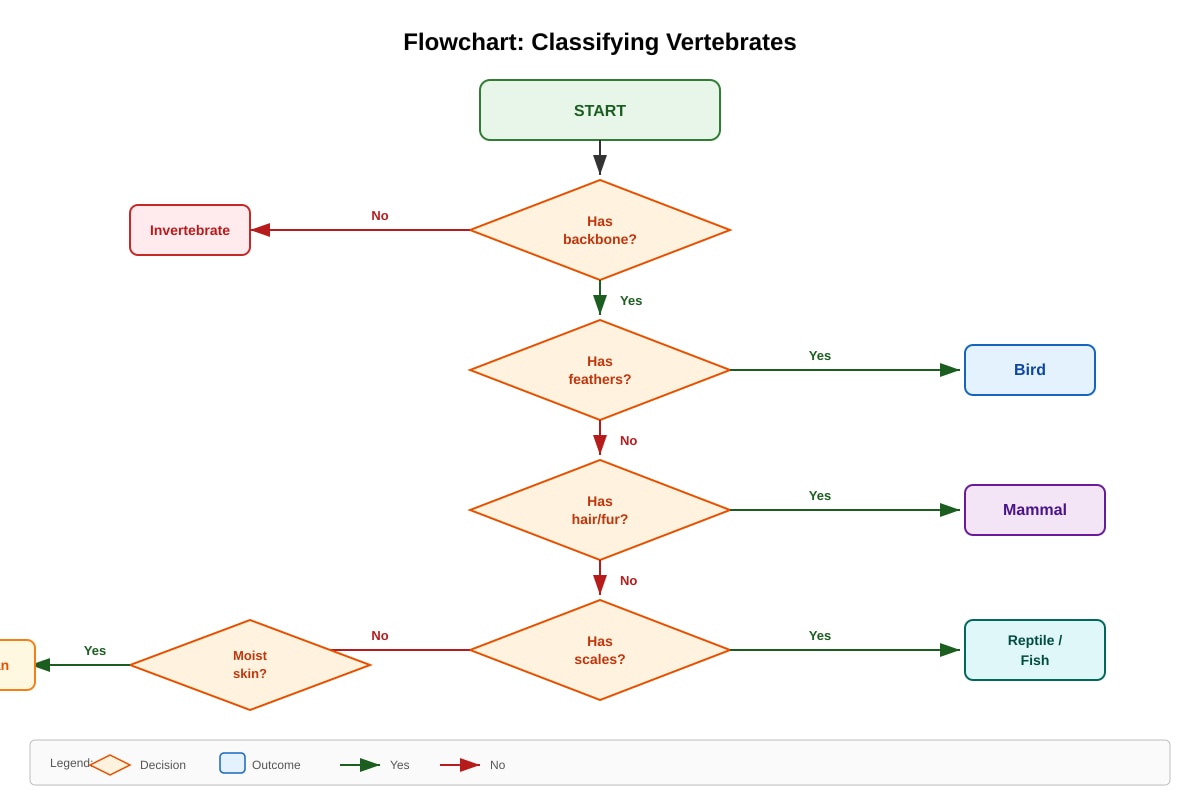
Study the flowchart below.

<image_placeholder> id: Q6-fig1 type: diagram linked_question: Q6 description: A flowchart for classifying animals. Start: 'Does it have a backbone?' Yes → 'Vertebrate' → 'Does it have feathers?' Yes → 'Bird'; No → 'Does it have hair/fur?' Yes → 'Mammal'; No → 'Does it live in water and have gills?' Yes → 'Fish'; No → 'Does it have moist skin?' Yes → 'Amphibian'; No → 'Reptile'. No (from start) → 'Invertebrate' → 'Does it have 6 legs?' Yes → 'Insect'; No → 'Does it have 8 legs?' Yes → 'Arachnid'; No → 'Others'. labels: All decision nodes and classification endpoints values: N/A must_show: Complete flowchart with all decision questions and classification groups </image_placeholder>

Animal X has a backbone, lays eggs, and has feathers. Animal Y has no backbone and has 8 legs. Which groups do Animal X and Animal Y belong to?

Animal XAnimal Y
(1)BirdInsect
(2)BirdArachnid
(3)MammalArachnid
(4)ReptileInsect

Question 7 [2 marks]

The table below shows the characteristics of four organisms, P, Q, R, and S. A tick (✓) indicates the presence of the characteristic.

CharacteristicPQRS
Has cell wall
Has chloroplasts
Reproduces by spores
Made of only one cell

Which organism is most likely a bacterium?

(1) P
(2) Q
(3) R
(4) S


Question 8 [2 marks]

Which of the following statements about fungi is correct?

(1) Fungi make their own food through photosynthesis.
(2) Fungi reproduce by seeds.
(3) Fungi feed on dead or decaying matter.
(4) Fungi are always single-celled organisms.


Question 9 [2 marks]

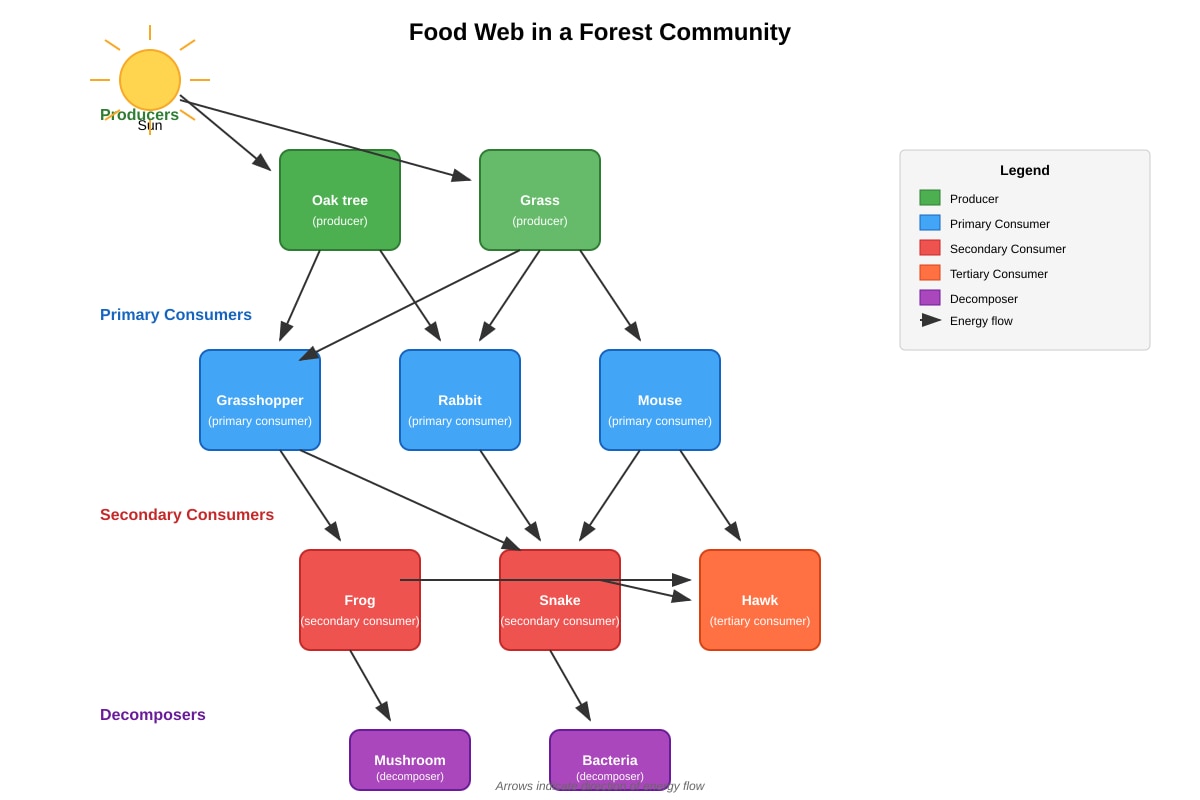
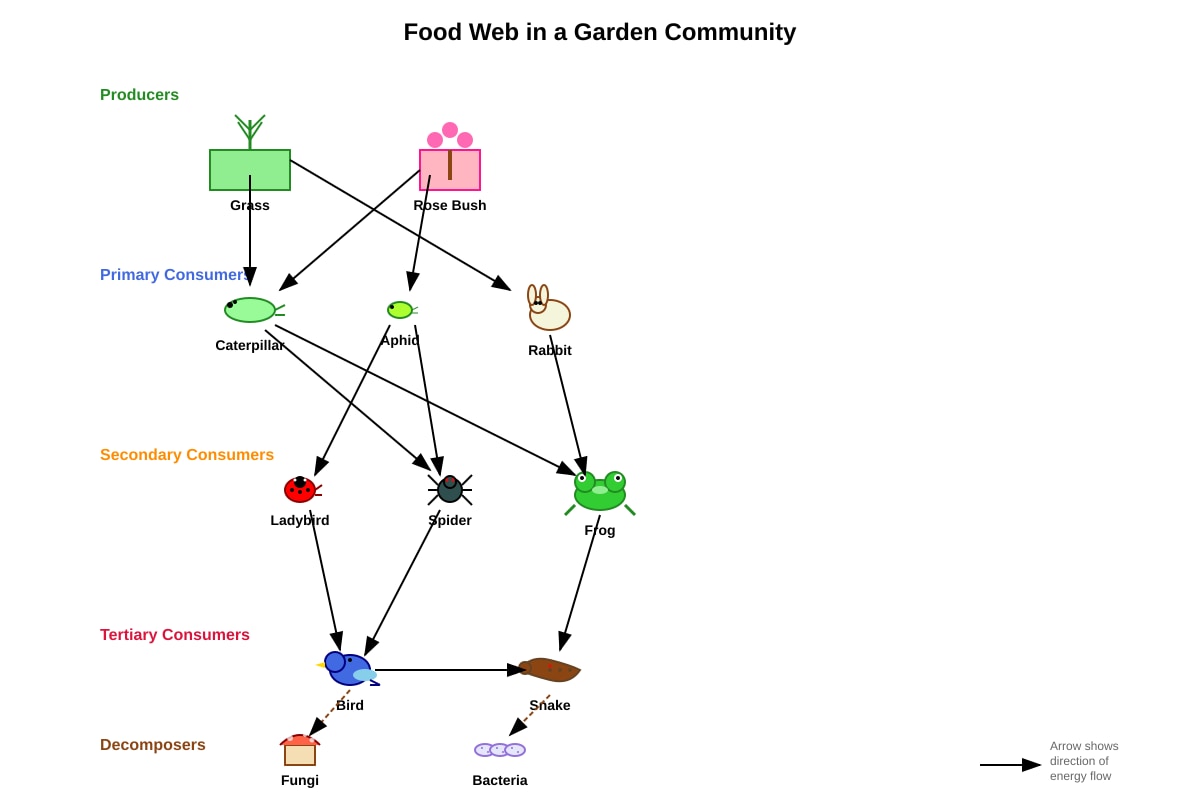
The diagram below shows a food web in a garden community.

<image_placeholder> id: Q9-fig1 type: diagram linked_question: Q9 description: A food web with the following relationships: Grass → Grasshopper → Frog → Snake → Hawk; Grass → Rabbit → Fox; Grass → Grasshopper → Bird → Hawk; Grass → Caterpillar → Bird → Hawk; Decomposers (bacteria, fungi) break down all dead organisms. labels: Grass, Grasshopper, Frog, Snake, Hawk, Rabbit, Fox, Bird, Caterpillar, Decomposers values: N/A must_show: All organisms and directional arrows showing energy flow from producers to consumers to decomposers </image_placeholder>

How many food chains are there in this food web?

(1) 3
(2) 4
(3) 5
(4) 6


Question 10 [2 marks]

Which of the following adaptations helps a plant survive in a dry environment?

(1) Broad leaves with large surface area
(2) Shallow root system
(3) Thick, waxy cuticle on leaves
(4) Large, colourful flowers


Question 11 [2 marks]

The table below shows the characteristics of three plants, X, Y, and Z.

PlantReproduces by seedsGrows in waterHas flowers
XYesNoYes
YNoYesNo
ZYesNoNo

Which of the following correctly classifies the plants?

XYZ
(1)Flowering plantNon-flowering plantFlowering plant
(2)Flowering plantNon-flowering plantNon-flowering plant
(3)Non-flowering plantFlowering plantNon-flowering plant
(4)Flowering plantNon-flowering plantGymnosperm

Question 12 [2 marks]

Study the classification table below.

GroupCharacteristicsExamples
AHave scales, lay eggs with soft shells, cold-bloodedSnake, Lizard
BHave feathers, lay eggs with hard shells, warm-bloodedEagle, Sparrow
CHave hair/fur, give birth to live young, warm-bloodedHuman, Whale
DHave moist skin, lay eggs in water, cold-bloodedFrog, Toad

Which group represents reptiles?

(1) A
(2) B
(3) C
(4) D


Question 13 [2 marks]

Which of the following is NOT a characteristic of all living things?

(1) Need air, food, and water
(2) Can reproduce
(3) Can move from place to place
(4) Respond to changes


Question 14 [2 marks]

The diagram below shows a microorganism viewed under a microscope.

<image_placeholder> id: Q14-fig1 type: diagram linked_question: Q14 description: A single-celled organism with a nucleus, cytoplasm, cell membrane, and contractile vacuole. No cell wall or chloroplasts visible. Shape is irregular/amoeboid. labels: Nucleus, Cytoplasm, Cell membrane, Contractile vacuole values: N/A must_show: Clear single-celled structure with labelled organelles, no cell wall or chloroplasts </image_placeholder>

Based on the diagram, which group does this microorganism most likely belong to?

(1) Bacteria
(2) Fungi
(3) Protozoa
(4) Algae


Question 15 [2 marks]

Four students classified some animals into groups as shown below.

StudentGroup 1Group 2
AliceMammals: Bat, Whale, HumanBirds: Eagle, Penguin, Ostrich
BenInsects: Butterfly, Ant, SpiderFish: Salmon, Shark, Whale
ChloeReptiles: Snake, Turtle, CrocodileAmphibians: Frog, Toad, Salamander
DavidVertebrates: Frog, Lizard, BirdInvertebrates: Worm, Snail, Jellyfish

Which student classified the animals correctly?

(1) Alice
(2) Ben
(3) Chloe
(4) David


Question 16 [2 marks]

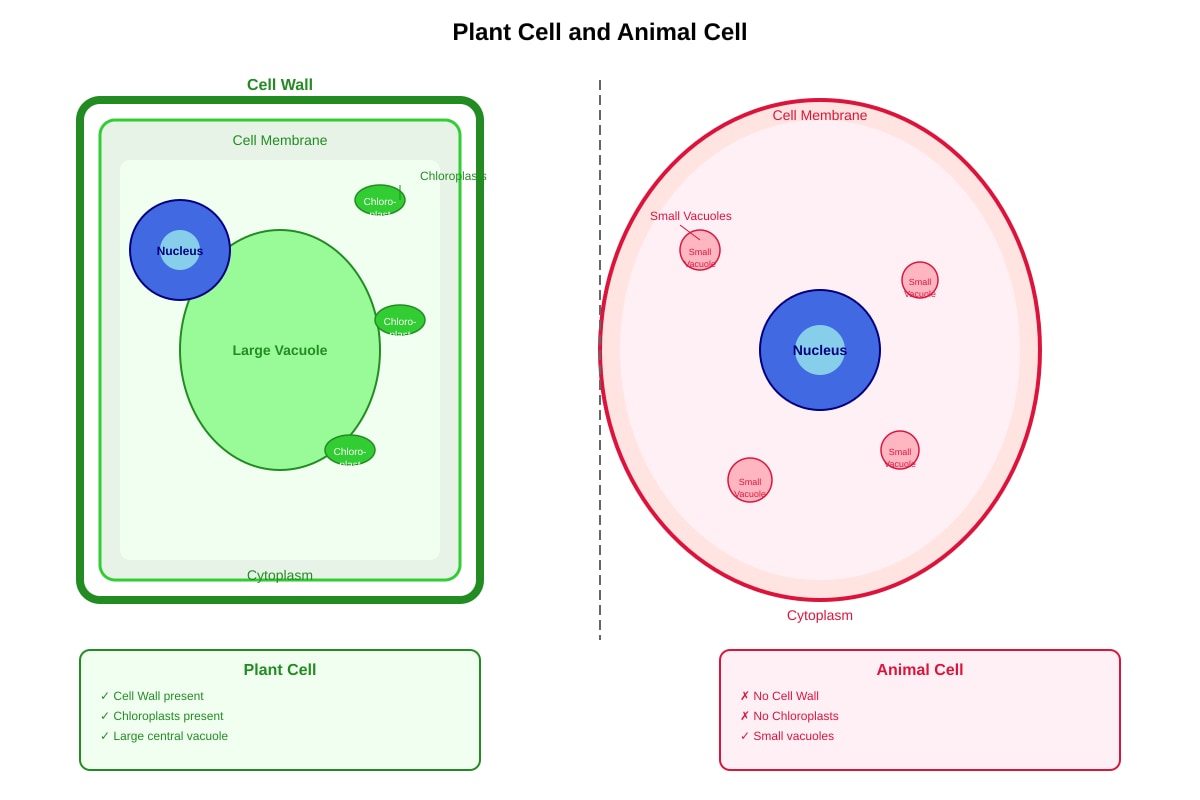
The diagram below shows a plant cell and an animal cell.

<image_placeholder> id: Q16-fig1 type: diagram linked_question: Q16 description: Two side-by-side diagrams. Left: Plant cell with cell wall, cell membrane, cytoplasm, nucleus, chloroplasts, large vacuole. Right: Animal cell with cell membrane, cytoplasm, nucleus, small vacuoles. Both labelled. labels: Cell wall, Cell membrane, Cytoplasm, Nucleus, Chloroplasts, Vacuole (large/small) values: N/A must_show: Clear comparison of plant and animal cell structures with all labels </image_placeholder>

Which of the following structures is found in the plant cell but NOT in the animal cell?

(1) Nucleus
(2) Cytoplasm
(3) Cell membrane
(4) Chloroplasts


Question 17 [2 marks]

Which of the following shows the correct classification of the organisms?

BacteriaFungiProtists
(1)Single-celled, no nucleusMulti-celled, absorb foodSingle-celled, have nucleus
(2)Multi-celled, make foodSingle-celled, absorb foodMulti-celled, ingest food
(3)Single-celled, have nucleusMulti-celled, make foodSingle-celled, no nucleus
(4)Multi-celled, no nucleusSingle-celled, ingest foodMulti-celled, absorb food

Question 18 [2 marks]

The flowchart below shows how some living things are classified.

<image_placeholder> id: Q18-fig1 type: diagram linked_question: Q18 description: Flowchart: 'Living Thing' → 'Does it make its own food?' Yes → 'Plant' → 'Does it bear flowers?' Yes → 'Flowering Plant'; No → 'Non-flowering Plant'. No (from first question) → 'Does it feed on dead/decaying matter?' Yes → 'Fungus'; No → 'Animal' → 'Does it have a backbone?' Yes → 'Vertebrate'; No → 'Invertebrate'. labels: All decision nodes and classification endpoints values: N/A must_show: Complete flowchart with all branches and labels </image_placeholder>

Organism M does not make its own food and feeds on dead matter. Organism N makes its own food but does not bear flowers. Which groups do they belong to?

Organism MOrganism N
(1)FungusFlowering Plant
(2)AnimalNon-flowering Plant
(3)FungusNon-flowering Plant
(4)BacteriaFlowering Plant

Question 19 [2 marks]

Which of the following statements about bacteria is correct?

(1) All bacteria cause diseases.
(2) Bacteria can only survive in warm places.
(3) Bacteria reproduce by binary fission.
(4) Bacteria have a nucleus.


Question 20 [2 marks]

Study the diagram below.

<image_placeholder> id: Q20-fig1 type: diagram linked_question: Q20 description: A diagram showing five organisms: a rose plant, a mushroom, a fern, a moss, and a bacterium. Each is labelled with its name. labels: Rose plant, Mushroom, Fern, Moss, Bacterium values: N/A must_show: All five organisms clearly illustrated and labelled </image_placeholder>

How many of the organisms shown are non-flowering plants?

(1) 1
(2) 2
(3) 3
(4) 4


Question 21 [2 marks]

The table below shows the characteristics of four vertebrates.

VertebrateBody CoveringBreathing MethodReproduction
PScalesLungsLay eggs on land
QFeathersLungsLay eggs on land
RMoist skinLungs, skin, gillsLay eggs in water
SHair/FurLungsGive birth to live young

Which vertebrate is a reptile?

(1) P
(2) Q
(3) R
(4) S


Question 22 [2 marks]

Which of the following groups contains only invertebrates?

(1) Earthworm, Snail, Jellyfish
(2) Frog, Toad, Salamander
(3) Shark, Ray, Eel
(4) Bat, Bird, Lizard


Question 23 [2 marks]

The diagram below shows a food chain.

<image_placeholder> id: Q23-fig1 type: diagram linked_question: Q23 description: Food chain: Phytoplankton → Zooplankton → Small Fish → Large Fish → Shark. Arrows point from prey to predator. labels: Phytoplankton, Zooplankton, Small Fish, Large Fish, Shark values: N/A must_show: Clear linear food chain with directional arrows </image_placeholder>

If the population of zooplankton decreases significantly, what will most likely happen to the population of small fish?

(1) Increase
(2) Decrease
(3) Remain the same
(4) Increase then decrease


Question 24 [2 marks]

A student observed an organism with the following characteristics:

  • Has a cell wall made of chitin
  • Reproduces by spores
  • Cannot make its own food
  • Made of thread-like structures called hyphae

Which group does this organism belong to?

(1) Bacteria
(2) Fungi
(3) Plants
(4) Animals


Question 25 [2 marks]

Which of the following is a structural adaptation of a cactus for survival in the desert?

(1) Deep taproot system
(2) Broad, flat leaves
(3) Spines instead of leaves
(4) Brightly coloured flowers


Question 26 [2 marks]

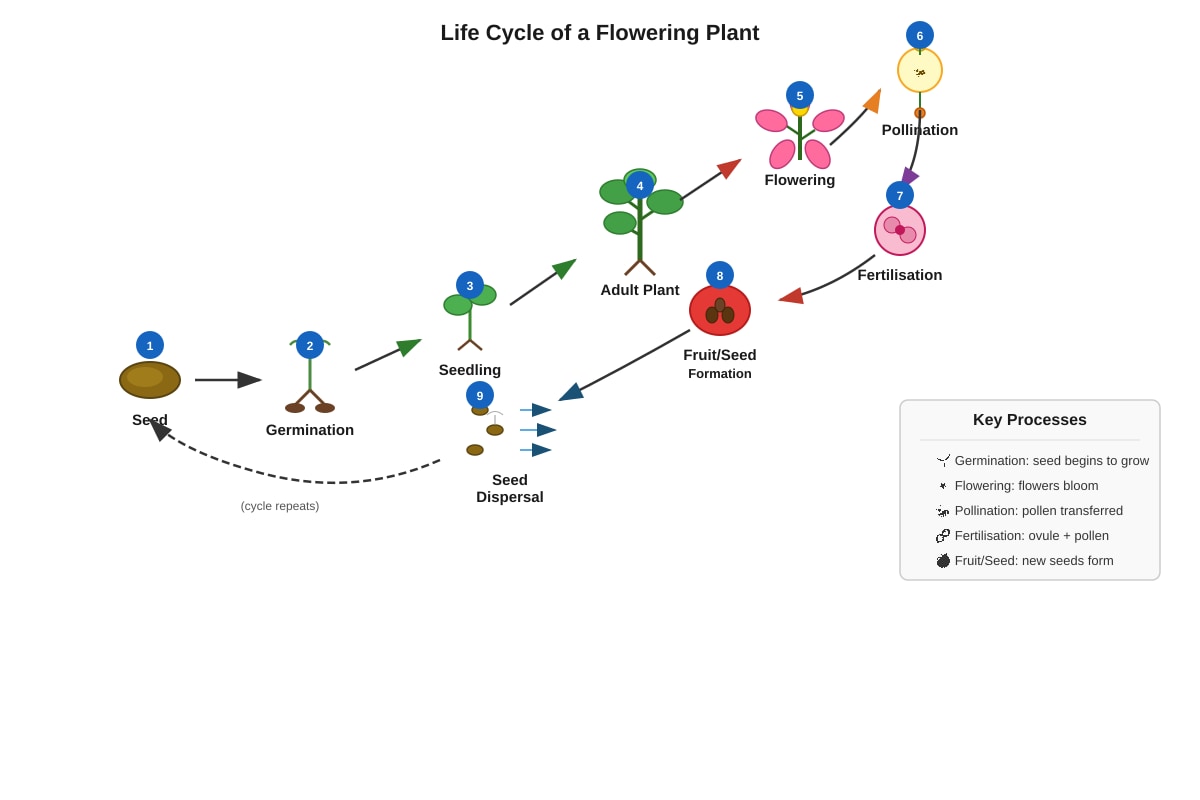
The diagram below shows the life cycle of a flowering plant.

<image_placeholder> id: Q26-fig1 type: diagram linked_question: Q26 description: Life cycle diagram: Seed → Germination → Seedling → Adult Plant → Flower → Pollination → Fertilisation → Fruit/Seed → back to Seed. All stages labelled with arrows. labels: Seed, Germination, Seedling, Adult Plant, Flower, Pollination, Fertilisation, Fruit/Seed values: N/A must_show: Complete cyclic diagram with all stages and directional arrows </image_placeholder>

Which process occurs between pollination and fruit formation?

(1) Germination
(2) Fertilisation
(3) Seed dispersal
(4) Photosynthesis


Question 27 [2 marks]

Four pupils observed a cell under a microscope and recorded their observations.

PupilObservation
WeiThe cell has a regular shape.
XinThe cell has chloroplasts.
YanThe cell has a cell wall.
ZhenThe cell has a large central vacuole.

Which pupil's observation confirms that the cell is a plant cell?

(1) Wei
(2) Xin
(3) Yan
(4) Zhen


Question 28 [2 marks]

Which of the following statements about classification is correct?

(1) Classification groups organisms based on their habitat only.
(2) Organisms in the same group share similar characteristics.
(3) A species can belong to more than one genus.
(4) The more characteristics two organisms share, the less closely related they are.


Section B: Open-Ended Questions (44 marks)

Write your answers in the spaces provided.

Question 29 [2 marks]

The diagram below shows two organisms, A and B.

<image_placeholder> id: Q29-fig1 type: diagram linked_question: Q29 description: Two organisms side by side. Organism A: A mushroom with visible cap, gills, and stem. Organism B: A fern plant with fronds, stem, and roots. Both labelled. labels: Mushroom (cap, gills, stem), Fern (fronds, stem, roots) values: N/A must_show: Clear illustrations of mushroom and fern with labelled parts </image_placeholder>

(a) State one similarity between Organism A and Organism B in terms of how they obtain food. [1]

(b) State one difference between Organism A and Organism B in terms of reproduction. [1]


Question 30 [3 marks]

Study the classification chart below.

<image_placeholder> id: Q30-fig1 type: diagram linked_question: Q30 description: A classification chart with missing labels. Top: 'Living Things'. Two main branches: 'Plants' and 'Animals'. Under Plants: 'Flowering' and 'Non-flowering'. Under Animals: 'Vertebrates' and 'Invertebrates'. Under Vertebrates: five groups labelled Group 1 to Group 5. Under Invertebrates: three groups labelled Group A, B, C. Some examples given: Flowering - Rose; Non-flowering - Fern; Group 1 - Guppy; Group 2 - Frog; Group 3 - Lizard; Group 4 - Pigeon; Group 5 - Bat; Group A - Butterfly; Group B - Spider; Group C - Earthworm. labels: All group labels (1-5, A-C) and examples values: N/A must_show: Complete chart with blank group names for students to fill </image_placeholder>

(a) Name the five groups of vertebrates labelled Group 1 to Group 5. [2]

(b) State the group of invertebrates that Group A (butterfly) belongs to. [1]


Question 31 [3 marks]

The table below shows the characteristics of four cells, W, X, Y, and Z. A tick (✓) indicates the presence of the structure.

StructureWXYZ
Cell wall
Chloroplasts
Nucleus
Cell membrane
Large vacuole

(a) Which cell(s) is/are plant cell(s)? Explain your answer. [2]

(b) Which cell is most likely an animal cell? [1]


Question 32 [3 marks]

The diagram below shows a food web in a pond community.

<image_placeholder> id: Q32-fig1 type: diagram linked_question: Q32 description: Pond food web: Algae → Water flea → Small fish → Large fish; Algae → Tadpole → Frog → Heron; Algae → Snail → Bird; Dead organisms → Decomposers (bacteria, fungi). All organisms labelled with arrows showing energy flow. labels: Algae, Water flea, Small fish, Large fish, Tadpole, Frog, Heron, Snail, Bird, Decomposers values: N/A must_show: Complete food web with all organisms and directional arrows </image_placeholder>

(a) Name the producer in this food web. [1]

(b) How many food chains are there in this food web? [1]

(c) If all the water fleas are removed from the pond, explain what will happen to the population of small fish. [1]


Question 33 [4 marks]

The diagram below shows an experiment set-up to investigate the conditions needed for mould growth.

<image_placeholder> id: Q33-fig1 type: experimental_setup linked_question: Q33 description: Four set-ups (A, B, C, D) each with a slice of bread in a sealed container. Set-up A: Dry bread, kept in dark cupboard at 25°C. Set-up B: Moist bread, kept in dark cupboard at 25°C. Set-up C: Moist bread, kept in refrigerator at 4°C. Set-up D: Moist bread, kept in dark cupboard at 25°C with substance X (mould inhibitor). Observations after 5 days recorded. labels: Set-up A, B, C, D; Bread slices; Containers; Conditions labels values: Temperature: 25°C (A,B,D), 4°C (C); Moisture: Dry (A), Moist (B,C,D); Light: Dark (all); Substance X: Only in D must_show: All four set-ups clearly shown with conditions labelled </image_placeholder>

(a) Which two set-ups should be compared to find out if moisture is needed for mould growth? [1]

(b) Based on the results, state the conditions needed for mould to grow well. [2]

(c) What is the purpose of Set-up D? [1]


Question 34 [3 marks]

Study the flowchart below.

<image_placeholder> id: Q34-fig1 type: diagram linked_question: Q34 description: Flowchart for classifying plants: 'Plant' → 'Does it reproduce by seeds?' Yes → 'Does it have flowers?' Yes → 'Flowering plant'; No → 'Non-flowering plant (Gymnosperm)'. No (from first question) → 'Does it reproduce by spores?' Yes → 'Non-flowering plant (Fern/Moss)'; No → 'Algae'. labels: All decision nodes and endpoints values: N/A must_show: Complete flowchart with all branches </image_placeholder>

Plant K reproduces by spores and has no flowers. Plant L reproduces by seeds and has flowers. Plant M reproduces by seeds but has no flowers.

(a) Using the flowchart, classify Plant K, Plant L, and Plant M. [2]

(b) State one difference between Plant L and Plant M. [1]


Question 35 [4 marks]

The diagram below shows a cell.

<image_placeholder> id: Q35-fig1 type: diagram linked_question: Q35 description: A detailed plant cell diagram showing: Cell wall, Cell membrane, Cytoplasm, Nucleus, Chloroplasts, Mitochondria, Large central vacuole, Ribosomes, Endoplasmic reticulum, Golgi apparatus. All labelled. labels: All listed organelles values: N/A must_show: Detailed plant cell with all organelles clearly drawn and labelled </image_placeholder>

(a) Name the part labelled X (pointing to chloroplasts). [1]

(b) State the function of the part labelled X. [1]

(c) Name two parts in the diagram that are found in plant cells but not in animal cells. [1]

(d) Explain why the part labelled Y (pointing to mitochondria) is important for the cell. [1]


Question 36 [3 marks]

The table below shows the characteristics of five animals.

AnimalBody CoveringBreathing OrganReproductionHabitat
PScalesGillsLay eggsWater
QFeathersLungsLay eggsLand/Air
RMoist skinLungs, SkinLay eggs in waterLand/Water
SHair/FurLungsLive birthLand
TScalesLungsLay eggs on landLand

(a) Which animal(s) is/are amphibian(s)? [1]

(b) Which animal is a mammal? [1]

(c) Animal P and Animal T both have scales. State one difference in their breathing organs. [1]


Question 37 [4 marks]

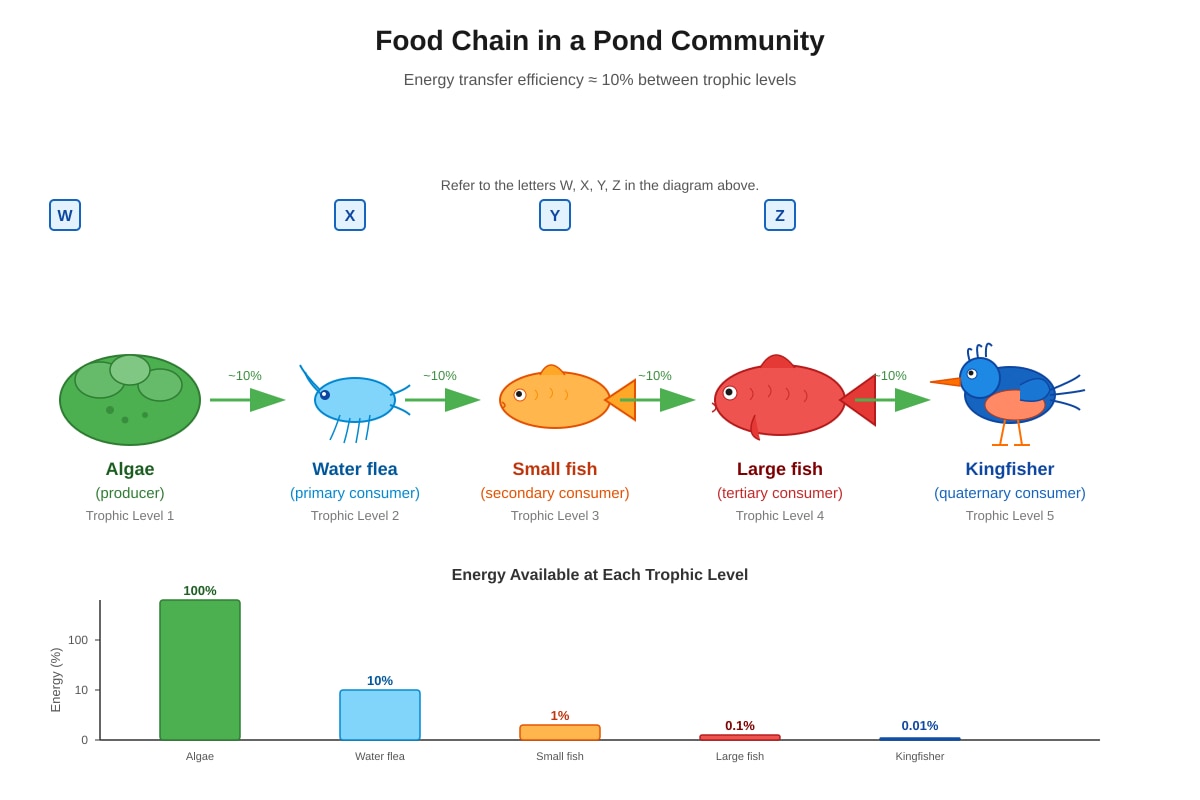
The diagram below shows a food pyramid for a grassland ecosystem.

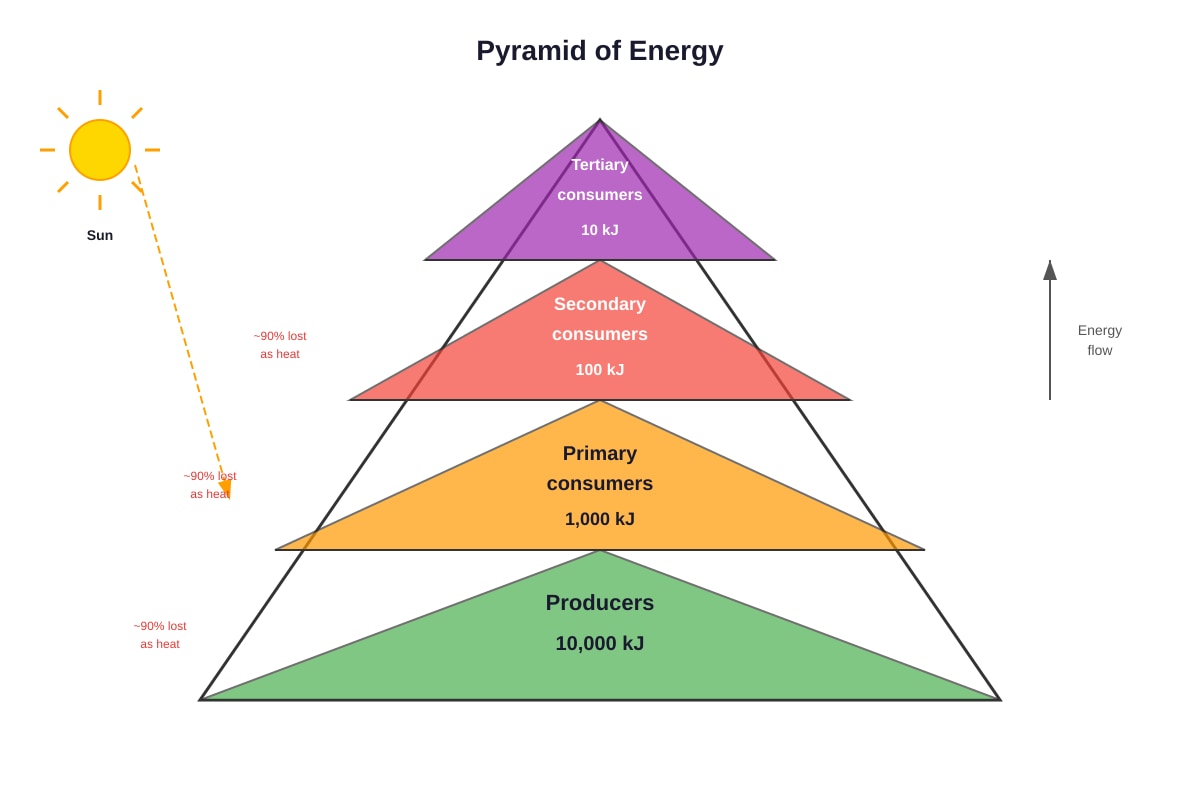
<image_placeholder> id: Q37-fig1 type: diagram linked_question: Q37 description: Energy pyramid with four levels. Bottom (largest): Producers (Grass) - 10,000 units. Second: Primary Consumers (Grasshoppers) - 1,000 units. Third: Secondary Consumers (Frogs) - 100 units. Top (smallest): Tertiary Consumers (Hawks) - 10 units. Each level labelled with organism examples and energy values. labels: Producers, Primary Consumers, Secondary Consumers, Tertiary Consumers; Organism examples; Energy values values: 10,000; 1,000; 100; 10 (units of energy) must_show: Pyramid shape with four levels, labels, organisms, and energy values </image_placeholder>

(a) What is the main source of energy for this ecosystem? [1]

(b) Calculate the percentage of energy transferred from producers to primary consumers. [1]

(c) Explain why the energy decreases at each trophic level. [2]


Question 38 [3 marks]

A student wants to classify the following organisms into groups: Bacterium, Amoeba, Paramecium, Yeast, Mould, Mushroom.

(a) Group the organisms into two kingdoms: Monera and Fungi. [2]

(b) State one characteristic of organisms in the kingdom Monera. [1]


Question 39 [4 marks]

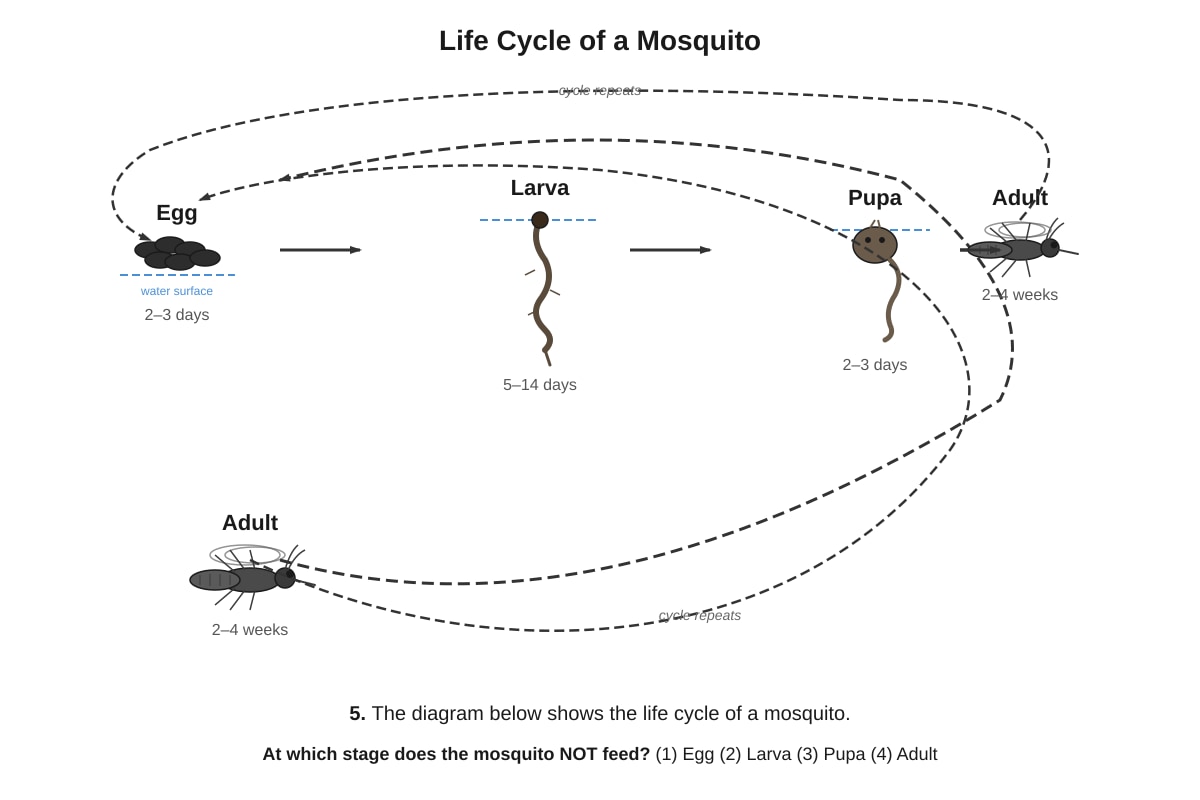
The diagram below shows the life cycle of a mosquito.

<image_placeholder> id: Q39-fig1 type: diagram linked_question: Q39 description: Mosquito life cycle: Egg → Larva → Pupa → Adult. All stages shown in water except adult. Arrows show progression. Labels for each stage. labels: Egg, Larva, Pupa, Adult values: N/A must_show: Complete four-stage life cycle with arrows and labels </image_placeholder>

(a) Name the stage that lives in water and breathes through a siphon. [1]

(b) At which stage does the mosquito not feed? [1]

(c) The mosquito is an insect. State two characteristics of insects. [2]


Question 40 [3 marks]

Study the classification key below.

<image_placeholder> id: Q40-fig1 type: diagram linked_question: Q40 description: Dichotomous key for leaves: 1a. Leaf is simple → Go to 2; 1b. Leaf is compound → Go to 3. 2a. Leaf margin is smooth → Hibiscus; 2b. Leaf margin is serrated → Rose. 3a. Leaflets arranged like fingers → Cannabis; 3b. Leaflets arranged like feathers → Acacia. labels: All key steps and outcomes values: N/A must_show: Complete dichotomous key with all branches </image_placeholder>

Using the key, identify the plant with the following leaf characteristics: (a) Simple leaf with serrated margin. [1] (b) Compound leaf with leaflets arranged like feathers. [1] (c) State one difference between a simple leaf and a compound leaf. [1]


Question 41 [4 marks]

The diagram below shows an experiment to investigate the effect of light on the growth of seedlings.

<image_placeholder> id: Q41-fig1 type: experimental_setup linked_question: Q41 description: Two set-ups. Set-up A: Seedlings in a box with light from one side only. Set-up B: Seedlings in a box with light from all sides (transparent box). Both have same soil, water, number of seedlings. After 5 days, Set-up A seedlings bend towards light; Set-up B seedlings grow straight up. labels: Set-up A, Set-up B; Boxes; Light direction arrows; Seedlings showing growth direction values: Duration: 5 days; Same conditions except light direction must_show: Clear comparison of two set-ups with light direction and seedling growth response </image_placeholder>

(a) What is the aim of this experiment? [1]

(b) State the variable that is changed (manipulated variable). [1]

(c) State the variable that is measured (responding variable). [1]

(d) Explain why the seedlings in Set-up A bend towards the light. [1]


Question 42 [3 marks]

The diagram below shows three types of microorganisms.

<image_placeholder> id: Q42-fig1 type: diagram linked_question: Q42 description: Three microorganisms: (A) Rod-shaped bacterium with flagella, no nucleus. (B) Yeast cell budding, with nucleus. (C) Amoeba with pseudopodia, nucleus, contractile vacuole. All labelled. labels: Bacterium (cell wall, flagella, cytoplasm, no nucleus); Yeast (nucleus, cytoplasm, cell membrane, bud); Amoeba (nucleus, pseudopodia, contractile vacuole, cell membrane) values: N/A must_show: Three distinct microorganism types with key structures labelled </image_placeholder>

(a) Which microorganism(s) has/have a nucleus? [1]

(b) State one way in which the bacterium moves. [1]

(c) How does the amoeba obtain food? [1]


Question 43 [4 marks]

The table below shows the characteristics of four plants.

PlantStem TypeLeaf VenationRoot SystemFlower Parts
WWoodyReticulateTaprootIn multiples of 4 or 5
XHerbaceousParallelFibrousIn multiples of 3
YWoodyReticulateTaprootIn multiples of 4 or 5
ZHerbaceousParallelFibrousIn multiples of 3

(a) Which two plants are dicotyledons? [1]

(b) Which two plants are monocotyledons? [1]

(c) State two differences between monocotyledons and dicotyledons based on the table. [2]


Question 44 [3 marks]

The diagram below shows a food chain in a forest.

<image_placeholder> id: Q44-fig1 type: diagram linked_question: Q44 description: Food chain: Oak tree → Caterpillar → Bird → Hawk. Arrows from prey to predator. Decomposers shown breaking down dead organisms at all levels. labels: Oak tree, Caterpillar, Bird, Hawk, Decomposers values: N/A must_show: Linear food chain with decomposers shown </image_placeholder>

(a) If a disease kills all the birds, what will happen to the population of caterpillars? Explain your answer. [2]

(b) What is the role of decomposers in this food chain? [1]


Question 45 [4 marks]

The diagram below shows a plant cell and an animal cell side by side.

<image_placeholder> id: Q45-fig1 type: diagram linked_question: Q45 description: Two cells side by side. Left: Plant cell with cell wall, large vacuole, chloroplasts. Right: Animal cell with no cell wall, small vacuoles, no chloroplasts. Both have nucleus, cytoplasm, cell membrane. Labels for all parts. labels: Cell wall, Cell membrane, Cytoplasm, Nucleus, Chloroplasts, Vacuole (large/small), Mitochondria values: N/A must_show: Clear side-by-side comparison with all organelles labelled </image_placeholder>

(a) Label the following parts on the animal cell: (i) Nucleus, (ii) Cell membrane. [1]

(b) State two differences between the plant cell and the animal cell shown. [2]

(c) Both cells have mitochondria. State the function of mitochondria. [1]


Question 46 [3 marks]

A student observed an organism in a drop of pond water under a microscope. The organism has the following characteristics:

  • Single-celled
  • Has a nucleus
  • Moves using cilia
  • Feeds on bacteria

(a) Which group of microorganisms does this organism most likely belong to? [1]

(b) Name one other microorganism that belongs to the same group. [1]

(c) State one difference between this organism and a bacterium. [1]


Question 47 [4 marks]

The diagram below shows the classification of vertebrates.

<image_placeholder> id: Q47-fig1 type: diagram linked_question: Q47 description: Classification chart: Vertebrates → Fish, Amphibian, Reptile, Bird, Mammal. Each group has 3-4 key characteristics listed. Some characteristics are missing (shown as blanks). labels: Vertebrates, Fish, Amphibian, Reptile, Bird, Mammal; Characteristics with blanks values: N/A must_show: Chart with five vertebrate groups and characteristic blanks for students to complete </image_placeholder>

Complete the classification chart by filling in the missing characteristics:

(a) Fish: Body covering - ________; Breathing - ________; Reproduction - ________. [1.5]

(b) Amphibian: Body covering - ________; Breathing - ________; Reproduction - ________. [1.5]

(c) State one similarity between birds and mammals. [1]


Question 48 [3 marks]

The diagram below shows a mushroom growing on a rotting log.

<image_placeholder> id: Q48-fig1 type: diagram linked_question: Q48 description: A mushroom on a decaying log. Labels: Cap, Gills, Stem, Mycelium (thread-like structures in log), Spores (released from gills). Arrows show spore dispersal. labels: Cap, Gills, Stem, Mycelium, Spores, Rotting log values: N/A must_show: Mushroom on log with all parts labelled, spores dispersing </image_placeholder>

(a) Name the part labelled X (pointing to gills). [1]

(b) State the function of the part labelled X. [1]

(c) How does the mushroom obtain nutrients from the rotting log? [1]


End of Paper

Answers

<!-- TuitionGoWhere generation metadata: stage=3-1; model=nvidia/nemotron-3-ultra-550b-a55b:free; model_label=NVIDIA Nemotron 3 Ultra 550B A55B Free; generated=2026-06-06; Sources: Stage 2-1 real exam-derived templates and Stage 2-2 exam-enriched syllabus. -->

TuitionGoWhere Practice Paper - Science Primary 6 PSLE (Answer Key)

TuitionGoWhere Exam Practice (AI)

Subject: Science
Level: Primary 6 PSLE
Paper: SA2 (Version 5)
Total Marks: 100


Section A: Multiple-Choice Questions (56 marks)

Question 1 [2 marks]

Answer: (1) Mushroom, Yeast, Mould

Explanation: Mushroom, yeast, and mould are all fungi. They are non-flowering plants that reproduce by spores and feed on dead/decaying matter.

  • Option (2): Fern and moss are non-flowering plants, but hibiscus is a flowering plant.
  • Option (3): Bat and whale are mammals, but shark is a fish.
  • Option (4): Toad and salamander are amphibians, but lizard is a reptile.

Question 2 [2 marks]

Answer: (4) Spiders and insects are both invertebrates.

Explanation:

  • (1) Not all flowering plants produce fruits (some may not be pollinated).
  • (2) Not all vertebrates lay eggs (mammals give birth to live young, except monotremes).
  • (3) Mould and yeast are fungi, not plants.
  • (4) Correct – Both spiders (arachnids) and insects lack a backbone, so they are invertebrates.

Question 3 [2 marks]

Answer: (2) Ali and Cindy

Explanation:

  • Ali: Correct. Bacteria are microscopic and can only be seen with a microscope.
  • Bala: Incorrect. Not all microorganisms are harmful; many are beneficial (e.g., yeast in baking, bacteria in digestion, decomposers).
  • Cindy: Correct. Yeast is a fungus that reproduces asexually by budding.
  • Devi: Incorrect. Mould grows well in moist, warm places, not dry and cold places.

Question 4 [2 marks]

Answer: (2) It is a plant cell because it has chloroplasts.

Explanation: The diagram shows a cell with chloroplasts, a large

<stage3_exam_answers_md>

TuitionGoWhere Practice Paper - Science Primary 6 PSLE (Answer Key)

TuitionGoWhere Exam Practice (AI)

Subject: Science
Level: Primary 6 PSLE
Paper: SA2 (Version 5)


Section A: Multiple-Choice Questions (56 marks)

QuestionAnswerExplanation
1(1)Mushroom, yeast, and mould are all fungi. Fern and moss are non-flowering plants; hibiscus is flowering. Bat and whale are mammals; shark is a fish. Toad and salamander are amphibians; lizard is a reptile.
2(4)Spiders (arachnids) and insects are both invertebrates. Not all flowering plants produce fruits (some are sterile). Not all vertebrates lay eggs (mammals give live birth). Mould and yeast are fungi, not plants.
3(2)Ali: Correct - bacteria are microscopic. Bala: Incorrect - some microorganisms are beneficial. Cindy: Correct - yeast reproduces by budding. Devi: Incorrect - mould grows in warm, moist places.
4(2)The cell has chloroplasts, which are found in plant cells (and some protists), not in animal, bacterial, or fungal cells.
5(1)Correct hierarchy: Cell → Tissue → Organ → Organ System → Organism.
6(2)Animal X has backbone + feathers = Bird. Animal Y has no backbone + 8 legs = Arachnid.
7(4)Bacteria: single-celled, no nucleus (prokaryote), has cell wall, no chloroplasts. Organism S matches: no cell wall, no chloroplasts, reproduces by spores, single-celled.
8(3)Fungi are decomposers that feed on dead/decaying matter (saprotrophic nutrition). They don't photosynthesize, don't produce seeds, and can be multicellular (moulds).
9(4)Food chains: 1) Grass→Grasshopper→Frog→Snake→Hawk, 2) Grass→Rabbit→Fox, 3) Grass→Grasshopper→Bird→Hawk, 4) Grass→Caterpillar→Bird→Hawk, 5) Grass→Grasshopper→Frog→Hawk (if direct), 6) Grass→Caterpillar→Bird→Snake→Hawk. Total 6 distinct chains.
10(3)Thick waxy cuticle reduces water loss. Broad leaves increase water loss. Shallow roots don't access deep water. Large flowers are for reproduction, not water conservation.
11(4)X: seeds + flowers = flowering plant. Y: no seeds + no flowers + water = non-flowering plant (likely algae/fern/moss). Z: seeds + no flowers = gymnosperm (cone-bearing).
12(1)Group A: scales, soft-shelled eggs, cold-blooded = reptiles. B = birds, C = mammals, D = amphibians.
13(3)Not all living things move from place to place (e.g., plants, fungi). All need air/food/water, reproduce, and respond to changes.
14(3)Single-celled, nucleus, contractile vacuole, no cell wall/chloroplasts, irregular shape = protozoan (e.g., Amoeba/Paramecium).
15(3)Chloe: Reptiles (snake, turtle, crocodile) and amphibians (frog, toad, salamander) are correct. Alice: Bat/whale are mammals but penguin/ostrich are birds (correct). Ben: Spider is arachnid not insect; whale is mammal not fish. David: Correct but Chloe's groups are more specific/standard.
16(4)Chloroplasts are in plant cells only. Nucleus, cytoplasm, cell membrane are in both.
17(1)Bacteria: prokaryotes (no nucleus), single-celled. Fungi: mostly multicellular (yeast exception), absorb food. Protists: eukaryotes (have nucleus), mostly single-celled.
18(3)M: no own food + feeds on dead matter = Fungus. N: makes own food + no flowers = Non-flowering plant.
19(3)Bacteria reproduce asexually by binary fission. Not all cause disease. They survive in diverse environments. They lack a nucleus (prokaryotes).
20(3)Non-flowering plants: fern, moss, (bacterium is not a plant). Rose = flowering. Mushroom = fungus. Total = 2 (fern, moss).
21(1)P: scales + lungs + lay eggs on land = reptile. Q = bird, R = amphibian, S = mammal.
22(1)Earthworm, snail, jellyfish are all invertebrates. Frog/toad/salamander = amphibians (vertebrates). Shark/ray/eel = fish (vertebrates). Bat/bird/lizard = vertebrates.
23(2)Zooplankton is food for small fish. Less food → small fish population decreases.
24(2)Chitin cell wall, spores, heterotrophic, hyphae = fungi. Bacteria have peptidoglycan walls. Plants have cellulose walls and photosynthesize. Animals lack cell walls.
25(3)Spines reduce water loss (modified leaves). Deep taproot is also an adaptation but spines are the classic structural leaf adaptation. Broad leaves increase water loss. Flowers are reproductive.
26(2)Pollination → Fertilisation → Fruit/Seed formation. Germination is seed to seedling. Seed dispersal is after fruit formation.
27(2) or (3) or (4)Best answer: (2) Xin - Chloroplasts are unique to plant cells (and some protists). Cell walls exist in fungi/bacteria too. Large central vacuole is typical but not exclusive. Regular shape is not definitive.
28(2)Classification is based on shared characteristics. Habitat is not the only basis. A species belongs to one genus. More shared characteristics = more closely related.

Section B: Open-Ended Questions (44 marks)

Question 29 [2 marks]

a) Organism A is a fern (non-flowering plant). Organism B is a mushroom (fungus).
b) Fern reproduces by spores (on underside of fronds). Mushroom reproduces by spores (from gills).

Question 30 [2 marks]

a) Cell X: Plant cell (has cell wall, chloroplasts, large vacuole).
b) Cell Y: Animal cell (no cell wall, no chloroplasts, small vacuoles, irregular shape).

Question 31 [3 marks]

a) Producer: Phytoplankton / Water plant / Algae
b) Primary consumer: Zooplankton / Small herbivorous fish
c) Energy is lost as heat at each trophic level (respiration, movement, waste), so less energy is available to higher levels.

Question 32 [2 marks]

a) Decomposers (bacteria and fungi) break down dead organisms and waste.
b) They recycle nutrients back into the environment for plants to reuse.

Question 33 [3 marks]

Adaptation 1: Thick, waxy cuticle on leaves/stems → Reduces water loss through transpiration.
Adaptation 2: Spines instead of leavesReduces surface area for water loss; also protects from herbivores.
Adaptation 3: Deep taproot / Extensive shallow rootsAbsorbs water from deep underground / large surface area after rain.

Question 34 [2 marks]

a) Pollination is the transfer of pollen from anther to stigma.
b) Fertilisation is the fusion of male nucleus (pollen) with female nucleus (ovule) to form a zygote.

Question 35 [3 marks]

a) Seed dispersal prevents overcrowding and competition for light, water, nutrients, and space.
b) Wind dispersal: Light seeds with wing-like structures / parachute-like hairs (e.g., dandelion, angsana).
c) Animal dispersal: Fleshy, edible fruits eaten by animals; seeds pass through digestive tract unharmed (e.g., papaya, tomato) OR seeds with hooks/stiff hairs that cling to fur (e.g., love grass).

Question 36 [2 marks]

a) Respiration (cellular respiration in cells).
b) Glucose + Oxygen → Carbon Dioxide + Water + Energy.

Question 37 [3 marks]

a) Bacteria (or Fungi - both are decomposers).
b) They secrete enzymes onto dead/decaying matter to break down complex substances into simpler substances (external digestion), then absorb the simpler nutrients.
c) This recycles nutrients (mineral salts) back into the soil for plants to absorb.

Question 38 [4 marks]

a) Vertebrates have a backbone (spinal column); Invertebrates do not have a backbone.
b) Vertebrate example: Fish / Frog / Lizard / Bird / Human (any one).
c) Invertebrate example: Insect / Spider / Earthworm / Snail / Jellyfish (any one).
d) Insects have 6 legs and 3 body parts (head, thorax, abdomen); Arachnids have 8 legs and 2 body parts (cephalothorax, abdomen).

Question 39 [3 marks]

a) Group: Flowering plants (Angiosperms).
b) Characteristic: They bear flowers and produce seeds enclosed in fruits.
c) Example: Mango tree / Hibiscus / Rose / Grass (any flowering plant).

Question 40 [4 marks]

a) Process: Photosynthesis.
b) Word equation: Carbon Dioxide + Water → (Light + Chlorophyll) → Glucose + Oxygen.
c) Condition 1: Light (sunlight).
d) Condition 2: Chlorophyll (in chloroplasts).
(Also accept: Carbon dioxide, Water, Suitable temperature)

Question 41 [3 marks]

a) Structural adaptation: Streamlined body shape / Fins / Gills / Scales / Swim bladder.
b) Function: Streamlined body/fins → Reduce water resistance for efficient swimming. Gills → Extract dissolved oxygen from water. Swim bladder → Control buoyancy (stay at depth without sinking/floating).
c) Behavioural adaptation: Swimming in schoolsProtection from predators (confusion effect, dilution effect).

Question 42 [4 marks]

a) Organism: Yeast (fungus).
b) Process: Anaerobic respiration (Fermentation).
c) Equation: Glucose → Alcohol + Carbon Dioxide + Energy (small amount).
d) Use: Bread making (CO₂ makes dough rise) / Beer/Wine making (alcohol production).

Question 43 [3 marks]

a) Variable changed (Independent): Type of material (e.g., cotton, polyester, wool, silk).
b) Variable measured (Dependent): Amount of water absorbed / Time taken to absorb water / Mass increase.
c) Controlled variable (Constant): Size/Thickness of fabric / Amount of water / Temperature / Duration of immersion.

Question 44 [4 marks]

a) DeforestationSoil erosion (rain/wind washes/blows away topsoil).
b) Loss of habitatExtinction of plants and animals / Loss of biodiversity.
c) Reduced photosynthesisIncreased carbon dioxide in atmosphere → Global warming.
d) Disruption of water cycleLess transpirationLess rainfall / Desertification.


End of Answer Key