From Real Exams Exam Paper
Primary 6 PSLE Science Semestral Assessment 2 (End of Year) Paper 5
Free P6 PSLE Science SA2 Paper 5, HY3 Exam version, with questions, answers, and PSLE-focused practice for Singapore students.
These static practice materials are generated from the site's syllabus and paper-generation workflow, with source and model context shown so students and parents can evaluate the material before use.
Questions
TuitionGoWhere Exam Practice (AI) — Science Primary 6 PSLE
SA2 Practice Paper — Version 5 of 5
School: TuitionGoWhere Exam Practice (AI)
Subject: Science
Level: Primary 6 (PSLE)
Paper: SA2 Practice Paper (Version 5)
Duration: 60 minutes
Total Marks: 60
Name: ______________________
Class: ______
Date: ____________
Instructions:
- This paper contains 20 questions on the topic of Diversity.
- Section A: 10 multiple-choice questions (1 mark each).
- Section B: 6 short-answer questions (2–3 marks each).
- Section C: 4 structured questions (3–5 marks each).
- Write your answers clearly in the spaces provided.
- Marks allocated are shown at the end of each question.
Section A (10 marks)
Answer all questions. Each question carries 1 mark.
1. Which of the following is a correct example of diversity among living things?
A. A cat that changes colour
B. Different breeds of dogs with different fur lengths
C. A plant growing taller
D. A fish swimming faster
2. Which group of organisms can make their own food?
A. Consumers
B. Decomposers
C. Producers
D. Predators
3. A habitat is best described as:
A. A type of animal
B. The place where an organism lives
C. A kind of food chain
D. A group of populations
4. Which of these is NOT a reason why organisms are diverse?
A. Different habitats
B. Different food sources
C. All organisms having the same DNA
D. Different adaptations
5. Mangrove swamps are home to many different organisms. This shows:
A. Low diversity
B. High diversity
C. No diversity
D. Only plant diversity
6. Which term means a group of the same kind of organisms living together?
A. Community
B. Population
C. Habitat
D. Ecosystem
7. A cactus stores water in its stem. This is an example of:
A. Behavioural adaptation
B. Structural adaptation
C. Habitat loss
D. Decomposer role
8. Which of the following increases diversity in a garden?
A. Planting only one type of flower
B. Removing all insects
C. Planting different flowers, shrubs, and trees
D. Paving the whole garden
9. Birds migrating to warmer places in winter is an example of:
A. Structural adaptation
B. Behavioural adaptation
C. Producers
D. Population
10. Decomposers help the environment by:
A. Eating producers
B. Breaking down dead organisms
C. Hunting prey
D. Making food from sunlight
Section B (14 marks)
Answer all questions. Marks shown at end.
11. List two ways in which animals in a pond may be diverse. (2 marks)
12. Explain why a forest usually has higher diversity than a bare field. (2 marks)
13. A student saw a lizard with a long tail and a frog with smooth skin in the same habitat. Are they part of the same population? Explain. (2 marks)
14. Give one structural adaptation and one behavioural adaptation of a desert animal. (2 marks)
15. Why is it important to have many different producers in a habitat? (3 marks)
16. Man cuts down a mangrove forest to build a port. State two negative impacts on diversity. (3 marks)
Section C (36 marks)
Answer all questions. Marks shown at end.
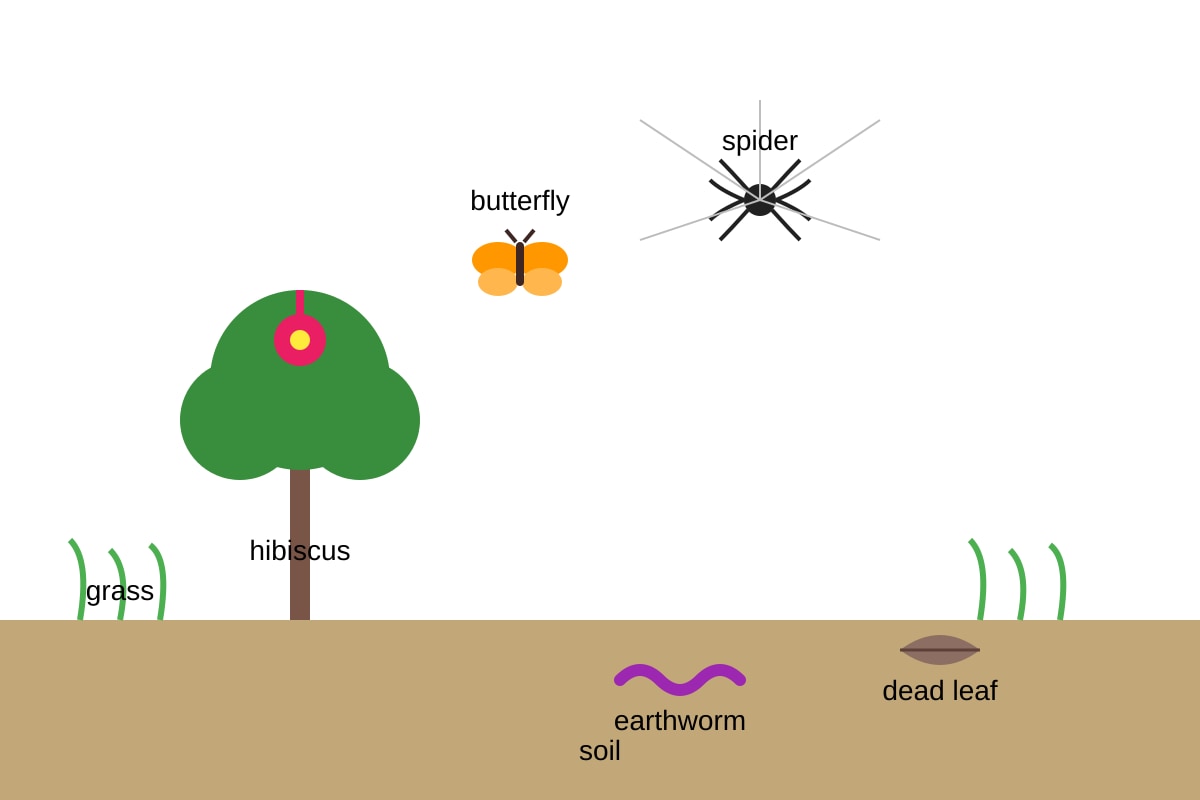
17. The diagram below shows a small garden with different organisms.
Image pending generation: diagram for Q17.
(a) Name one producer and one decomposer shown. (2 marks)
(b) Explain how diversity is shown in this garden. (3 marks)
18. A class recorded the number of different organisms in a pond and a roadside drain.
| Habitat | Number of species |
|---|---|
| Pond | 15 |
| Drain | 4 |
(a) Which habitat has higher diversity? (1 mark)
(b) Give two reasons why the pond has more diversity. (2 marks)
(c) Suggest one way to increase diversity in the drain. (2 marks)
19. Read the passage.
Octopuses can change colour to hide from predators. Penguins have thick fat to keep warm in cold seas. Both live in the ocean but are very different.
(a) What type of adaptation does the octopus show? (1 mark)
(b) Explain how the penguin's adaptation helps it survive. (2 marks)
(c) Why do you think the ocean can support such diverse animals? (2 marks)
20. A farmer uses only one type of rice plant in his field every year.
(a) State one problem this may cause for diversity. (1 mark)
(b) Explain how planting different crops at different times can help. (2 marks)
(c) Design a simple plan to make the field more diverse. (2 marks)
End of Paper
Answers
TuitionGoWhere Exam Practice (AI) — Science Primary 6 PSLE
SA2 Practice Paper Version 5 — Answer Key
Total Marks: 60
Section A (10 marks)
1. B
Different breeds of dogs with different fur lengths show diversity (variation among living things).
Teaching note: Diversity means differences among organisms. A, C, D are changes in one organism, not diversity.
2. C
Producers (plants) make their own food by photosynthesis.
Teaching note: Consumers eat others; decomposers break down dead matter; predators are a type of consumer.
3. B
A habitat is the place where an organism lives.
Teaching note: Do not confuse with community (many populations) or ecosystem (habitat + organisms).
4. C
All organisms having the same DNA is false; DNA differs and causes diversity.
Teaching note: Habitats, food, adaptations create diversity.
5. B
Mangrove swamps with many organisms show high diversity.
Teaching note: More kinds of organisms = higher diversity.
6. B
Population = group of same kind of organisms.
Teaching note: Community = different populations together.
7. B
Water-storing stem is a structural adaptation (body feature).
Teaching note: Behavioural = action, e.g. sleeping at day.
8. C
Planting different plants increases diversity.
Teaching note: Monoculture (one type) lowers diversity.
9. B
Migration is a behavioural adaptation (action).
Teaching note: Structural would be body part.
10. B
Decomposers break down dead organisms, returning nutrients.
Teaching note: They are not producers or predators.
Section B (14 marks)
11. [2 marks]
Accepted: different sizes, colours, feeding habits, body shapes, habitats within pond.
Marking: 1 mark per correct way. e.g. (a) different fish sizes, (b) some eat plants, some eat meat.
12. [2 marks]
Forest has more kinds of plants and animals (1m) because more habitats, food, shelter (1m). Bare field has fewer resources.
13. [2 marks]
No (1m). They are different species, so different populations (1m). Population is same kind only.
14. [2 marks]
Structural: e.g. thick skin / hump for water (1m). Behavioural: e.g. active at night (1m).
15. [3 marks]
- Many producers give different food sources (1m)
- Support more consumers (1m)
- More stable if one fails (1m)
16. [3 marks]
- Loss of habitat for animals (1.5m)
- Fewer species survive (1.5m)
Other: pollution, less breeding places.
Section C (36 marks)
17. [5 marks]
(a) Producer: grass or hibiscus (1m). Decomposer: earthworm (1m).
(b) Diversity shown by different plants and animals (1m), different roles (1m), dead matter recycled (1m).
Image note: Garden must show labelled grass, hibiscus, butterfly, spider, earthworm, dead leaf.
18. [5 marks]
(a) Pond (1m)
(b) More water, more plants, more shelter, more food (any 2 = 2m)
(c) Add plants, stop pollution, create small pool (2m)
19. [5 marks]
(a) Structural / colour change (1m)
(b) Thick fat keeps warm in cold (2m: fat 1m, keep warm 1m)
(c) Ocean has many niches, temperatures, food (2m)
20. [5 marks]
(a) Disease can wipe all (1m)
(b) Different crops = different food, less pest spread (2m)
(c) Plan: rotate crops, plant flowers, keep pond (2m)
End of Answer Key
Free quiz and exam paper access
Enter your details to view this paper
Your access is remembered on this device.