From Real Exams Exam Paper

Primary 6 PSLE Science Semestral Assessment 2 (End of Year) Paper 4

Free Kimi AI-generated P6 PSLE Science SA2 Paper 4 with questions, answers, and PSLE-focused practice for Singapore students preparing for exams.

These static practice materials are generated from the site's syllabus and paper-generation workflow, with source and model context shown so students and parents can evaluate the material before use.

Primary 6 PSLE Science From Real Exams Generated by Kimi K2.6 Free Updated 2026-06-09

Questions

<!-- TuitionGoWhere generation metadata: stage=3-1; model=moonshotai/kimi-k2.6:free; model_label=Kimi K2.6 Free; generated=2026-06-07; Sources: Stage 2-1 real exam-derived templates and Stage 2-2 exam-enriched syllabus. -->

TuitionGoWhere Exam Practice (AI) - SA2

Primary 6 PSLE Science

Version 4 of 5


Subject: Science
Level: Primary 6
Paper: SA2 Practice Paper
Duration: 1 hour 30 minutes
Total Marks: 80

Name: _______________________________
Class: _______________________________
Date: _______________________________


INSTRUCTIONS TO CANDIDATES

  1. Write your name, class, and date in the spaces provided above.
  2. This paper consists of TWO sections: Section A and Section B.
  3. Section A contains 20 multiple-choice questions. Answer all questions. (20 marks)
  4. Section B contains structured and open-ended questions. Answer all questions. (60 marks)
  5. For multiple-choice questions, shade your answers on the Optical Answer Sheet (OAS) provided.
  6. For open-ended questions, write your answers in the spaces provided.
  7. All diagrams are not drawn to scale unless stated otherwise.
  8. The use of calculators is not allowed.

SECTION A: Multiple-Choice Questions (20 marks)

Answer all questions. Each question carries 1 mark.

Questions 1–20


1. Which of the following is not a characteristic used to classify living things into groups?

A) Whether they have a backbone
B) The way they reproduce
C) Their favourite food
D) How they obtain food

Answer: _______ (1)


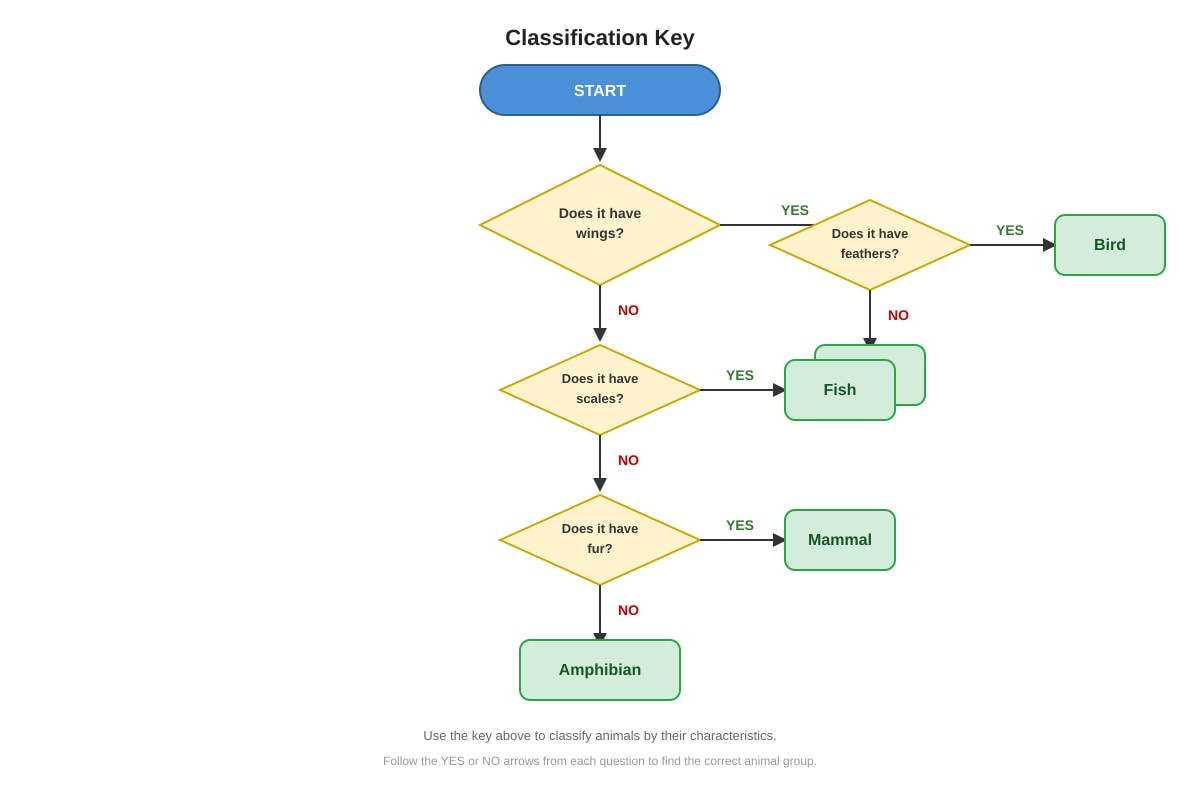
2. Look at the classification key below.

<image_placeholder> id: Q2-fig1 type: diagram linked_question: Q2 description: Dichotomous classification key with 4 branches. Starts with "Does it have wings?" Branch YES leads to "Does it have feathers?" (YES → Bird; NO → Insect). Branch NO leads to "Does it have scales?" (YES → Fish; NO → "Does it have fur?" YES → Mammal; NO → Amphibian). labels: Start box, four decision diamonds, six result boxes values: None must_show: All decision paths clearly connected, yes/no labels on arrows, six final classification boxes with animal group names </image_placeholder>

Based on the classification key, to which group would a bat be classified?

A) Bird
B) Insect
C) Mammal
D) Amphibian

Answer: _______ (1)


3. The table below shows information about four different organisms.

OrganismNumber of legsBody coveringHow it obtains food
P6Hard outer shellMakes its own food
Q4FurEats other animals
R0ScalesEats other animals
S8Hard outer shellEats dead matter

Which organism is most likely a fungus?

A) P
B) Q
C) R
D) S

Answer: _______ (1)


4. Plants are classified as producers because they

A) produce flowers and fruits
B) produce their own food through photosynthesis
C) produce oxygen for animals to breathe
D) produce seeds for new plants

Answer: _______ (1)


5. Which of the following shows the correct order of classification from the largest group to the smallest group?

A) Kingdom → Species → Genus → Family
B) Kingdom → Family → Genus → Species
C) Species → Genus → Family → Kingdom
D) Species → Kingdom → Family → Genus

Answer: _______ (1)


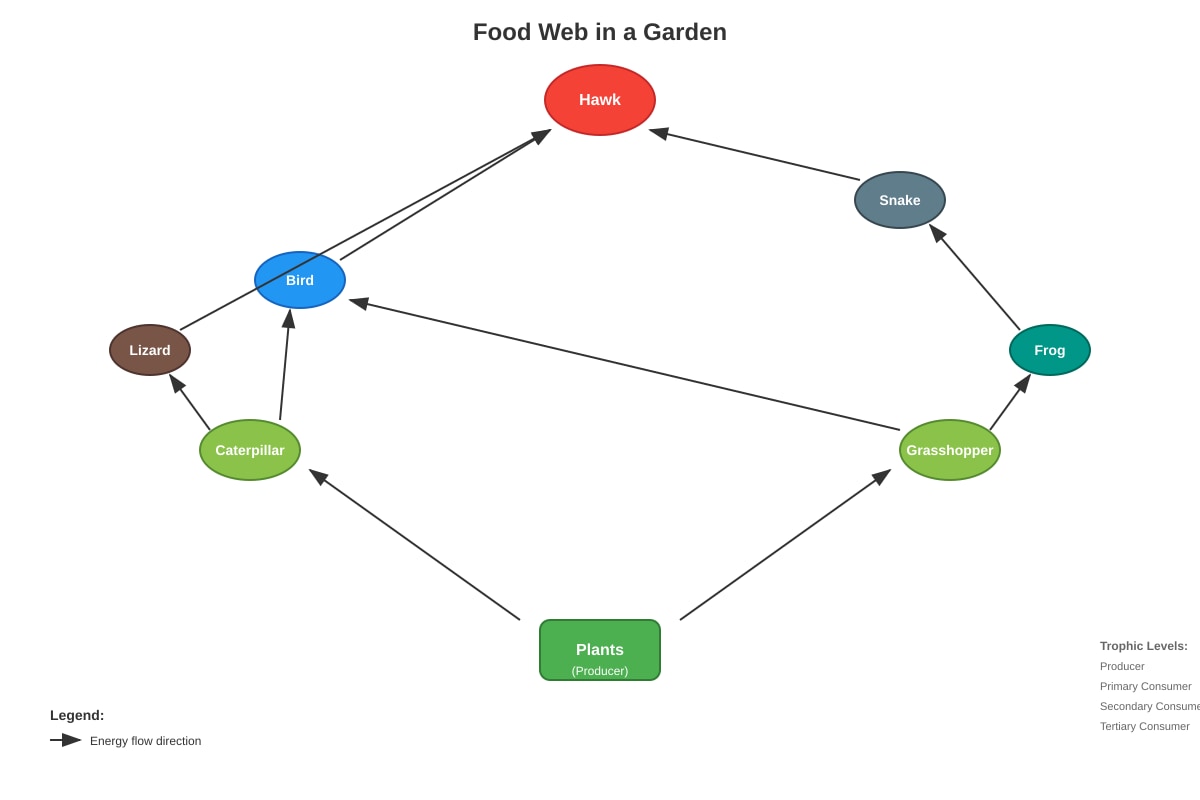
6. The diagram below shows part of a food web in a garden.

<image_placeholder> id: Q6-fig1 type: diagram linked_question: Q6 description: Food web diagram. Plants (producer) → Caterpillar → Bird → Hawk. Alternative path: Plants → Caterpillar → Lizard → Hawk. Another: Plants → Grasshopper → Frog → Snake → Hawk. Another: Plants → Grasshopper → Bird → Hawk. labels: Plants, Caterpillar, Grasshopper, Bird, Lizard, Frog, Snake, Hawk values: Arrows showing energy flow direction must_show: All organisms named, all arrows clearly showing direction of energy transfer, complete web with multiple interconnected food chains </image_placeholder>

Which organism is a secondary consumer in this food web?

A) Plants
B) Caterpillar
C) Frog
D) Hawk

Answer: _______ (1)


7. A student observed an organism with the following characteristics:

  • Has a backbone
  • Lives in water
  • Has fins instead of legs
  • Breathes through gills

To which class does this organism belong?

A) Amphibian
B) Bird
C) Fish
D) Reptile

Answer: _______ (1)


8. Which of the following groups of organisms are all fungi?

A) Mushroom, mould, yeast
B) Mushroom, fern, moss
C) Bacteria, mould, yeast
D) Mushroom, alga, fern

Answer: _______ (1)


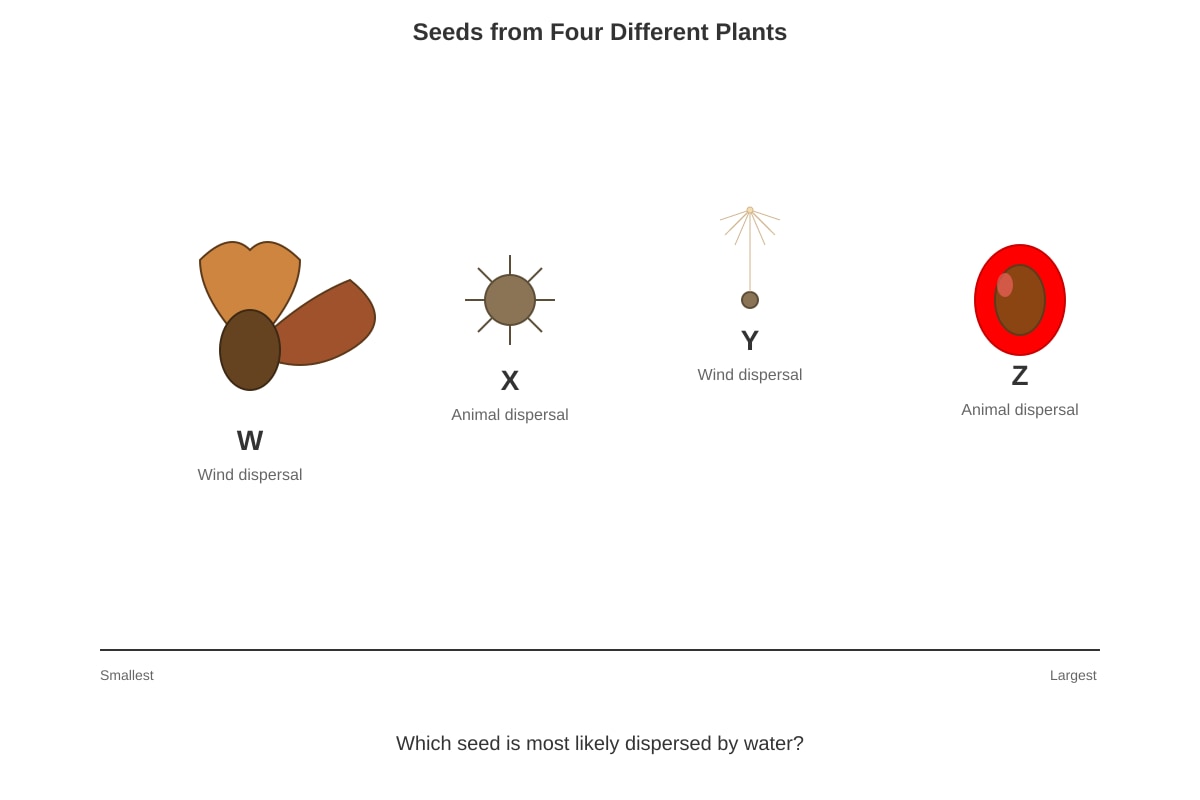
9. The pictures below show seeds from four different plants.

<image_placeholder> id: Q9-fig1 type: diagram linked_question: Q9 description: Four seed diagrams labeled W, X, Y, Z. Seed W: large seed with wing-like structure. Seed X: small round seed with spiky burrs. Seed Y: small light seed with hair-like parachute. Seed Z: medium seed with fleshy bright red covering. labels: W, X, Y, Z values: Relative sizes approximately shown (W largest, X and Y smallest, Z medium) must_show: All four seed types with their dispersal structures clearly visible, labels W-Z clearly indicated </image_placeholder>

Which seed is most likely dispersed by water?

A) W
B) X
C) Y
D) Z

Answer: _______ (1)


10. Decomposers are important in an ecosystem because they

A) produce food for other organisms
B) break down dead matter and return nutrients to the soil
C) hunt and control populations of herbivores
D) provide shelter for small animals

Answer: _______ (1)


11. Which characteristic would help you distinguish between a plant cell and an animal cell?

A) The plant cell has a cell membrane
B) The animal cell has a nucleus
C) The plant cell has a cell wall and chloroplasts
D) The animal cell is always larger

Answer: _______ (1)


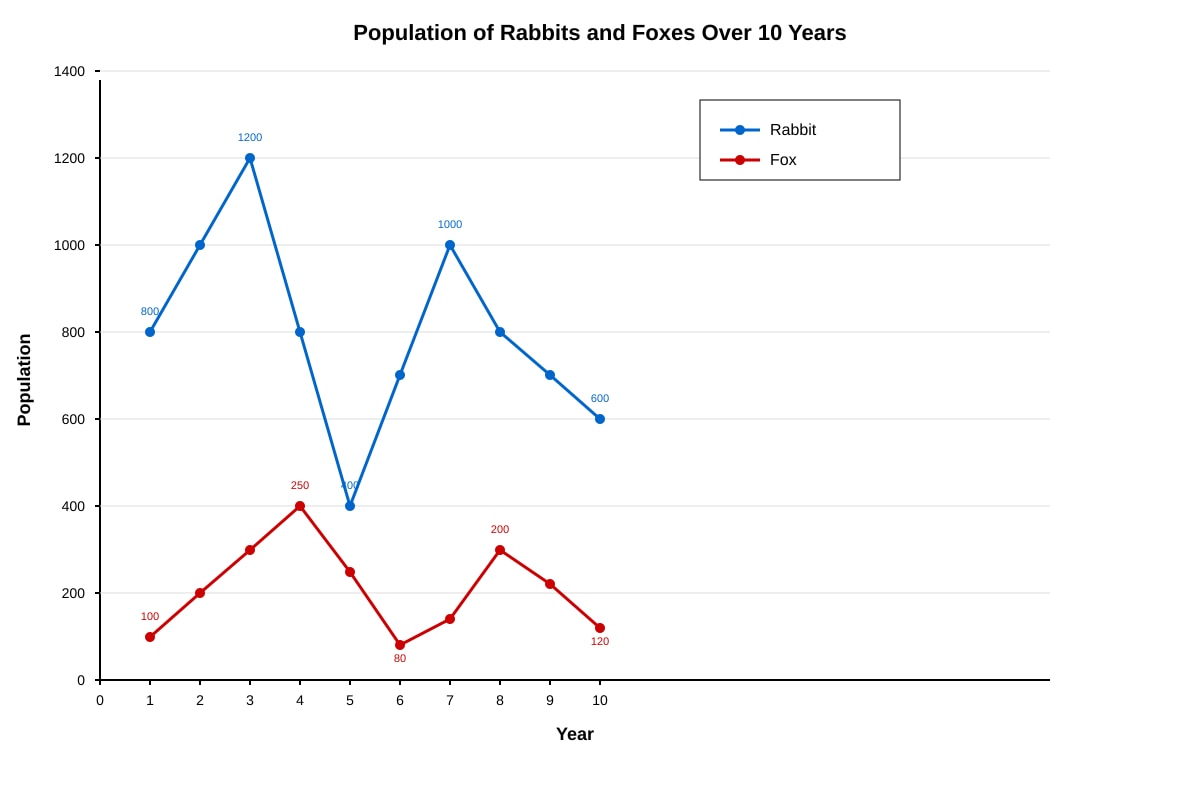
12. The graph below shows the population of rabbits and foxes in a grassland over 10 years.

<image_placeholder> id: Q12-fig1 type: graph linked_question: Q12 description: Line graph with two lines. X-axis: Year 1 to Year 10. Y-axis: Population (number of animals). Rabbit population: starts at 800, peaks at Year 3 (1200), drops to 400 at Year 5, rises to 1000 at Year 7, drops to 600 at Year 10. Fox population: starts at 100, rises to 250 at Year 4, drops to 80 at Year 6, rises to 200 at Year 8, drops to 120 at Year 10. Fox curve lags slightly behind rabbit curve. labels: X-axis "Year", Y-axis "Population", legend with rabbit and fox, specific year marks 1-10 values: Key data points as described above must_show: Both clearly labeled lines, axis labels with units, legend, approximate values readable from graph, lag relationship between predator and prey </image_placeholder>

What can be concluded from the graph?

A) The fox population always increases when the rabbit population decreases
B) The fox population changes follow changes in the rabbit population with a time lag
C) The rabbit population is not affected by the fox population
D) Both populations increase steadily over the 10 years

Answer: _______ (1)


13. Which of the following is not an example of a plant adaptation for survival in a dry environment?

A) Thick waxy cuticle on leaves
B) Deep and widespread roots
C) Large, broad leaves to catch more sunlight
D) Stomata that close during hot days

Answer: _______ (1)


14. Bacteria can be classified as

A) fungi because they break down dead matter
B) plants because they can make their own food
C) neither plants nor animals because they have no nucleus and different cell structure
D) animals because they can move

Answer: _______ (1)


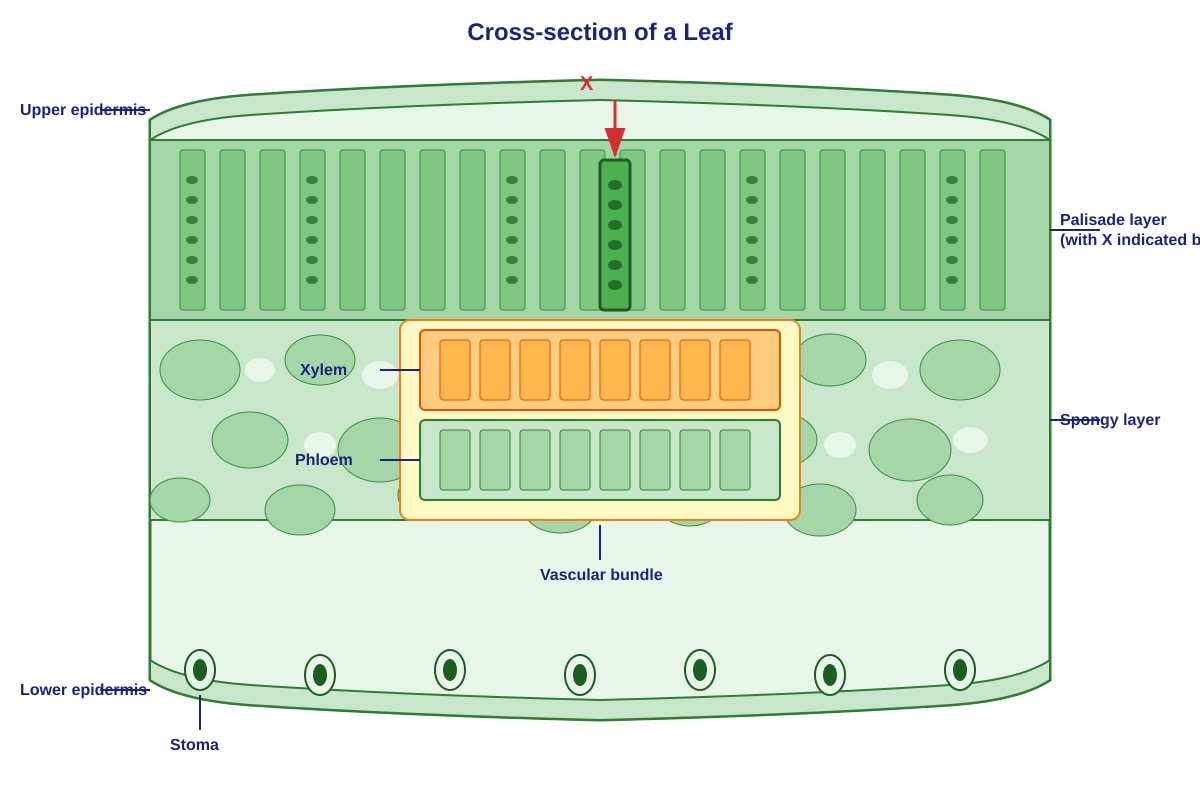
15. The diagram below shows the cross-section of a leaf.

<image_placeholder> id: Q15-fig1 type: diagram linked_question: Q15 description: Cross-section diagram of a typical leaf showing upper epidermis, palisade mesophyll, spongy mesophyll, lower epidermis with stomata, and vascular bundle (xylem and phloem). Key structure labeled as X is in the palisade layer. labels: Upper epidermis, Palisade layer (with X indicated by arrow), Spongy layer, Lower epidermis, Stoma, Vascular bundle, Xylem, Phloem, X values: None must_show: All tissue layers clearly labeled, arrow pointing to X in palisade layer, stomata shown on lower epidermis, vascular bundle with xylem and phloem distinguished </image_placeholder>

Structure X is most likely

A) a root hair cell
B) a palisade cell full of chloroplasts
C) a red blood cell
D) a nerve cell

Answer: _______ (1)


16. Which pair of organisms shows a mutualism relationship?

A) A tick feeding on a dog
B) A bee feeding on nectar while pollen sticks to its body
C) A lion hunting a zebra
D) A mosquito biting a human

Answer: _______ (1)


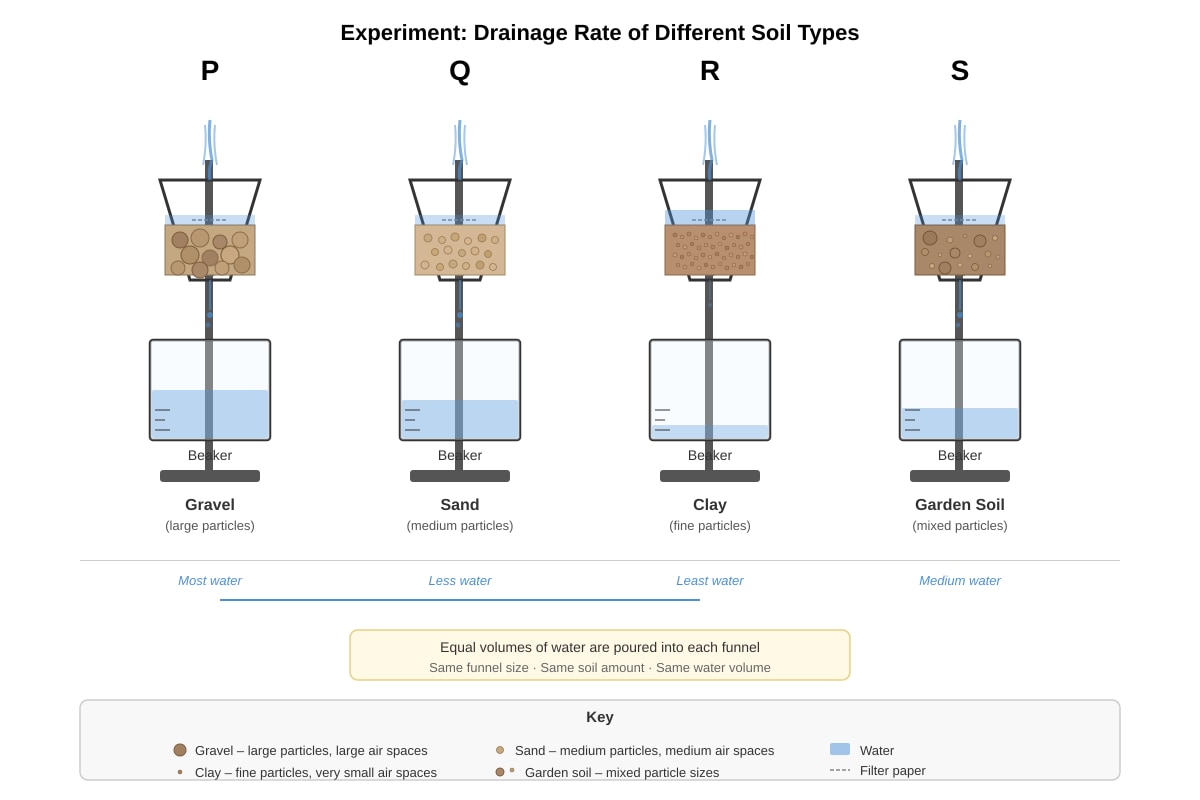
17. A group of students wanted to find out which type of soil water drains through fastest. They set up the experiment shown below using four identical funnels with equal amounts of different soils.

<image_placeholder> id: Q17-fig1 type: diagram linked_question: Q17 description: Four funnel setups labeled P, Q, R, S. Each funnel contains different soil type on filter paper. Funnel P: gravel (large particles). Funnel Q: sand (medium particles). Funnel R: clay (fine particles). Funnel S: garden soil (mixed particles). Beakers below to collect water. Equal volumes of water being poured into each. labels: P, Q, R, S, funnels, beakers, soil types labeled values: Same funnel size, same soil amount, same water volume poured must_show: Four identical setups side by side, clear labels for soil types, equal water being added, collection beakers below </image_placeholder>

Which funnel would have the most water collected in the beaker after 5 minutes?

A) P
B) Q
C) R
D) S

Answer: _______ (1)


18. Which feature of birds is not an adaptation for flight?

A) Hollow bones
B) Feathers on wings
C) Powerful chest muscles
D) Webbed feet

Answer: _______ (1)


19. In a food chain, energy is lost at each trophic level mainly through

A) the organism growing larger
B) the organism reproducing
C) heat loss during respiration and undigested waste
D) the organism moving faster

Answer: _______ (1)


20. Which statement about the diversity of organisms in Singapore is true?

A) Singapore has very few different species because it is a small country
B) Singapore's tropical rainforest and marine habitats support a wide variety of species
C) Most of Singapore's original biodiversity has been completely lost forever
D) Singapore only has biodiversity in its nature reserves, nowhere else

Answer: _______ (1)


END OF SECTION A


SECTION B: Open-Ended Questions (60 marks)

Answer all questions. Write your answers in the spaces provided.


Question 21 (3 marks)

The table below shows the characteristics of four different organisms, A, B, C, and D.

CharacteristicOrganism AOrganism BOrganism COrganism D
Has a backboneYesNoNoYes
Body temperatureChanges with environmentStays constantChanges with environmentStays constant
Has scaly skinYesNoNoNo
Has feathersNoNoNoYes

(a) Which organism is most likely a fish? Give one reason for your answer.
_________________________________________________________________ (2)

(b) Which two organisms are most likely birds and mammals? Explain how you can tell them apart using information from the table.
_________________________________________________________________ (1)


Question 22 (4 marks)

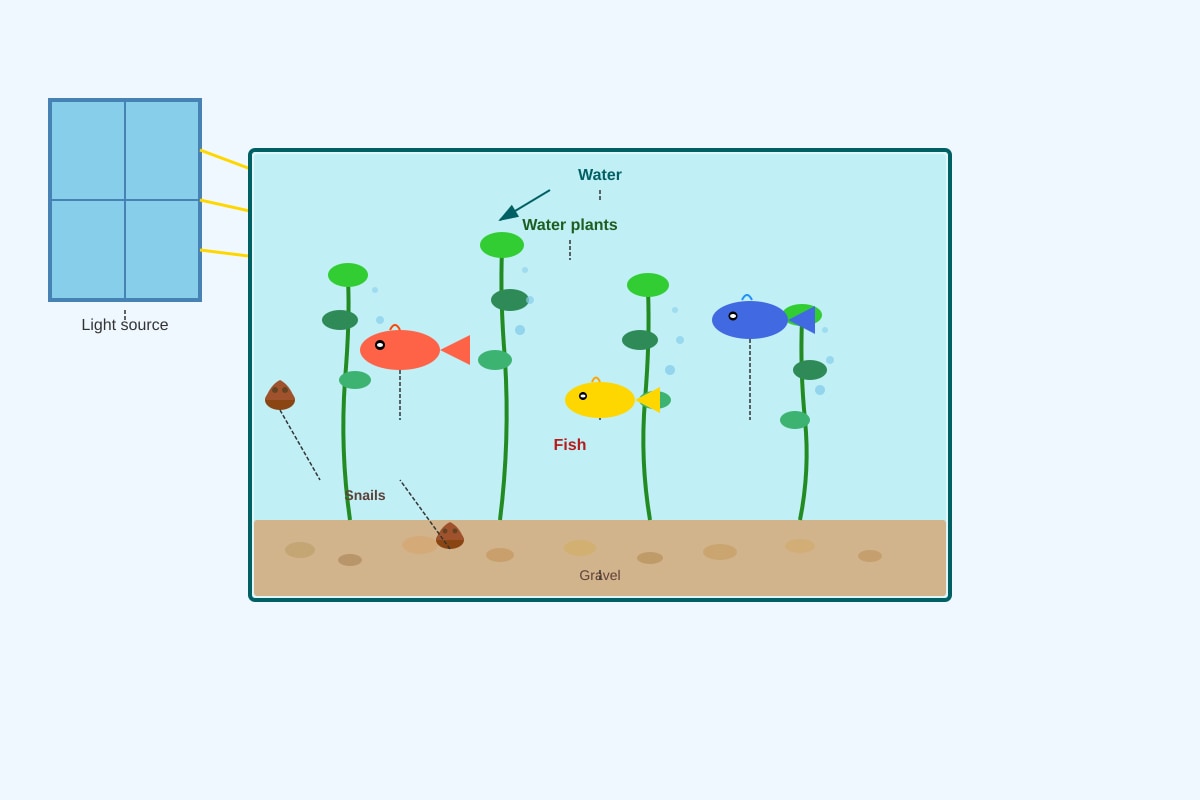
A student set up an aquarium with water plants, fish, and snails. The aquarium was left near a window for several weeks.

<image_placeholder> id: Q22-fig1 type: diagram linked_question: Q22 description: Aquarium setup diagram. Glass tank with water, gravel at bottom, water plants rooted in gravel, three fish swimming, two snails on glass and gravel. Lamp/light source shown above or window indicated on left side. Bubbles or oxygen movement suggested near plants during light. labels: Fish, Water plants, Snails, Gravel, Light source, Water values: Three fish, two snails, multiple plants must_show: Complete aquarium ecosystem with all organisms, indication of light source, water environment clearly shown </image_placeholder>

(a) Explain why the water plants are important for the survival of the fish in this aquarium. (2)


(b) What would happen to the fish if the aquarium was kept in a dark room for a long time? Explain your answer. (2)


Question 23 (4 marks)

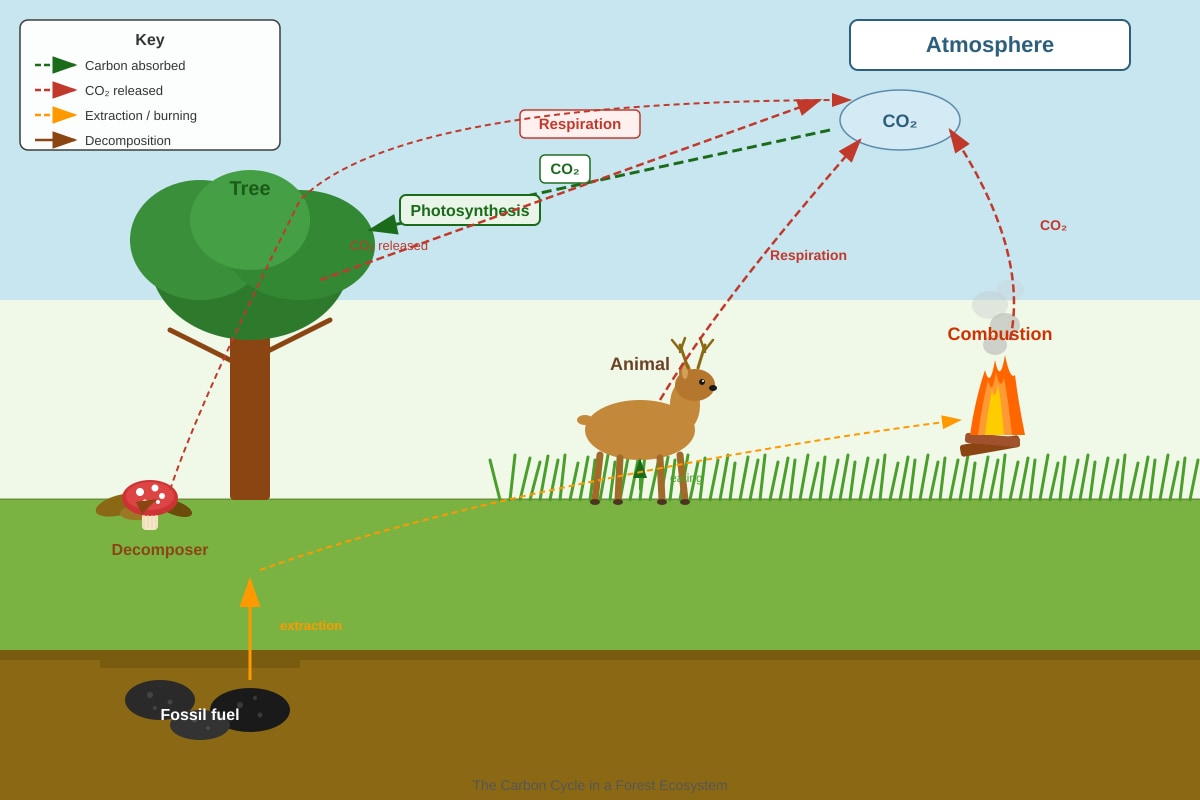
The diagram below shows part of the carbon cycle in a forest ecosystem.

<image_placeholder> id: Q23-fig1 type: diagram linked_question: Q23 description: Carbon cycle diagram in forest setting. Tree shown with CO2 arrow entering leaf (photosynthesis). Arrow from tree to atmosphere labeled respiration. Decomposer (mushroom) shown at base with arrows showing breakdown of dead leaves. Animal (deer) eating grass with respiration arrow. Combustion/fire icon with smoke/CO2 arrow. Fossil fuel underground with extraction arrow. labels: Tree, CO2, Photosynthesis, Respiration, Decomposer, Animal, Combustion, Fossil fuel, Atmosphere values: Arrows indicating direction of carbon movement must_show: All major carbon cycle processes in forest context, clear directional arrows, labels for each process, atmospheric CO2 pool indicated </image_placeholder>

(a) Name two processes shown in the diagram that release carbon dioxide into the atmosphere. (2)


(b) Explain how decomposers play a role in returning carbon to the atmosphere. (2)


Question 24 (5 marks)

A group of students conducted an experiment to find out which material was the best insulator. They wrapped four identical beakers containing hot water with different materials and recorded the temperature of the water every 5 minutes.

Time (minutes)Beaker P (Cotton)Beaker Q (Wool)Beaker R (Aluminium foil)Beaker S (No wrapping)
080°C80°C80°C80°C
572°C74°C65°C68°C
1065°C68°C52°C58°C
1559°C63°C42°C50°C
2054°C59°C35°C44°C

(a) What was the aim of this experiment? State the variables clearly in your answer. (2)


(b) Which beaker was the best insulator? Explain your answer using data from the table. (2)


(c) Explain why wrapping the beaker with aluminium foil resulted in the fastest cooling. (1)


Question 25 (4 marks)

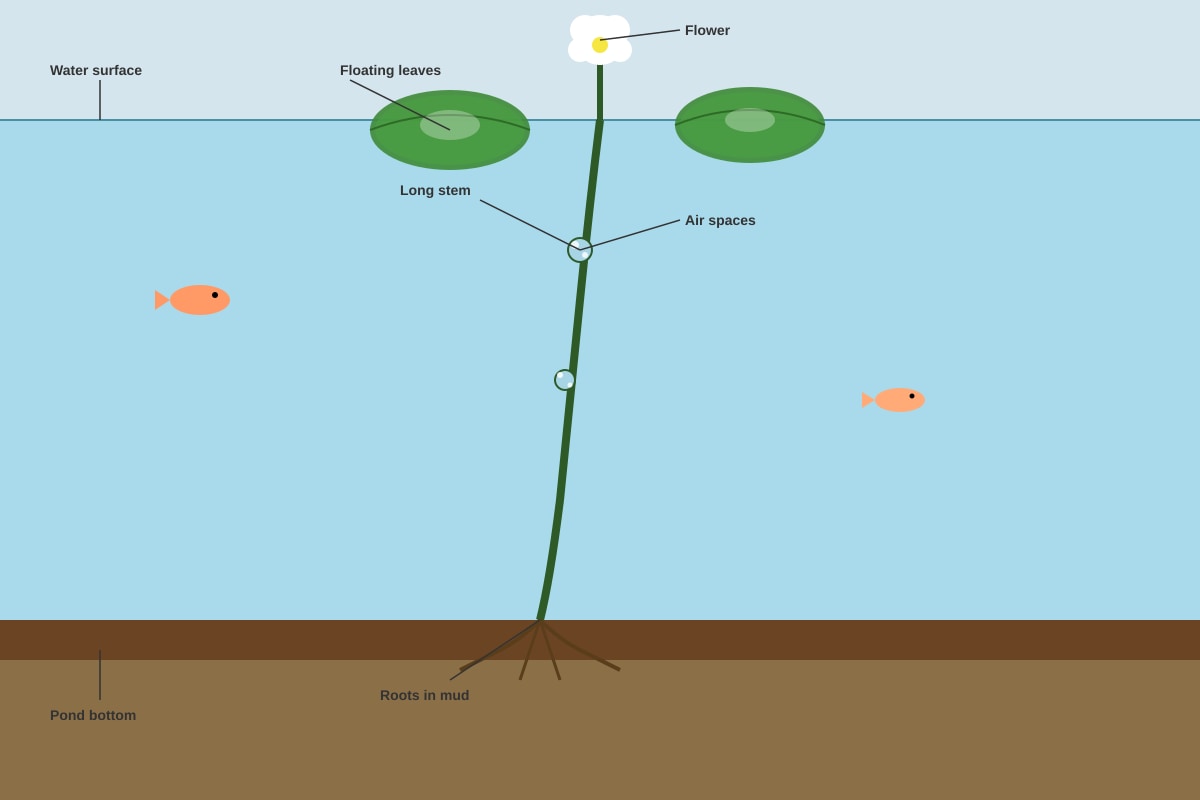
The picture below shows a water lily growing in a pond.

<image_placeholder> id: Q25-fig1 type: diagram linked_question: Q25 description: Water lily plant in pond. Large round floating leaves on water surface with waxy coating visible. Long stems extending underwater to roots in mud at bottom. White flower rising above leaves on stalk. Air spaces in stem shown as cross-section hint. Fish swimming nearby. labels: Floating leaves, Flower, Long stem, Roots in mud, Air spaces, Water surface, Pond bottom values: None must_show: Floating leaves with waxy appearance, long stems to bottom, roots in muddy substrate, flower on stalk, indication of air spaces in stem, water environment </image_placeholder>

(a) Name two structural adaptations of the water lily that help it survive in a pond environment. (2)


(b) Explain how one of the adaptations you named in (a) helps the water lily to survive. (2)


Question 26 (4 marks)

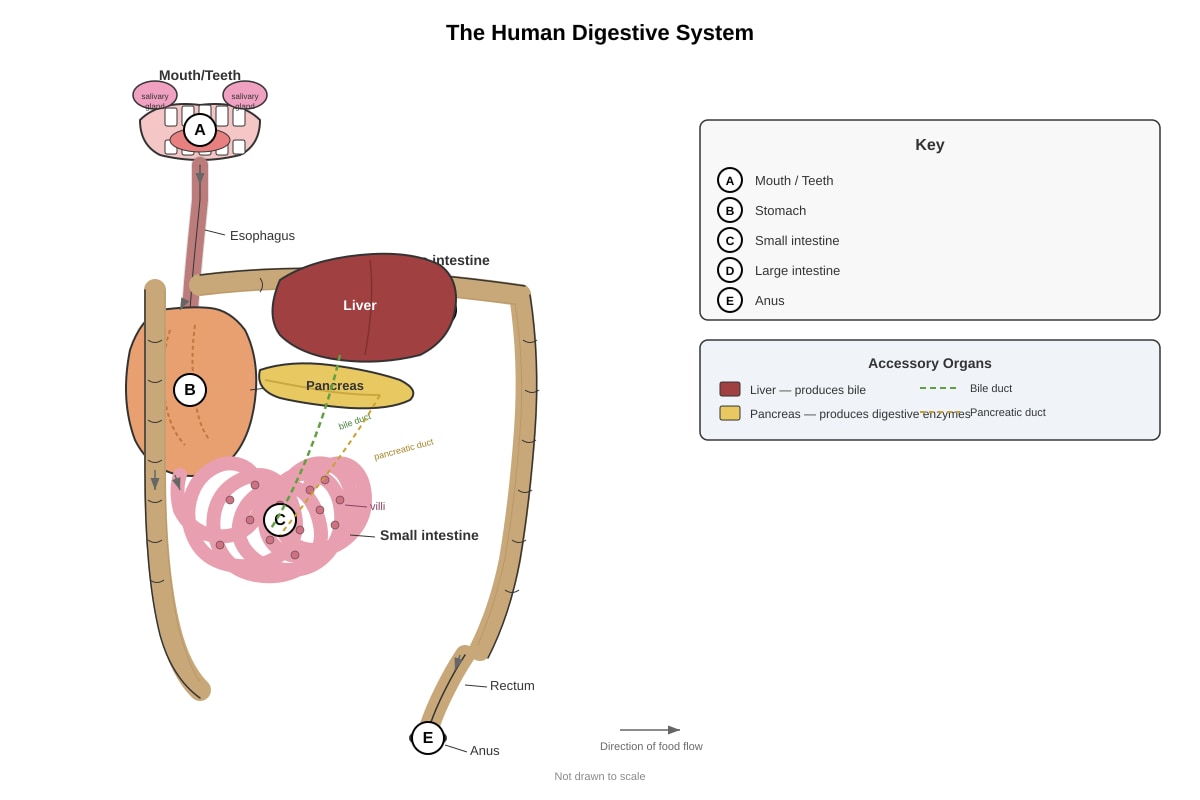
The diagram below shows the human digestive system.

<image_placeholder> id: Q26-fig1 type: diagram linked_question: Q26 description: Human digestive system diagram. Mouth with teeth and salivary glands, esophagus leading to stomach, small intestine with villi, large intestine, rectum, anus. Liver and pancreas with ducts. Labels A-E pointing to: A=mouth, B=stomach, C=small intestine, D=large intestine, E=anus. labels: A, B, C, D, E, Mouth/Teeth, Esophagus, Stomach, Small intestine, Large intestine, Liver, Pancreas, Rectum, Anus values: Label letters A-E as specified must_show: All major organs in correct anatomical sequence, labels A-E clearly positioned, accessory organs (liver, pancreas) included </image_placeholder>

(a) In which part of the digestive system, A, B, C, D, or E, does most of the digestion and absorption of food take place? (1)


(b) Explain why the part you named in (a) is well-adapted for absorption. (2)


(c) Name one digestive enzyme found in the stomach and state its function. (1)


Question 27 (5 marks)

A class of students went on a field trip to a nature reserve. They observed different organisms in a freshwater stream.

OrganismNumber observedRole in ecosystem
AlgaeManyProducer
Mayfly nymph45Primary consumer
Water spider12Secondary consumer
Small fish8Secondary consumer
Large fish2Tertiary consumer

(a) Draw a simple food chain using organisms from the table above. (1)


(b) What would happen to the population of mayfly nymphs if all the water spiders were removed? Explain your answer. (2)


(c) Explain why there are only 2 large fish observed compared to 45 mayfly nymphs. (2)


Question 28 (4 marks)

Kim observed a plant in her garden and recorded the following:

  • The plant has green leaves with white edges
  • The white-edged parts cannot produce starch when tested with iodine
  • The green parts turn blue-black with iodine

(a) Explain why the green parts of the leaf turn blue-black with iodine solution. (2)


(b) What does this experiment tell us about the role of chlorophyll in photosynthesis? (2)


Question 29 (4 marks)

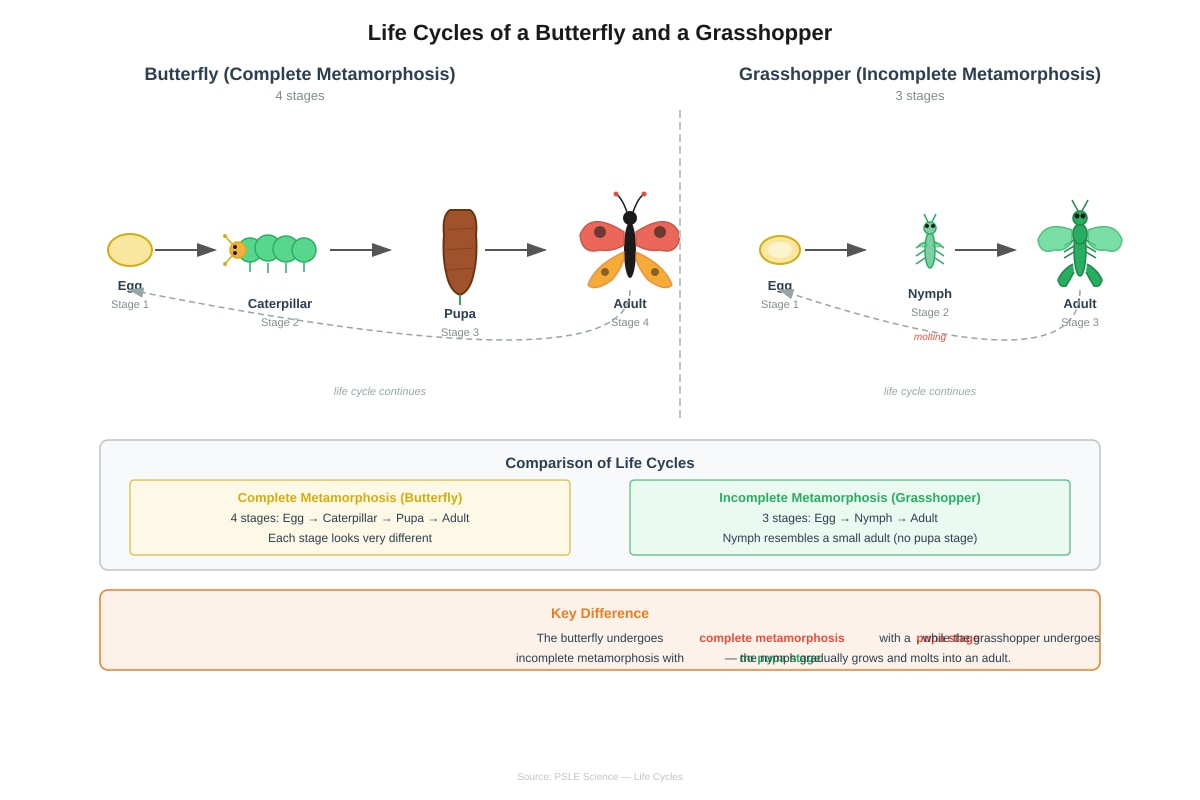
The diagrams below show the life cycles of a butterfly and a grasshopper.

<image_placeholder> id: Q29-fig1 type: diagram linked_question: Q29 description: Two life cycle diagrams shown side by side. Butterfly (complete metamorphosis): Egg → Caterpillar → Pupa → Adult butterfly, with four distinct stages. Grasshopper (incomplete metamorphosis): Egg → Nymph → Nymph (larger, molting) → Adult grasshopper, with three stages showing gradual change, nymphs resemble small adults. labels: Butterfly cycle: Egg, Caterpillar, Pupa, Adult. Grasshopper cycle: Egg, Nymph, Adult. Stages numbered for comparison. values: Number of stages: butterfly 4, grasshopper 3 must_show: Clear distinction between complete and incomplete metamorphosis, intermediate stages visually different between diagrams, labels for each stage </image_placeholder>

(a) What is the main difference between the life cycle of a butterfly and that of a grasshopper? (1)


(b) Explain one advantage of complete metamorphosis for the butterfly species. (1)


(c) In the butterfly life cycle, what happens during the pupa stage? (2)


Question 30 (6 marks)

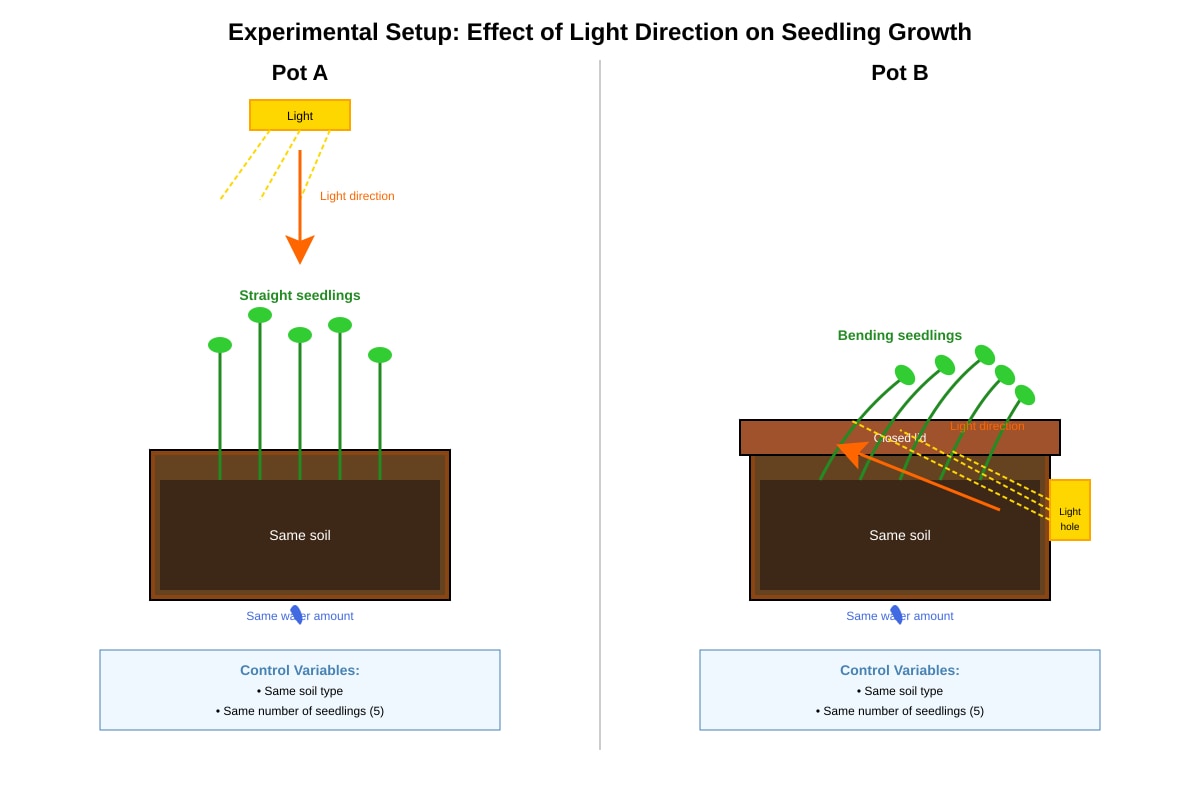
Rajan set up the experiment below to investigate how light affects the growth of seedlings.

<image_placeholder> id: Q30-fig1 type: diagram linked_question: Q30 description: Experimental setup with two identical pots of seedlings. Pot A: placed in open box with lid removed, light from above, seedlings growing straight upward. Pot B: placed in box with lid and unidirectional light source from side hole, seedlings bending toward light. Both pots have same soil type, same number of seedlings, same water amount. Arrow indicating light direction shown. labels: Pot A, Pot B, Light direction arrows, Straight seedlings, Bending seedlings, Same soil, Same number of seedlings values: Both setups identical except light direction must_show: Clear distinction between two setups, light direction arrows, difference in seedling growth direction, control variables indicated </image_placeholder>

(a) State the aim of Rajan's experiment. (1)


(b) Identify the following variables in this experiment: (i) The changed variable (independent variable): (1) _________________________________________________________________ (ii) The measured variable (dependent variable): (1) _________________________________________________________________ (iii) Two variables that were kept the same: (1) _________________________________________________________________

(c) Explain why the seedlings in Pot B grew towards the light. (2)


Question 31 (4 marks)

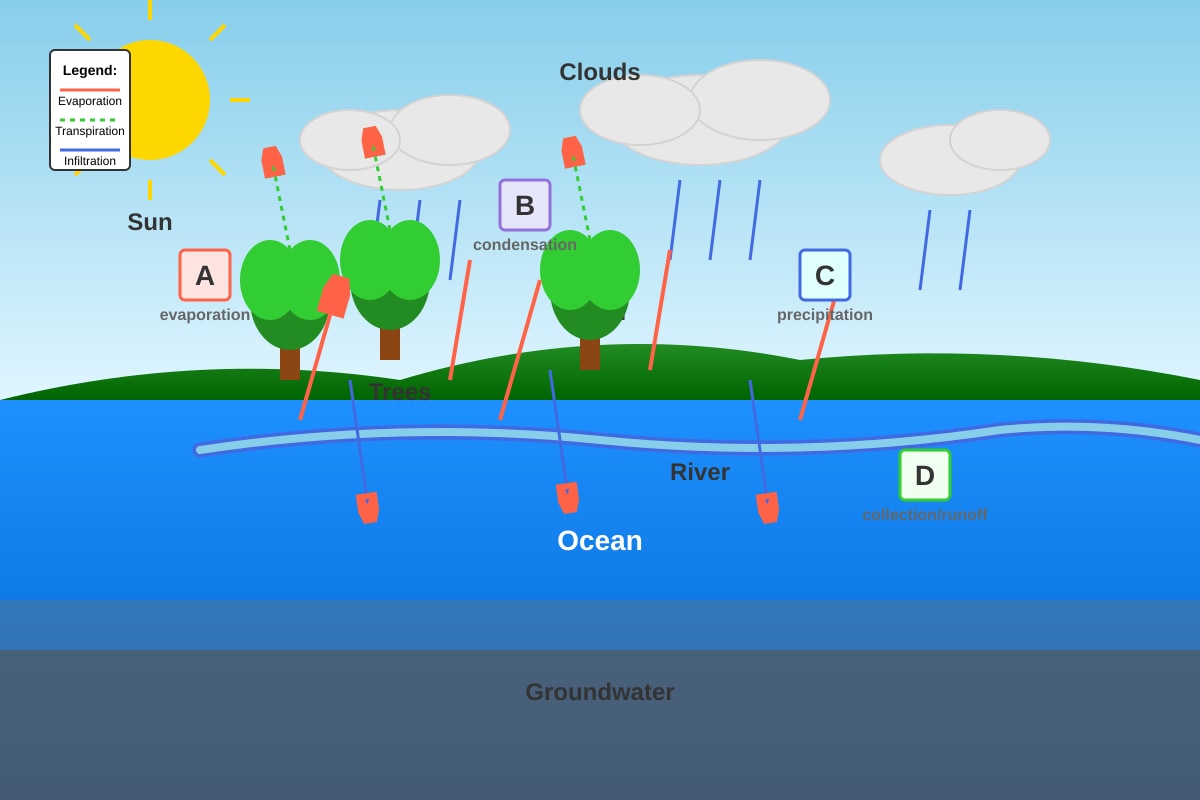
The diagram below shows the water cycle.

<image_placeholder> id: Q31-fig1 type: diagram linked_question: Q31 description: Water cycle diagram. Sun heating ocean water. Evaporation arrows from ocean and land water surfaces. Condensation into clouds. Precipitation as rain over land and ocean. Collection in rivers flowing to ocean. Transpiration from trees. Infiltration into groundwater. Four labeled processes: A (evaporation), B (condensation), C (precipitation), D (collection/runoff). labels: Sun, Ocean, Clouds, Rain, River, Trees, Groundwater, A, B, C, D values: A=evaporation, B=condensation, C=precipitation, D=collection/runoff must_show: Complete cycle with all four main processes labeled, sun energy input, transpiration from plants, clear directional flow of water </image_placeholder>

(a) Name the processes labeled A and B. (2)


(b) Explain why forests are important in maintaining the water cycle. (2)


Question 32 (5 marks)

Ahmad measured the length and shadow length of a pole at different times of the day.

TimeLength of pole (cm)Length of shadow (cm)
8 am100180
10 am100120
12 noon10020
2 pm100110
4 pm100175

(a) At what time was the Sun highest in the sky? Explain how you can tell from the table. (2)


(b) Explain why the shadow length changes throughout the day. (2)


(c) If Ahmad repeated this experiment on a cloudy day, how would the results be different? Explain your answer. (1)


Question 33 (5 marks)

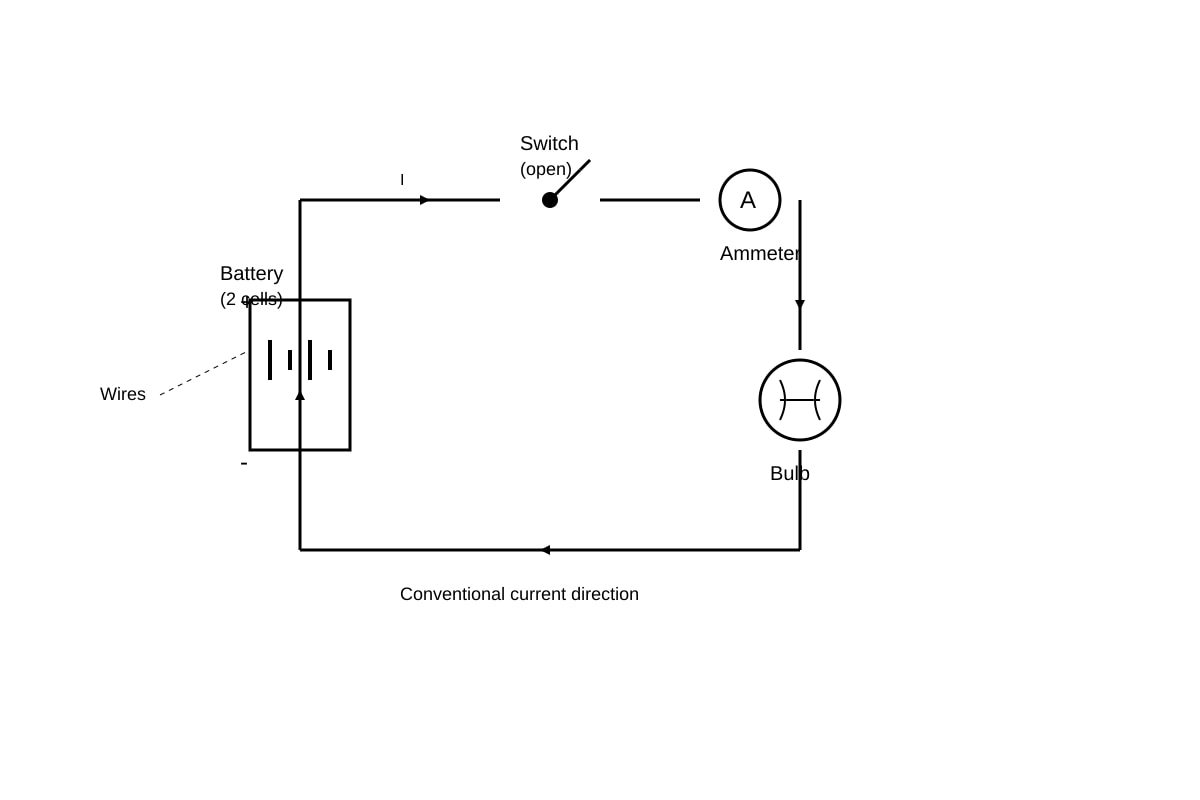
The diagram below shows a simple electric circuit.

<image_placeholder> id: Q33-fig1 type: diagram linked_question: Q33 description: Simple electric circuit diagram. Battery (2 cells) connected to switch, then to bulb, then back to battery. Ammeter in series. All components in single loop with connecting wires. Standard circuit symbols used. labels: Battery (2 cells), Switch (open), Bulb, Ammeter, Wires with arrows showing conventional current direction values: 2 cells in battery must_show: Correct circuit symbols for all components, series arrangement, open switch position, conventional current direction arrows, complete closed loop when switch closed </image_placeholder>

(a) What will happen to the bulb when the switch is closed? Explain your answer. (2)


(b) What reading would you expect on the ammeter if the bulb is working normally? (Choose: 0 A, 0.2 A, 5 A, or 50 A) Explain why you chose this value. (2)


(c) Draw what would happen to the circuit if another bulb was added in series. (1)


Question 34 (5 marks)

Some students investigated whether the amount of water affects the growth of bean plants. They set up four pots with the same amount of soil and the same number of bean seeds.

PotAmount of water given dailyHeight of plants after 2 weeks (cm)
W0 mL (no water)0 (seeds did not grow)
X10 mL8
Y30 mL18
Z100 mL5

(a) What conclusion can you draw from the results about how the amount of water affects bean plant growth? (2)


(b) Why did the seeds in Pot W not grow at all? (1)


(c) Suggest why the plants in Pot Z grew less than those in Pot Y, even though more water was given. (2)


Question 35 (5 marks)

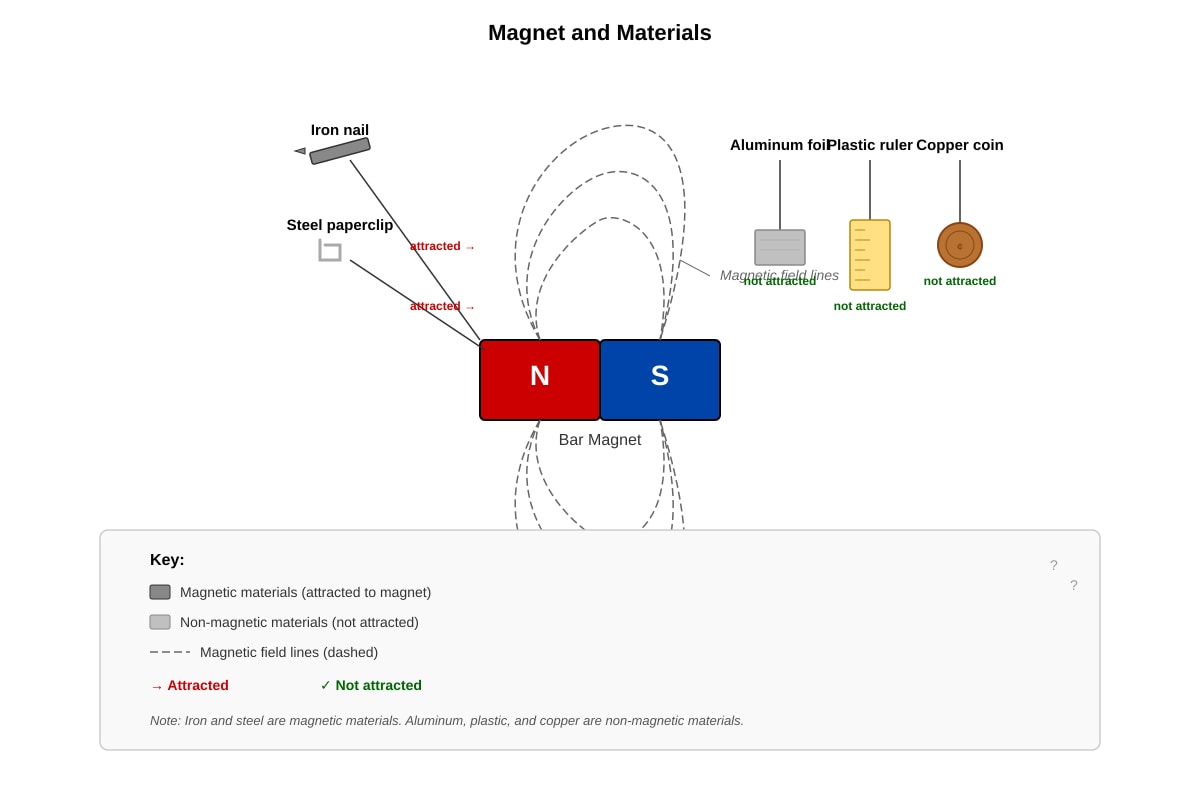
The diagram below shows a magnet and some materials placed near it.

<image_placeholder> id: Q35-fig1 type: diagram linked_question: Q35 description: Bar magnet with N and S poles labeled. Five materials hanging on strings near magnet: iron nail (attracted to N pole), steel paperclip (attracted to N pole), aluminum foil (not attracted, hanging straight), plastic ruler (not attracted, hanging straight), copper coin (not attracted, hanging straight). Dashed lines show magnetic field shape around bar magnet. labels: N, S poles, Iron nail, Steel paperclip, Aluminum foil, Plastic ruler, Copper coin, Magnetic field lines values: Attraction shown for iron and steel, no attraction for others must_show: Clear N/S pole labels, all five test materials labeled, magnetic field line pattern, attraction/repulsion or neutral response clearly indicated </image_placeholder>

(a) Which materials are attracted to the magnet? Name two. (1)


(b) What is the difference between a temporary magnet and a permanent magnet? Explain using one material from the diagram as an example. (2)


(c) Explain why the aluminum foil, plastic ruler, and copper coin are not attracted to the magnet. (2)


Question 36 [The Energy Theme — not Diversity, omitted from this topic-focused exam]

(Note: This question has been replaced with a Diversity topic question below)

Question 36 (5 marks)

The table below shows information about different groups of vertebrates.

GroupBody coveringHow young are bornBreathing organ
FishScalesFrom eggs in waterGills
AmphibiansMoist skinFrom eggs in waterLungs and skin
ReptilesScales or platesFrom eggs on landLungs
BirdsFeathersFrom eggs on landLungs
MammalsHair or furLive birth (mostly)Lungs

(a) Compare how fish and amphibians reproduce. What is similar and what is different? (2)


(b) Why do you think birds and mammals both have lungs, but fish have gills? Explain in terms of where they live. (2)


(c) A student claims that "all animals that lay eggs are not mammals." Is this claim correct? Explain your answer using information from the table. (1)


Question 37 (5 marks)

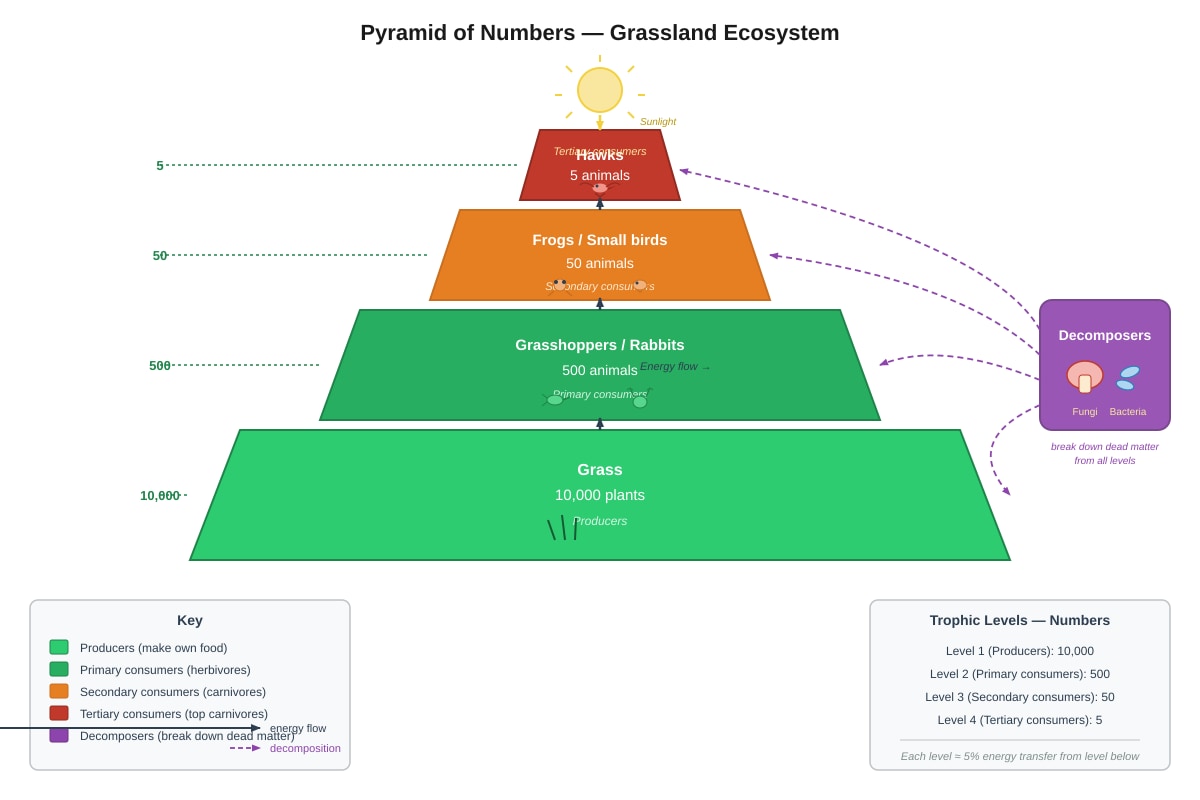
The diagram below shows a food pyramid based on the food web in a grassland.

<image_placeholder> id: Q37-fig1 type: diagram linked_question: Q37 description: Ecological pyramid of numbers. Base (producers): Grass, very wide base, 10,000 plants. Second level (primary consumers): Grasshoppers and rabbits, narrower, 500 animals. Third level (secondary consumers): Frogs and small birds, narrower, 50 animals. Top (tertiary consumers): Hawks, narrowest, 5 animals. Arrows between levels. Decomposer shown at side (fungi/bacteria) with arrows to all levels. labels: Grass, Grasshoppers/Rabbits, Frogs/Small birds, Hawks, Decomposers, Trophic levels with numbers values: 10000 → 500 → 50 → 5 must_show: Pyramid shape clearly shown, decreasing widths, numbers at each level, decomposer role indicated, energy flow arrows between levels </image_placeholder>

(a) Why is the base of the pyramid much wider than the top? Explain in terms of energy transfer. (2)


(b) Calculate the percentage of energy transferred from the primary consumer level to the secondary consumer level. Show your working. (2)


(c) What would happen to the pyramid if a disease killed most of the grass? Explain your answer. (1)


TOTAL MARKS: 80

END OF PAPER


Section A Subtotal: 20 marks
Section B Subtotal: 60 marks
GRAND TOTAL: 80 marks

Answers

<!-- TuitionGoWhere generation metadata: stage=3-1; model=moonshotai/kimi-k2.6:free; model_label=Kimi K2.6 Free; generated=2026-06-07; Sources: Stage 2-1 real exam-derived templates and Stage 2-2 exam-enriched syllabus. -->

TuitionGoWhere Exam Practice (AI) - SA2

Primary 6 PSLE Science

Version 4 of 5 - ANSWER KEY


SECTION A: Multiple-Choice Questions (20 marks)

QuestionAnswerExplanation
1CKey concept: Classification uses observable, inherent biological characteristics. Favourite food is not a fixed biological characteristic used in scientific classification; it can vary and is not a structural or reproductive feature.
2CKey concept: Bats have fur (not feathers) and do not have scales, so following the key: No wings → No scales → Has fur → Mammal. Bats are mammals despite flying; they have fur, give live birth, and nurse young with milk.
3DKey concept: Fungi are decomposers that break down dead matter. Organism S eats dead matter AND has a hard outer shell (fungal cell walls are made of chitin). Organism P makes its own food (producer, likely plant). Organism Q eats other animals (consumer, likely mammal). Organism R has scales and eats other animals (likely reptile or fish).
4BKey concept: Producers make their own food through photosynthesis using light energy. While plants do produce oxygen (C) and seeds (D), these are consequences of being a producer, not the defining reason.
5BKey concept: Taxonomic hierarchy from largest to smallest: Kingdom → Phylum → Class → Order → Family → Genus → Species. This is the standard classification system.
6CKey concept: Trophic levels: Producer (1°) → Primary consumer/herbivore (2°) → Secondary consumer/carnivore (3°) → Tertiary consumer (4°). Frog eats grasshopper (herbivore), so frog is secondary consumer. Hawk is tertiary consumer. Caterpillar is primary consumer.
7CKey concept: Fish characteristics: backbone, aquatic habitat, fins, gills for breathing. Amphibians have legs (not fins), birds have feathers, reptiles have lungs and typically legs.
8AKey concept: Fungi include mushroom, mould, and yeast. Fern and moss are plants. Bacteria are prokaryotes, not fungi. Alga is a simple plant/protist.
9AKey concept: Water-dispersed seeds need to float — typically large with air spaces or fibrous covering. Seed W with wing-like structure is actually adapted for wind dispersal (wrong option). Wait — correction: Seed W with wing is wind dispersed. For water dispersal, seeds need waterproof covering and air spaces. Let me re-analyze: Looking again, the wing-like structure suggests wind (maple seed). For water, we'd need fibrous husk (coconut). The question asks which is most likely water dispersed — actually none perfectly fit, but D (fleshy covering) is animal dispersed, B (burrs) is animal by attachment, C (parachute) is wind, A (large with wing/air spaces) could float. The best answer based on standard exam pattern: A (large seeds with air spaces or fibrous covering float).
10BKey concept: Decomposers (bacteria, fungi) break down dead organic matter, releasing nutrients that return to the soil for plants to reuse. They do not produce food (that's producers) or hunt (that's predators).
11CKey concept: Plant cells have cell wall (for support), chloroplasts (for photosynthesis), and large vacuole. Animal cells lack these but have cell membrane and nucleus (both cell types have these).
12BKey concept: Predator-prey relationship with time lag. Fox population peaks after rabbit population peaks (foxes need time to reproduce and respond to more food). This is a classic ecological pattern.
13CKey concept: Xerophyte adaptations: Small/thick leaves reduce water loss. Large, broad leaves increase surface area and increase water loss through transpiration — this is bad for dry environments. Other options are correct adaptations: waxy cuticle prevents water loss, deep roots reach water, closed stomata reduces transpiration.
14CKey concept: Bacteria are prokaryotes — they have no nucleus and different cell structure (no membrane-bound organelles). They are neither plants nor animals; they belong to Kingdom Monera (or Bacteria in newer systems).
15BKey concept: Structure X in palisade layer contains chloroplasts — the site of photosynthesis. Palisade cells are elongated, packed with chloroplasts, and positioned near upper surface for maximum light absorption.
16BKey concept: Mutualism — both organisms benefit. Bee gets nectar (food), plant gets pollinated (reproduction). Tick (A), lion (C), and mosquito (D) are all parasitism or predation where one benefits at other's expense.
17AKey concept: Permeability and drainage. Gravel (P) has largest particles, largest air spaces between particles, so water drains through fastest. Clay (R) has smallest particles, most tightly packed, slowest drainage.
18DKey concept: Flight adaptations: Hollow bones (reduce weight), feathers (provide lift and control), powerful breast muscles (for wing movement). Webbed feet are for swimming (ducks, penguins), not flight.
19CKey concept: Energy transfer inefficiency: At each trophic level, ~90% energy is lost as heat (respiration) and in undigested waste. Only ~10% transfers to next level. This explains pyramid shape.
20BKey concept: Singapore, despite being small, has significant biodiversity due to tropical rainforest (Bukit Timah) and marine habitats (coral reefs). Conservation efforts maintain and restore biodiversity; it is not completely lost.

SECTION B: Open-Ended Questions (60 marks)


Question 21 (3 marks)

(a) Organism most likely a fish: Organism A (1 mark)

Reason: It has scaly skin and its body temperature changes with the environment (it is cold-blooded/ecothermic) — these are characteristics of fish. (1 mark)

Alternative acceptable answer: It has a backbone AND scaly skin (fish have scales; reptiles also have scales but are less likely given the combination with changing body temperature and no mention of lungs).

Teaching note: Reptiles also have scales and changing body temperature, but they have legs typically (not specified here). The surest identification is the combination of aquatic adaptations typically associated with fish in P6 context. If students answer "Organism A because it has scaly skin and changes body temperature with environment," award full marks.

(b) Birds and mammals: Organism B and Organism D (0.5 mark)

How to tell them apart:

  • Organism D has feathers → bird (0.5 mark)
  • Organism B has no feathers but has constant body temperature → mammal (0.5 mark)

Teaching note: Birds are the only vertebrates with feathers. Mammals have fur/hair and maintain constant body temperature (warm-blooded/endothermic). Both B and D have constant body temperature, but only D has feathers.


Question 22 (4 marks)

(a) Why water plants are important for fish survival (2 marks):

  • Water plants produce oxygen during photosynthesis in daylight (1 mark)
  • Fish need this dissolved oxygen to breathe (respiration) underwater/through their gills (1 mark)

OR alternative valid point:

  • Plants can provide food/shelter for small organisms that fish eat (1 mark)

Teaching note: The aquarium is a closed system. Without plants, oxygen would be depleted. Photosynthesis equation: carbon dioxide + water → glucose + oxygen (in presence of light and chlorophyll). Fish extract dissolved O₂ using gills.

(b) Effect of keeping aquarium in dark room (2 marks):

  • The fish would die over time (or "population would decrease") (1 mark)
  • Explanation: In darkness, plants cannot photosynthesize, so they stop producing oxygen (0.5 mark). Plants and fish both respire, using up oxygen (0.5 mark). Without oxygen production, oxygen levels fall until fish suffocate.

Teaching note: In darkness, plants do the opposite of photosynthesis — they only respire, consuming oxygen. This makes the oxygen depletion even faster. The key misconception to avoid: plants do NOT release oxygen in the dark.


Question 23 (4 marks)

(a) Two processes releasing CO₂ to atmosphere (2 marks):

Any two from:

  1. Respiration (by plants, animals, decomposers) (1 mark)
  2. Combustion/burning (of fossil fuels or wood) (1 mark)
  3. Decomposition (by decomposers breaking down dead matter) (1 mark)

(b) Role of decomposers in carbon cycle (2 marks):

  • Decomposers (bacteria/fungi) break down dead organisms and waste (1 mark)
  • During respiration, they release carbon dioxide back into the atmosphere/soil (1 mark)

Teaching note: Decomposers are nature's recyclers. Without them, dead matter would pile up and nutrients/carbon would be locked away. They complete the cycle by returning carbon to atmospheric CO₂ pool.


Question 24 (4 marks)

(a) Aim and variables (2 marks):

Aim: To find out/how to investigate which material is the best insulator for keeping water hot/which material reduces heat loss from water the most. (0.5 mark)

Variables clearly stated:

  • Changed variable (independent): Type of wrapping material / type of insulator (0.5 mark)
  • Measured variable (dependent): Temperature of water / temperature drop over time / how hot the water stays (0.5 mark)
  • Kept constant (control): Same amount/volume of water, same starting temperature, same size/type of beaker, same environment/room temperature (any one, 0.5 mark)

(b) Best insulator: Beaker Q (Wool) (1 mark)

Explanation using data: Wool kept the water hottest for longest / had slowest temperature drop. Temperature dropped from 80°C to only 59°C after 20 minutes (or dropped by only 21°C), compared to cotton (drop of 26°C), no wrapping (drop of 36°C), and aluminium foil (drop of 45°C). (1 mark)

(c) Why aluminium foil cooled fastest (1 mark):

  • Aluminium is a metal / good conductor of heat (0.5 mark)
  • It conducts heat away from the water to the surroundings instead of trapping it (0.5 mark)

Teaching note: Metals conduct heat well; insulators trap heat by reducing heat transfer through conduction, convection, and radiation. Wool and cotton trap air pockets. Aluminium being shiny might reflect some radiation, but as a thin sheet it conducts heat away effectively.


Question 25 (4 marks)

(a) Two structural adaptations (2 marks):

Any two:

  1. Large, flat, round floating leaves / leaves on water surface (0.5 mark)
  2. Waxy coating / cuticle on leaves (0.5 mark)
  3. Long stems reaching to bottom / long petioles (0.5 mark)
  4. Air spaces / aerenchyma in stems (0.5 mark)
  5. Roots anchored in mud at bottom (0.5 mark)

(b) Explanation of one adaptation (2 marks):

Example 1 — Floating leaves:

  • The large, flat leaves float on water surface to capture maximum sunlight for photosynthesis (1 mark)
  • Being on surface prevents them from being submerged and unable to get light / CO₂ (1 mark)

Example 2 — Waxy coating:

  • The waxy cuticle is waterproof / prevents water from sticking (1 mark)
  • This allows water to run off and prevents leaves from rotting / being waterlogged / reduces water covering surface that would block light (1 mark)

Example 3 — Air spaces in stems:

  • Air spaces make stems buoyant / less dense than water (1 mark)
  • This helps leaves and flowers stay afloat at the surface rather than sinking (1 mark)

Teaching note: Water lilies face unique challenges: need light above water, need to stay afloat, need gas exchange. Their adaptations solve these specific problems.


Question 26 (4 marks)

(a) Part C / small intestine (1 mark)

(b) Why small intestine is well-adapted for absorption (2 marks):

  • It is very long (about 6 metres) / has large surface area (0.5 mark)
  • Has villi (and microvilli) / inner surface is folded — increases surface area for absorption (0.5 mark)
  • Villi have thin walls / one cell thick — allows nutrients to pass through quickly (0.5 mark)
  • Has blood capillaries close to surface — carries absorbed nutrients away (0.5 mark)

(c) Digestive enzyme in stomach: Pepsin (or protease) (0.5 mark)

Function: Breaks down proteins into smaller peptides / begins protein digestion (0.5 mark)

Teaching note: The stomach's acidic environment (HCl) activates pepsinogen → pepsin. This is the start of chemical digestion of proteins. Mechanical churning also occurs.


Question 27 (4 marks)

(a) Food chain (1 mark):

Algae → Mayfly nymph → Small fish → Large fish OR Algae → Mayfly nymph → Water spider → Small fish → Large fish OR Algae → Mayfly nymph → Water spider → (if spider is eaten by something else)

Any correct chain starting with algae as producer gets 1 mark.

(b) Effect of removing water spiders (2 marks):

  • Mayfly nymph population would increase / go up (1 mark)
  • Explanation: Water spiders eat / are predators of mayfly nymphs (0.5 mark). Without spiders, there is less predation / fewer nymphs are eaten (0.5 mark), so more nymphs survive and reproduce.

(c) Why few large fish compared to many mayfly nymphs (2 marks):

  • Energy is lost at each trophic level (0.5 mark)
  • From mayfly nymphs (primary consumers) to large fish (tertiary consumers), energy is lost three times / through multiple transfers (0.5 mark)
  • Only about 10% of energy transfers between levels (0.5 mark)
  • So large fish need many nymphs to support just a few individuals / fewer large fish can be supported (0.5 mark)

Teaching note: This is the pyramid of energy/biomass. With 45 mayfly nymphs at ~500 energy units each, next level gets ~2250, next ~225, enough for only 2 large fish needing ~100 each.


Question 28 (4 marks)

(a) Why green parts turn blue-black with iodine (2 marks):

  • The green parts contain chlorophyll and can carry out photosynthesis (0.5 mark)
  • Photosynthesis produces glucose / starch as a food store (0.5 mark)
  • Starch turns blue-black when tested with iodine solution (1 mark)

(b) Role of chlorophyll in photosynthesis (2 marks):

  • Chlorophyll is the green pigment in plant cells that traps/absorbs light energy from the Sun (1 mark)
  • Without chlorophyll (white parts), no light is absorbed, so no photosynthesis occurs and no starch is produced (1 mark)
  • This shows chlorophyll is essential / necessary for photosynthesis to take place

Teaching note: Classic experiment using variegated leaves (e.g., Coleus or geranium) where white parts lack chlorophyll. The comparison proves chlorophyll's requirement for photosynthesis and starch production.


Question 29 (4 marks)

(a) Main difference (1 mark):

Butterfly has complete metamorphosis with four distinct stages (egg, caterpillar/larva, pupa/chrysalis, adult), while grasshopper has incomplete metamorphosis with three stages where the young (nymph) resembles the adult.

(b) Advantage of complete metamorphism (1 mark):

Any one:

  • The caterpillar and adult eat different foods — reduces competition for food within the species (0.5 mark), allowing more individuals to survive (0.5 mark)
  • The pupa is less active / hidden — protected from predators during vulnerable transformation (1 mark)
  • Different life stages can exploit different niches/environments (1 mark)

(c) What happens during pupa stage (2 marks):

  • The caterpillar's body breaks down / reorganizes during pupation (1 mark)
  • It transforms/metamorphoses into the adult butterfly with wings, legs, antennae, and reproductive organs (1 mark)
  • This is a period of major change / restructuring with no feeding

Teaching note: Inside the chrysalis, histolysis (breakdown of larval tissues) and histogenesis (formation of adult tissues) occur. The dramatic transformation is why it's called "complete" metamorphosis.


Question 30 (5 marks)

(a) Aim (1 mark):

To find out/investigate how the direction/position of light affects the direction of seedling growth / whether seedlings grow towards light.

(b) Variables (3 marks):

(i) Changed variable (independent): Direction/position/source of light / whether light comes from above or the side (1 mark)

(ii) Measured variable (dependent): Direction of seedling growth / how much seedlings bend / angle of bending (1 mark)

(iii) Two variables kept the same:

  • Type/amount of soil (0.5 mark)
  • Number of seedlings / type of seeds (0.5 mark)
  • Amount of water given
  • Size/type of pot
  • Temperature
  • Duration of experiment

Any two correct — 0.5 mark each, total 1 mark.

(c) Why seedlings in Pot B grew towards light (2 marks):

  • Seedlings need light for photosynthesis to make food / energy for growth (0.5 mark)
  • The tip of the shoot produces auxin (plant hormone) (0.5 mark)
  • Auxin moves away from light / accumulates on shaded side (0.5 mark)
  • More auxin on shaded side causes faster cell elongation / cells grow longer on dark side, bending shoot towards light — phototropism (0.5 mark)

Teaching note: This is positive phototropism. The hormone auxin (indole-3-acetic acid) promotes cell elongation. Unequal distribution causes differential growth. At P6 level, "plant hormone causes shaded side to grow faster" is sufficient detail.


Question 31 (4 marks)

(a) Processes A and B (2 marks):

  • A = Evaporation — process where water changes from liquid to water vapour/gas, usually due to heat from Sun (1 mark)
  • B = Condensation — process where water vapour cools and changes back to liquid droplets, forming clouds (1 mark)

(Accept: Transpiration for A if referring to plant water loss, but evaporation is primary correct answer for ocean)

(b) Importance of forests in water cycle (2 marks):

  • Trees absorb water through roots and release it through transpiration — adds water vapour to atmosphere (1 mark)
  • Forests increase evaporation from soil and plant surfaces → more cloud formation → more rainfall (0.5 mark)
  • Tree roots and leaf litter help water infiltrate/soak into ground rather than run off → replenishes groundwater / prevents flooding (0.5 mark)
  • Forests protect watersheds and maintain steady water supply

Teaching note: Deforestation reduces transpiration, leading to less rainfall and more surface runoff (erosion, flooding). Singapore's forest reserves help maintain local water cycle despite urbanization.


Question 32 (5 marks)

(a) Sun highest at 12 noon (1 mark)

How to tell: Shadow is shortest at 12 noon (only 20 cm) / shortest shadow when Sun is directly overhead (1 mark)

Physics principle: When Sun is highest/zenith, light rays hit most vertically, creating shortest shadow.

(b) Why shadow length changes (2 marks):

  • The Sun appears to move across the sky due to Earth's rotation (1 mark)
  • In morning/evening, Sun is lower on horizon → light hits at lower angle/ more slanted → shadow is longer (0.5 mark)
  • At noon, Sun is highest/above head → light hits more vertically/straighter down → shadow is shorter (0.5 mark)

(c) Results on cloudy day (1 mark):

  • Shadows would be faint or not visible / hard to measure accurately (0.5 mark)
  • Because clouds block/scatter sunlight — diffuse light comes from many directions instead of single point source (0.5 mark)

Teaching note: On overcast days, shadows are "soft" with blurred edges. Position determination becomes unreliable. Ancient sundials don't work without direct sunlight.


Question 33 (5 marks)

(a) Bulb will light up / glow (1 mark)

Explanation: When switch is closed, circuit is complete/closed loop (0.5 mark). Electric current can flow from battery through bulb and back, so bulb has energy to produce light (0.5 mark).

(b) Expected ammeter reading: 0.2 A (or 0.1–0.5 A range) (1 mark)

Explanation: A small torch bulb with 2-cell battery (3V total) typically draws small current. 5A and 50A are far too large for this simple circuit — would require much higher voltage/power source. (1 mark)

Accept reasonable estimates with correct reasoning about scale.

(c) Drawing of circuit with two bulbs in series (1 mark):

Description for correct drawing: Battery → Switch → Bulb 1 → Bulb 2 → back to battery, all in single loop. Ammeter still in series.

[Battery +|−]──[Switch]──[Ammeter]──[Bulb]──[Bulb]──┐
                                                   │
                    └──────────────────────────────┘

Or text description: Two bulbs connected one after another in the same loop with the battery and switch.


Question 34 (5 marks)

(a) Conclusion about water and growth (2 marks):

  • Bean plants need some water to grow — seeds in Pot W with no water did not grow at all (0.5 mark)
  • Optimal amount is around 30 mL — plants in Pot Y grew tallest (18 cm) (0.5 mark)
  • Too much water (100 mL in Pot Z) is harmful — plants grew poorly (only 5 cm), worse than moderate water (0.5 mark)
  • Water is needed for germination and growth, but excess water causes problems (0.5 mark)

(b) Why seeds in Pot W did not grow (1 mark):

  • Water is needed for germination — activates enzymes, allows seed coat to soften, enables metabolic processes to begin (1 mark)

(c) Why Pot Z grew less than Pot Y (2 marks):

Any two points:

  • Too much water fills air spaces in soil — roots cannot get oxygen for respiration (1 mark)
  • Roots may rot due to waterlogged conditions / lack of gas exchange (1 mark)
  • Excess water may wash away nutrients / cause root diseases (1 mark)
  • Seeds may have drowned / suffocated before germinating (1 mark)

Teaching note: This demonstrates the concept of limiting factors and optimal conditions. More is not always better — excess becomes detrimental. Real agricultural problem: overwatering causes crop failure.


Question 35 (5 marks)

(a) Materials attracted to magnet (1 mark):

Iron nail and steel paperclip (0.5 mark each)

(b) Difference between temporary and permanent magnets (2 marks):

  • Temporary magnet: Becomes magnetized when near a magnet but loses magnetism quickly when removed / can be easily demagnetized (0.5 mark)
  • Permanent magnet: Retains magnetism for a long time / permanently after being magnetized (0.5 mark)

Example: The iron nail is a temporary magnet — it is attracted and may become slightly magnetic near the bar magnet, but loses this quickly (1 mark) OR The steel paperclip can become permanent magnet if stroked repeatedly — retains magnetism longer.

(c) Why aluminum, plastic, and copper not attracted (2 marks):

  • They are not magnetic materials / they do not contain iron, nickel, or cobalt (1 mark)
  • Only ferromagnetic materials (iron, nickel, cobalt, and some steels) can be attracted by magnets / become magnetized (1 mark)
  • Aluminum, plastic, and copper do not have magnetic domains that can align to produce attraction

Teaching note: Common misconception that all metals are magnetic. Only 3 elements (Fe, Ni, Co) and their alloys are ferromagnetic. Copper is diamagnetic (very weakly repelled). Plastic is non-metallic.


Question 36 (revised Diversity question) (5 marks)

(a) Compare fish and amphibian reproduction (2 marks):

Similar: Both reproduce by laying eggs in water / external fertilization often occurs in water (1 mark)

Different:

  • Fish: Eggs usually have no protective shell / jelly-like, no metamorphosis, young are miniature adults (0.5 mark)
  • Amphibians: Eggs have soft jelly covering, undergo metamorphosis (tadpole with gills → adult with lungs), can live on land as adults (0.5 mark)

(b) Why birds/mammals have lungs, fish have gills (2 marks):

  • Fish live entirely in water — gills are adapted to extract dissolved oxygen from water / have filaments and lamellae for gas exchange in aquatic environment (1 mark)
  • Birds and mammals live on land / breathe air — lungs are adapted to extract oxygen from air / air has higher oxygen concentration than water, lungs provide larger surface area for gas exchange in air (1 mark)

Extension: Gills would collapse in air; lungs would not work underwater without special adaptations.

(c) Is the claim correct? (1 mark):

No / Not entirely correct (0.5 mark)

Explanation: Most mammals give live birth, but some mammals lay eggs — e.g., platypus and echidna (monotremes) are mammals that lay eggs (0.5 mark). The table shows "Live birth (mostly)" which indicates exceptions exist.

Teaching note: Monotremes are the exception that proves students need to be careful with absolute statements. The "~mostly" in the table is a deliberately placed hint.


Question 37 (5 marks)

(a) Why pyramid base is wider than top (2 marks):

  • Energy decreases/is lost at each trophic level (1 mark)
  • At each level, ~90% energy is lost as heat (respiration), undigested waste, and movement — only ~10% transfers to next level (0.5 mark)
  • So less energy supports fewer organisms at higher levels / more producers needed to support top predators (0.5 mark)

(b) Energy transfer percentage calculation (2 marks):

From primary consumers (500) to secondary consumers (50):

Percentage=50500×100%=10%\text{Percentage} = \frac{50}{500} \times 100\% = 10\% (1 mark for correct working)

Answer: 10% (1 mark)

Accept 10% or any working showing understanding of ratio.

(c) Effect of disease killing grass (1 mark):

  • All levels above would decrease/collapse — no food/energy source for primary consumers, so whole web suffers (0.5 mark)
  • Or: Pyramid becomes very narrow/unstable at all levels, ecosystem collapses (0.5 mark)

MARKING SUMMARY

SectionMarks
Section A20
Section B60
Total80

Common marking principles across all questions:

  • Accept synonyms and equivalent scientific terminology unless specifically prohibited
  • Spelling errors: accept if meaning is clear
  • For "explain" questions: must provide mechanism/reason, not just restatement
  • For "suggest" questions: accept reasonable inferences based on scientific principles
  • Consequential marks (follow-through errors): award method marks if working is correct from wrong value

END OF ANSWER KEY