From Real Exams Exam Paper
Primary 6 PSLE Science Semestral Assessment 2 (End of Year) Paper 4
Free P6 PSLE Science SA2 Paper 4, HY3 Exam version, with questions, answers, and PSLE-focused practice for Singapore students.
These static practice materials are generated from the site's syllabus and paper-generation workflow, with source and model context shown so students and parents can evaluate the material before use.
Questions
TuitionGoWhere Exam Practice (AI) — Science Primary 6 PSLE
SA2 Practice Paper (Version 4 of 5)
School: TuitionGoWhere Exam Practice (AI)
Subject: Science
Level: Primary 6 (PSLE)
Paper: SA2 Practice Paper
Version: 4
Duration: 60 minutes
Total Marks: 60
Name: ___________________________
Class: ___________________________
Date: ___________________________
Instructions
- This paper contains 20 questions on the topic of Diversity.
- Section A: 10 multiple-choice questions (1 mark each).
- Section B: 6 short-answer questions (2 marks each).
- Section C: 4 structured questions (total 28 marks).
- Write your answers clearly in the spaces provided.
- Marks for each question are shown at the end.
Section A (10 marks)
Answer all questions. Each question carries 1 mark.
1. Which of the following is a correct way to group living things based on their characteristics?
A. By the colour of their toys
B. By whether they have backbones or not
C. By the size of their school bag
D. By the language they use
[1]
2. A student groups animals into those with feathers and those without feathers. Which group has feathers?
A. Fish
B. Birds
C. Insects
D. Worms
[1]
3. Which of the following is NOT a characteristic used to classify plants?
A. Whether they have flowers
B. Whether they have seeds
C. The colour of the pot they are in
D. Whether they have leaves
[1]
4. Fungi such as mushrooms are classified separately from plants because they —
A. can make their own food using sunlight
B. do not make their own food and absorb nutrients
C. can fly
D. have backbones
[1]
5. Which group of animals breathes using gills?
A. Mammals
B. Reptiles
C. Fish
D. Birds
[1]
6. Which of the following is a vertebrate?
A. Snail
B. Frog
C. Spider
D. Earthworm
[1]
7. Bacteria are best described as —
A. large multicellular organisms
B. tiny living things made of one cell
C. plants with flowers
D. animals with backbones
[1]
8. A mango tree is a —
A. non-flowering plant
B. flowering plant with seeds
C. fungus
D. bacterium
[1]
9. Which habitat is most likely to be home to both frogs and lotus plants?
A. Desert
B. Pond
C. Mountain top
D. Arctic ice
[1]
10. The main reason we classify living things is to —
A. make them look nicer
B. organise them so we can study their characteristics
C. count how many pets there are
D. decide what to eat for lunch
[1]
Section B (12 marks)
Answer all questions. Each question carries 2 marks.
11. Name two characteristics used to group animals into vertebrates and invertebrates. [2]
12. State one difference between flowering plants and non-flowering plants. [2]
13. Give two examples of habitats and one living thing found in each. [2]
14. Why are bacteria placed in their own group and not with plants? [2]
15. List two characteristics of fungi. [2]
16. A child says, "All small living things are insects." Explain why this is not correct using diversity ideas. [2]
Section C (28 marks)
Answer all questions. Marks shown at the end of each part.
17. A class did a survey of living things in a garden. (a) Group the following into plants or animals: rose bush, ant, grasshopper, fern, lizard, hibiscus. [3] (b) From the animals listed, circle which are invertebrates. [1] (c) Explain one way the students could further group the plants. [2]
18. Study the grouping table below.
| Group | Characteristic | Example |
|---|---|---|
| A | Has backbone | Snake |
| B | No backbone | Crab |
| C | Makes food using sunlight | Grass |
| D | Absorbs food | Mushroom |
(a) Which two groups contain animals? [1] (b) Which group is a fungus? [1] (c) Draw a simple label showing how you would separate a snail, a sunflower, and a yeast cell into the correct groups above. [3] (d) Why is Group C not a heterotroph? [2]
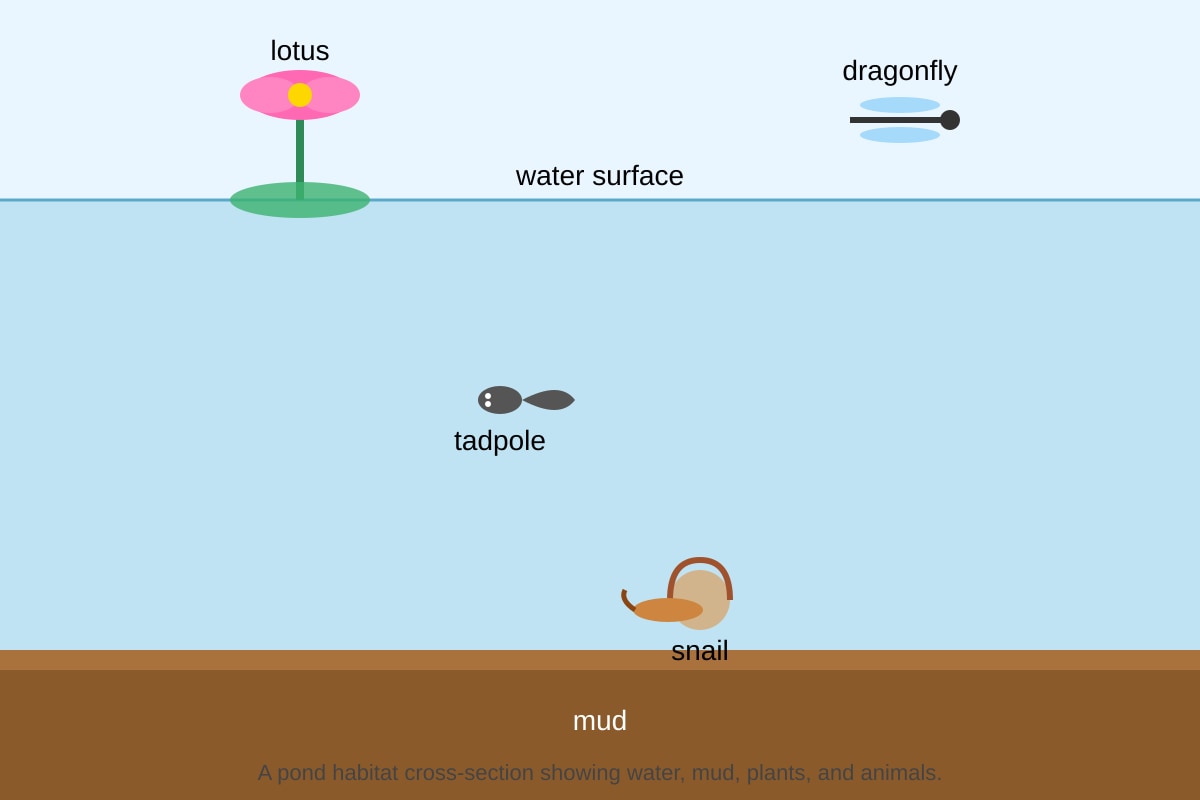
19.
Image pending generation: diagram for 19.
(a) Using the diagram, name two living things that are producers and two that are consumers. [4] (b) Explain how the pond habitat supports diversity of living things. [3]
20. A student wants to classify 5 unknown objects: (1) moss, (2) crow, (3) bread mould, (4) goldfish, (5) bacterium. (a) Place each object into one of these groups: flowering plant, non-flowering plant, vertebrate, invertebrate, fungus, bacterium. [6] (b) State one characteristic that separates the vertebrate from the invertebrate in your list. [2] (c) Give one reason why classification helps scientists. [2]
Answers
TuitionGoWhere Exam Practice (AI) — Science Primary 6 PSLE
SA2 Practice Paper (Version 4) — Answer Key
Topic: Diversity
Total Marks: 60
Section A (10 marks)
1. B [1]
Teaching note: Living things are grouped by body features such as presence of a backbone, not by human objects.
2. B [1]
Teaching note: Birds are the only group listed that have feathers; fish have scales, insects have exoskeletons, worms have soft bodies.
3. C [1]
Teaching note: Pot colour is not a living characteristic; plant classification uses flowers, seeds, leaves.
4. B [1]
Teaching note: Fungi absorb nutrients; plants make food by photosynthesis.
5. C [1]
Teaching note: Fish use gills to take in oxygen from water.
6. B [1]
Teaching note: Frog is an amphibian with a backbone; others are invertebrates.
7. B [1]
Teaching note: Bacteria are single-celled microorganisms.
8. B [1]
Teaching note: Mango tree flowers and produces seeds.
9. B [1]
Teaching note: Pond supports aquatic and semi-aquatic life.
10. B [1]
Teaching note: Classification organises biodiversity for study.
Section B (12 marks)
11. [2]
- Has backbone / vertebral column (1)
- Body covering such as feathers, scales, skin (1)
Teaching note: Vertebrates have internal backbone; invertebrates do not.
12. [2]
- Flowering plants produce flowers and seeds; non-flowering do not produce flowers (2)
OR one correct difference stated clearly.
Teaching note: E.g., ferns are non-flowering and reproduce by spores.
13. [2]
- Pond → frog (1)
- Garden → rose bush (1)
Teaching note: Any two sensible habitat–organism pairs accepted.
14. [2]
- Bacteria are single-celled and do not have the cell structure of plants (1); they do not make food by photosynthesis (1).
Teaching note: They are a separate kingdom.
15. [2]
- Absorb nutrients from surroundings (1)
- Do not have chlorophyll / not green (1)
Teaching note: Mushrooms are examples.
16. [2]
- Small living things include bacteria and fungi which are not insects (1); insects are a specific animal group with 6 legs and exoskeleton (1).
Teaching note: Size alone is not a classification feature.
Section C (28 marks)
17. [6]
(a) Plants: rose bush, fern, hibiscus (1.5); Animals: ant, grasshopper, lizard (1.5)
(b) Invertebrates: ant, grasshopper (1)
(c) By flower presence: flowering (rose, hibiscus) vs non-flowering (fern) (2)
Teaching note: Ferns are non-flowering spore plants.
18. [7]
(a) A and B (1)
(b) D (1)
(c) Snail → B, Sunflower → C, Yeast → D (3)
(d) Group C makes its own food using sunlight, so it is autotroph not heterotroph (2)
Teaching note: Heterotrophs consume others; autotrophs produce own food.
19. [7]
(a) Producers: lotus, (any pond plant shown) (2); Consumers: tadpole, dragonfly, snail (any two) (2)
(b) Pond has water, plants, and shelter supporting different life forms; multiple niches increase diversity (3)
Teaching note: Diagram must show listed labels; answer uses those.
20. [10]
(a) moss → non-flowering plant (1); crow → vertebrate (1); bread mould → fungus (1); goldfish → vertebrate (1); bacterium → bacterium (1); (if crow & goldfish both vertebrate, ok) (1 for correct list total)
(b) Vertebrate has backbone, invertebrate does not (2)
(c) Helps organise knowledge and identify relationships (2)
Teaching note: Moss is non-flowering; bread mould is fungus.
Free quiz and exam paper access
Enter your details to view this paper
Your access is remembered on this device.