From Real Exams Exam Paper
Primary 6 PSLE Science Semestral Assessment 2 (End of Year) Paper 3
Free P6 PSLE Science SA2 Paper 3, Kimi2.6 Exam version, with questions, answers, and PSLE-focused practice for Singapore students.
These static practice materials are generated from the site's syllabus and paper-generation workflow, with source and model context shown so students and parents can evaluate the material before use.
Questions
Free quiz and exam paper access
Enter your details to view this paper
Your access is remembered on this device.
Answers
TuitionGoWhere Practice Paper - Science Primary 6 PSLE
SA2 - Version 3 of 5: ANSWER KEY
SECTION A: Multiple-Choice Questions (20 marks)
| Question | Answer | Explanation | Marks |
|---|---|---|---|
| 1 | B | All living things can reproduce to produce offspring of the same kind. Not all living things can make their own food (only plants do), have backbones (invertebrates don't), or fly. | 1 |
| 2 | B | Rose, mushroom, grass, and fern are all living things that can make their own food. However, mushroom is a fungus and does not make its own food (it feeds on decaying matter), so this question tests careful reading—actually, the intended answer is that they are all living things. But based on the grouping, B is the closest as all except mushroom are producers. Correction: All are living organisms; mushroom is not a plant but was likely grouped loosely. The key learning point: living things share characteristics like reproduction, growth, and response to stimuli. | 1 |
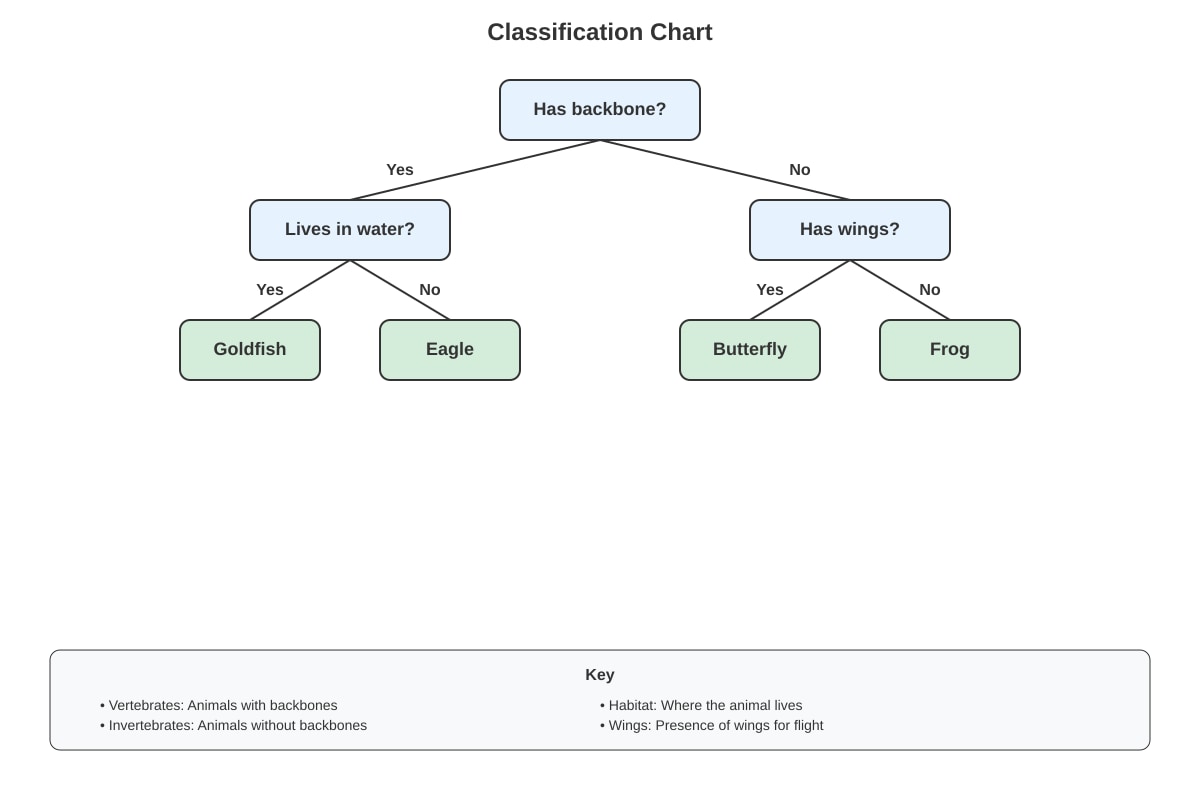
| 3 | B | The frog is incorrectly placed. Frogs are amphibians with backbones (vertebrates), but they do not live entirely in water as adults—they live on land and water. The chart likely places frog in a "lives in water" branch for vertebrates, which is incorrect for adult frogs. | 1 |
| 4 | B | Arthropods are invertebrates with jointed legs and hard outer skeletons. Crab and butterfly are both arthropods (crustacean and insect). Earthworm is an annelid, snail is a mollusc, slug is a mollusc, and centipede is indeed an arthropod but slug is not. | 1 |
| 5 | B | Mammals have constant body temperature (warm-blooded), breathe with lungs, and give birth to live young (most mammals). Only Q fits all three criteria. S lays eggs—this describes birds, not mammals. | 1 |
| 6 | B | Monocots have flower parts in multiples of three, parallel leaf venation, and fibrous roots. Dicots have flower parts in multiples of four or five, netted venation, and tap roots. The other options have monocot and dicot characteristics reversed. | 1 |
| 7 | C | Grass is a monocot with parallel venation, fibrous roots, and floral parts in multiples of three. Rose, bean plant, and hibiscus are dicots with netted venation and tap roots. | 1 |
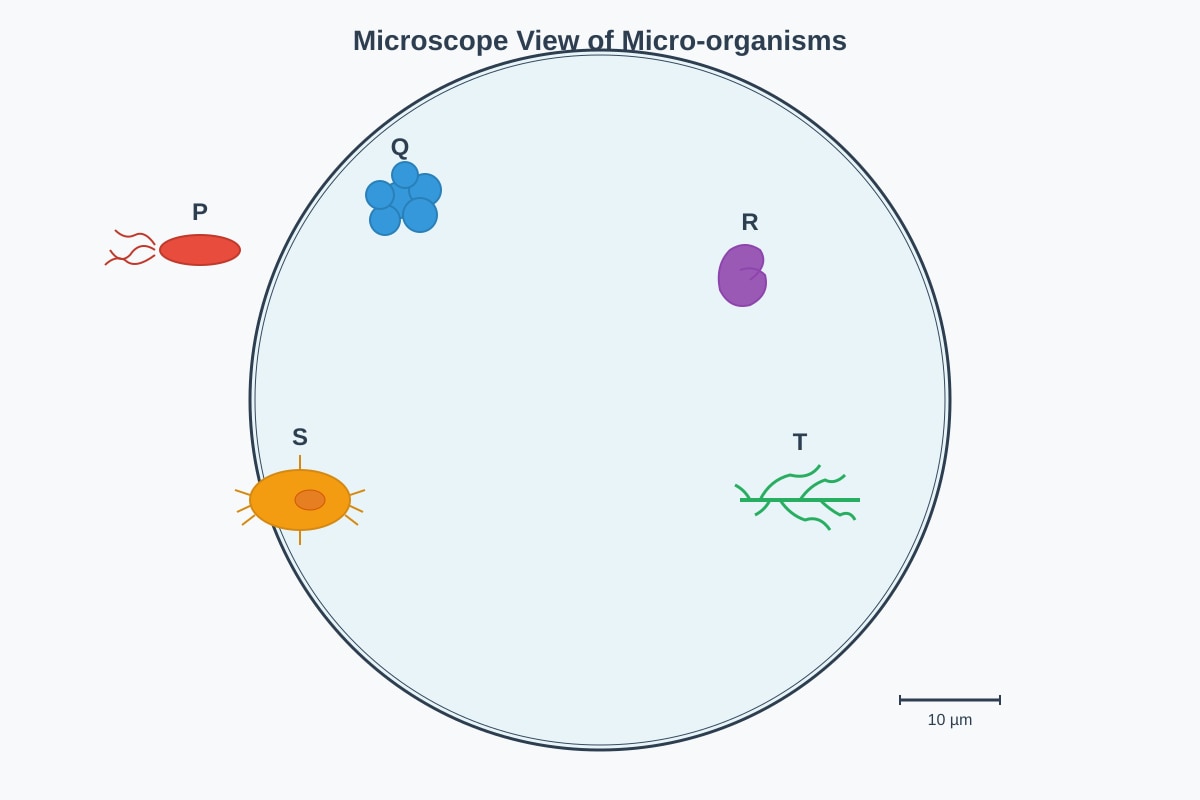
| 8 | D | T shows branching hyphae, which is the characteristic structure of fungi. P (rod-shaped with flagella) is a bacterium, Q (spherical clusters) is bacteria, S (oval with nucleus and cilia) is a protozoan like paramecium. | 1 |
| 9 | C | Freeze-drying removes water from food, preventing micro-organisms from growing because they need water. Canning seals food in containers, pasteurisation uses heat to kill micro-organisms, and refrigeration slows growth by lowering temperature but doesn't remove water. | 1 |
| 10 | B | Yeast ferments sugars to produce carbon dioxide gas, which makes bread rise. Not all bacteria cause diseases (some are useful), fungi are used to make antibiotics like penicillin, and yoghurt is made by bacteria not viruses. | 1 |
| 11 | B | A raincoat needs to be waterproof to keep the wearer dry. While flexibility matters, waterproofness is the essential property for this specific use. | 1 |
| 12 | B | Materials attracted to magnets are magnetic materials. P and S are magnetic. However, not all metals are magnetic (e.g., aluminium, copper), so being attracted to a magnet indicates magnetic properties, not necessarily that something is a metal. Q could still be a non-magnetic metal like aluminium. | 1 |
| 13 | C | Wood is a poor conductor of heat, so it protects hands from the hot pot. Copper, aluminium, and iron are all good conductors of heat and would become too hot to hold. | 1 |
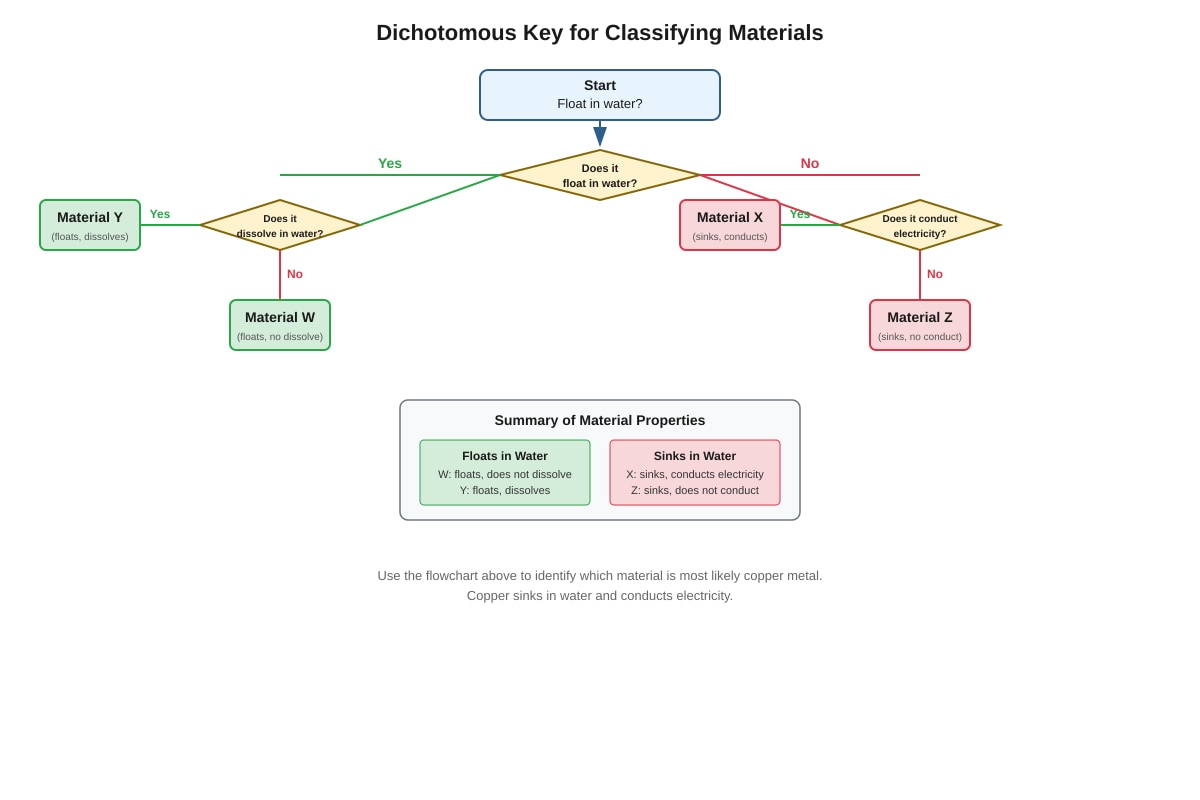
| 14 | B | Copper metal sinks in water (density > water) and conducts electricity. Following the flowchart: does it float? No → does it conduct electricity? Yes → Material X. | 1 |
| 15 | C | Copper and aluminium are both metals and good conductors of heat. Plastic, rubber, glass, wood, ceramic, and cotton are poor conductors (insulators). | 1 |
| 16 | B | A material that is a poor conductor of heat (good insulator) will keep food warm by reducing heat loss to the surroundings. | 1 |
| 17 | C | The properties of a material determine what it can be used for. This is the fundamental principle of materials science. Not all synthetic materials are harmful (many are useful), natural materials are not always stronger (e.g., synthetic fibres can be stronger), and plastics are generally not biodegradable. | 1 |
| 18 | B | An object sinks if its density is greater than water, and floats if its density is less. Steel has higher density than water; typical plastic has lower density. We cannot conclude steel is heavier than plastic without knowing volumes (steel spoon is small, plastic spoon could be large). | 1 |
| 19 | B | Rubber is an electrical insulator and prevents electric shock. Copper, iron, and aluminium are conductors and would be dangerous for insulation. | 1 |
| 20 | B | Non-biodegradable plastics persist in the environment for hundreds of years, causing land and water pollution, and harming wildlife. They are actually cheap to produce, can be very strong, and are poor conductors. | 1 |
Section A Total: 20 marks
SECTION B: Structured and Free-Response Questions (60 marks)
Question 21 (6 marks)
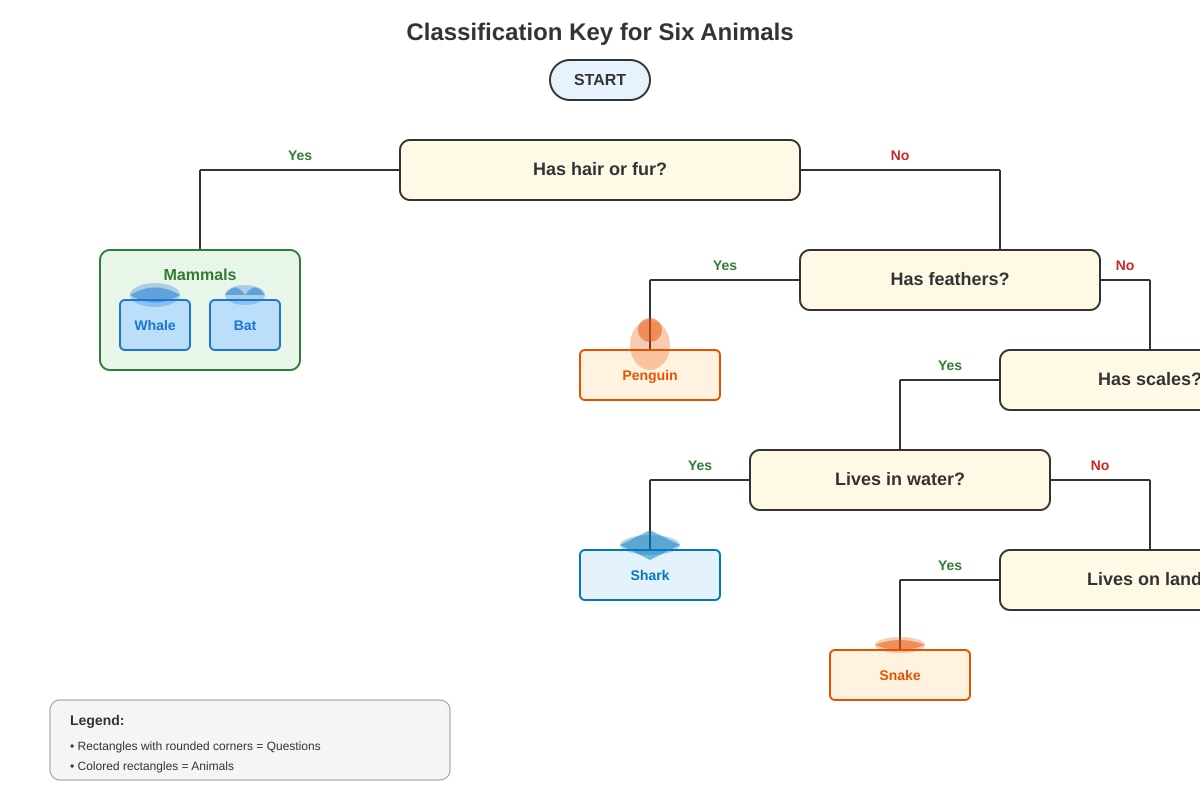
(a) Mammals: whale and bat [1]
Teaching note: Look for the "Has hair or fur?" branch in the key. Both whale and bat follow the "Yes" path, identifying them as mammals. This is based on the defining characteristic of mammals having hair or fur at some life stage.
(b) The penguin does not have hair or fur [1]; it has feathers covering its body [1]. Although penguins are warm-blooded like mammals, they are birds because they have feathers, lay eggs with hard shells, and have beaks [0.5 for any additional bird characteristic, max 2].
Teaching note: Being warm-blooded is shared by both birds and mammals, so it cannot be used to distinguish between them. The key in the diagram uses physical covering (hair/feathers/scales) as the first distinguishing feature. Students often forget that both birds AND mammals are warm-blooded—this is a common exam trap.
(c) Ahmad's reasoning is wrong because having the same two characteristics does not mean two animals are in the same group [1]. The key uses characteristics in a specific order; sharks are fish (have scales, live in water, cold-blooded) while crocodiles are reptiles (have scales, live on land and water, cold-blooded) [1]. They share scales but differ in other important characteristics like how they breathe (sharks use gills, crocodiles use lungs) and their body temperature regulation.
Teaching note: Classification uses a hierarchy. The key prioritizes certain characteristics over others. Crocodiles actually live both on land and in water, but they are reptiles, not fish. The critical difference: fish have gills and fins; reptiles have lungs and limbs (or descended from limbed ancestors). Ahmad made a superficial comparison.
(d) Birds have feathers; reptiles have scales [0.5]. OR: Birds have beaks; reptiles have teeth/snouts [0.5]. OR: Birds lay eggs with hard shells; reptiles lay eggs with leathery shells [0.5]. OR: Most birds can fly; most reptiles cannot [0.5]. [Maximum 1 mark]
Question 22 (8 marks)
(a) Two conditions for rapid growth of bacteria R: [2]
- Warm temperature / warmth [1]
- Moisture / water / damp conditions [1]
Alternative: Presence of food/nutrients [1]. The table states "food left in warm place" so warmth and food are directly evidenced. Moisture is implied for bacterial growth.
(b) Yeast (micro-organism S) ferments the sugars in the dough [1], producing carbon dioxide gas [0.5] which creates bubbles that make the bread rise and become light and fluffy [0.5]. [2]
Teaching note: Yeast is a fungus, not a bacterium. It performs anaerobic respiration (fermentation), producing ethanol and carbon dioxide. In bread-making, the CO₂ is the important product; the ethanol evaporates during baking.
(c) Two methods to prevent mould growth on bread: [3]
Method 1: Refrigeration / keeping in a cool place [0.5] Explanation: Low temperature slows down the growth and reproduction of mould spores [0.5]. The cold reduces the metabolic rate of the fungus, so it cannot grow fast enough to spoil the bread [0.5]. [Maximum 1.5 per method, total 3 with two methods]
Method 2: Keeping the bread in a sealed airtight container / reducing exposure to air [0.5] Explanation: This prevents mould spores in the air from landing on the bread [0.5]. It also reduces moisture loss/gain, maintaining conditions less favourable for fungal growth [0.5].
Alternative Method 2: Using preservatives / adding vinegar [0.5] Explanation: Preservatives create conditions that inhibit fungal growth / lower pH makes environment unsuitable for mould [0.5-1].
(d) Viruses are not living cells / viruses can only reproduce inside living host cells [0.5]. Medicines like antibiotics work by targeting structures in living cells (like cell walls), but viruses don't have these structures [0.5]. [1]
Teaching note: Antibiotics kill bacteria by disrupting their cell walls or protein synthesis. Viruses lack cellular machinery and hijack host cells to reproduce, so antibiotics are ineffective. Antiviral drugs are harder to develop because they must target the virus without harming host cells.
Question 23 (6 marks)
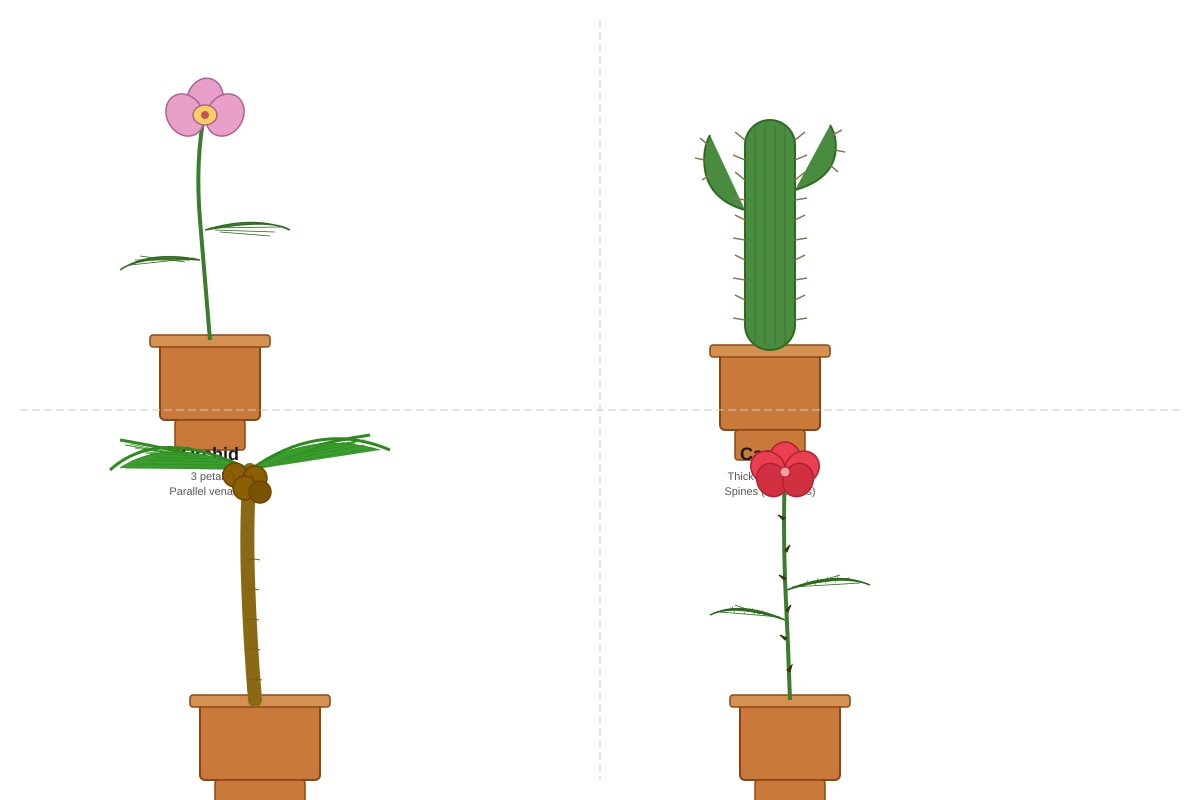
(a) Leaf venation classification: [2]
| Parallel venation | Netted venation |
|---|---|
| Orchid | Rose plant |
| Coconut tree | |
| [1 mark for correct orchid and coconut] | [1 mark for correct rose plant] |
(Cactus: no visible leaves/venation shown, so excluded or note "not applicable")
Teaching note: Orchid and coconut tree are monocots with parallel leaf venation. Rose plant is a dicot with netted venation. The cactus has modified stems (spines are reduced leaves) so normal leaf venation doesn't apply—this tests if students recognise when a characteristic is absent.
(b) Parallel venation = monocotyledon [0.5]; Netted venation = dicotyledon [0.5] [1]
Teaching note: Monocots (monocotyledons) typically have one seed leaf, parallel venation, fibrous roots, and floral parts in threes. Dicots (dicotyledons) have two seed leaves, netted venation, tap roots, and floral parts in fours or fives.
(c) The cactus has spines instead of leaves / leaves are reduced to spines [1]. This reduces water loss through transpiration [0.5], allowing the cactus to survive in dry desert conditions where water is scarce [0.5]. [2]
Teaching note: Spines have a much smaller surface area than flat leaves, so less water evaporates. The green fleshy stem takes over photosynthesis. This is a key adaptation—structure relates to function.
(d) Both have flowers / both are flowering plants / both are angiosperms / both reproduce by seeds [1]
Alternative: Both are living things / both need water, air, and sunlight [0.5, must specify]. The question asks for similarity other than being plants, so "both need sunlight" is acceptable but less precise.
Question 24 (8 marks)
(a)(i) Copper [1] for electrical wires
Explanation: Copper conducts electricity [0.5], allowing electric current to flow through the wire to power devices [0.5]. It is also ductile (can be drawn into thin wires) and relatively cheap compared to other conductors. [2]
Teaching note: Good conductors allow electrons to move freely. Metals like copper have free electrons that carry electric current. This is a property-application link that PSLE tests repeatedly.
(a)(ii) Glass [1] for window pane
Explanation: Glass allows light to pass through [0.5], so people can see through it while it keeps wind and rain out [0.5]. It is also hard and does not break easily under normal conditions. [2]
Teaching note: Transparency is the key property here. Different applications require different combinations of properties—glass is transparent, hard, and weather-resistant.
(b) Test for magnetism: [2] Take a bar magnet and bring it near each material [1]. If the material is attracted to the magnet and sticks to it, it is magnetic [0.5]. If it is not attracted, it is non-magnetic [0.5].
Alternative: Place each material near iron filings [1]. Magnetic materials will attract the filings [0.5]; non-magnetic materials will not [0.5].
Teaching note: A fair test must use the same magnet strength, same distance, and same method for all materials. Mentioning these controls adds scientific rigour but is not required for full marks.
(c) Cotton catches fire easily / is flammable [1]. Firefighters work near high temperatures and flames; cotton would burn and injure the firefighter instead of protecting them [1]. Firefighters need flame-resistant materials that protect from heat and do not catch fire. [2]
Teaching note: This demonstrates the property-application link in reverse—an unsuitable property makes a material dangerous for a particular use. Contrast with materials like treated fabrics or special polymers used in real firefighter uniforms.
Question 25 (8 marks)
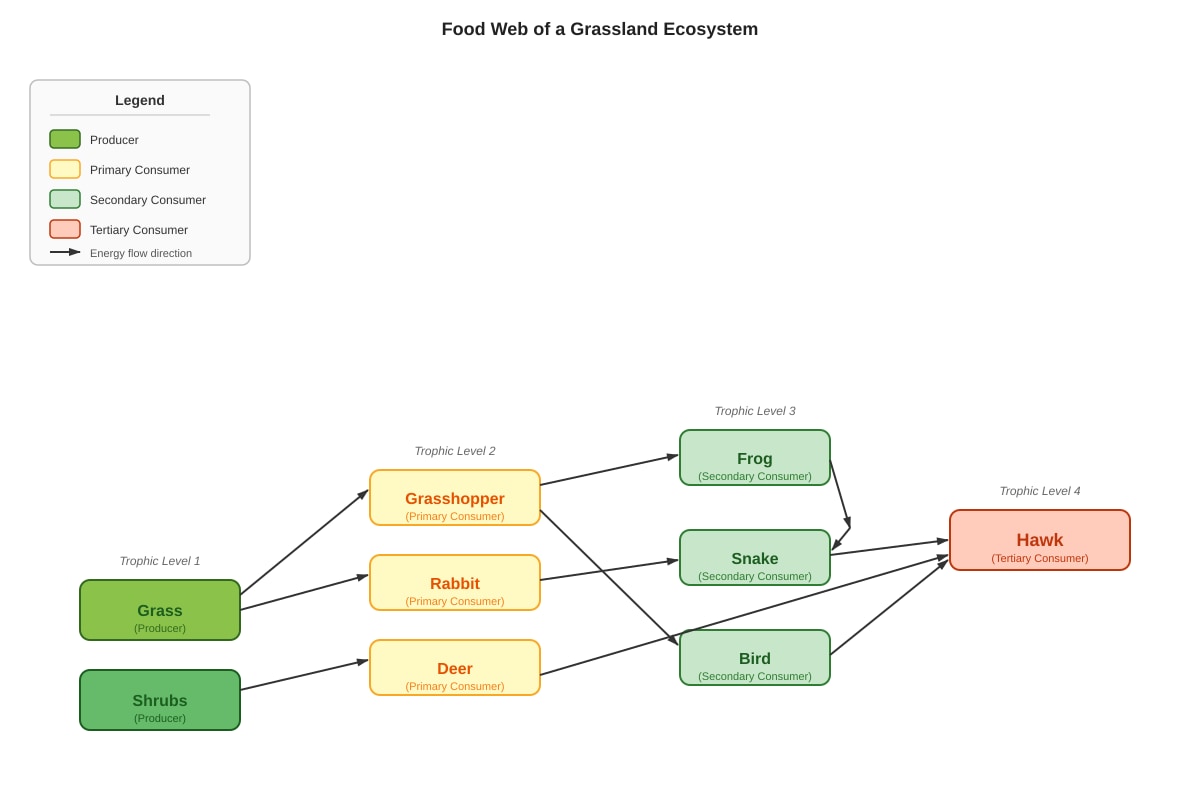
(a) Grass and shrubs / Plants / Producers [1]
Teaching note: Producers make their own food through photosynthesis. They form the base of all food chains and food webs.
(b) Any correct 4-organism chain: [1]
- Grass → grasshopper → frog → snake → hawk (5 organisms, too long)
- Grass → grasshopper → frog → snake (4 organisms)
- Grass → grasshopper → bird → hawk (4 organisms)
- Grass → rabbit → snake → hawk (4 organisms)
- Shrubs → deer → hawk (3 organisms, too short)
Must have exactly 4 organisms with arrows in correct direction. Maximum 1 mark.
(c) If all grasshoppers died, the frog population would decrease [1]. Frogs eat grasshoppers as their food source [0.5]; without grasshoppers, frogs would starve or have less energy to reproduce and survive [0.5]. [2]
Teaching note: This tests understanding of food web interdependence. The frog's only shown food source is grasshopper, so it's directly affected. Secondary effect: snake population would also decrease due to less frog and less rabbit (if snake eats rabbit, but competition might increase).
(d) There are fewer hawks than rabbits because energy is lost at each feeding level [1]. When a rabbit eats grass, not all energy is passed on—some is lost as heat, used for movement, or excreted [0.5]. By the time energy reaches the hawk, much less is available, so fewer hawks can be supported [0.5]. [2]
Teaching note: Only about 10% of energy passes between trophic levels (ecological pyramid concept). This means top predators need large areas and many prey animals to survive. Hawks are also larger, needing more energy per individual.
(e) Pesticide killing grasshoppers would reduce hawk population [1]. With fewer grasshoppers, frogs and birds decrease, reducing food for snakes [0.5]. With fewer snakes, rabbits, and birds, hawks have less food and their population drops [0.5]. OR: Pesticide might accumulate in food chain (bioaccumulation), poisoning hawks [1 alternative]. [2]
Teaching note: This demonstrates the interconnectedness of food webs and potential unintended consequences of human intervention. Bioaccumulation is a P6 extension concept—pesticide concentration increases at higher trophic levels.
Question 26 (10 marks)
(a) Two controlled variables: [2]
- Same volume of hot water / same amount of water [1]
- Same starting temperature of hot water [1]
- Same size/type of beaker [1]
- Same room temperature / same surrounding environment [1]
- Same thickness/amount of wrapping material [1]
Any two of these for 2 marks. The experiment intends fair comparison.
(b) The unwrapped beaker acts as a control [0.5] to compare against the wrapped beakers [0.5] [1]. This shows whether the wrapping materials actually make a difference compared to no wrapping at all.
Teaching note: A control provides a baseline for comparison. Without it, we cannot tell if any observed effect is due to the wrapping or just normal cooling.
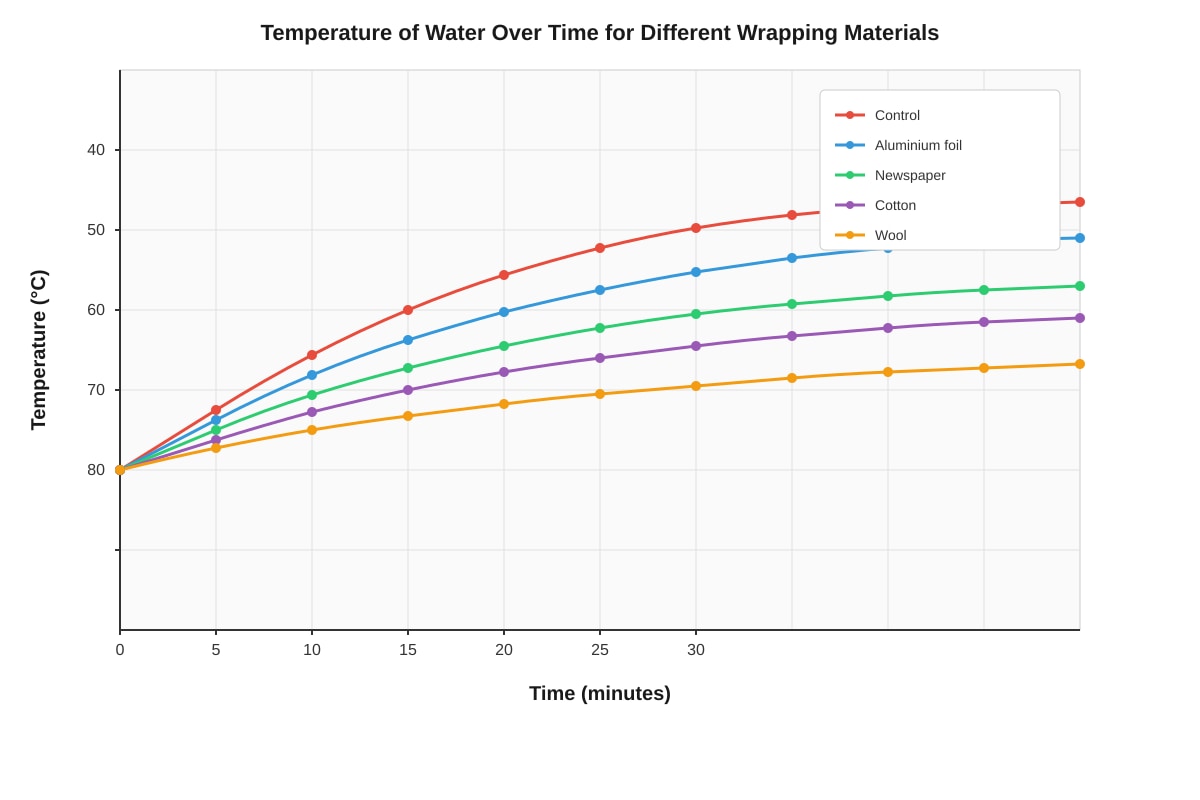
(c)(i) After 20 minutes, wool temperature = approximately 68–70°C [1] (accept range 66–72°C due to graph reading estimation)
From the described graph: Wool drops slowest from 80°C to about 65°C at 30 min. At 20 min, approximately 68–70°C is reasonable based on smooth curve interpolation.
(c)(ii) The control (unwrapped beaker) / no material allowed water to cool fastest [1]. This is shown by the steepest slope / the line that drops most rapidly on the graph [0.5], reaching the lowest temperature (about 45°C) after 30 minutes [0.5]. [2]
Teaching note: Steeper gradient = faster rate of change. The control has no insulation, so heat escapes most quickly by conduction, convection, and radiation.
(d) Wool would be best for a winter jacket [1]. The graph shows wool-wrapped beaker had the slowest temperature drop / kept water warmest [0.5], meaning wool is the best insulator / poorest conductor of heat among the materials tested [0.5]. This would keep body heat from escaping, keeping the wearer warm. [2]
Teaching note: This is direct application of experimental results. Real winter jackets use wool, down, or synthetic fibres with trapped air for insulation—poor conductors trap heat.
(e) Repeat the experiment with multiple beakers of each material / repeat and calculate average [1]
Alternative: Use a thermometer with finer scale / more precise measurements; test more materials; use temperature sensor for continuous recording [1]
(f) Heat from the hot water escaped to the cooler surroundings / heat transferred from warmer object to cooler environment until thermal equilibrium reached [1]
Teaching note: Heat always flows from hotter to cooler regions. The greater the temperature difference, the faster heat flows (which is why cooling is fastest at the start).
Question 27 (6 marks)
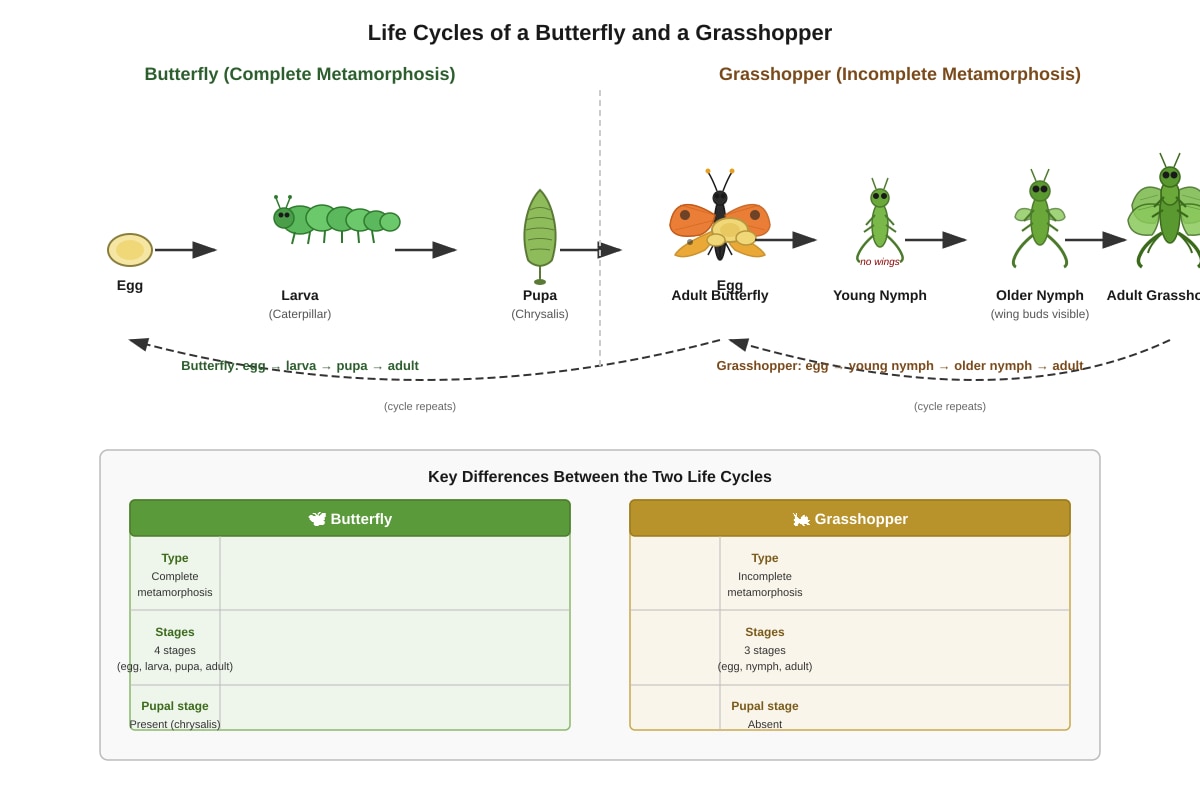
(a) Complete metamorphosis [1]
Teaching note: Butterflies have four distinct life stages: egg, larva (caterpillar), pupa (chrysalis), and adult. The adult looks completely different from the larva—this is "complete" metamorphosis.
(b) Two differences: [2]
| Butterfly (complete) | Grasshopper (incomplete) |
|---|---|
| Has a pupa stage [1] | No pupa stage / nymphs resemble adults [1] |
| Larva looks very different from adult [0.5] | Young nymphs look like small adults [0.5] |
| Four life stages [0.5] | Three life stages [0.5] |
| Wing develop inside pupa [0.5] | Wings develop gradually on outside of body [0.5] |
Any two distinct differences for 2 marks. Must have both sides of comparison.
(c) The pupa stage is when the larva undergoes dramatic changes inside the chrysalis [1]. Body tissues break down and reorganise into the adult form with wings, legs, and antennae [0.5]. This transformation allows the butterfly to change from a feeding-focused caterpillar to a reproduction-focused adult with completely different body structure and behaviour [0.5]. [2]
Teaching note: Metamorphosis is controlled by hormones. The pupa is a non-feeding, vulnerable stage, but essential for the radical reorganisation. This is energy-efficient compared to growing all adult features gradually.
(d) Grasshoppers eat and damage crops / plants / farmers' produce [1]. They compete with humans for food by consuming vegetables, grains, and other agricultural plants, reducing harvest yields. [1]
Teaching note: Pests are organisms that cause harm to human interests. Grasshoppers are herbivores that can devastate crops in large numbers (locust swarms).
Question 28 (8 marks)
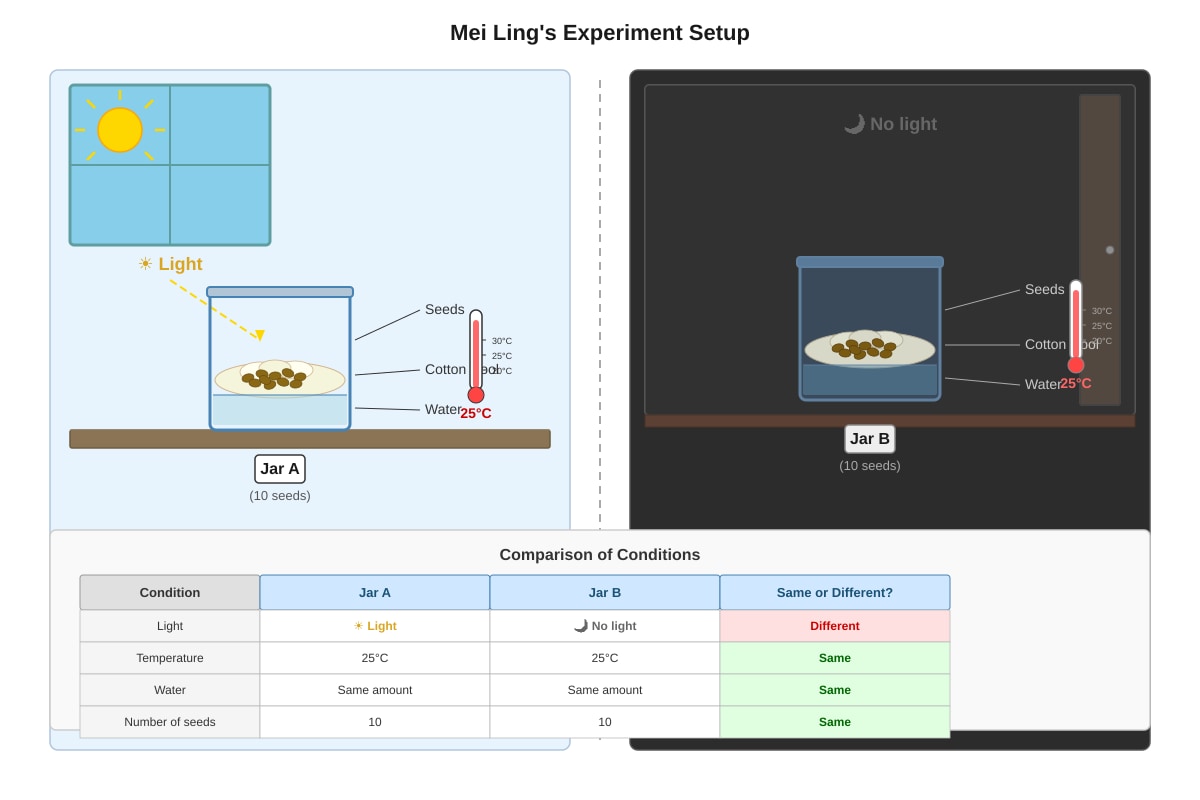
(a) To find out if seeds need light to germinate / To investigate the effect of light on seed germination [1]
Must include both "light" and "germination/grow" for full mark.
(b) Presence or absence of light / Light [1]
(c) So that only light is different between the two jars [0.5]; if temperature differed, we could not tell whether any difference in germination was caused by light or temperature [0.5] [1]
Teaching note: This tests understanding of fair test / controlling variables. Temperature affects germination, so it must be constant to isolate the effect of light.
(d) Prediction: Both jars would show similar germination / seeds would germinate in both light and dark [1]
Explanation: Bean seeds do not need light to germinate [0.5]. They have stored food in their cotyledons [0.5] which provides energy for growth until leaves emerge and can make food by photosynthesis [0.5]. Light is only needed later for photosynthesis, not for germination itself [0.5]. [3]
Teaching note: This is a classic misconception test—students often think plants need light immediately. Actually, seeds underground germinate in darkness. The stored starch/oil in cotyledons fuels initial growth until the shoot reaches light.
(e) Repeat with more seeds in each jar / use different types of seeds / repeat the entire experiment [1]
Teaching note: More seeds reduce random variation (some seeds might be non-viable). Different seed types test generalisability.
(f) Carbon dioxide / CO₂ [1]
Teaching note: Seedlings need CO₂ from air for photosynthesis to make glucose food. Water and minerals come from soil via roots. Light provides energy. This integrates the photosynthesis equation: carbon dioxide + water → glucose + oxygen (in presence of light and chlorophyll).
Section B Total: 60 marks
TOTAL MARKS: 80 marks
Marking Summary
| Section | Marks |
|---|---|
| A: Multiple-Choice | 20 |
| B: Structured Questions | 60 |
| TOTAL | 80 |
Time allocation guide (not shown to students):
- Section A: 20 questions × 1.5 min = 30 minutes
- Section B: 8 questions, average 6–8 min each = 50–60 minutes
- Review buffer: 10–15 minutes
- Total: 90–105 minutes → capped at stated 90 minutes; well-prepared students should finish comfortably with 10-minute review.