From Real Exams Exam Paper
Primary 6 PSLE Science Semestral Assessment 2 (End of Year) Paper 3
Free P6 PSLE Science SA2 Paper 3, HY3 Exam version, with questions, answers, and PSLE-focused practice for Singapore students.
These static practice materials are generated from the site's syllabus and paper-generation workflow, with source and model context shown so students and parents can evaluate the material before use.
Questions
Free quiz and exam paper access
Enter your details to view this paper
Your access is remembered on this device.
Answers
TuitionGoWhere Exam Practice (AI) - Science Primary 6 PSLE
Paper: SA2 Practice Paper (Version 3 of 5)
Answer Key with Teaching Notes
Section A (10 marks)
1. B (1 mark)
Teaching: Diversity means differences among living things. Different leaf shapes show variation in plants. A, C, D are non-living or single actions, not diversity.
2. C (1 mark)
Teaching: Producers (plants) make food by photosynthesis. Consumers eat others; decomposers break dead matter; predators are a type of consumer.
3. B (1 mark)
Teaching: Population = same kind of organisms in one place. A is organism; C is community+habitat; D is cell level.
4. C (1 mark)
Teaching: Diversity comes from different DNA, not same DNA. A, B, D are real reasons for diversity.
5. B (1 mark)
Teaching: Habitat supports a community (many populations). Mangrove has plants, animals, decomposers.
6. B (1 mark)
Teaching: Decomposers break down dead organisms. A is predator; C is producer; D false.
7. B (1 mark)
Teaching: Structural = body features. Long tail and sticky toes are body parts, not actions.
8. C (1 mark)
Teaching: Reforestation is positive. Others are negative impacts.
9. A (1 mark)
Teaching: Rocks of different colours show non-living diversity. B, C, D show no diversity.
10. B (1 mark)
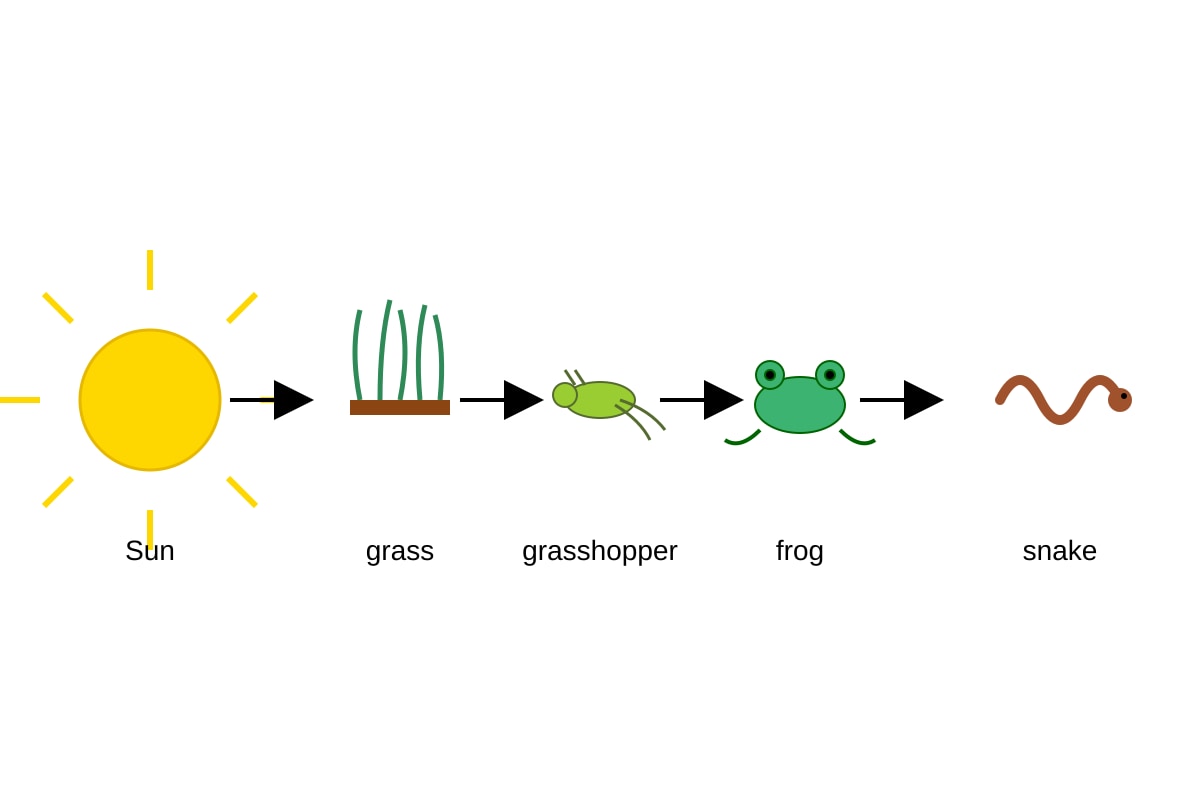
Teaching: Food chain shows energy flow Sun → producer → consumer.
Section B (12 marks)
11. (2 marks)
Answers: Temperature, light, water (any two).
Marking: 1 mark each correct characteristic.
Teaching: Physical factors are non-living parts of environment that organisms need.
12. (2 marks)
Answers: Community = many populations living together; population = one kind only.
Marking: 1 mark for community definition, 1 mark for population contrast.
Teaching: Pond community includes plants, frogs, bacteria etc. Frog population is only frogs.
13. (2 marks)
Answers: Structural: e.g. thick fur; Behavioural: e.g. hibernating.
Marking: 1 mark each.
Teaching: Structural = body part; behavioural = action.
14. (2 marks)
Answers: Deforestation, pollution (land/water/air), global warming (any two).
Marking: 1 mark each.
Teaching: Negative impacts harm environment.
15. (2 marks)
Answers: Producer = grass; Decomposer = mushrooms.
Marking: 1 mark each.
Teaching: Grass makes food; mushrooms break down dead matter.
16. (2 marks)
Answers: Many species help balance, some survive if conditions change, food webs stable.
Marking: 2 marks for valid reason (1+1).
Teaching: Diversity means if one species dies, others can fill role.
Section C (18 marks)
17. (3 marks)
Expected visual: arrows Sun→grass→grasshopper→frog→snake.
Answers: Producer = grass; Consumer = grasshopper/frog/snake; Predator of grasshopper = frog.
Marking: 1 mark each.
Teaching: Producer first, consumers eat others, frog eats grasshopper.
18. (2 marks)
Answers: Seaweed is producer (makes food), crab is consumer (eats others) → different roles show diversity.
Marking: 1 mark seaweed role, 1 mark crab role.
Teaching: Roles in community show diversity of functions.
19. (3 marks)
Answers: (1) Some organisms die; (2) Some move away; (3) Some adapt. Any two.
Marking: 1.5 marks each.
Teaching: Unfavourable environment → die/move/adapt.
20. (3 marks)
Answers: Similar: both have communities with producers, consumers, decomposers. Different: different organisms, e.g. pond has fish, mangrove has roots plants/crabs.
Marking: 1 mark similar, 2 marks different examples.
Teaching: Communities differ by habitat but share organisation levels.