From Real Exams Exam Paper
Primary 6 PSLE Science Semestral Assessment 2 (End of Year) Paper 2
Free Exam-Derived Owl Alpha Primary 6 PSLE Science Semestral Assessment 2 (End of Year) Paper 2 practice paper with questions and answers for Singapore students. This page is rendered as a direct URL so the questions and answers can be discovered without pressing in-page buttons.
These static practice materials are generated from the site's syllabus and paper-generation workflow, with source and model context shown so students and parents can evaluate the material before use.
Questions
TuitionGoWhere Practice Paper - Science Primary 6 PSLE
TuitionGoWhere Secondary School (AI)
| Subject: | Science |
| Level: | Primary 6 PSLE |
| Paper: | SA2 — Version 2 of 5 |
| Duration: | 1 hour 45 minutes |
| Total Marks: | 60 |
Name: ________________________
Class: ________________________
Date: ________________________
Instructions
- This paper consists of Section A, Section B, and Section C.
- Section A: Multiple-choice questions (20 marks) — Questions 1–20.
- Section B: Structured questions (25 marks) — Questions 21–30.
- Section C: Free-response questions (15 marks) — Questions 31–35.
- Answer all questions.
- Write your answers in the spaces provided.
- The use of calculators is not allowed.
Section A: Multiple-Choice Questions [20 marks]
For each question, choose the most suitable answer (A, B, C, or D).
1. Which of the following is a characteristic that helps a polar bear survive in the Arctic?
A. Thin fur to stay cool B. White fur for camouflage C. Large ears to release heat D. Short legs to move slowly
2. The diagram below shows four organisms.
[Image description: A cactus, a water lily, a camel, and a polar bear.]
Which organism is best adapted to survive in a hot, dry desert?
A. Cactus B. Water lily C. Camel D. Both A and C
3. Which of the following groups of living things are plants?
A. Fern, mushroom, moss B. Algae, fern, moss C. Yeast, algae, fern D. Moss, mushroom, yeast
4. A student classified four animals as shown below.
| Group X | Group Y |
|---|---|
| Frog | Eagle |
| Salamander | Bat |
Which characteristic was most likely used to classify the animals?
A. Whether they can fly B. Whether they have feathers C. Whether they have a backbone D. Whether they have moist skin
5. Which of the following is not a characteristic of all living things?
A. They can move B. They can reproduce C. They need air, food, and water D. They can grow
6. The diagram shows a food chain.
Grass → Grasshopper → Frog → Snake
Which statement about the food chain is correct?
A. The grasshopper is the predator of the frog. B. The snake is the prey of the grasshopper. C. Energy flows from the grass to the snake. D. The frog is a producer.
7. Which of the following is a mammal?
A. Penguin B. Crocodile D. Dolphin D. Lizard
8. A student observed an organism with the following characteristics:
- It has feathers.
- It has a beak.
- It lays eggs.
- It has wings.
The organism is most likely a
A. bat. B. butterfly. C. bird. D. bee.
9. Which of the following correctly classifies the organisms?
| Vertebrate | Invertebrate | |
|---|---|---|
| A | Fish, frog | Spider, crab |
| B | Spider, crab | Fish, frog |
| C | Fish, spider | Frog, crab |
| D | Frog, crab | Fish, spider |
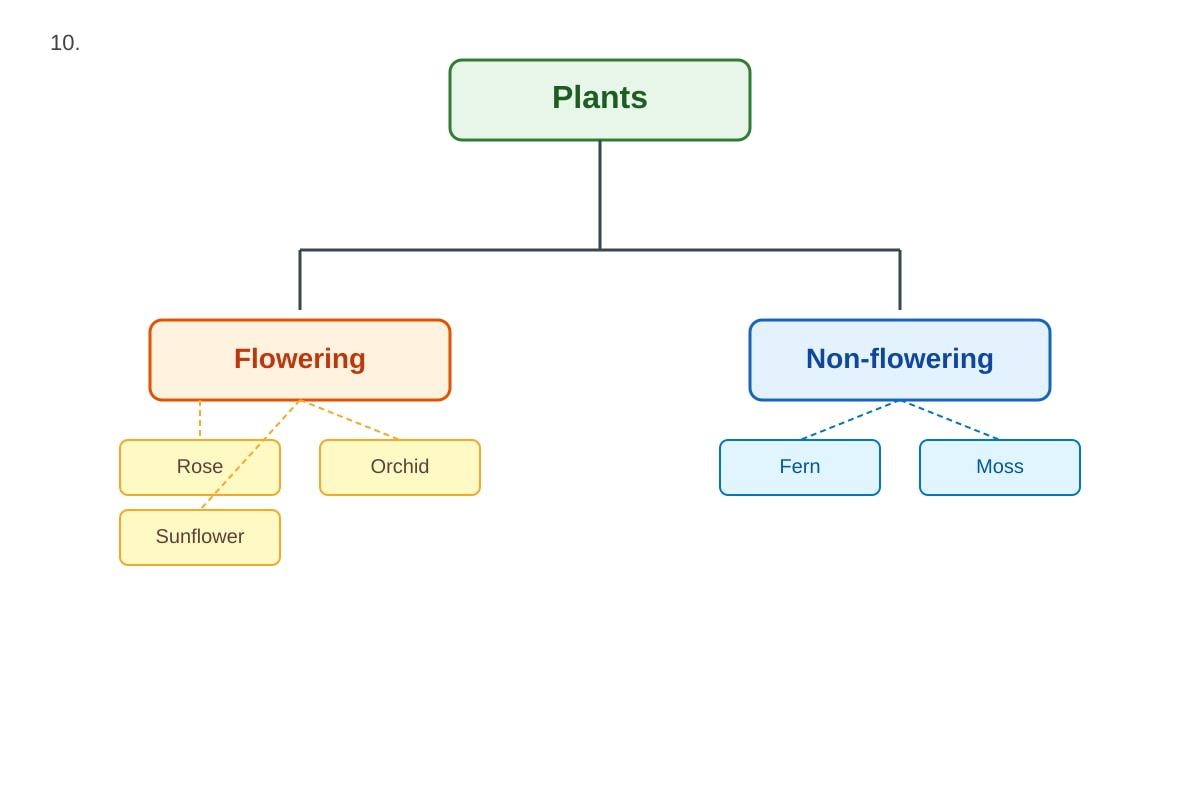
10. The diagram shows a classification of plants.
[Image description: A flow chart showing "Plants" branching into "Flowering" and "Non-flowering."]
Which organism belongs in the "Non-flowering" group?
A. Rose B. Orchid C. Fern D. Sunflower
11. Which of the following is a fungus?
A. Algae B. Mushroom C. Fern D. Moss
12. A food web shows that a hawk eats both mice and snakes. If the number of snakes decreases, what will most likely happen to the number of mice?
A. The number of mice will decrease. B. The number of mice will increase. C. The number of mice will remain the same. D. The number of mice will first increase then decrease.
13. Which adaptation helps a fish survive in water?
A. Lungs for breathing B. Gills for breathing C. Wings for swimming D. Legs for walking
14. Which of the following is a producer in a food chain?
A. Grasshopper B. Grass C. Frog D. Snake
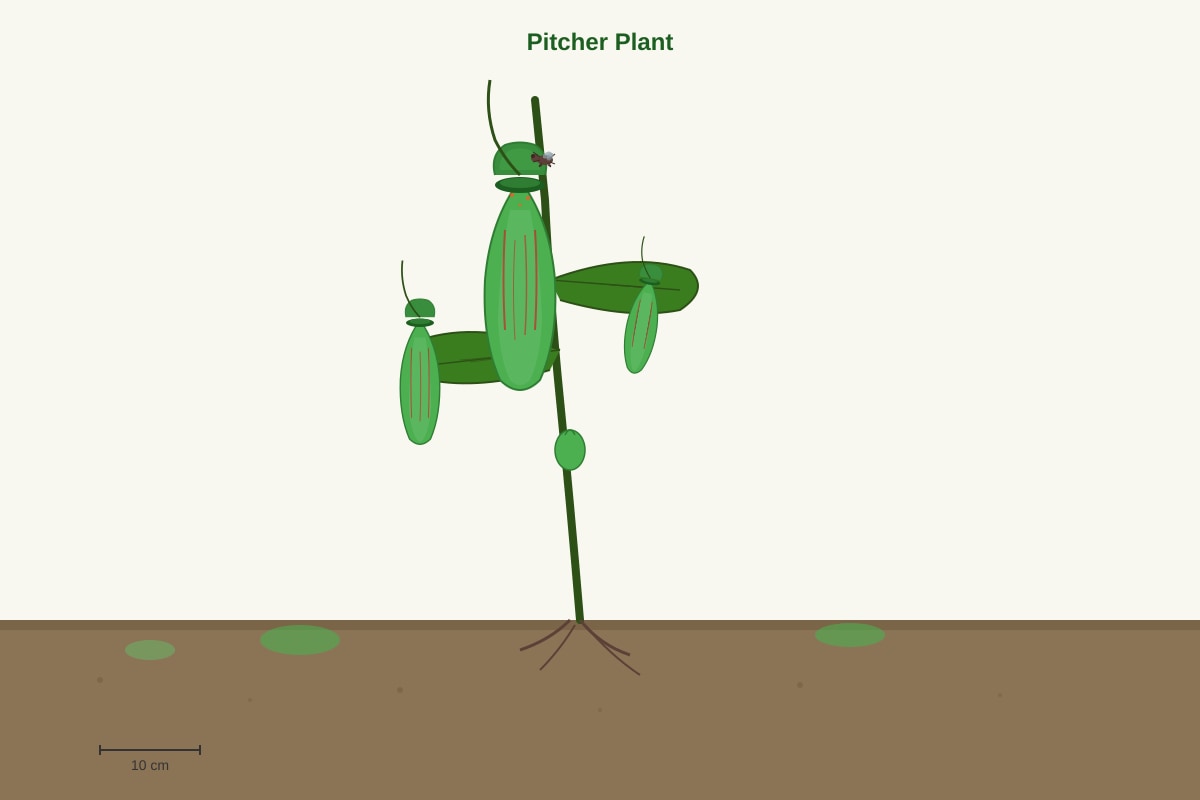
15. The diagram shows an organism.
[Image description: A picture of a pitcher plant.]
The pitcher plant can trap and digest insects. This adaptation helps the plant obtain
A. water. B. sunlight. C. nutrients. D. oxygen.
16. Which of the following groups contains only invertebrates?
A. Ant, spider, earthworm B. Fish, ant, spider C. Earthworm, fish, ant D. Spider, fish, earthworm
17. In a food web, which organism is a secondary consumer?
A. Grass B. Rabbit C. Fox D. Mushroom
18. Which of the following is a characteristic of all birds?
A. They can fly. B. They have feathers. C. They live in nests. D. They eat seeds.
19. A student grouped the following organisms: bacteria, yeast, and mushroom. These organisms are grouped together because they
A. are all plants. B. are all animals. C. do not have a backbone. D. do not make their own food.
20. Which of the following food chains is correct?
A. Grass → Rabbit → Fox → Eagle B. Eagle → Fox → Rabbit → Grass C. Rabbit → Grass → Fox → Eagle D. Fox → Grass → Eagle → Rabbit
Section B: Structured Questions [25 marks]
Answer all questions. Write your answers in the spaces provided.
21. [3 marks]
The table below shows the characteristics of four organisms (P, Q, R, and S).
| Organism | Has backbone | Has feathers | Has scales | Lays eggs |
|---|---|---|---|---|
| P | ✓ | ✗ | ✓ | ✓ |
| Q | ✓ | ✓ | ✗ | ✓ |
| R | ✗ | ✗ | ✗ | ✗ |
| S | ✗ | ✗ | ✓ | ✓ |
(a) Which organism is most likely a bird? Explain your answer. [2 marks]
(b) Which organism is most likely an insect? Explain your answer. [1 mark]
22. [3 marks]
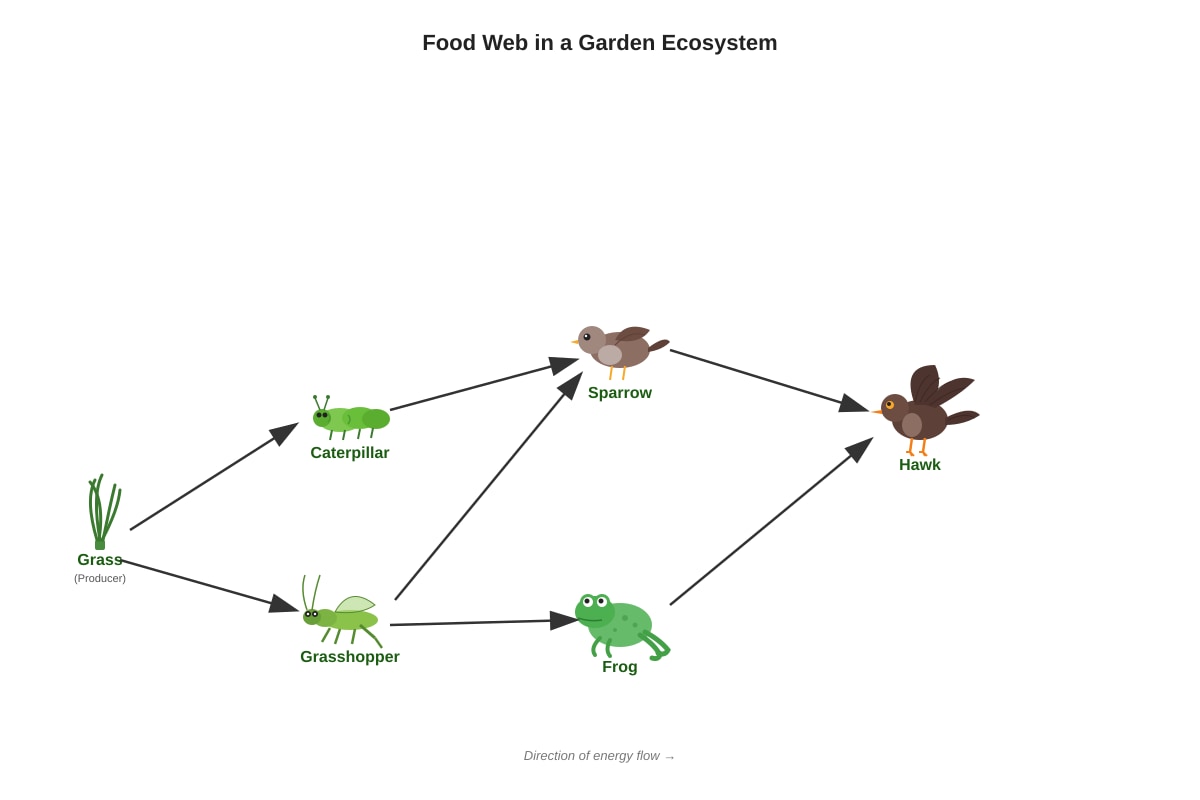
The diagram below shows a simple food web in a garden ecosystem.
[Image description: A food web showing: Grass → Caterpillar → Sparrow → Hawk; Grass → Grasshopper → Sparrow; Grass → Grasshopper → Frog → Hawk.]
(a) Name the producer in this food web. [1 mark]
(b) Name two secondary consumers in this food web. [2 marks]
23. [3 marks]
Study the following organisms: bat, whale, shark, and crocodile.
(a) Classify these organisms into mammals and non-mammals. [2 marks]
| Mammals | Non-mammals |
|---|---|
(b) Give one characteristic that distinguishes mammals from the other group. [1 mark]
24. [4 marks]
The diagram shows two plants, Plant X and Plant Y.
[Image description: Plant X has broad, flat leaves and shallow roots. Plant Y has needle-like leaves and deep roots.]
Plant X grows in a wet environment. Plant Y grows in a cold, dry environment.
(a) Explain how the needle-like leaves of Plant Y help it survive in a cold, dry environment. [2 marks]
(b) Explain how the broad, flat leaves of Plant X help it survive in a wet environment. [2 marks]
25. [3 marks]
A student conducted an experiment to study the diversity of organisms in two different habitats: a garden and a pond.
The results are shown below.
| Organism | Garden | Pond |
|---|---|---|
| Ant | 15 | 0 |
| Dragonfly | 3 | 8 |
| Grasshopper | 10 | 0 |
| Water lily | 0 | 5 |
| Fish | 0 | 12 |
(a) Which habitat has a greater diversity of organisms? Explain your answer. [2 marks]
(b) Explain why no fish were found in the garden. [1 mark]
26. [3 marks]
The diagram shows a food chain in a forest.
Leaves → Caterpillar → Bird → Wild Cat
(a) What will happen to the number of birds if the number of caterpillars decreases? Explain your answer. [2 marks]
(b) What will happen to the number of wild cats in the long term? Explain your answer. [1 mark]
27. [3 marks]
Study the classification table below.
| Group 1 | Group 2 | Group 3 |
|---|---|---|
| Eagle | Shark | Spider |
| Sparrow | Whale | Ant |
| Bat | Crocodile | Earthworm |
(a) Name one characteristic used to classify organisms in Group 1. [1 mark]
(b) Name one characteristic used to classify organisms in Group 2. [1 mark]
(c) Name one characteristic used to classify organisms in Group 3. [1 mark]
28. [3 marks]
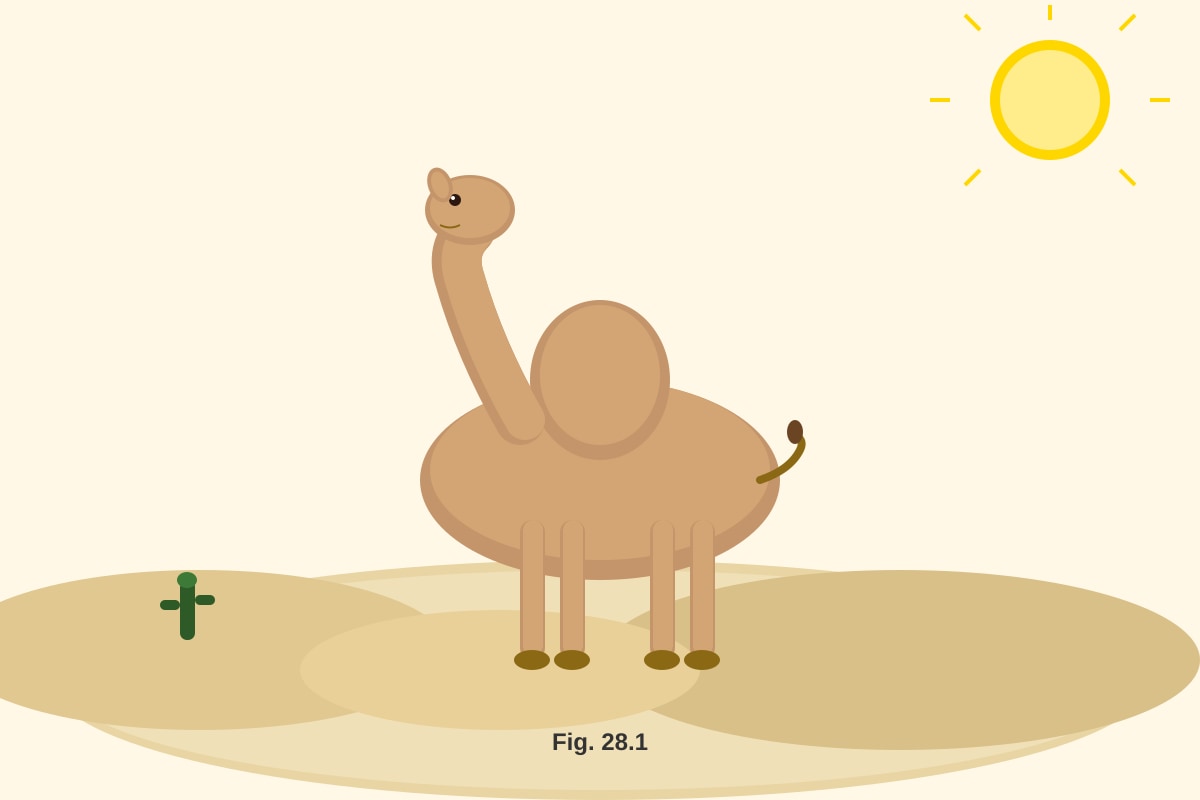
The diagram shows an organism.
[Image description: A picture of a camel.]
Give three adaptations of the camel that help it survive in the desert. [3 marks]
(a) _________________________________________________________________________
(b) _________________________________________________________________________
(c) _________________________________________________________________________
Section C: Free-Response Questions [15 marks]
Answer all questions. Write your answers in the spaces provided.
29. [4 marks]
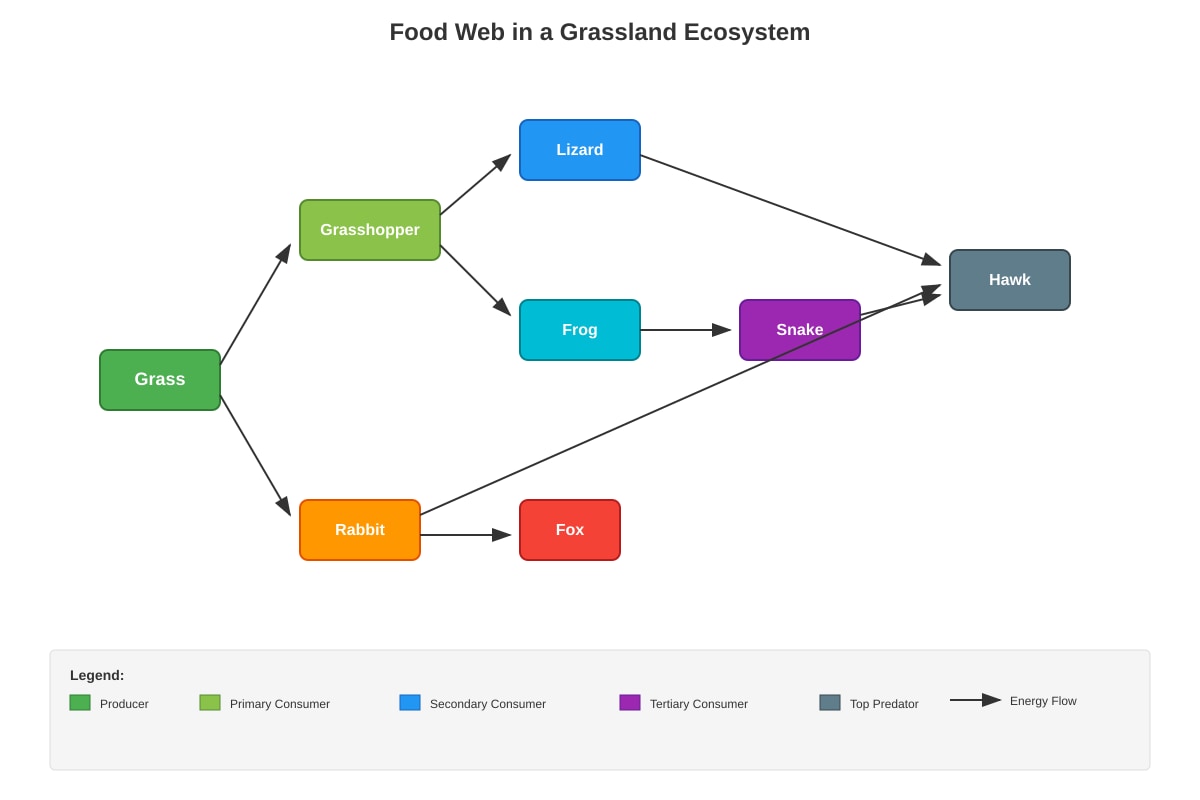
The diagram shows a food web in a grassland ecosystem.
[Image description: A food web showing: Grass → Grasshopper → Lizard → Hawk; Grass → Rabbit → Hawk; Grass → Rabbit → Fox; Grass → Grasshopper → Frog → Snake → Hawk.]
(a) Identify the producer in this food web. [1 mark]
(b) Identify two primary consumers. [2 marks]
(c) Identify one organism that can occupy two different trophic levels. Explain your answer. [1 mark]
30. [4 marks]
A student found the following organisms in a mangrove swamp: mud crab, monitor lizard, mangrove tree, algae, egret, and mudskipper fish.
(a) Classify these organisms into plants and animals. [2 marks]
| Plants | Animals |
|---|---|
(b) Further classify the animals into vertebrates and invertebrates. [2 marks]
| Vertebrates | Invertebrates |
|---|---|
31. [4 marks]
Explain how two different adaptations of a cactus help it survive in a hot, dry desert environment. [4 marks]
32. [3 marks]
The diagram shows a food chain.
Algae → Small Fish → Large Fish → Human
(a) What is the original source of energy for this food chain? [1 mark]
(b) If the large fish is overfished (caught in large numbers), explain what will happen to the number of small fish and the number of humans in the long term. [2 marks]
End of Paper
Answers
TuitionGoWhere Practice Paper - Science Primary 6 PSLE
SA2 — Version 2 of 5 — Answer Key
Section A: Multiple-Choice Questions [20 marks]
| Q | Answer | Marks | Notes |
|---|---|---|---|
| 1 | B | 1 | White fur provides camouflage in the Arctic snow, helping the polar bear hunt prey. |
| 2 | D | 1 | Both cactus and camel have adaptations for hot, dry desert environments. |
| 3 | B | 1 | Algae, fern, and moss are all plants; mushroom and yeast are fungi. |
| 4 | D | 1 | Frog and salamanders have moist skin; eagle and bat have feathers/fur and dry skin. |
| 5 | A | 1 | Not all living things can move (e.g., plants). |
| 6 | C | 1 | Energy flows from the producer (grass) through the food chain to the snake. |
| 7 | C | 1 | Dolphin is a mammal; penguin is a bird; crocodile and lizards are reptiles. |
| 8 | C | 1 | Feathers, beak, wings, and egg-laying are characteristics of birds. |
| 9 | A | 1 | Fish and frog are vertebrates; spider and crab are invertebrates. |
| 10 | C | 1 | Fern is a non-flowering plant; rose, orchid, and sunflower are flowering plants. |
| 11 | B | 1 | Mushroom is a fungus; algae, fern, and moss are plants. |
| 12 | A | 1 | With fewer snakes, the hawk will prey more on mice, so the number of mice will decrease. |
| 13 | B | 1 | Gills allow fish to breathe underwater. |
| 14 | B | 1 | Grass is a producer; the others are consumers. |
| 15 | C | 1 | The pitcher plant digests insects to obtain nutrients (nitrogen) from them. |
| 16 | A | 1 | Ant, spider, and earthworm are all invertebrates. |
| 17 | C | 1 | Fox is a secondary consumer; grass is a producer; rabbit is a primary consumer; mushroom is a decomposer. |
| 18 | B | 1 | All birds have feathers; not all birds can fly (e.g., penguin). |
| 19 | D | 1 | Bacteria, yeast, and mushroom are all fungi — they do not make their own food (heterotrophs). |
| 20 | A | 1 | A food chain starts with a producer and flows in the correct direction of energy transfer. |
Section B: Structured Questions [25 marks]
21. [3 marks]
(a) Organism Q [1 mark]. It has feathers, which is a characteristic unique to birds [1 mark].
(b) Organism R [1 mark]. It has no backbone, which is a characteristic of insects/invertebrates.
22. [3 marks]
(a) Grass [1 mark].
(b) Sparrow and Frog [1 mark each]. (Accept any two secondary consumers from the food web.)
23. [3 marks]
(a) [2 marks]
| Mammals | Non-mammals |
|---|---|
| Bat, Whale | Shark, Crocodile |
[1 mark for each correct column.]
(b) Mammals give birth to live young (or mammals have mammary glands / mammals have hair or fur) [1 mark].
24. [4 marks]
(a) Needle-like leaves reduce the surface area [1 mark], which helps to reduce water loss (transpiration) in a cold, dry environment [1 mark].
(b) Broad, flat leaves have a large surface area [1 mark], which helps the plant absorb more sunlight for photosynthesis in a wet environment [1 mark].
25. [3 marks]
(a) The garden has greater diversity [1 mark]. It has more different types of organisms (ant, grasshopper, dragonfly) compared to the pond (only dragonfly, water lily, fish) [1 mark].
(b) Fish need water to survive [1 mark]. The garden does not have a body of water for fish to live in.
26. [3 marks]
(a) The number of birds will decrease [1 mark]. The birds feed on caterpillars, so with fewer caterpillars, there is less food available for the birds [1 mark].
(b) The number of wild cats will decrease [1 mark]. With fewer birds, there is less food for the wild cats.
27. [3 marks]
(a) They can fly (or they have feathers / they have wings) [1 mark].
(b) They have a backbone (or they are vertebrates) [1 mark].
(c) They do not have a backbone (or they are invertebrates) [1 mark].
28. [3 marks]
(a) Humps store fat for energy in the desert where food is scarce [1 mark].
(b) Long eyelashes protect eyes from sand [1 mark].
(c) Wide, flat feet prevent sinking into the sand [1 mark].
(Accept other valid adaptations: ability to go without water for long periods, thick fur on top to protect from sun, etc.)
Section C: Free-Response Questions [15 marks]
29. [4 marks]
(a) Grass [1 mark].
(b) Grasshopper and Rabbit [1 mark each].
(c) Hawk [1 mark]. The hawk is both a secondary consumer (when it eats the lizard) and a tertiary consumer (when it eats the snake).
30. [4 marks]
(a) [2 marks]
| Plants | Animals |
|---|---|
| Mangrove tree, Algae | Mud crab, Monitor lizard, Egret, Mudskipper fish |
[1 mark for each correct column.]
(b) [2 marks]
| Vertebrates | Invertebrates |
|---|---|
| Monitor lizard, Egret, Mudskipper fish | Mud crab |
[1 mark for each correct column.]
31. [4 marks]
Adaptation 1: The cactus has a thick, waxy outer covering [1 mark], which helps to reduce water loss (transpiration) in the hot desert [1 mark].
Adaptation 2: The cactus has spines instead of leaves [1 mark], which helps to reduce water loss and protect the plant from being eaten by animals [1 mark].
(Accept other valid adaptations: shallow but widespread roots to absorb water quickly, thick stem to store water, etc.)
32. [3 marks]
(a) The Sun [1 mark].
(b) The number of small fish will increase [1 mark]. With fewer large fish, there is less predation on the small fish, so their population will grow [1 mark].
End of Answer Key