From Real Exams Exam Paper
Primary 6 PSLE Science Semestral Assessment 2 (End of Year) Paper 2
Free Exam-Derived NVIDIA Nemotron 3 Ultra 550B A55B Free Primary 6 PSLE Science Semestral Assessment 2 (End of Year) Paper 2 practice paper with questions and answers for Singapore students. This page is rendered as a direct URL so the questions and answers can be discovered without pressing in-page buttons.
These static practice materials are generated from the site's syllabus and paper-generation workflow, with source and model context shown so students and parents can evaluate the material before use.
Questions
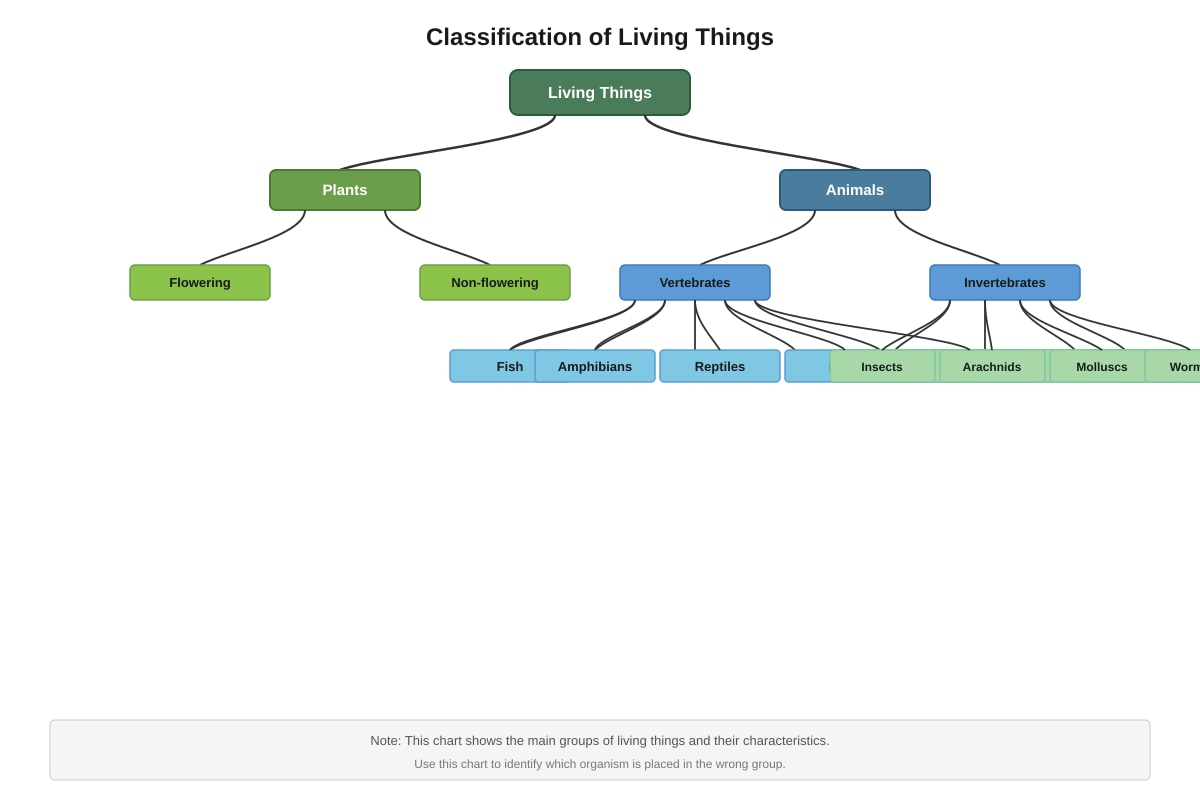
TuitionGoWhere Practice Paper - Science Primary 6 PSLE
TuitionGoWhere Exam Practice (AI)
Subject: Science
Level: Primary 6 PSLE
Paper: SA2 (Version 2)
Duration: 1 h 45 min
Total Marks: 100
Name: _______________________
Class: Primary 6 ______
Date: _______________
Instructions to Candidates
- Do not open this booklet until you are told to do so.
- Follow all instructions carefully.
- Answer all questions.
- For Section A, shade your answers on the Optical Answer Sheet (OAS) provided.
- For Section B, write your answers in the spaces provided in this booklet.
- The number of marks is given in brackets [ ] at the end of each question or part question.
- The total marks for this paper is 100.
Section A: Multiple-Choice Questions (56 marks)
Questions 1 to 28 carry 2 marks each. For each question, four options are given. Choose the correct answer and shade the correct oval on the OAS.
1
Which of the following groups of living things consists only of microorganisms?
(1) Bacteria, yeast, mushroom
(2) Bacteria, virus, protozoa
(3) Mould, fern, algae
(4) Yeast, moss, bacteria
[2]
2
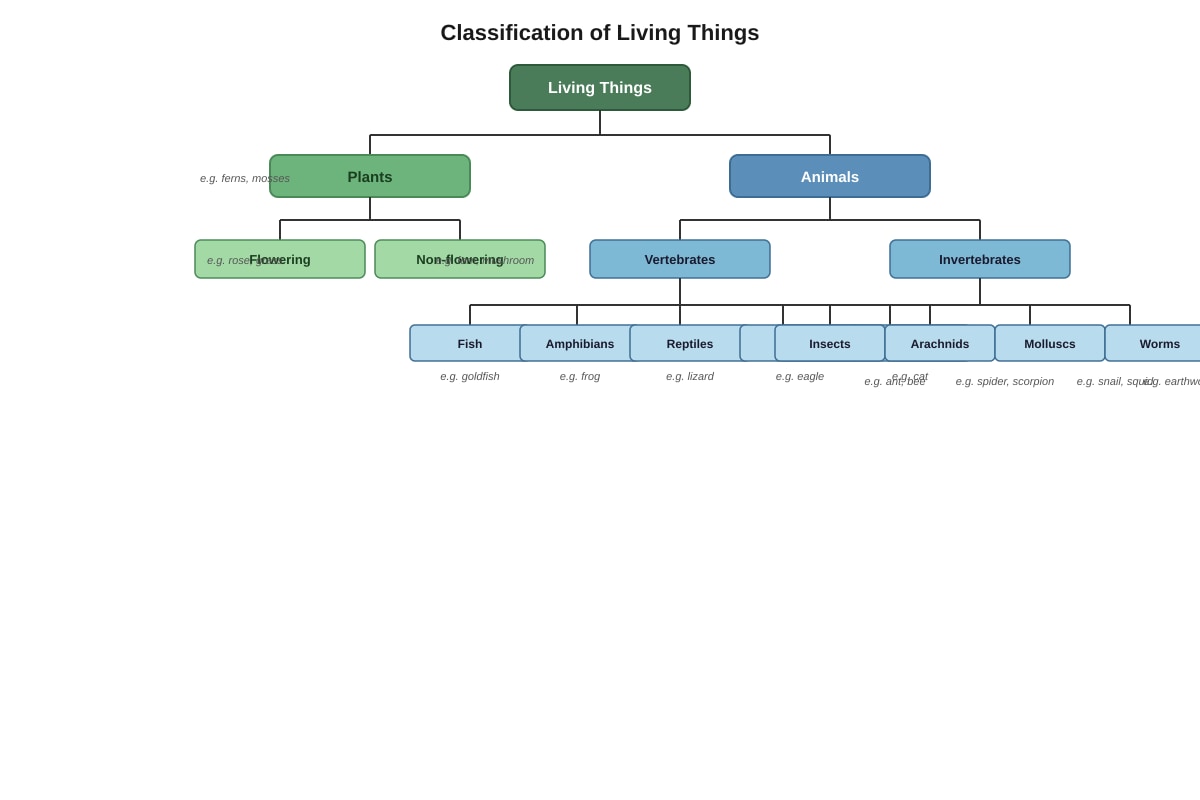
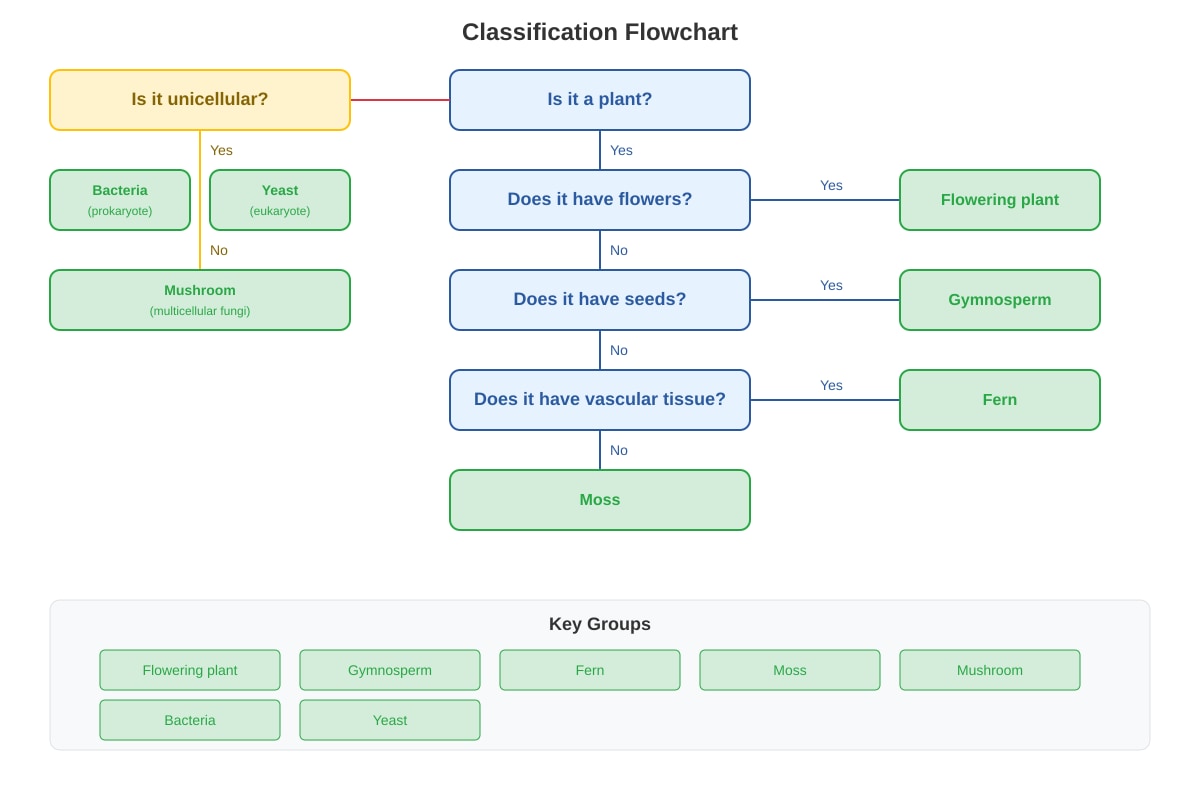
Study the classification chart below.
<image_placeholder> id: Q2-fig1 type: diagram linked_question: Q2 description: Classification chart showing two main groups: Group X and Group Y. Group X has three examples: Mould, Yeast, Bacteria. Group Y has three examples: Bird's nest fern, Hibiscus plant, Balsam plant. Arrows point from main groups to examples. labels: Group X, Group Y, Mould, Yeast, Bacteria, Bird's nest fern, Hibiscus plant, Balsam plant values: None must_show: Clear separation between Group X (microorganisms/fungi/bacteria) and Group Y (plants); examples correctly placed </image_placeholder>
Which of the following headings best represent Group X and Group Y?
| Group X | Group Y |
|---|---|
| (1) Fungi | Plants |
| (2) Microorganisms | Non-microorganisms |
| (3) Non-flowering plants | Flowering plants |
| (4) Reproduce by spores | Reproduce by seeds |
[2]
3
Four students made the following statements about bacteria:
- Ali: Bacteria can only be seen under a microscope.
- Bala: All bacteria are harmful to humans.
- Cindy: Bacteria reproduce by binary fission.
- Devi: Bacteria have a nucleus.
Which two students made correct statements?
(1) Ali and Bala
(2) Ali and Cindy
(3) Bala and Devi
(4) Cindy and Devi
[2]
4
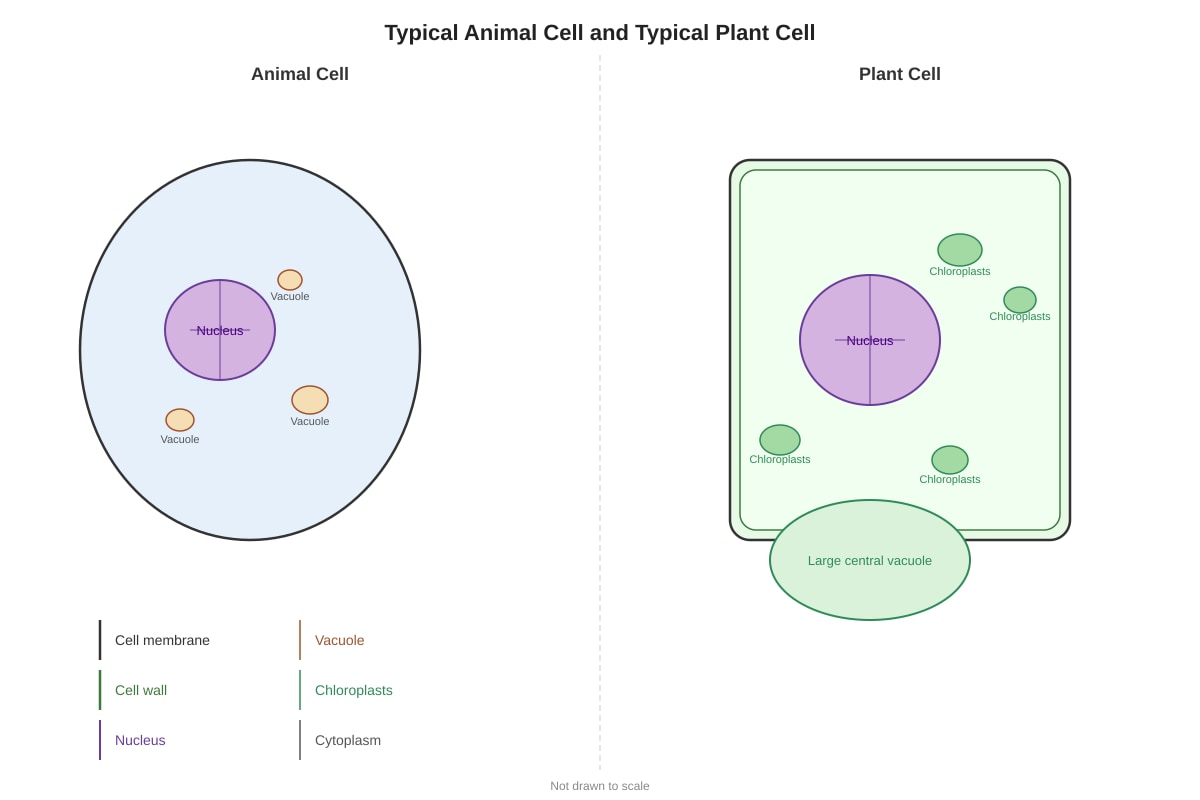
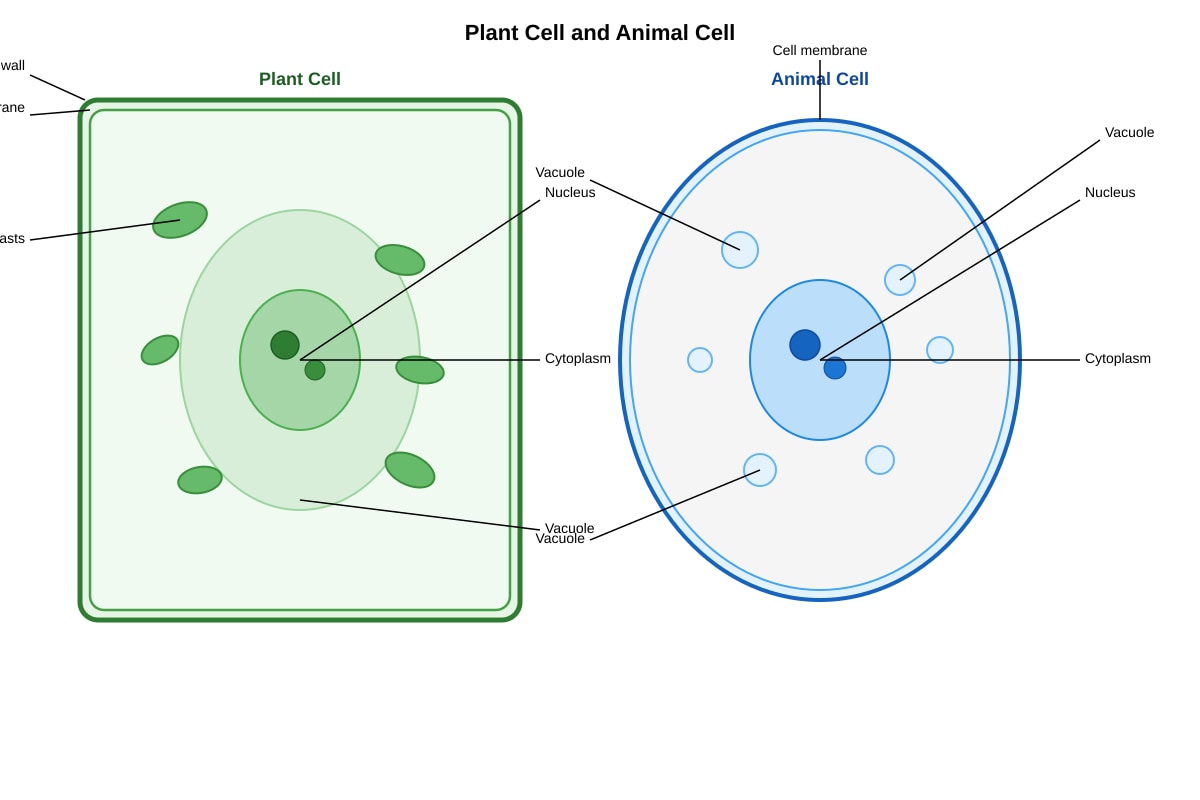
The diagram below shows a plant cell and an animal cell.
<image_placeholder> id: Q4-fig1 type: diagram linked_question: Q4 description: Two cells side by side labelled Plant Cell and Animal Cell. Plant cell shows: cell wall, cell membrane, cytoplasm, nucleus, chloroplasts, large vacuole. Animal cell shows: cell membrane, cytoplasm, nucleus, small vacuoles. No cell wall or chloroplasts in animal cell. labels: Cell wall, Cell membrane, Cytoplasm, Nucleus, Chloroplast, Vacuole (large in plant, small in animal) values: None must_show: Clear labels on both cells; distinct differences visible (cell wall, chloroplasts, vacuole size) </image_placeholder>
Which of the following statements is correct?
(1) Only the plant cell has a nucleus.
(2) Only the animal cell has a cell membrane.
(3) The plant cell has a cell wall but the animal cell does not.
(4) Both cells have chloroplasts.
[2]
5
Which of the following organisms is classified as a flowering plant?
(1) Fern
(2) Moss
(3) Mushroom
(4) Hibiscus
[2]
6
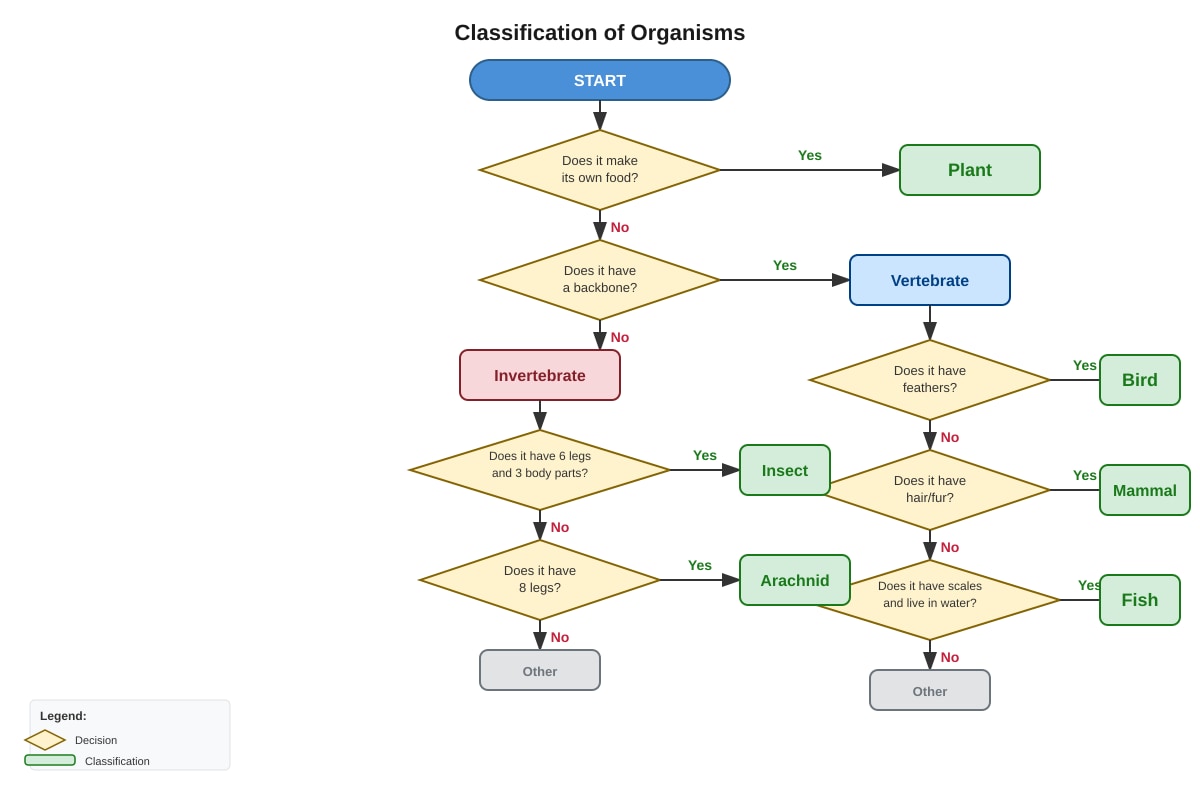
Study the flowchart below.
<image_placeholder> id: Q6-fig1 type: diagram linked_question: Q6 description: Flowchart for classifying living things. Start: Does it make its own food? Yes -> Does it produce seeds? Yes -> Flowering plant; No -> Non-flowering plant. No (from first question) -> Does it reproduce by spores? Yes -> Fungi/Bacteria; No -> Animal. labels: Start, Does it make its own food?, Yes, No, Does it produce seeds?, Does it reproduce by spores?, Flowering plant, Non-flowering plant, Fungi/Bacteria, Animal values: None must_show: Clear decision diamonds and rectangular outcomes; logical flow from top to bottom </image_placeholder>
An organism does not make its own food and reproduces by spores. Which group does it belong to?
(1) Flowering plant
(2) Non-flowering plant
(3) Fungi/Bacteria
(4) Animal
[2]
7
Which of the following characteristics is common to both birds and mammals?
(1) Lay eggs
(2) Have hair or fur
(3) Have feathers
(4) Breathe using lungs
[2]
8
The table below shows the characteristics of four organisms, W, X, Y, and Z. A tick (✓) indicates the presence of the characteristic.
| Characteristic | W | X | Y | Z |
|---|---|---|---|---|
| Has backbone | ✓ | ✓ | ✗ | ✗ |
| Lays eggs | ✓ | ✗ | ✓ | ✗ |
| Has feathers | ✓ | ✗ | ✗ | ✗ |
| Has hair/fur | ✗ | ✓ | ✗ | ✗ |
Which organism is most likely a mammal?
(1) W
(2) X
(3) Y
(4) Z
[2]
9
Which of the following groups of animals are all invertebrates?
(1) Earthworm, grasshopper, spider
(2) Frog, snake, lizard
(3) Shark, whale, dolphin
(4) Eagle, bat, penguin
[2]
10
Study the diagram of a flower below.
<image_placeholder> id: Q10-fig1 type: diagram linked_question: Q10 description: Longitudinal section of a typical flower showing: sepal, petal, stamen (anther and filament), pistil (stigma, style, ovary, ovule). All parts clearly labelled. labels: Sepal, Petal, Anther, Filament, Stigma, Style, Ovary, Ovule values: None must_show: All reproductive parts clearly visible and labelled; longitudinal section view </image_placeholder>
Which part develops into a fruit after fertilisation?
(1) Ovary
(2) Ovule
(3) Stigma
(4) Anther
[2]
11
The diagram below shows the life cycle of a flowering plant.
<image_placeholder> id: Q11-fig1 type: diagram linked_question: Q11 description: Circular life cycle diagram: Seed -> Germination -> Seedling -> Adult plant -> Flower -> Pollination -> Fertilisation -> Fruit/Seed -> back to Seed. Arrows show direction. labels: Seed, Germination, Seedling, Adult plant, Flower, Pollination, Fertilisation, Fruit, Seed values: None must_show: Complete cycle with all stages; arrows showing correct sequence </image_placeholder>
Which process occurs between pollination and fertilisation?
(1) Germination
(2) Seed dispersal
(3) Growth of pollen tube
(4) Fruit formation
[2]
12
Which of the following statements about seed dispersal is correct?
(1) All seeds are dispersed by wind.
(2) Seeds dispersed by water have waterproof coverings.
(3) Animal-dispersed seeds are always fleshy and sweet.
(4) Explosive dispersal only occurs in non-flowering plants.
[2]
13
The diagram below shows a food chain in a garden community.
<image_placeholder> id: Q13-fig1 type: diagram linked_question: Q13 description: Food chain: Grass -> Grasshopper -> Frog -> Snake -> Eagle. Arrows point from food to consumer (Grass to Grasshopper, etc.). Each organism labelled. labels: Grass (Producer), Grasshopper (Primary consumer), Frog (Secondary consumer), Snake (Tertiary consumer), Eagle (Quaternary consumer) values: None must_show: Clear arrows showing energy transfer direction; trophic levels identifiable </image_placeholder>
If a disease kills most of the grasshoppers, what will most likely happen to the frog population?
(1) Increase
(2) Decrease
(3) Remain the same
(4) Migrate to another habitat
[2]
14
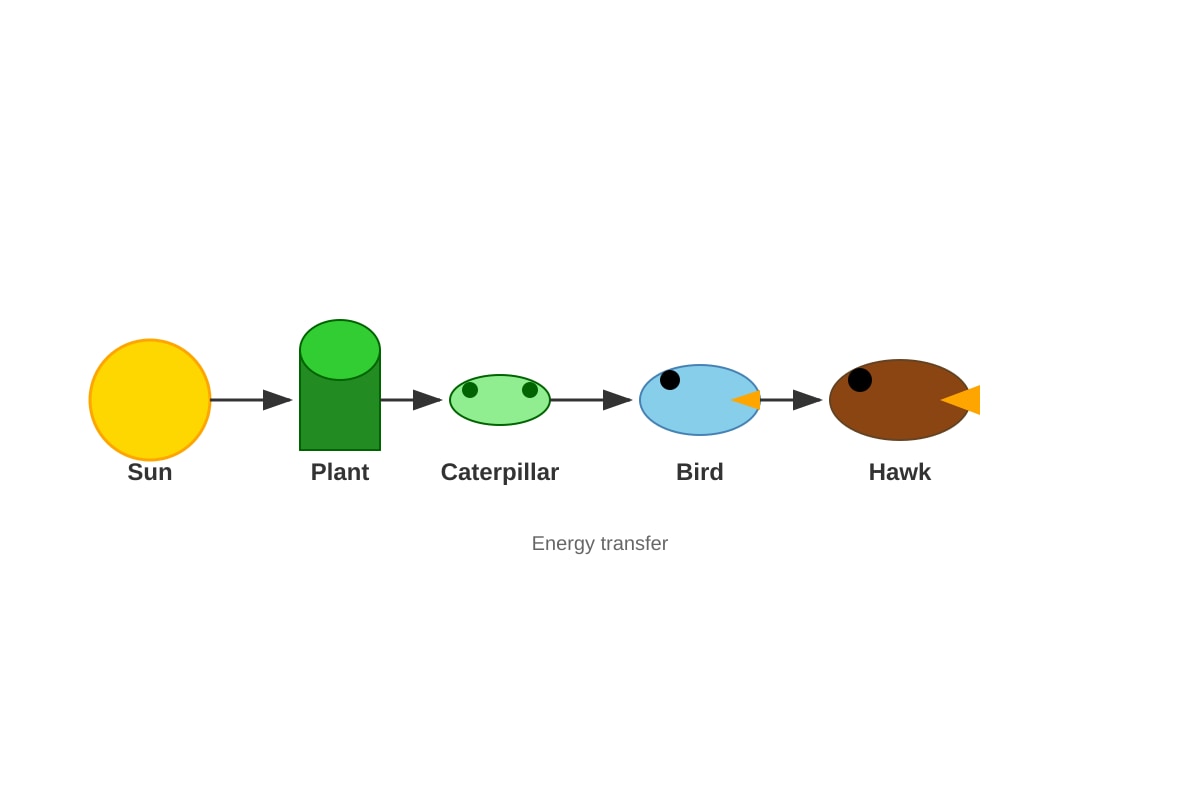
Which of the following shows the correct order of energy transfer in a food chain?
(1) Sun -> Producer -> Primary Consumer -> Secondary Consumer
(2) Producer -> Sun -> Primary Consumer -> Secondary Consumer
(3) Primary Consumer -> Producer -> Sun -> Secondary Consumer
(4) Sun -> Secondary Consumer -> Producer -> Primary Consumer
[2]
15
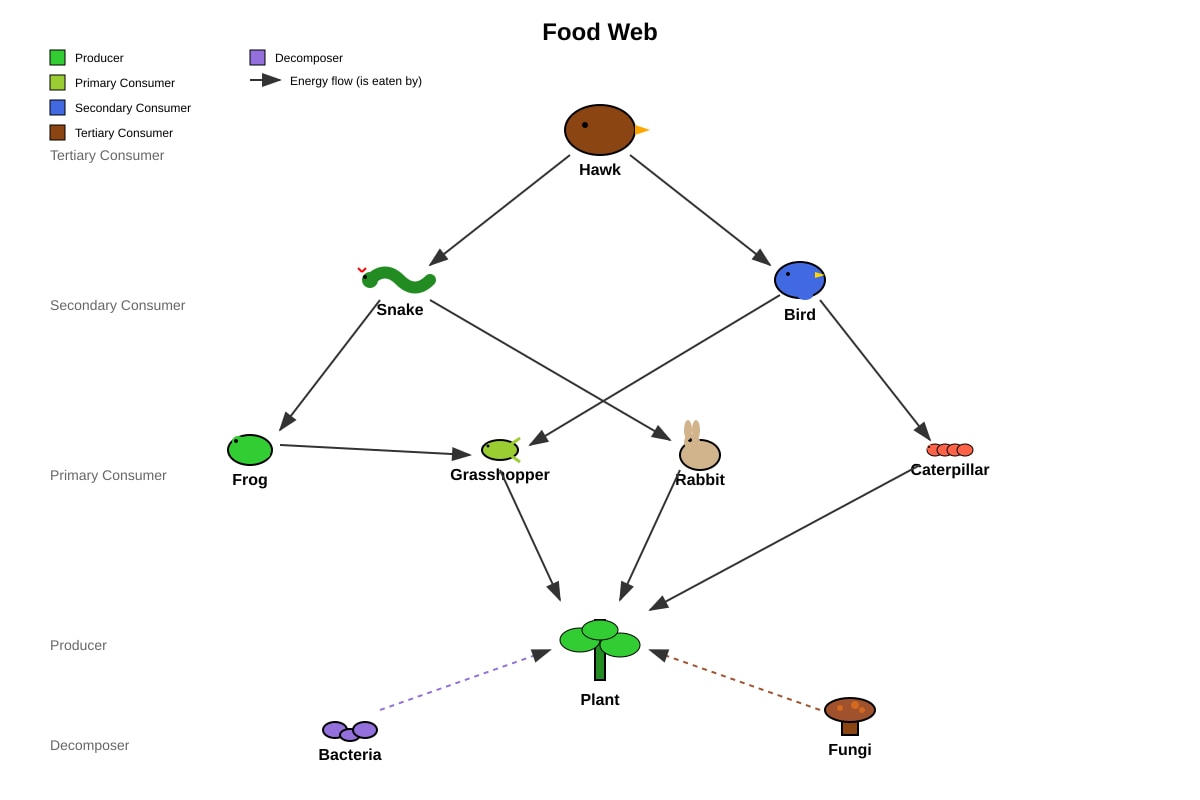
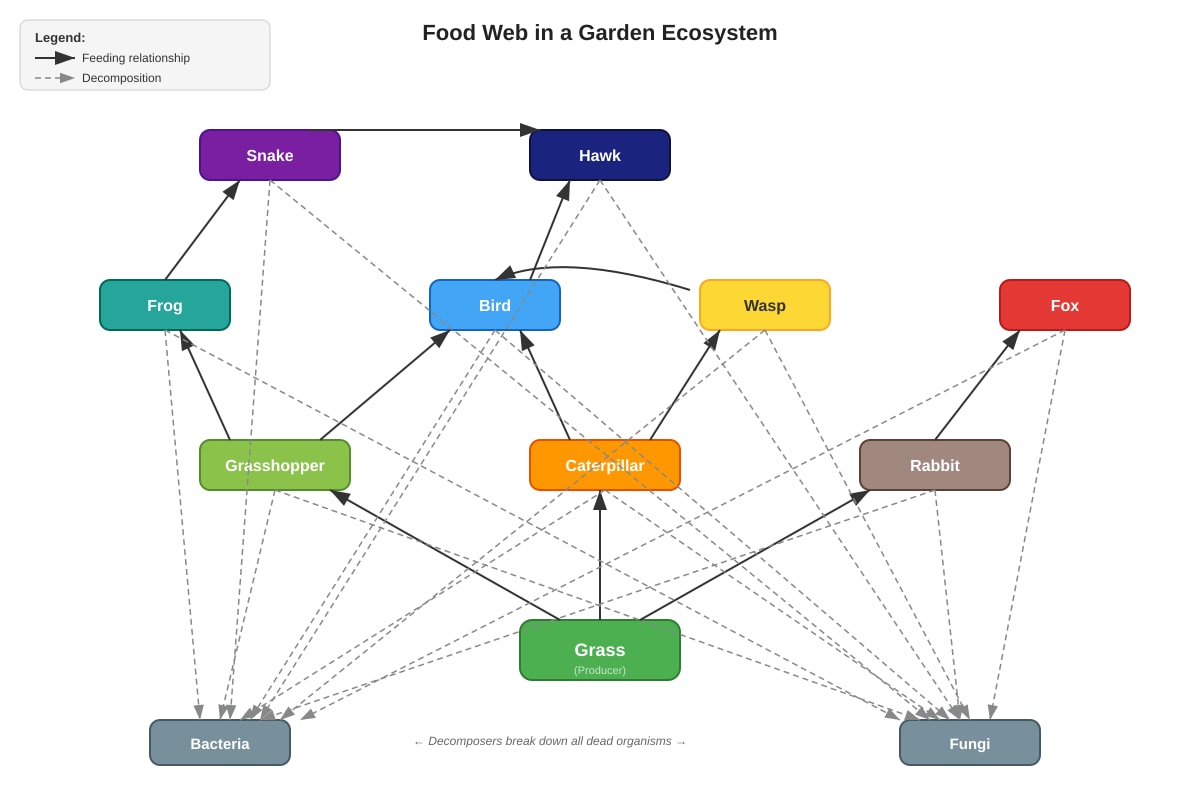
Study the food web below.
<image_placeholder> id: Q15-fig1 type: diagram linked_question: Q15 description: Food web with: Plants (producers) at bottom. Arrows from Plants to Grasshopper, Caterpillar, Rabbit. Arrows from Grasshopper to Frog and Bird. Arrows from Caterpillar to Bird. Arrows from Rabbit to Fox. Arrows from Frog to Snake and Bird. Arrows from Bird to Eagle. Arrows from Snake to Eagle. All organisms labelled. labels: Plants, Grasshopper, Caterpillar, Rabbit, Frog, Bird, Fox, Snake, Eagle values: None must_show: Multiple interconnected food chains; clear arrows showing energy flow; at least 3 trophic levels </image_placeholder>
How many food chains are there in this food web?
(1) 3
(2) 4
(3) 5
(4) 6
[2]
16
Which of the following is a structural adaptation of a cactus to survive in the desert?
(1) Deep roots to absorb water
(2) Broad leaves to capture sunlight
(3) Thin stem to store water
(4) Bright flowers to attract pollinators
[2]
17
The diagram below shows the cross-section of a pond.
<image_placeholder> id: Q17-fig1 type: diagram linked_question: Q17 description: Cross-section of pond showing: Surface with floating plants (water lily), Submerged plants (hydrilla), Emergent plants (cattail) at edges. Zones labelled: Littoral zone (shallow, plants rooted), Limnetic zone (open water, sunlight), Profundal zone (deep, no sunlight). Organisms: Fish in limnetic, Insects on surface, Decomposers at bottom. labels: Floating plants, Submerged plants, Emergent plants, Littoral zone, Limnetic zone, Profundal zone, Fish, Insects, Decomposers values: None must_show: Three distinct zones; plant types in correct zones; organisms placed appropriately </image_placeholder>
Which zone receives the most sunlight and has the highest rate of photosynthesis?
(1) Littoral zone
(2) Limnetic zone
(3) Profundal zone
(4) All zones receive equal sunlight
[2]
18
Which of the following human activities has a positive impact on the environment?
(1) Clearing forests for farming
(2) Releasing untreated sewage into rivers
(3) Planting trees in deforested areas
(4) Burning fossil fuels for energy
[2]
19
The diagram below shows the water cycle.
<image_placeholder> id: Q19-fig1 type: diagram linked_question: Q19 description: Water cycle diagram: Sun heating ocean -> Evaporation -> Water vapour rises -> Condensation (clouds) -> Precipitation (rain) -> Surface runoff / Infiltration -> Groundwater -> Back to ocean. Arrows show continuous cycle. Labels: Evaporation, Condensation, Precipitation, Collection, Transpiration from plants. labels: Sun, Ocean, Evaporation, Condensation, Precipitation, Surface runoff, Infiltration, Groundwater, Transpiration values: None must_show: Complete cycle with all processes labelled; arrows showing direction; transpiration from plants shown </image_placeholder>
Which process in the water cycle involves a change of state from gas to liquid?
(1) Evaporation
(2) Condensation
(3) Precipitation
(4) Transpiration
[2]
20
Which of the following is a non-renewable resource?
(1) Solar energy
(2) Wind energy
(3) Coal
(4) Biomass
[2]
21
Study the classification table below.
| Group A | Group B |
|---|---|
| Moss | Bird's nest fern |
| Liverwort | Staghorn fern |
| Hornwort | Maidenhair fern |
What is the main characteristic used to classify the plants into Group A and Group B?
(1) Presence of flowers
(2) Presence of true roots, stems, and leaves
(3) Method of reproduction
(4) Habitat
[2]
22
Which of the following organisms is a decomposer?
(1) Grass
(2) Grasshopper
(3) Mushroom
(4) Frog
[2]
23
The diagram below shows a cell.
<image_placeholder> id: Q23-fig1 type: diagram linked_question: Q23 description: Cell diagram showing: Cell wall, Cell membrane, Cytoplasm, Nucleus, Chloroplasts, Large central vacuole. No centrioles visible. Labelled as Plant Cell. labels: Cell wall, Cell membrane, Cytoplasm, Nucleus, Chloroplast, Large central vacuole values: None must_show: All plant cell organelles clearly visible and labelled </image_placeholder>
Which of the following functions is correctly matched to the cell part?
| Cell Part | Function |
|---|---|
| (1) Cell wall | Controls movement of substances in and out of the cell |
| (2) Chloroplast | Controls all cell activities |
| (3) Nucleus | Contains genetic information |
| (4) Vacuole | Site of photosynthesis |
[2]
24
Which of the following statements about viruses is correct?
(1) Viruses are living things because they can reproduce on their own.
(2) Viruses are non-living things because they cannot carry out life processes on their own.
(3) Viruses are larger than bacteria.
(4) Viruses can be treated with antibiotics.
[2]
25
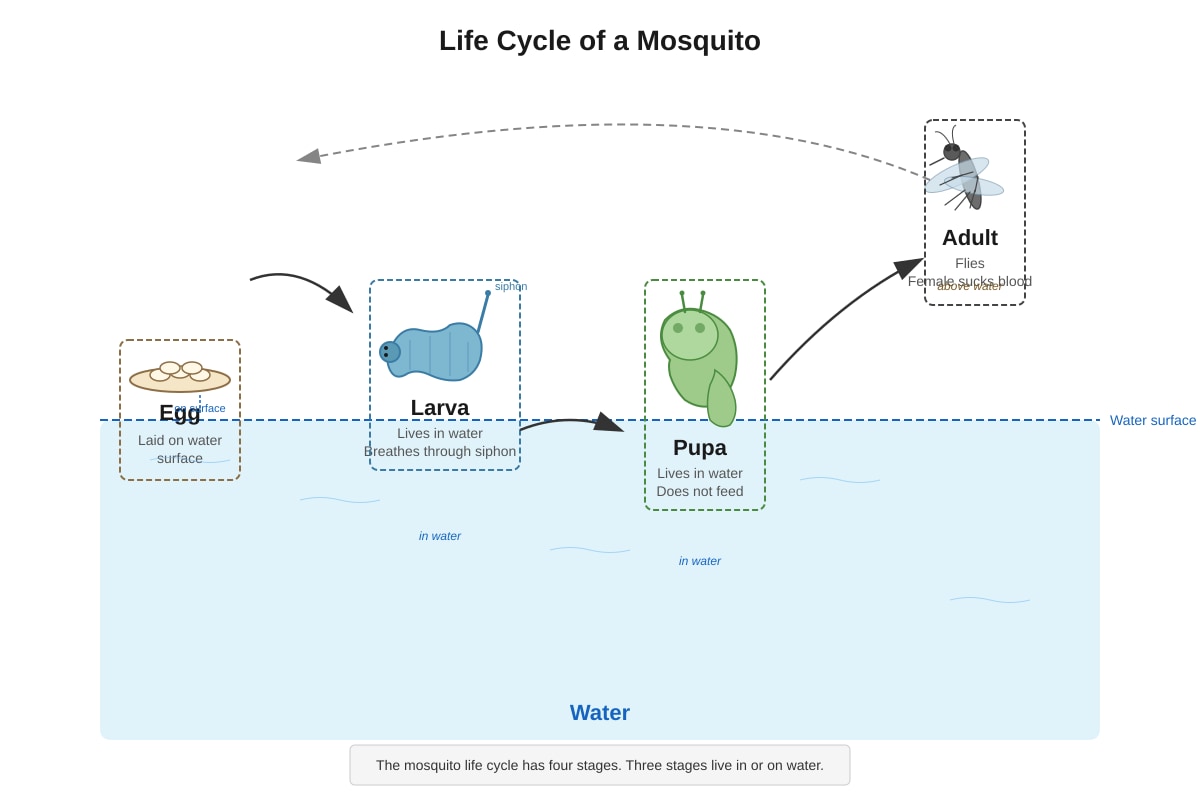
The diagram below shows the life cycle of a mosquito.
<image_placeholder> id: Q25-fig1 type: diagram linked_question: Q25 description: Complete metamorphosis life cycle: Egg -> Larva (wiggler) -> Pupa (tumbler) -> Adult mosquito. Arrows show progression. Labels: Egg (laid in water), Larva (lives in water, breathes through siphon), Pupa (lives in water, does not eat), Adult (flies, feeds on nectar/blood). labels: Egg, Larva, Pupa, Adult values: None must_show: Four distinct stages; aquatic larval and pupal stages; terrestrial adult </image_placeholder>
At which stage does the mosquito not feed?
(1) Egg
(2) Larva
(3) Pupa
(4) Adult
[2]
26
Which of the following shows the correct classification hierarchy from broadest to most specific?
(1) Species -> Genus -> Family -> Order -> Class -> Phylum -> Kingdom
(2) Kingdom -> Phylum -> Class -> Order -> Family -> Genus -> Species
(3) Kingdom -> Class -> Phylum -> Order -> Family -> Genus -> Species
(4) Species -> Family -> Genus -> Order -> Class -> Phylum -> Kingdom
[2]
27
Study the diagram of a leaf cross-section below.
<image_placeholder> id: Q27-fig1 type: diagram linked_question: Q27 description: Leaf cross-section showing: Upper epidermis, Palisade mesophyll (tightly packed cells, many chloroplasts), Spongy mesophyll (loosely packed cells, air spaces), Lower epidermis with stomata and guard cells, Vascular bundle (xylem and phloem). All parts labelled. labels: Upper epidermis, Palisade mesophyll, Spongy mesophyll, Lower epidermis, Stoma, Guard cells, Xylem, Phloem, Air spaces values: None must_show: All leaf tissues clearly visible; stomata on lower epidermis; air spaces in spongy mesophyll; vascular bundle </image_placeholder>
In which layer are most chloroplasts found?
(1) Upper epidermis
(2) Palisade mesophyll
(3) Spongy mesophyll
(4) Lower epidermis
[2]
28
Which of the following is a behavioural adaptation?
(1) Polar bear has thick fur
(2) Camel has hump to store fat
(3) Birds migrate to warmer regions in winter
(4) Cactus has spines instead of leaves
[2]
Section B: Open-Ended Questions (44 marks)
Write your answers in the spaces provided. The number of marks is given in brackets [ ] at the end of each question or part question.
29
The diagram below shows two organisms, A and B.
<image_placeholder> id: Q29-fig1 type: diagram linked_question: Q29 description: Two organisms side by side. Organism A: Mushroom (fungus) - shows cap, gills, stalk, mycelium in soil. Organism B: Balsam plant (flowering plant) - shows roots, stem, leaves, flower with petals. Both labelled clearly. labels: Organism A: Cap, Gills, Stalk, Mycelium. Organism B: Roots, Stem, Leaves, Flower, Petals values: None must_show: Clear structural differences between fungus and flowering plant; reproductive structures visible (gills vs flower) </image_placeholder>
(a) State one similarity between Organism A and Organism B in terms of how they obtain food. [1]
(b) State two differences between Organism A and Organism B. [2]
(c) Organism A reproduces by spores. Explain how spores are dispersed. [1]
30
The flowchart below shows the classification of five animals: P, Q, R, S, and T.
<image_placeholder> id: Q30-fig1 type: diagram linked_question: Q30 description: Flowchart: Start -> Has backbone? Yes -> Has feathers? Yes -> P (Eagle); No -> Has hair/fur? Yes -> Q (Bat); No -> Lays eggs in water? Yes -> R (Frog); No -> S (Lizard). No (from Has backbone?) -> Has 3 body parts? Yes -> T (Grasshopper); No -> U (Spider). labels: Start, Has backbone?, Yes, No, Has feathers?, Has hair/fur?, Lays eggs in water?, Has 3 body parts?, P, Q, R, S, T, U values: None must_show: Clear branching logic; all 6 animals placed at endpoints; questions distinguish vertebrate/invertebrate and classes </image_placeholder>
(a) Based on the flowchart, state all the characteristics of animal R. [2]
(b) Which animal group does animal T belong to? [1]
(c) Animal P and animal Q both have backbones. State one other similarity and one difference between them. [2]
31
The diagram below shows the reproductive parts of a flower.
<image_placeholder> id: Q31-fig1 type: diagram linked_question: Q31 description: Close-up of flower reproductive parts: Stigma (sticky), Style, Ovary (with ovules inside), Anther (with pollen grains), Filament. Pollen tube growing from stigma down style into ovary. Labels on all parts. labels: Stigma, Style, Ovary, Ovule, Anther, Filament, Pollen grain, Pollen tube values: None must_show: Pollen tube visible growing down style into ovary; ovules inside ovary; pollen on anther </image_placeholder>
(a) Name the process shown by the arrow from the stigma to the ovary. [1]
(b) After this process, the ovule develops into a _______________. [1]
(c) The ovary develops into a _______________. [1]
(d) State one way the flower above can be pollinated. [1]
32
The table below shows the number of three types of organisms in a community over a period of time.
| Year | Plant (Producer) | Rabbit (Herbivore) | Fox (Carnivore) |
|---|---|---|---|
| 2020 | 5000 | 200 | 20 |
| 2021 | 4000 | 150 | 15 |
| 2022 | 3000 | 100 | 10 |
(a) Describe the trend in the population of all three organisms from 2020 to 2022. [1]
(b) Explain why the populations of all three organisms show this trend. [2]
(c) If a new predator of the fox is introduced in 2023, predict what will happen to the rabbit population. Explain your answer. [2]
33
The diagram below shows a food web in a forest community.
<image_placeholder> id: Q33-fig1 type: diagram linked_question: Q33 description: Food web: Oak tree (producer) -> Caterpillar, Squirrel, Deer. Caterpillar -> Bird, Spider. Squirrel -> Hawk, Fox. Deer -> Fox. Bird -> Hawk. Spider -> Bird. Fox -> (top). Hawk -> (top). Decomposers (fungi, bacteria) breaking down all dead organisms. Arrows show energy flow. labels: Oak tree, Caterpillar, Squirrel, Deer, Bird, Spider, Hawk, Fox, Decomposers values: None must_show: Multiple interconnected chains; decomposers linked to all; clear energy flow arrows </image_placeholder>
(a) How many food chains are there in this food web? [1]
(b) Name one organism that is both a predator and a prey. [1]
(c) If all the caterpillars are killed by a pesticide, explain how the population of the oak tree might be affected. [2]
(d) State the role of decomposers in this food web. [1]
34
The diagram below shows a polar bear in its natural habitat.
<image_placeholder> id: Q34-fig1 type: diagram linked_question: Q34 description: Polar bear on ice: Thick white fur, thick layer of fat under skin, small ears, large paws with fur on soles, sharp claws. Environment: Ice, snow, cold water. Labels on adaptations. labels: Thick white fur, Thick fat layer, Small ears, Large paws with fur, Sharp claws, Ice habitat values: None must_show: All listed adaptations visible and labelled; polar environment context </image_placeholder>
(a) Identify two structural adaptations of the polar bear that help it keep warm. [2]
(b) Explain how each adaptation helps the polar bear survive in the cold. [2]
(c) State one behavioural adaptation of the polar bear. [1]
35
The diagram below shows the cross-section of a river ecosystem.
<image_placeholder> id: Q35-fig1 type: diagram linked_question: Q35 description: River cross-section: Fast-flowing upper course (steep, rocky, high oxygen) -> Middle course (wider, slower, more plants) -> Lower course (wide, slow, muddy, low oxygen). Organisms: Trout in upper, Minnows in middle, Catfish in lower. Plants: Mosses on rocks upper, Submerged plants middle, Floating plants lower. labels: Upper course, Middle course, Lower course, Trout, Minnows, Catfish, Mosses, Submerged plants, Floating plants, Fast flow, Slow flow, High oxygen, Low oxygen values: None must_show: Three distinct river zones with different flow rates, oxygen levels, and characteristic organisms/plants </image_placeholder>
(a) State one difference between the upper course and lower course of the river in terms of water flow and oxygen content. [1]
(b) Explain why trout are found in the upper course but not in the lower course. [2]
(c) State one way human activity can pollute this river ecosystem. [1]
36
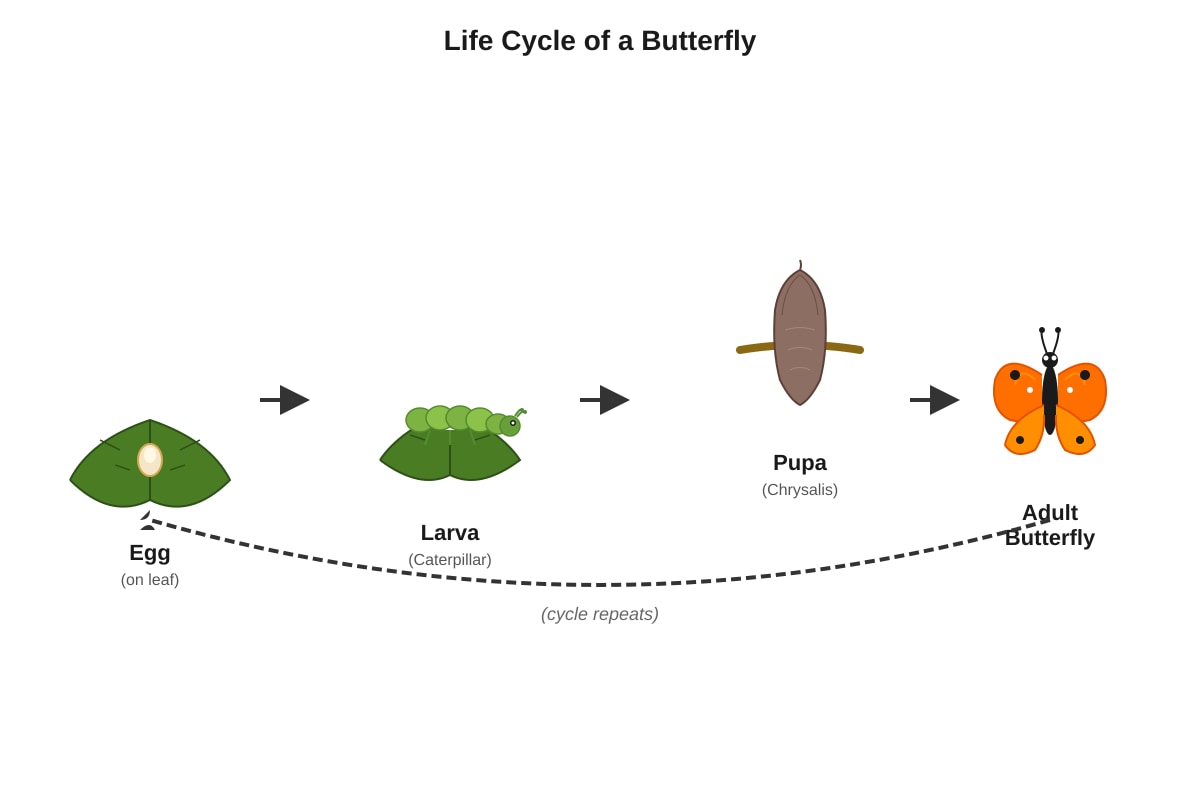
The diagram below shows the life cycle of a butterfly.
<image_placeholder> id: Q36-fig1 type: diagram linked_question: Q36 description: Complete metamorphosis: Egg (on leaf) -> Larva/Caterpillar (eating leaves) -> Pupa/Chrysalis (attached to branch) -> Adult Butterfly (feeding on nectar). Arrows show cycle. Labels on each stage. labels: Egg, Larva (Caterpillar), Pupa (Chrysalis), Adult Butterfly values: None must_show: Four distinct stages; caterpillar eating leaves; chrysalis; adult with proboscis </image_placeholder>
(a) Name the type of metamorphosis shown by the butterfly. [1]
(b) State one difference between the larva and the adult in terms of food source. [1]
(c) The pupa does not eat or move. Explain how it gets energy for development. [1]
(d) How does the butterfly contribute to the reproduction of flowering plants? [1]
37
A group of students conducted an experiment to find out how the amount of light affects the rate of photosynthesis in a water plant. They set up the apparatus as shown below.
<image_placeholder> id: Q37-fig1 type: experimental_setup linked_question: Q37 description: Photosynthesis experiment: Beaker with water and hydrilla plant. Lamp at varying distances (10cm, 20cm, 30cm, 40cm). Test tube inverted over plant to collect gas bubbles. Ruler measuring distance. Stopwatch. Labels: Lamp, Distance, Hydrilla, Water, Gas bubbles, Test tube, Beaker. labels: Lamp, Distance (10/20/30/40 cm), Hydrilla plant, Water, Gas bubbles (oxygen), Test tube, Beaker, Stopwatch must_show: Clear experimental setup; variable distance; gas collection method; measurement tools </image_placeholder>
The table below shows their results.
| Distance of lamp from plant (cm) | Number of bubbles per minute |
|---|---|
| 10 | 48 |
| 20 | 32 |
| 30 | 18 |
| 40 | 8 |
(a) What is the relationship between the distance of the lamp and the number of bubbles produced per minute? [1]
(b) Explain why the number of bubbles changes with distance. [2]
(c) State one variable that must be kept constant for a fair test. [1]
(d) The gas collected is oxygen. Describe a test to confirm the presence of oxygen. [1]
38
The diagram below shows a compost bin with organic waste.
<image_placeholder> id: Q38-fig1 type: diagram linked_question: Q38 description: Compost bin cross-section: Layers of fruit peels, vegetable scraps, dry leaves, grass clippings, soil. Holes for aeration. Thermometer showing temperature rise. Earthworms and microorganisms labelled. Arrows: Air in, Heat out, Decomposition. labels: Fruit peels, Vegetable scraps, Dry leaves, Grass clippings, Soil, Air holes, Thermometer, Earthworms, Microorganisms (bacteria, fungi), Decomposition arrows values: None must_show: Layered organic materials; aeration holes; decomposers visible; temperature indication </image_placeholder>
(a) Name the group of organisms that breaks down the organic waste in the compost bin. [1]
(b) Explain how these organisms obtain energy from the waste. [1]
(c) State two conditions needed for the decomposition process to occur quickly. [2]
(d) How is the compost produced beneficial to plants? [1]
End of Paper
Answers
TuitionGoWhere Practice Paper - Science Primary 6 PSLE (Answer Key)
Subject: Science
Level: Primary 6 PSLE
Paper: SA2 (Version 2)
Total Marks: 100
Section A: Multiple-Choice Questions (56 marks)
1
Answer: (2) Bacteria, virus, protozoa
Explanation: Microorganisms are organisms too small to be seen with the naked eye. Bacteria, viruses, and protozoa are all microorganisms. Mushrooms and moulds are fungi (some visible), ferns and mosses are plants, yeast is a fungus (microorganism). Only option (2) contains exclusively microorganisms.
2
Answer: (1) Fungi | Plants
Explanation: Group X contains mould, yeast, and bacteria — these are microorganisms (fungi and bacteria). Group Y contains bird's nest fern, hibiscus, and balsam — these are all plants. The best classification headings are Fungi (for Group X, though bacteria are not fungi, they are often grouped as microorganisms in primary science) and Plants (for Group Y). Option (1) is the most appropriate among the choices.
3
Answer: (2) Ali and Cindy
Explanation:
- Ali: Correct. Bacteria are microscopic and can only be seen under a microscope.
- Bala: Incorrect. Not all bacteria are harmful; many are beneficial (e.g., gut bacteria, decomposers, used in food production).
- Cindy: Correct. Bacteria reproduce asexually by binary fission.
- Devi: Incorrect. Bacteria are prokaryotes and do not have a true nucleus (no nuclear membrane).
4
Answer: (3) The plant cell has a cell wall but the animal cell does not.
Explanation: Plant cells have a rigid cell wall made of cellulose; animal cells do not. Both have a nucleus, both have a cell membrane, and only plant cells have chloroplasts (for photosynthesis).
5
Answer: (4) Hibiscus
Explanation: Hibiscus is a flowering plant (angiosperm). Ferns and mosses are non-flowering plants (reproduce by spores). Mushroom is a fungus.
6
Answer: (3) Fungi/Bacteria
Explanation: Following the flowchart: Does it make its own food? No → Does it reproduce by spores? Yes → Fungi/Bacteria.
7
Answer: (4) Breathe using lungs
Explanation: Both birds and mammals are vertebrates that breathe using lungs. Birds lay eggs (most mammals don't), mammals have hair/fur (birds have feathers), only birds have feathers.
8
Answer: (2) X
Explanation: Mammals have backbones, have hair/fur, and do not lay eggs (except monotremes, not tested at PSLE). Organism X has backbone (✓), has hair/fur (✓), lays eggs (✗). This matches mammal characteristics.
9
Answer: (1) Earthworm, grasshopper, spider
Explanation: Invertebrates lack a backbone. Earthworm (annelid), grasshopper (insect), spider (arachnid) are all invertebrates. Frog, snake, lizard are vertebrates (amphibians/reptiles). Shark, whale, dolphin are vertebrates (fish/mammals). Eagle, bat, penguin are vertebrates (birds/mammals).
10
Answer: (1) Ovary
Explanation: After fertilisation, the ovary develops into the fruit. The ovule develops into the seed. The stigma receives pollen; the anther produces pollen.
11
Answer: (3) Growth of pollen tube
Explanation: After pollination (pollen lands on stigma), the pollen grain germinates and grows a pollen tube down the style to the ovary for fertilisation. Germination refers to seed growth; seed dispersal and fruit formation occur after fertilisation.
12
Answer: (2) Seeds dispersed by water have waterproof coverings.
Explanation: Water-dispersed seeds (e.g., coconut) have fibrous, waterproof husks that allow them to float. Not all seeds are wind-dispersed. Animal-dispersed seeds may be fleshy/fruity or have hooks. Explosive dispersal occurs in some flowering plants (e.g., balsam, rubber tree).
13
Answer: (2) Decrease
Explanation: Grasshoppers are the food source for frogs. If grasshoppers decrease, frogs have less food, leading to a decrease in frog population (food chain effect).
14
Answer: (1) Sun -> Producer -> Primary Consumer -> Secondary Consumer
Explanation: Energy flows from the Sun to producers (plants via photosynthesis), then to primary consumers (herbivores), then to secondary consumers (carnivores).
15
Answer: (4) 6
Explanation: Counting distinct food chains in the web:
- Plants → Grasshopper → Frog → Snake → Eagle
- Plants → Grasshopper → Frog → Bird → Eagle
- Plants → Grasshopper → Bird → Eagle
- Plants → Caterpillar → Bird → Eagle
- Plants → Rabbit → Fox
- Plants → Rabbit → Fox → (no further) — wait, let's recount carefully.
Actually from the description: Plants to Grasshopper, Caterpillar, Rabbit (3 chains start). Grasshopper to Frog and Bird (2). Caterpillar to Bird (1). Rabbit to Fox (1). Frog to Snake and Bird (2). Bird to Eagle (1). Snake to Eagle (1).
Complete chains ending at top predators: - Plants-Grasshopper-Frog-Snake-Eagle
- Plants-Grasshopper-Frog-Bird-Eagle
- Plants-Grasshopper-Bird-Eagle
- Plants-Caterpillar-Bird-Eagle
- Plants-Rabbit-Fox
- Plants-Rabbit-Fox (ends at Fox) — but Fox is not connected to Eagle. So 5 chains ending at Eagle + 1 ending at Fox = 6 chains. Option (4).
16
Answer: (1) Deep roots to absorb water
Explanation: Cacti have deep or widespread roots to absorb scarce water. They have spines (not broad leaves) to reduce water loss, thick stems to store water (not thin), and flowers for reproduction (not primarily for desert survival).
17
Answer: (2) Limnetic zone
Explanation: The limnetic zone is the open water area where sunlight penetrates, allowing high photosynthesis by phytoplankton. Littoral zone has plants but is shallow; profundal zone is deep with no sunlight.
18
Answer: (3) Planting trees in deforested areas
Explanation: Reforestation restores habitats, reduces soil erosion, absorbs CO₂. The other options are negative impacts: deforestation, water pollution, air pollution/climate change.
19
Answer: (2) Condensation
Explanation: Condensation is the change of state from water vapour (gas) to liquid water (clouds). Evaporation is liquid to gas. Precipitation is liquid/solid falling. Transpiration is liquid to gas from plants.
20
Answer: (3) Coal
Explanation: Coal is a fossil fuel formed over millions of years; it is non-renewable. Solar, wind, and biomass are renewable resources.
21
Answer: (2) Presence of true roots, stems, and leaves
Explanation: Group A (mosses, liverworts, hornworts) are non-vascular plants (bryophytes) lacking true roots, stems, leaves. Group B (ferns) are vascular plants (pteridophytes) with true roots, stems, leaves. Neither group flowers; both reproduce by spores; habitat varies.
22
Answer: (3) Mushroom
Explanation: Mushrooms are fungi, which are decomposers. Grass is a producer; grasshopper is a primary consumer; frog is a secondary consumer.
23
Answer: (3) Nucleus | Contains genetic information
Explanation: The nucleus contains DNA (genetic information). Cell wall provides support/protection (cell membrane controls movement). Chloroplast is site of photosynthesis. Vacuole stores water/substances.
24
Answer: (2) Viruses are non-living things because they cannot carry out life processes on their own.
Explanation: Viruses are non-living outside a host cell; they cannot reproduce, respire, or metabolise independently. They are smaller than bacteria. Antibiotics target bacteria, not viruses.
25
Answer: (3) Pupa
Explanation: In mosquito complete metamorphosis, the pupa (tumbler) is a non-feeding stage. It does not eat; it undergoes transformation. Larva feeds actively; adult feeds on nectar/blood; egg is dormant.
26
Answer: (2) Kingdom -> Phylum -> Class -> Order -> Family -> Genus -> Species
Explanation: This is the correct taxonomic hierarchy from broadest (Kingdom) to most specific (Species). Mnemonic: "King Philip Came Over For Good Soup."
27
Answer: (2) Palisade mesophyll
Explanation: Palisade mesophyll cells are tightly packed beneath the upper epidermis and contain the most chloroplasts for maximum light absorption and photosynthesis. Spongy mesophyll has fewer chloroplasts and air spaces for gas exchange. Epidermis lacks chloroplasts.
28
Answer: (3) Birds migrate to warmer regions in winter
Explanation: Behavioural adaptations are actions organisms take to survive. Migration is a behaviour. Thick fur, fat storage, and spines are structural (physical) adaptations.
Section B: Open-Ended Questions (44 marks)
29
(a) Both are living things that need food for energy and growth. / Both obtain food from their environment. [1]
*Marking note: Accept any valid similarity in nutrition — both are heterotrophs (though plants are autotrophs, at P6 level "obtain food" for plants
<stage3_exam_answers_md>
TuitionGoWhere Practice Paper - Science Primary 6 PSLE (Answer Key)
Subject: Science
Level: Primary 6 PSLE
Paper: SA2 (Version 2)
Section A: Multiple-Choice Questions (56 marks)
| Question | Answer | Explanation |
|---|---|---|
| 1 | (2) | Bacteria, virus, and protozoa are all microorganisms. Mushroom and mould are fungi (macroorganisms visible to naked eye), fern and moss are plants, yeast is a microorganism (fungus). |
| 2 | (1) | Group X: Mould, Yeast, Bacteria → Fungi (mould, yeast) and Bacteria. Group Y: Bird's nest fern, Hibiscus, Balsam → Plants. Best heading: Fungi and Plants. |
| 3 | (2) | Ali: Correct - bacteria are microscopic. Bala: Incorrect - some bacteria are beneficial (e.g., gut flora, decomposition). Cindy: Correct - bacteria reproduce asexually by binary fission. Devi: Incorrect - bacteria are prokaryotes, no nucleus. |
| 4 | (3) | Plant cells have cell walls (cellulose), chloroplasts, large central vacuole. Animal cells lack cell walls and chloroplasts, have small vacuoles. Both have nucleus and cell membrane. |
| 5 | (4) | Hibiscus is a flowering plant (angiosperm). Fern and moss are non-flowering plants. Mushroom is a fungus. |
| 6 | (3) | Does not make own food (heterotroph) + reproduces by spores → Fungi/Bacteria. |
| 7 | (4) | Both birds and mammals breathe using lungs. Birds lay eggs (most), mammals mostly give live birth. Birds have feathers, mammals have hair/fur. |
| 8 | (2) | Mammal characteristics: Has backbone, does not lay eggs (mostly), has hair/fur, no feathers. Organism X matches. W = Bird, Y = Reptile/Amphibian, Z = Invertebrate. |
| 9 | (1) | Earthworm (annelid), grasshopper (insect), spider (arachnid) are all invertebrates. Others contain vertebrates. |
| 10 | (1) | Ovary develops into fruit after fertilisation. Ovule develops into seed. Stigma receives pollen. Anther produces pollen. |
| 11 | (3) | After pollination, pollen tube grows down style to ovary for fertilisation. Germination occurs after seed dispersal. Fruit formation occurs after fertilisation. |
| 12 | (2) | Water-dispersed seeds (e.g., coconut, lotus) have waterproof coverings/fibrous husks to float. Not all seeds dispersed by wind. Animal-dispersed seeds can be hooked (not fleshy). Explosive dispersal occurs in flowering plants (e.g., balsam, rubber tree). |
| 13 | (2) | Grasshoppers are food for frogs. Fewer grasshoppers → less food for frogs → frog population decreases. |
| 14 | (1) | Energy flow: Sun → Producer (photosynthesis) → Primary Consumer (herbivore) → Secondary Consumer (carnivore). |
| 15 | (4) | Food chains: 1) Plants→Grasshopper→Frog→Snake→Eagle 2) Plants→Grasshopper→Frog→Bird→Eagle 3) Plants→Grasshopper→Bird→Eagle 4) Plants→Caterpillar→Bird→Eagle 5) Plants→Rabbit→Fox 6) Plants→Rabbit→? (Fox only shown). Total 6 distinct chains. |
| 16 | (1) | Deep roots absorb groundwater. Broad leaves increase water loss (desert plants have reduced leaves/spines). Cactus has thick stem for water storage. Bright flowers for pollination (reproduction, not survival adaptation). |
| 17 | (2) | Limnetic zone = open water, well-lit, high photosynthesis by phytoplankton. Littoral has plants but shaded. Profundal = deep, no light. |
| 18 | (3) | Planting trees restores forests, prevents erosion, absorbs CO₂. Others are harmful: deforestation, pollution, greenhouse gases. |
| 19 | (2) | Condensation: water vapour (gas) → liquid water droplets (clouds). Evaporation: liquid→gas. Precipitation: liquid/solid falling. Transpiration: liquid→gas from plants. |
| 20 | (3) | Coal is fossil fuel, takes millions of years to form → non-renewable. Solar, wind, biomass are renewable. |
| 21 | (2) | Group A: Moss, Liverwort, Hornwort → Bryophytes (no true roots/stems/leaves). Group B: Ferns → Pteridophytes (have true roots, stems, leaves). Both reproduce by spores, both non-flowering. |
| 22 | (3) | Mushroom (fungus) is a decomposer. Grass = producer, Grasshopper = primary consumer, Frog = secondary consumer. |
| 23 | (3) | Nucleus contains genetic material (DNA). Cell wall = support/protection. Chloroplast = photosynthesis. Vacuole = storage/turgidity. |
| 24 | (2) | Viruses are non-living: cannot reproduce independently, no metabolism, need host cell. Smaller than bacteria. Antibiotics target bacteria, not viruses. |
| 25 | (3) | Pupa stage is non-feeding, metamorphosis occurs. Larva feeds actively. Egg contains yolk. Adult feeds on nectar/blood. |
| 26 | (2) | Taxonomic hierarchy (broad to specific): Kingdom → Phylum → Class → Order → Family → Genus → Species. |
| 27 | (2) | Palisade mesophyll: tightly packed, columnar cells, many chloroplasts for maximum photosynthesis. Upper epidermis: transparent, few/no chloroplasts. Spongy mesophyll: fewer chloroplasts, air spaces for gas exchange. Lower epidermis: mainly guard cells. |
| 28 | (3) | Migration is behavioural adaptation (action). Thick fur, fat storage, spines are structural adaptations (physical features). |
Section B: Open-Ended Questions (44 marks)
29
(a) Both obtain food by external digestion and absorption / decomposing dead organic matter / saprotrophic nutrition.
(Accept: Both are heterotrophs / cannot make their own food)
[1]
(b)
- Organism A (mushroom) is a fungus; Organism B (balsam) is a flowering plant.
- Organism A reproduces by spores (on gills); Organism B reproduces by seeds (in flowers/fruits).
(Other valid differences: A has no chlorophyll/does not photosynthesise, B photosynthesises; A has mycelium/hyphae, B has roots/stems/leaves; A absorbs nutrients, B makes own food)
[2]
(c) Spores are light and small, dispersed by wind / air currents.
(Accept: water, animals, explosive discharge)
[1]
30
Flowchart Description (reconstructed):
Start → Has backbone?
- Yes → Has feathers? → Yes → P (Bird)
- Yes → No feathers → Has hair/fur? → Yes → Q (Mammal)
- Yes → No hair/fur → Lays eggs in water? → Yes → R (Amphibian)
- Yes → No → Has dry scaly skin? → Yes → S (Reptile)
- No backbone → T (Invertebrate)
(a) Animal P (has backbone, has feathers → Bird)
[1]
(b) Animal T (no backbone → Invertebrate)
[1]
(c) Animal R (has backbone, no feathers, no hair/fur, lays eggs in water → Amphibian)
[1]
(d) Animal S (has backbone, no feathers, no hair/fur, does not lay eggs in water, has dry scaly skin → Reptile)
[1]
(e) Animal Q (has backbone, no feathers, has hair/fur → Mammal)
[1]
31
Diagram: Human digestive system labelled: Mouth, Oesophagus, Stomach, Small Intestine, Large Intestine, Anus. Liver, Pancreas, Gall Bladder shown as accessory organs.
(a) Small intestine
(Most digestion and absorption occurs here)
[1]
(b) Large intestine / Colon
(Absorbs water and mineral salts from undigested food)
[1]
(c) Liver produces bile, stored in gall bladder, released into small intestine (duodenum). Bile emulsifies fats (breaks large fat globules into smaller droplets), increasing surface area for lipase (from pancreas) to digest fats into fatty acids and glycerol.
[2]
(d) Villi (finger-like projections) and microvilli on the inner wall of the small intestine greatly increase surface area for efficient absorption of digested nutrients (glucose, amino acids, fatty acids, glycerol, vitamins, minerals) into the bloodstream (and lacteals for fats).
[2]
32
Diagram: Respiratory system: Nose → Trachea → Bronchi → Bronchioles → Alveoli (air sacs). Rib cage, diaphragm, intercostal muscles shown.
(a) Trachea (windpipe)
[1]
(b) Alveoli (air sacs)
[1]
(c) C-shaped cartilage rings keep the trachea open/prevent collapse during breathing (especially inhalation when pressure drops), ensuring unobstructed airflow to and from the lungs.
[1]
(d) Inhalation: Diaphragm contracts and flattens (moves down). External intercostal muscles contract → ribs move up and out. Chest volume increases, pressure decreases below atmospheric → air rushes in.
Exhalation: Diaphragm relaxes and domes up. Internal intercostal muscles contract → ribs move down and in. Chest volume decreases, pressure increases → air forced out.
[2]
(e) Alveoli have:
- Thin walls (one cell thick) → short diffusion distance.
- Moist lining → gases dissolve for diffusion.
- Large surface area (millions of alveoli) → rapid gas exchange.
- Dense capillary network → maintains steep concentration gradient.
(Any two)
[2]
33
Diagram: Circulatory system: Heart (4 chambers), Lungs, Body. Arrows: Deoxygenated blood (blue) → Right atrium → Right ventricle → Pulmonary artery → Lungs → Pulmonary vein → Left atrium → Left ventricle → Aorta → Body → Vena cava → Right atrium. Oxygenated blood (red).
(a) Pulmonary artery
(Only artery carrying deoxygenated blood)
[1]
(b) Left ventricle
(Thickest muscular wall to pump blood at high pressure to whole body)
[1]
(c) Valves (tricuspid, bicuspid/mitral, pulmonary, aortic) prevent backflow of blood, ensuring one-way flow through the heart chambers and into arteries.
[1]
(d) Double circulation: Blood passes through the heart twice in one complete circuit.
- Pulmonary circulation: Heart → Lungs → Heart (oxygenation).
- Systemic circulation: Heart → Body → Heart (delivery of oxygen/nutrients).
Advantage: Higher blood pressure in systemic circulation → faster delivery of oxygen and nutrients to meet high energy demands of active animals (mammals/birds).
[2]
(e) Coronary arteries supply oxygen and nutrients to the heart muscle (cardiac muscle) itself for cellular respiration to produce energy (ATP) for continuous contraction. Blockage → heart attack.
[2]
34
Diagram: Electric circuit with battery, switch, three bulbs (B1, B2, B3). B1 in series with parallel combination of B2 and B3. Ammeter positions: A1 (main), A2 (through B2), A3 (through B3).
(a) Parallel
(B2 and B3 are connected across same two points, providing separate paths)
[1]
(b) B1 is brightest. B2 and B3 are equally bright (but dimmer than B1).
Reason: In series, current through B1 = total current. In parallel, current splits equally between B2 and B3 (identical bulbs). Power (brightness) ∝ I²R. B1 gets full current; B2/B3 get half each.
[2]
(c) B2 and B3 remain lit (same brightness). B1 remains lit (same brightness).
Reason: In parallel, each branch is independent. Removing B2 (open circuit in that branch) does not affect B3's branch. Total resistance increases, total current decreases, but voltage across parallel combination unchanged (same battery), so B3 current unchanged. B1 in series gets new total current (now only through B3), so B1 brightness decreases slightly (but stays lit).
(Accept: B3 stays same brightness, B1 becomes dimmer)
[2]
(d) Ammeter A1 (main circuit, measures total current).
[1]
35
Diagram: Light ray hitting plane mirror. Incident ray, reflected ray, normal line. Angle of incidence (i) = 40°, Angle of reflection (r) = ?.
(a) 40°
(Law of reflection: angle of incidence = angle of reflection)
[1]
(b) Virtual, upright, laterally inverted, same size as object, same distance behind mirror as object in front.
(Any two)
[1]
(c) Periscope / Mirror in blind corner / Dentist's mirror / Make-up mirror
(Any one valid use of plane mirror reflection)
[1]
(d) Regular reflection (smooth surface → parallel rays reflected parallel → clear image).
Diffuse reflection (rough surface → parallel rays reflected in many directions → no clear image).
[1]
36
Diagram: Three beakers with water at different temperatures (10°C, 50°C, 90°C). Identical sugar cubes added simultaneously. Time for sugar to dissolve recorded.
(a) Temperature of water
[1]
(b) Time taken for sugar to dissolve completely
[1]
(c) Size of sugar cube, volume of water, stirring (or no stirring), type of sugar, mass of sugar
(Any two)
[1]
(d) Beaker with 90°C water (highest temperature).
Reason: Higher temperature → water molecules move faster → more frequent and energetic collisions with sugar particles → faster breaking of bonds between sugar particles → faster dissolution.
[2]
(e) Stirring increases contact between sugar particles and water molecules / brings fresh solvent into contact with solute / distributes heat evenly → increases rate of dissolving.
[1]
37
Diagram: Three set-ups with iron nail, copper wire, battery, paper clips.
Set-up A: 10 coils, 1 battery.
Set-up B: 20 coils, 1 battery.
Set-up C: 20 coils, 2 batteries (in series).
(a) Electromagnet / Temporary magnet
[1]
(b) Set-up C
[1]
(c) Number of coils (Set-up A vs B: more coils → stronger magnet). Number of batteries / Voltage / Current (Set-up B vs C: more batteries → more current → stronger magnet).
(Accept: Current, Voltage)
[1]
(d) Increase number of coils / Increase current (more batteries/higher voltage) / Use soft iron core (instead of steel) / Wind coils tightly/closely.
(Any two)
[2]
(e) Electric bell / Relay switch / Circuit breaker / Maglev train / MRI machine / Electromagnetic crane
(Any one)
[1]
38
Diagram: Food web: Phytoplankton → Zooplankton → Small Fish → Big Fish → Shark. Also: Phytoplankton → Coral → Parrotfish → Shark. Detritus → Bacteria → Nutrients → Phytoplankton.
(a) Phytoplankton
(Producer, base of all food chains)
[1]
(b) Energy is lost as heat at each trophic level (respiration, movement, undigested waste). Only ~10% transferred. Less energy available at higher levels → fewer organisms can be supported.
[2]
(c) Bacteria (decomposers) break down dead organisms and waste (detritus) into simple inorganic nutrients (nitrates, phosphates) which are recycled back to phytoplankton for photosynthesis.
[2]
(d) Shark population decreases.
Reason: Overfishing reduces big fish (shark's food) → less food for sharks → starvation, lower reproduction, population decline.
[2]
(e) Biological control / Introduce natural predator / Manual removal / Barriers / Chemical control (targeted).
Must not harm: Other native species, water quality, food web balance.
(Any one valid method with consideration)
[2]
39
Diagram: Water cycle in a terrarium (sealed container with soil, plants, water). Sunlight → Evaporation/Transpiration → Condensation on lid → 'Rain' → Soil → Roots → Plant → Transpiration.
(a) Evaporation (from soil/water surface) and Transpiration (from plant leaves).
[1]
(b) Condensation
(Water vapour → liquid droplets on cooler lid)
[1]
(c) The lid is cooler than the air inside (loses heat to surroundings). Warm moist air rises, contacts cold lid → water vapour loses heat → condenses into droplets.
[1]
(d) Advantage: Self-sustaining / No need to water (water recycled). Disadvantage: Mould/fungal growth (high humidity) / Plants may outgrow container / Difficult to add nutrients/fertiliser / Overheating in direct sun.
[2]
(e) Transpiration creates transpirational pull (suction force) which pulls water up from roots through xylem (cohesion-tension theory), enabling transport of water and dissolved minerals to leaves for photosynthesis.
[2]
End of Answer Key
Total Marks: 100 (Section A: 56, Section B: 44)