From Real Exams Exam Paper
Primary 6 PSLE Science Semestral Assessment 2 (End of Year) Paper 1
Free Exam-Derived Qwen3.7 Plus Primary 6 PSLE Science Semestral Assessment 2 (End of Year) Paper 1 practice paper with questions and answers for Singapore students. This page is rendered as a direct URL so the questions and answers can be discovered without pressing in-page buttons.
These static practice materials are generated from the site's syllabus and paper-generation workflow, with source and model context shown so students and parents can evaluate the material before use.
Questions
TuitionGoWhere Practice Paper - Science Primary 6 PSLE
TuitionGoWhere Exam Practice (AI)
Subject: Science
Level: Primary 6
Paper: SA2 Practice Paper (Version 1 of 5)
Duration: 1 hour 45 minutes
Total Marks: 56
Name: __________________________
Class: __________
Date: __________________________
Instructions to Candidates:
- Write your name, class, and date in the spaces provided.
- Answer all questions.
- Write your answers in the spaces provided in this booklet.
- For questions which require pictures, tables, or graphs, draw them clearly.
- The number of marks available for each question or part question is given in brackets [ ] at the end of the question or part question.
Section A (28 marks)
For each question from 1 to 14, four options are given. One of them is the correct answer. Make your choice (1, 2, 3 or 4) and write your answer in the brackets provided.
1. The table below shows the characteristics of four different organisms, P, Q, R, and S.
| Organism | Has wings | Lays eggs | Has feathers |
|---|---|---|---|
| P | Yes | Yes | No |
| Q | No | Yes | No |
| R | Yes | Yes | Yes |
| S | No | No | No |
Which organism is most likely to be a bird? (1) P (2) Q (3) R (4) S
[1]
2. Study the classification chart below.
Living Things
├── Group A: Have chlorophyll
│ ├── Group X: Produce spores
│ └── Group Y: Produce seeds
└── Group B: Do not have chlorophyll
├── Group Z: Have 6 legs
└── Group W: Do not have 6 legs
Which of the following organisms belongs to Group Y? (1) Fern (2) Mushroom (3) Rose plant (4) Grasshopper
[1]
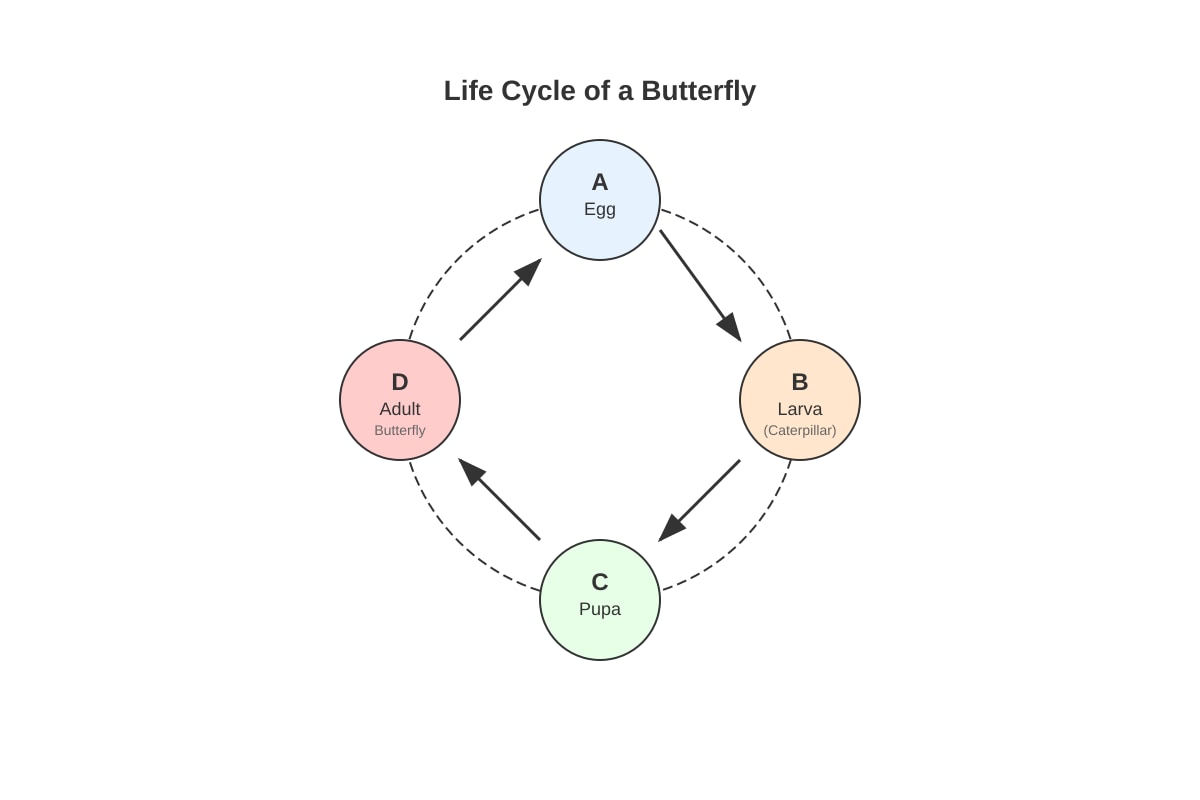
3. The diagram shows the life cycle of a butterfly.
<image_placeholder> id: Q3-fig1 type: diagram linked_question: Q3 description: A circular life cycle diagram with four stages labelled A, B, C, and D in clockwise order. labels: A: Egg, B: Larva (Caterpillar), C: Pupa, D: Adult Butterfly must_show: Arrows indicating the direction of development from Egg to Larva to Pupa to Adult. </image_placeholder>
Which stage represents the period where the organism does not feed and undergoes major changes inside a protective covering? (1) A (2) B (3) C (4) D
[1]
4. Which of the following statements about fungi is correct? (1) They make their own food using sunlight. (2) They reproduce by laying eggs. (3) They obtain nutrients from dead or decaying matter. (4) They have roots, stems, and leaves.
[1]
5. The table shows the number of legs and body parts of three animals, J, K, and L.
| Animal | Number of Legs | Body Parts |
|---|---|---|
| J | 8 | 2 (Cephalothorax and Abdomen) |
| K | 6 | 3 (Head, Thorax, Abdomen) |
| L | Many | Many segments |
Which of the following correctly identifies J, K, and L? (1) J: Spider, K: Ant, L: Earthworm (2) J: Scorpion, K: Bee, L: Centipede (3) J: Crab, K: Beetle, L: Millipede (4) J: Spider, K: Butterfly, L: Leech
[1]
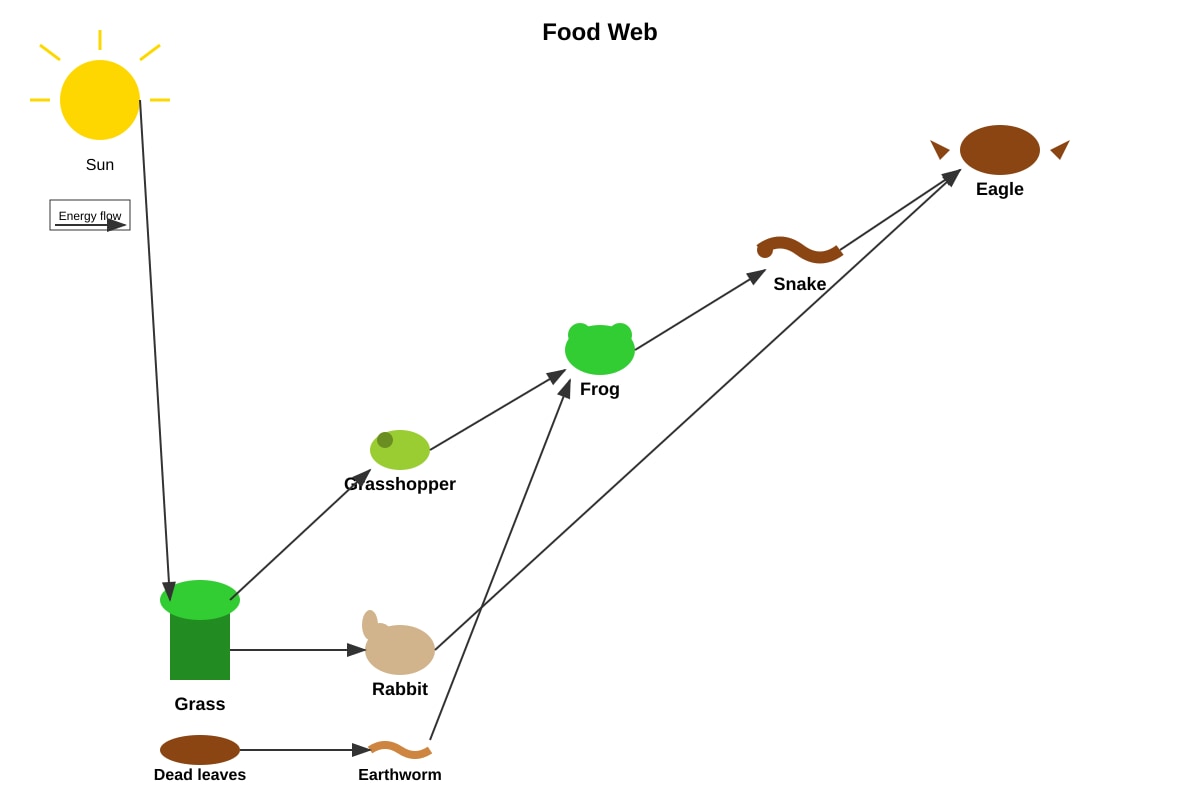
6. Study the food web below.
<image_placeholder> id: Q6-fig1 type: diagram linked_question: Q6 description: A food web showing energy flow. Arrows point from eaten to eater. labels: Grass -> Grasshopper -> Frog -> Snake -> Eagle. Also: Grass -> Rabbit -> Eagle. Also: Dead leaves -> Earthworm -> Frog. must_show: Clear arrows indicating the direction of energy transfer. </image_placeholder>
If the population of frogs decreases significantly due to disease, what is the most likely immediate effect on the ecosystem? (1) The population of grasshoppers will decrease. (2) The population of snakes will increase. (3) The population of earthworms will increase. (4) The population of eagles will decrease.
[1]
7. Which of the following is an example of an adaptation that helps a cactus survive in a hot and dry desert? (1) Broad leaves to capture more sunlight. (2) Thick, waxy skin to reduce water loss. (3) Shallow roots to absorb surface rain quickly. (4) Bright flowers to attract insects.
[1]
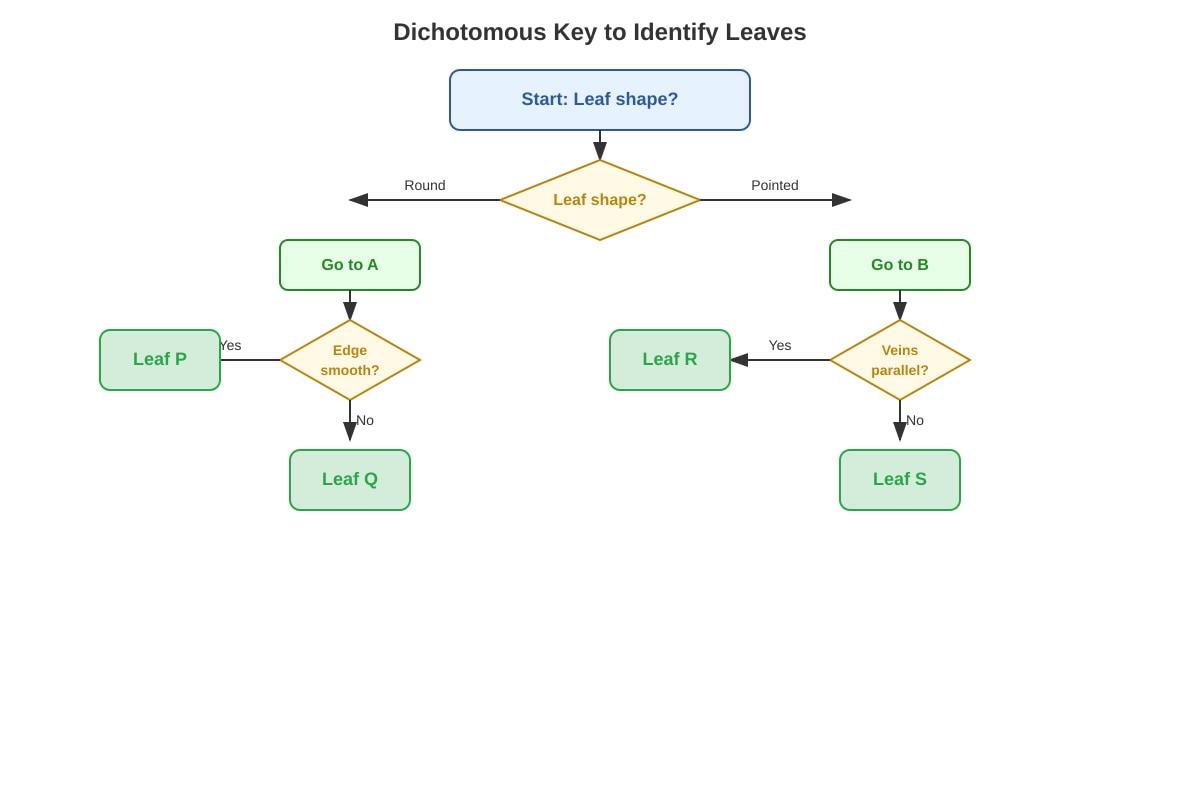
8. The diagram shows a simple key used to identify four different leaves.
<image_placeholder> id: Q8-fig1 type: diagram linked_question: Q8 description: A dichotomous key flowchart. labels: Start: Leaf shape? -> Round: Go to A. Pointed: Go to B. A: Edge smooth? Yes: Leaf P. No: Leaf Q. B: Veins parallel? Yes: Leaf R. No: Leaf S. must_show: Clear branching logic leading to leaves P, Q, R, and S. </image_placeholder>
A leaf has a pointed shape and net-like veins. Which leaf is it? (1) Leaf P (2) Leaf Q (3) Leaf R (4) Leaf S
[1]
9. Which of the following groups contains only mammals? (1) Whale, Bat, Dolphin (2) Penguin, Ostrich, Kiwi (3) Shark, Ray, Salmon (4) Frog, Toad, Newt
[1]
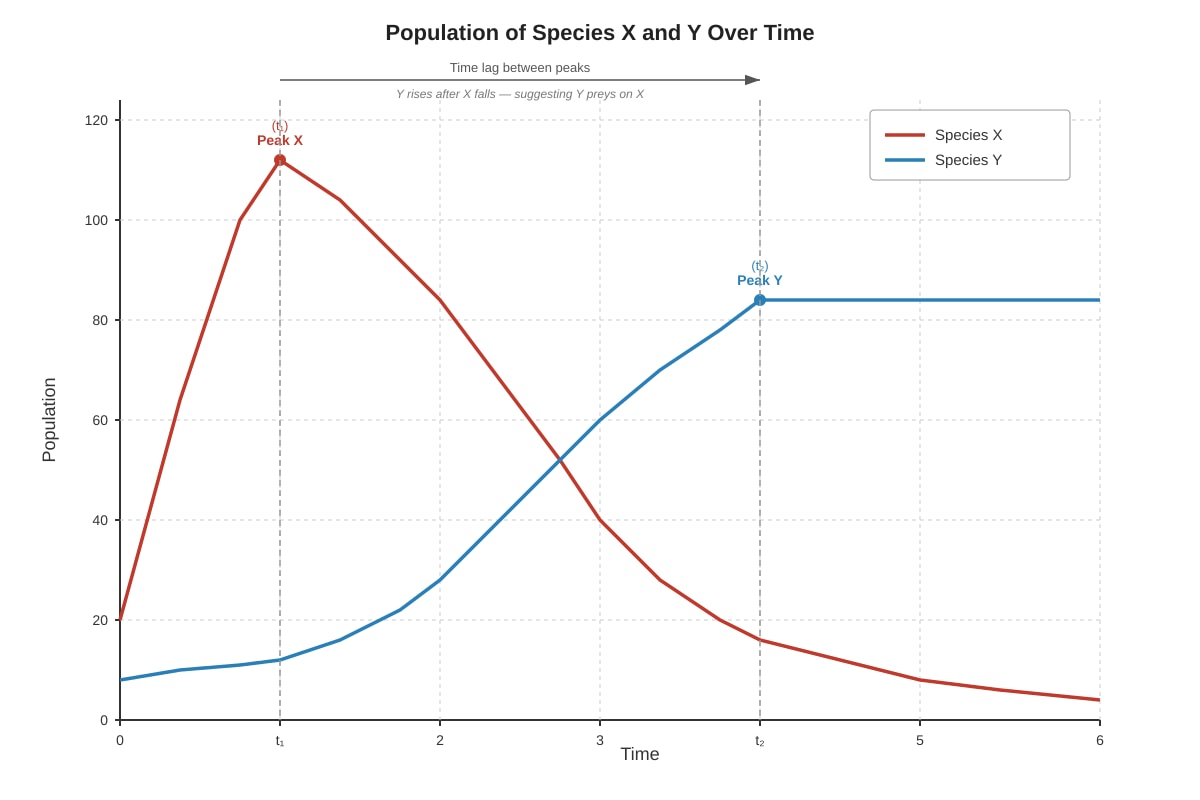
10. The graph shows the change in the population of two species, X and Y, over time in a closed environment.
<image_placeholder> id: Q10-fig1 type: graph linked_question: Q10 description: A line graph with Time on the x-axis and Population on the y-axis. Two lines, X and Y. labels: Line X rises sharply then falls. Line Y rises slowly after X starts falling, then stabilizes. values: X peaks at time t1. Y peaks at time t2 (where t2 > t1). must_show: The lag between the peak of population X and the rise of population Y, suggesting a predator-prey relationship where Y eats X. </image_placeholder>
What is the most likely relationship between species X and Y? (1) X is the predator and Y is the prey. (2) Y is the predator and X is the prey. (3) X and Y compete for the same food source. (4) X and Y have a mutualistic relationship.
[1]
11. Which of the following statements about the classification of living things is true? (1) All animals with backbones are mammals. (2) All plants with flowers produce seeds. (3) All insects have 8 legs. (4) All fungi are green because they contain chlorophyll.
[1]
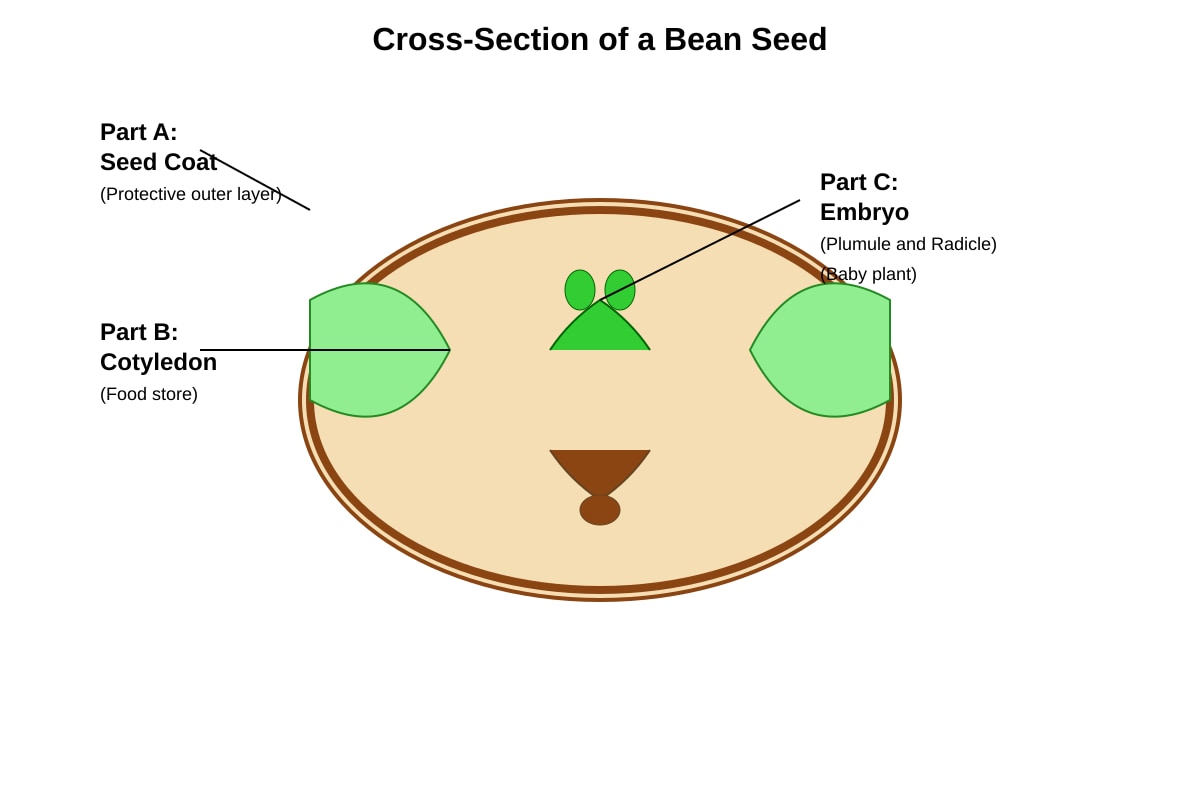
12. The diagram shows the internal structure of a seed.
<image_placeholder> id: Q12-fig1 type: diagram linked_question: Q12 description: A cross-section of a bean seed. labels: Part A: Seed Coat. Part B: Cotyledon. Part C: Embryo (Plumule and Radicle). must_show: Labels pointing to the protective outer layer, the food store, and the baby plant. </image_placeholder>
Which part provides the food for the embryo to grow until it can make its own food? (1) Part A (2) Part B (3) Part C (4) Both Part A and Part C
[1]
13. Why do polar bears have white fur? (1) To keep them warm in the cold climate. (2) To camouflage them against the snow and ice. (3) To attract mates during the breeding season. (4) To reflect sunlight and prevent overheating.
[1]
14. Which of the following is not a characteristic of all living things? (1) Growth (2) Reproduction (3) Movement from place to place (4) Response to changes
[1]
Section B (28 marks)
Answer all questions in the spaces provided.
15. The table below shows the characteristics of five organisms, A to E.
| Organism | Green parts? | Lays eggs? | Has hair/fur? | Breathes using gills? |
|---|---|---|---|---|
| A | Yes | No | No | No |
| B | No | Yes | No | Yes |
| C | No | Yes | No | No |
| D | No | No | Yes | No |
| E | Yes | No | No | No |
(a) Based on the table, classify organisms A, B, C, D, and E into the correct groups: Plant, Fish, Bird, Mammal, or Reptile. [5]
- Organism A: __________________________
- Organism B: __________________________
- Organism C: __________________________
- Organism D: __________________________
- Organism E: __________________________
(b) Organism C and Organism D both lay eggs. State one difference in how their young are cared for after hatching/birth. [1]
16. Study the food chain below:
Leaf -> Caterpillar -> Bird -> Snake
(a) Identify the producer in this food chain. [1]
(b) Explain why the number of snakes is usually smaller than the number of caterpillars in this ecosystem. [2]
(c) If a new predator, the Mynah bird, is introduced and it also eats caterpillars, predict what will happen to the population of the original Bird species. Explain your answer. [2]
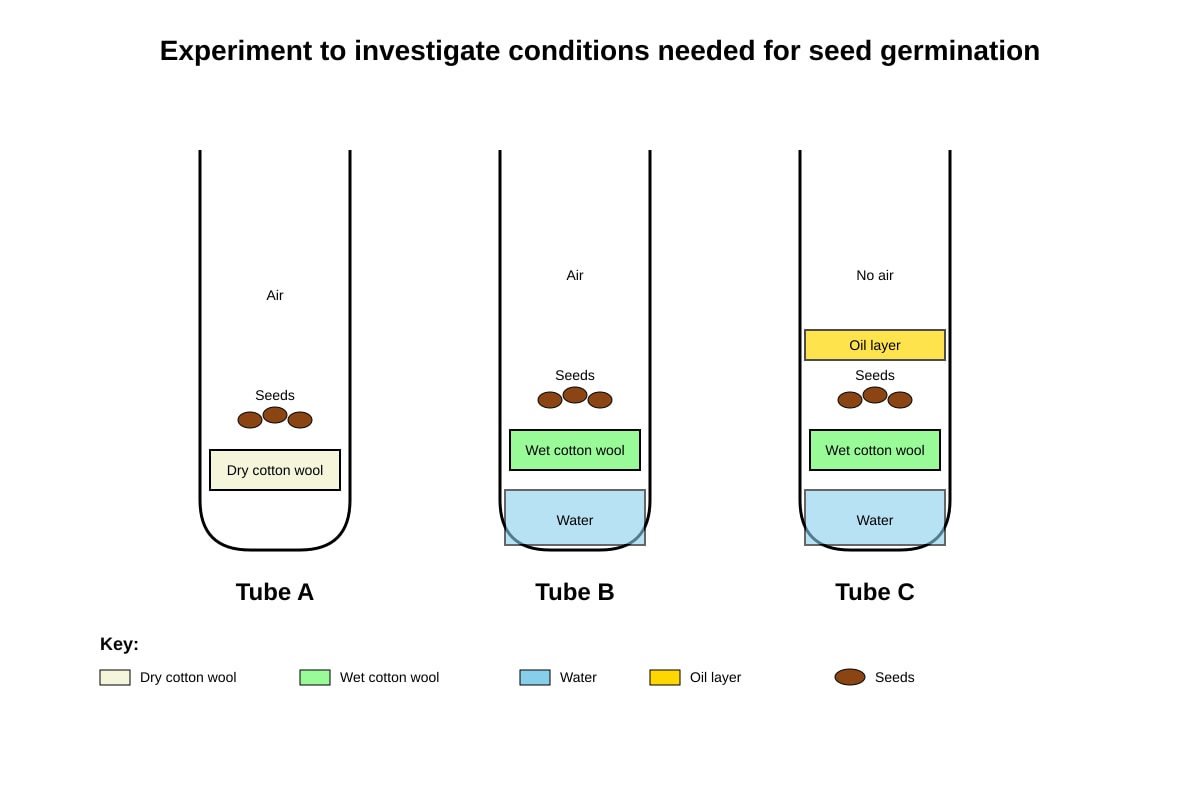
17. The diagram shows an experiment set up to investigate the conditions needed for seed germination.
<image_placeholder> id: Q17-fig1 type: experimental_setup linked_question: Q17 description: Three test tubes labelled A, B, and C. labels: Tube A: Dry cotton wool, seeds, air. Tube B: Wet cotton wool, seeds, air. Tube C: Wet cotton wool, seeds, covered with oil layer (no air). must_show: Tube B has water and air. Tube A has no water. Tube C has water but no air. </image_placeholder>
(a) Which test tube serves as the control in this experiment? [1]
(b) After 5 days, seeds in which test tube(s) will germinate? [1]
(c) Explain why the seeds in the other test tube(s) did not germinate. [2]
18. The chart below shows the classification of four animals: Lion, Tiger, House Cat, and Dog.
- Family Felidae: Lion, Tiger, House Cat
- Family Canidae: Dog
(a) Which two animals are most closely related? Explain your answer using the classification information. [2]
(b) State one characteristic that all members of Family Felidae likely share. [1]
19. Read the passage below and answer the questions.
The Mangrove Forest is a unique ecosystem found in coastal areas. The soil is muddy and salty. The water level changes with the tides. Mangrove trees have special roots called "prop roots" that stick out of the mud. These roots help the tree stand firmly in the soft mud and also allow the tree to take in air.
(a) Why is it difficult for most plants to survive in the Mangrove Forest? [1]
(b) How do the prop roots help the mangrove tree survive in its environment? [2]
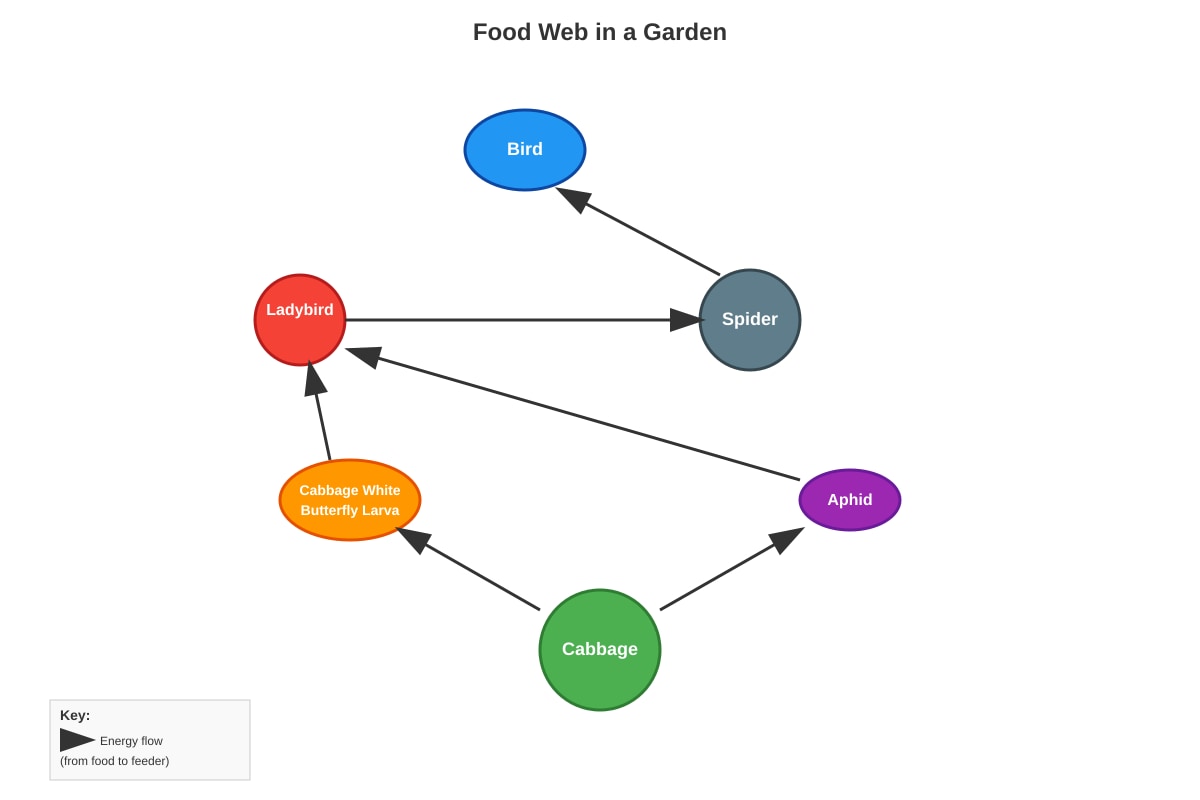
20. The diagram shows a simple food web in a garden.
<image_placeholder> id: Q20-fig1 type: diagram linked_question: Q20 description: A food web. labels: Cabbage -> Cabbage White Butterfly Larva -> Ladybird -> Spider. Also: Cabbage -> Aphid -> Ladybird. Also: Spider -> Bird. must_show: Arrows showing energy flow. </image_placeholder>
(a) Name one organism in the food web that is both a predator and prey. [1]
(b) The gardener uses pesticide to kill all the aphids. Explain how this might affect the population of spiders. [2]
(c) Suggest one natural method the gardener can use to control the population of cabbage white butterfly larvae without using chemicals. [1]
[End of Paper]
Answers
Answer Key - Science Primary 6 PSLE (SA2 Practice Paper Version 1)
Topic: Diversity
Total Marks: 56
Section A (28 marks)
1. (3)
Reasoning: Birds are characterized by having feathers, wings, and laying eggs. Organism R has all three. P has wings and lays eggs but no feathers (likely an insect or bat). Q lays eggs but no wings/feathers (likely a reptile or amphibian). S has none of these.
2. (3)
Reasoning: Group Y produces seeds and has chlorophyll. This describes flowering plants (angiosperms) or cone-bearing plants (gymnosperms). Rose plant is a flowering plant. Ferns (Group X) produce spores. Mushrooms (Group B) do not have chlorophyll. Grasshoppers (Group Z) are animals.
3. (3)
Reasoning: Stage C is the Pupa. During the pupal stage, the caterpillar is enclosed in a chrysalis, does not feed, and undergoes metamorphosis to become an adult.
4. (3)
Reasoning: Fungi are heterotrophs; they cannot make their own food (no chlorophyll). They obtain nutrients by absorbing them from dead or decaying organic matter. They reproduce via spores, not eggs.
5. (1)
Reasoning: J has 8 legs and 2 body parts, characteristic of arachnids (Spider). K has 6 legs and 3 body parts, characteristic of insects (Ant). L has many legs and segments, characteristic of myriapods (Earthworm is an annelid, but in primary science context, "many legs" often points to centipedes/millipedes, but Earthworm has no legs. Wait, let's re-evaluate Option 1 vs 2. Option 1: L is Earthworm. Earthworms have 0 legs. The table says "Many". This is a trick. Let's look at Option 2: L is Centipede. Centipedes have many legs. J is Scorpion (Arachnid, 8 legs). K is Bee (Insect, 6 legs). This fits better. Let's re-read the table. L: Many legs. Earthworm has 0. So Option 1 is incorrect for L. Option 2: L is Centipede (Many legs). Correct. Option 3: L is Millipede (Many legs). J is Crab (Crustacean, usually 10 legs, not 8). So Option 3 is incorrect for J. Option 4: L is Leech (0 legs). Incorrect. Therefore, Option 2 is the best fit. Correction: The question asks for the correct identification.
Re-evaluating Option 1: J=Spider (8 legs, 2 parts). K=Ant (6 legs, 3 parts). L=Earthworm (0 legs). Table says "Many". Mismatch.
Re-evaluating Option 2: J=Scorpion (8 legs, 2 parts). K=Bee (6 legs, 3 parts). L=Centipede (Many legs). Match.
Answer: (2)
6. (4)
Reasoning: Frogs are eaten by snakes. If frogs decrease, snakes have less food, so their population decreases. Eagles eat snakes and rabbits. If snakes decrease, eagles might rely more on rabbits, but the direct impact on the snake population is a decrease. The question asks for the most likely immediate effect. A decrease in prey (frog) leads to a decrease in predator (snake). Consequently, eagles (which eat snakes) may also decrease if they cannot compensate with rabbits. However, looking at the options: (1) Grasshoppers would increase (less predation). (2) Snakes would decrease. (3) Earthworms are eaten by frogs, so they might increase. (4) Eagles might decrease. Between 2 and 4, the effect on snakes is more direct. Wait, option 2 says "increase". That is wrong. Option 4 says "decrease". This is plausible. Let's re-read carefully.
Option 1: Grasshoppers decrease? No, they increase.
Option 2: Snakes increase? No, they decrease.
Option 3: Earthworms increase? Yes, because frogs eat them.
Option 4: Eagles decrease? Possible, but they have alternative food (rabbits).
So, (3) is a strong candidate. Let's check the food web again. Dead leaves -> Earthworm -> Frog. If Frogs decrease, Earthworms have fewer predators, so Earthworms increase. This is a direct effect.
Answer: (3)
7. (2)
Reasoning: Cacti live in dry environments. A thick, waxy skin (cuticle) reduces water loss through evaporation. Broad leaves would increase water loss. Shallow roots are for absorbing rain, but the waxy skin is the primary adaptation for retention.
8. (4)
Reasoning: Pointed shape -> Go to B. Net-like veins (not parallel) -> Leaf S.
9. (1)
Reasoning: Whales, bats, and dolphins are all mammals (give birth to live young, feed milk, have hair/fur at some stage). Penguins are birds. Sharks are fish. Frogs are amphibians.
10. (2)
Reasoning: In a predator-prey graph, the predator population peak follows the prey population peak. Here, X peaks first, then Y peaks. This suggests X is the prey and Y is the predator. As X increases, Y has more food and increases. As Y increases, it eats more X, causing X to fall.
11. (2)
Reasoning: Flowering plants produce seeds. (1) is false (birds, reptiles, fish have backbones). (3) is false (insects have 6 legs). (4) is false (fungi are not green).
12. (2)
Reasoning: Part B is the Cotyledon, which stores food for the embryo. Part A is the seed coat (protection). Part C is the embryo.
13. (2)
Reasoning: White fur provides camouflage against the snow, helping polar bears hunt prey and avoid detection.
14. (3)
Reasoning: Not all living things move from place to place (e.g., plants). All living things grow, reproduce, and respond to stimuli.
Section B (28 marks)
15.
(a) [5 marks]
- Organism A: Plant (Has green parts, does not lay eggs/has seeds/spores implied by exclusion of animal traits). Note: Specifically, it has chlorophyll.
- Organism B: Fish (Has gills, lays eggs, no hair).
- Organism C: Reptile (Lays eggs, no hair, no gills, not green). *Note: Birds also lay eggs, but usually "no hair" distinguishes from mammals. Between Bird and Reptile, without "feathers" specified, Reptile is a safe bet, or Bird. However, looking at D (Mammal), C is likely Reptile or Bird. Let's assume standard classification questions: A=Plant, B=Fish, C=Reptile/Bird, D=Mammal, E=Plant. Wait, E has green parts but no seeds? No, E has green parts, no eggs, no hair, no gills. E is likely a Plant (non-flowering or flowering). A is also a Plant. Let's look closer. A: Green, No Eggs. E: Green, No Eggs. Both are plants. C: No Green, Eggs, No Hair, No Gills. This fits Reptile or Bird. D: No Green, No Eggs, Hair. Mammal.
- Refined Answer:
- A: Plant
- B: Fish
- C: Reptile (or Bird)
- D: Mammal
- E: Plant
- Marking: 1 mark for each correct classification. Accept "Bird" for C if justified, but "Reptile" is standard for "scales/skin" implied by lack of feathers/hair. Given the options, C is likely a Reptile.
- Refined Answer:
(b) [1 mark]
- Mammals (D) feed their young with milk, whereas Reptiles/Birds (C) do not. OR Mammals provide parental care, while many reptiles do not.
16.
(a) [1 mark]
- Leaf (or the Plant producing the leaf).
(b) [2 marks]
- Energy is lost at each trophic level as heat/respiration/movement. [1]
- Therefore, less energy is available to support a large population of snakes compared to caterpillars. [1]
(c) [2 marks]
- The population of the original Bird species will decrease. [1]
- Because the Mynah bird competes with the original Bird for the same food source (caterpillars), leading to less food available for the original Bird. [1]
17.
(a) [1 mark]
- Test tube B. (It has both water and air, the standard conditions for germination).
(b) [1 mark]
- Test tube B.
(c) [2 marks]
- Test tube A did not germinate because it lacked water. [1]
- Test tube C did not germinate because it lacked air (oxygen). [1]
18.
(a) [2 marks]
- Lion and Tiger (or Lion and House Cat, or Tiger and House Cat). Any pair from Felidae. [1]
- They belong to the same Family (Felidae), which is a more specific classification group than the different Families (Felidae vs Canidae). [1]
(b) [1 mark]
- They have fur/hair. OR They give birth to live young. OR They feed their young with milk. (Any mammalian/feline trait).
19.
(a) [1 mark]
- The soil is salty (high salinity) and muddy (low oxygen/waterlogged), which is harmful to most plants.
(b) [2 marks]
- The prop roots provide support to keep the tree upright in the soft, muddy soil. [1]
- They also allow the tree to absorb oxygen/air directly from the atmosphere, as the muddy soil lacks oxygen. [1]
20.
(a) [1 mark]
- Ladybird (eats Aphids/Larva, eaten by Spider) OR Spider (eats Ladybird, eaten by Bird).
(b) [2 marks]
- The population of spiders will decrease. [1]
- Aphids are food for Ladybirds. If Aphids die, Ladybird population decreases. Spiders eat Ladybirds, so with fewer Ladybirds, Spiders have less food. [1]
(c) [1 mark]
- Introduce natural predators (e.g., more Ladybirds or Birds). OR Use physical barriers (nets). OR Hand-pick the larvae.