From Real Exams Exam Paper
Primary 6 PSLE Science Semestral Assessment 2 (End of Year) Paper 1
Free P6 PSLE Science SA2 Paper 1, HY3 Exam version, with questions, answers, and PSLE-focused practice for Singapore students.
These static practice materials are generated from the site's syllabus and paper-generation workflow, with source and model context shown so students and parents can evaluate the material before use.
Questions
TuitionGoWhere Exam Practice (AI) — Science Primary 6 PSLE
SA2 Practice Paper — Diversity (Version 1 of 5)
School: TuitionGoWhere Exam Practice (AI)
Subject: Science
Level: Primary 6 (PSLE)
Paper: SA2 Practice — Topic: Diversity
Version: 1 of 5
Duration: 60 minutes
Total Marks: 40
Name: ______________________
Class: _________
Date: ____________
Instructions:
- This paper contains 20 questions on the topic of Diversity.
- Section A: 10 multiple-choice questions (1 mark each).
- Section B: 6 short-answer questions (2 marks each).
- Section C: 4 structured questions (total 8 marks).
- Answer all questions in the spaces provided.
- Use a pencil to shade or write your answers clearly.
Section A (10 marks)
Choose the correct option for each question.
1. Which of the following is an example of diversity among living things?
A. A cat and a dog having different fur colours
B. A boy running faster than a girl
C. A plant growing taller in sunlight
D. Water freezing into ice
2. Which group of organisms can make their own food?
A. Consumers
B. Decomposers
C. Producers
D. Predators
3. A population is best described as:
A. All living things in a pond
B. A group of the same kind of organisms living together
C. One rabbit in a field
D. Different animals in a forest
4. Which habitat would most likely support a community of fish, water plants, and frogs?
A. Desert
B. Pond
C. Mountain top
D. Car park
5. An adaptation that helps a cactus survive in dry conditions is:
A. Broad leaves
B. Thick stem to store water
C. Bright flowers
D. Deep roots for shade
6. Which of the following is a decomposer?
A. Grass
B. Frog
C. Mushroom
D. Hawk
7. Diversity in non-living things can be seen in:
A. Different types of rocks
B. Same breed of dogs
C. One species of tree
D. Identical cups
8. A food chain shows:
A. How animals play
B. The flow of energy from the Sun to producers to consumers
C. The life cycle of a butterfly
D. How plants reproduce
9. Which is a behavioural adaptation?
A. A bird building a nest
B. A fish having gills
C. A lion having sharp teeth
D. A leaf being green
10. Man's positive impact on the environment includes:
A. Cutting down all trees
B. Reforesting a cleared hill
C. Dumping rubbish into the sea
D. Burning plastic openly
Section B (12 marks)
Answer each question in the space provided.
11. State one way in which organisms in a community depend on each other. (2 marks)
12. Give two examples of different habitats and name one organism found in each. (2 marks)
13. Explain why a polar bear's thick fur is an adaptation. (2 marks)
14. What is the difference between a population and a community? (2 marks)
15. List two negative impacts of man on the environment. (2 marks)
16. Describe one structural adaptation of a plant and how it helps the plant. (2 marks)
Section C (8 marks)
Answer the following structured questions.
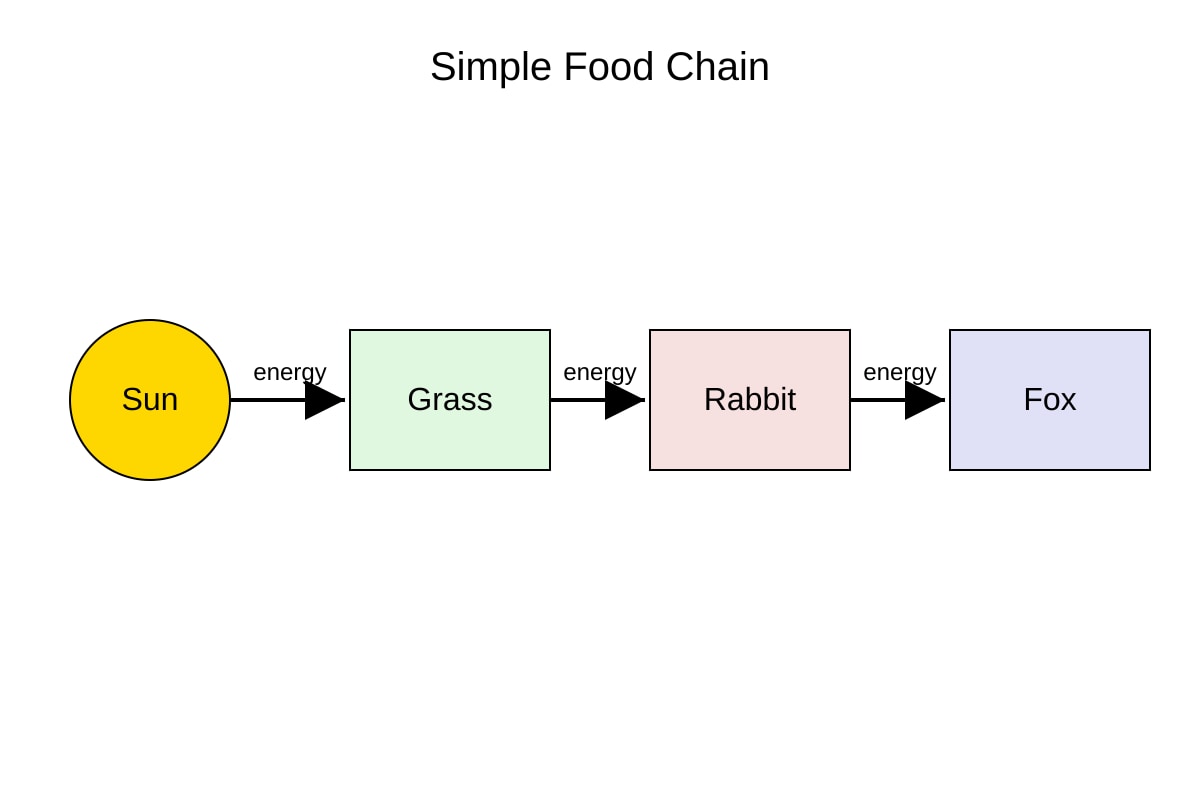
17. The diagram below shows a simple food chain.
Image pending generation: diagram for Q17.
(a) Name the producer in the food chain. (1 mark)
(b) What would happen if all the grass died? Explain. (1 mark)
18. A garden has many roses, bees, ants, and earthworms.
(a) Which of these are producers? (1 mark)
(b) Name one decomposer from the list and state its role. (1 mark)
19. Fill in the table for diversity of living things. (2 marks)
| Group | Example | Feature showing diversity |
|---|---|---|
| Plant | _________ | _________ |
| Animal | _________ | _________ |
20. Explain how replanting trees helps maintain diversity. (2 marks)
Answers
TuitionGoWhere Exam Practice (AI) — Science Primary 6 PSLE
SA2 Practice Paper — Diversity (Version 1 of 5) — Answer Key
Total Marks: 40
Section A: 10 marks
Section B: 12 marks
Section C: 8 marks
Section A — Answers (1 mark each)
1. A
Teaching note: Diversity means differences among living things. Different fur colours in cat and dog show variation. B is about speed, C is growth, D is non-living change.
2. C
Producers (plants) make food using sunlight. Consumers eat, decomposers break down, predators hunt.
3. B
Population = same species living together. A is community, C is organism, D is community.
4. B
Pond supports aquatic life. Desert/mountain/carpark lack water for those organisms.
5. B
Thick stem stores water — adaptation for dry habitat. Broad leaves lose water; others not key.
6. C
Mushroom is fungus decomposer. Grass=producer, frog/hawk=consumers.
7. A
Rocks are non-living diverse. Others show similarity or living things.
8. B
Food chain shows energy Sun→producer→consumer.
9. A
Nest building is behaviour. Others are structural.
10. B
Reforestation is positive. Others negative.
Section B — Answers (2 marks each)
11. (2m)
Accepted: Plants provide oxygen/animals eat plants / decomposers break down waste.
Teaching: In a community, organisms depend via food, air, or decomposition. 1m for idea, 1m example.
12. (2m)
Habitat 1: Pond – fish (1m); Habitat 2: Garden – butterfly (1m).
Mark: 1m each correct pair.
13. (2m)
Thick fur keeps bear warm in cold (1m) because it traps heat (1m). Adaptation helps survive low temperature.
14. (2m)
Population: same species group (1m). Community: different populations together (1m).
15. (2m)
Any two: deforestation, pollution, global warming, resource depletion (1m each).
16. (2m)
Example: cactus thick stem stores water (1m) helps survive dry (1m). Structural = body part.
Section C — Answers (8 marks)
17. (2m)
(a) Grass (1m) — producer makes own food.
(b) Rabbits and fox lose food (1m) — energy flow stops, may die/move.
18. (2m)
(a) Roses (1m) — plant producer.
(b) Earthworm (1m) — decomposer breaks dead matter.
19. (2m)
Plant: Rose – has flowers (1m). Animal: Bee – can fly (1m). Any sensible diversity feature.
20. (2m)
Trees give homes/food for animals (1m), increase variety of life (1m). Maintains diversity.
Free quiz and exam paper access
Enter your details to view this paper
Your access is remembered on this device.