From Real Exams Exam Paper
Primary 6 PSLE Science Semestral Assessment 1 (Mid-Year) Paper 2
Free Exam-Derived Qwen3.7 Plus Primary 6 PSLE Science Semestral Assessment 1 (Mid-Year) Paper 2 practice paper with questions and answers for Singapore students. This page is rendered as a direct URL so the questions and answers can be discovered without pressing in-page buttons.
These static practice materials are generated from the site's syllabus and paper-generation workflow, with source and model context shown so students and parents can evaluate the material before use.
Questions
TuitionGoWhere Practice Paper - Science Primary 6 PSLE
TuitionGoWhere Exam Practice (AI)
Subject: Science
Level: Primary 6
Paper: SA1 (Version 2 of 5)
Duration: 1 hour 45 minutes
Total Marks: 56
Name: __________________________
Class: __________
Date: __________________________
Instructions to Candidates:
- This paper consists of two sections, A and B.
- Answer all questions.
- Write your answers in the spaces provided.
- For questions in Section A, shade your answer on the Optical Answer Sheet (OAS) provided.
- For questions in Section B, write your answers in the spaces provided in this booklet.
Section A (28 marks)
For each question from 1 to 28, four options are given. One of them is the correct answer. Make your choice (1, 2, 3 or 4) and shade your answer on the Optical Answer Sheet.
1. Which of the following groups of animals are classified correctly based on their method of reproduction?
| Group | Method of Reproduction | Animals |
|---|---|---|
| A | Viviparous | Human, Cat, Chicken |
| B | Oviparous | Frog, Snake, Eagle |
| C | Viviparous | Cow, Shark, Butterfly |
| D | Oviparous | Dog, Goldfish, Crocodile |
(1) A
(2) B
(3) C
(4) D
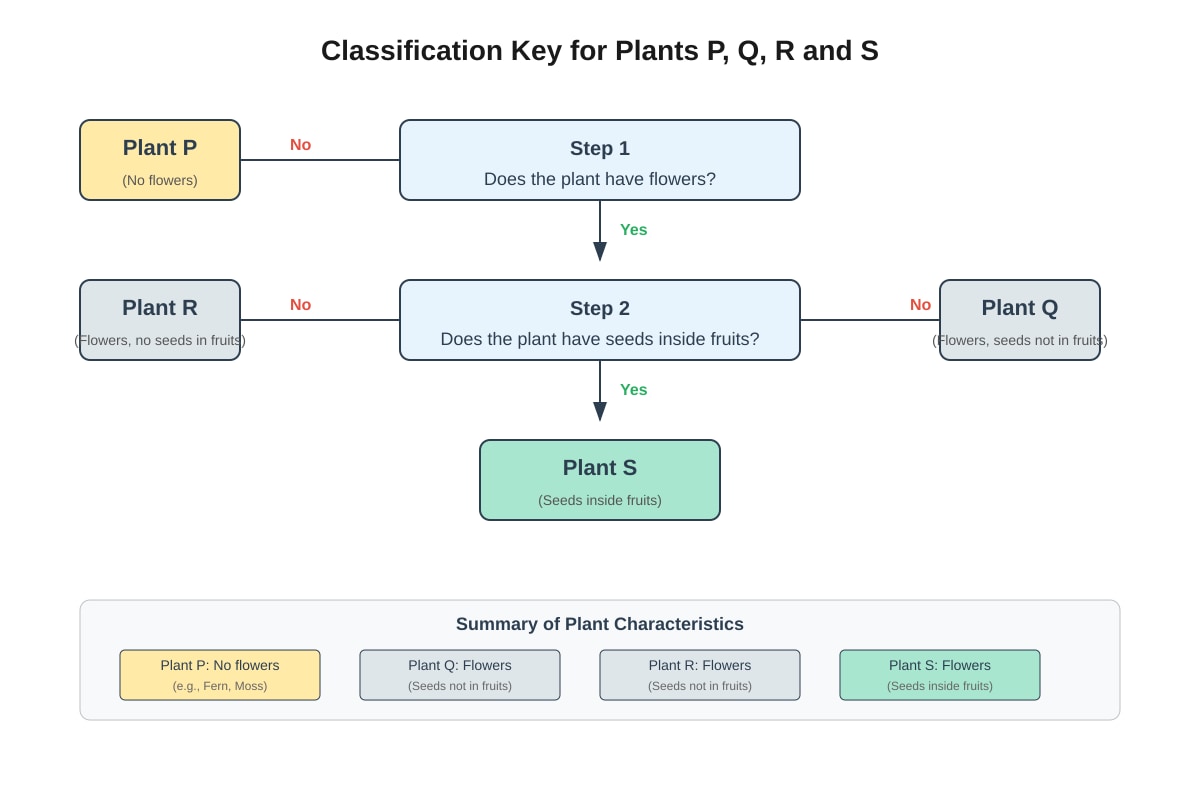
2. The diagram below shows the classification key for four different plants P, Q, R, and S.
<image_placeholder> id: Q2-fig1 type: diagram linked_question: Q2 description: A dichotomous key flowchart. Start: Does the plant have flowers? Yes -> Go to Step 2. No -> Plant P. Step 2: Does the plant have seeds inside fruits? Yes -> Plant Q. No -> Plant R. (Note: This is a simplified logic for P6 level, usually distinguishing between flowering/non-flowering or spore/seed). Let's adjust to standard P6: Start: Does it produce spores? Yes -> Plant P. No -> Go to 2. 2: Does it produce flowers? Yes -> Plant Q. No -> Go to 3. 3: Are seeds enclosed in fruits? Yes -> Plant R. No -> Plant S. labels: P, Q, R, S must_show: The branching logic clearly. </image_placeholder>
Based on the key, which statement is true?
(1) Plant P produces flowers.
(2) Plant Q produces spores.
(3) Plant R is a flowering plant.
(4) Plant S produces seeds enclosed in fruits.
3. Which of the following characteristics is used to classify mammals?
(1) They have scales and lay eggs.
(2) They have feathers and can fly.
(3) They have hair or fur and feed their young with milk.
(4) They have moist skin and live in water.
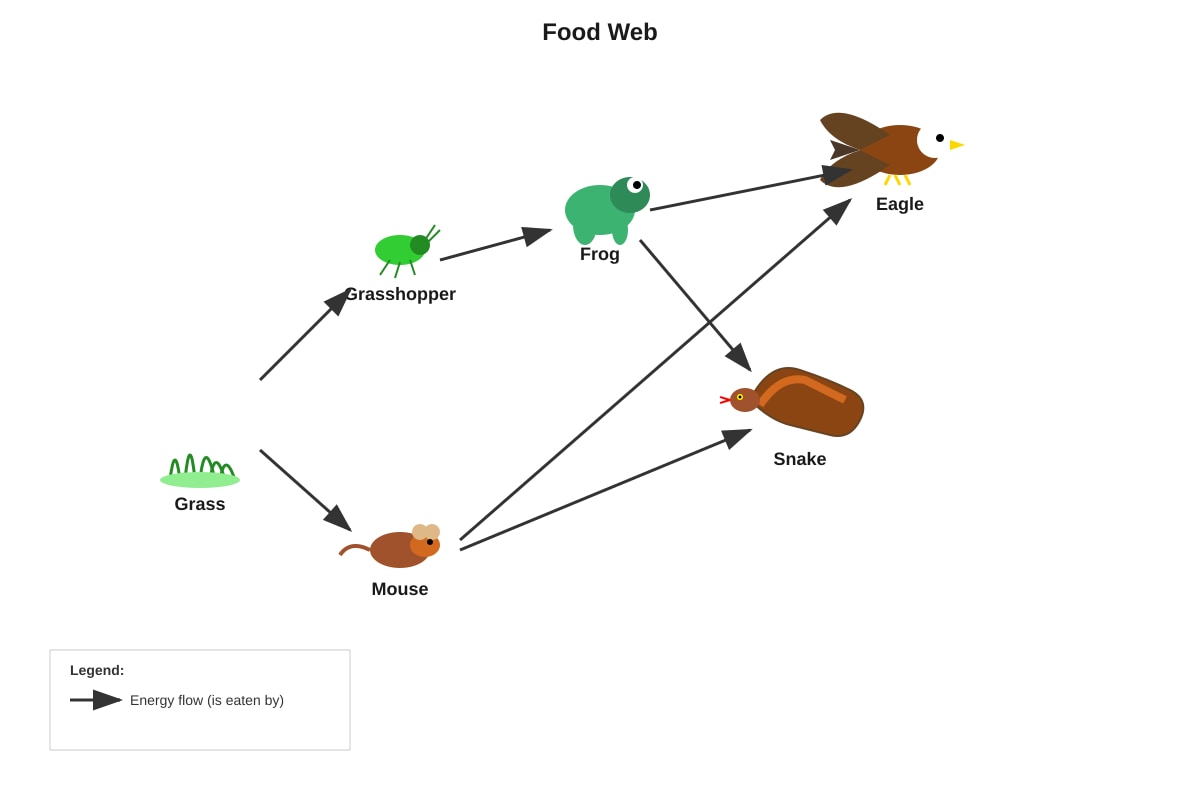
4. Study the food web below.
<image_placeholder> id: Q4-fig1 type: diagram linked_question: Q4 description: A food web showing: Grass -> Grasshopper -> Frog -> Snake. Grass -> Mouse -> Snake. Grass -> Mouse -> Eagle. Frog -> Eagle. labels: Grass, Grasshopper, Frog, Snake, Mouse, Eagle arrows: Pointing from eaten to eater. must_show: Clear arrows indicating energy flow. </image_placeholder>
If the population of frogs decreases significantly due to disease, what is the most likely immediate effect on the ecosystem?
(1) The population of grasshoppers will decrease.
(2) The population of snakes will increase.
(3) The population of mice will decrease due to increased predation by snakes.
(4) The population of eagles will increase.
5. Which of the following is an example of an adaptation that helps a cactus survive in a hot and dry desert?
(1) Broad leaves to capture more sunlight.
(2) Thick, waxy skin to reduce water loss.
(3) Shallow roots to absorb surface rain quickly.
(4) Large flowers to attract pollinators.
6. The table below shows the characteristics of three organisms X, Y, and Z.
| Organism | Has Chlorophyll | Reproduces by Spores | Has Vascular Tissue |
|---|---|---|---|
| X | Yes | Yes | No |
| Y | Yes | No | Yes |
| Z | No | Yes | No |
Which of the following correctly identifies X, Y, and Z?
(1) X: Fern, Y: Moss, Z: Mushroom
(2) X: Moss, Y: Flowering Plant, Z: Mushroom
(3) X: Fern, Y: Flowering Plant, Z: Bacteria
(4) X: Moss, Y: Fern, Z: Mushroom
7. Why are fungi classified separately from plants?
(1) Fungi do not have chlorophyll and cannot make their own food.
(2) Fungi do not have roots, stems, or leaves.
(3) Fungi reproduce using spores.
(4) Fungi grow on dead organic matter.
8. Which of the following pairs of animals belongs to the same group based on their body covering?
(1) Snake and Lizard
(2) Frog and Toad
(3) Bat and Bird
(4) Whale and Shark
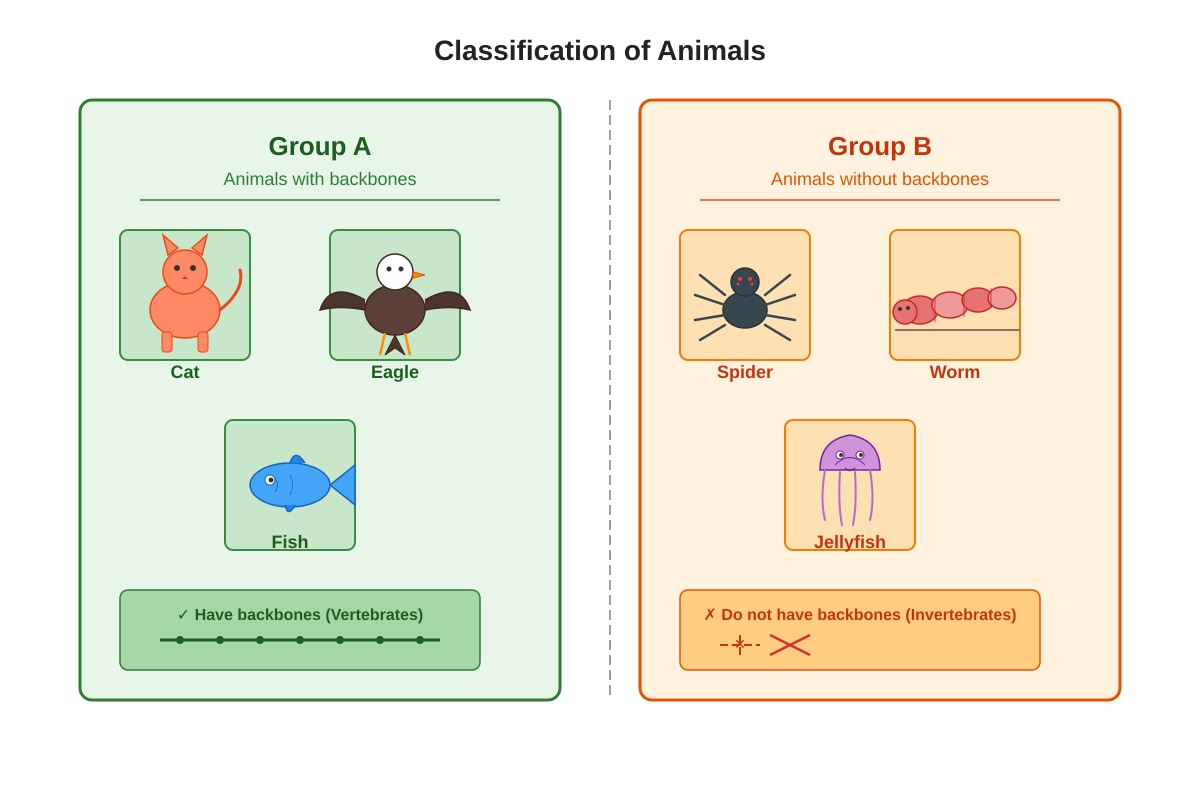
9. Look at the classification chart below.
<image_placeholder> id: Q9-fig1 type: diagram linked_question: Q9 description: A chart classifying animals into Group A and Group B. Group A: Animals with backbones. Group B: Animals without backbones. Examples listed under A: Cat, Eagle, Fish. Examples listed under B: Spider, Worm, Jellyfish. labels: Group A, Group B must_show: The distinction between vertebrates and invertebrates. </image_placeholder>
Which animal can be added to Group B?
(1) Goldfish
(2) Earthworm
(3) Penguin
(4) Turtle
10. Which of the following statements about biodiversity is correct?
(1) Biodiversity refers only to the number of plant species in an area.
(2) High biodiversity makes an ecosystem more stable and resilient to changes.
(3) Humans have no impact on the biodiversity of a rainforest.
(4) Biodiversity is highest in polar regions.
11. A student observed an organism in the garden. It had a hard outer shell, six legs, and three body parts. To which group does this organism belong?
(1) Arachnids
(2) Insects
(3) Crustaceans
(4) Myriapods
12. Which of the following is NOT a reason for conserving biodiversity?
(1) To maintain the balance of nature.
(2) To provide sources for new medicines.
(3) To ensure a variety of food sources for humans.
(4) To increase the number of pests in agricultural fields.
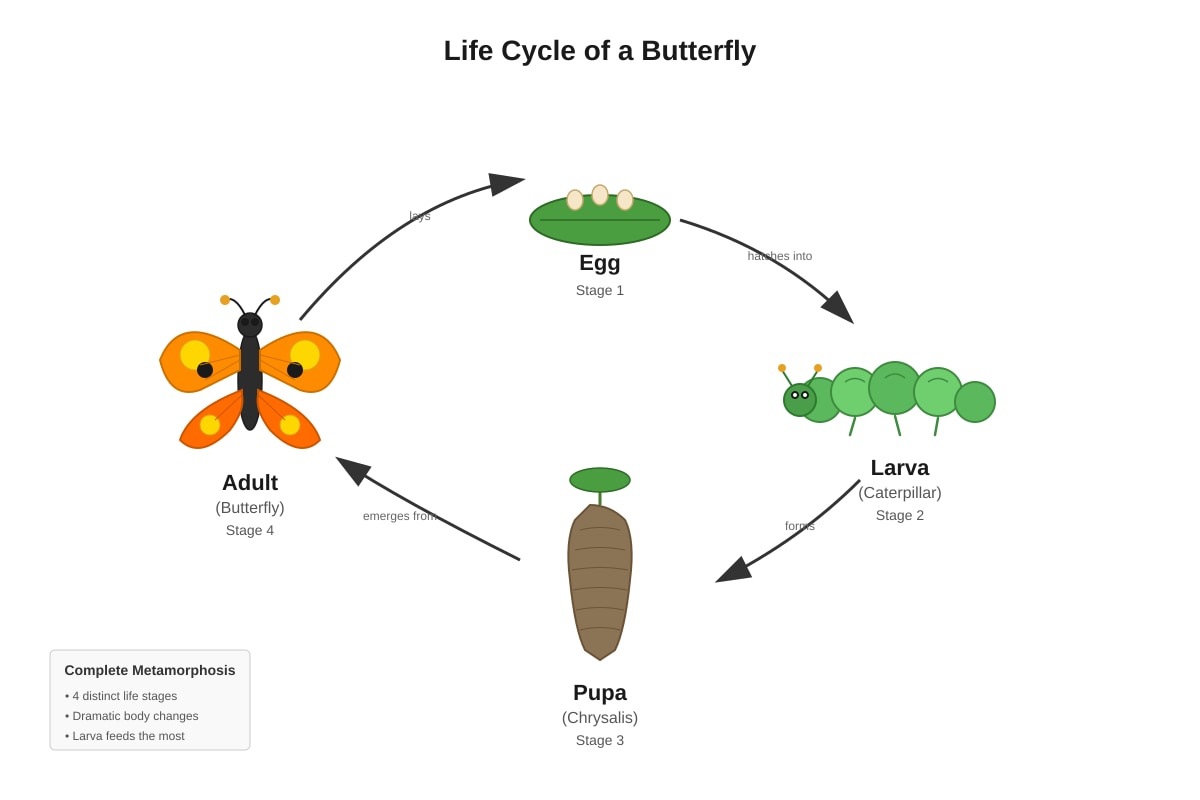
13. The diagram shows the life cycle of a butterfly.
<image_placeholder> id: Q13-fig1 type: diagram linked_question: Q13 description: Four stages: Egg -> Larva (Caterpillar) -> Pupa (Chrysalis) -> Adult (Butterfly). Arrows connect them in a cycle. labels: Egg, Larva, Pupa, Adult must_show: The complete metamorphosis cycle. </image_placeholder>
During which stage does the butterfly feed the most to store energy for reproduction?
(1) Egg
(2) Larva
(3) Pupa
(4) Adult
14. Which of the following plants is a non-flowering plant that reproduces by spores?
(1) Rose
(2) Fern
(3) Pine Tree
(4) Mango Tree
15. What is the main function of the roots of a mangrove tree that grow above the ground (pneumatophores)?
(1) To absorb more sunlight.
(2) To obtain oxygen from the air in waterlogged soil.
(3) To support the tree against strong winds.
(4) To trap fish for food.
16. Which of the following sequences correctly shows the hierarchy of classification from largest to smallest group?
(1) Species -> Genus -> Family -> Order
(2) Kingdom -> Phylum -> Class -> Order
(3) Phylum -> Kingdom -> Class -> Family
(4) Order -> Family -> Genus -> Kingdom
17. In a forest ecosystem, trees provide shelter for birds. Birds eat insects that damage the trees. This relationship is an example of:
(1) Competition
(2) Interdependence
(3) Parasitism
(4) Predation only
18. Which of the following is an adaptive feature of a polar bear?
(1) Thin fur to release heat.
(2) White fur for camouflage in snow.
(3) Small body size to conserve heat.
(4) Webbed feet for climbing trees.
19. Why are viruses not considered living organisms by some scientists?
(1) They are too small to be seen.
(2) They cannot reproduce on their own and need a host cell.
(3) They do not have DNA.
(4) They cause diseases.
20. Which of the following actions would most negatively affect the biodiversity of a coral reef?
(1) Establishing a marine protected area.
(2) Reducing plastic waste in the ocean.
(3) Overfishing and destructive fishing practices.
(4) Planting mangroves along the coast.
Section B (28 marks)
Answer all questions in the spaces provided.
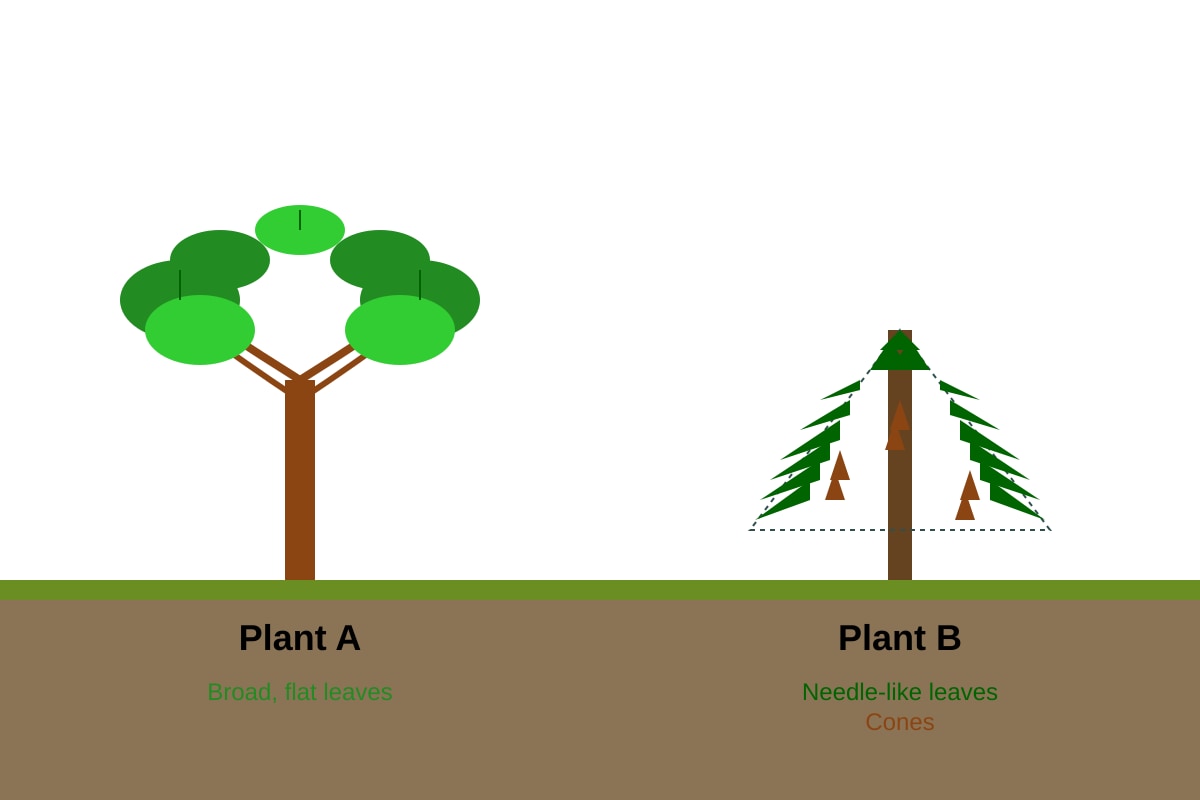
21. The diagram below shows two types of plants, Plant A and Plant B.
<image_placeholder> id: Q21-fig1 type: diagram linked_question: Q21 description: Plant A has broad, flat green leaves. Plant B has needle-like leaves and cones. labels: Plant A, Plant B must_show: Distinct leaf shapes and presence of cone on Plant B. </image_placeholder>
(a) State one similarity between Plant A and Plant B in terms of their reproduction. [1]
(b) Plant B is a conifer. State one difference between the seeds of Plant A (a flowering plant) and Plant B. [1]
(c) Why are conifers often found in colder regions? Explain how their needle-like leaves help them survive. [2]
22. Study the food chain below:
Leaf Aphid Ladybird Spider
(a) Identify the producer in this food chain. [1]
(b) If a pesticide is sprayed on the leaves to kill the aphids, explain what might happen to the population of spiders after a few weeks. [2]
(c) Why is a food web a better representation of feeding relationships in an ecosystem than a single food chain? [1]
23. The table below shows the characteristics of three animals, J, K, and L.
| Animal | Body Covering | Method of Reproduction | Breathes using |
|---|---|---|---|
| J | Scales | Lays eggs with hard shells | Lungs |
| K | Moist skin | Lays eggs in water (jelly-like) | Lungs and Skin |
| L | Scales | Lays eggs in water (soft shell) | Gills |
(a) Identify the group of vertebrates to which Animal J belongs. [1]
(b) Animal K is an amphibian. Explain why it needs to live near water. [2]
(c) Animal L is a fish. State one adaptive feature of Animal L that helps it move efficiently in water. [1]
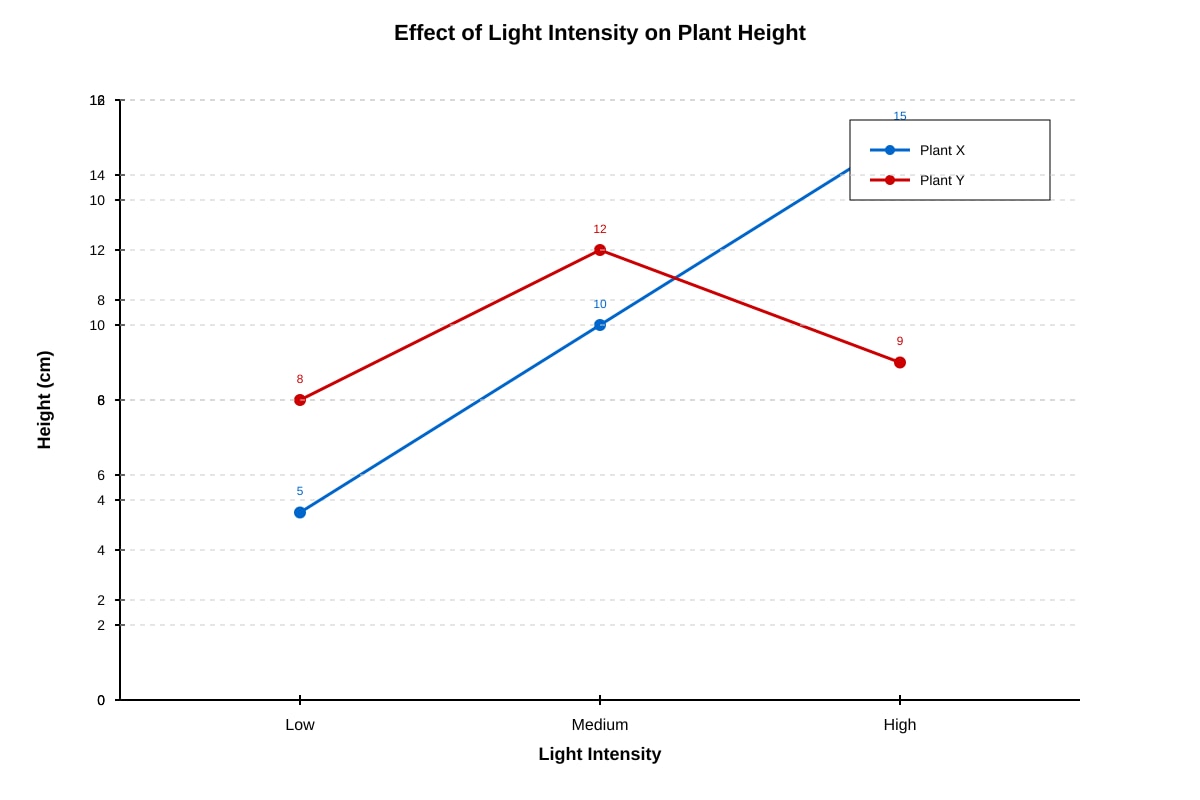
24. A group of students investigated the effect of light intensity on the growth of two types of plants, Plant X and Plant Y.
<image_placeholder> id: Q24-fig1 type: graph linked_question: Q24 description: A line graph. X-axis: Light Intensity (Low, Medium, High). Y-axis: Height of Plant (cm). Two lines: Plant X increases steadily from Low to High. Plant Y increases from Low to Medium, then decreases at High. labels: Light Intensity, Height (cm), Plant X, Plant Y values: Plant X: 5cm, 10cm, 15cm. Plant Y: 8cm, 12cm, 9cm. must_show: Clear trend lines for both plants. </image_placeholder>
(a) What is the independent variable in this experiment? [1]
(b) Based on the graph, which plant is better suited for a shady garden? Explain your answer. [2]
(c) Suggest one variable that must be kept constant to ensure a fair test. [1]
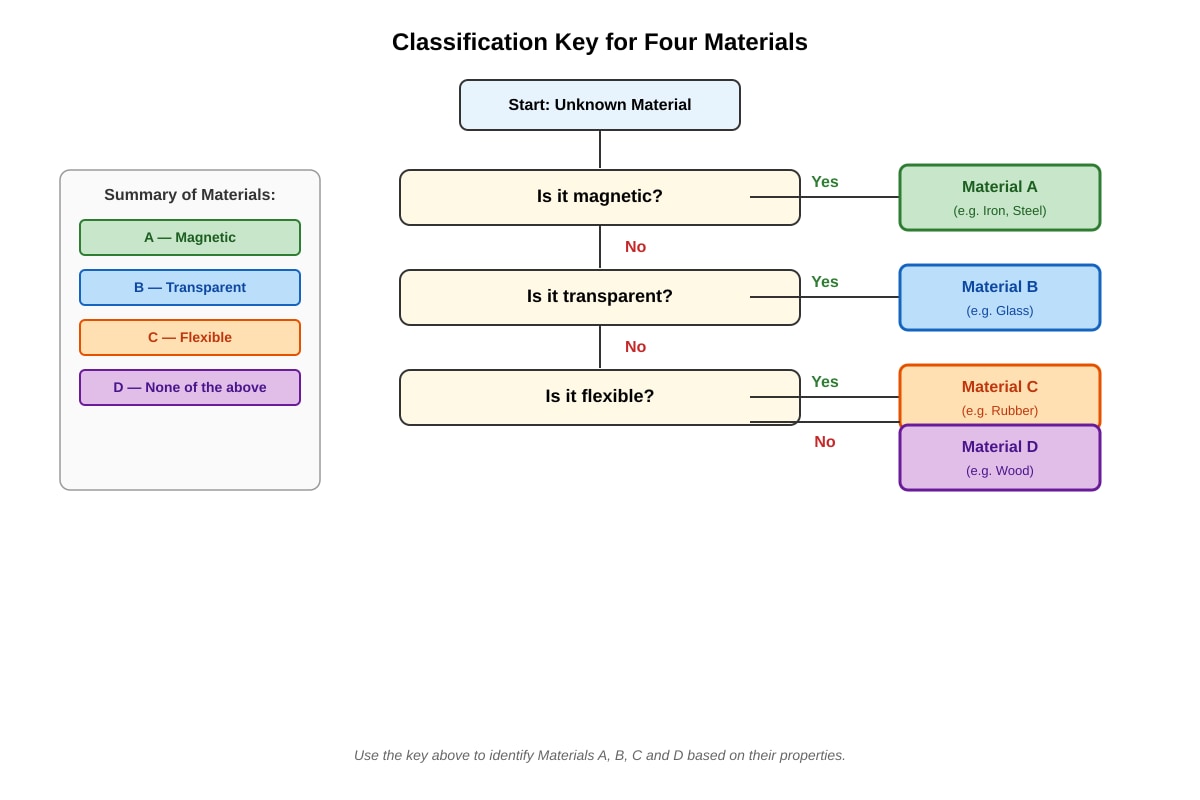
25. The diagram below shows a simple classification key for four materials.
<image_placeholder> id: Q25-fig1 type: diagram linked_question: Q25 description: Key: Is it magnetic? Yes -> Material A. No -> Is it transparent? Yes -> Material B. No -> Is it flexible? Yes -> Material C. No -> Material D. labels: A, B, C, D must_show: The decision tree. </image_placeholder>
(a) Material A is likely to be made of which metal? [1]
(b) Material B is used for making windows. What property makes it suitable for this use? [1]
(c) Material C is used for making rubber bands. State one property of Material C. [1]
26. Deforestation is a major threat to biodiversity.
(a) Explain how deforestation leads to a loss of habitat for animals. [2]
(b) Suggest one way humans can help to restore biodiversity in deforested areas. [1]
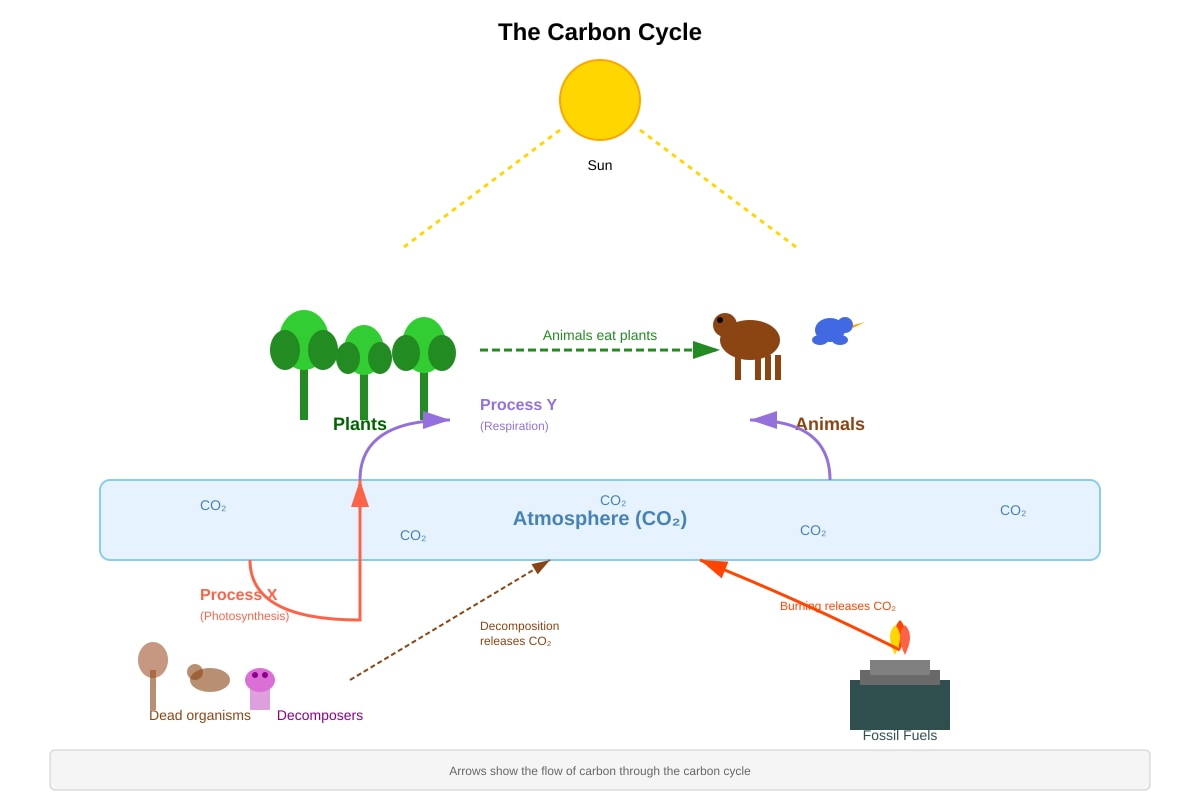
27. The diagram shows the carbon cycle.
<image_placeholder> id: Q27-fig1 type: diagram linked_question: Q27 description: Diagram showing: Plants take in CO2 (Process X). Animals eat plants. Animals and Plants release CO2 (Process Y). Dead organisms decompose. Fossil fuels burn and release CO2. labels: Process X, Process Y, CO2, Plants, Animals must_show: Arrows indicating flow of carbon. </image_placeholder>
(a) Name Process X. [1]
(b) Name Process Y. [1]
(c) How does an increase in Process Y contribute to global warming? [2]
28. A student found an unknown organism in the soil. It had no legs, no eyes, and a segmented body. It moved by contracting its muscles.
(a) Suggest one identity for this organism. [1]
(b) State one importance of this organism to the soil ecosystem. [1]
(c) Why is it important to classify organisms correctly? [1]
[End of Paper]
Answers
TuitionGoWhere Practice Paper - Science Primary 6 PSLE (SA1 Version 2)
Answer Key and Marking Scheme
Section A (28 marks)
| Qn | Answer | Remarks |
|---|---|---|
| 1 | 2 | Frogs, snakes, and eagles are all oviparous (lay eggs). |
| 2 | 3 | Plant R follows the path: No spores -> Has flowers -> Seeds in fruits. This describes a flowering plant. |
| 3 | 3 | Mammals are characterized by hair/fur and mammary glands (milk). |
| 4 | 3 | If frogs decrease, snakes have less food from frogs, so they may eat more mice. Increased predation on mice causes their population to decrease. |
| 5 | 2 | Thick, waxy skin (cuticle) reduces water loss through transpiration. |
| 6 | 2 | X: Moss (spores, no vascular). Y: Flowering Plant (seeds, vascular). Z: Mushroom (fungi, spores, no chlorophyll). |
| 7 | 1 | Fungi are heterotrophs (saprophytes/parasites), unlike plants which are autotrophs. |
| 8 | 1 | Snakes and lizards are both reptiles with scales. |
| 9 | 2 | Earthworms are invertebrates (no backbone). |
| 10 | 2 | High biodiversity increases ecosystem stability. |
| 11 | 2 | Insects have 6 legs, 3 body parts, and an exoskeleton. |
| 12 | 4 | Increasing pests is harmful, not a reason for conservation. |
| 13 | 2 | The larva (caterpillar) stage is the main feeding stage to store energy. |
| 14 | 2 | Ferns are non-flowering vascular plants that reproduce by spores. |
| 15 | 2 | Pneumatophores allow gas exchange in oxygen-poor muddy soil. |
| 16 | 2 | Kingdom -> Phylum -> Class -> Order is the correct hierarchy. |
| 17 | 2 | Interdependence describes mutual reliance. |
| 18 | 2 | White fur provides camouflage in snowy environments. |
| 19 | 2 | Viruses lack cellular structure and cannot reproduce independently. |
| 20 | 3 | Overfishing directly reduces species populations and disrupts food webs. |
Section B (28 marks)
21.
(a) Both produce seeds. [1]
Note: Accept "Both are seed-producing plants". Do not accept "Both have roots" as the question asks about reproduction.
(b) Plant A's seeds are enclosed in a fruit, while Plant B's seeds are naked (in cones) and not enclosed in a fruit. [1]
Note: Must mention "enclosed in fruit" vs "naked/not in fruit".
(c) Needle-like leaves have a smaller surface area, which reduces water loss through transpiration. This helps the plant conserve water in cold/dry conditions where water may be frozen. [2]
Marking: 1 mark for smaller surface area/reduces transpiration. 1 mark for conserving water.
22. (a) Leaf (or Plant). [1]
(b) The population of spiders will decrease. [1] Because the ladybirds will die due to lack of food (aphids), leading to a lack of food for the spiders. [1]
Marking: 1 mark for correct trend (decrease). 1 mark for correct reasoning (link through food chain).
(c) A food web shows multiple feeding relationships and how organisms are interconnected, whereas a food chain shows only a single linear path. [1]
Note: Accept "shows more complex relationships" or "shows what happens if one food source is removed".
23. (a) Reptile. [1]
(b) Amphibians have moist skin that allows for gas exchange, which requires moisture. [1] Also, they lay jelly-like eggs without shells that would dry out on land, so they need water for reproduction. [1]
Marking: 1 mark for skin/respiration. 1 mark for reproduction/eggs.
(c) Streamlined body shape OR Fins OR Tail for propulsion. [1]
24. (a) Light intensity. [1]
(b) Plant Y. [1] Because Plant Y grows taller at low to medium light intensity compared to Plant X, or Plant Y's growth decreases at high light intensity suggesting it prefers shade. [1]
Note: Looking at the graph data provided in placeholder: Plant Y is 8cm at Low, Plant X is 5cm. Plant Y is taller at low light.
(c) Amount of water OR Type of soil OR Temperature OR Size of pot. [1]
Note: Must be a relevant variable. "Time" is not accepted as it is the duration of the experiment.
25.
(a) Iron (or Steel/Nickel/Cobalt). [1]
Note: Must be a magnetic material.
(b) Transparency (allows light to pass through). [1]
(c) Elasticity (or Stretchy). [1]
26.
(a) Deforestation removes trees which are the homes/shelter for many animals. [1] Without shelter and food sources, animals cannot survive or reproduce, leading to population decline or extinction. [1]
Marking: 1 mark for removal of home/food. 1 mark for consequence (death/migration).
(b) Replanting trees (reforestation) OR Creating nature reserves OR Enforcing laws against illegal logging. [1]
27. (a) Photosynthesis. [1]
(b) Respiration. [1]
(c) Process Y (Respiration/Combustion) releases carbon dioxide into the atmosphere. [1] Carbon dioxide is a greenhouse gas that traps heat, causing the Earth's temperature to rise. [1]
Marking: 1 mark for CO2 release. 1 mark for trapping heat/global warming mechanism.
28. (a) Earthworm. [1]
(b) It aerates the soil (makes holes for air/water) OR It decomposes dead organic matter to enrich the soil with nutrients. [1]
(c) To understand the relationships between organisms OR To identify organisms correctly for conservation/study. [1]
Note: Accept any valid reason related to scientific organization or conservation.