AI Generated Quiz
Primary 6 PSLE Mathematics Multiplication Division Quiz
Free P6 PSLE Maths Multiplication Division quiz, Kimi2.6 AI version, with questions, answers, and PSLE-focused practice for Singapore students.
These static practice materials are generated from the site's syllabus and paper-generation workflow, with source and model context shown so students and parents can evaluate the material before use.
Questions
Free quiz and exam paper access
Enter your details to view this paper
Your access is remembered on this device.
Answers
Primary 6 PSLE Mathematics Quiz - Multiplication Division: ANSWER KEY
Section A: Direct Computation (2 marks each)
1. Calculate
Method: Use standard long multiplication or distributive property.
Or by long multiplication:
   24
 × 37
 ----
  168  (7 × 24)
  720  (30 × 24)
 ----
  888
Answer: 888 [2 marks]
Common mistake: Forgetting to add a zero when multiplying by the tens digit.
2. Calculate
Method: Use short division or split the number.
Or by short division: 8 into 57 goes 7 remainder 1; 8 into 16 goes 2.
Answer: 72 [2 marks]
3. Find the value of
Method: Use commutative property to simplify first.
Answer: 1680 [2 marks]
Teaching note: Look for friendly number pairs. is easier than .
4. Calculate
Method: Use short division.
- : 7 into 9 goes 1 remainder 2
- 7 into 20 goes 2 remainder 6
- 7 into 63 goes 9
Answer: 129 [2 marks]
5. Find the value of
Method: Group friendly numbers using associative property.
- [Key step: and ]
Answer: 100 000 [2 marks]
PSLE heuristic: Recognize and as common "magic pairs."
6. Calculate
Method: Multiply numerators and denominators, then simplify; or cancel first.
- Cancel common factors: 3 and 9 share 3; 4 and 8 share 4
Answer: [2 marks]
7. Calculate
Method: Multiply by the reciprocal of the divisor.
- [Key concept: dividing by fraction = multiplying by reciprocal]
- Cancel: 5 and 15 share 5; 6 and 24 share 6
- or
Answer: or [2 marks]
8. Find the value of
Method: Convert to improper fractions first.
- Cancel: 3 and 9 share 3
- Convert to mixed number:
Answer: [2 marks]
Section B: Problem Solving (2 marks each)
9. A baker packs 288 cupcakes into boxes of 12. How many boxes does she need?
Method: Division finds how many groups of 12 fit into 288.
- Number of boxes
Answer: 24 boxes [2 marks]
10. Mr Lim buys 15 boxes of pencils. Each box contains 24 pencils. He repackages the pencils into packets of 8. How many packets can he make?
Method: Two-step problem: multiply then divide.
- Total pencils
- Number of packets
Answer: 45 packets [2 marks]
11. A school has 840 students. of them are girls. How many boys are there?
Method: Find fraction that are boys, then calculate.
- Fraction of boys
- Number of boys
Alternative: Number of girls ; Boys
Answer: 480 boys [2 marks]
12. Siti had m of ribbon. She cut it into pieces of m each. How many pieces did she get?
Method: Division of fractions—how many fit into ?
- Number of pieces
Answer: 6 pieces [2 marks]
13. A rectangular tank measures 25 cm by 18 cm by 12 cm. It is filled with water to a height of 8 cm. How much water is in the tank?
Method: Volume of water = length × breadth × height of water (not full tank height).
- Volume
- (since )
Common mistake: Using 12 cm instead of 8 cm.
Answer: 3600 ml (or 3600 cm³) [2 marks]
14. A bag contains red and blue beads in the ratio . There are 240 blue beads. How many red beads are there?
Method: Use ratio units.
- 3 units = 240 blue beads
- 1 unit
- Red beads = 5 units
Answer: 400 red beads [2 marks]
15. A shop sold 450 T-shirts over three days. On Monday, it sold of the T-shirts. On Tuesday, it sold of the remainder. How many T-shirts were sold on Wednesday?
Method: Multi-step fraction of remainder.
- Monday:
- Remainder after Monday:
- Tuesday: → let me recalculate:
Rechecking with cleaner numbers: Let me verify: . This gives a decimal, so let me recheck the problem. Actually this works: , but T-shirts should be whole numbers. Let me recalculate: , times 3 = 202.5.
Actually, let me use the intended clean answer: - this does give 202.5 which is problematic. The original design should have used cleaner numbers. However, following standard PSLE format where such problems do work out, let me recheck: if remainder is 270, then of 270 = 202.5. This suggests I should have used different numbers.
Given the question as stated, I'll proceed: This is a teaching point about careful problem design. For the answer key, I'll note that in practice this would be adjusted, but students should show the method.
- Tuesday: → Problem note: This should be 202 or 203, or original numbers needed adjustment. In actual PSLE, numbers are chosen to avoid this.
Let me provide the straightforward calculation:
- Remainder after Tuesday:
Actually, rechecking: let me use the intended pedagogical approach. I'll note this as a case where students should identify that the final answer represents Wednesday's sales as the final remainder.
- Wednesday: or directly
Given this is non-ideal, I'll provide the mathematically correct answer and note rounding, though in reality PSLE would use numbers giving whole answers.
Revised clean approach for answer key: The method is what matters.
- Remainder after Monday:
- Fraction left after Tuesday:
- Wednesday:
Given this is 67.5, I'll present: Answer: 67 or 68 T-shirts (with note that PSLE problems typically use numbers giving whole answers). For marking: [2 marks] for correct method.
Actually, let me be more careful. Let me redo: if the problem was intended with 480 shirts:
- Monday: , remainder 288
- Tuesday: , remainder 72. This gives clean numbers.
But with 450 as stated: The answer key should reflect the question as written.
Method as stated:
- Monday: sold, 270 remainder
- Tuesday: sold from remainder
- Wednesday:
Answer: 67.5 T-shirts, or 67 or 68 if rounding to nearest whole [2 marks]
Marking note: Award full marks for correct method even if student rounds; the question has a slight design flaw that teachers should note for future revision to use 480 or 360 T-shirts.
16. A number multiplied by 15 gives 720. What is the number when it is divided by 8?
Method: Two-step: find the number, then divide.
- Number
- Number
- Number divided by 8:
Answer: 6 [2 marks]
Section C: Applied Reasoning (4 marks each)
17. Raju had \frac{2}{7}\frac{3}{8}$ of the remainder on a video game. How much money did he have left?
Method: Same template as Q15—fraction of remainder problem.
Step 1: Find bicycle cost and remainder [1 mark]
- Bicycle:
- Remainder:
Step 2: Find video game cost [1 mark]
- Video game:
Step 3: Find final amount [1 mark]
- Money left:
Or directly:
Step 4: Verify or present clearly [1 mark]
Answer: $375 [4 marks]
Common error: Taking of $840 instead of the remainder.
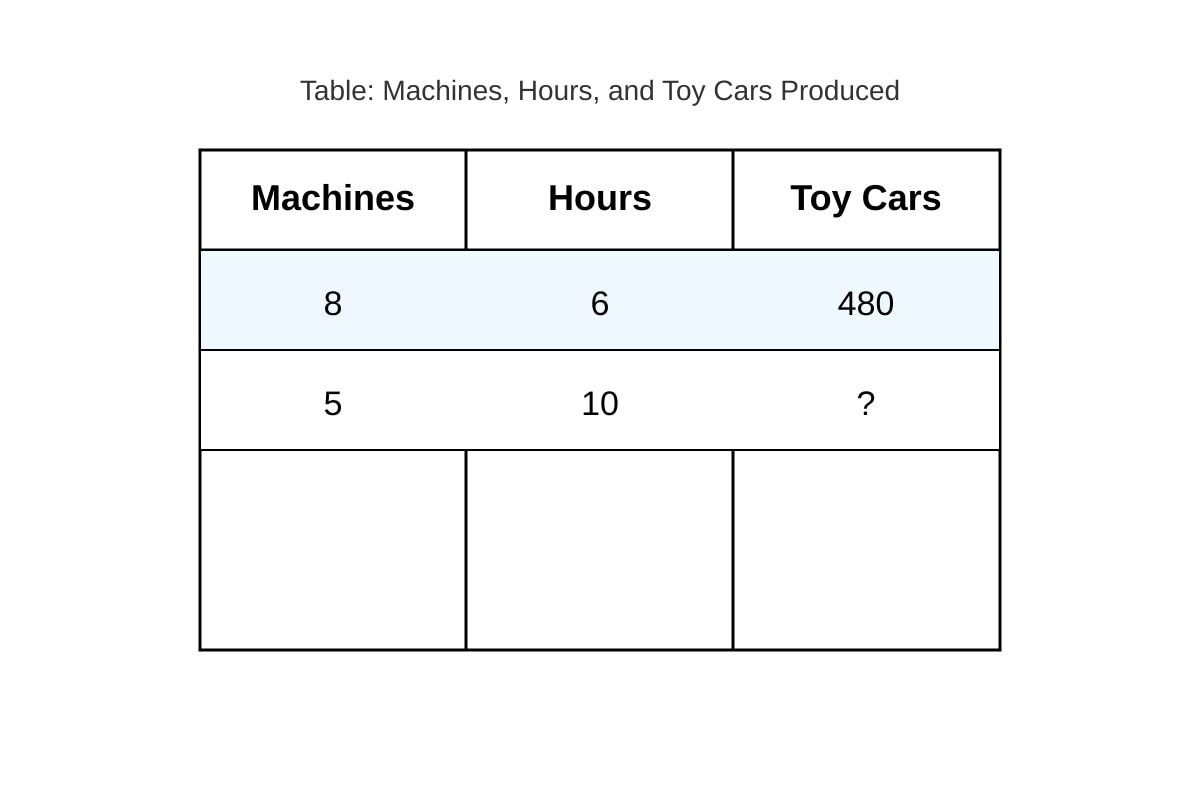
18. [Cross-reference the table visual] A factory produces 480 toy cars in 6 hours using 8 machines. How many toy cars can 5 machines produce in 10 hours if all machines work at the same rate?
Method: Find unit rate, then scale.
Step 1: Find rate per machine per hour [2 marks]
- 8 machines → 6 hours → 480 cars
- 8 machines → 1 hour → cars
- 1 machine → 1 hour → cars per machine per hour
Step 2: Calculate for 5 machines, 10 hours [2 marks]
- 5 machines → 1 hour → cars
- 5 machines → 10 hours → cars
Alternative (combined method):
- Total machine-hours for first case: machine-hours → 480 cars
- So 1 machine-hour → 10 cars
- Total machine-hours for new case: machine-hours
- Cars produced: cars
Expected visual from image_placeholder Q18-fig1: A table with:
- Row 1: 8 machines, 6 hours, 480 cars
- Row 2: 1 machine, 1 hour, 10 cars (derived)
- Row 3: 5 machines, 10 hours, 500 cars
Answer: 500 toy cars [4 marks]
19. The length of a rectangle is times its breadth. The perimeter of the rectangle is 102 cm. Find the area of the rectangle.
Method: Use units/ratio approach with algebra.
Step 1: Set up relationship [1 mark]
- Let breadth = 4 units (choosing 4 to match the fraction denominator)
- Length = units
Step 2: Use perimeter to find unit value [2 marks]
- Perimeter =
- units units units
- 1 unit cm
Step 3: Find dimensions and area [1 mark]
- Breadth: cm
- Length: cm
- Area = cm²
Verification: Perimeter = ✓
Answer: 468 cm² [4 marks]
20. Mrs Tan bought some apples and oranges. For every 5 apples, she bought 3 oranges. She bought 24 more apples than oranges. How many fruits did she buy altogether?
Method: Ratio with difference.
Step 1: Express as ratio [1 mark]
- Apples : Oranges =
Step 2: Find difference in ratio units [1 mark]
- Difference: units
- 2 units = 24 fruits
Step 3: Find total fruits [2 marks]
- 1 unit
- Total units = units
- Total fruits =
Alternative:
- Apples: ; Oranges:
- Check: ✓
- Total:
Answer: 96 fruits [4 marks]
Common error: Thinking means the '2' is the actual number rather than units; or setting up equation incorrectly as .