AI Generated Quiz
Primary 6 PSLE Mathematics Measurement Quiz
Free P6 PSLE Maths Measurement quiz, Kimi2.6 AI version, with questions, answers, and PSLE-focused practice for Singapore students.
These static practice materials are generated from the site's syllabus and paper-generation workflow, with source and model context shown so students and parents can evaluate the material before use.
Questions
Free quiz and exam paper access
Enter your details to view this paper
Your access is remembered on this device.
Answers
Primary 6 PSLE Mathematics Quiz — Measurement (Answer Key)
Total Marks: 40
Section A: Multiple Choice (1 mark each)
1. Answer: (C) 2 m
Explanation: A standard classroom door is about 2 metres tall. 2 cm is far too small (about a thumb width), 20 cm is too small (a ruler length), and 20 m is far too large (about 6 storeys). This tests estimation skills with standard units. Common mistake: Choosing (B) by confusing centimetres with metres.
2. Answer: (B) 60 ℓ
Step-by-step working:
- Volume = length × width × height
- Volume = 50 cm × 40 cm × 30 cm = 60 000 cm³
- Since 1 ℓ = 1000 cm³: 60 000 ÷ 1000 = 60 ℓ
Concept: Capacity is volume expressed in litres. The conversion 1 ℓ = 1000 cm³ is essential for volume-capacity conversions. Common mistake: Forgetting to divide by 1000, giving 60 000 ℓ (D).
3. Answer: (B) 7
Step-by-step working:
- Number of pieces = Total length ÷ Length per piece
- 5.6 ÷ 0.8 = 56 ÷ 8 = 7
Concept: Division with decimals. Eliminate decimals by multiplying both numbers by 10, then divide. Common mistake: Answering 0.7 by dividing incorrectly.
4. Answer: (C) 20 000 g
Step-by-step working:
- Mass of 8 packets = 2.5 kg × 8 = 20 kg
- Convert to grams: 20 kg × 1000 = 20 000 g
Concept: Two-step conversion — first find total mass, then convert kg to g using 1 kg = 1000 g. Common mistake: Converting before multiplying (2.5 × 1000 = 2500, then × 8 = 20 000 g gives same answer, but 2500 g × 8 = 20 000 g is correct too; error is stopping at 2500 g or 2000 g).
5. Answer: (A) 3 h 35 min
Step-by-step working:
- From 09:45 to 13:45 would be exactly 4 hours
- But we stop at 13:20, which is 25 minutes before 13:45
- 4 hours − 25 minutes = 3 hours 35 minutes
Alternative method:
- 09:45 to 13:20
- Hours: 13 − 9 = 4 hours, but minutes: 20 − 45 (can't do)
- Borrow 1 hour: 3 hours + (60 + 20) − 45 = 3 hours + 35 minutes = 3 h 35 min
Section B: Short Answer (2 marks each)
6. Answer: 3450 m
Step-by-step working:
- 1 km = 1000 m
- 3.45 km = 3.45 × 1000 = 3450 m
Concept: When converting from larger to smaller units, multiply. The decimal point moves 3 places right. Marking: 1 mark for correct method, 1 mark for correct answer.
7. Answer: 1250 ml
Step-by-step working:
- 1 ℓ = 1000 ml
- 1.25 ℓ = 1.25 × 1000 = 1250 ml
Concept: Litres to millilitres conversion. "Milli-" means one-thousandth, so 1 ℓ = 1000 ml. Marking: 1 mark for correct method, 1 mark for correct answer.
8. Answer: 30 000 cm³
Step-by-step working:
- Volume of cuboid = base area × height
- Volume = 1200 cm² × 25 cm = 30 000 cm³
Concept: Volume = area of base × perpendicular height. This works for any prism. Marking: 1 mark for correct formula, 1 mark for correct answer.
9. Answer: 18 kg
Step-by-step working:
- Total mass = 3.6 kg × 5
- 3.6 × 5 = (3 × 5) + (0.6 × 5) = 15 + 3 = 18 kg
Concept: Decimal multiplication. Break into whole and decimal parts for easier calculation. Marking: 1 mark for correct method, 1 mark for correct answer.
10. Answer: 168 minutes
Step-by-step working:
- 2 hours = 2 × 60 = 120 minutes
- Total = 120 + 48 = 168 minutes
Concept: Time conversion. 1 hour = 60 minutes (not 100!). Common mistake: Converting to decimal (2.48) and getting confused. Marking: 1 mark for converting hours, 1 mark for final answer.
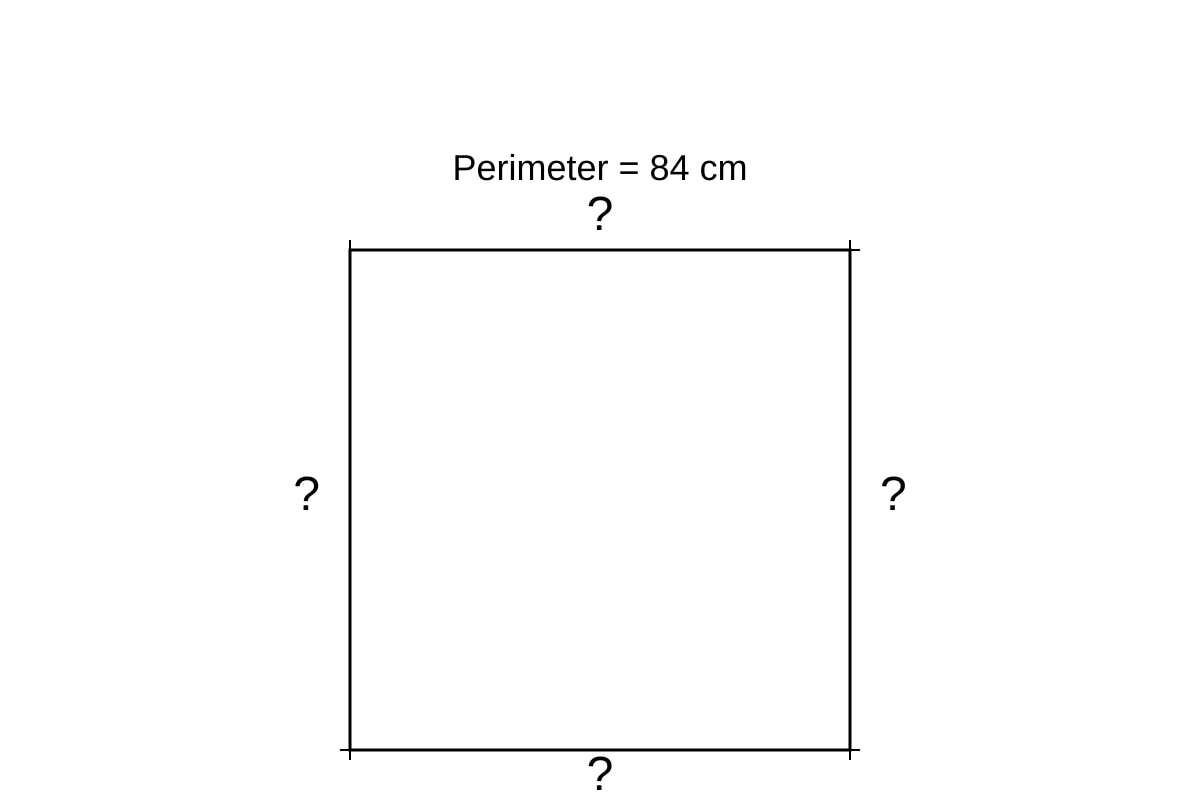
11. Answer: 21 cm
Step-by-step working:
- Perimeter of square = 4 × side length
- 4 × side = 84 cm
- Side = 84 ÷ 4 = 21 cm
Concept: In a square, all four sides are equal. Perimeter is the total distance around the shape. From the diagram with perimeter 84 cm and four equal sides marked, we divide by 4. Marking: 1 mark for correct division setup, 1 mark for correct answer.
12. Answer: 240 cm³
Step-by-step working:
- Volume of cuboid = length × width × height
- Volume = 8 cm × 6 cm × 5 cm
- 8 × 6 = 48; 48 × 5 = 240 cm³
Concept: Volume of a cuboid formula. Multiply three dimensions. Marking: 1 mark for correct formula/substitution, 1 mark for correct answer.
13. Answer: 80 km/h
Step-by-step working:
- Average speed = Total distance ÷ Total time
- Speed = 240 km ÷ 3 h = 80 km/h
Concept: Speed is distance per unit time. Units must match (km and h give km/h). Marking: 1 mark for correct formula, 1 mark for correct answer.
14. Answer: 7 minutes 30 seconds (or 7 min 30 s)
Step-by-step working:
- 1 minute = 60 seconds
- 450 ÷ 60 = 7 remainder 30
- So 450 s = 7 minutes 30 seconds
Concept: Division with remainder for time conversion. 7 × 60 = 420, and 450 − 420 = 30. Marking: 1 mark for correct division (7 min), 1 mark for remainder converted correctly.
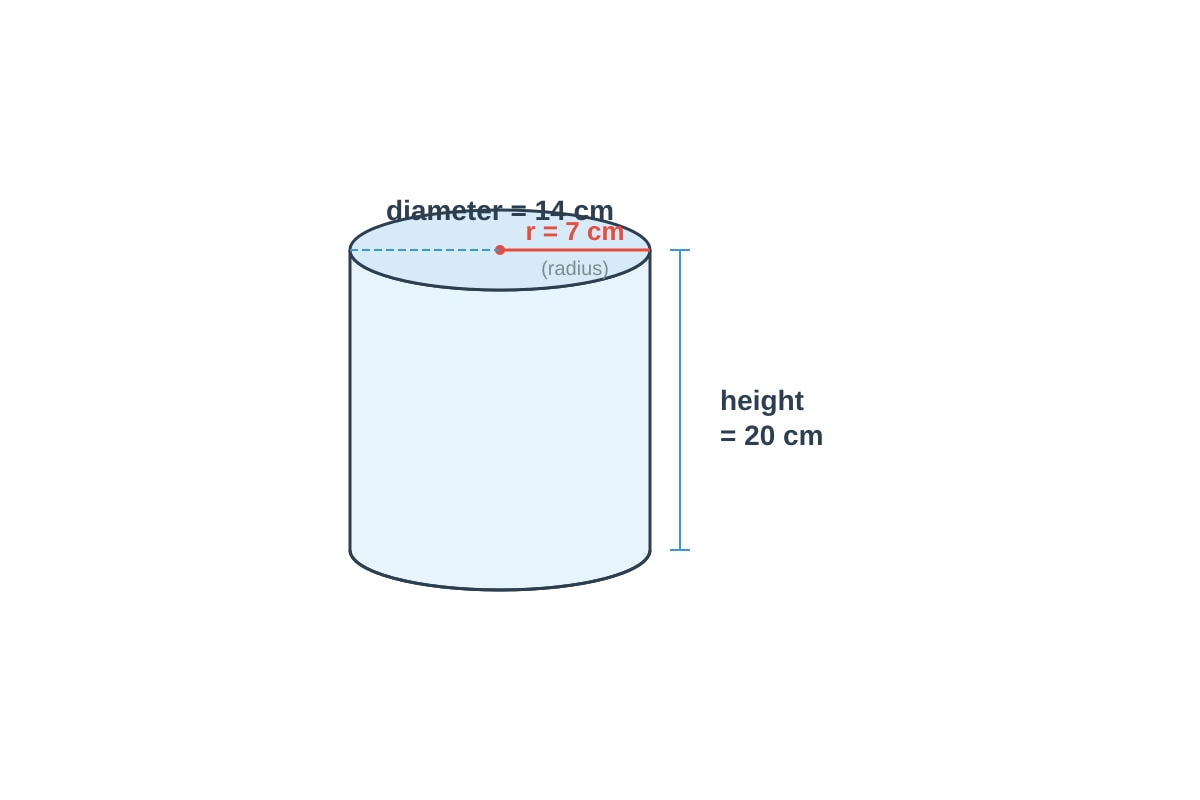
15. (a) Answer: 7 cm
Step-by-step working:
- Radius = diameter ÷ 2
- Radius = 14 cm ÷ 2 = 7 cm
Concept: Diameter passes through the centre; radius is half the diameter. From the diagram showing diameter 14 cm across the circular face. Marking: 1 mark for correct answer.
15. (b) Answer: 3080 cm³
Step-by-step working:
- Volume of cylinder =
- Volume =
- =
- = (since 49 ÷ 7 = 7)
- = = 3080 cm³
Concept: The formula finds the space inside a cylinder. The diagram shows radius 7 cm (from part a) and height 20 cm. Using simplifies nicely since r = 7. Marking: 1 mark for correct formula and substitution, 1 mark for correct calculation.
Section C: Problem Solving (3 marks each)
16. Answer: 60 ℓ
Step-by-step working:
Method: Using fractions
- Difference in water level:
- So of tank = 15 ℓ
- Full tank: 15 ℓ × 4 = 60 ℓ
Concept: The 15 ℓ poured out represents the difference between -full and -full. Find this difference as a fraction of the whole, then scale up. Marking scheme: [1] Correct fraction difference, [1] Correct unit value, [1] Correct final answer.
Common mistake: Adding 15 to original amount without finding what fraction 15 ℓ represents.
17. Answer: 54 cm
Step-by-step working:
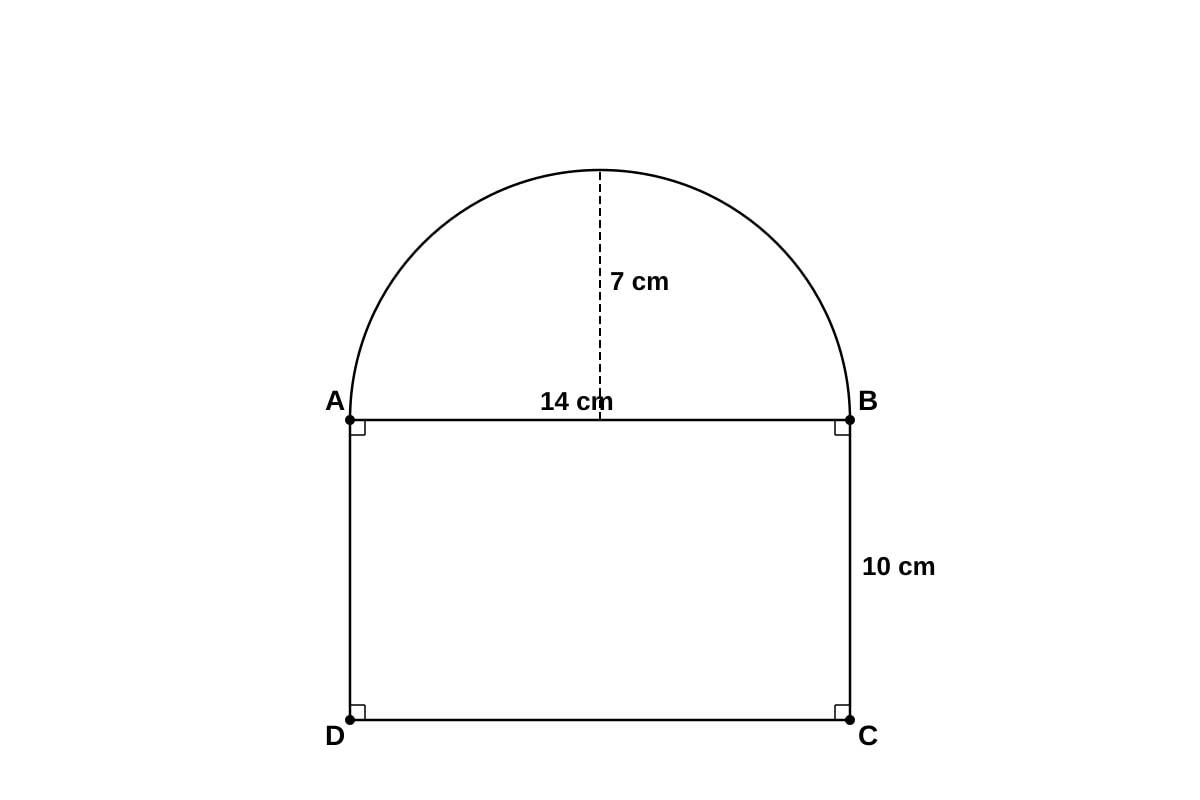
From the diagram: rectangle with length 14 cm, width 10 cm, semicircle on top with diameter 14 cm (radius 7 cm).
The perimeter of the composite figure includes:
- Three sides of the rectangle (the top side is covered by semicircle diameter, not part of perimeter)
- The curved part of the semicircle
Rectangle sides in perimeter:
- Two widths: 10 cm + 10 cm = 20 cm
- One length (bottom): 14 cm
Semicircle arc length:
- Circumference of full circle = cm
- Semicircle arc = cm
Total perimeter = 20 + 14 + 22 = 56 cm
Wait — let me recheck: The figure shows semicircle ON TOP of rectangle. The perimeter = bottom (14) + two sides (10 + 10) + semicircle arc.
Actually, re-reading: if semicircle is attached to the 14 cm side, the perimeter includes:
- The semicircle arc: cm
- The two vertical sides: 10 cm + 10 cm = 20 cm
- The bottom side: 14 cm
Total = 22 + 20 + 14 = 56 cm
Concept: Perimeter is the outer boundary only. The diameter line where semicircle meets rectangle is internal, not part of perimeter. Must identify which sides are exposed. Marking scheme: [1] Correct identification of perimeter components, [1] Correct semicircle arc calculation, [1] Correct final answer.
Common mistake: Including the diameter (14 cm) in perimeter, giving 70 cm; or forgetting one side.
18. (a) Answer: 84 000 cm³
Step-by-step working:
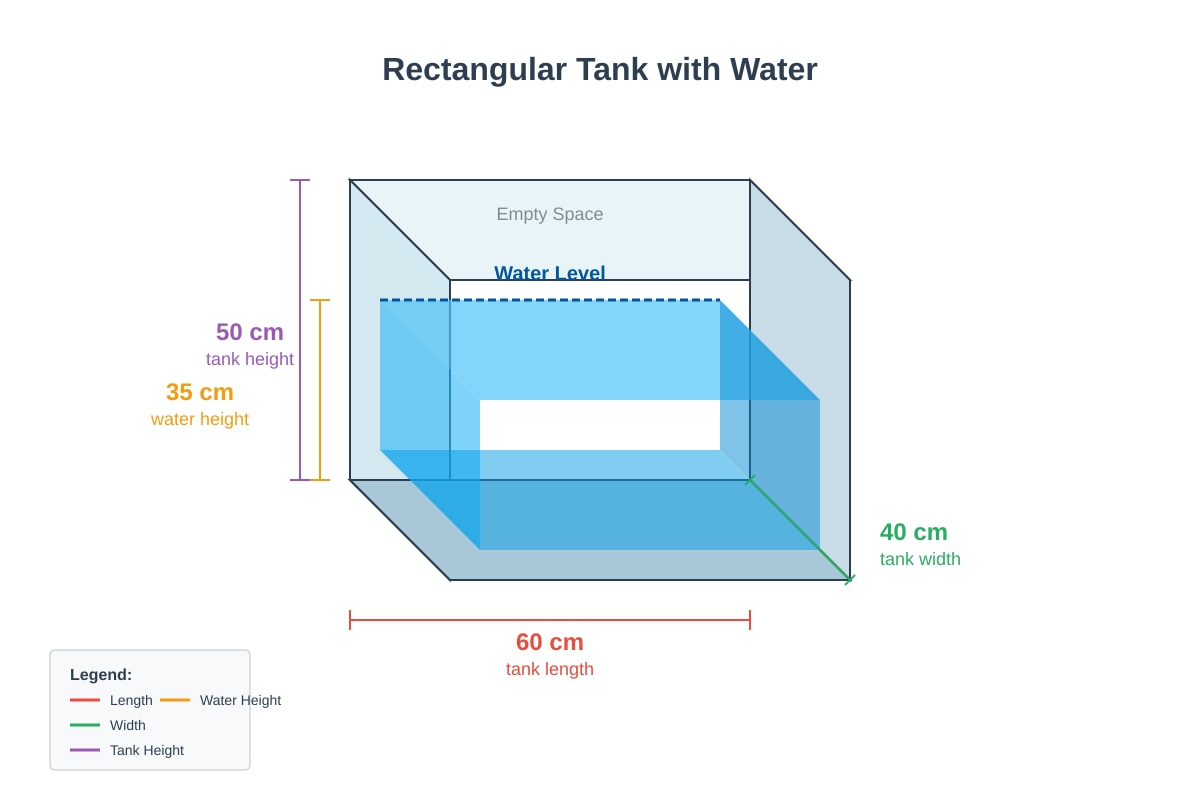
- Volume of water = length × width × water height
- = 60 cm × 40 cm × 35 cm
- = 2400 × 35
- = 84 000 cm³
Concept: The water forms a smaller cuboid with the tank's base dimensions but only 35 cm height. Marking: [1] correct substitution, [1] correct answer.
18. (b) Answer: 36 ℓ
Step-by-step working:
- Empty height = 50 − 35 = 15 cm
- Volume of empty space = 60 × 40 × 15 = 36 000 cm³
- Convert to litres: 36 000 ÷ 1000 = 36 ℓ
Alternative method:
- Total tank volume = 60 × 40 × 50 = 120 000 cm³ = 120 ℓ
- Water volume = 84 000 cm³ = 84 ℓ
- Empty = 120 − 84 = 36 ℓ
Concept: Either find empty space directly or subtract water from total. Both methods valid. Marking: [1] correct empty volume in cm³ or method, [1] correct conversion to litres, [1] correct final answer.
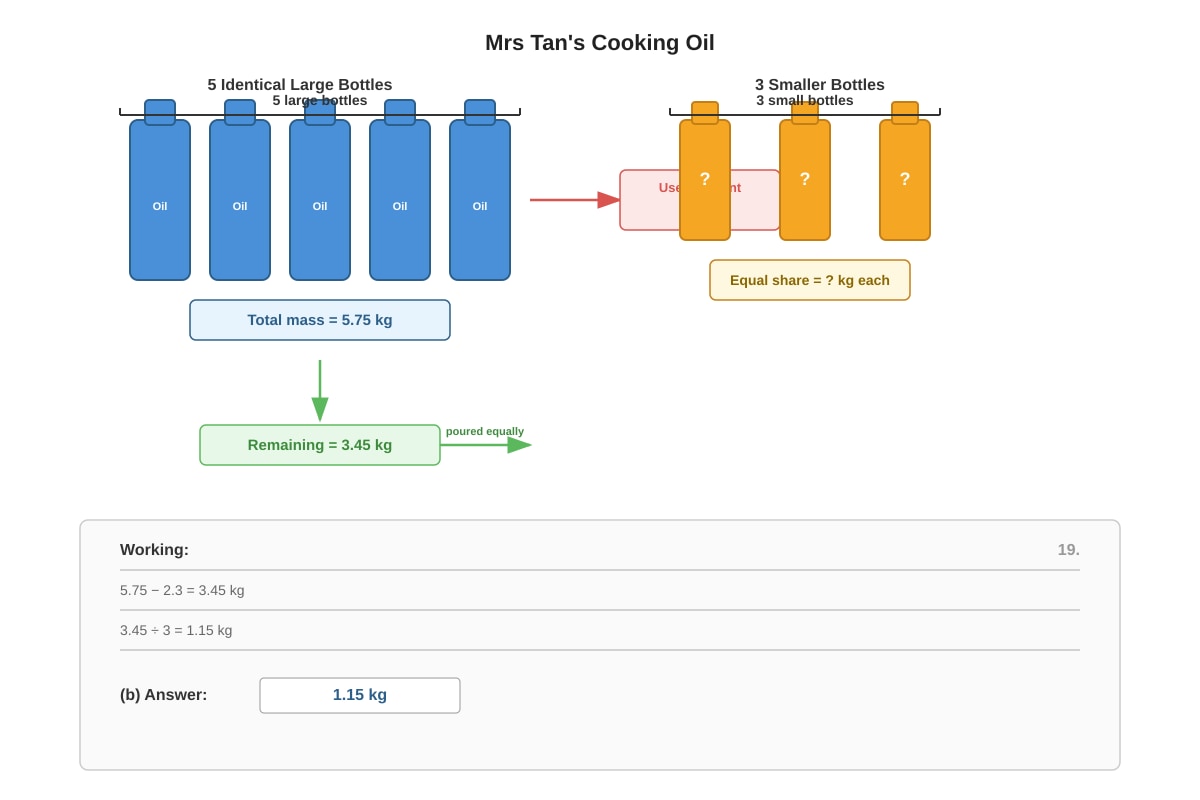
19. Answer: 1.15 kg (or 1 kg or kg)
Step-by-step working:
- Total mass of oil = 5.75 kg
- Mass used = 2.3 kg
- Remaining oil = 5.75 − 2.3 = 3.45 kg
- Mass in each small bottle = 3.45 ÷ 3 = 1.15 kg
Checking: 1.15 × 3 = 3.45 ✓
Concept: Multi-step word problem requiring subtraction then division. The diagram shows 5 bottles total → used portion → redistribution into 3 equal shares. Marking scheme: [1] Correct remaining mass, [1] Correct division by 3, [1] Correct final answer with unit.
Common mistake: Dividing 5.75 by 3 directly, ignoring the "used 2.3 kg" information.
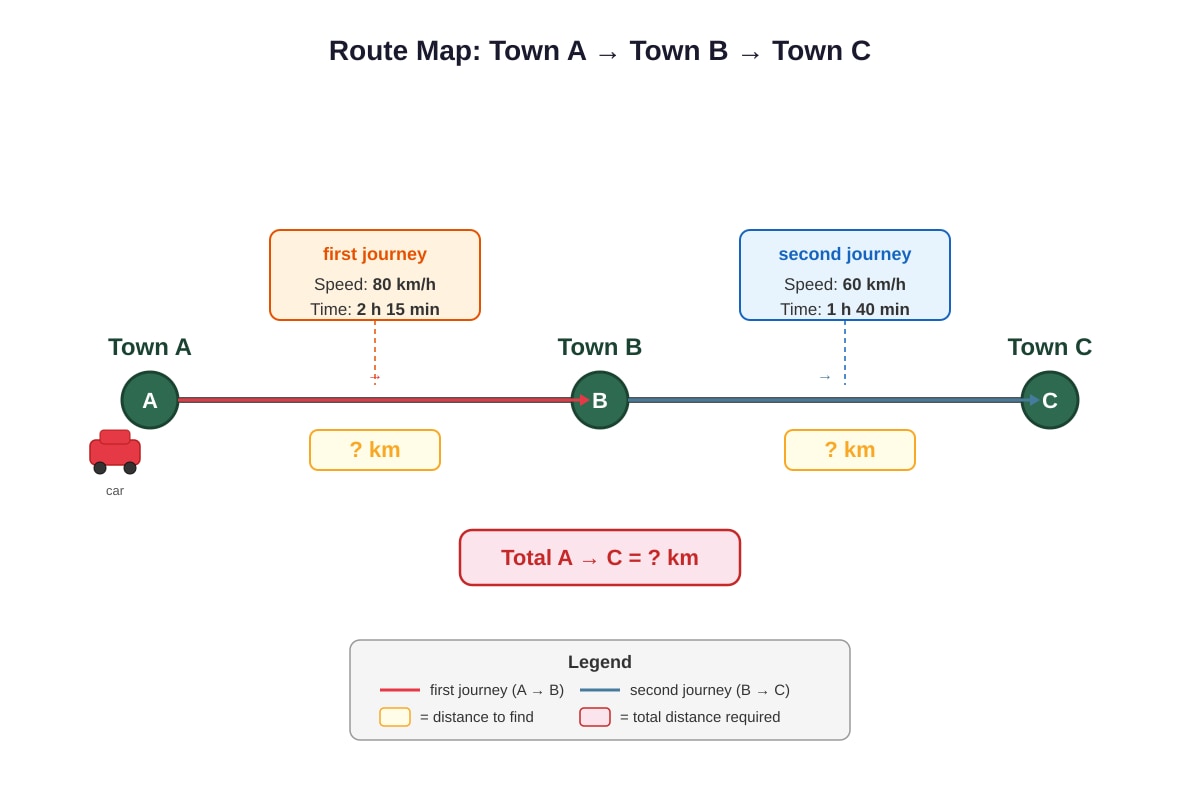
20. Answer: 280 km
Step-by-step working:
Journey A to B:
- Time = 2 h 15 min = 2.25 h (or h)
- Distance = speed × time = 80 × 2.25 = 80 × = = 180 km
Alternative: 80 × 2 = 160; 80 × 0.25 = 20; total = 180 km
Journey B to C:
- Time = 1 h 40 min = 1 h = h
- Distance = 60 × = = 100 km
Alternative conversion: 1 h 40 min = 100 minutes = h = h
Total distance:
- 180 km + 100 km = 280 km
Concept: Distance = speed × time. Must convert mixed time units to hours (or all to minutes, then adjust). The diagram shows two segments with different speeds and times. Marking scheme: [1] Correct distance A to B, [1] Correct distance B to C, [1] Correct total.
Common mistakes:
- Using 2.15 instead of 2.25 for 2 h 15 min
- Using 1.4 instead of 1 for 1 h 40 min
- Forgetting to add distances at the end
END OF ANSWER KEY
Section Totals: A: 5 marks | B: 20 marks | C: 15 marks | Total: 40 marks