AI Generated Quiz

Primary 6 PSLE Mathematics Data Analysis Quiz

Free AI-Generated Kimi K2 6 Free Primary 6 PSLE Mathematics Data Analysis quiz with questions and answers for Singapore students. This page is rendered as a direct URL so the questions and answers can be discovered without pressing in-page buttons.

These static practice materials are generated from the site's syllabus and paper-generation workflow, with source and model context shown so students and parents can evaluate the material before use.

Primary 6 PSLE Mathematics AI Generated Generated by Kimi K2 6 Free Updated 2026-06-07

Questions

<!-- TuitionGoWhere generation metadata: stage=5-1; model=moonshotai/kimi-k2.6:free; model_label=Kimi K2.6 Free; generated=2026-06-07; Sources: Stage 4-0 LLM templates, syllabus context, and Stage 2 evidence where available. -->

Primary 6 PSLE Mathematics Quiz - Data Analysis

Name: _______________________________ Class: _______

Date: ___________________ Score: _______ / 40

Duration: 40 minutes

Total Marks: 40

Instructions:

  • Answer all questions.
  • Show your working clearly in the space provided.
  • Marks are awarded for correct method even if the final answer is inaccurate.
  • Use of calculators is not allowed.

Section A: Simple Data Interpretation (Questions 1–8)

Each question carries 2 marks.


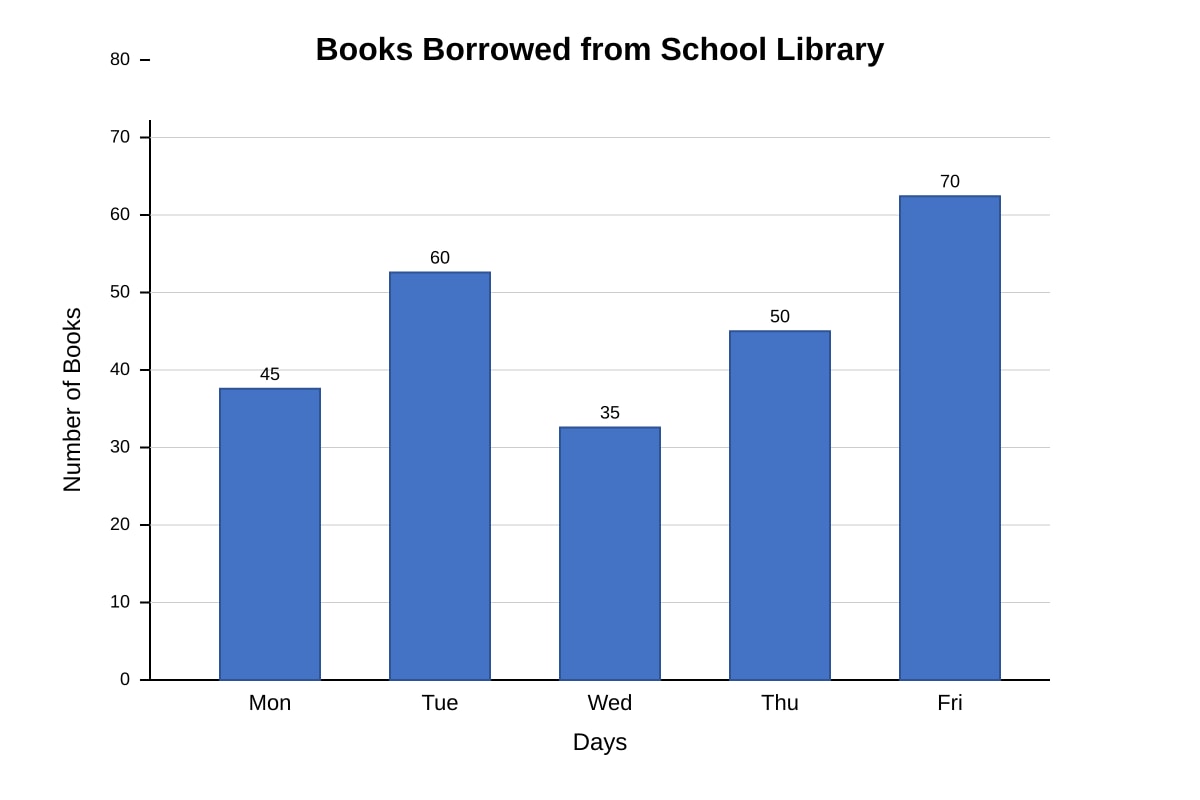
1. The bar graph below shows the number of books borrowed from the school library from Monday to Friday.

<image_placeholder> id: Q1-fig1 type: bar_graph linked_question: Q1 description: Bar graph showing books borrowed Monday to Friday labels: Days (Mon, Tue, Wed, Thu, Fri) on horizontal axis; Number of books on vertical axis values: Mon=45, Tue=60, Wed=35, Thu=50, Fri=70 must_show: Bar heights corresponding to values, labeled axes with scale (0, 10, 20, 30, 40, 50, 60, 70, 80), title "Books Borrowed from School Library" </image_placeholder>

(a) On which day were the most books borrowed?

_______________________________________________ [1]

(b) What is the total number of books borrowed from Monday to Friday?

_______________________________________________ [1]


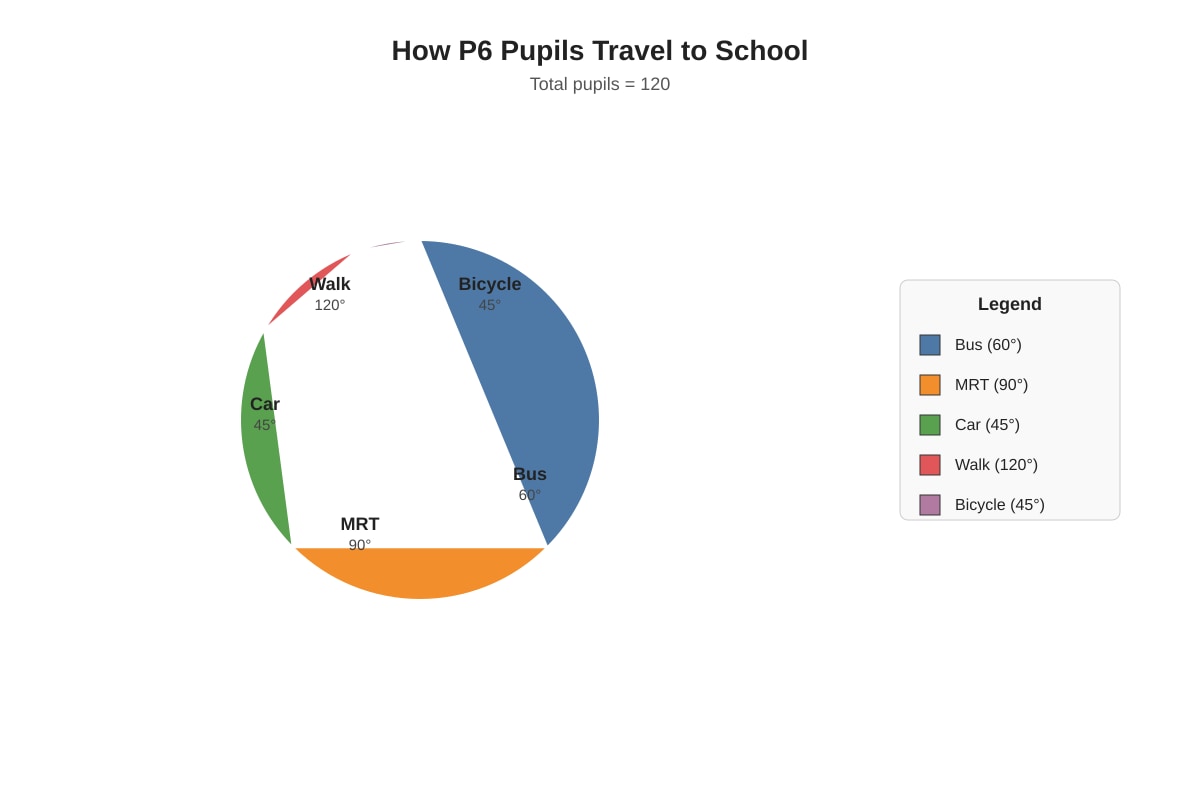
2. The pie chart below shows how 120 pupils in Primary 6 travel to school.

<image_placeholder> id: Q2-fig1 type: pie_chart linked_question: Q2 description: Pie chart showing modes of transport to school labels: Bus, MRT, Car, Walk, Bicycle values: Bus=60°, MRT=90°, Car=45°, Walk=120°, Bicycle=45° must_show: Sector angles labeled, color-coded sectors with labels, title "How P6 Pupils Travel to School", total pupils = 120 </image_placeholder>

(a) What fraction of the pupils walk to school? Express your answer in the simplest form.

_______________________________________________ [1]

(b) How many more pupils travel by bus than by car?

_______________________________________________ [1]


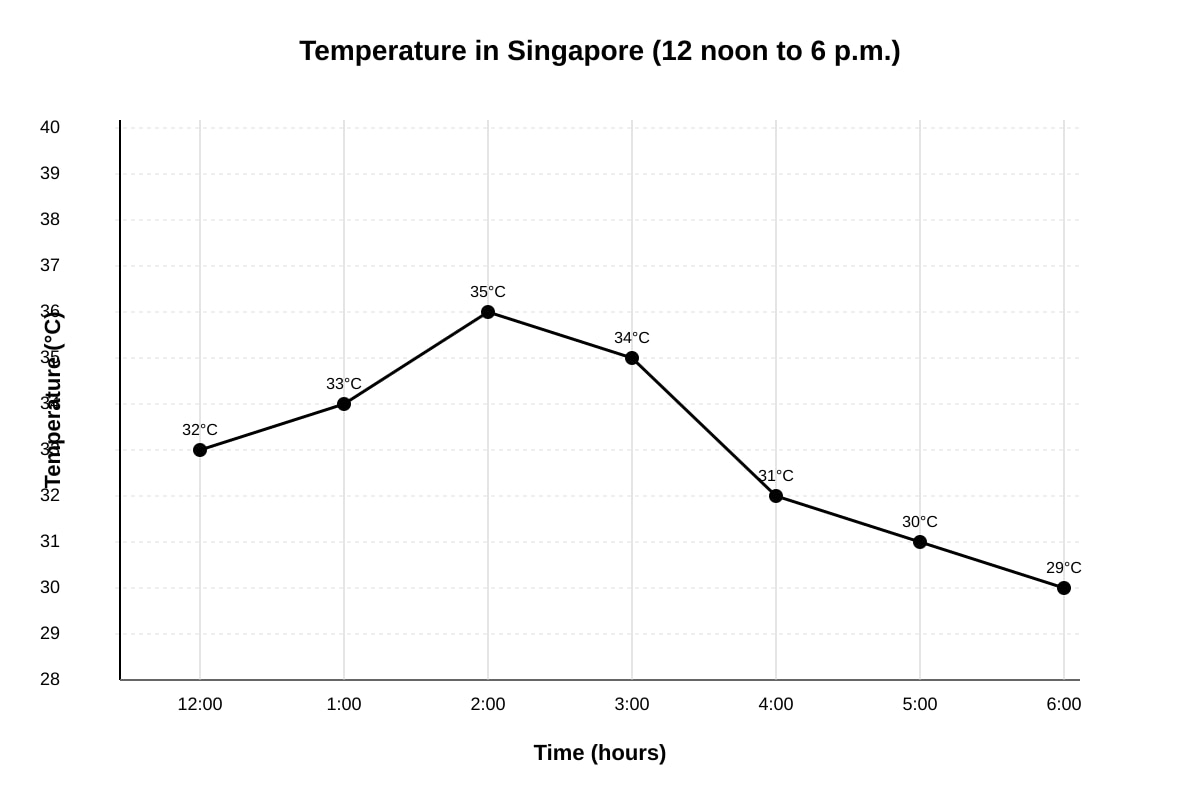
3. The line graph shows the temperature in Singapore over a 6-hour period.

<image_placeholder> id: Q3-fig1 type: line_graph linked_question: Q3 description: Line graph showing temperature from 12 noon to 6 p.m. labels: Time (hours) on horizontal axis; Temperature (°C) on vertical axis values: 12:00=32°C, 1:00=33°C, 2:00=35°C, 3:00=34°C, 4:00=31°C, 5:00=30°C, 6:00=29°C must_show: Data points connected by line, labeled axes with appropriate scale, title "Temperature in Singapore (12 noon to 6 p.m.)", point coordinates visible </image_placeholder>

(a) What was the temperature at 2 p.m.?

_______________________________________________ [1]

(b) What was the greatest decrease in temperature between any two consecutive hours?

_______________________________________________ [1]


4. The table shows the test scores of five pupils.

PupilTest Score
Alice78
Ben65
Clara92
David65
Evan80

(a) What is the mode of the test scores?

_______________________________________________ [1]

(b) What is the mean test score?

_______________________________________________ [1]


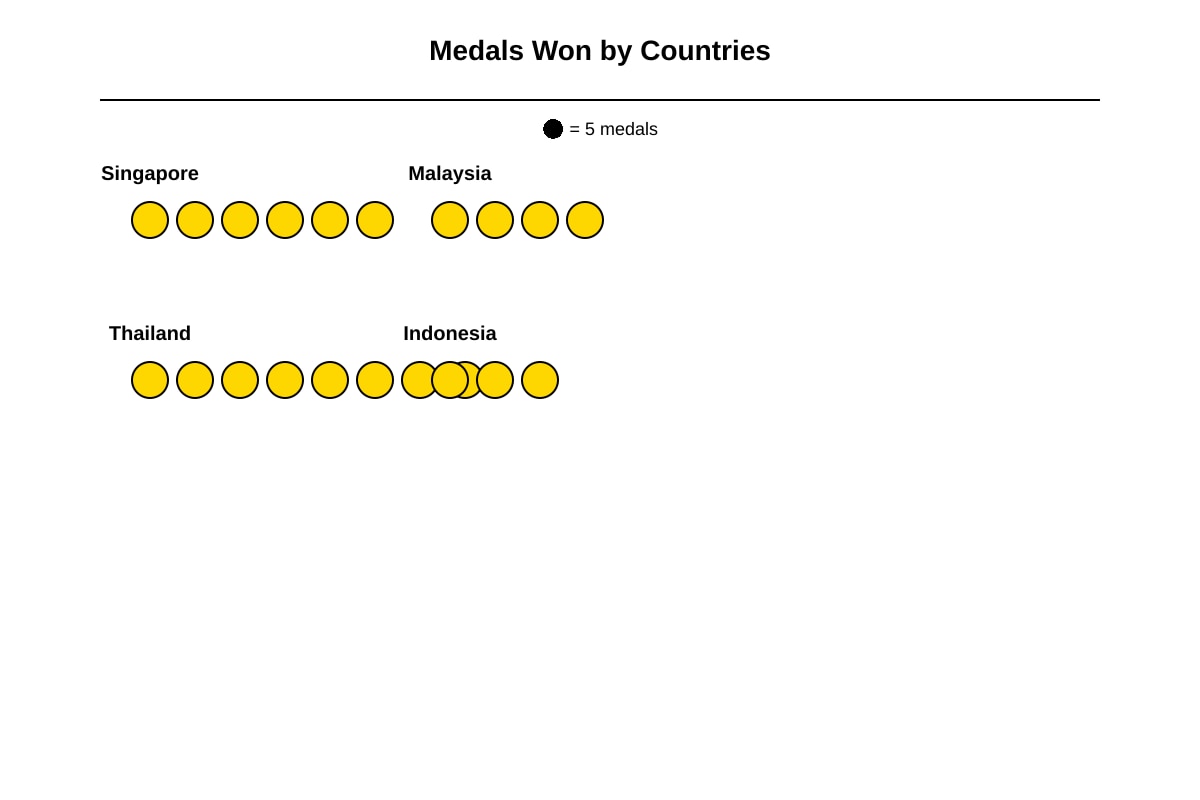
5. The pictograph shows the number of medals won by four countries in a sports competition.

<image_placeholder> id: Q5-fig1 type: pictograph linked_question: Q5 description: Pictograph showing medals won by four countries labels: Countries (Singapore, Malaysia, Thailand, Indonesia); Symbol = 5 medals values: Singapore=6 symbols, Malaysia=4 symbols, Thailand=8 symbols, Indonesia=3 symbols must_show: Country labels, exact number of symbols per country, legend "⚫ = 5 medals", title "Medals Won by Countries" </image_placeholder>

(a) How many medals did Thailand win?

_______________________________________________ [1]

(b) What is the total number of medals won by all four countries?

_______________________________________________ [1]


6. The table shows the favourite fruits of a group of pupils.

FruitNumber of Pupils
Apple24
Orange18
Mango30
Grape12
Pear6

(a) What percentage of the pupils chose mango as their favourite fruit?

_______________________________________________ [1]

(b) The same information is to be shown in a pie chart. What is the angle of the sector representing apple?

_______________________________________________ [1]


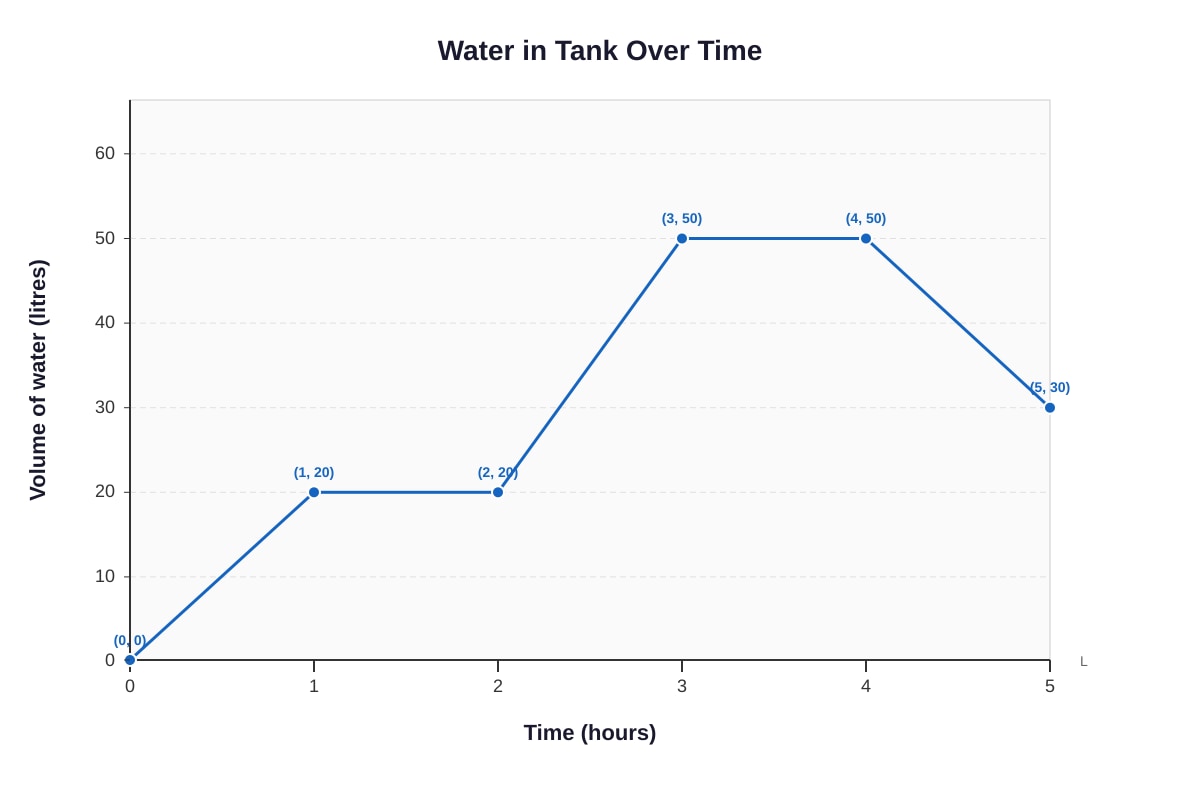
7. The graph shows the amount of water in a tank over time.

<image_placeholder> id: Q7-fig1 type: line_graph linked_question: Q7 description: Line graph showing water volume in a tank over 5 hours labels: Time (hours) on horizontal axis; Volume of water (litres) on vertical axis values: 0h=0L, 1h=20L, 2h=20L, 3h=50L, 4h=50L, 5h=30L must_show: Piecewise linear graph with horizontal segments, labeled axes, title "Water in Tank Over Time", coordinates of key points (turning points) </image_placeholder>

(a) For how long was the volume of water in the tank constant at 50 litres?

_______________________________________________ [1]

(b) At which hour was water flowing out of the tank?

_______________________________________________ [1]


8. The table shows the heights of six plants after 3 weeks of growth.

PlantHeight (cm)
A8.5
B12.3
C9.0
D15.6
E10.2
F11.5

(a) What is the range of the heights?

_______________________________________________ [1]

(b) Another plant G has a height of 14.0 cm. What is the median height of all seven plants?

_______________________________________________ [1]


Section B: Data Analysis and Problem Solving (Questions 9–16)

Each question carries 3 marks.


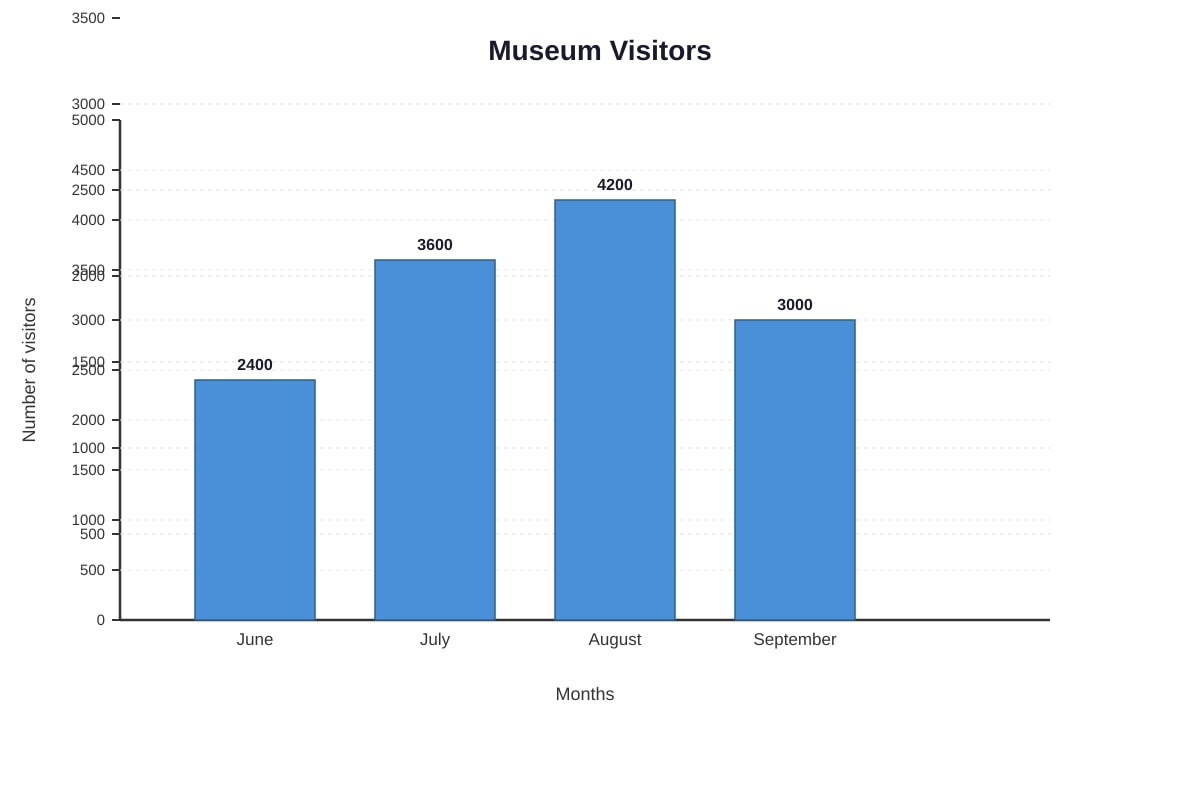
9. The bar graph shows the number of visitors to a museum over four months.

<image_placeholder> id: Q9-fig1 type: bar_graph linked_question: Q9 description: Bar graph showing museum visitors over four months labels: Months (June, July, August, September) on horizontal axis; Number of visitors on vertical axis values: June=2400, July=3600, August=4200, September=3000 must_show: Bar heights with exact values labeled on top of bars, labeled axes, title "Museum Visitors", scale in hundreds (0, 500, 1000, ... , 5000) </image_placeholder>

(a) Which month had 75% more visitors than June?

_______________________________________________ [2]

(b) The entrance fee is $8 per visitor. How much more money was collected in August than in September?

_______________________________________________ [1]


10. The table shows the time taken by four runners in a 100 m race.

RunnerTime (seconds)
P12.5
Q11.8
R13.2
S12.0

(a) Who was the fastest runner?

_______________________________________________ [1]

(b) The average time of the four runners was 12.4 seconds. Another runner T joined the race. The average time of all five runners became 12.6 seconds. What was T's time?

_______________________________________________ [2]


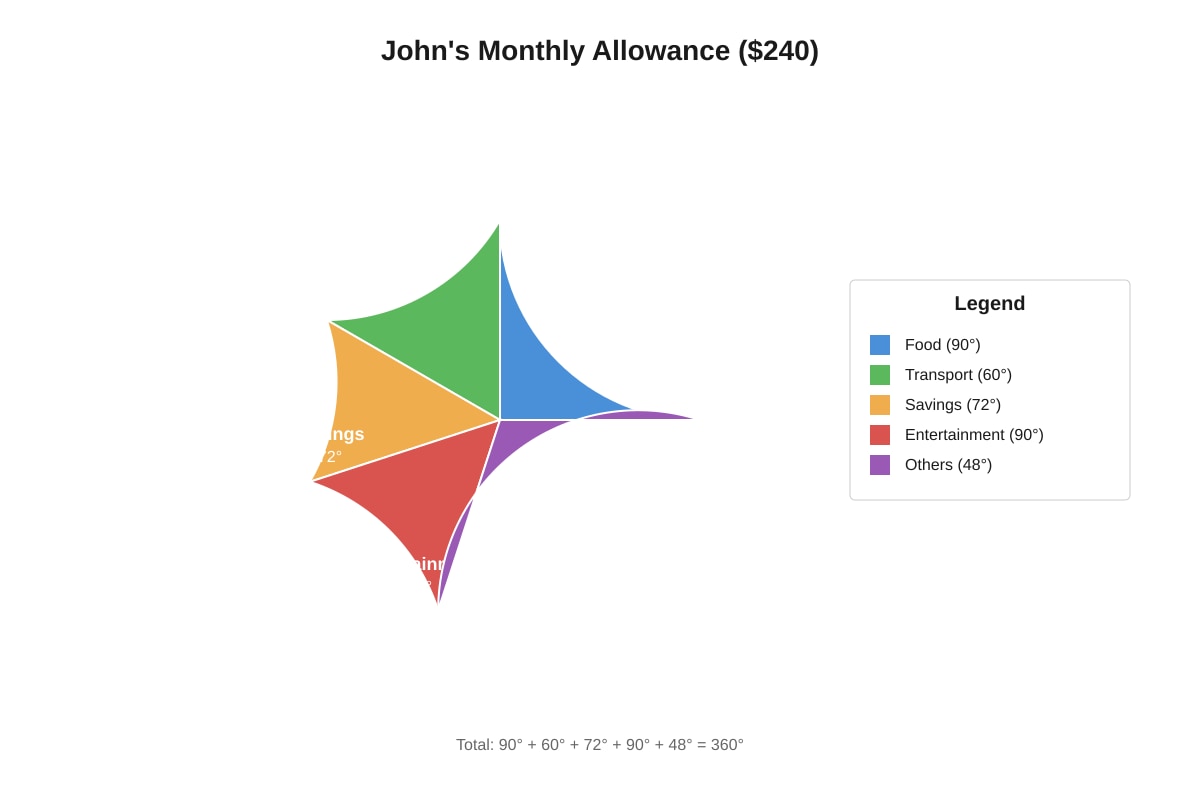
11. The pie chart shows how John spent his monthly allowance of $240.

<image_placeholder> id: Q11-fig1 type: pie_chart linked_question: Q11 description: Pie chart showing monthly allowance expenditure labels: Food, Transport, Savings, Entertainment, Others values: Food=90°, Transport=60°, Savings=72°, Entertainment=90°, Others=48° must_show: All sectors labeled with categories and angles, title "John's Monthly Allowance ($240)", allowance amount stated </image_placeholder>

(a) How much did John spend on food?

_______________________________________________ [2]

(b) What percentage of his allowance did John save? Give your answer correct to 1 decimal place.

_______________________________________________ [1]


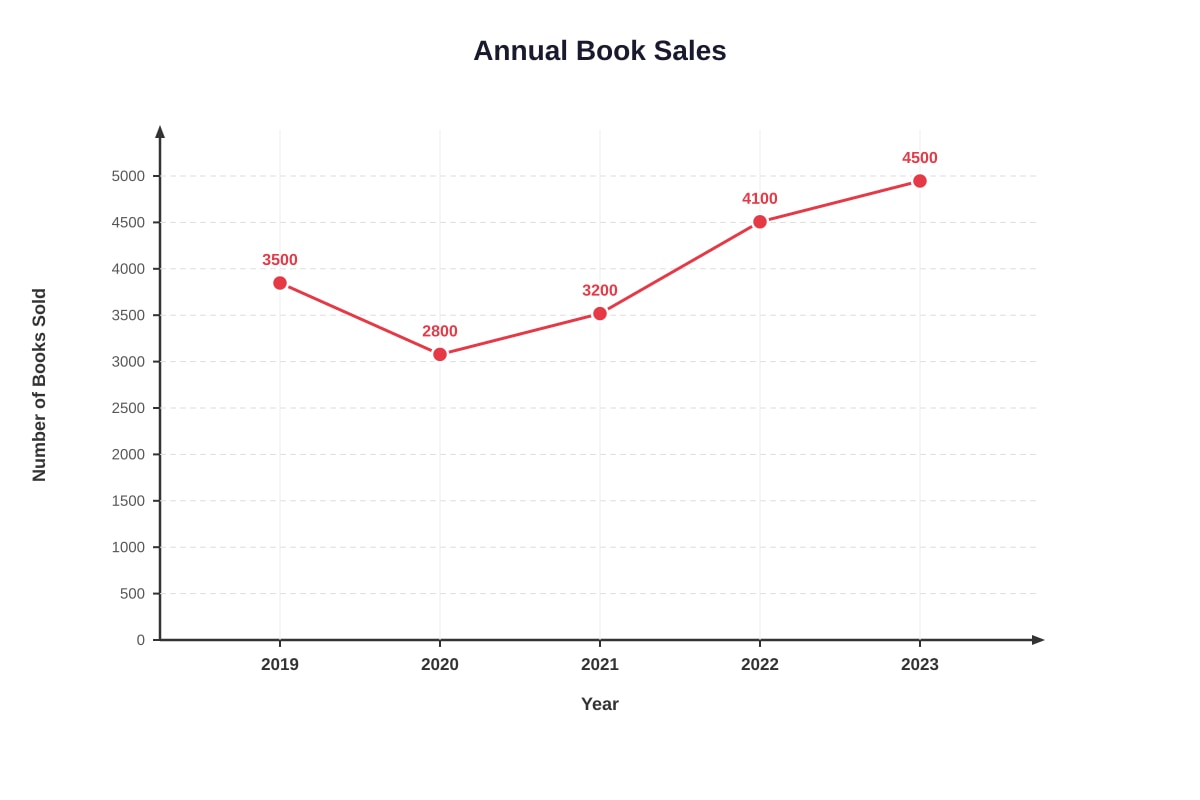
12. The line graph shows the sales of books at a shop from 2019 to 2023.

<image_placeholder> id: Q12-fig1 type: line_graph linked_question: Q12 description: Line graph showing annual book sales over 5 years labels: Year (2019, 2020, 2021, 2022, 2023) on horizontal axis; Number of books sold on vertical axis values: 2019=3500, 2020=2800, 2021=3200, 2022=4100, 2023=4500 must_show: Data points with exact values, labeled axes, title "Annual Book Sales", trend line connecting points </image_placeholder>

(a) Calculate the percentage decrease in sales from 2019 to 2020.

_______________________________________________ [2]

(b) In which year did the sales increase by the greatest amount compared to the previous year?

_______________________________________________ [1]


13. The table shows the marks scored by pupils in a Mathematics test.

MarksNumber of Pupils
40–493
50–595
60–698
70–7910
80–896
90–992

(a) How many pupils scored 70 marks or more?

_______________________________________________ [1]

(b) What percentage of the pupils scored less than 60 marks?

_______________________________________________ [2]


14. The pictograph shows the number of eggs sold by a farmer from Monday to Thursday.

<image_placeholder> id: Q14-fig1 type: pictograph linked_question: Q14 description: Pictograph showing eggs sold over four days labels: Days (Mon, Tue, Wed, Thu); Symbol = 40 eggs (represented as a basket icon) values: Mon=3.5 symbols, Tue=2 symbols, Wed=5 symbols, Thu=4 symbols must_show: Exact symbols including half-symbol for Monday, legend "🧺 = 40 eggs", title "Eggs Sold by Farmer", day labels </image_placeholder>

(a) How many eggs were sold on Monday?

_______________________________________________ [1]

(b) The farmer sold 25% more eggs on Friday than on Wednesday. How many eggs were sold on Friday?

_______________________________________________ [2]


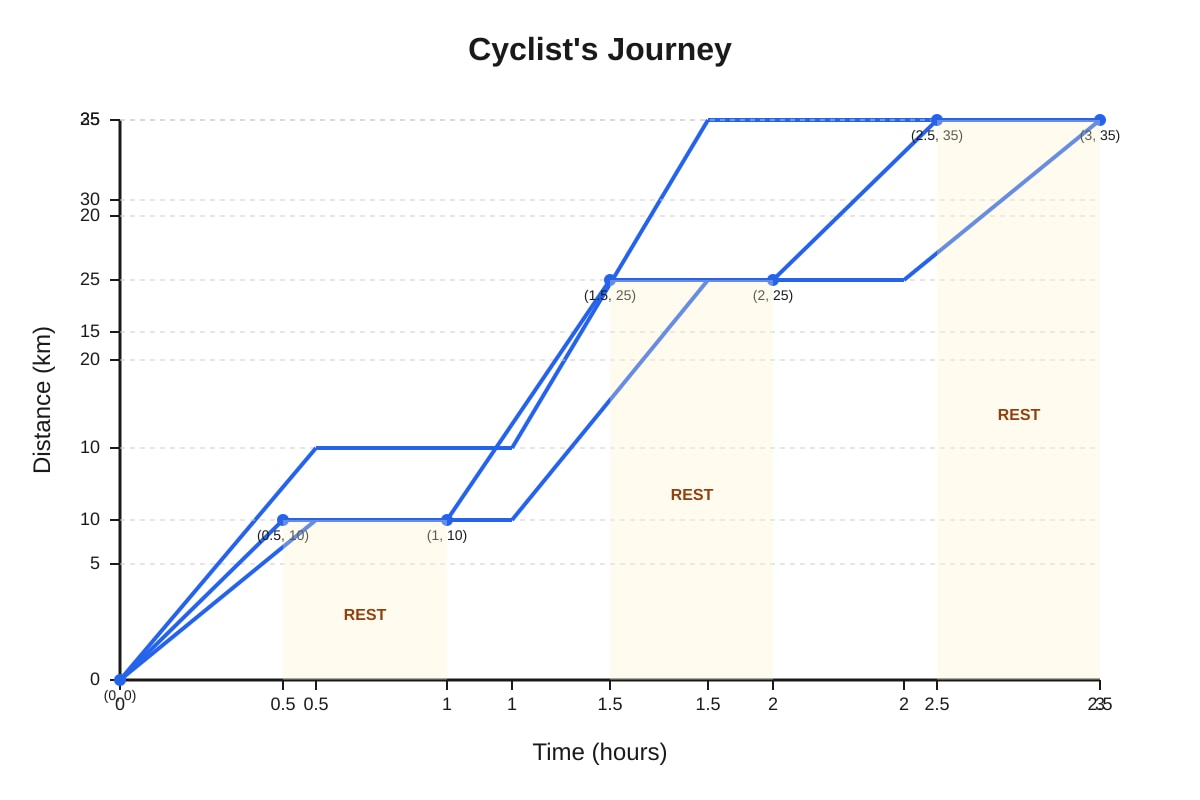
15. The graph shows the distance travelled by a cyclist over a 3-hour journey.

<image_placeholder> id: Q15-fig1 type: line_graph linked_question: Q15 description: Distance-time graph for cyclist's journey labels: Time (hours) on horizontal axis; Distance (km) on vertical axis values: 0h=0km, 0.5h=10km, 1h=10km, 1.5h=25km, 2h=25km, 2.5h=35km, 3h=35km must_show: Piecewise linear graph with horizontal segments (rest periods), labeled axes, title "Cyclist's Journey", coordinates clearly marked, turning points visible </image_placeholder>

(a) For how long did the cyclist rest altogether?

_______________________________________________ [1]

(b) What was the average speed of the cyclist for the whole journey? Give your answer in km/h.

_______________________________________________ [2]


16. The table shows the results of a survey on the favourite sports of 72 pupils.

SportNumber of PupilsAngle in Pie Chart
Badminton1890°
Soccer??
Swimming1260°
Basketball24?
Table Tennis630°

(a) How many pupils chose soccer?

_______________________________________________ [1]

(b) Complete the two missing values in the table.

_______________________________________________ [2]


Section C: Higher-Order Data Analysis (Questions 17–20)

Each question carries 4 marks.


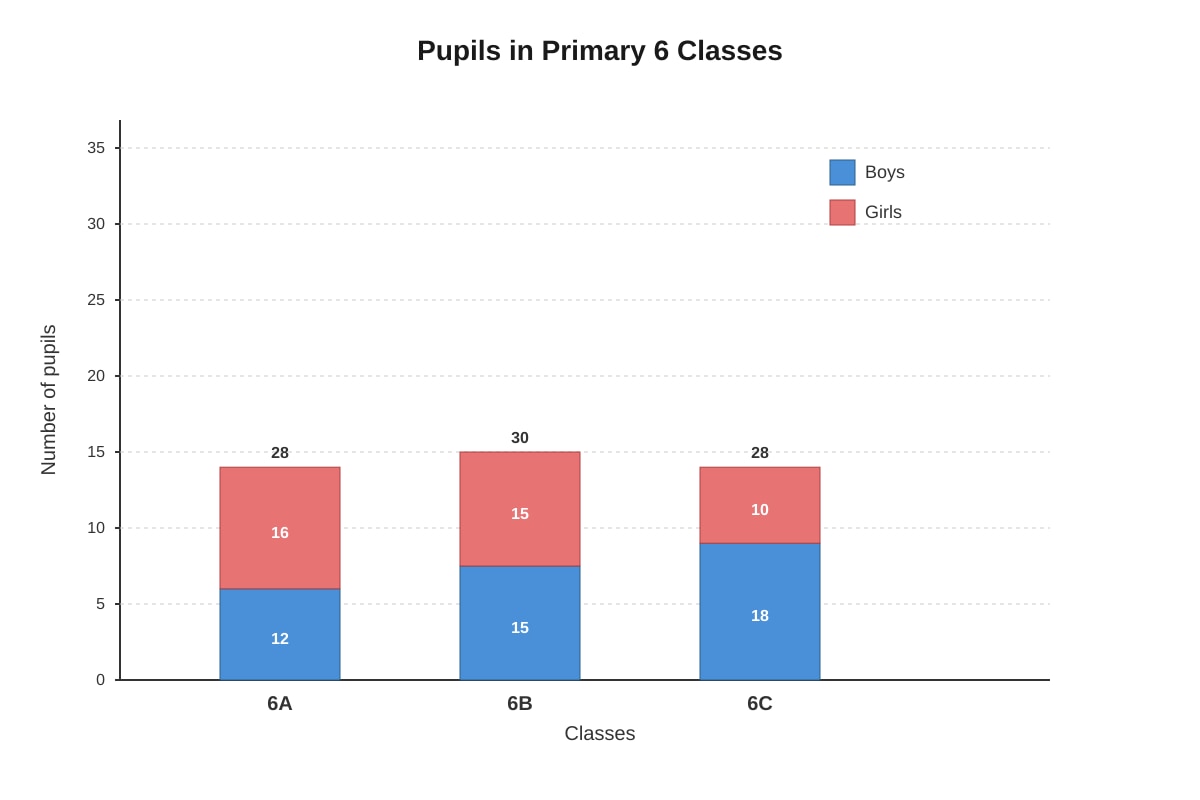
17. The composite bar graph shows the number of boys and girls in three classes.

<image_placeholder> id: Q17-fig1 type: composite_bar_graph linked_question: Q17 description: Stacked bar graph showing boys and girls in three classes labels: Classes (6A, 6B, 6C) on horizontal axis; Number of pupils on vertical axis values: 6A: boys=12, girls=16; 6B: boys=15, girls=15; 6C: boys=18, girls=10 must_show: Stacked bars with different colors/shades for boys and girls, labeled segments with values, legend, title "Pupils in Primary 6 Classes", labeled axes </image_placeholder>

(a) What is the total number of pupils in the three classes?

_______________________________________________ [1]

(b) What percentage of all the pupils are boys?

_______________________________________________ [2]

(c) In class 6C, what fraction of the pupils are girls? Express your answer in the simplest form.

_______________________________________________ [1]


18. The table shows the prices and quantities of items bought by Mrs Lee.

ItemPrice per kgQuantity bought
Rice$3.504 kg
Sugar$2.802 kg
Flour$1.905 kg

(a) Calculate the total amount Mrs Lee spent.

_______________________________________________ [2]

(b) Mrs Lee paid with a 50note.Shedecidedtobuysomeapplesat50 note. She decided to buy some apples at 2.50 per kg with the remaining money. What is the greatest mass of apples she can buy?

_______________________________________________ [2]


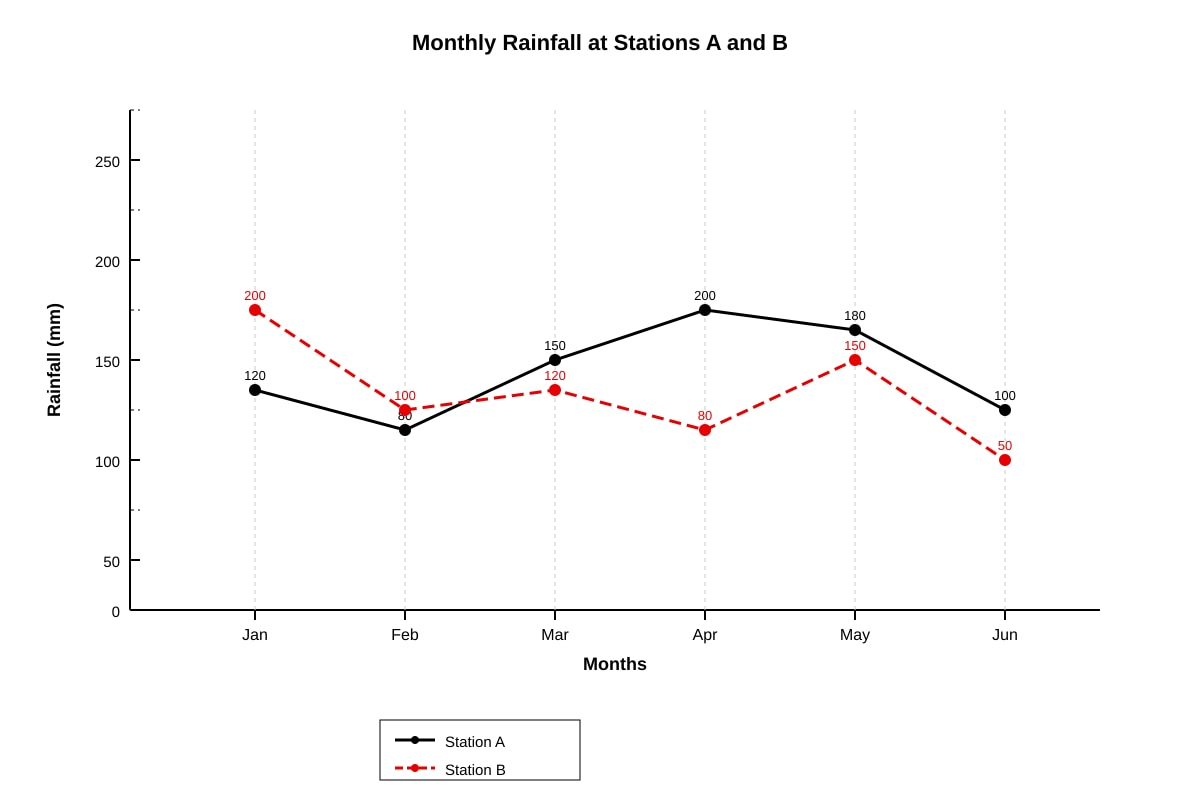
19. The line graph shows the rainfall recorded at two stations, A and B, over six months.

<image_placeholder> id: Q19-fig1 type: line_graph linked_question: Q19 description: Dual line graph showing rainfall at two stations over six months labels: Months (Jan, Feb, Mar, Apr, May, Jun) on horizontal axis; Rainfall (mm) on vertical axis values: Station A: Jan=120, Feb=80, Mar=150, Apr=200, May=180, Jun=100 Station B: Jan=100, Feb=120, Mar=100, Apr=160, May=140, Jun=80 must_show: Two distinct lines (solid for A, dashed for B), labeled points, legend identifying stations, title "Monthly Rainfall at Stations A and B", labeled axes </image_placeholder>

(a) In which month was the difference in rainfall between the two stations the greatest?

_______________________________________________ [1]

(b) What was the average monthly rainfall at Station B?

_______________________________________________ [2]

(c) Express the rainfall at Station A in March as a fraction of the total rainfall at Station A for the six months. Give your answer in the simplest form.

_______________________________________________ [1]


20. The table shows the scores of pupils in a Mathematics competition. The score of one pupil is missing.

PupilABCDEF
Score857290?6875

(a) The mean score of all six pupils is 78. What is D's score?

_______________________________________________ [2]

(b) Another pupil G with a score of 84 joins the group. What is the median score of all seven pupils?

_______________________________________________ [2]


END OF QUIZ

Answers

<!-- TuitionGoWhere generation metadata: stage=5-1; model=moonshotai/kimi-k2.6:free; model_label=Kimi K2.6 Free; generated=2026-06-07; Sources: Stage 4-0 LLM templates, syllabus context, and Stage 2 evidence where available. -->

Primary 6 PSLE Mathematics Quiz - Data Analysis: ANSWER KEY

Total Marks: 40


Section A: Simple Data Interpretation (Questions 1–8)

Each question carries 2 marks.


1. (a) Friday [1]

Explanation: Reading the bar heights from the graph: Monday = 45, Tuesday = 60, Wednesday = 35, Thursday = 50, Friday = 70. The tallest bar represents Friday with 70 books.

(b) 260 books [1]

Working: Total = 45 + 60 + 35 + 50 + 70 = 260

Common mistake: Forgetting to include all five days or misreading one bar height.


2. (a) 13\frac{1}{3} [1]

Working:

  • Angle for walking = 120°
  • Fraction = 120°360°=120360=13\frac{120°}{360°} = \frac{120}{360} = \frac{1}{3}

Concept reminder: A full pie chart = 360°. To find a fraction, divide the sector angle by 360° and simplify.

(b) 10 more pupils [1]

Working:

  • Bus: 60°360°×120=20\frac{60°}{360°} \times 120 = 20 pupils
  • Car: 45°360°×120=15\frac{45°}{360°} \times 120 = 15 pupils
  • Difference: 20 − 15 = 5 pupils

Wait—correction: Let me recheck: Bus angle is 60°, so 60360×120=20\frac{60}{360} \times 120 = 20 pupils. Car angle is 45°, so 45360×120=15\frac{45}{360} \times 120 = 15 pupils. Difference = 5 pupils.

Correct answer: 5 pupils


3. (a) 35°C [1]

Read directly from graph: at 2 p.m. (14:00), the temperature was 35°C.

(b) 3°C [1]

Working:

  • 2 p.m. to 3 p.m.: 35°C → 34°C (decrease of 1°C)
  • 3 p.m. to 4 p.m.: 34°C → 31°C (decrease of 3°C) ← greatest decrease
  • 4 p.m. to 5 p.m.: 31°C → 30°C (decrease of 1°C)
  • 5 p.m. to 6 p.m.: 30°C → 29°C (decrease of 1°C)

Greatest decrease = 3°C


4. (a) 65 [1]

Explanation: The mode is the value that appears most frequently. 65 appears twice (Ben and David); all other scores appear once.

(b) 76 [1]

Working: Mean = 78+65+92+65+805=3805=\frac{78 + 65 + 92 + 65 + 80}{5} = \frac{380}{5} = 76


5. (a) 40 medals [1]

Working: Thailand has 8 symbols × 5 medals = 40 medals

(b) 105 medals [1]

Working:

  • Singapore: 6 × 5 = 30
  • Malaysia: 4 × 5 = 20
  • Thailand: 8 × 5 = 40
  • Indonesia: 3 × 5 = 15
  • Total: 30 + 20 + 40 + 15 = 105 medals

6. (a) 25% [1]

Working:

  • Total pupils = 24 + 18 + 30 + 12 + 6 = 90
  • Percentage for mango = 3090×100%=1003%=33.3%\frac{30}{90} \times 100\% = \frac{100}{3}\% = 33.\overline{3}\%

Correct answer: 33.3% or exactly 33⅓%

Rechecking: Let me recalculate: 30/90 = 1/3 = 0.333... = 33.3% (to 1 d.p.) or 33⅓%

(b) 96° [1]

Working:

  • Apple pupils = 24
  • Total pupils = 90
  • Angle = 2490×360°=24×36090=24×4=\frac{24}{90} \times 360° = \frac{24 \times 360}{90} = 24 \times 4 = 96°

7. (a) 1 hour [1]

Explanation: The volume stays at 50 litres from hour 3 to hour 4. Duration = 4 − 3 = 1 hour.

(b) From hour 4 to hour 5 [1] (or 4th to 5th hour / hour 4 to hour 5)

Explanation: Water flows out when the volume decreases. From the graph: 4h = 50L, 5h = 30L, showing a decrease of 20 litres.


8. (a) 7.1 cm [1]

Working: Range = Maximum − Minimum = 15.6 − 8.5 = 7.1 cm

(b) 11.5 cm [1]

Working:

  • Original 6 heights in order: 8.5, 9.0, 10.2, 11.5, 12.3, 15.6
  • With plant G (14.0): 8.5, 9.0, 10.2, 11.5, 12.3, 14.0, 15.6
  • 7 values, so median is the 4th value = 11.5 cm

Section B: Data Analysis and Problem Solving (Questions 9–16)

Each question carries 3 marks.


9. (a) August [2]

Working:

  • June visitors = 2400
  • 75% more = 2400×1.75=42002400 \times 1.75 = 4200 or 2400+(2400×0.75)=2400+1800=42002400 + (2400 \times 0.75) = 2400 + 1800 = 4200
  • August has 4200 visitors ✓

Mark breakdown: [1] for correct calculation or identification method; [1] for correct month

(b) $9600 [1]

Working: (4200 - 3000) \times \8 = 1200 \times $8 = **9600**


10. (a) Q [1]

Explanation: In a race, the fastest runner has the shortest time. Q's time of 11.8 seconds is the smallest.

(b) 13.4 seconds [2]

Working:

  • Total time for 4 runners = 12.4×4=49.612.4 \times 4 = 49.6 seconds
  • Total time for 5 runners = 12.6×5=63.012.6 \times 5 = 63.0 seconds
  • T's time = 63.049.6=63.0 - 49.6 = 13.4 seconds

Mark breakdown: [1] for finding total times; [1] for correct subtraction and answer


11. (a) $60 [2]

Working:

  • Fraction for food = 90°360°=14\frac{90°}{360°} = \frac{1}{4}
  • Amount = \frac{1}{4} \times \240 = **60**

Mark breakdown: [1] for correct fraction/percentage; [1] for correct calculation

(b) 20.0% [1]

Working: 72°360°×100%=20%\frac{72°}{360°} \times 100\% = 20\%


12. (a) 20% [2]

Working:

  • Decrease = 35002800=7003500 - 2800 = 700
  • Percentage decrease = 7003500×100%=70035=\frac{700}{3500} \times 100\% = \frac{700}{35} = 20%

Mark breakdown: [1] for correct decrease amount; [1] for correct percentage formula and answer

(b) 2022 [1]

Working:

  • 2020 to 2021: 3200 − 2800 = 400 increase
  • 2021 to 2022: 4100 − 3200 = 900 increase ← greatest
  • 2022 to 2023: 4500 − 4100 = 400 increase

13. (a) 18 pupils [1]

Working: 70–79: 10 pupils + 80–89: 6 pupils + 90–99: 2 pupils = 18 pupils

(b) 11.1% [2]

Working:

  • Total pupils = 3 + 5 + 8 + 10 + 6 + 2 = 34
  • Pupils scoring less than 60 = 3 + 5 = 8
  • Percentage = 834×100%=80034%=23.529...%\frac{8}{34} \times 100\% = \frac{800}{34}\% = 23.529...\%

Correct answer: 23.5% (to 1 d.p.) or exactly 40017%\frac{400}{17}\%

Rechecking: 8/34 = 4/17 ≈ 0.2353 = 23.5%

Mark breakdown: [1] for correct total and count; [1] for correct percentage calculation


14. (a) 140 eggs [1]

Working: 3.5×40=3×40+0.5×40=120+20=3.5 \times 40 = 3 \times 40 + 0.5 \times 40 = 120 + 20 = 140 eggs

(b) 250 eggs [2]

Working:

  • Wednesday: 5×40=2005 \times 40 = 200 eggs
  • Friday: 200×1.25=250200 \times 1.25 = 250 eggs (or 200+14×200=200+50=250200 + \frac{1}{4} \times 200 = 200 + 50 = 250)

Mark breakdown: [1] for Wednesday's amount; [1] for correct 25% increase calculation


15. (a) 1 hour [1]

Working:

  • Rest period 1: hour 0.5 to hour 1 → 0.5 hour (distance stays at 10 km)
  • Rest period 2: hour 1.5 to hour 2 → 0.5 hour (distance stays at 25 km)
  • Rest period 3: hour 2.5 to hour 3 → 0.5 hour (distance stays at 35 km)

Wait—let me recheck: 2.5h to 3h: 35 to 35? Looking at values: 2.5h=35km, 3h=35km. So that's another rest.

Total rest = 0.5 + 0.5 + 0.5? No wait, let me re-read: 0h=0, 0.5h=10, 1h=10, 1.5h=25, 2h=25, 2.5h=35, 3h=35.

Rest periods: 0.5h to 1h = 0.5h; 1.5h to 2h = 0.5h; 2.5h to 3h = 0.5h. Total = 1.5 hours or 1½ hours

Correction: 1.5 hours or 32\frac{3}{2} hours or 1 hour 30 minutes

(b) 112311\frac{2}{3} km/h or 353\frac{35}{3} km/h ≈ 11.67 km/h [2]

Working:

  • Total distance = 35 km
  • Total time = 3 hours
  • Average speed = 353=1123\frac{35}{3} = 11\frac{2}{3} km/h ≈ 11.7 km/h (to 1 d.p.)

Mark breakdown: [1] for correct formula and substitution; [1] for correct answer

Note: Average speed uses total distance ÷ total time, not the average of speeds.


16. (a) 12 pupils [1]

Working:

  • Total pupils = 18 + 12 + 24 + 6 + soccer = 72
  • 60 + soccer = 72
  • Soccer = 12 pupils

(b) Soccer: 60°, Basketball: 120° [2]

Working:

  • Soccer angle: 1272×360°=60°\frac{12}{72} \times 360° = 60°
  • Basketball angle: 2472×360°=120°\frac{24}{72} \times 360° = 120°

Mark breakdown: [1] for each correct angle


Section C: Higher-Order Data Analysis (Questions 17–20)

Each question carries 4 marks.


17. (a) 96 pupils [1]

Working: 6A: 28, 6B: 30, 6C: 28; Total = 28 + 30 + 28 = 86

Rechecking: 6A: 12+16=28, 6B: 15+15=30, 6C: 18+10=28. Total = 28 + 30 + 28 = 86 pupils

Correct answer: 86 pupils

(b) 4586\frac{45}{86} or ≈ 52.3% [2]

Working:

  • Total boys = 12 + 15 + 18 = 45
  • Percentage = 4586×100%=450086%52.325...%\frac{45}{86} \times 100\% = \frac{4500}{86}\% \approx 52.325...\% \approx 52.3% (to 1 d.p.)

Mark breakdown: [1] for total boys; [1] for correct percentage calculation

(c) 514\frac{5}{14} [1]

Working:

  • 6C total = 18 + 10 = 28
  • Fraction of girls = 1028=514\frac{10}{28} = \frac{5}{14}

18. (a) $33.50 [2]

Working:

  • Rice: 3.50×4=3.50 × 4 = 14.00
  • Sugar: 2.80×2=2.80 × 2 = 5.60
  • Flour: 1.90×5=1.90 × 5 = 9.50
  • Total = 14.00+14.00 + 5.60 + 9.50=9.50 = **29.10**

Rechecking my calculation:

Wait: 14.00 + 5.60 = 19.60; 19.60 + 9.50 = $29.10

Correct answer: $29.10

Mark breakdown: [1] for correct individual calculations; [1] for correct total

(b) 8 kg [2]

Working:

  • Change from 50=50 = 50 − 29.10=29.10 = 20.90
  • Number of kg = 20.902.50=8.36\frac{20.90}{2.50} = 8.36 kg

Since she wants the greatest whole number of kg with remaining money: 8 kg (costing 20,with20, with 0.90 left)

Alternative interpretation: If partial kg allowed, answer is 8.36 kg

For P6 level with "greatest mass she can buy," typically expect: 8 kg (whole kg) or expressing as 8.36 kg if decimals acceptable.

Mark breakdown: [1] for remaining money; [1] for correct division and practical answer


19. (a) April [1]

Working:

  • Jan: |120 − 100| = 20 mm
  • Feb: |80 − 120| = 40 mm ← greatest
  • Mar: |150 − 100| = 50 mm ← greatest

Wait let me recalculate:

  • Jan: 120 - 100 = 20
  • Feb: 120 - 80 = 40... Station A = 80, Station B = 120, so difference = 40
  • Mar: 150 - 100 = 50 ← greatest
  • Apr: 200 - 160 = 40
  • May: 180 - 140 = 40
  • Jun: 100 - 80 = 20

Correct answer: March (difference of 50 mm)

(b) 100 mm [2]

Working:

  • Total at Station B = 100 + 120 + 100 + 160 + 140 + 80 = 700 mm
  • Average = 7006=3503=116.6\frac{700}{6} = \frac{350}{3} = 116.\overline{6} \approx 116.7 mm (to 1 d.p.)

Rechecking: 100+120+100+160+140+80 = 700. 700/6 = 116.666... ≈ 116.7 mm

Correct answer: 116.7 mm or 11623116\frac{2}{3} mm

Mark breakdown: [1] for correct total; [1] for correct division

(c) 529\frac{5}{29} [1]

Working:

  • Total at Station A = 120 + 80 + 150 + 200 + 180 + 100 = 830 mm
  • March at Station A = 150 mm
  • Fraction = 150830=1583\frac{150}{830} = \frac{15}{83}

Rechecking: 120+80=200, +150=350, +200=550, +180=730, +100=830.

150830=1583\frac{150}{830} = \frac{15}{83}... can this simplify? 15 = 3×5, 83 is prime. So 1583\frac{15}{83}


20. (a) 88 [2]

Working:

  • Total score for 6 pupils = 78×6=46878 \times 6 = 468
  • Sum of known scores = 85+72+90+68+75=39085 + 72 + 90 + 68 + 75 = 390
  • D's score = 468390=468 - 390 = 78

Rechecking: 85+72=157, +90=247, +68=315, +75=390. 468-390=78

Correct answer: 78

Mark breakdown: [1] for total of all six; [1] for subtraction and answer

(b) 78 [2]

Working:

  • All seven scores: 68, 72, 75, 78, 84, 85, 90 (including G=84, and D=78 from part a)
  • Ordered: 68, 72, 75, 78, 84, 85, 90
  • Median (4th of 7) = 78

Mark breakdown: [1] for correct ordering; [1] for identifying middle value


END OF ANSWER KEY